

United Kingdom Barley Market Size & Forecast:
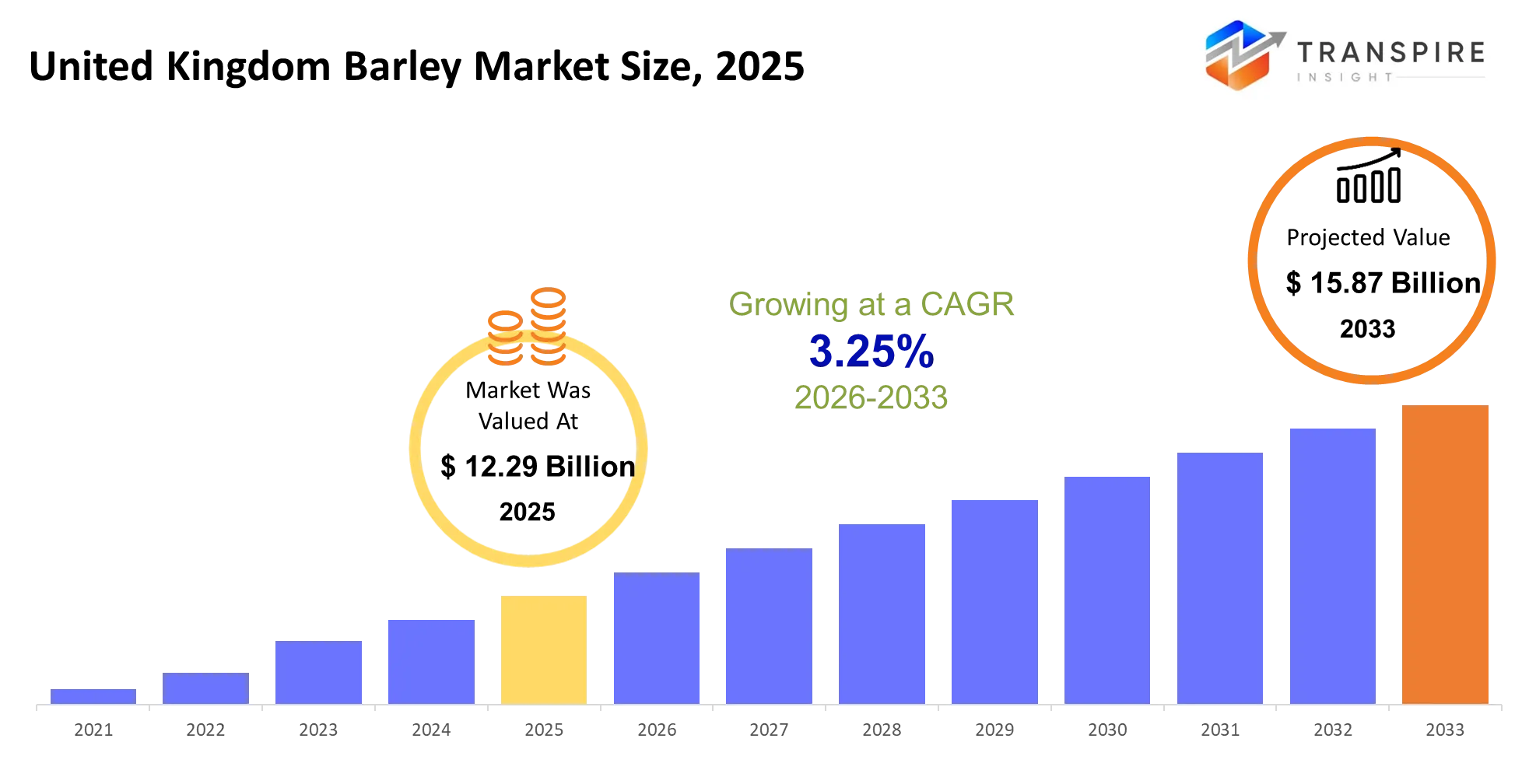
- United Kingdom Barley Market Size 2025: USD 12.29 Billion
- United Kingdom Barley Market Size 2033: USD 15.87 Billion
- United Kingdom Barley Market CAGR: 3.25%
- United Kingdom Barley Market Segments: By Type (Feed Barley, Malting Barley, Food Barley, Organic Barley, Hulled Barley, Others); By Application (Animal Feed, Brewing, Food Processing, Biofuel, Industrial Use, Others); By End-User (Farmers, Breweries, Food Industry, Agriculture Industry, Exporters, Others); By Form (Whole Grain, Flour, Pellets, Powder, Processed, Others)
To learn more about this report,  Download Free Sample Report
United Kingdom Barley Market Summary
The United Kingdom Barley Market was valued at USD 12.29 Billion in 2025. It is forecast to reach USD 15.87 Billion by 2033. That is a CAGR of 3.25% over the period.
The United Kingdom barley market, sort of underpins two critical supply lines livestock feed side and malt production for brewing and distilling. In real life barley ends up being a flexible raw stuff that lets feed makers manage grain costs, while also giving breweries as well as whisky producers a dependable malt basis, with fairly steady starch and protein traits. Over the last five years, things have moved toward tighter linkages between growers, maltsters, and beverage producers, as buyers keep pushing for traceable sourcing and a more resilient domestic supply. Brexit trade reshuffling and general bumps in Black Sea grain exports, sped this up a bit, because it highlighted import dependence risks and changed the way grain pricing behaves across Europe. Meanwhile, UK distilleries kept expanding capacity to grab export demand for premium whisky, plus craft beer. So, overall that strengthened appetite for malting-grade barley, encouraged contract farming, and drove more spending into storage, quality testing, and yield optimization tools throughout the agricultural value chain.
Key Market Insights
- Scotland kind of dominated over 45% of United Kingdom Barley Market revenue in 2025 , mainly because whisky distilleries are super concentrated and the malting infrastructure was, well, pretty advanced.
- Northern England showed up as the fastest-growing regional market between 2026 and 2033, driven by regenerative agriculture investment and additional regional malting expansion projects, which is kind of a big deal.
- Malting barley took the largest slice of industry size in 2025 , since whisky exporters needed steady starch quality plus traceable premium grain supplies.
- Feed barley stayed as the second-largest segment too, as livestock producers leaned into grain substitution during stretches of higher wheat pricing across UK agriculture markets.
- Organic barley looked like the fastest-growing product category right after 2024 , because food manufacturers pushed ahead with certified low-input ingredient sourcing programs, more or less.
- For applications, brewing was over 50% market share in 2025, helped by solid Scotch whisky exports and also more capacity for craft beer production.
- Food processing demand accelerated after 2023, as bakery and cereal manufacturers used more barley flour in high-fiber consumer formulations.
- Breweries basically dominated end-user demand, because multi-year procurement contracts kept barley purchasing volumes steady across distilling and brewing operations.
- And sustainability-focused food manufacturers became the fastest-growing end-user category through investments in regenerative sourcing, plus carbon-accountable agricultural supply chains .
- Strategic partnerships between brewers and maltsters accelerated in 2025 as carbon disclosure requirements reshaped barley sourcing and supplier compliance standards.
What are the Key Drivers, Restraints, and Opportunities in the United Kingdom Barley Market?
The strongest factor steering the United Kingdom barley market is still the ongoing growth of premium whisky making and export related activity. Scotch whisky producers upped their distillery capacity and locked in bigger, multi-year grain procurement agreements after export demand picked up across North America and Asia between 2022 and 2025. That kind of shift nudged maltsters and grain merchants to push for high quality malting barley cultivation, giving growers better revenue sightlines when they operate under long-term contracts. Also, sustainability tied sourcing rules from big brewers and distillers sped up spending on traceable barley supply chains, regenerative agriculture initiatives, and quality assurance systems.
Climate volatility is the market’s most notable structural limiter though, because rainfall behaving unpredictably drought spells, and temperature swings directly interfere with crop yield and grain quality uniformity. This is different from short run price shocks , because climate induced production instability comes with longer investment loops—seed development, irrigation buildouts, agronomic adaptation tactics, the whole package. If harvest quality turns weak, then malting-grade barley supplies can shrink, and processors often end up diverting volumes into lower-margin feed barley avenues, which then constrains profitability across the wider value chain.
A pretty big upcoming opportunity is forming around low-carbon barley certification and emissions-accountable farming. Brewers, distillers, and food manufacturers are ramping up regenerative farming collaborations, and they’re leaning on digital traceability platforms plus carbon measurement tools to make it stick. Scotland and parts of eastern England are becoming major focal areas for these programs as exporters chase stronger premium positioning in sustainability sensitive international beverage markets, and it’s getting clearer year by year.
What Has the Impact of Artificial Intelligence Been on the United Kingdom Barley Market?
Artificial intelligence and more advanced digital setups are shifting how marine emission control systems operate, across commercial shipping fleets. Operators, are now leaning on AI enabled scrubber monitoring platforms to largely automate sulfur emissions tracking, catch noncompliance events, and fine tune washwater discharge performance on the fly. Wärtsilä’s Expert Insight platform, mixes machine learning with rule based diagnostics to keep an eye on scrubber utilization vessel compliance and equipment health, across entire fleets. It basically provides operators with live compliance mapping, plus automated reporting, so manual inspection work is reduced and operational uptime tends to improve.
Predictive analytics are also making maintenance planning calmer for exhaust gas cleaning technology. Recent machine learning work reported predictive accuracy over 92% when forecasting marine scrubber performance using inputs like seawater acidity, inlet sulfur concentration, and outlet temperature. In practice these kinds of models help shipping companies dial in chemical consumption, cut down unnecessary maintenance intervals, and boost fuel efficiency by better coordinating engine and scrubber behavior. AI supported predictive maintenance efforts are furthermore assisting operators in spotting faults earlier, which reduces surprise downtime and extends equipment life cycles.
Still, AI adoption has real-world sticking points. A lot of vessels run with scattered onboard sensor arrangements, and connectivity can be inconsistent at sea, so real time data integration and model accuracy become difficult when maritime operating conditions keep changing.
Key Market Trends
- Since 2022, some major maltsters kinda upped the long term grower contracts to lower exposure to Black Sea grain disruptions ,and to dampen the import pricing swings that kept feeling pretty volatile.
- Simpsons Malt said in 2026 they reached 100% FSA Gold verified malting barley sourcing, which is sorta pushing faster sustainability benchmarking across UK brewing supply chains , especially where everyone keeps benchmarking everything.
- Scottish distilleries moved harder on their malt procurement programs after whisky export demand got stronger , and that premium barley pricing stayed supported across 2023-2025.
- Feed manufacturers started leaning more aggressively into barley based livestock rations as wheat price volatility squeezed farm operating margins during the recent harvest cycles , kind of a squeeze and then another squeeze.
- Brewers and barley growers also expanded regenerative farming partnerships after carbon disclosure requirements got more intense across European beverage supply chains in 2025.
- Boortmalt increased investment into Scottish malting infrastructure, mainly to back bigger whisky production volumes and to improve domestic grain processing capacity, not just for the moment but for the next run too.
- Food manufacturers boosted barley flour uptake across cereals and bakery products , driven by high fiber ingredient demand picking up across health focused retail categories.
- On the grower side , precision agriculture adoption rose among barley growers ,as climate volatility increased the need for drought resistant seed varieties and yield optimization technologies ,that whole bundle.
- Meanwhile export oriented grain traders tightened storage and traceability systems after Brexit changed procurement flows and customs procedures across European agricultural markets.
- And smaller craft brewers , more and more , began sourcing specialty barley varieties from regional maltsters, in order to set apart premium beer products and reinforce local sourcing stories.
United Kingdom Barley Market Segmentation
By Type
Malting barley keeps the most solid market position, because whisky distilleries and breweries require pretty strict grain specifications for alcohol production, and not, like, anything too flexible. Stable procurement agreements between maltsters and growers help support premium pricing, and they keep cultivation volumes steady across Scotland and eastern England. Feed barley still has a meaningful share due to the wide livestock sector need, especially when wheat costs are rising. Food barley and organic barley stay smaller segments but they’re still growing, driven by interest in functional grains, clean-label ingredients and those sustainable agriculture programs that brands like to mention.
The growth pattern feel pretty different when you compare types. Malting barley benefits from export-led whisky production and sustainability-linked sourcing contracts, while feed barley really depends on livestock economics, plus whether grain substitution trends are leaning its way. Organic barley picks up speed thanks to specialty food manufacturers that want certified low-input raw materials, even though higher cultivation costs keep slowing the acreage jump. Hulled barley and processed specialty varieties are likely to draw more investment over the forecast period, because food processors keep building fiber-rich formulations and using differentiated grain products for health-focused consumers

To learn more about this report, Download Free Sample Report
By Application
Brewing is the leading application segment, mostly because malted barley remains essential for beer, and for whisky production too, across both domestic and export-oriented beverage industries. Distilleries need high-quality grain, with controlled protein and starch characteristics, so that creates steady demand for traceable, contract-grown barley supplies. Animal feed applications also bring a large revenue share, since cattle, poultry, and swine nutrition programs use barley widely.
Food processing and industrial use segments stay smaller , but they keep becoming more commercially relevant as manufacturers end up diversifying grain based ingredient portfolios , kind of in a slower way.
Different structural drivers sort of steer each application category. Brewing demand leans on premium alcohol exports and the longer term distillery capacity expansion, while animal feed use swings with grain price cycles , plus the overall economics of livestock production. Biofuel applications are getting a bit more attention too, mainly because renewable energy policies keep moving forward and because people are exploring alternative agricultural feedstocks. Over the forecast period, it looks like food processing and bio based industrial use will likely open fresh doors for barley ingredient developers, especially around functional nutrition, sustainable fermentation, and low-carbon manufacturing inputs.
By End User
Breweries sit in the top spot among end users , because large brewing and distilling operations buy big quantities of malting barley under long term supply arrangements. Export led whisky production also supports the segment, since it helps keep procurement demand steadier for premium grade grain. Farmers stay central, due to their direct involvement in cultivation, crop quality management , and contract farming programs that connect back to maltsters and grain traders. Meanwhile food industry players and exporters keep expanding their influence , since barley utilization broadens across packaged foods and international grain shipments.
By Form
Whole grain barley keeps the largest share , since feed manufacturers, maltsters, and grain exporters tend to depend on minimally processed raw material for bulk handling, and the big scale industrial jobs. Flour , and other processed barley products, keep growing too , with demand rising from bakery, cereal, and health food manufacturers that want high-fiber grain inputs. Pellets and powder formats still sit in a smaller slice , but they matter for specialized use like feed blending, nutritional supplements, and industrial processing. Demand however shifts a lot, mainly based on storage needs, how well transport works, and how intense the processing is.
Processed plus value-added formats show the steadiest long-term growth outlook, as food brands push into functional grain products and clean-label ingredient updates. Flour and powder uses are gaining ground because plant-based mixes are expanding, nutritional drinks are multiplying, and specialty baking products keep appearing. Pelletized barley products are also getting more attention from livestock operators, because they offer easier feed handling and more stable nutritional consistency. During the forecast period , higher-margin processed forms are likely to pull in more capital investment from ingredient firms and agricultural processors, especially those trying to limit exposure to commodity grain price swings.
What are the Key Use Cases Driving the United Kingdom Barley Market?
Malting still kind of, stays the leading use case in the United Kingdom barley market because brewers and Scotch whisky distilleries need steady grain quality , starch levels, and sourcing that’s traceable enough for big scale alcohol production. Export demand for higher grade whisky keeps pushing those long-term procurement contracts between maltsters and growers, like it’s not going anywhere soon.
At the same time animal feed uses are growing as livestock producers, try to manage ration costs during stretches where wheat prices wobble around. Food manufacturers are also leaning into barley in cereals , baking goods, and plant based formulations, since shoppers want higher fiber grain products with less processing intensity, or at least that’s the story being sold to them.
Some newer paths are showing up too, for example low carbon barley supply programs that connect to emissions reporting across parts of the beverage sector, plus regenerative agriculture initiatives backed by sustainability linked procurement agreements. There’s also bio based ingredient development for brewing byproducts, and even niche fermentation markets, where processors see room for extra revenue streams from barley derived inputs.
|
Report Metrics |
Details |
|
Market size value in 2025 |
USD 12.29 Billion |
|
Market size value in 2026 |
USD 12.69 Billion |
|
Revenue forecast in 2033 |
USD 15.87 Billion |
|
Growth rate |
CAGR of 3.25% from 2026 to 2033 |
|
Base year |
2025 |
|
Historical data |
2021 - 2024 |
|
Forecast period |
2026 - 2033 |
|
Report coverage |
Revenue forecast, competitive landscape, growth factors, and trends |
|
Regional scope |
United Kingdom |
|
Key company profiled |
Cargill, ADM, Bunge, Louis Dreyfus, GrainCorp, Soufflet Group, Muntons, Simpsons Malt, Boortmalt, Crisp Malt, Malteurop, ABF Grain Products, Openfield, Frontier Agriculture, Glencore Agriculture |
|
Customization scope |
Free report customization (country, regional & segment scope). Avail customized purchase options to meet your exact research needs. |
|
Report Segmentation |
By Type (Feed Barley, Malting Barley, Food Barley, Organic Barley, Hulled Barley, Others); By Application (Animal Feed, Brewing, Food Processing, Biofuel, Industrial Use, Others); By End-User (Farmers, Breweries, Food Industry, Agriculture Industry, Exporters, Others); By Form (Whole Grain, Flour, Pellets, Powder, Processed, Others) |
Which Regions are Driving the United Kingdom Barley Market Growth?
Scotland is still kind of the dominant region in the United Kingdom barley market, mostly because it’s deeply tied into the Scotch whisky industry and it has this big concentration of malting infrastructure at scale. You can see it working through a mature agricultural ecosystem that basically knots together barley growers, maltsters, distilleries, storage locations, and export logistics—ports like Aberdeen , and Grangemouth help keep everything moving. On top of that, long term procurement arrangements between distillers and barley suppliers end up creating fairly predictable demand signals, which then encourages producers to invest in yield optimization and grain quality programs, even when planning cycles get tricky. And there’s also the geographic branding angle around Scotch whisky, it tends to support premium pricing and keeps sustained demand steady for malting grade barley in export channels.
Eastern England, especially East Anglia and Yorkshire, kind of plays a different part. It functions more like the country’s most stable feed and brewing barley production hub, not so much a whisky engine. Here the advantages come from highly productive farmland, established grain trading networks, and transport access that’s efficient for both domestic feed manufacturers and export terminals. In contrast to Scotland, where the demand model is more whisky driven, this setup leans on diversified end users, so exposure to swings from just one sector is less severe. Producers also keep putting money into precision farming plus agronomy services, and that helps them maintain dependable crop volumes even when weather related pressures hit.
Northern England and parts of the Midlands are looking like the fastest growing zones right now. That’s linked to increased investment in sustainable farming initiatives, plus low carbon grain supply chains that seem to be getting more traction over time.Lately it’s been more noticeable how partnerships between maltsters brewers and agricultural service providers are speeding up the adoption of regenerative barley growing practices , especially those now tied in with emissions reporting rules. At the same time, the craft brewing scene keeps expanding and the regional malting upgrades are also opening up fresh sourcing opportunities, not only inside the usual Scottish strongholds. If you look at the 2026–2033 stretch, this momentum should pull in investors who care about traceable farm supply lines , climate resilient grain output, and that premium value barley processing infrastructure.
Who are the Key Players in the United Kingdom Barley Market and How Do They Compete?
The United Kingdom barley market runs like a fairly consolidated scene, where big grain merchants and maltsters sorta handle procurement, warehousing, processing, and then the onward relationships with brewers, distillers, and feed producers. In practice, rivalry isn’t only about barley or raw grain prices , it’s more about dependable delivery, sustainability standing, stable malting quality, and whether a firm can reach export-leaning beverage customers. The established players keep protecting their slice of the pie with vertically integrated supply chains and longer grower contracts, while the smaller specialist maltsters push back using premium craft brewing ties and traceable sourcing models. At the same time, climate swings and tighter sustainability expectations are nudging competition toward agronomic guidance, carbon reporting know-how, and steadier domestic supply networks.
Simpsons Malt sets itself apart with sustainability-minded barley buying and direct grower partnership across the UK. Its recent win, full FSA Gold verification across contracted barley suppliers, really adds weight when dealing with whisky distillers and brewers that want audited low-impact supply chains. Boortmalt competes by leaning on its large-scale malting infrastructure and close integration with the Scotch whisky industry. The firm keeps adding Scottish malting capacity, mainly to lock in long-term supply commitments linked to whisky export momentum.
Muntons leans into value-added malt and ingredient solutions, made for craft brewers, distillers, and food manufacturers , instead of competing strictly on bulk commodity movement. Their emphasis on tailored malt blends and sustainable ingredient development improves customer stickiness in higher-end beverage uses.Frontier Agriculture uses an advisory-led strategy that combines grain trading with agronomy, seed selection, and crop management services. This integrated service model helps growers improve barley quality and yield consistency, giving Frontier stronger influence over supply chain quality assurance and procurement stability.
Company List
- Cargill
- ADM
- Bunge
- Louis Dreyfus
- GrainCorp
- Soufflet Group
- Muntons
- Simpsons Malt
- Boortmalt
- Crisp Malt
- Malteurop
- ABF Grain Products
- Openfield
- Frontier Agriculture
- Glencore Agriculture
Recent Development News
In January 2026, Simpsons Malt achieved 100% SAI Platform Farm Sustainability Assessment (FSA) Gold verification across its UK malting barley procurement network. The certification covered 678 contracted growers and strengthened Simpsons Malt’s position in sustainable barley sourcing for brewers and distillers, reinforcing traceability and premium supply chain credentials in the UK barley market. https://www.simpsonsmalt.co.uk
In December 2024, with implementation continuing into 2026, Boortmalt announced major expansion investments across its Scottish maltings operations. The capacity expansion at Buckie and Glenesk maltings was designed to support growing distilling-sector demand for premium malt from the 2025 barley harvest onward, strengthening Scotland’s barley processing infrastructure and export-oriented whisky supply chain. https://www.boortmalt.com
What Strategic Insights Define the Future of the United Kingdom Barley Market?
The United Kingdom barley market seems to be sliding toward a structure that is more quality focused and contract led, where value creation will lean less on commodity grain tonnages and more on dependable supply, sustainability benchmarks, and end use specialization, kinda. Climate volatility is now becoming the main driver behind this shift, pushing maltsters and brewers to lock in steady domestic sourcing, while also nudging spending on drought tolerant barley varieties and precision agriculture tools. At the same time there is a quieter risk that many people don’t really notice, namely the growing concentration of procurement power in large beverage and feed firms, which could squeeze grower margins, and narrow the market’s ability to adapt when harvests turn weak.
Still, an opportunity is taking shape, around low carbon barley supply chains linked to environmental disclosure rules and sustainable whisky exports, especially as UK producers get more pressure from overseas buyers to reveal agricultural emissions. Market participants should therefore build durable agreements with growers, and start early with traceability systems, regenerative farming initiatives, and climate resilient seed development. That way, pricing leverage improves, and future supply continuity is protected.
United Kingdom Barley Market Report Segmentation
By Type
- Feed Barley
- Malting Barley
- Food Barley
- Organic Barley
- Hulled Barley
- Others
By Application
- Animal Feed
- Brewing
- Food Processing
- Biofuel
- Industrial Use
- Others
By End-User
- Farmers
- Breweries
- Food Industry
- Agriculture Industry
- Exporters
- Others
By Form
- Whole Grain
- Flour
- Pellets
- Powder
- Processed
- Others
Frequently Asked Questions
Find quick answers to common questions.
The expected United Kingdom Barley Market size is USD 15.87 Billion in 2033.
Key segments for the United Kingdom Barley Market are By Type (Feed Barley, Malting Barley, Food Barley, Organic Barley, Hulled Barley, Others); By Application (Animal Feed, Brewing, Food Processing, Biofuel, Industrial Use, Others); By End-User (Farmers, Breweries, Food Industry, Agriculture Industry, Exporters, Others); By Form (Whole Grain, Flour, Pellets, Powder, Processed, Others).
Major United Kingdom Barley Market players are Cargill, ADM, Bunge, Louis Dreyfus, GrainCorp, Soufflet Group, Muntons, Simpsons Malt, Boortmalt, Crisp Malt, Malteurop, ABF Grain Products, Openfield, Frontier Agriculture, Glencore Agriculture.
The United Kingdom Barley Market size is USD 12.29 Billion in 2025.
The United Kingdom Barley Market CAGR is 3.25% from 2026 to 2033.
- Cargill
- ADM
- Bunge
- Louis Dreyfus
- GrainCorp
- Soufflet Group
- Muntons
- Simpsons Malt
- Boortmalt
- Crisp Malt
- Malteurop
- ABF Grain Products
- Openfield
- Frontier Agriculture
- Glencore Agriculture
Recently Published Reports
-
Apr 2026
Baby Infant Formula Market
Baby Infant Formula Market Size, Share & Analysis Report By ype (Infant Milk, Follow On Milk, Specialty Baby Milk, Growing-Up Milk), By Ingredient (Carbohydrate, Fat, Protein, Minerals, Vitamins, and Others), By Product Form (Powder, Liquid, and Ready-to-feed), By Distribution Channels (Supermarket/Hypermarket, Specialty Store, Pharmacies, Online Retail, and Others), and Geography (North America, Europe, Asia-Pacific, Middle East and Africa, South and Central America), 2021 - 2031
-
Apr 2026
Edible Insects for Animal Feed Market
Edible Insects for Animal Feed Market Size, Share & Analysis Report By Type (Insect Powder, Insect Meal, Insect Bar, Insect Paste, Insect Oil, and Others), By Insect Type (Beetles, Cricket, Caterpillar, Hymenoptera, Orthoptera, Tree Bugs, and Others), By Application (Livestock, Pet Food, and Aquaculture), By Livestock Type (Poultry, Swine, and Others), and Geography (North America, Europe, Asia-Pacific, Middle East and Africa, South and Central America), 2021 - 2031
-
Apr 2026
Food Industry Disinfection and Bacterial Control Market
Food Industry Disinfection and Bacterial Control Market Size, Share & Analysis Report By Type (Chemical Disinfectants, Physical Disinfectants, and Biocides and Antimicrobials), By Application (Food Processing Equipment Surface Disinfection, Food Preparation Areas Surface Disinfection, Storage Areas Surface Disinfection, Anti-microbial Coatings Food Preservation, and Preservative Solutions Food Preservation), By End User (Meat and Poultry Processing, Dairy Processing, Seafood Processing, Bakery and Confectionery, Restaurants and Commercial Kitchens, and Food Service Providers), By Sales Channel (Online, Offline), and Geography (North America, Europe, Asia-Pacific, Middle East and Africa, South and Central America), 2021 - 2031
-
Apr 2026
Freeze Dried Food Market
Freeze Dried Food Market Size, Share & Analysis Report By Product Type (Fruits, Vegetables, Freeze-Dried Dairy Products, Freeze-Dried Meat and Seafood, Freeze-Dried Pet Food, and Prepared Meal), By Nature (Organic, and Conventional), By Form (Powdered, Granules, and Diced), By End Use (Breakfast Cereals, Dairy Products, Bakery & Confectionery, Nutritional Bars & Supplements, Powdered Beverages, Snacks, and Retail (Household)), and Geography (North America, Europe, Asia-Pacific, Middle East and Africa, South and Central America), 2021 - 2031