
South Korea L-Cysteine and Derivatives Market Size & Forecast:
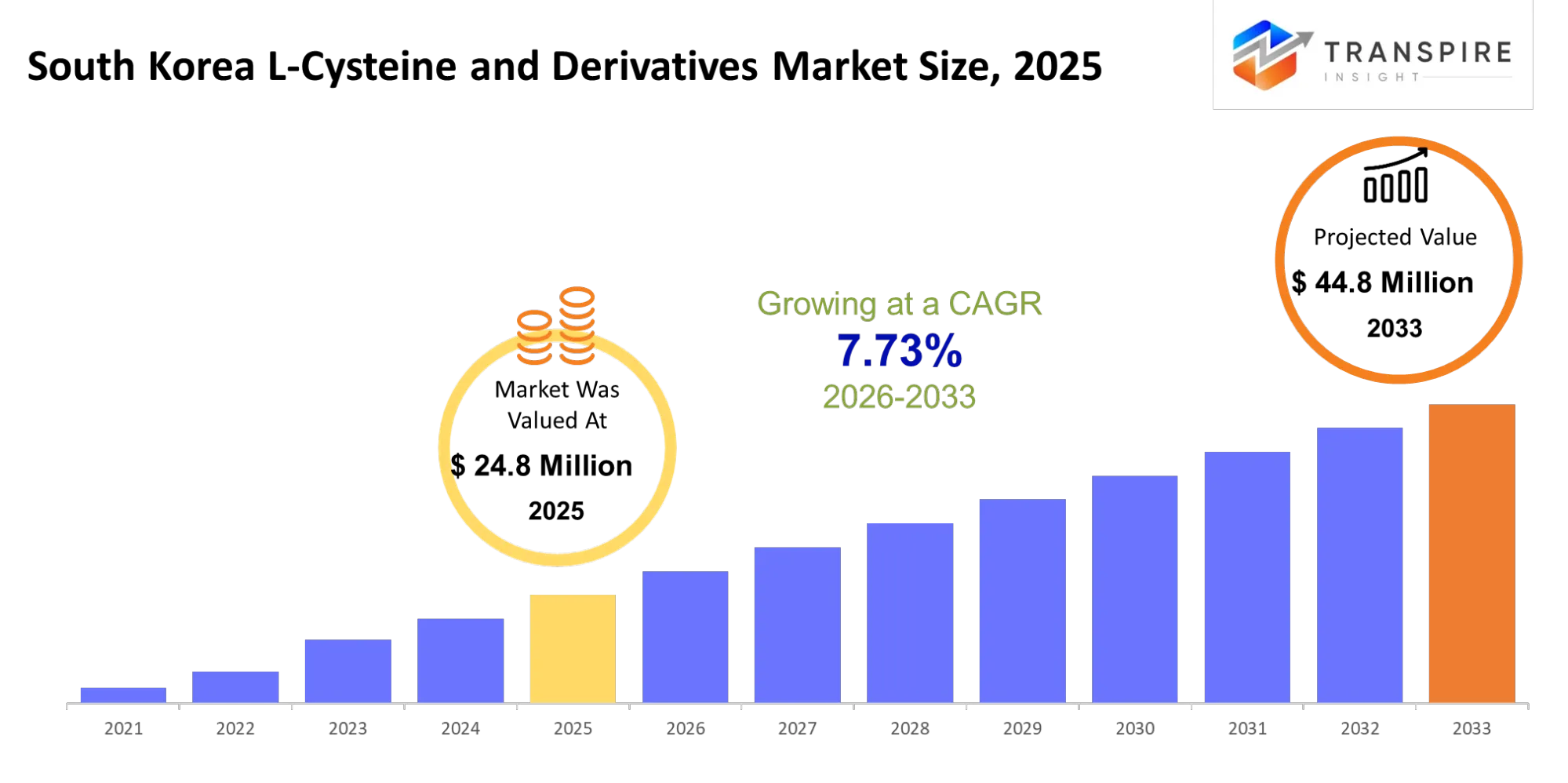
- South Korea L-Cysteine and Derivatives Market Size 2025: USD 24.8 Million
- South Korea L-Cysteine and Derivatives Market Size 2033: USD 44.8 Million
- South Korea L-Cysteine and Derivatives Market CAGR: 7.73%
- South Korea L-Cysteine and Derivatives Market Segments: By Product Type (L-Cysteine, N-Acetyl-L-Cysteine, Cysteine Hydrochloride, Others); By Application (Food & Beverage, Pharmaceuticals, Cosmetics, Animal Feed, Others); By End User (Food Industry, Pharma Industry, Others)
To learn more about this report,  Download Free Sample Report
South Korea L-Cysteine and Derivatives Market Summary
The South Korea L-Cysteine and Derivatives Market was valued at USD 24.8 Million in 2025. It is forecast to reach USD 44.8 Million by 2033. That is a CAGR of 7.73% over the period.
L-Cysteine and its derivatives in South Korea kind of work as a key input for food processing, pharmaceuticals, and personal care making, where they help improve dough feel in baked goods, keep flavors more steady, and also back the synthesis of active pharmaceutical ingredients. In everyday practice, the market lets domestic formulators keep their output consistent on large production lines, and a big part of that setup still relies on imported amino acid intermediates, not always the easiest to source.
Over the last five years, the market has moved away from conventional extraction in favor of bio- fermentation based production, mostly because makers want cleaner labels and sourcing that feels more stable. At the same time pandemic-era shipping headaches, plus more restrictive export dynamics out of China, made the concentration risk pretty visible. So Korean buyers started to diversify suppliers and lock in longer-term agreements. Overall, these shifts strengthened localized procurement approaches and pushed investment into synthetic biology capability, which improves resilience while also enabling higher-value uses in nutraceutical and pharmaceutical manufacturing, and that’s where margins usually start to matter.
Key Market Insights
- South Korea’s L-Cysteine and derivatives market still looks pretty import- dependent, mostly because the domestic processing hubs are kind of clustered around industrial areas near Seoul and Incheon.
- You know, the Northern industrial zones do bring a notable portion as well, mainly due to how close they are to pharmaceutical and food ingredient manufacturers.
- Meanwhile, sourcing corridors tied to Southeast Asia are showing up as the fastest-growing routes through the forecast period, not just slowly expanding.
- And bio-fermented L-Cysteine, like that category specifically, is moving the quickest segment wise, in large part because of clean-label expectations plus sustainable production requirements.
- For what it’s used for, food processing applications dominate the market in South Korea, especially for bakery applications and flavor stabilization needs.
- On the other hand, pharmaceutical synthesis is the fastest-growing application segment, supported by the growing demand for amino acid based drug intermediates.
- Personal care applications are sort of emerging steadily, with demand going up for functional cosmetic ingredients and such.
- In the South Korea market for L-Cysteine and Derivatives , food and beverage manufacturers hold the largest slice of demand, mainly because they need huge scale production ,every day more or less.
- Pharmaceutical companies are also gaining momentum, they are the fastest-growing end-user group, pulled along by precision formulation requirements and broader R&D efforts.
- Meanwhile, nutraceutical producers are widening their use across functional health products, like supplements and related items, so it keeps spreading out.
What are the Key Drivers, Restraints, and Opportunities in the South Korea L-Cysteine and Derivatives Market?
The main growth driver is basically the faster turn toward bio-fermentation led production of L-Cysteine, set off by tighter global purity expectations in food and pharmaceutical inputs plus rising ups and downs in traditional animal derived sourcing. In South Korea, manufacturers keep upgrading toward microbial fermentation platforms, so production steadiness has gotten better , which in turn lowers batch variability across bakery enhancers and pharmaceutical intermediates. That movement plainly backs higher margin product lines and lets suppliers secure longer term deals with food processors, drug formulators , who also insist on traceable high-purity amino acids.
The biggest problem is how the whole setup still leans on imported raw materials and intermediate amino acid feedstocks , mainly sourced out of East Asian supply hubs. It is hard to unwind that quickly because domestic fermentation capacity at industrial scale is still limited, and the bioreactor infrastructure also demands heavy capital. So even now, upstream price swings keep squeezing margin growth and this can delay procurement decisions among mid-sized formulators, particularly for cost sensitive bakery applications.
So a key opportunity is starting to show up in precision fermentation scale-up, inside South Korea’s biotech clusters, and it’s mostly being felt around Incheon and Daejeon where the pilot investments for synthetic biology are maturing. A few companies, like CJ CheilJedang are expanding their microbial amino acid production lines and this is kind of opening a space for more local, higher purity supply chains for L-Cysteine. In turn, those changes could lessen import reliance and also help unlock export potential that’s closer to pharmaceutical grade.
What Has the Impact of Artificial Intelligence Been on the South Korea L-Cysteine and Derivatives Market?
Artificial intelligence is more and more stitched into the South Korea L-Cysteine and Derivatives Market, through manufacturing tinkering and downstream logistics handling, especially where chemical and maritime supply lines meet. In production spaces, AI control systems with fermentation parameters and scrubber performance watching, basically in real time, do quick adjustments to pH, temperature, and the filtration cycles that keep amino acid yield steadier and cut down batch rejection numbers. At the same time predictive maintenance models are pulling from sensor streams tied to exhaust gas cleaning technology and processing equipment, so they can guess component wear earlier, which then helps uptime stay higher and reduces those annoying unplanned stoppages in bio-based L-cysteine plants.
For logistics, machine learning approaches help with fleet compliance tracking and emissions forecasting for vessels carrying chemical intermediates, and this ends up improving fuel efficiency, plus it gives operators a way to match tightening environmental requirements. People have linked these setups to visible gains in operational continuity, and also some moderate energy consumption decreases, mainly in big fermentation operations. Still, the rollout isn’t effortless. The adoption is held back by pricey integration work and by not enough high-quality, real-world maritime and biochemical datasets, so model accuracy can wobble when operating conditions change. And then connectivity gaps in offshore zones block smooth continuous data streaming, which slows the full deployment across the whole value chain.
Key Market Trends
- Since 2021 fermentation based production has in many cases been taking over from extraction methods, and that’s helped with purity being more consistent plus batch to batch variability going down across amino acid supply chains.
- Between 2022 and 2025, South Korean buyers also reduced how much they depended on one single-country source by around 20% , so imports got more spread between Japan and several Southeast Asia suppliers.
- In 2023 CJ CheilJedang moved to expand microbial amino acid capacity, and kind of shifted output toward higher margin bio based derivatives that fit better for food and pharmaceutical use, not just the standard stuff.
- Also after 2022 the need for pharmaceutical grade variants rose quite a lot, because drug manufacturers started tightening impurity thresholds for amino acid based excipients and intermediates.
- Then bakery ingredient formulators, after 2023, began steering procurement contracts toward long term agreements, since price swings basically scrambled spot market cycles and the usual short-term buying rhythm.
- Evonik Industries strengthened regional supply partnerships in 2024, so that it could enable a more stable distribution of high-purity L-cysteine into Korean industrial buyers.
- Meanwhile, the adoption of digital fermentation monitoring also went up after 2022, which helped improve yield efficiency by optimizing temperature and pH control in real time production systems, not just batch settings.
- Then in 2023, the regulatory tightening around food additive traceability was a real push, manufacturers had to switch toward certified bio based sourcing instead of conventional chemical synthesis routes.
- Also, import logistics disruptions during 2022–2023 made localized investment interest grow faster in synthetic biology hubs across the Incheon and Daejeon industrial clusters, kinda like a domino effect.
South Korea L-Cysteine and Derivatives Market Segmentation
By Product Type :
South Korea L-Cysteine and Derivatives Market shows a pretty strong concentration around L-Cysteine as the core product type, because it’s used widely in food processing and in pharmaceutical formulation too. Bio fermentation approaches will help deliver higher purity output ,and that ends up improving stability in bakery applications as well as for controlled drug synthesis processes. Supply consistency stays a big deal and it still shapes purchasing decisions across industrial buyers.
N-Acetyl-L-Cysteine and Cysteine Hydrochloride keep handling specialized roles in therapeutic use and formulation grade supply. Demand is moving toward higher purity grades, since pharmaceutical manufacturers are tightening their quality requirements for amino acid derivatives . The “Others” category stays relatively smaller, yet it backs niche industrial uses, where functional performance and regulatory compliance will actually steer the selection criteria.
By Application :
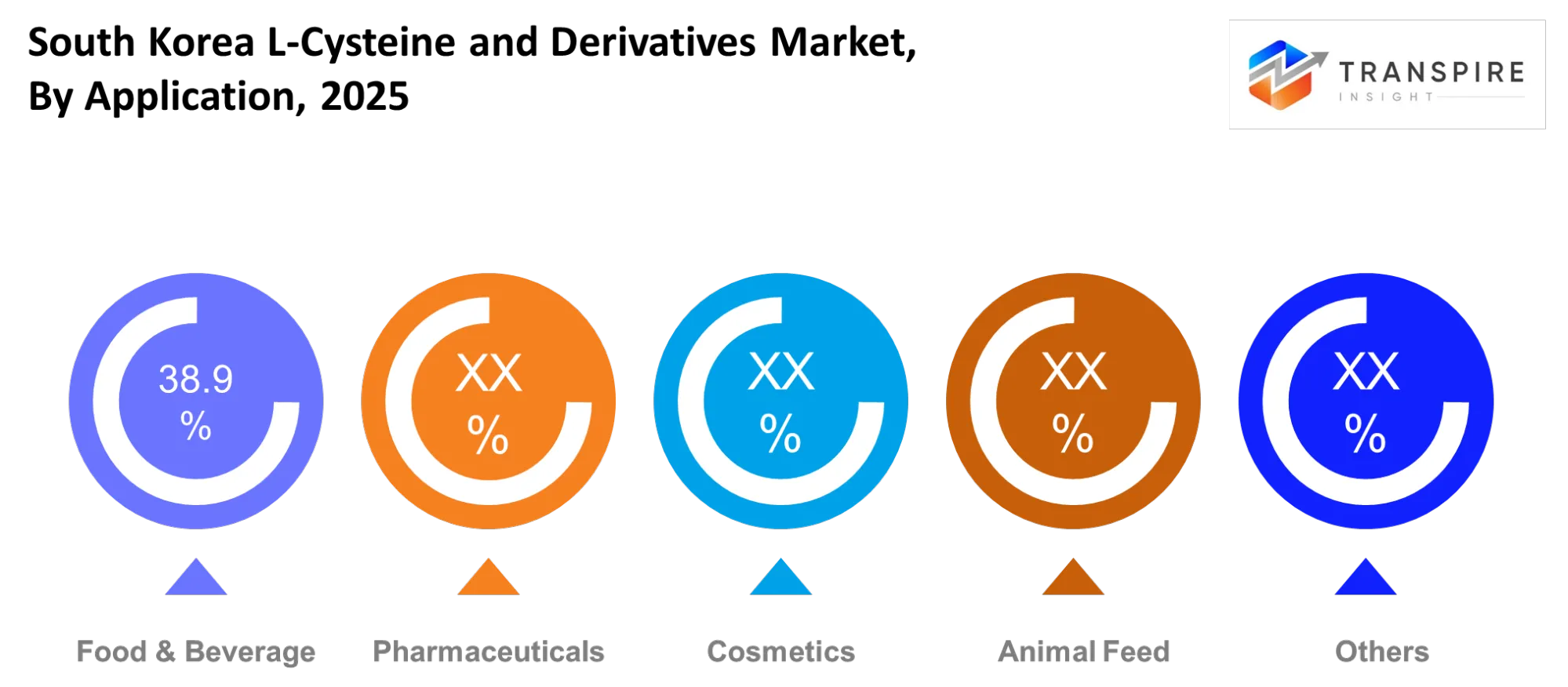
Food , and beverage applications seem to take a big chunk of the South Korea L-Cysteine and Derivatives Market because they get used over and over in bakery processing plus as a kind of flavor stabilization system. Ingredient manufacturers usually look for dependable supply and cost efficiency, in particular after those earlier import disruptions, where raw material availability was kinda squeezed. Going forward, bio-based inputs are expected to keep gaining ground across processed food production, more like steadily but with a clear momentum.
On the pharmaceutical side, growth appears to be quicker , since amino acid derivatives turn more and more relevant for drug formulation as well as excipient development. Cosmetics use is moving upward in a steady way too, driven by the desire for functional skin and hair care ingredients. Animal feed and other uses stay relatively stable though, just smaller in scale, and that is helped by gradual upgrades in feed efficiency formulations, along with regulatory compliance standards that get a bit more defined over time.
To learn more about this report, Download Free Sample Report
By End User :
Food industry end users basically are the biggest demand base in the South Korea L-Cysteine and Derivatives Market, mostly because bakery , processed food, and seasoning production lines run at scale. In practice procurement often leans on long-term supplier contracts and pretty stable pricing mechanisms, so companies can limit risk from import swings and the kind of raw material gaps people saw in earlier supply cycles.
Meanwhile Pharma industry end users seem to be adopting more , because the purity expectations go up, and formulation rules for amino-acid based intermediates get tighter. Also the ongoing expansion of nutraceutical and therapeutic product development helps keep procurement moving forward at a steady pace. Other end users, like specialty chemical and cosmetic manufacturers, still sit in the mid range, their demand linked to functional ingredient blending , plus regulatory-driven quality upgrades that they have to do sooner than later.
What are the Key Use Cases Driving the South Korea L-Cysteine and Derivatives Market?
Food and beverage manufacturing is still the main use case within the South Korea L-Cysteine and Derivatives Market, mostly pushed by bakery output and flavor stabilization requirements. Big processors lean on L-Cysteine to help dough handling, and for better texture consistency too , which ends up backing high-volume production efficiency plus more predictable product quality across industrial baking lines.
On the other side pharmaceutical formulation is also widening, since drug makers put amino acid derivatives into excipient systems, and use them for active compound stabilization. Cosmetic producers are jumping in as well, particularly for skin and hair care formulations where functional amino acids help with product performance and overall texture refinement. In a lot of cases these applications match what pharma and personal care customers want , higher purity inputs that behave consistently.
Newer use cases are starting to show up in nutraceutical production and in specialized clinical nutrition products, where precision blended amino acid mixtures are picking up momentum. There is also extra attention around advanced fermentation based biotech processes, because they can support more sustainable ingredient production , and cut back on dependence on older chemical synthesis routes.
|
Report Metrics |
Details |
|
Market size value in 2025 |
USD 24.8 Million |
|
Market size value in 2026 |
USD 26.6 Million |
|
Revenue forecast in 2033 |
USD 44.8 Million |
|
Growth rate |
CAGR of 7.73% from 2026 to 2033 |
|
Base year |
2025 |
|
Historical data |
2021 - 2024 |
|
Forecast period |
2026 - 2033 |
|
Report coverage |
Revenue forecast, competitive landscape, growth factors, and trends |
|
Country scope |
South Korea |
|
Key company profiled |
Ajinomoto, Wacker Chemie, CJ CheilJedang, Nippon Rika, Shine Star, Bachem, Merck, Thermo Fisher, Evonik, Kyowa Hakko, Sigma-Aldrich, Aceto, Cargill, DSM-Firmenich, Daesang |
|
Customization scope |
Free report customization (country, regional & segment scope). Avail customized purchase options to meet your exact research needs. |
|
Report Segmentation |
By Product Type (L-Cysteine, N-Acetyl-L-Cysteine, Cysteine Hydrochloride, Others); By Application (Food & Beverage, Pharmaceuticals, Cosmetics, Animal Feed, Others); By End User (Food Industry, Pharma Industry, Others) |
Which Regions are Driving the South Korea L-Cysteine and Derivatives Market Growth?
Seoul, along with the nearby Gyeonggi-Incheon industrial stretch, seems to drive the South Korea L-Cysteine and Derivatives market, mostly because the food processing quarters are packed so tightly and the pharmaceutical manufacturing setup is really advanced. Also, the national food safety authorities keep pretty close regulatory watch, so compliance levels stay high. That kind of environment usually benefits the established players, but not only them, it really helps the whole supply chain follow the rules. On top of that, Incheon has major import terminals, which makes it easier for the amino acid raw inputs to flow in without much delay. In the end the procurement feel is smoother, so the bigger buyers keep ending up in this same zone, again and again.
Meanwhile the southeastern industrial corridor, including Busan and Ulsan, has a more stable but somewhat secondary position in the market. It’s not the same as the capital area, but it does lean on export-focused manufacturing linkages and petrochemical logistics channels. Because shipper agreements tend to be long-term, and industrial demand is steady, consumption patterns look more predictable. Port operations stay active too, and the industrial mix is diversified, so revenue stability is easier to protect even when global supply conditions wobble.
What’s really picking up the fastest momentum is coming from the central innovation areas around Daejeon and Sejong. There the biotech side and fermentation investments are speeding up. Government-backed initiatives are now backing synthetic biology, plus precision fermentation, which has pulled in new pilot scale production. This change is lowering the entry hurdles for specialized amino acid producers, and for research-first startups too. With more infrastructure support showing up, it feels like there will be stronger opportunities for technology providers and investors, especially for high-purity production, between 2026 and 2033.
Who are the Key Players in the South Korea L-Cysteine and Derivatives Market and How Do They Compete?
Competition in the South Korea L-Cysteine and derivatives space is, I’d say, moderately consolidated, where a mix of global amino acid heavyweights and a smaller cluster of Korean bio-manufacturers kinda run the long-term supply show. Most of the control comes from their ability to lock in supply contracts over time, not so much from random spot pricing. In practice, what matters most is fermentation efficiency, the purity levels, and how reliably they can deliver again and again. Buyers, especially across food and pharmaceutical uses, tend to care a lot about steady certification rules and batch-to-batch quality that stays consistent.
CJ CheilJedang seems to push for big-scale fermentation integration, plus proprietary microbial strains, so they can reduce dependence on imported intermediate materials while keeping output steady for their customers in food processing. Daesang Corporation, on the other hand, leans into diversified fermentation capacity, and also close coordination with domestic food manufacturers , which helps it stay in the stable contract lane. Ajinomoto Co. differentiates by using purification systems and maintaining pharmaceutical-grade certification, so they can reach the higher-spec amino acid purchasers who require tighter compliance.
Evonik Industries competes with high-purity specialty amino acid manufacture, plus chemical engineering know-how that supports pharmaceutical intermediates where impurity limits are, frankly, strict. Kyowa Hakko Bio takes a more biotechnology-driven refinement route, targeting niche clinical nutrition uses while relying on proprietary fermentation strains. To reinforce their positions, both types tend to expand via working relationships with Korean distributors, and by doing co-development with pharma firms, which helps keep those long-term contract spots more defensible.
Company List
- Ajinomoto
- Wacker Chemie
- CJ CheilJedang
- Nippon Rika
- Shine Star
- Bachem
- Merck
- Thermo Fisher
- Evonik
- Kyowa Hakko
- Sigma-Aldrich
- Aceto
- Cargill
- DSM-Firmenich
- Daesang
Recent Development News
In September 2025, Nanoform Finland Plc entered a commercial partnership with A&LS Pharma in South Korea. The agreement expanded Nanoform’s commercial presence in the South Korean pharmaceutical ingredients market, strengthening access to advanced drug-development technologies that are relevant for amino-acid-derived and specialty pharmaceutical ingredient applications, including L-cysteine derivatives.
Source https://www.nanoform.com/
What Strategic Insights Define the Future of the South Korea L-Cysteine and Derivatives Market?
The South Korea L-Cysteine and Derivatives Market is kinda moving, in the next five to seven years, toward a more vertically integrated and bio based supply setup, mostly because fermentation know-how is scaling up and food and pharmaceutical regulators are getting a bit more strict about purity. As time goes on, buyers will likely lean more heavily on suppliers that can balance cost effectiveness with verifiable, non animal production routes, and that is already reshaping how industrial customers buy in the first place, or how they qualify vendors.
There’s also a less obvious risk that people often gloss over: over reliance on a small group of fermentation feedstock inputs, especially glucose derived substrates and imported microbial cultures. If something goes wrong upstream with those biological inputs, production could get squeezed fast, even if end demand is still staying solid. On the other hand, a newer opportunity is starting to show up through the commercialization of modular fermentation units in regional biotech hubs, like Daejon, where pilot scale systems are slowly turning into semi industrial production lines, more and more.
Market players should put emphasis on investing in adaptable manufacturing setups that can switch between feedstock origins and different product grades. That way, firms can lower their exposure to supply swings, while also getting better positioned to win higher value pharmaceutical grade deals as quality bars keep tightening and becoming harder to meet.
South Korea L-Cysteine and Derivatives Market Report Segmentation
By Product Type
- L-Cysteine
- N-Acetyl-L-Cysteine
- Cysteine Hydrochloride
By Application
- Food & Beverage
- Pharmaceuticals
- Cosmetics
- Animal Feed
By End User
- Food Industry
- Pharma Industry
Frequently Asked Questions
Find quick answers to common questions.
The expected South Korea L-Cysteine and Derivatives Market size is USD 44.8 Million in 2033.
Key segments for the South Korea L-Cysteine and Derivatives Market are By Product Type (L-Cysteine, N-Acetyl-L-Cysteine, Cysteine Hydrochloride, Others); By Application (Food & Beverage, Pharmaceuticals, Cosmetics, Animal Feed, Others); By End User (Food Industry, Pharma Industry, Others).
Major South Korea L-Cysteine and Derivatives Market players are Ajinomoto, Wacker Chemie, CJ CheilJedang, Nippon Rika, Shine Star, Bachem, Merck, Thermo Fisher, Evonik, Kyowa Hakko, Sigma-Aldrich, Aceto, Cargill, DSM-Firmenich, Daesang.
The South Korea L-Cysteine and Derivatives Market size is USD 24.8 Million in 2025.
The South Korea L-Cysteine and Derivatives Market CAGR is 7.73% from 2026 to 2033.
- Ajinomoto
- Wacker Chemie
- CJ CheilJedang
- Nippon Rika
- Shine Star
- Bachem
- Merck
- Thermo Fisher
- Evonik
- Kyowa Hakko
- Sigma-Aldrich
- Aceto
- Cargill
- DSM-Firmenich
- Daesang
About the Authors

Pankaj Ghogare Patil
I am Pankaj Ghogare Patil, a Senior Research Analyst at Transpire Insight, specializing in the Pharmaceutical, Chemicals & Materials, Healthcare IT, and Biotechnology industry. My expertise lies in conducting comprehensive market research, analyzing industry trends, evaluating competitive landscapes, and translating complex data into actionable insights. At Transpire Insight, I closely follow emerging technologies, regulatory developments, and market innovations to create accurate, well-researched, and informative content that helps businesses and professionals make informed decisions. I am committed to producing credible, evidence-based articles that reflect industry best practices while making technical topics accessible and valuable for a broad audience.

Chakradhar Khansole
Chakradhar serves as the Research Director at Transpire Insight, bringing over 8 years of experience in technology, innovation, and strategic market intelligence. He specializes in transforming complex market data into actionable business insights that enable organizations to make informed, growth-oriented decisions. Recognized for his strategic vision and analytical expertise, Chakradhar leads high-impact research initiatives, delivering comprehensive market assessments, competitive intelligence, and forward-looking industry analysis.
Recently Published Reports
-
Jul 2026
Alopecia Treatment Market
Alopecia Treatment Market Size, Share & Analysis Report By Disease Type (Alopecia Areata, Cicatricial Alopecia, Traction Alopecia, Alopecia Totalis, Androgenetic Alopecia, Alopecia Universalis, and Other Disease Types), By Treatment Type (Topical Treatments, Oral Medications, Injectable Therapies, and Hair Transplantation), By Gender (Male, and Female), By Distribution Channel (Hospitals and Clinics, Retail Pharmacies, and Online Retailers), and Geography (North America, Europe, Asia-Pacific, Middle East and Africa, South and Central America), 2021 - 2031
-
Jul 2026
Medical Ultrasound Probe Market
Medical Ultrasound Probe Market Size, Share & Analysis Report By Type (Linear Type, Convex Type, Endocavitary Probe, Phased Array/Cardiac Probe, Transesophageal (TEE) Probe, and Others), By Application (Ophthalmology, Cardiology, Musculoskeletal, Oncology, Obstetrics & Gynecology, General Imaging, and Others), By End User (Hospitals & Clinics, Diagnostic Centers, Ambulatory Surgical Centers, and Others), and Geography (North America, Europe, Asia-Pacific, Middle East and Africa, South and Central America), 2021 – 2031
-
May 2026
Biosimilars Market
Biosimilars Market By Product Type (Monoclonal Antibodies, Recombinant Hormones, Erythropoietin, G-CSF, Others), By Indication (Oncology, Autoimmune Diseases, Blood Disorders, Diabetes, Others), By Manufacturing Type (In-House Manufacturing, Contract Manufacturing), By Distribution Channel (Hospital Pharmacies, Retail Pharmacies, Online Pharmacies), By Industry Analysis, Size, Share, Growth, Trends, and Forecasts 2021-2033
-
Apr 2026
Gastrointestinal Endoscopy Market
Gastrointestinal Endoscopy Market By Type (Rigid Gastrointestinal Endoscope, Flexible Gastrointestinal Endoscopes, Disposable Gastrointestinal Endoscope), By Procedure Type (Colonoscopy, Gastroscopy, Duodenoscopy, Enteroscopy, Flexible Sigmoidoscopy, Others), By Application (Diagnosis, Treatment), By End-Users (Hospitals, Ambulatory Surgical Centers, Specialty Clinics, Laboratories, Others), By Industry Analysis, Size, Share, Growth, Trends, and Forecasts 2021-2033