

South Korea Graphene Oxide Market Size & Forecast:
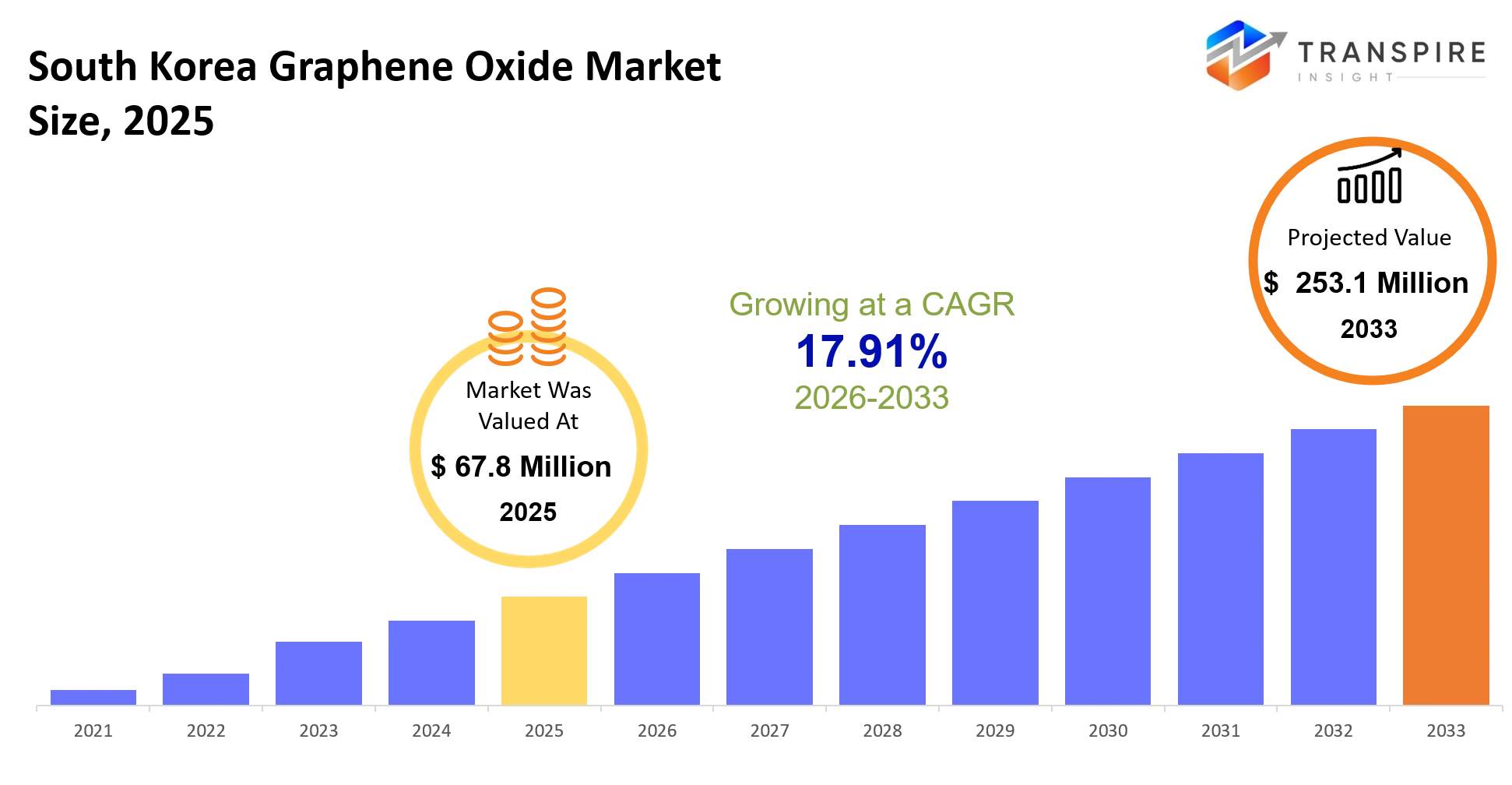
- South Korea Graphene Oxide Market Size 2025: USD 67.8 Million
- South Korea Graphene Oxide Market Size 2033: USD 253.1 Million
- South Korea Graphene Oxide Market CAGR: 17.91%
- South Korea Graphene Oxide Market Segments: By Product Type (Powder Graphene Oxide, Dispersion Graphene Oxide, Reduced Graphene Oxide, Functionalized Graphene Oxide, Nano Graphene Oxide, High Purity GO, Industrial Grade GO, Others); By Application (Electronics, Energy Storage, Coatings, Composites, Biomedical, Sensors, Water Treatment, Others); By End User (Electronics Companies, Battery Manufacturers, Research Institutes, Chemical Firms, Healthcare Companies, Automotive Firms, Industrial Users, Others); By Distribution Channel (Direct Sales, Distributors, Online Platforms, Research Suppliers, OEM Partnerships, Contract Supply, Export Sales, Others)
South Korea Graphene Oxide Market Summary
The South Korea Graphene Oxide Market was valued at USD 67.8 Million in 2025. It is forecast to reach USD 253.1 Million by 2033. That is a CAGR of 17.91% over the period.
South Korea’s graphene oxide market sort of backs advanced coating, energy storage, and filtration setups that show up in shipbuilding, batteries, and industrial water treatment. In practice it helps with lighter composite materials, corrosion-resistant marine coatings, and high-efficiency electrode structures those can improve durability as well as energy density in real operating conditions.
Over the last 3 to 5 years, the market has shifted from lab-scale material adoption into early-stage industrial integration, especially within battery and maritime coating supply lines. Stricter maritime emissions and antifouling rules, plus EV battery localization policies, and then those pandemic-era supply chain disruptions for imported nanomaterials , pushed more domestic production and formulation work.
Because of that, manufacturers have started leaning toward in-house formulation partnerships and scalable production processes, so they can reduce dependence on volatile imports. This ends up supporting clearer commercialization routes , and helps speed up pilot-to-production conversion across industrial customers.
Key Market Insights
- The South Korea Graphene Oxide Market is kind of moving, toward industrial scale adoption in lithium-ion batteries and corrosion resistant marine coatings across heavy industries, and yeah it’s more visible now than before.
- Most domestic production clusters in Gyeonggi and the southeastern industrial corridor take the lead because the proximity to electronics and shipbuilding ecosystems really matters.
- Functional graphene oxide dispersions currently lead the market, with consistent demand for conductive inks, marine coating layers and composite material formulations that stick and perform.
- The graphene oxide nanopowder segment stays second, still, because more firms are integrating it in energy storage electrode enhancement applications that need higher effectiveness.
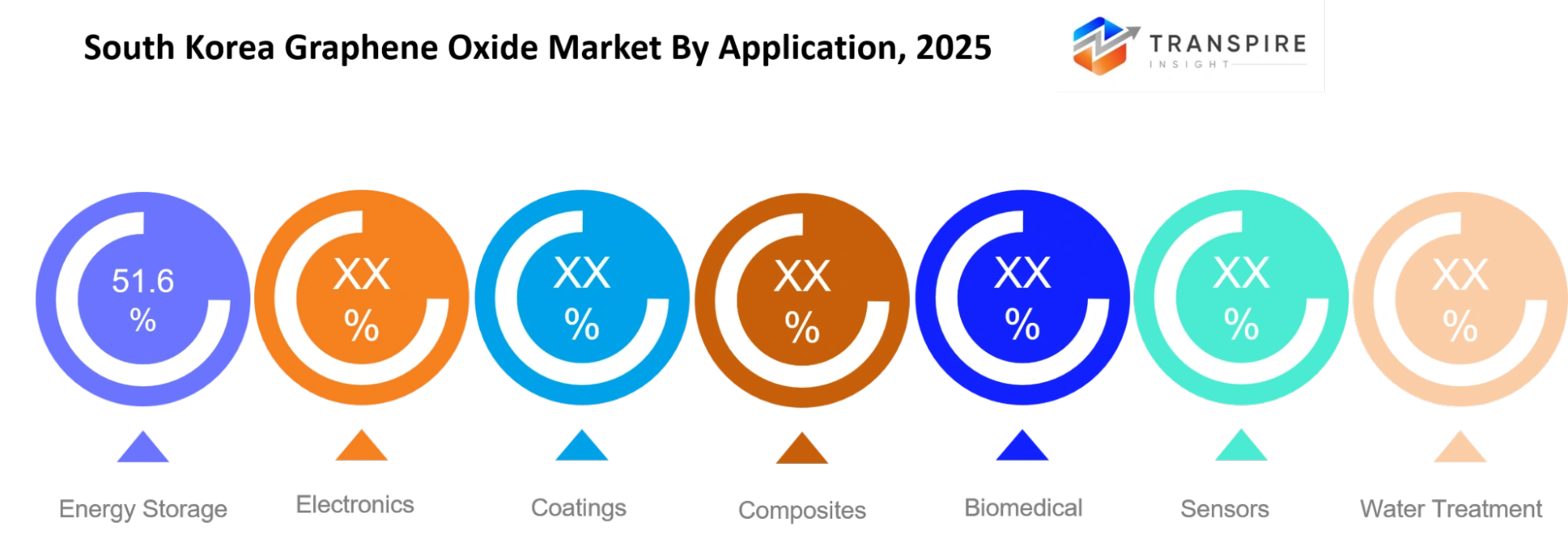
- Battery energy storage applications keep the dominant share at about one third of the overall demand in the South Korea Graphene Oxide Market, give or take a bit depending on the quarter.
- Water purification and desalination systems are showing the fastest growth through 2024–2030, mainly driven by industrial compliance requirements and tighter regulations.
- Electronics manufacturers are acting as the leading end-user segment, due to use in semiconductors, flexible displays and advanced sensors.
- Maritime and automotive industries are also the fastest-growing end user categories, as lightweight corrosion resistant materials gain traction faster in practice.
- Firms like LG Chem, Samsung SDI, and POSCO Future M are expanding how they integrate graphene oxide into energy materials and related products.
- Strategic partnerships between Korean material companies and nanotech specialists such as Graphene Square and SKC help push commercialization along, while also supporting process scaling.
What are the Key Drivers, Restraints, and Opportunities in the South Korea Graphene Oxide Market?
The main thing driving the South Korea Graphene Oxide Market is the rapid shift toward locating advanced battery material supply chains after the whole global semiconductor and EV supply disruptions thing. In other words, manufacturers have basically been pushed to fold graphene oxide into electrode setups and coating systems, so they can squeeze better conductivity, stronger durability, and overall longer lifecycle performance. And then the outcome looks like quicker commercialization in energy storage along with industrial coatings, which directly boosts procurement volumes from domestic producers, plus it keeps revenue concentrated more inside the higher-value uses.
The main thing that slows it down as a restraint is the high cost and also the full-on complexity of scaling graphene oxide synthesis while keeping the quality control steady and repeatable. Industrial buyers run into variability with material purity and the dispersion stability, so it becomes hard to completely swap out traditional materials at full scale. This is kind of sticky though, because production depends on tightly managed chemical oxidation processes, plus specialized equipment, so cost lowering is slow and it tends to be capital intensive. So adoption cycles still stretch out, especially for industrial customers that are price sensitive.
A big opportunity, meanwhile, is the integration path with next-generation solid-state batteries and smart maritime coatings, especially around South Korea shipbuilding hubs. There are already pilot efforts in Ulsan and Busan shipyards, where graphene-enhanced coatings are being tried for corrosion resistance and for improving fuel efficiency optimization. If those pilots scale, it could open demand streams beyond just electronics, and it may position graphene oxide as a core enabler for industrial decarbonization technologies, which is pretty important right now.
What Has the Impact of Artificial Intelligence Been on the South Korea Graphene Oxide Market?
Artificial intelligence is really starting to reshape material design, production optimization, and the way industry deploys advanced nanomaterials, especially inside the South Korea Graphene Oxide Market. In the manufacturing line, AI-based process control setups are being used to track oxidation levels, how well particles disperse and whether the coating stays uniform in real time which helps smooth out those annoying batch-to-batch differences in graphene oxide output. So you get steadier yield and less material wasted when doing large-scale synthesis, more or less.
Then in downstream use cases like battery systems and marine emission control, machine learning models show up to forecast performance decline and tweak lifecycle efficiency. For instance, there are AI-enabled predictive maintenance systems in energy storage where teams estimate electrode wear and thermal stress patterns, this supports longer operational uptime since unexpected failures are less likely, and overall system reliability goes up.
Day to day, firms describe practical benefits , such as better production efficiency and lower rejection rates thanks to automated quality inspection. Still, uptake is held back by a shortage of high-quality training data for nanoscale material behavior, especially under real world industrial conditions. And in maritime settings, connectivity blind spots plus harsh operating conditions make real-time AI integration difficult, so full-scale deployment is slowed for offshore equipment or shipboard use, even when the concept is clearly valuable.
Key Market Trends
- Between 2021 and 2025, South Korea kind of shifted from lab-scale graphene oxide work to industrial battery integration, across several key material suppliers. It was not instant, but the movement was pretty clear.
- In Busan, shipbuilding companies started using graphene based coatings a lot more, by more than 30% since 2022, mainly to push corrosion resistance higher, and also to help fuel efficiency.
- Meanwhile, electronics manufacturers reduced how much they leaned on imported nanomaterials, and that sped up domestic graphene oxide sourcing. This happened through local chemical supply chain integration, kinda like a feedstock bridge.
- After 2023 supply disruptions made graphite dependency feel riskier, EV battery producers expanded graphene enhanced electrode testing programs, as if they were trying to future proof performance.
- Water treatment facilities moved toward graphene oxide membranes for filtration upgrades, largely because stricter industrial wastewater discharge rules started tightening.
- LG Chem and Samsung SDI also increased R&D collaboration with nanomaterial startups, aiming to improve electrode conductivity performance , and generally make results more consistent.
- On the production side, graphene oxide dispersion technology advanced a lot, so coatings and composite manufacturing processes could scale better starting around 2022.
- Maritime regulators meanwhile added stricter antifouling performance benchmarks, which pushed companies to adopt advanced graphene protective coatings faster.
- There were also cross-sector partnerships between POSCO Future M and material innovators, and these helped improve supply chain resilience for advanced carbon materials.
- Finally, export oriented chemical firms in South Korea increased graphene oxide pilot production capacity, to reach global energy storage markets, even if demand timing still feels a bit uncertain.
South Korea Graphene Oxide Market Segmentation
By Product Type :
Powder graphene oxide and dispersion-based forms dominate industrial use because it is just easier blending in coating systems, batteries and various chemical processing setups. Demand keeps expanding, not only for “high purity” but also for functionalized varieties, which help advanced electronics plus energy storage products move ahead. Industrial grade materials stay key for cost-sensitive manufacturing, while nano variants quietly improve performance in filtration and sensor systems across South Korea, overall.
Powder and dispersion types still get selected a lot across manufacturing lines, mostly for steadier handling and plain compatibility with large scale production systems. Higher purity and functionalized grades support the more precise uses where conductivity plus chemical stability need to hold up. Industrial grade offerings remain basically essential for bulk usage environments where cost control is the main priority when choosing materials.
By Application :
Energy storage applications lead the usage, mainly because graphene oxide integrates well in lithium-ion battery electrodes, and also into conductivity enhancement setups. Electronics and coatings come next, driven by demand for flexible circuits, and corrosion-resistant surfaces that just last longer. Water treatment use keeps growing too, because filtration efficiency requirements keep rising across industrial facilities in South Korea.
Energy storage systems continue strong adoption, because they improve charge retention and cycle stability in a practical way. Electronics benefit from conductivity enhancement in miniaturized parts where space matters. Coatings and composites expand as industrial users prioritize durability, while water treatment keeps moving forward due to tougher discharge standards and industrial recycling requirements, in the real world.
By End User :
Battery manufacturers and electronics companies show up as leading end users, mainly because of large-scale integration in energy storage systems and semiconductor related applications. Research institutes kinda back early-stage innovation, while chemical firms push the material formulation development side. Automotive and industrial users help expand adoption for lightweight but also durable material systems, not just one thing.
Battery manufacturing demand is getting stronger, driven by the expansion of electric mobility supply chains and energy storage infrastructure. Electronics firms focus on miniaturization, plus performance efficiency improvements at the same time. Automotive and industrial sectors tend to adopt graphene oxide for structural reinforcement and corrosion resistance. Research institutions back continuous material innovation, plus testing so it can scale into real usage.
By Distribution Channel :
Distribution is mostly led by direct sales and OEM partnerships, because material requirements are customized for electronics and battery manufacturing. Contract supply arrangements also expand for long-term industrial usage , and distributors fill in for smaller industrial buyers. Export channels keep rising too, as South Korea strengthens advanced material trade networks.
Direct engagement with manufacturers helps keep material quality steady and also aligns the technical side for specialized applications. OEM partnerships support integration into final products across electronics and energy systems. Contract supply models give stability for large-scale buyers, while export channels extend global reach for advanced graphene oxide formulations produced in South Korea.
What are the Key Use Cases Driving the South Korea Graphene Oxide Market?
Energy storage still feels like the main use case in the South Korea Graphene Oxide Market, mostly pulled by lithium-ion battery electrode enhancement in EVs and for grid storage systems. In other words, graphene oxide boosts conductivity , and that also supports cycle stability so battery makers can squeeze out longer service life and better thermal control. You can see the demand tied pretty directly to South Korea’s huge battery production base, plus the ongoing push for higher energy density systems across commercial and industrial uses.
At the same time coatings and electronics are filling in more space, with semiconductor firms and advanced materials processors helping along. For example corrosion-resistant marine coatings and industrial coatings use graphene oxide to raise surface durability, while electronics companies are putting it into flexible circuits and conductive films. Battery manufacturers and electronics end users are basically combining these materials to lift performance efficiency, and to lower those long-term maintenance costs, sometimes it’s a big selling point.
Newer applications are also coming up, like water treatment membranes and sensor technologies for industrial monitoring. Industrial users are testing graphene oxide for high-efficiency filtration in wastewater recovery, while early-stage sensors lean toward real time environmental and chemical detection. These areas are still kinda developing, but they look promising as regulatory pressure on water quality and industrial emissions keeps going up, and it’s getting more strict year after year.
|
Report Metrics |
Details |
|
Market size value in 2025 |
USD 67.8 Million |
|
Market size value in 2026 |
USD 79.9 Million |
|
Revenue forecast in 2033 |
USD 253.1 Million |
|
Growth rate |
CAGR of 17.91% from 2026 to 2033 |
|
Base year |
2025 |
|
Historical data |
2021 - 2024 |
|
Forecast period |
2026 - 2033 |
|
Report coverage |
Revenue forecast, competitive landscape, growth factors, and trends |
|
Country scope |
South Korea |
|
Key company profiled |
Graphenea, NanoXplore, Directa Plus, Thomas Swan, First Graphene, Applied Graphene Materials, Cabot, Global Graphene Group, Haydale, ACS Material, LG Chem, Samsung SDI, Vorbeck Materials, Nanografi, CVD Equipment |
|
Customization scope |
Free report customization (country, regional & segment scope). Avail customized purchase options to meet your exact research needs. |
|
Report Segmentation |
By Product Type (Powder Graphene Oxide, Dispersion Graphene Oxide, Reduced Graphene Oxide, Functionalized Graphene Oxide, Nano Graphene Oxide, High Purity GO, Industrial Grade GO, Others); By Application (Electronics, Energy Storage, Coatings, Composites, Biomedical, Sensors, Water Treatment, Others); By End User (Electronics Companies, Battery Manufacturers, Research Institutes, Chemical Firms, Healthcare Companies, Automotive Firms, Industrial Users, Others); By Distribution Channel (Direct Sales, Distributors, Online Platforms, Research Suppliers, OEM Partnerships, Contract Supply, Export Sales, Others) |
Which Regions are Driving the South Korea Graphene Oxide Market Growth?
Gyeonggi Province is kind of acting as the leading region in the South Korea Graphene Oxide Market, mainly because there’s this dense gathering of electronics, semiconductors, and advanced material research clusters. There’s also strong government-backed R&D funding, so companies keep testing graphene-based formulations for batteries and conductive films, constantly. On top of that, the region has a close integration between manufacturers and research institutions, which somehow speeds up the commercialization cycle faster than you’d expect. And honestly, the high demand coming from electronics and energy storage companies keeps the material adoption going across the production lines pretty consistently.
Ulsan is more like a stable contributor , supported by its strong industrial manufacturing base and those long-term capital investment cycles that don’t jump around too much. Instead of being as innovation-forward as some places, Ulsan leans toward consistent material usage in large-scale chemical processing, and also in automotive component manufacturing. Industrial firms often favor reliability and cost efficiency over rapid experimentation, so the graphene oxide integration happens gradually, but it stays steady. The outcome is a dependable demand base that remains resilient even when the economy shifts.
Busan looks like the fastest-growing region in the South Korea Graphene Oxide Market, largely because of recent industrial diversification and upgraded advanced materials infrastructure. New investment in electronics component manufacturing, plus industrial material processing, has increased adoption of graphene-enhanced coatings and composites. Local industries are also moving toward higher performance materials, to satisfy stricter efficiency and durability needs. This momentum suggests solid opportunities for new entrants that want scalable industrial demand, especially between 2026 and 2033, without too much uncertainty.
Who are the Key Players in the South Korea Graphene Oxide Market and How Do They Compete?
The competitive landscape of the South Korea Graphene Oxide Market is sort of moderately consolidated, not fully, but close, with a small cluster of big chemical and battery material producers running the core supply chains. Still, a few specialized nanomaterial startups are showing up more and more, and they keep pushing higher purity grades, plus customized dispersion technologies. What really drives the competition is mostly material performance consistency, how well it integrates into battery systems, and whether production can be scaled in a cost-efficient way, not just pricing.
LG Chem is leaning hard into tech-led differentiation, by integrating graphene oxide into advanced battery electrode materials. They strengthen their standing by scaling internal R&D and also through long-term collaboration with electronics manufacturers, with the goal to improve conductivity and cycle life. The edge they have comes from established large-scale chemical production systems that help keep material output steady for industrial clients, even when demand swings.
Samsung SDI competes by optimizing performance for energy storage uses, especially high-density battery systems. They prioritize material testing partnerships with upstream suppliers to fine-tune electrode efficiency. Growth is supported through global EV supply chain integration and ongoing refinement for next-generation battery chemistry, so the whole stack keeps improving.
POSCO Future M leans into cost-competitive advanced material production, with strong ties into steel-linked chemical processing capabilities. Its differentiation is mainly about scaling material output using existing industrial infrastructure, which lowers production cost barriers. The company expands through strategic supply agreements with battery manufacturers and with material technology partners, so it doesn’t just sell, it also connects.
Company List
- Graphenea
- NanoXplore
- Directa Plus
- Thomas Swan
- First Graphene
- Applied Graphene Materials
- Cabot
- Global Graphene Group
- Haydale
- ACS Material
- LG Chem
- Samsung SDI
- Vorbeck Materials
- Nanografi
- CVD Equipment
Recent Development News
In January 2026, LG Chem announced expansion of advanced materials development for next-generation battery components. The company highlighted increased focus on conductive additives and graphene-based formulations to improve electrode stability and charging efficiency in energy storage systems. Sourcehttps://www.lgchem.com
In March 2026, Graphene Square completed expansion of its graphene mass-production plant in South Korea. The facility upgrade strengthens domestic supply capacity for advanced graphene materials used in electronics and industrial coatings, improving commercialization speed for local manufacturers. Sourcehttps://www.graphene-info.com/
What Strategic Insights Define the Future of the South Korea Graphene Oxide Market?
The South Korea Graphene Oxide Market is kinda moving like structurally, not just casually—toward deeper industrial integration across energy storage systems, advanced coatings, and precision electronics. That momentum is pushed by national supply chain localization and by the ongoing performance upgrading inside battery technologies. Over the next 5 to 7 years, growth should be driven less by “new material discoveries” and more by scalable manufacturing efficiency, plus steady quality control across those high-volume applications.
There’s also a less obvious risk, it’s sort of hidden. It comes from substitution pressure, from alternative nanomaterials, and even from silicon-based enhancements that could slowly reduce reliance on graphene oxide in some battery and coating use-cases. This change won’t pop up overnight, instead it’ll gradually nudge procurement decisions especially as cost versus performance trade-offs keep shifting.
On the opportunity side, an emerging angle is the integration of graphene oxide inside solid-state battery architectures and smart industrial filtration systems, mainly in export-oriented manufacturing hubs. It’s still in early validation, but it’s getting real technical traction through pilot projects. Market participants might want to focus on long-term partnerships with battery manufacturers and also invest in scalable dispersion technologies, so they can lock in early positioning within high-volume production ecosystems.
South Korea Graphene Oxide Market Report Segmentation
By Product Type
- Powder Graphene Oxide
- Dispersion Graphene Oxide
- Reduced Graphene Oxide
- Functionalized Graphene Oxide
- Nano Graphene Oxide
- High Purity GO
- Industrial Grade GO
By Application
- Electronics
- Energy Storage
- Coatings
- Composites
- Biomedical
- Sensors
- Water Treatment
By End User
- Electronics Companies
- Battery Manufacturers
- Research Institutes
- Chemical Firms
- Healthcare Companies
- Automotive Firms
- Industrial Users
By Distribution Channel
- Direct Sales
- Distributors
- Online Platforms
- Research Suppliers
- OEM Partnerships
- Contract Supply
- Export Sales
Frequently Asked Questions
Find quick answers to common questions.
The South Korea Graphene Oxide Market size is USD 253.1 Million in 2033.
Key segments for the South Korea Graphene Oxide Market are By Product Type (Powder Graphene Oxide, Dispersion Graphene Oxide, Reduced Graphene Oxide, Functionalized Graphene Oxide, Nano Graphene Oxide, High Purity GO, Industrial Grade GO, Others); By Application (Electronics, Energy Storage, Coatings, Composites, Biomedical, Sensors, Water Treatment, Others); By End User (Electronics Companies, Battery Manufacturers, Research Institutes, Chemical Firms, Healthcare Companies, Automotive Firms, Industrial Users, Others); By Distribution Channel (Direct Sales, Distributors, Online Platforms, Research Suppliers, OEM Partnerships, Contract Supply, Export Sales, Others).
Major South Korea Graphene Oxide Market players are Graphenea, NanoXplore, Directa Plus, Thomas Swan, First Graphene, Applied Graphene Materials, Cabot, Global Graphene Group, Haydale, ACS Material, LG Chem, Samsung SDI, Vorbeck Materials, Nanografi, CVD Equipment.
The South Korea Graphene Oxide Market size is USD 67.8 Million in 2025.
The South Korea Graphene Oxide Market CAGR is 17.91% from 2026 to 2033.
- Graphenea
- NanoXplore
- Directa Plus
- Thomas Swan
- First Graphene
- Applied Graphene Materials
- Cabot
- Global Graphene Group
- Haydale
- ACS Material
- LG Chem
- Samsung SDI
- Vorbeck Materials
- Nanografi
- CVD Equipment
About the Authors

Pankaj Ghogare Patil
I am Pankaj Ghogare Patil, a Senior Research Analyst at Transpire Insight, specializing in the Pharmaceutical, Chemicals & Materials, Healthcare IT, and Biotechnology industry. My expertise lies in conducting comprehensive market research, analyzing industry trends, evaluating competitive landscapes, and translating complex data into actionable insights. At Transpire Insight, I closely follow emerging technologies, regulatory developments, and market innovations to create accurate, well-researched, and informative content that helps businesses and professionals make informed decisions. I am committed to producing credible, evidence-based articles that reflect industry best practices while making technical topics accessible and valuable for a broad audience.

Chakradhar Khansole
Chakradhar serves as the Research Director at Transpire Insight, bringing over 8 years of experience in technology, innovation, and strategic market intelligence. He specializes in transforming complex market data into actionable business insights that enable organizations to make informed, growth-oriented decisions. Recognized for his strategic vision and analytical expertise, Chakradhar leads high-impact research initiatives, delivering comprehensive market assessments, competitive intelligence, and forward-looking industry analysis.
Recently Published Reports
-
May 2026
Healthcare Polymer Packaging Market
Healthcare Polymer Packaging Market Size, Share & Analysis Report By Packaging Type (Syringes, IV Bottles and Pouches, Clamshells, Blisters, Bottles & Jars, Containers, Tubes, IV Parental Packaging, Others), By Type (Regulated, Non-regulated), By Polymer Type (LDPE (Low-Density Polyethylene), HDPE (High-Density Polyethylene), Homo-polymer (Homo), Random Copolymer (Random), Block Copolymer (Block), PET, Polystyrene, Polyvinyl Chloride, Polyamide/EVOH, Others), and Geography (North America, Europe, Asia-Pacific, Middle East and Africa, South and Central America), 2021 - 2031
-
Apr 2026
Hydrophilic Tape (Waterstop) Market
Hydrophilic Tape (Waterstop) Market Size, Share & Analysis Report By Type (Bentonite-Based Hydrophilic Tape, Rubber-Based Hydrophilic Tape), By Application (Residential Buildings, Commercial Buildings, Infrastructure Projects), and Geography (North America, Europe, Asia-Pacific, Middle East and Africa, South and Central America), 2021 - 2031
-
Apr 2026
Metalens Market
Metalens Market Size, Share & Analysis Report By Type (Visible Light Metalens, and Infrared Metalens), By Application (Consumer Electronics, Automotive Electronics, Industrial, Medical, and Others), and Geography (North America, Europe, Asia-Pacific, Middle East and Africa, South and Central America), 2021 - 2031
-
Apr 2026
PBT Resin Market
PBT Resin Market Size, Share & Analysis Report By Type (Reinforced PBT Resin, Unreinforced PBT Resin), By Processing Method (Injection Molding, Extrusion, Blow Molding, Others), By End-User (Automotive, Electrical & Electronics, Consumer Appliances, Industrial Machinery, Medical Devices, Packaging, Others), and Geography (North America, Europe, Asia-Pacific, Middle East and Africa, South and Central America), 2021 - 2031