
Asia Pacific Grid-scale Battery Storage Market Size & Forecast:
- Asia Pacific Grid-scale Battery Storage Market Size 2025: USD 6.74 Billion
- Asia Pacific Grid-scale Battery Storage Market Size 2033: USD 31.42 Billion
- Asia Pacific Grid-scale Battery Storage Market CAGR: 21.22%
- Asia Pacific Grid-scale Battery Storage Market Segments: By Battery Type (Lithium-Ion, Sodium-Ion, Flow Batteries, Lead Acid, Nickel-Based Batteries, Solid-State Batteries, Others); By Application (Renewable Energy Integration, Peak Shaving, Frequency Regulation, Backup Power, Grid Stabilization, Others); By Ownership Model (Utility-Owned, Third-Party Owned, Community Storage, Others); By End User (Utilities, Renewable Energy Developers, Government, Industrial Users, Others)
Asia Pacific Grid-scale Battery Storage Market Summary
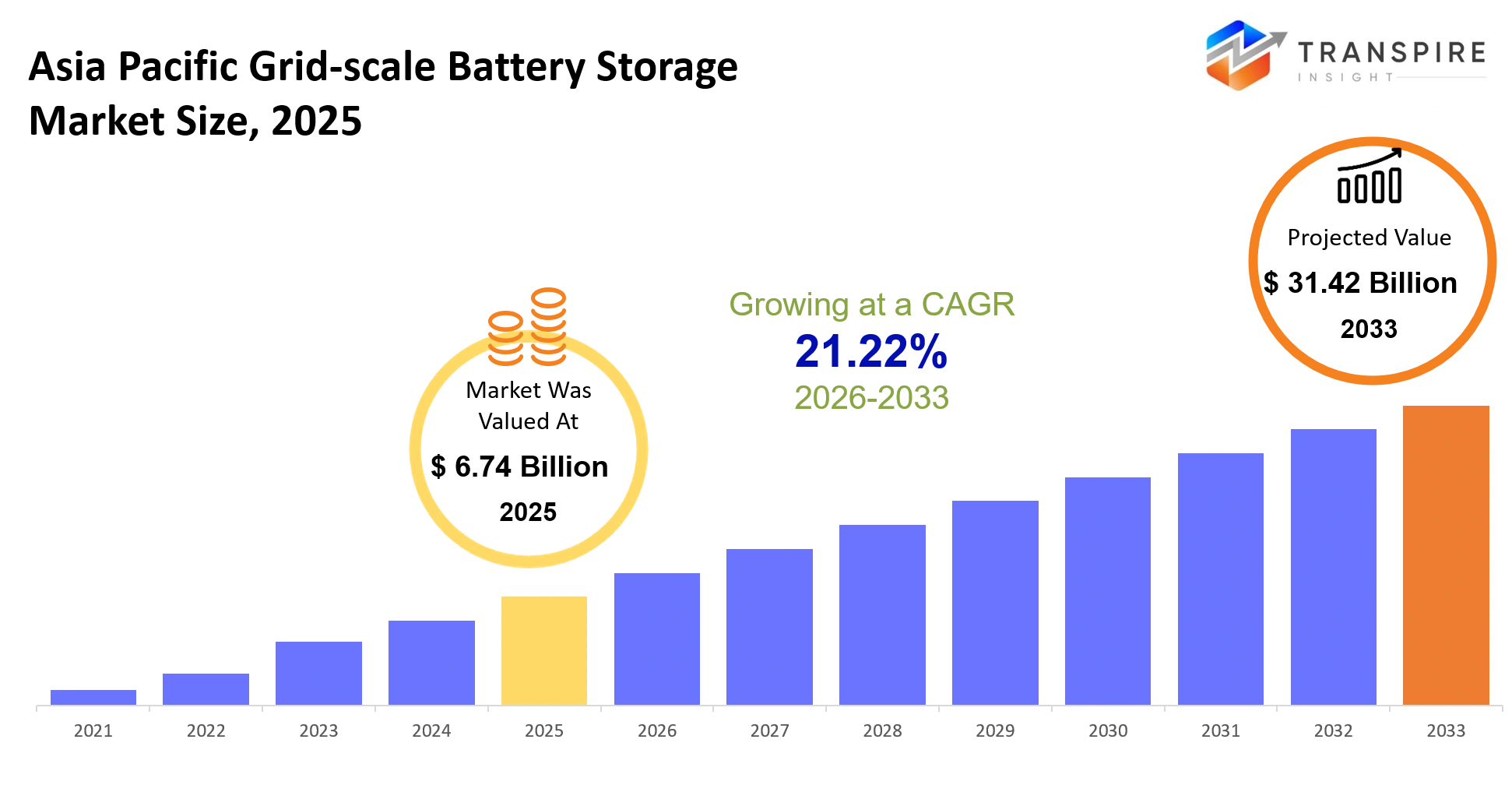
The Asia Pacific Grid-scale Battery Storage Market was valued at USD 6.74 Billion in 2025. It is forecast to reach USD 31.42 Billion by 2033. That is a CAGR of 21.22% over the period.
The Asia Pacific Grid-scale Battery Storage Market will be key to managing electricity supply and demand across increasingly sophisticated power grids. This includes utilities and grid operators managing volatile power inputs such as those from renewable energy resources, stabilizing frequencies, avoiding curtailment of renewable capacity and providing back-up during high demand and outages. This market has structurally shifted from demonstration projects to utility-owned and merchant storage facilities which have been directly integrated into national power strategies during the last five years, following the volatility of power prices and supply problems stemming from the Russia-Ukraine war that brought to light the risks associated with a reliance on fuel imports. As nation-states scale up solar and wind power output the need for elastic storage to offset the inherent variability of such sources and thus defer potentially expensive network investment will influence investment priorities and generate new revenue streams for operators.
Key Market Insights
- The Asia Pacific Grid-scale Battery Storage Market has transitioned from pilot stages to utility-scale applications integrated with solar and wind plants.
- China is the dominant regional market, holding over 55% share in 2025, backed by stringent renewable and storage targets.
- India is the fastest-growing market over the forecast period (2025-2032) on account of renewable capacity addition, grid modernization initiatives, and energy security concerns.
- Lithium-ion batteries dominate the market share (over 75%) driven by the declining prices and superior energy densities.
- Flow batteries stand second in the market share for long duration storage and grid stability applications.
- Sodium-ion batteries are the fastest-growing technology market over the forecast period, as battery manufacturers expand the scope of their supply chain.
- The renewable energy integration application led, taking a market share of nearly 45% with a focus on optimizing the variable production from solar and wind.
- Peak shaving and frequency regulation are becoming the fast growing applications with the market for ancillary services growing to become commercial.
- Utility is the top end user application with a regional installation share of over 60% in 2025.
- IPP is the fastest growing application as the merchant storage business model becomes commercially feasible.
What are the Key Drivers, Restraints, and Opportunities in the Asia Pacific Grid-scale Battery Storage Market?
The single biggest factor enabling rapid market expansion is the rapid deployment of renewables together with regulatory mandates on grid flexibility. Policy in China, India, Australia and South Korea are imposing storage targets and renewable integration measures driving utilities to purchase grid scale battery capacity, while at the same time falling Li-ion costs over the last decade has made grid scale storage competitive with fossil peaker plants leading to an increased pipeline, profitability and revenue velocity along the value chain.
The most critical issue will continue to be the dependence on critical minerals (lithium, nickel and cobalt) within the supply chain. This will remain a structural issue that can only be overcome slowly as mining, refining and geopolitical risk can neither be scaled or reduced with any significant speed. Price volatility and supply bottlenecks will push up project costs, delay procurement and slow deployment growth- especially in developing countries with low levels of domestic manufacturing.
The next big area of market opportunity will be long duration energy storage, as batteries with six-twelve hour durations- such as sodium-ion and flow batteries- begin to garner investment as utilities are pressured to integrate higher penetrations of renewable power and modernized the grid. India and Australia have been identified as leading markets for large scale commercial deployment due to the factors outlined above.
What Has the Impact of Artificial Intelligence Been on the Asia Pacific Grid-scale Battery Storage Market?
AI and advanced digital technologies are further impacting the APAC Grid-Scale Battery Storage market, enhancing operation efficiencies and extending battery life and improving overall grid management. Energy operators are adopting AI based energy management systems, which autonomously manages charging and discharging according to electricity prices, forecast generation output of renewable sources and the state of the grid, enabling storage facilities to play an active role in the energy arbitrage and ancillary service market, thus decreasing manual work.
Predictive maintenance using ML is another approach that enhances operational efficiencies. By analysing the data on voltage, temperature, degradation of cells etc. In energy storage facilities in real time, the anomaly detection is applied by using the trained ML algorithms, thus preventing possible failures in advance, enhancing asset availability, reducing unplanned downtime and extending the operating life of batteries. Also, the AI based forecasting tools enhance renewable energy integration through a more precise forecast on wind power and solar generation.
Despite these advantages of AI and other advanced digital technology deployment, limitations do exist. Huge capital expenditures for modern grid architecture integration with the existing legacy infrastructures and insufficient operation data for new battery chemistries can cause decreased model accuracy and a prolonged deployment timeline.
Key Market Trends
- Utilities, which previously used to only test demonstration projects, are now implementing 1 gigawatt battery deployment from 2020 as storage becomes an inevitable necessity in integrating intermittent renewable power sources.
- China's storage mandating, from 2021 onwards, requires renewable developers to integrate batteries with solar and wind power, instead of independent renewable assets.
- In a decade's time, prices of lithium-ion batteries decreased by more than 80% forcing utilities to switch to battery storage from gas peaking power plants.
- Manufacturers such as CATL and BYD are accelerating the commercialization of sodium-ion batteries to reduce their reliance on lithium and diversify their supply chain, from 2023.
- Demand for four- to eight-hour storage systems is now being favored, moving from the need for shorter term grid stabilization, towards longer-term energy management.
- Australia is serving as a test ground for merchant battery projects where owners are increasingly making profit through energy arbitrage and ancillary services.
- Market regulators in India, Japan and South Korea are moving from a subsidized based system toward an auction system, which favors cost-effectiveness and performance based storage solutions.
- Supply chains have become increasingly regionalised since 2022, due to tensions around geopolitics, the industry has witnessed a global spread of manufacturers closer to their end users.
- Energy management systems are utilizing artificial intelligence, which can eliminate manual dispatch decisions, control the battery charge-discharge cycles and prolong the batteries lifespan.
- Strategic partnerships, between utilities, renewable developers and technology companies have begun to increase along with large project size and complicated funding structures.
Asia Pacific Grid-scale Battery Storage Market Segmentation
By Battery Type:
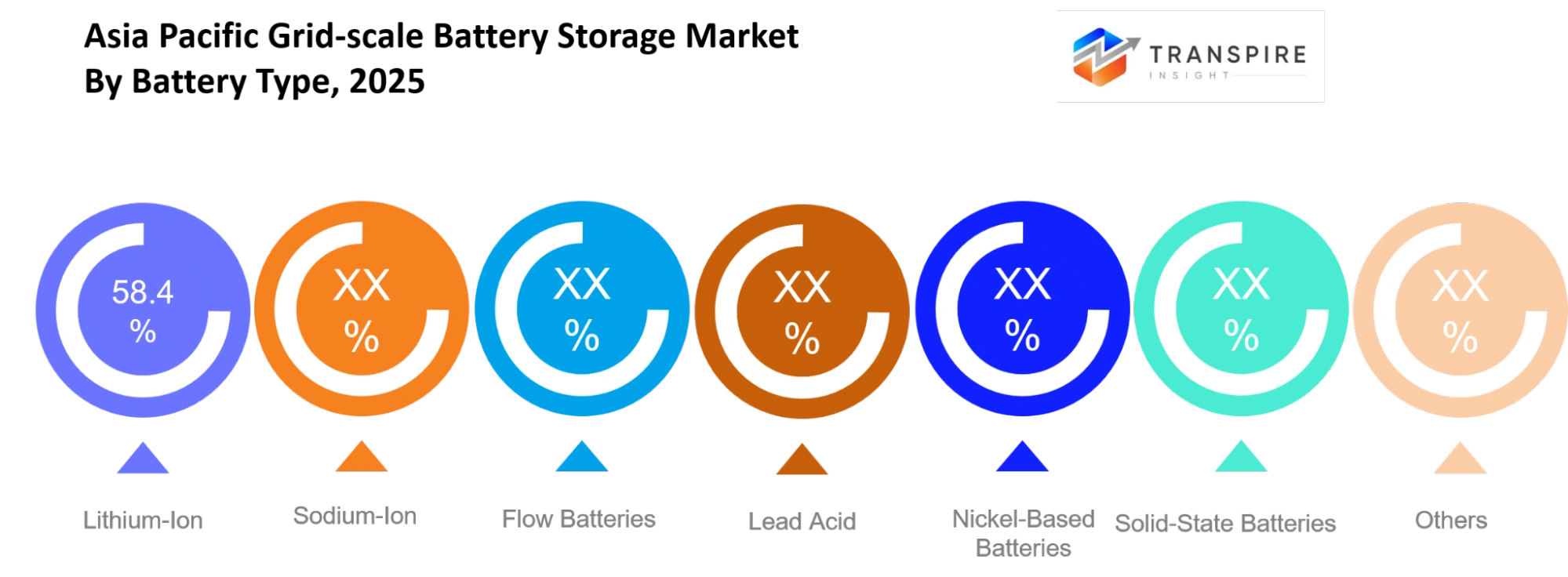
Lithium-Ion batteries provide highly efficient storage of electrical energy with fast charge/discharge cycles and so such types of batteries are preferred for large grid projects. Good energy density, decrease in manufacturing cost and longer operational life of the Lithium-Ion batteries lead to wider acceptance for renewable energy integration and grid balancing applications.
Sodium-Ion batteries employ inexpensive raw materials and will serve as a substitute for lithium. Flow Batteries, which store energy as liquids have long discharge time, ideal for utility storage application. Lead Acid batteries offer an effective alternative for backup power, and low cost storage application while Nickel-Based Batteries offer stable performance. Solid-State Batteries and others refer to future technologies that can serve all storage demands with increase in efficiency and safety.
By Application:
Renewable Energy Integration refers to storing electricity produced by wind, and solar power plants. Storage systems also allow utilization of renewable power at times of low production, thus ensuring balance of supply, demand of electricity, and minimizes renewable energy curtailment. The increasing number of installations of renewable power in Asia Pacific will continue to drive demand from this sector. Peak Shaving involves a drastic reduction in the load from electricity at times of peak demand and consequently reduces grid stress.
Frequency Regulation, involved maintaining a constant frequency within the grid by responding to any deviations between supply and demand. Back-Up Power, Grid Stabilization and Others are some applications to ensure continuous electricity supply and enhance power system reliability. Increase in smart grids and investment in renewable energy will spur these applications further.
By Ownership Model:
Utility-owned systems: These systems are owned and operated directly by the utility company and aim to increase the performance and integration of renewables within the grid. Large utilities fund these systems with significant capital investments that focus on improving reliability of electricity, optimizing grid operation and mitigating reliance on traditional peaker plants.
These are systems developed and owned by private investors and developers that sell electricity from these systems on long-term contracts. Community Storage systems, where the storage unit's output is shared amongst a number of consumers or businesses locally, or Other such as hybrid ownership structures aimed at addressing specific regulatory or operational needs are common forms of these systems.
By End User:
The largest end-user segment is utilities as grid operators necessitate bulk-scale systems for renewable energy integration and reliable electricity distribution. Furthermore, ongoing investments in transmission infrastructure and clean energy programs within the region will maintain the trend of utility investment in storage. Renewable energy developers utilize battery storage in conjunction with their projects to boost economics and reliability of output.
Government agencies use battery storage systems as they contribute to enhanced energy security and meet targets of decarbonization. Industrial users are increasingly adopting storage systems that optimize electricity costs and guarantee operational continuity, whereas Other sectors comprise commercial organizations and emerging energy service providers that rely on high-end battery systems.
What are the Key Use Cases Driving the Asia Pacific Grid-scale Battery Storage Market?
Integration of renewable power remains as the dominant application within the Asia Pacific Grid-scale Battery Storage Market. Utilities and power generators will employ battery systems of considerable scale in an attempt to store excess power from solar and wind plants and inject this power when production dips. The scale of the storage application will contribute to the bulk of demand as many countries are implementing renewable generation capacity at a faster pace than the grid can cope.
Peak shaving and frequency regulation are gaining traction due to an increase in fluctuation of electricity consumption patterns. Industrial users implement battery storage systems in an effort to limit their peak power cost and operators utilize fast response storage solutions to stabilize the grid and eliminate the need for costly investments in the transmission network.
New applications for energy storage such as long duration energy storage and virtual power plants. Utility companies in both Australia and India will trial these models, bolstering the resilience of the electricity network, consolidating distributed energy sources and enabling increased penetration of renewables throughout the projection period.
|
Report Metrics |
Details |
|
Market size value in 2025 |
USD 6.74 Billion |
|
Market size value in 2026 |
USD 8.17 Billion |
|
Revenue forecast in 2033 |
USD 31.42 Billion |
|
Growth rate |
CAGR of 21.22% from 2026 to 2033 |
|
Base year |
2025 |
|
Historical data |
2021 - 2024 |
|
Forecast period |
2026 - 2033 |
|
Report coverage |
Revenue forecast, competitive landscape, growth factors, and trends |
|
Regional scope |
Asia Pacific (India, China, Japan, Australia, South Korea, Rest of Asia Pacific) |
|
Key company profiled |
Tesla Energy, BYD, CATL, LG Energy Solution, Samsung SDI, Panasonic, Fluence, Sungrow, Hitachi Energy, ABB, GE Vernova, Siemens Energy, Toshiba, Kokam, Narada |
|
Customization scope |
Free report customization (country, regional & segment scope). Avail customized purchase options to meet your exact research needs. |
|
Report Segmentation |
By Battery Type (Lithium-Ion, Sodium-Ion, Flow Batteries, Lead Acid, Nickel-Based Batteries, Solid-State Batteries, Others); By Application (Renewable Energy Integration, Peak Shaving, Frequency Regulation, Backup Power, Grid Stabilization, Others); By Ownership Model (Utility-Owned, Third-Party Owned, Community Storage, Others); By End User (Utilities, Renewable Energy Developers, Government, Industrial Users, Others) |
Which Regions are Driving the Asia Pacific Grid-scale Battery Storage Market Growth?
China dominates the Asia Pacific grid-scale battery storage market due to an energy policy that heavily incentivizes the integration of renewables and the modernization of its grid infrastructure. Mandates from national and provincial authorities requiring new solar and wind installations to include energy storage result in a steady stream of new projects. Strong manufacturing scale, both at the national level and for individual battery manufacturers, further decrease cost and shorten supply chains, all of which ensure continued market growth.
The second largest regional player by market share is Japan, although its growth pattern differs from that of China. In Japan, the driver of the growth is neither the scale of domestic manufacturing nor the desire to support the adoption of a high percentage of renewable energy. Market development here focuses on energy security, network reliability, and deliberate, sequential reforms in regulations. Private developers, together with utilities, still invest in energy storage systems in order to build robust electricity grids. The combination of reliable investment frameworks and a supportive, long-term national policy make Japan a consistently stable contributor to market revenue.
The fastest growing market will be India as its renewable energy targets have continued to climb and demand for electricity continues to rise. Auction of stand-alone storage projects and combined battery-plus-renewable power projects from national and state governments have established robust project pipelines. Transmission reinforcements and incentives for local battery manufacturing are improving investment conditions, thereby building a favorable environment for both equipment vendors and project developers. Strong market growth in the 2026-2033 period will bring opportunities to tech vendors, project developers and investors that want exposure to large-scale energy infrastructure.
Who are the Key Players in the Asia Pacific Grid-scale Battery Storage Market and How Do They Compete?
Competition in the Asia Pacific grid-scale battery storage market is intensifying as manufacturers of batteries, systems integrators, and energy technology firms vie on factors such as cost, technology efficiency, and project implementation capabilities. The Asia Pacific market is moderately concentrated, with key battery suppliers (a few large manufacturing companies) and technology and software firms providing the energy storage system software and energy management functions. The firms which maintain competitive advantages will have the capability to scale battery production while being able to leverage advances in battery chemistry and grid integration. With emerging new technology such as sodium-ion and long-duration storage, additional pressure is placed on existing players.
CARL's competitive advantage comes from scale of manufacturing, combined with a drive to innovate within battery chemistry. It has strong performance in high energy-density Li-ion battery technology, in addition to efforts to commercialize its sodium-ion technology in an effort to broaden its supply chain of raw materials and reduce overall costs in the long run. BYD benefits from its vertically integrated structure, with both battery manufacturing and system development capabilities giving it more control over both pricing and product quality, and it continues to increase manufacturing capacity in Asia. Tesla benefits from its control of software, which optimizes battery performance and market interaction, while Fluence has an advantage in its sophisticated energy management and digital control technology. Both firms continue to increase its geographical reach through strategic partnerships with renewable energy project developers and utility firms, as well as improve system performance and long-term customer relationships.
Company List
- Tesla Energy
- BYD
- CATL
- LG Energy Solution
- Samsung SDI
- Panasonic
- Fluence
- Sungrow
- Hitachi Energy
- ABB
- GE Vernova
- Siemens Energy
- Toshiba
- Kokam
- Narada
Recent Development News
In April 2026, CATL secured a major supply partnership with Beijing HyperStrong Technology for 60 GWh of sodium-ion batteries over three years. The agreement marked CATL's first large-scale sodium-ion energy storage deal and accelerated commercialization of lower-cost battery chemistry for grid-scale storage projects across Asia Pacific.
Sourcehttps://www.reuters.com/
n May 2026, Adani Green Energy commissioned a 3.37 GWh Battery Energy Storage System at the Khavda renewable energy complex in India. The investment strengthened one of the world's largest renewable energy hubs and improved India's capability to integrate large volumes of solar and wind power into the grid. Sourcehttps://m.economictimes.com/
What Strategic Insights Define the Future of the Asia Pacific Grid-scale Battery Storage Market?
The Asia Pacific Grid-scale Battery Storage Market is transitioning to the central part of power grids and from support for renewable energy projects. This is going to be driven by requirement for grid flexibility as solar and wind capacity grows at higher speed than transmission lines. In the next five to seven years, storage assets will play in multiple revenue streams, namely energy arbitrage, capacity markets and ancillary services, bringing higher economics and drawing in institutional money.
A less noticeable risk exists in market concentration in battery manufacturing and critical mineral processing stages. Heavy reliance on limited vendors may bring risks like price volatility, trade restrictions and procurement delay even if installations are increasing.
A new opportunity is emerging in long-duration storage driven by sodium-ion and flow batteries, particularly in India and Australia where policy development is ongoing. Investing early in a diversified portfolio of battery chemistries and localized supply chain would bring down risk.
Asia Pacific Grid-scale Battery Storage Market Report Segmentation
By Battery Type
- Lithium-Ion
- Sodium-Ion
- Flow Batteries
- Lead Acid
- Nickel-Based Batteries
- Solid-State Batteries
By Application
- Renewable Energy Integration
- Peak Shaving
- Frequency Regulation
- Backup Power
- Grid Stabilization
By Ownership Model
- Utility-Owned
- Third-Party Owned
- Community Storage
By End User
- Utilities
- Renewable Energy Developers
- Government
- Industrial Users
Frequently Asked Questions
Find quick answers to common questions.
The Asia Pacific Grid-scale Battery Storage Market size is USD 31.42 Billion in 2033.
Key segments for the Asia Pacific Grid-scale Battery Storage Market are By Battery Type (Lithium-Ion, Sodium-Ion, Flow Batteries, Lead Acid, Nickel-Based Batteries, Solid-State Batteries, Others); By Application (Renewable Energy Integration, Peak Shaving, Frequency Regulation, Backup Power, Grid Stabilization, Others); By Ownership Model (Utility-Owned, Third-Party Owned, Community Storage, Others); By End User (Utilities, Renewable Energy Developers, Government, Industrial Users, Others).
Major Asia Pacific Grid-scale Battery Storage Market players are Tesla Energy, BYD, CATL, LG Energy Solution, Samsung SDI, Panasonic, Fluence, Sungrow, Hitachi Energy, ABB, GE Vernova, Siemens Energy, Toshiba, Kokam, Narada.
The Asia Pacific Grid-scale Battery Storage Market size is USD 6.74 Billion in 2025.
The Asia Pacific Grid-scale Battery Storage Market CAGR is 21.22% from 2026 to 2033.
- Tesla Energy
- BYD
- CATL
- LG Energy Solution
- Samsung SDI
- Panasonic
- Fluence
- Sungrow
- Hitachi Energy
- ABB
- GE Vernova
- Siemens Energy
- Toshiba
- Kokam
- Narada
About the Authors

Avinash Kumar
I’m Avinash Kumar, a Senior Research Analyst at Transpire Insight, with expertise in the Electronics and Semiconductor and Energy & Power industry. My work focuses on analyzing emerging technologies, market trends, industry developments, and innovation across these sectors. I specialize in transforming complex technical and market insights into clear, research-backed content that helps professionals, businesses, and decision-makers stay informed. Through continuous industry research and data-driven analysis, I strive to deliver accurate, reliable, and practical perspectives on the latest advancements shaping the semiconductor and energy landscape.

Chakradhar Khansole
Chakradhar serves as the Research Director at Transpire Insight, bringing over 8 years of experience in technology, innovation, and strategic market intelligence. He specializes in transforming complex market data into actionable business insights that enable organizations to make informed, growth-oriented decisions. Recognized for his strategic vision and analytical expertise, Chakradhar leads high-impact research initiatives, delivering comprehensive market assessments, competitive intelligence, and forward-looking industry analysis.
Recently Published Reports
-
Apr 2026
Active Power Filter Market
Active Power Filter Market Size, Share & Analysis Report By Type (Shunt Active Power Filters, Series Active Power Filter, Hybrid Active Power Filter), By Application (Harmonics Mitigation, Reactive Power Compensation, Voltage Regulation, Power Factor Correction), By Phase (Single Phase, Three Phase), By End-User Industry (Manufacturing, Healthcare, Commercial, Automotive, Oil and Gas, Others), and Geography (North America, Europe, Asia-Pacific, Middle East and Africa, South and Central America), 2021 - 2031
-
Apr 2026
Electrical Transformer Market
Electrical Transformer Market Size, Share & Analysis Report By Core (Closed, Shell, and Berry), By Insulation (Gas, Oil, Solid, Air, and Other), By Phase (Single, and Three), By Rating (100 MVA to 500 MVA, 501 MVA to 800 MVA, and 801 MVA to 1200 MVA), and Geography (North America, Europe, Asia-Pacific, Middle East and Africa, South and Central America), 2021 – 2031
-
Apr 2026
Hydraulic Piston Pumps Market
Hydraulic Piston Pumps Market Size, Share & Analysis Report By Type (Axial Piston Pumps, Radial Piston Pumps), By Operating Pressure (Low Pressure, Medium Pressure, High Pressure), By Application (Construction, Mining, Agriculture, Automotive, Oil & Gas, Industrial Machinery, Others), By End-User (OEMs, Aftermarket), and Geography (North America, Europe, Asia-Pacific, Middle East and Africa, South and Central America), 2021 – 2031
-
Apr 2026
Laboratory Gas Generators Market
Laboratory Gas Generators Market Size, Share & Analysis Report By Product (Nitrogen Gas Generator, Hydrogen Gas Generator, Zero Air Gas Generator, Purge Gas Generator, TOC Gas Generators, Others), By Application (Gas Chromatography, Liquid Chromatography-mass Spectrometry (LC-MS), Gas Analyzers, Others), By End-user (Life Science, Chemical & Petrochemical, Food & Beverage, Others), and Geography (North America, Europe, Asia-Pacific, Middle East and Africa, South and Central America), 2021 – 2031