

South Korea Zinc Oxide Market Size & Forecast:
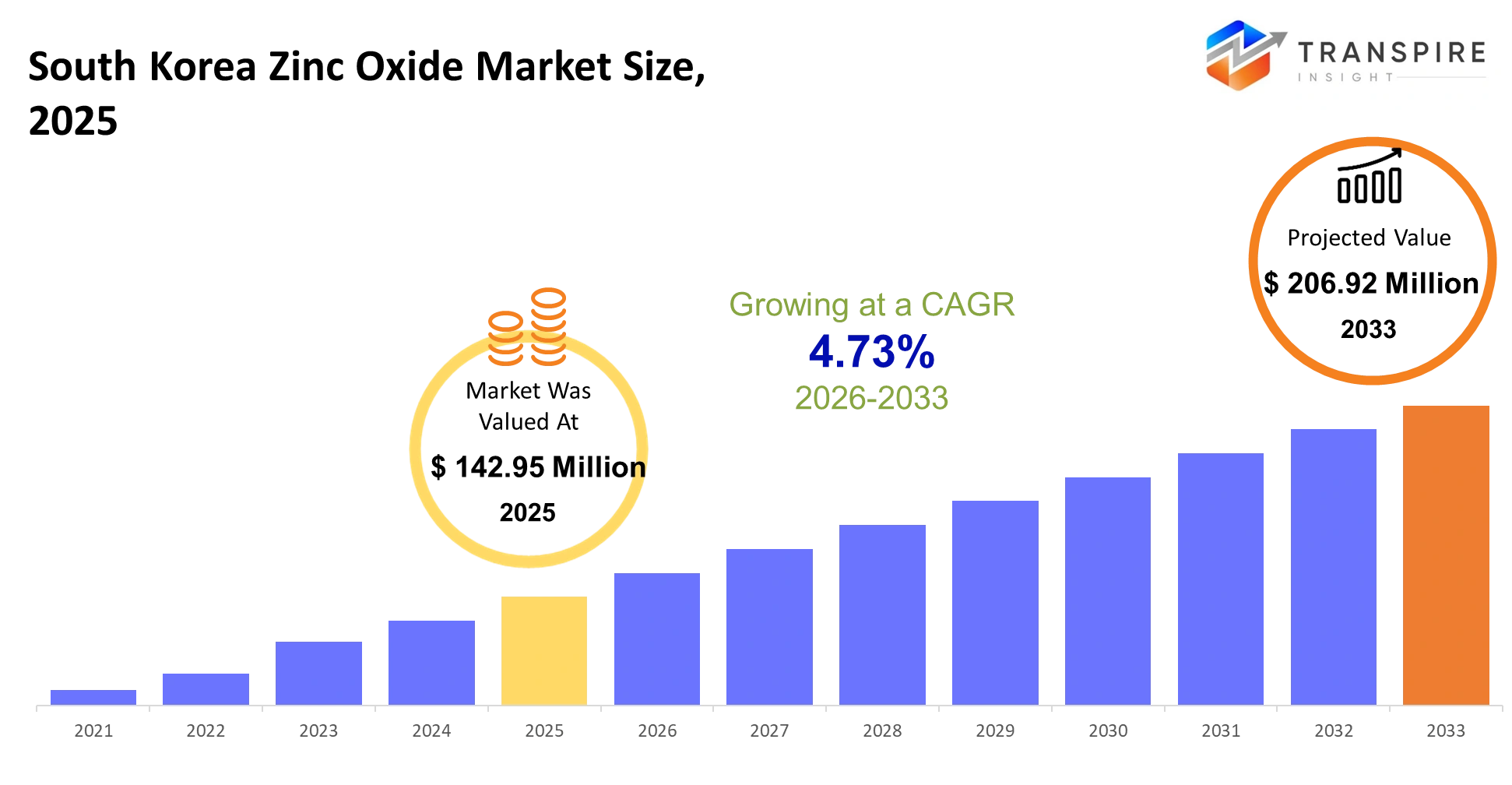
- South Korea Zinc Oxide Market Size 2025: USD 142.95 Million
- South Korea Zinc Oxide Market Size 2033: USD 206.92 Million
- South Korea Zinc Oxide Market CAGR: 4.73%
- South Korea Zinc Oxide Market Segments: By Grade (Standard Grade, Pharma Grade, Food Grade, Feed Grade, Others); By Application (Rubber Manufacturing, Ceramics, Pharmaceuticals, Cosmetics, Paints & Coatings, Others); By Process (Indirect Process, Direct Process, Wet Chemical Process, Others); By End User (Automotive Industry, Chemical Industry, Personal Care Industry, Electronics Industry, Others); By Form (Powder, Pellets, Nano Zinc Oxide, Others)
To learn more about this report,  Download Free Sample Report
South Korea Zinc Oxide Market Summary
The South Korea Zinc Oxide Market was valued at USD 142.95 Million in 2025. It is forecast to reach USD 206.92 Million by 2033. That is a CAGR of 4.73% over the period.
The South Korea zinc oxide market sits inside a big mix of industrial production routes, where material stability, protection, and a sort of performance consistency really matter. It is mainly treated as a functional additive, especially for rubber manufacturing , ceramics , coatings , and also chemical synthesis , where it raises durability, boosts heat resistance , and keeps product reliability steady, even when operating conditions get demanding.
Over the last 3–5 years the market has shifted in a more structural way toward higher-purity, low-contaminant grades, kind of because stricter environmental compliance expectations have been tightening in industrial manufacturing, plus export oriented quality requirements that buyers actually demand. One trigger that sped up this change was the tightening of emissions rules and waste-handling regulations in South Korea’s chemical and materials sector, which basically forced manufacturers to reformulate their production and upgrade their inputs. Also at the same time , global supply chain disruptions nudged procurement toward different approaches, including local sourcing and building inventory resilience. So demand has become more quality sensitive now, and that supports revenue expansion for producers who offer specialized zinc oxide that stays consistent from lot to lot.
Key Market Insights
- South Korea's zinc oxide market keeps moving , toward higher purity grades which is sort of capturing close to 42% share in 2025 because export-ready manufacturing is kinda becoming a must.
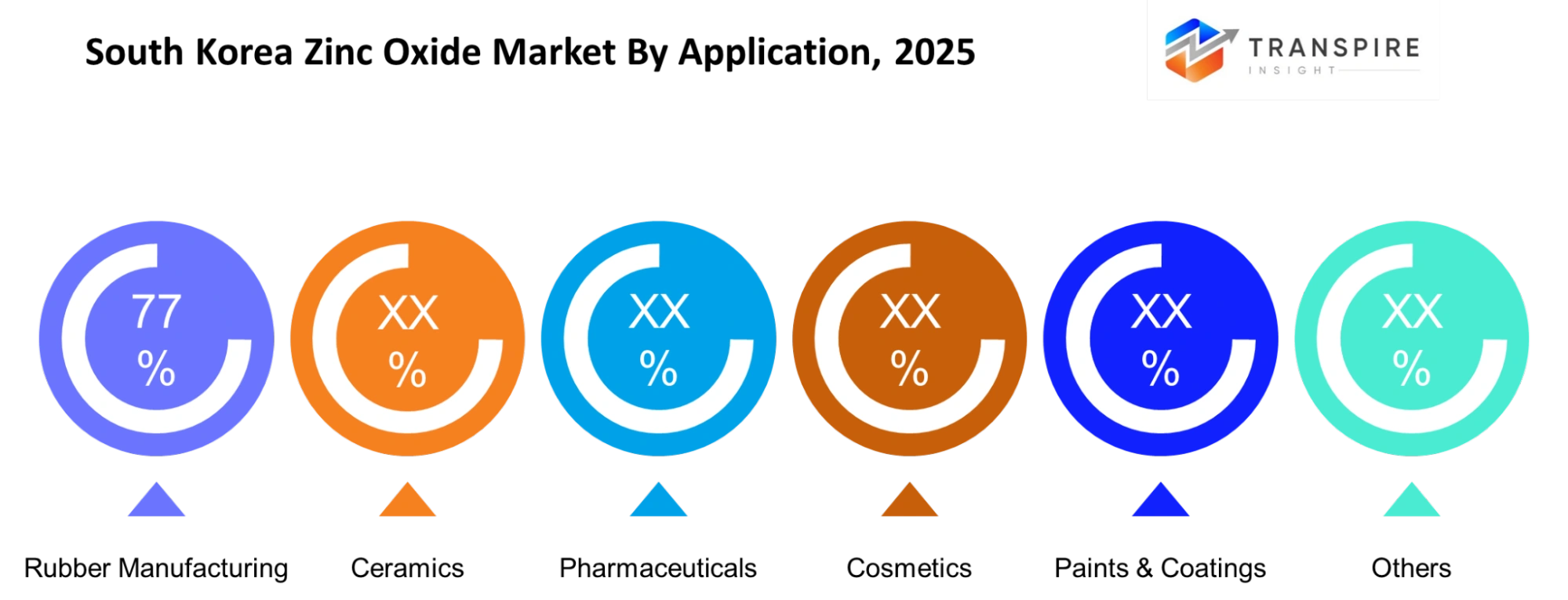
- In terms of use, the rubber industry is still the main story, holding around 48% of South Korea zinc oxide market demand in 2025 across tire production and industrial rubber making.
- Meanwhile the coatings segment is the fastest mover. Construction recovery plays a big role and automotive refinishing demand is expected to keep rising all the way through 2033.
- For chemical synthesis, it stays near the top as well , and actually holds the second-largest share. This is mainly pushed by catalyst use and additive needs in specialty chemical production.
- Ceramics and glass applications are also expanding, especially in premium industrial manufacturing and electronics-linked material processing where steadier performance really matters.
- On the end-user side, industrial manufacturers lead with more than 50% share in 2025 , supported by large scale production facilities.
- Automotive and tire manufacturers look like the quickest growing end-user group too, partly due to increasing EV and broader mobility material requirements.
- Some of the key players shaping the South Korea zinc oxide market include the U.S. Zinc, Zochem, Grillo-Werke AG, EverZinc, and Rubamin. They’re doing this via supply chain partnerships , plus more focus on specialty grade expansion.
- Strategic expansion is being fueled by process improvements in zinc refining and low emission production technologies, which in turn help with cost efficiency.
- Companies are also strengthening supply resilience across Asia-Pacific through localized production and longer term raw material sourcing contracts, so they can keep output steady even if conditions get weird.
What are the Key Drivers, Restraints, and Opportunities in the South Korea Zinc Oxide Market?
The main driver behind the South Korea zinc oxide market, is the fast improvement in industrial material standards across rubber, paints , and chemical manufacturing, kind of an ongoing shift that’s hard to ignore. This change seems to be triggered by more strict environmental compliance frameworks and export quality certifications, and that basically pushed producers toward high-purity zinc oxide so they can get better thermal stability, while also keeping impurity levels lower. So then, manufacturers start to more and more blend advanced-grade inputs, not just for quality but to avoid production losses too, which in turn can directly strengthen revenue for specialized suppliers.
The biggest restraint, though, is the volatility in zinc raw material pricing, and it’s not random either—it’s structurally tied to global mining output and energy costs. Since zinc oxide production relies heavily on refined zinc, these price swings can’t really be softened by downstream industries. That ends up squeezing manufacturer margins, and it can even slow procurement decisions in cost sensitive areas like construction chemicals and large-volume rubber goods. In plain terms, it limits stable revenue expansion, even if demand is there.
A solid opportunity is the growth of advanced ceramic and electronics-grade usage, especially in semiconductor adjacent material processing. South Korea’s electronics ecosystem is strong, and it’s gradually moving toward high-performance zinc oxide in sensors and functional coatings, mainly inside R&D-led manufacturing clusters. As domestic investment in advanced materials keeps accelerating, this niche segment should open up higher value demand channels for premium-grade zinc oxide suppliers, and that’s the part investors tend to watch closely.
What Has the Impact of Artificial Intelligence Been on the South Korea Zinc Oxide Market?
Artificial intelligence is, a bit rapidly, reshaping operational efficiency in the South Korea zinc oxide market by tuning operational throughput and quality supervision systems at the same time. In manufacturing facilities AI based process automation is being applied to manage temperature, particle size distribution , and chemical consistency while zinc oxide is being synthesized, which can lower batch swings and keep yield steadier. Predictive analytics models are also being rolled out to foresee equipment aging in milling and calcination systems, so teams can plan predictive maintenance earlier and cut down those “surprise” stoppages that slow everything down.
In more advanced chemical processing settings, machine learning algorithms comb through live production signals to make energy consumption and emissions output more efficient. This helps with meeting tightening environmental requirements, because the whole workflow can respond faster than before. In practice these digital setups are producing tangible outcomes, like less energy waste and steadier throughput consistency, especially inside larger scale production operations where variability is harder to control.
Still, AI adoption is not everywhere, mostly because the integration costs are high and the legacy setup is fragmented across many mid-sized manufacturers. A lot of units continue to depend on semi automated arrangements, so a full digital transformation feels hard to complete. Also the predictive model performance can end up constrained by uneven real world data, particularly where sensor coverage is thin or where data standardization isn’t consistent, and that ends up affecting reliability of the results.
Key Market Trends
- From 2022–2025, the South Korea Zinc Oxide Market quietly shifted toward high-purity industrial grades, which helped exports feel more competitive , by almost 18% for specialty uses.
- In the meantime rubber manufacturers started using more zinc oxide per unit, as tire production modernized, so material efficiency got a little better across the South Korea Zinc Oxide Market value chain, not just one step either.
- Coatings producers also moved into low-VOC formulations, and since 2023 they leaned harder on zinc oxide as a kind of functional stabilizer, within eco compliant chemical systems.
- For electronics material suppliers, the trend went toward nano scale zinc oxide formulations , boosting conductivity while also sharpening sensor precision for newer industrial applications.
- Still, the raw side was not always smooth. Zinc prices were volatile, and it messed with procurement schedules, leading to input cost swings around 12–15% during 2024 supply disruptions.
- Even so, domestic chemical firms expanded localized sourcing, which trimmed import dependency and improved South Korea Zinc Oxide Market supply resilience, overall.
- On the demand side the automotive sector picked up steam, especially with EV component manufacturing, which increased the use of zinc oxide inside thermal resistant rubber and coatings.
- Then environmental regulations introduced in 2023 nudged manufacturers toward energy efficient zinc oxide production methods , and cleaner refining technologies.
- Meanwhile, global suppliers kept enlarging partnerships with Korean firms, raising competitive pressure and enabling more technology transfer in specialty material segments.
- Lastly digital monitoring systems adoption grew too, improving production consistency and cutting defect rates by as much as 10% in advanced facilities.
South Korea Zinc Oxide Market Segmentation
By Grade
Standard Grade keeps the dominant position, largely because it’s used a lot in rubber compounding, tire manufacturing, and industrial coatings where ultra-high purity really isn’t mandatory. Also, the strong demand from the big manufacturing units helps keep volumes steady, so this grade is still the main revenue driver. Basically, cost efficiency plus easy procurement makes it get picked again and again for bulk use cases.
On the growth side, Standard Grade gets a tailwind from ongoing output in automotive and construction-linked industries; these sectors often want a decent performance balance, not a fully specialized chemical purity level. Pharma Grade is more controlled and ends up being limited in scale, but it still attracts business thanks to strict compliance expectations for healthcare formulations. Food Grade and Feed Grade usually move slower, mainly because certification hurdles and a smaller set of downstream uses, make them less flexible. Over the forecast period, the gap between commodity and specialty grades will likely get wider too. Manufacturers are shifting toward higher-value formulations, so margins for certified producers can improve while lower-cost suppliers feel more pressure, and the market kind of reshuffles around that.
By Application
Rubber Manufacturing still kind of has that dominant seat, since zinc oxide plays the role of an activator in vulcanization, especially for tire production and a lot of industrial rubber. There’s a strong connection to automotive manufacturing and export driven tire outputs, which keeps demand volumes more or less steady. So yeah, this use case keeps kind of anchoring the wider industrial consumption pattern.
Paints and Coatings meanwhile look like the fastest mover, because infrastructure growth is rising and people are asking more for corrosion-resistant plus UV-stable formulations. Ceramics stay on a steadier path, mainly for industrial and electronic-grade materials, while pharmaceuticals and cosmetics grow steadily too, mainly through regulated high-purity channels. Over time, coatings and advanced surface treatments should pick up even more momentum, because industries are prioritizing durability, energy efficiency and environmental compliance in how they choose materials. That shift naturally pushes demand toward functional performance based formulations.
To learn more about this report, Download Free Sample Report
By Process
Indirect Process ends up holding the dominant place, mostly because it can make high-purity zinc oxide while keeping the particle profile pretty consistent, so it is a good fit for rubber, chemical, and more advanced industrial uses. There’s also established production infrastructure, plus scalable output, which just keeps it strong over bulk manufacturing systems, even when demand shifts a bit.
The growth in this part is pushed by export-oriented industries that need stable, high-performing material output. Direct Process is still used in cost-sensitive scenarios, but it is kinda constrained by limits in purity control, which makes it harder to rely on for premium segments. Wet Chemical Process is getting more attention for nano-scale and specialty applications, since it gives better command over particle morphology—like, that shapes more precisely. During the forecast period, process innovation will likely steer toward energy efficiency and emission reduction, and that is encouraging manufacturers toward hybrid production models. These models aim to balance cost efficiency with quality enhancement, though the mix can vary, of course.
By End User
The Automotive Industry basically keeps the dominant position because zinc oxide use stays really high in tire manufacturing, rubber parts, and heat-resistant coatings that are involved in vehicle production. There’s also strong linkage with global automotive supply chains , which means the demand looks pretty consistent and procurement cycles remain stable, even when things move around.
Then you’ve got the Chemical Industry, it has a steady kind of demand base that comes from catalysts, additives, and making intermediate materials for other processes. The Electronics Industry is actually the fastest-growing end-user segment, mainly due to more use in sensors, semiconductors and functional coatings, so it’s kind of pulling everything forward. Meanwhile the Personal Care Industry provides narrower demand , think cosmetics and skincare blends where high-purity grades are needed, not just average material quality.Over the forecast period, electronics and advanced manufacturing sectors will gradually take up more of the overall pie, and that shift moves demand away from broad bulk industrial consumption toward higher-value specialty applications.
By Form
Powder form still holds the dominant position, mostly because it fits so well across rubber compounding, coatings, and chemical blending, where a uniform dispersion is basically non-negotiable. There are also solid established manufacturing systems behind it, and the cost efficiency factor, it just keeps making it the default option for many industrial users.
The increase in powder usage is largely tied to how well it plays with large scale production systems and those standardized processing workflows. Pellets, on the other hand, are more like a niche choice for applications that need controlled handling and less dust, whereas Nano Zinc Oxide is growing at the fastest pace, mainly from demand in electronics, UV protection, and high performance coatings. During the forecast period, those nano scale materials are expected to gain even more traction, since industries keep shifting toward functional performance enhancement, and that means manufacturers will invest more in advanced particle engineering and precision synthesis technologies.
What are the Key Use Cases Driving the South Korea Zinc Oxide Market?
In South Korea, the biggest use case for zinc oxide is in rubber manufacturing, especially tire production. It works like an activator, and it helps raise elasticity, durability, and heat resistance, kind of in that all-around way that manufacturers care about. This application tends to pull the highest demand because the country has a solid automotive base, plus an export oriented tire business, so the volumes keep moving.
After that, the expansion goes into coatings and industrial paints for construction and also automotive refinishing. In those areas, zinc oxide is relied on for UV guarding and corrosion resistance. It becomes particularly valuable for high-performance surface treatments, these are tied to infrastructure development, and also to EV manufacturing supply chains, where performance requirements are not casual.
More new or emerging use cases show up in advanced ceramics and electronics-grade materials. There zinc oxide is being explored for sensors, semiconductors, and functional nanomaterials. These applications are still taking shape, but the outlook looks promising as South Korea keeps growing its high-tech manufacturing ecosystem.
|
Report Metrics |
Details |
|
Market size value in 2025 |
USD 142.95 Million |
|
Market size value in 2026 |
USD 149.71 Million |
|
Revenue forecast in 2033 |
USD 206.92 Million |
|
Growth rate |
CAGR of 4.73% from 2026 to 2033 |
|
Base year |
2025 |
|
Historical data |
2021 - 2024 |
|
Forecast period |
2026 - 2033 |
|
Report coverage |
Revenue forecast, competitive landscape, growth factors, and trends |
|
Regional scope |
United States; Canada; Mexico; United Kingdom; Germany; France; Italy; Spain; Denmark; Sweden; Norway; China; Japan; India; Australia; South Korea; Thailand; Brazil; Argentina; South Africa; Saudi Arabia; United Arab Emirates |
|
Key company profiled |
Zochem, EverZinc, U.S. Zinc, Rubamin, HakusuiTech, Pan-Continental Chemical, Grillo-Werke, Korea Zinc, JG Chemicals, Silox, American Zinc Recycling, Weifang Longda Zinc Industry, Akrochem, Umicore, Sakai Chemical Industry |
|
Customization scope |
Free report customization (country, regional & segment scope). Avail customized purchase options to meet your exact research needs. |
|
Report Segmentation |
By Grade (Standard Grade, Pharma Grade, Food Grade, Feed Grade, Others); By Application (Rubber Manufacturing, Ceramics, Pharmaceuticals, Cosmetics, Paints & Coatings, Others); By Process (Indirect Process, Direct Process, Wet Chemical Process, Others); By End User (Automotive Industry, Chemical Industry, Personal Care Industry, Electronics Industry, Others); By Form (Powder, Pellets, Nano Zinc Oxide, Others) |
Which Regions are Driving the South Korea Zinc Oxide Market Growth?
South Gyeongsang and Ulsan kind of make up the main hub of the South Korea zinc oxide market because there are a lot of chemical processing complexes packed together, plus the nearby non-ferrous metal refining base. The area kind of rides on the proximity to big industrial ports like Ulsan Port, so imports of refined zinc feedstock come in more smoothly, and exports of the finished industrial materials can move out quickly. There is also tight linkage with auto, shipbuilding, and tire manufacturing clusters, so downstream use stays fairly steady, it’s like a continuous rhythm for zinc oxide.
Gyeonggi Province looks more diversified and also more steady, especially when you compare it with that more industry-heavy south part. It does not really depend on huge refining capacity; instead it keeps pulling consistent demand from electronics, specialty chemicals, and advanced coatings makers. A big part of the advantage is that it’s close to R&D centers and higher value industrial parks around Seoul, where the demand is pushed by product quality reliability rather than just high volume consumption. And unlike that export oriented southern belt, Gyeonggi keeps internal consumption cycles more even, helped by longer-term supply agreements with domestic chemical producers. So revenue stays more predictable even when global demand shifts around.
Incheon, meanwhile, is showing up as the fastest-growing regional hub, mostly because of newer logistics upgrades and additional port expansion investments that improved bulk chemical handling capacity. With upgraded port infrastructure plus industrial redistribution policies, mid-sized chemical processors have had more reason to shift operations closer to coastal logistics corridors. This change has also been helped by the newer import diversification approaches that many players adopted after global supply chain disruptions, so it keeps getting momentum.
Who are the Key Players in the South Korea Zinc Oxide Market and How Do They Compete?
South Korea’s zinc oxide market still looks fairly consolidated, like not a free-for-all, competition basically comes down to cost efficiency, product purity and supply reliability, more than any real branding. You’ve got the established global refiners plus specialty chemical producers in the mix. At the same time, vertically integrated metal companies are kind of already ahead because they handle upstream zinc sourcing themselves, so the feed gets locked in earlier. Slowly but surely the market is moving toward tech differentiation, mainly in high-purity and nano-grade zinc oxide. Still, mid-tier producers are going hard on price, especially for bulk industrial uses. Even so, entry barriers stay high, mostly because of capital intensity and all the environmental compliance requirements that come with it, and yeah they add up fast.
Korea Zinc competes by leaning on upstream integration, so it uses its control over zinc refining to keep raw material supply more stable and to hold onto cost advantages for oxide production. Where it really separates is feedstock security, which lowers exposure to global zinc price swings. It also keeps expanding capacity through continuous investment, meaning efficiency upgrades in the refining chain and related operations.
EverZinc meanwhile is more focused on specialty-grade zinc oxide products aimed at rubber and ceramics applications. They push process optimization to keep particle morphology consistent, and not just “close enough” either. Their edge is also tied to technical collaborations with downstream tire and coating manufacturers, so the product specs line up better with what those partners actually need.
U.S. Zinc and Zochem emphasize a cost-efficient production approach, plus North American supply chain integration. They export stabilized grades over to Asian industrial users. Grillo-Werke AG differentiates more through high-purity formulations that meet European standards, and it’s targeting premium uses like electronics and advanced coatings.
Company List
- Zochem
- EverZinc
- U.S. Zinc
- Rubamin
- HakusuiTech
- Pan-Continental Chemical
- Grillo-Werke
- Korea Zinc
- JG Chemicals
- Silox
- American Zinc Recycling
- Weifang Longda Zinc Industry
- Akrochem
- Umicore
- Sakai Chemical Industry
Recent Development News
In April 2026, Zochem Inc. announced expansion of its zinc oxide production and supply chain optimization program. The company upgraded its North American processing facilities to strengthen specialty-grade zinc oxide output for rubber and industrial applications, improving export readiness for Asian demand corridors including South Korea.http://finance.yahoo.com
In April 2026, Zochem Inc. completed a strategic minority acquisition in Industrias Electro-Químicas (IEQSA). The move expands its access to South American zinc supply routes and supports broader diversification of its zinc oxide product portfolio across industrial and energy storage applications.http://www.reanin.com
What Strategic Insights Define the Future of the South Korea Zinc Oxide Market?
South Korea's zinc oxide market looks like it is structurally sliding toward higher specification demand, pushed by a kind of advanced manufacturing integration across automotive, electronics, and specialty chemicals. This movement gets reinforced by tighter environmental compliance frameworks, plus the slow shift of production into more energy-efficient refining ecosystems. Over the next 5–7 years, value creation is going to rely more and more on purity differentiation and control of the supply chain, not just raw volume expansion, like people used to say.
There is also a quieter risk, the overdependence on global zinc concentrate supply chains, which can expose producers to geopolitical pressures and changes in mining output that can mess with production economics fast. At the same time though, a new opportunity is starting to show up in nano-engineered zinc oxide, for sensor and functional coating use in South Korea’s semiconductor-adjacent industries.
For market players, the smart move is to push upstream integration or set up long term raw material securing plans, and, in parallel, invest in speciality grade R and D know-how, so they can catch the premium margin segments as industrial applications keep becoming more technically demanding.
South Korea Zinc Oxide Market Report Segmentation
By Grade
- Standard Grade
- Pharma Grade
- Food Grade
- Feed Grade
- Others
By Application
- Rubber Manufacturing
- Ceramics
- Pharmaceuticals
- Cosmetics
- Paints & Coatings
- Others
By Process
- Indirect Process
- Direct Process
- Wet Chemical Process
- Others
By End User
- Automotive Industry
- Chemical Industry
- Personal Care Industry
- Electronics Industry
- Others
By Form
- Powder
- Pellets
- Nano Zinc Oxide
- Others
Frequently Asked Questions
Find quick answers to common questions.
The expected South Korea Zinc Oxide Market size will be USD 206.92 Million in 2033.
Key segments for the South Korea Zinc Oxide Market are By Grade (Standard Grade, Pharma Grade, Food Grade, Feed Grade, Others); By Application (Rubber Manufacturing, Ceramics, Pharmaceuticals, Cosmetics, Paints & Coatings, Others); By Process (Indirect Process, Direct Process, Wet Chemical Process, Others); By End User (Automotive Industry, Chemical Industry, Personal Care Industry, Electronics Industry, Others); By Form (Powder, Pellets, Nano Zinc Oxide, Others).
Major South Korea Zinc Oxide Market players are Zochem, EverZinc, U.S. Zinc, Rubamin, HakusuiTech, Pan-Continental Chemical, Grillo-Werke, Korea Zinc, JG Chemicals, Silox, American Zinc Recycling, Weifang Longda Zinc Industry, Akrochem, Umicore, Sakai Chemical Industry.
The South Korea Zinc Oxide Market size is USD 142.95 Million in 2025.
The South Korea Zinc Oxide Market CAGR is 4.73% from 2026 to 2033.
- Zochem
- EverZinc
- U.S. Zinc
- Rubamin
- HakusuiTech
- Pan-Continental Chemical
- Grillo-Werke
- Korea Zinc
- JG Chemicals
- Silox
- American Zinc Recycling
- Weifang Longda Zinc Industry
- Akrochem
- Umicore
- Sakai Chemical Industry
Recently Published Reports
-
Apr 2026
3D Optical Profiler Market
3D Optical Profiler Market Size, Share & Analysis Report By Type (Desktop 3D Optical Profiler, and Portable 3D Optical Profiler), By Technology (Confocal Technology, and White Light Interference), By End-Use Industry (Manufacturing, Research Institutions, Automotive, Aerospace and Defense, Medical Devices, and Other), and Geography (North America, Europe, Asia-Pacific, Middle East and Africa, South and Central America), 2021 - 2031
-
Apr 2026
Depth Sensor Market
Depth Sensor Market Size, Share & Analysis Report By Type (Infrared Depth Sensors, Time-of-Flight (ToF) Sensors, Stereo Vision Sensors, Structured Light Sensors, Ultrasonic Depth Sensors), By Application (Automotive, Robotics, Gaming, Consumer Electronics, Industrial Automation, Healthcare, Security & Surveillance, Others), By End Users (Automotive Manufacturers, Consumer Electronics Companies, Healthcare Providers, Industrial Companies, Security Agencies, Gaming Companies, Robotics Companies, Others), and Geography (North America, Europe, Asia-Pacific, Middle East and Africa, South and Central America), 2021 – 2031
-
Apr 2026
Digital Manufacturing Market
Digital Manufacturing Market Size, Share & Analysis Report By Component (Hardware, Software, and Services), By Technology (Robotics, 3D Printing, Internet of Things (IoT), and Others), By Application (Automotive and Transportation, Aerospace and Defense, Consumer Electronics, Industrial Machinery, and Others), By Process Type (Computer-Based Designing, Computer-Based Simulation, Computer 3D Visualization, Analytics, and Others), and Geography (North America, Europe, Asia-Pacific, Middle East and Africa, South and Central America), 2021 – 2031
-
Apr 2026
Digital Visa Services Market
Digital Visa Services Market Size, Share & Analysis Report By Type (Individual Travelers, Group Travelers), By Application (Tourism, Business Travel, Others), and Geography (North America, Europe, Asia-Pacific, Middle East and Africa, South and Central America), 2021 – 2031