
South Korea Gold Mining Market Size & Forecast:
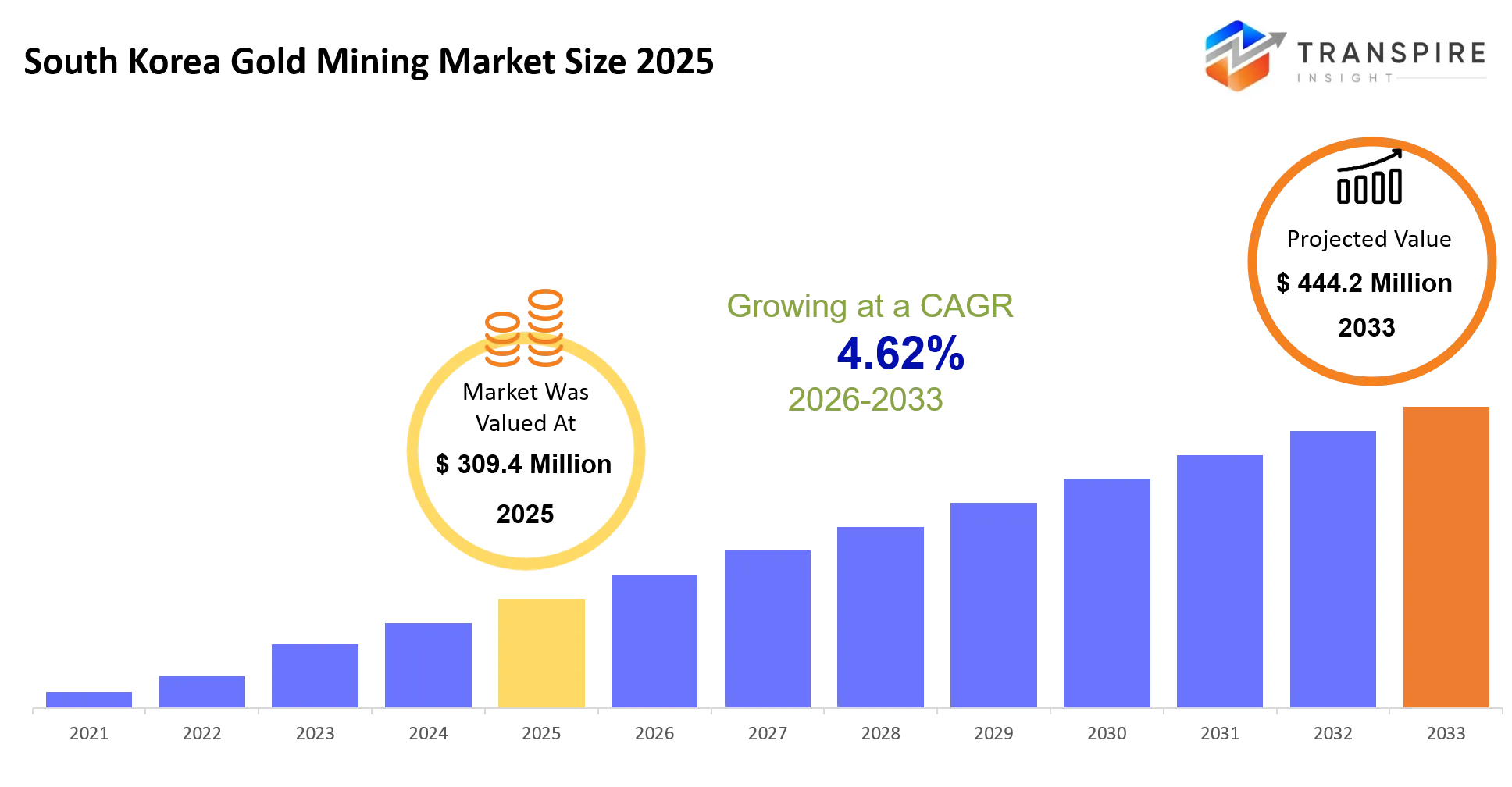
- South Korea Gold Mining Market Size 2025: USD 309.4 Million
- South Korea Gold Mining Market Size 2033: USD 444.2 Million
- South Korea Gold Mining Market CAGR: 4.62%
- South Korea Gold Mining Market Segments: By Mining Type (Open Pit Mining, Underground Mining, Placer Mining, Heap Leaching, Hard Rock Mining, Small-scale Mining, Exploration Projects, Others); By Application (Jewelry, Investment, Electronics, Industrial Uses, Dental Applications, Reserve Holdings, Coin Production, Others); By End User (Jewelry Manufacturers, Investors, Electronics Firms, Central Banks, Industrial Users, Traders, Refiners, Others); By Distribution Channel (Direct Sales, Commodity Exchanges, Bullion Dealers, Refiners, Online Platforms, Banks, Retail Channels, Others)
South Korea Gold Mining Market Summary
The South Korea Gold Mining Market was valued at USD 309.4 Million in 2025. It is forecast to reach USD 444.2 Million by 2033. That is a CAGR of 4.62% over the period.
By virtue of South Korea not being one of the world's largest gold producers, investment in the sector is crucial to the local procurement of investment products, electronics, manufacturing inputs, and reserve portfolio diversification. By focusing on mining operations within its borders, the country has less dependence on sourcing crude material and strengthening its supply chain to value-added processing sectors. South Korea has been actively making a paradigm shift towards the adoption of newer and more technology-dependent resource exploration and extraction processes for mining companies to extract higher value and economic return from more localized, smaller or lower grades of gold resources in the past 3-5 years. As uncertainty grows and commodity markets face volatile prices and pressures driven by various geo-political and macroeconomic events including inflationary shocks across the world, the elevated levels of the price of gold may result in projects to be more attractive, drive higher investment in gold exploration and also enable new streams of revenues for the mining and gold processing sectors in South Korea.
Key Market Insights
- Innovation and technology are gaining a central role for the growth of the South Korea Gold Mining Market. Since 2021, AI-based geological interpretation has increased the effectiveness of drilling by a maximum of 20%.
- The established level of mining infrastructure would indicate the central and eastern mining regions controlling an estimated 55 % of the market in 2025.
- The fastest growth regions through 2032 will be the southern regions, as exploration investments are introduced into new mineral belts.
- Due to the geological trend, the industry is dominated by the underground segment reflecting 65 percent of total industry revenue.
- Open-pit Mining comes second due to less operating cost and easy development of machinery.
- During the period 2025- 2032, automation and digital enabled mining operations are the fastest-growing areas as operators seek to improve productivity.
- Bullion and investment-grade gold products in use account for more than 45% of total gold, indicating strong sustained demand for portfolio diversification vehicles.
- Industrial uses are now becoming the fast growing application with electronics and MEMS, for example, in the semiconductor manufacturing associated with the development of domestic manufacturing.
- In the South Korea Gold Mining Market, collaboration is happening between exploration companies and technology to enhance resource estimation and advance existing operations.
- The adoption of remote monitoring, predictive maintenance and digital twins by the industries has become a common phenomenon. Businesses are currently looking at implementing the above techniques to optimize profitability and reduction in the operating cost.
What are the Key Drivers, Restraints, and Opportunities in the South Korea Gold Mining Market?
The major drivers expanding South Korea Gold Mining Market include a continued surge in gold prices, coupled with an elevated drive towards strategic mineral security. Sustained global inflation, geopolitical turbulence and currency instability drove investors to gold as a safe-haven asset,which in turn improved the profitability of domestic mining initiatives. An increase in prices spurred higher exploratory budgets, encouraging additional investment into modern mining extraction processes and thereby, fueling revenue growth while improving the feasibility of erstwhile marginally viable deposits.
South Korea's relative scarcity of high-grade gold deposits and expensive costs of developing economic mines continues to pose the largest constraints on market growth. This is fundamentally driven by the static nature of geological resource conditions as well as the lengthy, multi-year development process for mines before the commencement of commercial operations. These factors are compounded by stringent environmental permitting regulations and land restrictions, which impede the addition of new capacity and slow down revenue acceleration.
One of the biggest opportunities exists within AI-augmented mineral exploration and efficient recovery optimisation.Machine learning algorithms can be used to analyze and scrutinize complex geological datasets for enhanced targeting of gold deposits and increased precision, thereby mitigating the risks associated with exploration. Investment into digital mining technologies and data-intensive land-asset planning tools have the capacity to uncover previously sub-commercial deposits and facilitate a new phase of expansion in the country's gold mining industry.
What Has the Impact of Artificial Intelligence Been on the South Korea Gold Mining Market?
Gold mining is slowly but surely becoming smarter in South Korea with the implementation of artificial intelligence and new digital tools. Exploration is becoming more precise, equipment more reliable and the production process is more efficient. Gold mining companies are increasingly implementing geological AI tools to analyze satellite imagery, seismic data and old drillhole data to find mineral deposits more accurately, minimizing unnecessary drill activity.
Predictive maintenance of underground ventilation equipment, conveyors, pumps and crushers is another important application of machine learning, helping operators detect early failure signs, thereby enhancing equipment uptime and avoiding production delays. Operators can cut their maintenance expenses as well. Advanced analytics help optimize ore treatment processes in real time to maximize gold recovery, and minimize energy costs, as well as help ensure worker safety.
The widespread adoption of AI in South Korea mining industry faces a challenge, i.e. A high upfront cost. It is thus more the domain of big firms. The available large and complete data from past drilling is another bottleneck; some smaller mines may lack the data capacity or digital infrastructure to efficiently implement and take advantage of machine learning or automation technologies.
Key Market Trends
- Mining companies have allocated more funds to AI enabled exploration since 2021 in an attempt to increase drilling success and simultaneously, decrease geological risk.
- Between 1 January 2011 to 31 December 2015, even a milestone in gold prices increase after 2022 led operators to pay greater attention to resource expansion and better recovery technology rather than mere cost reduction.
- Robust digital mine management solutions formed at an accelerated pace resulting in real time tracking and a significant enhancement in visibility across work activities of exploration to production.
- Operators had to optimize their extraction processes and implement more sophisticated waste disposal systems, and the environmental rules were reinforced in 2020.
- Data driven exploration capabilities led to an upswing in strategic alliances between mining firms and technology suppliers.
- The security concern for domestic minerals has been pushing for the development of smaller deposits that were once considered economically unviable.
- Automated equipment monitoring became increasingly popular after 2023, enabling operators to decrease downtime and enhance asset utilization across mining operations.
- Expansion of industrial application and increased industrial demand for gold comes from electronics and semiconductor manufacturing.
- Competitive behavior was moving in the direction of technology adoption as the leaders focused on predictive analytics and remotely running stores rather than a focus on expansion.
South Korea Gold Mining Market Segmentation
By Mining Type:
Open pit mining entails recovering gold from deposits near the surface by means of large-scale excavation. Underground mining entails recovering gold from deeper deposits at greater depths by means of tunnels and shafts that are driven underground. Both methods of mining can meet the demands of gold production depending on the depth of the ore, the geological conditions and the cost effectiveness.
Placer mining is used to recover gold deposited in river beds, sediments and other loose surface materials by natural actions such as water and wind, which over time, have accumulated concentrations of heavy metals. Heap leaching involves using chemicals to dissolve the gold from large piles of crushed ore. Hard rock mining uses the same chemicals to extract unrefined gold from rock, which has been broken up by various means.
Small-scale mining is represented by low-capacity operations which target more localized deposits. Exploration initiatives are dedicated towards finding and assessing new gold deposits via domestic surveys, drilling and testing endeavors. Still others highlight specific extraction techniques that have been established to adapt to South Korea's unique geological and operational context within the gold mining industry.
By Application:
Gold's largest utilization is in jewelry in terms of consumer preference, longevity and visual appreciation. Investment uses include coin and bar investment, bullion and other investment products that are bought as a store of wealth and to diversify an investors' portfolio. This provides another consistent base for gold usage regardless of the economic cycle.
In the field of electronics, gold finds use because of its superlative properties of conduction, corrosion resistance and reliability in newer device technologies. In the field of Industry applications cover not only the manufacturing stages and processes but require the component to be functionally stable with improved performance. In Dentistry the most feasible application is where gold is used in combination with other materials for selected restorative procedures,by the positive attributes including their strength, biocompatibility and longevity.
Reserve holdings include the institutional holdings of gold as a financial asset and strategic store of value. Coin production, which fulfills a number of commemorative and investment demand needs for such, as best represented in coinage produced. The other consists of the uses of gold for technical and decorative or speciality industrial uses in the South Korea Gold Mining Market.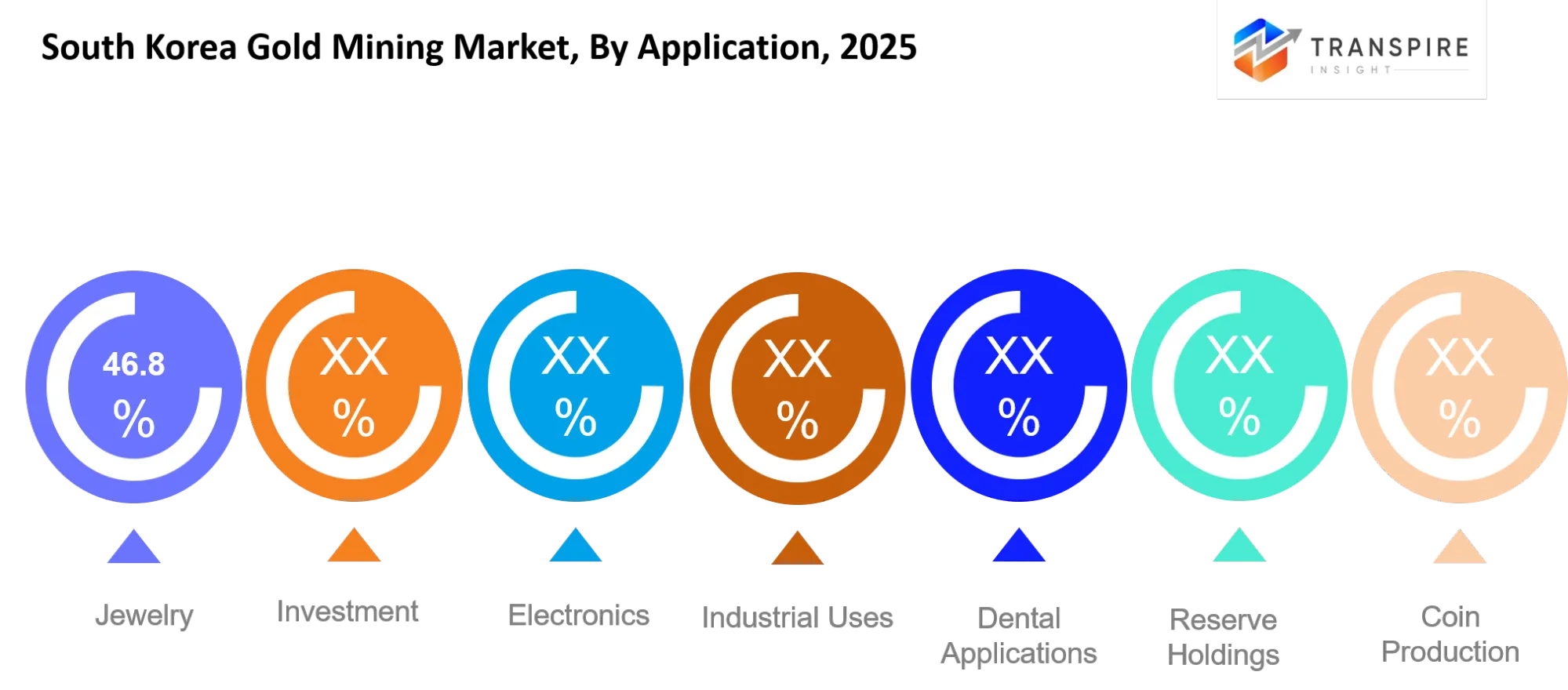
By End User:
Many jewelry manufactures buy gold as their primary material of rings, necklaces, bracelets or other decorations. Yet investors buy gold to hedge their financial risks and hold their value under uncertain market conditions. They both play a big part in the general consumption of gold in the world.
Manufacturing companies for electronics use gold in semiconductors, car plugs, circuit boards and other high-performance parts where a high degree of reliability is necessary. The central banks use their gold mostly for asset management reasons. The various types of industrial users utilize gold in precision manufacturing applications that need high conductivity, corrosion resistance or durable material.
Traders facilitate the exchanges and provide liquidity to the complete chain by linking buyers and sellers. Refiners transform raw gold into more refined and pure forms, such as bars or ingots, for commercial use. Remaining categories include standalone entities and organizations that buy or make use of gold for specific operational, investment, or organizational reasons.
By Distribution Channel:
In this channel of distribution, a transaction is held among producers and final buyers and has high level of control on prices and supply structure. Commodity exchange: this exchange channel provides trading platforms in a regulated system, which supports trading in contracts and physical gold contracts. Both the channel is instrumental in providing a good accessible market to the final users. Bullion dealers: Bullying dealers facilitate investors or institutional buyers to invest into various gold products.
Refiners are acting as distributors by providing refined gold to manufacturers, investors, as well as commercial buyers. Online platforms: the trend of buying gold on digital platforms or websites, which provides ease and speed to consumers for buying gold, has come up and growing significantly. Banks: they are playing the role in selling various gold products and investment schemes in addition to facilitating transaction processes.
Retail channels: consumer purchasing of gold is done through physical stores, special outlet. Others: alternative selling ways and intermediaries facilitating gold to reach at the market or further on its way towards value chain process is a part of others in South Korea Gold Mining Market.
What are the Key Use Cases Driving the South Korea Gold Mining Market?
The major driver behind South Korea’s gold demand remains its use in jewelry manufacturing, where its enduring nature, appealing quality, and value retention properties make it ideal for rings, necklaces, bracelets and premium accessories. Strong spending on luxuries and gift-giving has kept purchases from refiners and jewelers constant.
Gold is increasingly being bought for its investment purposes, to counter currency depreciation and inflationary pressure on a portfolio. Investment demands for gold bars, bullion, and coins among individual investors is growing, and has even begun among institutional investors. Gold also finds its use in various electronic devices from semiconductors and connectors to circuit boards, owing to its high electrical and corrosion resistant characteristics.
Advanced applications for artificial intelligence and high-performance computing semiconductors, as well as the recovery of gold and other precious metals from e-waste, have shown significant recent growth, contributing to domestic resource supply.
|
Report Metrics |
Details |
|
Market size value in 2025 |
USD 309.4 Million |
|
Market size value in 2026 |
USD 323.7 Million |
|
Revenue forecast in 2033 |
USD 444.2 Million |
|
Growth rate |
CAGR of 4.62% from 2026 to 2033 |
|
Base year |
2025 |
|
Historical data |
2021 - 2024 |
|
Forecast period |
2026 - 2033 |
|
Report coverage |
Revenue forecast, competitive landscape, growth factors, and trends |
|
Country scope |
South Korea |
|
Key company profiled |
Barrick Gold, Newmont, AngloGold Ashanti, Kinross Gold, Agnico Eagle, Harmony Gold, Gold Fields, Polyus, Zijin Mining, Shandong Gold, Evolution Mining, Northern Star, SSR Mining, Yamana Gold, Korea Resources Corporation |
|
Customization scope |
Free report customization (country, regional & segment scope). Avail customized purchase options to meet your exact research needs. |
|
Report Segmentation |
By Mining Type (Open Pit Mining, Underground Mining, Placer Mining, Heap Leaching, Hard Rock Mining, Small-scale Mining, Exploration Projects, Others); By Application (Jewelry, Investment, Electronics, Industrial Uses, Dental Applications, Reserve Holdings, Coin Production, Others); By End User (Jewelry Manufacturers, Investors, Electronics Firms, Central Banks, Industrial Users, Traders, Refiners, Others); By Distribution Channel (Direct Sales, Commodity Exchanges, Bullion Dealers, Refiners, Online Platforms, Banks, Retail Channels, Others) |
Which Regions are Driving the South Korea Gold Mining Market Growth?
The central region, due to its higher concentration of known exploration deposits and infrastructure for processing, dominates South Korea’s gold mining market and accounted for most of the revenue generated in 2023. It offers excellent transport links, and efficient access to a skilled labor pool and technical and financial services. Government institutions have played a role by conducting resource assessment initiatives and facilitating permit and license acquisition for new mining and exploration ventures.
South Korea’s eastern region constitutes the second-largest share of the gold mining market in South Korea but represents different growth trends from the central segment. Rather than existing as a region with a high number of well-developed assets to exploit, South Korea’s eastern area benefits from stable industrial activities and substantial interest in new exploration ventures to uncover smaller resources. Miners are interested in optimizing the retrieval rate and extending the operational life of current deposits. The eastern region maintains consistency over time.
Exploration activity in South Korea’s southern region is driving its fastest-growth profile as new projects targeting relatively untouched areas have increased since 2023. Factors influencing development include a higher prevalence of enhanced mapping tools and the favorable market for gold, leading several mining companies to initiate new exploration projects. Domestic investors and foreign companies show significant interest in projects to assess resources within the country’s previously untapped mineral deposits from 2026 to 2033.
Who are the Key Players in the South Korea Gold Mining Market and How Do They Compete?
Overall, competition in the South Korea Gold Mining Market is moderately concentrated due to shallow domestic output and significant commercial activity by a handful of mining and refining companies. Instead of scale, market competition relies heavily on capabilities such as exploration competence, resource quality, processing technology, and access to cutting-edge mining technologies. Established companies hold on to market share with significant investment in digital mining systems and resource optimization, and emerging players aim to secure positions in niche areas with specific exploration projects and novel techniques.
Korea Resources Corporation's main activities center on developing and exploring mineral and resource projects to bolster domestic resource security, distinguishing itself through its resource-related government projects and extensive geological knowledge of long-term resource explorations. Korea Zinc holds an edge in competition through a refined level of industrial processes that include the refining and metal processing of precious materials, continuously optimizing operational effectiveness through investing in cutting-edge refining technologies.
LS MnM leverages the efficiency and effectiveness of metal refining and recycling for profitable operations and materials recovery. Companies operating at global levels, like AngloGold Ashanti and Newmont Corporation, will maintain competitive advantage through technological advancement, in-depth geological analysis, as well as experienced management of complex projects. Strategic alliances, integrated digital exploration tools, and effective resource management technologies will continue to be critical for global players to increase their market share.
Company List
- Barrick Gold
- Newmont
- AngloGold Ashanti
- Kinross Gold
- Agnico Eagle
- Harmony Gold
- Gold Fields
- Polyus
- Zijin Mining
- Shandong Gold
- Evolution Mining
- Northern Star
- SSR Mining
- Yamana Gold
- Korea Resources Corporation
Recent Development News
In June 2025, Korea Zinc secured a strategic equity investment in The Metals Company worth US$85.2 million. The investment strengthened Korea Zinc's access to future critical minerals and precious metals supply chains, expanding long-term growth opportunities linked to gold and other strategic resources. Sourcehttps://investors.metals.co/
In August 2025, LS MnM expanded its investment-grade gold supply and trading channel through registration on the Korea Exchange (KRX). The move increased market access for investment gold products and strengthened the company's position in South Korea's precious metals ecosystem. Sourcehttps://www.lsmnm.com/
What Strategic Insights Define the Future of the South Korea Gold Mining Market?
The South Korea gold mining market is expected to become a technology-driven, resource-efficient industry over the next five to seven years. Innovation will focus on unlocking value from deposits traditionally deemed uneconomical, due to the increasing use of new exploration techniques and advanced micro-geological technologies using AI coupled with enhanced recovery methods.
Market concentration presents a concealed risk. A handful of cost-effective deposits and a handful of dominant producers could cause the industry to be vulnerable to supply disruptions, delays in permitting or a sudden shift in investment sentiment. In this respect, robust headline figures could disguise production limitations.
Another prospect is the importance of urban mining and gold recovery from electronic waste. With ever growing consumer electronics and semiconductor manufacturing, growing amounts of recycled precious metals will become a significant raw material source. Companies should start to position themselves by investment in recycling technologies and strategic relationships with electronics manufacturers.
South Korea Gold Mining Market Report Segmentation
By Mining Type
- Open Pit Mining
- Underground Mining
- Placer Mining
- Heap Leaching
- Hard Rock Mining
- Small-scale Mining
- Exploration Projects
By Application
- Jewelry
- Investment
- Electronics
- Industrial Uses
- Dental Applications
- Reserve Holdings
- Coin Production
By End User
- Jewelry Manufacturers
- Investors
- Electronics Firms
- Central Banks
- Industrial Users
- Traders
- Refiners
By Distribution Channel
- Direct Sales
- Commodity Exchanges
- Bullion Dealers
- Refiners
- Online Platforms
- Banks
- Retail Channels
Frequently Asked Questions
Find quick answers to common questions.
The South Korea Gold Mining Market size is USD 444.2 Million in 2033.
Key Segments for the South Korea Gold Mining Market are By Mining Type (Open Pit Mining, Underground Mining, Placer Mining, Heap Leaching, Hard Rock Mining, Small-scale Mining, Exploration Projects, Others); By Application (Jewelry, Investment, Electronics, Industrial Uses, Dental Applications, Reserve Holdings, Coin Production, Others); By End User (Jewelry Manufacturers, Investors, Electronics Firms, Central Banks, Industrial Users, Traders, Refiners, Others); By Distribution Channel (Direct Sales, Commodity Exchanges, Bullion Dealers, Refiners, Online Platforms, Banks, Retail Channels, Others).
Major South Korea Gold Mining Market Players are Barrick Gold, Newmont, AngloGold Ashanti, Kinross Gold, Agnico Eagle, Harmony Gold, Gold Fields, Polyus, Zijin Mining, Shandong Gold, Evolution Mining, Northern Star, SSR Mining, Yamana Gold, Korea Resources Corporation.
The Current South Korea Gold Mining Market size is USD 309.4 Million in 2025.
The South Korea Gold Mining Market CAGR is 4.62% from 2026 to 2033.
- Barrick Gold
- Newmont
- AngloGold Ashanti
- Kinross Gold
- Agnico Eagle
- Harmony Gold
- Gold Fields
- Polyus
- Zijin Mining
- Shandong Gold
- Evolution Mining
- Northern Star
- SSR Mining
- Yamana Gold
- Korea Resources Corporation
About the Authors

Pankaj Ghogare Patil
I am Pankaj Ghogare Patil, a Senior Research Analyst at Transpire Insight, specializing in the Pharmaceutical, Chemicals & Materials, Healthcare IT, and Biotechnology industry. My expertise lies in conducting comprehensive market research, analyzing industry trends, evaluating competitive landscapes, and translating complex data into actionable insights. At Transpire Insight, I closely follow emerging technologies, regulatory developments, and market innovations to create accurate, well-researched, and informative content that helps businesses and professionals make informed decisions. I am committed to producing credible, evidence-based articles that reflect industry best practices while making technical topics accessible and valuable for a broad audience.

Chakradhar Khansole
Chakradhar serves as the Research Director at Transpire Insight, bringing over 8 years of experience in technology, innovation, and strategic market intelligence. He specializes in transforming complex market data into actionable business insights that enable organizations to make informed, growth-oriented decisions. Recognized for his strategic vision and analytical expertise, Chakradhar leads high-impact research initiatives, delivering comprehensive market assessments, competitive intelligence, and forward-looking industry analysis.
Recently Published Reports
-
May 2026
Healthcare Polymer Packaging Market
Healthcare Polymer Packaging Market Size, Share & Analysis Report By Packaging Type (Syringes, IV Bottles and Pouches, Clamshells, Blisters, Bottles & Jars, Containers, Tubes, IV Parental Packaging, Others), By Type (Regulated, Non-regulated), By Polymer Type (LDPE (Low-Density Polyethylene), HDPE (High-Density Polyethylene), Homo-polymer (Homo), Random Copolymer (Random), Block Copolymer (Block), PET, Polystyrene, Polyvinyl Chloride, Polyamide/EVOH, Others), and Geography (North America, Europe, Asia-Pacific, Middle East and Africa, South and Central America), 2021 - 2031
-
Apr 2026
Hydrophilic Tape (Waterstop) Market
Hydrophilic Tape (Waterstop) Market Size, Share & Analysis Report By Type (Bentonite-Based Hydrophilic Tape, Rubber-Based Hydrophilic Tape), By Application (Residential Buildings, Commercial Buildings, Infrastructure Projects), and Geography (North America, Europe, Asia-Pacific, Middle East and Africa, South and Central America), 2021 - 2031
-
Apr 2026
Metalens Market
Metalens Market Size, Share & Analysis Report By Type (Visible Light Metalens, and Infrared Metalens), By Application (Consumer Electronics, Automotive Electronics, Industrial, Medical, and Others), and Geography (North America, Europe, Asia-Pacific, Middle East and Africa, South and Central America), 2021 - 2031
-
Apr 2026
PBT Resin Market
PBT Resin Market Size, Share & Analysis Report By Type (Reinforced PBT Resin, Unreinforced PBT Resin), By Processing Method (Injection Molding, Extrusion, Blow Molding, Others), By End-User (Automotive, Electrical & Electronics, Consumer Appliances, Industrial Machinery, Medical Devices, Packaging, Others), and Geography (North America, Europe, Asia-Pacific, Middle East and Africa, South and Central America), 2021 - 2031