

Asia Pacific Industrial Data Management Market Size & Forecast:
- Asia Pacific Industrial Data Management Market Size 2025: USD 34.9 Billion
- Asia Pacific Industrial Data Management Market Size 2033: USD 110.7 Billion
- Asia Pacific Industrial Data Management Market CAGR: 15.53%
- Asia Pacific Industrial Data Management Market Segments: By Component (Software, Services, Analytics Tools, Data Platforms, Integration Tools, Governance Tools, Reporting Tools, Others); By Deployment (Cloud, On-Premise, Hybrid, Edge Computing, Private Cloud, Multi-Cloud, Data Fabric Platforms, Others); By Application (Data Governance, Master Data Management, Data Integration, Data Quality Management, Metadata Management, Data Security, Data Warehousing, Others); By End User (Manufacturing, Energy, Healthcare, BFSI, Retail, Government, Telecommunications, Others)
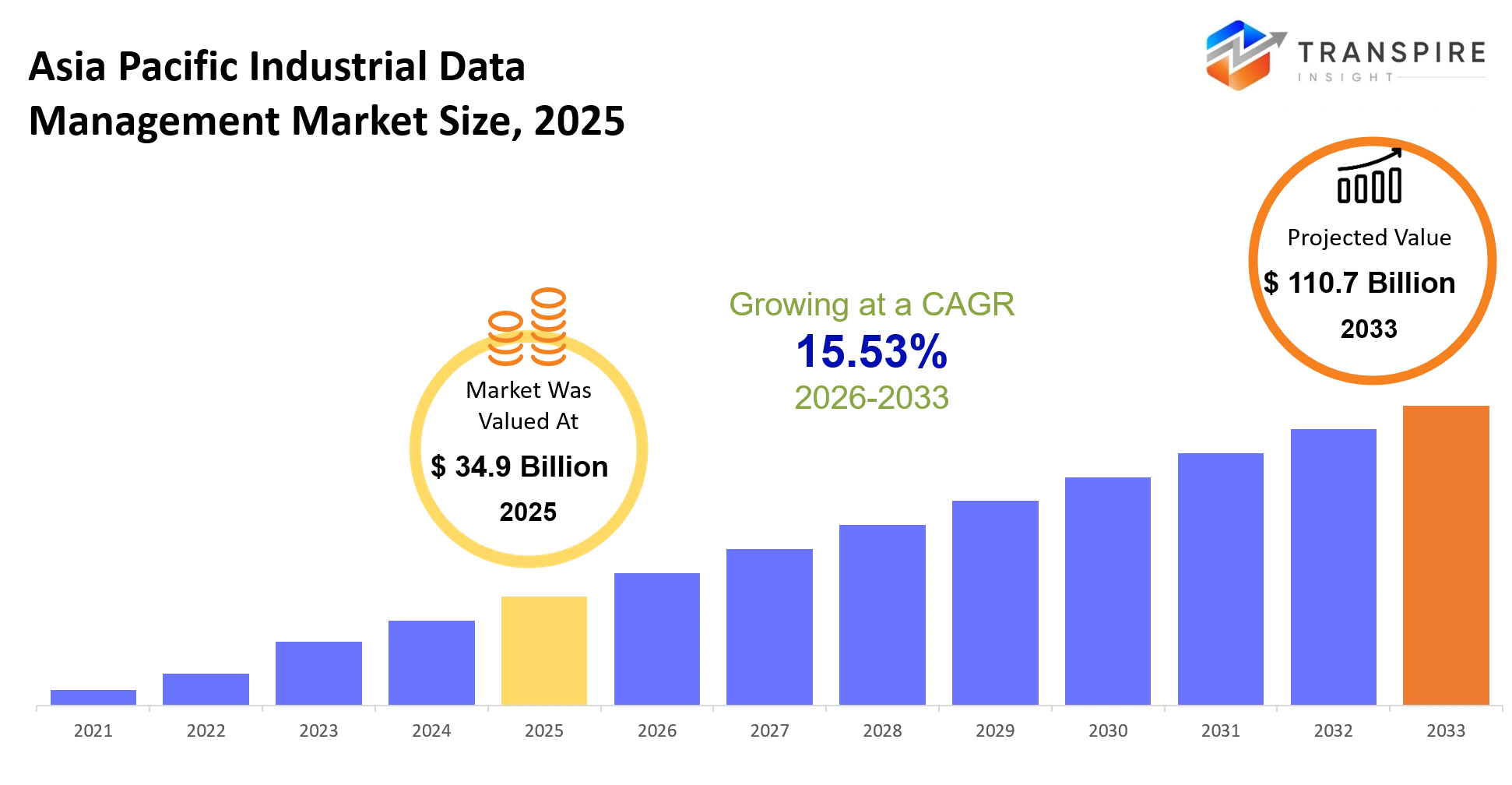
Asia Pacific Industrial Data Management Market Summary
The Asia Pacific Industrial Data Management Market was valued at USD 34.9 Billion in 2025. It is forecast to reach USD 110.7 Billion by 2033. That is a CAGR of 15.53% over the period.
Positioned at the nexus of manufacturing, energy, mining, and process industries, the Asia Pacific Industrial Data Management Market is essentially taking fragmented operational data and turning it into usable business insights. Businesses within these industrial segments can now collect information from machines and integrate it from sensors and production lines, providing engineers with live data regarding asset performance, maintenance schedules, and plant operations. The market has been evolving structurally over the last few years; the paradigm is changing from isolated on-premise databases to a cloud connected and edge enabled model which facilitates communication of data constantly across an organization's facilities. The COVID-19 pandemic accelerated the transformation towards these new models after it became clear that manually operated machines and separate supply chains were susceptible to numerous risks and firms had to transition toward remote monitoring and automated decision making solutions. With increasing connectivity in industrial assets, businesses can invest in an infrastructure to manage data in a scalable manner to support lower down time and improved performance which directly correlates to higher adoption rates and a strong trend of recurring service revenue.
Key Market Insights
- China accounts for nearly 38% of the region's market share in 2025 backed by its smart manufacturing investments & large-scale industrial automation programs.
- India is the fastest-growing country market thru 2032 backed by modernization of its factories, rollout of its Industrial IoT, and government-initiated digitalization efforts.
- Software platforms form more than 55% of the market size as manufacturers are building up their centralized data lakes, data analytics capabilities, and cloud-native industrial intelligence.
- Services, driven by consultancy, integration, migration, and managed data management services across various industrial ecosystems, stand as the second-largest market.
- Cloud based industrial data platforms will become the fastest-growing market thru 2032, driven by its scalability, cost of deployment, and real-time view to remote operations.
- Manufacturing contributes about 42% of application demand driven by connected factory projects and initiatives aimed at improving production optimization in real-time.
- Energy & Utilities represents the fastest-growing segment in terms of application as operators leverage predictive analytics & asset performance management technologies.
- Large enterprises dominateend-useradoption with almost 65% market share owing to their utilization of data analytics and enterprise-wide industrial data governance capabilities.
- Small & Medium Manufacturers will continue to be an emergent customer segment due to subscription-based software which requires lesser capital investment upfront.
- The Asia Pacific Industrial Data Management Market is growing strategically with key global technology players increasing their reach into the industrial digital ecosystem.
What are the Key Drivers, Restraints, and Opportunities in the Asia Pacific Industrial Data Management Market?
The major growth driver for the Asia Pacific Industrial Data Management Market is the movement towards connected, autonomous industrial facilities. Manufacturers are leveraging industrial IoT sensors, edge devices and cloud computing technologies to gain real-time data from their production assets. Post-pandemic, the inefficiency of disconnected information systems and manual monitoring practices spurred companies towards these investments. Companies are moving towards centralized industrial data management platforms as it increases asset utilization, reduces operational downtimes and enables faster decision-making. Digital factories and smart plants grow with software subscription and managed data service revenues propagating across the industrial ecosystem.
The key limitation in the market is the integration between legacy OT systems and digital infrastructures. Many industrial facilities are still running control systems of over two decades with their own protocol and isolated data bases. Integrating/updating these systems requires large CAPEX investment and long implementation lead time and expertise. The market faces a structural barrier of transforming old operational technologies into digital ones which reduces potential revenue opportunities especially to the SMEs and developing economies.
Significant market opportunity arises from industrial intelligence solutions driven by artificial intelligence (AI). Rapid investment in smart manufacturing within countries like India and Southeast Asian economies is expected to pave favorable market conditions for adoption of advanced analytics. Offering solutions that couple industrial data management with predictive AI, edge analytics and digital twins would further stimulate the next stage of market growth driven by quantifiable business benefits.
What Has the Impact of Artificial Intelligence Been on the Asia Pacific Industrial Data Management Market?
Artificial intelligence has transitioned the Asia Pacific Industrial Data Management Market from a data storing system into intelligent decision support services. Manufacturers now leverage AI algorithms to simplify data classification, monitor data anomaly detection and also help workflow administration at the factories, energy and mining facilities. Sensors can collect data, but the smart technology will continually run the analytics and make appropriate corrections at real-time to minimize human operation in the industry plants, energy and mining.
Machine learning can become a beneficial predictive maintenance system. By analyzing vibration level, temperature change and equipment history data, the AI system can discover device failure in advance. Manufacturers said that unplanned device downtime and maintenance costs have dropped and equipment uptimes and operational efficiency has increased due to machine learning implemented systems. Moreover, AI driven analytics can support energy consumption optimization, production scheduling as well as inventory management, thus enhancing company operational efficiency and profit margins.
Besides, modern technology such as edge computing and digital twin continue developing and it supports the industrial data management ecosystem to support immediate decision making from operational sites. However, there is one barrier hindering the adoption of artificial intelligence on industrial data management which is the incomplete legacy systems and inadequate data quality. These issues contribute to high model development costs, delay deployment, and limit some companies from enjoying the benefits of smart industrial operation.
Key Market Trends
- Since 2020 manufacturers have adopted a hybrid cloud infrastructure instead of on-premise systems enabling multi-site visibility and diminishing data silos.
- There was a sharp growth of industrial IoT adoption after COVID, as factories now generate millions of sensor data points a day and can make decisions in real-time.
- Buyers are now focused on industrial software delivered through a subscription model, so the focus has shifted from perpetual licenses to recurring revenue streams and cloud services.
- AI moves from pilot stages in 2021 to fully enterprise-wide solutions which allow operators to predict equipment failures and decrease unscheduled downtime by up to 30%.
- Edge computing came to mainstream in 2022 and allowed manufacturers to process relevant operational data locally with minimal latency and immediate reaction times.
- The increasing dominance of China through smart manufacturing initiatives along with the investment surge in India and Southeast Asia from 2023-2032 will create the highest growth areas in industrial digitization.
- Cybersecurity needs grew as there are more and more industrial devices connected, forcing companies to integrate zero-trust and advanced threat detection into the data platforms.
- The battle between global players such as Siemens, ABB, Schneider Electric and Honeywell now centers around AI capabilities, sector-specific solutions and local tech partnerships.
- Interoperable systems were favored by industrial companies instead of proprietary solutions pushing for vendors to adhere to open standards and easy integration with existing systems.
Asia Pacific Industrial Data Management Market Segmentation
By Component:
Software provides the foundation for industrial data management solutions and enables businesses to capture, store, and analyze operational data in significant volumes. Services help businesses integrate systems, maintain solutions and support, along with consulting, to ensure optimal performance and efficiency.
Data and Analytics tools help translate raw industrial data into insights enabling efficient planning and decision-making. A central platform provides a data source for an entire facility, integration tools facilitate communication between different applications and systems, while data governance, reporting and other tools help in sharing, compliance and transparency of industrial operations.
By Deployment:
Cloud deployments enable adaptability, remote access and reduce costs associated with IT infrastructure. On-Premise deployment is useful where organizations want a higher level of control and security.Hybrid deployments help companies enjoy the benefits of both, with a balance of on-premise security and cloud scalability.
Other models including edge computing which brings the processing capabilities closer to operational devices, along with private cloud, multi-cloud, data fabric and so on are gaining focus, as companies want a flexible and secure access for data mobility and integration of systems across facilities.
By Application:
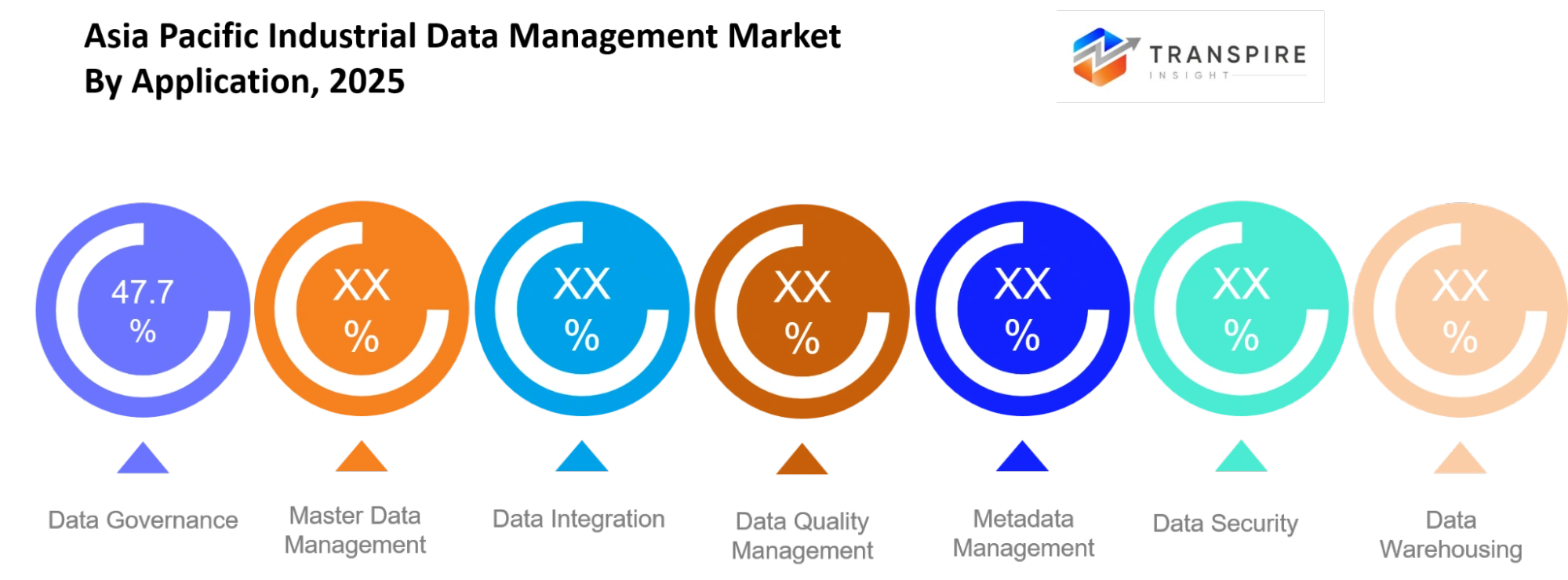
Ensures that there is uniformity in policy application to store and manage information, as well as maintain compliance requirements across the industrial context. Master data management brings a "single, consolidated view" of important business information. Data integration helps to provide unified access to information by integrating multiple sources.
Data quality management looks at the accuracy, and validity of the information. Metadata management is about categorizing data, while data security controls access to the information. Data Warehousing and other solutions provide long term storage, reporting and analysis capabilities.
By End User:
Manufacturing continues to be one of the major users as factories need immediate information to make operations smoother and reduce stoppages. Energy sector enterprises utilize industrial data systems to keep track of their assets, utilize their resources more efficiently and facilitate maintenance of these assets.
Healthcare sector enterprises utilize these solutions for the management of operational information to deliver better service. BFSI, retail, government, telecommunications etc continue to find applications of these systems as more and more enterprises adopt digital transformation and endeavor to gain better visibility, security and performance.
What are the Key Use Cases Driving the Asia Pacific Industrial Data Management Market?
Industry use for industrial data management in Asia Pacific is still mostly dominated by manufacturing. Huge volumes of machine, sensors and production data are generated each day at the factory floor, driving a high demand for the implementation of a central platform in order to provide better operational visibility to the industry players. Companies implement central platforms in order to increase visibility over machine operations, cut down equipment downtime and enhance production scheduling, all of which leads to better efficiency and lower operational cost.
The new emerging significant use areas are the industries of energy and healthcare. Power stations use the industrial data platforms in monitoring asset condition and maintenance, whereas healthcare practitioners use an integrated data platform to streamline operation workflows and ensure accuracy in data.
With digital twins and AI-driven industrial intelligence offering significant growth potential, these applications that simulate plant operation, predict equipment breakdown and make automated decision support will continue to transform industries into a more intelligent and robust one over the forecast period.
|
Report Metrics |
Details |
|
Market size value in 2025 |
USD 34.9 Billion |
|
Market size value in 2026 |
USD 40.3 Billion |
|
Revenue forecast in 2033 |
USD 110.7 Billion |
|
Growth rate |
CAGR of 15.53% from 2026 to 2033 |
|
Base year |
2025 |
|
Historical data |
2021 - 2024 |
|
Forecast period |
2026 - 2033 |
|
Report coverage |
Revenue forecast, competitive landscape, growth factors, and trends |
|
Regional scope |
Asia Pacific (India, China, Japan, Australia, South Korea, Rest of Asia Pacific) |
|
Key company profiled |
IBM, Oracle, SAP, Informatica, Microsoft, Talend, Cloudera, Snowflake, SAS, TIBCO, Qlik, Alteryx, Hitachi Vantara, Denodo, Teradata |
|
Customization scope |
Free report customization (country, regional & segment scope). Avail customized purchase options to meet your exact research needs. |
|
Report Segmentation |
By Component (Software, Services, Analytics Tools, Data Platforms, Integration Tools, Governance Tools, Reporting Tools, Others); By Deployment (Cloud, On-Premise, Hybrid, Edge Computing, Private Cloud, Multi-Cloud, Data Fabric Platforms, Others); By Application (Data Governance, Master Data Management, Data Integration, Data Quality Management, Metadata Management, Data Security, Data Warehousing, Others); By End User (Manufacturing, Energy, Healthcare, BFSI, Retail, Government, Telecommunications, Others) |
Which Regions are Driving the Asia Pacific Industrial Data Management Market Growth?
China is still the largest market in the APIDM market owing to robust industrial production, huge manufacturing capabilities and constant government support for digitalization. Smart manufacturing and industrial modernization initiatives have driven significant investment into smart factories and sophisticated analytics platforms by many businesses. Furthermore, established technology ecosystems, a growing cloud ecosystem and wide adoption of industrial IoT solutions are solidifying the country's market leadership. Ongoing cooperation among software vendors, manufacturers and industrial automation firms contributes to the continuous dominance of the country over the region's market.
While Japan is the second-largest regional market the market trend is not the same as China, i.e., instead of rapid industrial growth, the Japanese focus remains on precision and reliability of operations as well as technology investment on a long-term basis. Robotic process automation, relatively high production rates and a developed manufacturing ecosystem sustain steady expenditure on industrial data platforms. Such investment ensures constant revenue for vendors targeting long-term opportunities in the region.
As the fastest growing market, India has an accelerating trend for industrial digitalization and investment for manufacturing. Smart factory initiative driven by government, along with increasing cloud adoption and use of AI driven analytics, has completely revolutionized the investment scene of the country in the last couple of years and industrial enterprises have shown an aggressive approach to transform their existing processes and connecting legacy equipment with modern data platforms, which should ensure great business prospects for technology vendors and investors trying to penetrate the market in AP during the 2026-2033 period.
Who are the Key Players in the Asia Pacific Industrial Data Management Market and How Do They Compete?
Competition in the Asia Pacific Industrial Data Management Market is fairly concentrated with global tech vendors competing with regional players and cloud providers. The competitive factors primarily hinge on technology innovation and customers desire for platforms that integrate data integration, analytics, AI functions and cyber security within one environment. Established vendors are defending their market shares through a constant stream of product upgrades and innovative launches, whereas new players look to leverage industry-specific solutions and variable deployment options. Customers are increasingly moving beyond pure software vendors, looking for providers who deliver tangible operational efficiencies.
Siemens competes using industrial software and digital twins which link factory floor operations to enterprise systems. The company's unique selling point lies in the ability to integrate both automation hardware with data management and analytical capabilities in a unified platform for customers to run their operations. Schneider Electric is more inclined towards energy management and industrial automation solutions that enable organizations to achieve their operational efficiencies and sustainability targets while deepening its partner ecosystem across Asia Pacific.
ABB aims at building its presence in the industrial AI, robotics integration and asset performance management for improved customer productivity and operational reliability. Honeywell aims to offer real-time industrial intelligence, monitoring systems enabling customers with cloud-based performance management systems for various manufacturing processes. IBM also tries to expand its reach by using hybrid cloud strategies along with AI-driven analytics helping industrial organizations to modernize legacy infrastructure, to get more benefits from operational data.
Company List
- IBM
- Oracle
- SAP
- Informatica
- Microsoft
- Talend
- Cloudera
- Snowflake
- SAS
- TIBCO
- Qlik
- Alteryx
- Hitachi Vantara
- Denodo
- Teradata
Recent Development News
In June 2026, Schneider Electric entered a strategic partnership with Foxconn to develop and scale infrastructure for next-generation AI data centers. The collaboration combines Schneider Electric's power and energy management technologies with Foxconn's manufacturing and AI expertise, strengthening industrial data ecosystems and accelerating digital infrastructure deployment across Asia Pacific. Sourcehttps://www.reuters.com/
In April 2026, Schneider Electric launched more than 30 automation and digital solutions at Innovation Summit India 2026, including EcoStruxure Foresight and AI-enabled industrial technologies. The launch expanded advanced industrial data management capabilities for smart factories and data-driven operations, reinforcing the company's position in India's digital manufacturing ecosystem. Sourcehttps://www.industrialautomationindia.in/
What Strategic Insights Define the Future of the Asia Pacific Industrial Data Management Market?
In the Asia Pacific industrial data management market there is an obvious evolution towards an "intelligent", interconnected data layer where operational technology, cloud computing and artificial intelligence work as a combined layer throughout the industrial organization. This change is induced by demands for real time decision-making and fault tolerant operation for manufacturers who face production pressures, lack of labor force and increasingly sophisticated supply chains. Between 5-7 years from now, success on the market would be characterized by the ability of companies to use industrial data as the basis for automated and predictive decision-making actions, not for simple storage.
Less discussed is the risk of over-concentration. It is becoming increasingly evident that only a handful of cloud and industrial software providers will become market leaders. High dependency over proprietary architectures would reduce switching costs and lower the interoperability level, especially for small and medium manufacturers with legacy infrastructure.
The new opportunity consists in the industrial digital twin technology gaining ground in India and Southeast Asia, as new manufacturing investments provide a perfectly clean slate to develop new, greenfield platforms. Such companies seeking a share of the new market should focus on open architectures that are AI-enabled and easily integrate with existing industrial equipment for continued growth.
Asia Pacific Industrial Data Management Market Report Segmentation
By Component
- Software
- Services
- Analytics Tools
- Data Platforms
- Integration Tools
- Governance Tools
- Reporting Tools
By Deployment
- Cloud
- On-Premise
- Hybrid
- Edge Computing
- Private Cloud
- Multi-Cloud
- Data Fabric Platforms
By Application
- Data Governance
- Master Data Management
- Data Integration
- Data Quality Management
- Metadata Management
- Data Security
- Data Warehousing
By End User
- Manufacturing
- Energy
- Healthcare
- BFSI
- Retail
- Government
- Telecommunications
Frequently Asked Questions
Find quick answers to common questions.
The Asia Pacific Industrial Data Management Market size is USD 110.7 Billion in 2033.
Key segments for the Asia Pacific Industrial Data Management Market are By Component (Software, Services, Analytics Tools, Data Platforms, Integration Tools, Governance Tools, Reporting Tools, Others); By Deployment (Cloud, On-Premise, Hybrid, Edge Computing, Private Cloud, Multi-Cloud, Data Fabric Platforms, Others); By Application (Data Governance, Master Data Management, Data Integration, Data Quality Management, Metadata Management, Data Security, Data Warehousing, Others); By End User (Manufacturing, Energy, Healthcare, BFSI, Retail, Government, Telecommunications, Others).
Major Asia Pacific Industrial Data Management Market players are IBM, Oracle, SAP, Informatica, Microsoft, Talend, Cloudera, Snowflake, SAS, TIBCO, Qlik, Alteryx, Hitachi Vantara, Denodo, Teradata.
The Asia Pacific Industrial Data Management Market size is USD 34.9 Billion in 2025.
The Asia Pacific Industrial Data Management Market CAGR is 15.53% from 2026 to 2033.
- IBM
- Oracle
- SAP
- Informatica
- Microsoft
- Talend
- Cloudera
- Snowflake
- SAS
- TIBCO
- Qlik
- Alteryx
- Hitachi Vantara
- Denodo
- Teradata
About the Authors

Mayur Shinde
I am Mayur Shinde, a Senior Research Analyst at Transpire Insight, specializing in the Automotive & Transportation and Information & Communication Technology (ICT) Industry. My work focuses on analyzing emerging market trends, technological advancements, competitive landscapes, and industry developments to deliver accurate, data-driven insights. I am passionate about transforming complex market information into clear, actionable content that helps businesses, professionals, and decision-makers stay informed and make confident strategic decisions.

Chakradhar Khansole
Chakradhar serves as the Research Director at Transpire Insight, bringing over 8 years of experience in technology, innovation, and strategic market intelligence. He specializes in transforming complex market data into actionable business insights that enable organizations to make informed, growth-oriented decisions. Recognized for his strategic vision and analytical expertise, Chakradhar leads high-impact research initiatives, delivering comprehensive market assessments, competitive intelligence, and forward-looking industry analysis.
Recently Published Reports
-
Apr 2026
3D Optical Profiler Market
3D Optical Profiler Market Size, Share & Analysis Report By Type (Desktop 3D Optical Profiler, and Portable 3D Optical Profiler), By Technology (Confocal Technology, and White Light Interference), By End-Use Industry (Manufacturing, Research Institutions, Automotive, Aerospace and Defense, Medical Devices, and Other), and Geography (North America, Europe, Asia-Pacific, Middle East and Africa, South and Central America), 2021 - 2031
-
Apr 2026
Depth Sensor Market
Depth Sensor Market Size, Share & Analysis Report By Type (Infrared Depth Sensors, Time-of-Flight (ToF) Sensors, Stereo Vision Sensors, Structured Light Sensors, Ultrasonic Depth Sensors), By Application (Automotive, Robotics, Gaming, Consumer Electronics, Industrial Automation, Healthcare, Security & Surveillance, Others), By End Users (Automotive Manufacturers, Consumer Electronics Companies, Healthcare Providers, Industrial Companies, Security Agencies, Gaming Companies, Robotics Companies, Others), and Geography (North America, Europe, Asia-Pacific, Middle East and Africa, South and Central America), 2021 – 2031
-
Apr 2026
Digital Manufacturing Market
Digital Manufacturing Market Size, Share & Analysis Report By Component (Hardware, Software, and Services), By Technology (Robotics, 3D Printing, Internet of Things (IoT), and Others), By Application (Automotive and Transportation, Aerospace and Defense, Consumer Electronics, Industrial Machinery, and Others), By Process Type (Computer-Based Designing, Computer-Based Simulation, Computer 3D Visualization, Analytics, and Others), and Geography (North America, Europe, Asia-Pacific, Middle East and Africa, South and Central America), 2021 – 2031
-
Apr 2026
Digital Visa Services Market
Digital Visa Services Market Size, Share & Analysis Report By Type (Individual Travelers, Group Travelers), By Application (Tourism, Business Travel, Others), and Geography (North America, Europe, Asia-Pacific, Middle East and Africa, South and Central America), 2021 – 2031