

Asia Pacific Enterprise Data Management Market Size & Forecast:
- Asia Pacific Enterprise Data Management Market Size 2025: USD 40.11 Billion
- Asia Pacific Enterprise Data Management Market Size 2033: USD 117.4 Billion
- Asia Pacific Enterprise Data Management Market CAGR: 14.30%
- Asia Pacific Enterprise Data Management Market Segments: By Component (Software, Services, Consulting, Integration, Data Governance Tools, Master Data Management, Metadata Management, Others); By Deployment (Cloud, On-Premise, Hybrid, Others); By Enterprise Size (Large Enterprises, SMEs, Others); By End User (BFSI, Healthcare, Retail, Manufacturing, IT & Telecom, Government, Others)

Asia Pacific Enterprise Data Management Market Summary
The Asia Pacific Enterprise Data Management Market was valued at USD 40.11 Billion in 2025. It is forecast to reach USD 117.4 Billion by 2033. That is a CAGR of 14.30% over the period.
Enterprise data management systems in the Asia Pacific region form a crucial data infrastructure enabling organizations to reconcile their operational, supply chain, asset, and compliance data within a centrally controlled environment enabling decision-making real-time in maritime logistics, manufacturing, and energy sectors. On an everyday level, such systems break down the fragmentation between older databases and new digital applications to track shipments, performance of equipment and regulatory compliance in a faster way. Over the last five years the market has moved fundamentally from rigid, on-premise data warehouses to agile, cloud-native and AI-capable systems in data fabric topology. This shift has been further amplified by pandemic induced supply chain interruptions and geopolitical dynamics influencing the trade routes in Indo-Pacific, leading to awareness about the expense involved in deferred or isolated information processing. Consequently, companies are willing to invest in fully integrated data systems in order to increase robustness, better respond to strict data sovereignty regulations and enhance quick operation of distributed networks.
Key Market Insights
- Enterprise data management across Asia Pacific is increasingly moving toward a unified cloud-native enterprise and industrial data fabric and lakehouse solutions due to efficiency and integration of disparate datasets.
- More than 60 percent of major APAC enterprises plan to focus on hybrid cloud data management solutions, improving real-time analytics, and increasing visibility of operations in cross-border activities.
- Japan and China account for around 45-50 percent combined revenue share across the Asia Pacific Enterprise Data Management Market as a result of higher digital transformation in both countries.
- India is expected to be the fastest-growing region in Asia Pacific Enterprise Data Management Market between 2024 and 2030 due to its rapid digitization efforts across enterprises and increasing adoption of SaaS solutions.
- Data integration and data governance is expected to hold a significant market share due to increasing need for cybersecurity and compliances among organizations.
- Data quality management: quickest growing domain as enterprises are focused towards enhancement in decision accuracy and reliability of operations.
- Banking and financial services: Leading application area with > 30% share as they have significant reporting needs and also need to develop sophisticated fraud detection mechanisms.
- Manufacturing and logistics: Fastest growing applications due to growth of smart factories and digitalization of supply chains.
- Large enterprises: Dominant end-user domain with > 65% share as they have the need for management of data across multi-systems.
- Mid-sized enterprises: Fastest growing domain as cloud based platforms allow low entry cost and scalability.
What are the Key Drivers, Restraints, and Opportunities in the Asia Pacific Enterprise Data Management Market?
The Asia Pacific Enterprise Data Management Market is primarily driven by widespread enterprise cloud migration alongside increasingly rigorous data governance requirements, pushing enterprises to adopt integrated, centrally managed data systems and creating consistent recurring revenue streams for cloud and enterprise software providers while prompting accelerated modernization. Governments across the region, including China, India and Southeast Asia, are implementing data localization and compliance regulations, driving adoption of integrated data platforms which further stimulates cloud adoption and legacy system modernization efforts for a range of organizations.
The Asia Pacific Enterprise Data Management Market is largely hindered by ongoing infrastructure integration complexity stemming from extensive legacy systems, including siloed on-premises databases managed by many enterprises over many years, increasing operational complexity and making integration expensive to implement-effectively postponing wide-scale integration until all on-premises data has been consolidated. Many enterprises struggle with slow progress and high operational costs due to infrastructure integration, impacting their ability to efficiently transform digitally. Many large companies in manufacturing and the public sector continue to rely on a fragmented combination of legacy on-premises systems rather than fully modern data platforms to support their operations.
An increasing number of businesses across the region are investing in AI-based data governance and real-time analytics solutions, as particularly seen in the cases of India and Southeast Asia, providing a substantial opportunity for organizations developing AI data fabric and smart data governance solutions to offer automated data management. Banks and logistics companies, among others, have begun leveraging the integrated cloud data ecosystem provided by such solutions in order to improve anti-fraud measures and increase transparency in supply chains to identify further ways to derive value from their data and monetization opportunities.
What Has the Impact of Artificial Intelligence Been on the Asia Pacific Enterprise Data Management Market?
The nature of data across Asia Pacific enterprises is transforming with artificial intelligence powering the automation of classification, governance and operational improvement of data across complicated industrial and commercial networks. For instance, with AI-powered data platforms, the maritime logistics and manufacturing industries can monitor asset performance, control cargo movement, and monitor the fulfillment of regulations in real-time, decreasing manual effort and operational downtime.
These models are improving enterprise data within organizations by predicting failures in equipment, anticipating demand of the supply chain, and tracking emissions within industrial operations. By providing real-time prediction, these tools contribute to reducing organizational downtime in digitally advanced deployments by up to 20-30 percent, increasing speed in operations, and making operations more efficient.
In a broad operational scope, these systems increase data quality and facilitate the compliance reporting, a factor of high importance in the banking and shipping industries where automatic reconciliation improves reporting time and reduces errors. Despite the increasing use of these systems, their application is largely hindered by high integration costs and the variability in the quality of the data derived from old systems which limit wider AI application. The poor network connection on the sea continues to restrict real-time data processing in a maritime context, limiting the full implementation of AI enterprise data management systems.
Key Market Trends
- 2021-2026 enterprises' infrastructure shifted from siloed on-premise databases toward cloud-first environments, bringing tremendous acceleration in cross-border data accessibility and operations.
- Data localization enforcement in China and India after 2022 caused organizations to deploy hybridized on-premise clouds rather than globally central ones.
- AI-enabled data governance tools proliferated across the APAC enterprise sector by 2025. Automating data classification eliminated laborious manual data cleaning processes.
- Supply chain breakdowns between 2020 and 2023 enhanced investments into the deployment of real-time enterprise data platforms for the logistics tracking and predictive demands across the APAC region.
- 2022-2026, financial services firms adopted the integration of real-time analytics. Fraud detection time-frames and compliance report accuracy both decreased.
- 2023 onwards, manufacturing businesses in South Korea and Japan migrated to data fabrics to integrate OT and IT data.
- Cloud providers like Microsoft and Amazon Web Services established more regional data centers to comply with requirements regarding data sovereignty and low latency.
- The vendor competition and trends moved past traditional storage after 2022 toward embedding of AI in enterprise data platforms with IBM and Oracle leading the trend.
- The increasing adoption of subscription-based data management solutions is evidenced across mid-size enterprises post-2023 owing to decreased cloud onboard costs and ability to scale on demand.
- 2024 onward, security features were integrated into enterprise data platforms, with stricter regulatory requirements over reporting and audit trails across the APAC industries.
Asia Pacific Enterprise Data Management Market Segmentation
By Component:
This sector mainly covers software, services, consulting, integration, data governance tools, master data management, metadata management and other applications in this space. The software tool assists in classifying enterprise information whereas the service and consulting assist in the implementation, migration, maintenance of data governance and other solutions across different industry domains. These factors together streamline the data flow among the systems in order to achieve consistency.
The trend of the demand for basic storage tools is shifting towards advanced governance and metadata solutions. Companies now demand a high level of control and quality on the information instead of only storing the data. The demand on the integration services has increased from the end user to migrate the legacy systems towards the linked up and modern day IT framework throughout industries in Asia pacific.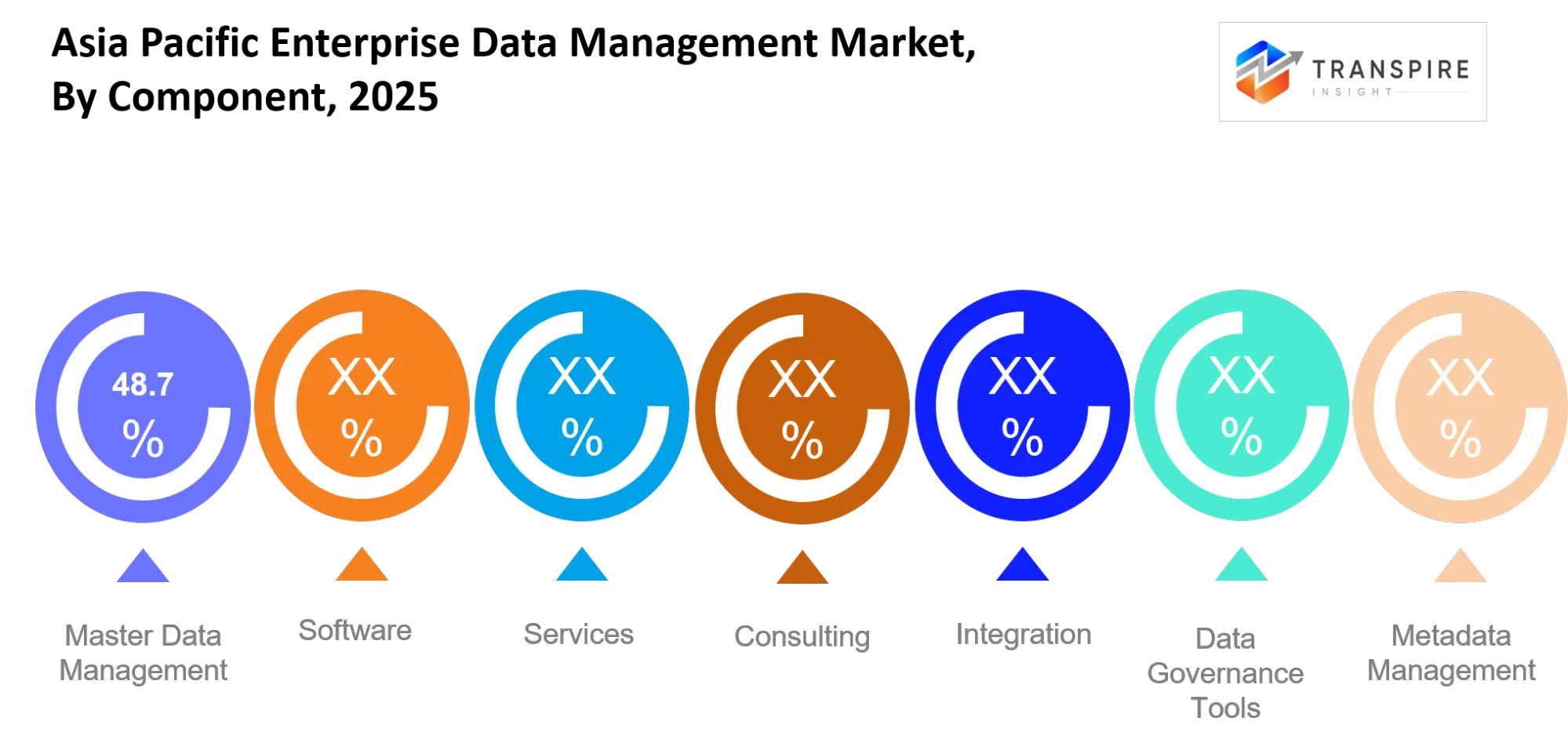
By Deployment:
The deployment models consist of cloud, on-premise, hybrid and others which enterprises employ to govern the data operations. Enterprises largely use cloud deployment owing to scalability and efficient access to the information. Enterprises are still using the on-premise framework to uphold strict controls and governance as a result of data sensitive industries.
Enterprises' tendency to move from the on-premise systems to hybrid and cloud based framework is highly observed. Enterprises combine the existing legacy system on premise and connect it with the cloud based platforms so that they have control as well as flexibility. The movement to the cloud framework is fueled by the rapid increase in remote working and digitalization adoption leading to high data mobility across various business locations and immediate need for data accessibility across various locations.
By Enterprise Size:
The major users in this space are Large Enterprises and Small and Medium Enterprises. Large Enterprises make use of comprehensive data systems to manage large volumes of operational, financial, and customer information across geographies. Small and Medium Enterprises use simpler platforms to enhance performance and minimize manual data manipulation.
The penetration in SMEs has risen over the period due to reduction in cloud prices and subscription based models while large enterprises continue migrating from legacy systems to advanced platforms which help to support automation and real-time analytics due to increasing stress for all the entities to make rapid and efficient decisions.
By End User:
The End Users are BFSI, Healthcare, Retail, Manufacturing, IT and Telecom, Government and so forth. The BFSI sector leverages the data systems for compliance, fraud prevention, and reporting. While healthcare leverages the structured data to record patient records, the manufacturing and retail sectors focus on managing operational processes and customer intelligence.
The usage patterns have transformed over the past with manufacturing and IT sectors enhancing adoption in the wake of digitally driven programs. The government sector is also strengthening the data systems due to the increasing need to be transparent and also for service delivery. BFSI is one of the large users but the growth is higher among the sectors which require real-time operations control.
What are the Key Use Cases Driving the Asia Pacific Enterprise Data Management Market?
The most prominent drivers for Core demand in the Asia Pacific Enterprise Data Management Market stem from the regulatory reporting and unified data governance across BFSI and large enterprises. Both financial institutions and regulated organizations need access to a single repository of transaction data for a streamlined process of dealing with transactions and mitigating compliance risk. It is the highest adoption for this use case because it impacts regulatory approval, transparent operations, and financial risk management across several regions.
The broadening use cases will include manufacturing and retail where these enterprises employ enterprise data platforms to create supply chain visibility and obtain an understanding of customer behavior. IT and telecommunication service providers are implementing these systems to handle massive network data to ensure service reliability. These sectors are also keenly interested in realizing the benefits of a faster and precise decision-making capability with real-time analytics.
In addition to existing use cases, new ones that are gaining adoption will include predictive maintenance of industrial equipment and combined ESG reporting across both the manufacturing and government sectors where organizations can tie together the operational data with sustainability reporting, so that they can meet a higher level of disclosure requirements and it will include smart city applications, where these data platforms would enable real-time monitoring of traffic, utility and infrastructure data.
|
Report Metrics |
Details |
|
Market size value in 2025 |
USD 40.11 Billion |
|
Market size value in 2026 |
USD 46.05 Billion |
|
Revenue forecast in 2033 |
USD 117.4 Billion |
|
Growth rate |
CAGR of 14.30% from 2026 to 2033 |
|
Base year |
2025 |
|
Historical data |
2021 - 2024 |
|
Forecast period |
2026 - 2033 |
|
Report coverage |
Revenue forecast, competitive landscape, growth factors, and trends |
|
Regional scope |
Asia Pacific (India, China, Japan, Australia, South Korea, Rest of Asia Pacific) |
|
Key company profiled |
Informatica, IBM, Oracle, SAP, Microsoft, SAS, Teradata, TIBCO, Ataccama, Semarchy, Precisely, Talend, Cloudera, Databricks, AWS |
|
Customization scope |
Free report customization (country, regional & segment scope). Avail customized purchase options to meet your exact research needs. |
|
Report Segmentation |
By Component (Software, Services, Consulting, Integration, Data Governance Tools, Master Data Management, Metadata Management, Others); By Deployment (Cloud, On-Premise, Hybrid, Others); By Enterprise Size (Large Enterprises, SMEs, Others); By End User (BFSI, Healthcare, Retail, Manufacturing, IT & Telecom, Government, Others) |
Which Regions are Driving the Asia Pacific Enterprise Data Management Market Growth?
China holds the #1 position in Asia Pacific Enterprise Data Management Market because of rapid state-driven digital infrastructure development and rigid data governance policies. High rate of implementation in finance, manufacturing, public administration areas leads to sustained demand for consolidated data platforms. Government regulations for data security and cross-border data flow force enterprises to invest in localized, compliant systems. Sophisticated cloud ecosystem and substantial investment on AI driven analytics ensure it leads this market.
Japan presents the second position as a stable, matured market in Asia Pacific Enterprise Data Management Market, driven by continued enterprise modernizations instead of the drastic changes in policies. Enterprises across the automotive, electronics and banking industry focus on long-term data stability and precision operations. The system reliability, security of the system and seamless integration with existing old infrastructure play a critical role in investment decisions. These upgrades create a continuous demand for better data management systems without much volatility.
The fastest growth is captured by the India in Asia Pacific Enterprise Data Management Market because of the fastest enterprise and government-driven digital transformation. This fast growth in cloud infrastructure and new regulation on data localization pushed the enterprises from the old traditional management system to the unified system and platform. Enterprise application and usage of big data is increasing exponentially driven by IT service, fintech, and e-commerce businesses and so on. This sustained adoption rate in the sector is pushing new players in adopting new techniques in cloud-native systems and driving new opportunities through 2026-2033.
Who are the Key Players in the Asia Pacific Enterprise Data Management Market and How Do They Compete?
The Asia Pacific Enterprise Data Management market has a moderately consolidated competitive landscape with technology giants focusing on core infrastructure and regional players offering tailored services. Competition is centered on cloud-scale capabilities, ability to leverage AI and compliance across diverse regulatory regions. The traditional vendors protect their market share through deeper ecosystem lock-in through unified platforms and long-term enterprise deals while the new-entrant, cloud-native solutions pose threat to their position through price-competitiveness and modern subscription-based deployment models.
Microsoft competes on its broad cloud-wide integration and availability of an analytics and productivity portfolio, making adoption easier for enterprises. AWS competes by offering its infrastructure and its wide geographical availability zones in the Asia Pacific region, thus ensuring low latency and compliance capabilities. IBM leads with enterprise-focused governance capabilities and the hybrid cloud strategy applicable to regulated industries. Oracle competes based on its specialized databases and its capability of performance at scale in transaction environments. Snowflake continues to be the fast-growing entrant, on its fully cloud-native, separates compute from storage, data platform to meet the enterprises scaling requirements.
Company List
- Informatica
- IBM
- Oracle
- SAP
- Microsoft
- SAS
- Teradata
- TIBCO
- Ataccama
- Semarchy
- Precisely
- Talend
- Cloudera
- Databricks
- AWS
Recent Development News
In May 2026, Snowflake expanded its strategic partnership with Amazon Web Services through a $6 billion, five-year infrastructure agreement. The deal enhances integration of AI workloads and cloud data services, supporting enterprise migration from legacy systems to AI-driven analytics platforms. Sourcehttps://www.reuters.com/
In April 2026, Oracle reported layoffs of nearly 12,000 employees in India as part of a broader restructuring of its cloud and enterprise software operations. The move reflects cost optimization and a shift toward AI-enabled cloud infrastructure and automation-focused service delivery.
Source https://www.reuters.com/
What Strategic Insights Define the Future of the Asia Pacific Enterprise Data Management Market?
The Asia Pacific Enterprise Data Management market is shifting towards automated, AI-driven data ecosystems in its structural composition, whereby governance, integration and analytics would work in one stream. This trend is influenced by rapid cloud migration, increasingly tight regulations for cross-border data flow, and enterprises' need to convert distributed transactional information into real time decision making insight, applicable to all verticals. It's expected that demand in the next 5-7 years will be focused more on platforms where data fabric is tightly integrated with embedded AI governance instead of separated tools focused solely on storage or integration.
A latent risk is increasing vendor concentration, which means only a limited set of hyperscale cloud service providers might control bulk of enterprise data, leading to heavy reliance and reducing bargaining power of enterprises. One emerging trend and opportunity is the creation of sovereign AI data platforms within Southeast Asia-governments are progressively mandating locally relevant intelligence solutions for financial sectors and public administration, to be increasingly embedded in AI technologies.
Participants in the market would need to make investments in interoperable, compliance-ready architectural frameworks to support multi-cloud operation, whilst retaining the flexibility for low-latency, geographically appropriate deployment.
Asia Pacific Enterprise Data Management Market Report Segmentation
By Component
- Software
- Services
- Consulting
- Integration
- Data Governance Tools
- Master Data Management
- Metadata Management
By Deployment
- Cloud
- On-Premise
- Hybrid
By Enterprise Size
- Large Enterprises
- SMEs
By End User
- BFSI
- Healthcare
- Retail
- Manufacturing
- IT & Telecom
- Government
Frequently Asked Questions
Find quick answers to common questions.
The Asia Pacific Enterprise Data Management Market size is USD 117.4 Billion in 2033.
Key Segments for the Asia Pacific Enterprise Data Management Market are By Component (Software, Services, Consulting, Integration, Data Governance Tools, Master Data Management, Metadata Management, Others); By Deployment (Cloud, On-Premise, Hybrid, Others); By Enterprise Size (Large Enterprises, SMEs, Others); By End User (BFSI, Healthcare, Retail, Manufacturing, IT & Telecom, Government, Others).
Major Asia Pacific Enterprise Data Management Market Players are Informatica, IBM, Oracle, SAP, Microsoft, SAS, Teradata, TIBCO, Ataccama, Semarchy, Precisely, Talend, Cloudera, Databricks, AWS.
The Current Asia Pacific Enterprise Data Management Market size is USD 40.11 Billion in 2025.
The Asia Pacific Enterprise Data Management Market CAGR is 14.30% from 2026 to 2033.
- Informatica
- IBM
- Oracle
- SAP
- Microsoft
- SAS
- Teradata
- TIBCO
- Ataccama
- Semarchy
- Precisely
- Talend
- Cloudera
- Databricks
- AWS
About the Authors

Mayur Shinde
I am Mayur Shinde, a Senior Research Analyst at Transpire Insight, specializing in the Automotive & Transportation and Information & Communication Technology (ICT) Industry. My work focuses on analyzing emerging market trends, technological advancements, competitive landscapes, and industry developments to deliver accurate, data-driven insights. I am passionate about transforming complex market information into clear, actionable content that helps businesses, professionals, and decision-makers stay informed and make confident strategic decisions.

Chakradhar Khansole
Chakradhar serves as the Research Director at Transpire Insight, bringing over 8 years of experience in technology, innovation, and strategic market intelligence. He specializes in transforming complex market data into actionable business insights that enable organizations to make informed, growth-oriented decisions. Recognized for his strategic vision and analytical expertise, Chakradhar leads high-impact research initiatives, delivering comprehensive market assessments, competitive intelligence, and forward-looking industry analysis.
Recently Published Reports
-
Apr 2026
3D Optical Profiler Market
3D Optical Profiler Market Size, Share & Analysis Report By Type (Desktop 3D Optical Profiler, and Portable 3D Optical Profiler), By Technology (Confocal Technology, and White Light Interference), By End-Use Industry (Manufacturing, Research Institutions, Automotive, Aerospace and Defense, Medical Devices, and Other), and Geography (North America, Europe, Asia-Pacific, Middle East and Africa, South and Central America), 2021 - 2031
-
Apr 2026
Depth Sensor Market
Depth Sensor Market Size, Share & Analysis Report By Type (Infrared Depth Sensors, Time-of-Flight (ToF) Sensors, Stereo Vision Sensors, Structured Light Sensors, Ultrasonic Depth Sensors), By Application (Automotive, Robotics, Gaming, Consumer Electronics, Industrial Automation, Healthcare, Security & Surveillance, Others), By End Users (Automotive Manufacturers, Consumer Electronics Companies, Healthcare Providers, Industrial Companies, Security Agencies, Gaming Companies, Robotics Companies, Others), and Geography (North America, Europe, Asia-Pacific, Middle East and Africa, South and Central America), 2021 – 2031
-
Apr 2026
Digital Manufacturing Market
Digital Manufacturing Market Size, Share & Analysis Report By Component (Hardware, Software, and Services), By Technology (Robotics, 3D Printing, Internet of Things (IoT), and Others), By Application (Automotive and Transportation, Aerospace and Defense, Consumer Electronics, Industrial Machinery, and Others), By Process Type (Computer-Based Designing, Computer-Based Simulation, Computer 3D Visualization, Analytics, and Others), and Geography (North America, Europe, Asia-Pacific, Middle East and Africa, South and Central America), 2021 – 2031
-
Apr 2026
Digital Visa Services Market
Digital Visa Services Market Size, Share & Analysis Report By Type (Individual Travelers, Group Travelers), By Application (Tourism, Business Travel, Others), and Geography (North America, Europe, Asia-Pacific, Middle East and Africa, South and Central America), 2021 – 2031