
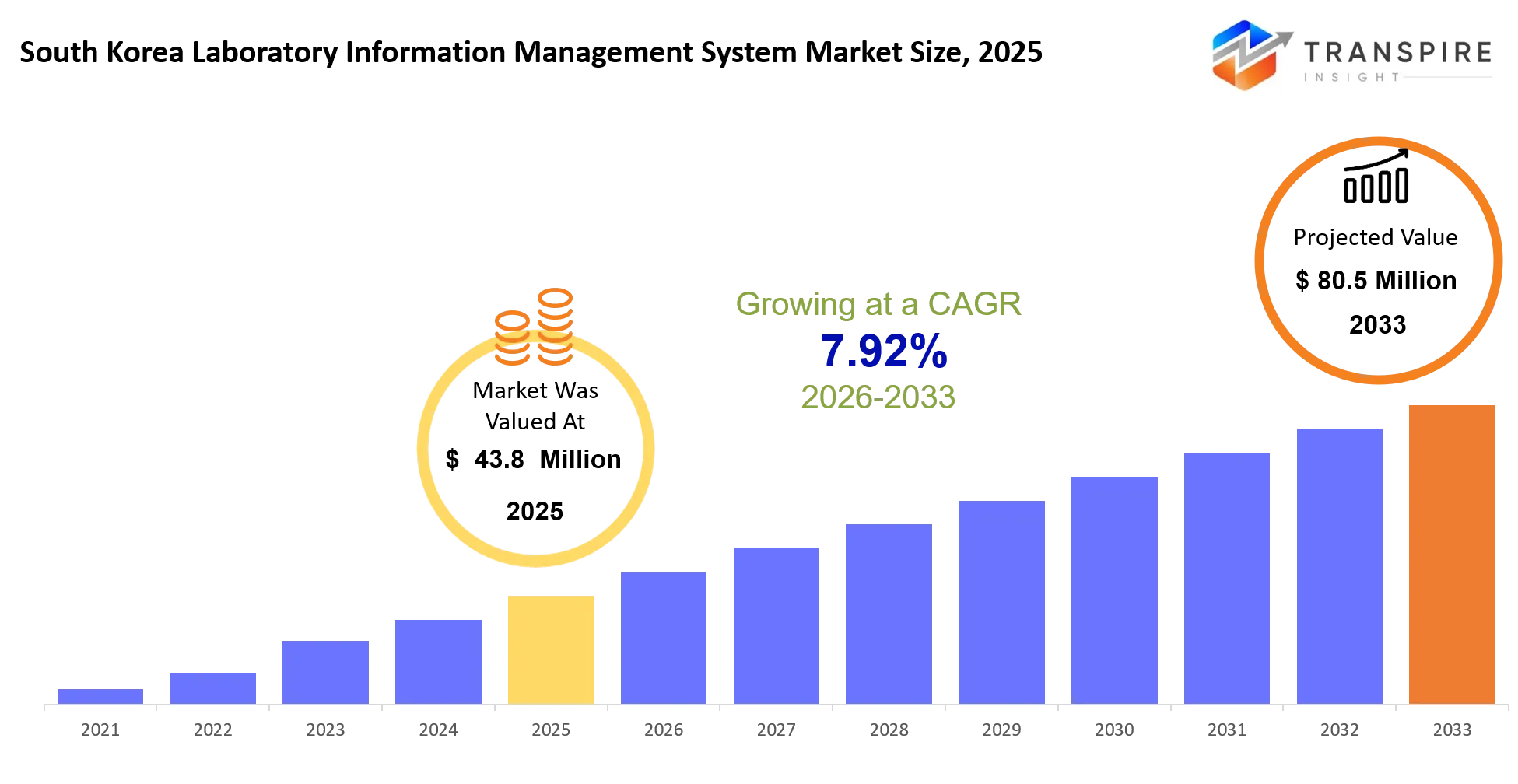
South Korea Laboratory Information Management System Market Size & Forecast:
- South Korea Laboratory Information Management System Market Size 2025: USD 43.8 Million
- South Korea Laboratory Information Management System Market Size 2033: USD 80.5 Million
- South Korea Laboratory Information Management System Market CAGR: 7.92%
- South Korea Laboratory Information Management System Market Segments: By Deployment (Cloud-based LIMS, On-premise LIMS, Hybrid LIMS, Others); By Component (Software Solutions, Services, Data Management Tools, Others); By Application (Sample Management, Workflow Automation, Quality Control, Compliance Management, Others); By End User (Pharmaceutical Laboratories, Research Institutes, Food Testing Laboratories, Hospitals, Others); By Industry (Healthcare, Biotechnology, Food & Beverage, Environmental Testing, Others)
To learn more about this report,  Download Free Sample Report
South Korea Laboratory Information Management System Market Summary
The South Korea Laboratory Information Management System Market was valued at USD 43.8 Million in 2025. It is forecast to reach USD 80.5 Million by 2033. That is a CAGR of 7.92% over the period.
In South Korea, Laboratory Information Management Systems are being used to kind of streamline how laboratories manage samples, test workflows, regulatory papers, and data traceability across pharmaceutical, biotech, food safety and also industrial quality control settings. In practice these platforms replace scattered manual recordkeeping with more integrated digital routines , so approvals tend to come faster, there are fewer mistakes and overall compliance stays stronger during the strict regulatory audits common in healthcare and manufacturing sectors.
Over roughly the last 3–5 years, the market shifted from on-premise deployments to cloud enabled and hybrid LIMS platforms, as labs start prioritizing real time data access and remote teamwork. One major structural change is that LIMS are now often integrated with enterprise data ecosystems such as ERP and quality management systems, which helps enable end to end digital traceability. Growth was strongly influenced by tougher pharmaceutical compliance duties and increased quality scrutiny across global supply chains after pandemic era disruptions revealed weaknesses in lab data transparency. That overall pressure pushed laboratories to modernize their infrastructure, which in turn increased adoption especially among mid sized and large enterprises.
Key Market Insights
- The South Korea Laboratory Information Management System market is getting more and more dominated by cloud based deployment models, kind of pushing out legacy on-premise systems, bit by bit.
- Pharmaceutical QC labs make up around 35% of the total demand in 2025, this is mostly due to GMP compliance and the constant need for audit readiness, which never really slows down.
- In the biotechnology space, the application segment is the quickest moving part, it’s backed by higher R and D spending, plus the wider roll out of precision medicine.
- Food safety testing laboratories take a big portion too, largely because stricter national traceability requirements and contamination monitoring rules are getting tougher.
- Meanwhile, hospital and clinical diagnostic labs sit at nearly 28% share, driven by automation of patient sample workflows, and faster reporting in general.
- In terms of geography, the market shows a strong regional grouping around Seoul and also the Gyeonggi Province industrial clusters.
- Cloud based LIMS solutions are the fastest-growing slice of the market, they are expected to expand adoption by more than 40% across the forecast adoption period.
- Key players in this area include Thermo Fisher Scientific, LabWare, LabVantage Solutions, Siemens Healthineers, and Dassault Systèmes BIOVIA.
- Many firms are moving forward via SaaS based LIMS platforms so they can cut deployment expenses while also improving scalability, especially for mid-sized laboratories.
- Integration with AI driven analytics together with automation tools is becoming a major competitive differentiator in the South Korea Laboratory Information Management System Market, pretty clearly now.
- And strategic partnerships with pharmaceutical manufacturers are speeding up localized tweaking of LIMS workflows as well as compliance modules.
What are the Key Drivers, Restraints, and Opportunities in the South Korea Laboratory Information Management System Market?
The main driver behind the South Korea Laboratory Information Management System Market is the fast push toward digitization across regulated lab settings, especially in areas like pharmaceuticals, biotechnology, and food safety . In these spaces, strict compliance frameworks—think GMP alongside ISO requirements—have made traceable, audit-ready digital records feel non negotiable. so labs are gradually swapping out manual, fragmented arrangements for more centralized LIMS platforms, which, in practice, cut down documentation mistakes and also make inspection preparation way smoother. Because of that shift, vendors often report more enterprise wide rollouts and recurring SaaS income, mostly tied to workflow automation and reliable data integration.
A notable restraint comes from the integration headache, mostly linked to older laboratory infrastructure. A lot of mid sized labs still run a mix of systems, where instruments, databases, and reporting tools don’t follow the same standard. That mismatch drives longer implementation timelines and bumps up total cost of ownership, especially during transitions toward cloud based LIMS platforms. The “root” of this obstacle is kind of structural: long equipment lifecycles plus strict validation expectations that slow down any quick replacement cycle.
Meanwhile, there’s an opportunity forming around AI enabled lab automation. Predictive analytics and smarter workflow tuning are increasingly getting embedded directly into LIMS environments. In South Korea, the expanding biotech startup scene, plus government backed smart healthcare efforts, are giving the market a steadier tailwind for next generation digital labs. Vendors that pair LIMS with AI driven decision support, may end up unlocking the next step of market growth—kinda the next phase, after today’s deployment push.
What Has the Impact of Artificial Intelligence Been on the South Korea Laboratory Information Management System Market?
Artificial intelligence is quietly, but pretty meaningfully, transforming the South Korea Laboratory Information Management System Market by changing how labs handle experimental data, how they route tasks, and how they keep regulatory compliance in place. AI-powered LIMS platforms are being adopted more and more to automate sample classification, catch errors in test outcomes, and handle workflow routing across pharmaceutical and biotech operations. In practice it cuts down manual touch points, and usually the turnaround time gets shorter for those urgent testing operations, especially when it’s high-volume diagnostics and active research.
At the same time, machine learning models are showing up in predictive analytics for day-to-day laboratory activity. This includes planning equipment maintenance schedules and fine-tuning testing cycles by looking at older workload patterns. With those features, labs can keep instruments more available, reduce the usual operational pinch points, and end up using resources in a more orderly way, which also helps push operational costs downward.
Also, AI-driven data analytics improves decision-making by highlighting weird anomalies in experimental results and by strengthening consistency in quality control procedures. A few more advanced labs even claim measurable gains in processing efficiency and compliance accuracy once AI is connected with LIMS platforms, though the improvement varies.
Still, adoption has a major snag. The integration itself can be complex, and there’s also limited availability of high-quality structured training data across different lab setups. Many labs in South Korea run with mixed or inconsistent data formats, plus legacy instruments, so fully deploying AI models is not always straightforward without a lot of system tailoring, and validation work that can take time and budget.
Key Market Trends
- South Korea Laboratory Information Management System Market, sort of shifted away from on premise deployments and moved into hybrid cloud models somewhere between 2022 and 2025, yes.
- During regulatory tightening cycles after 2023, pharmaceutical laboratories ramped up LIMS usage by more than 30% , with less fuss and more urgency.
- In 2024–2026, biotechnology R&D labs started leaning harder into digital workflow automation, largely because precision medicine investments kept growing, steadily and a bit faster than expected.
- Clinical diagnostic labs also cut down on manual reporting workload, by plugging LIMS into hospital information systems , and the hand work went down.
- Food testing facilities upgraded their traceability systems after stricter contamination monitoring regulations came in during 2023, so everybody had to adapt.
- AI enabled LIMS modules began to gain traction, helping improve data validation speed by nearly 25% across advanced laboratories, which sounded almost too good at first.
- For large pharmaceutical firms, integration with enterprise systems like ERP and QMS became the norm, not just an optional setup.
- Mid sized laboratories leaned toward SaaS based LIMS models to reduce infrastructure and upkeep costs , it made budgeting feel easier.
- Vendor competition got tougher too, because global players localized their platforms for South Korean compliance needs, and that localization mattered.
- Lastly, the need for real time analytics dashboards rose sharply, as labs wanted swifter decision making and stronger audit readiness, all at once.
South Korea Laboratory Information Management System Market Segmentation
By Deployment
Cloud based LIMS, kinda holds the strongest place in the South Korea Laboratory Information Management System Market mostly because pharmaceutical and biotech labs are moving fast into digital ways. With high scalability and also lower initial infrastructure spending, adoption looks easier for mid sized labs who need quicker setup cycles. Still, on premise LIMS keeps a real presence in environments that are heavily regulated, where data residency rules and internal IT control truly matter a lot. Meanwhile hybrid LIMS looks like the in between option that keeps getting bigger as teams migrate away from older platforms, but try not to interrupt already validated workflows. The other deployment categories, they stay small and mostly show up in specialized or more custom built lab situations.
Cloud based LIMS keeps getting stronger because researchers and lab teams want remote access, multi site teamwork, and near real time data exchanges across research networks. On premise setups are still used in compliance heavy pharmaceutical production, since validation timelines can slow down a full move. Hybrid keeps expanding as organizations try to hold onto regulatory governance while also getting some digital flexibility. Other deployments remain sort of niche because standardized scalability frameworks are not widely adopted there. Over the forecast period, cloud native architectures will re-shape what “deployment standard” even means, and that will nudge vendors more toward subscription based service models.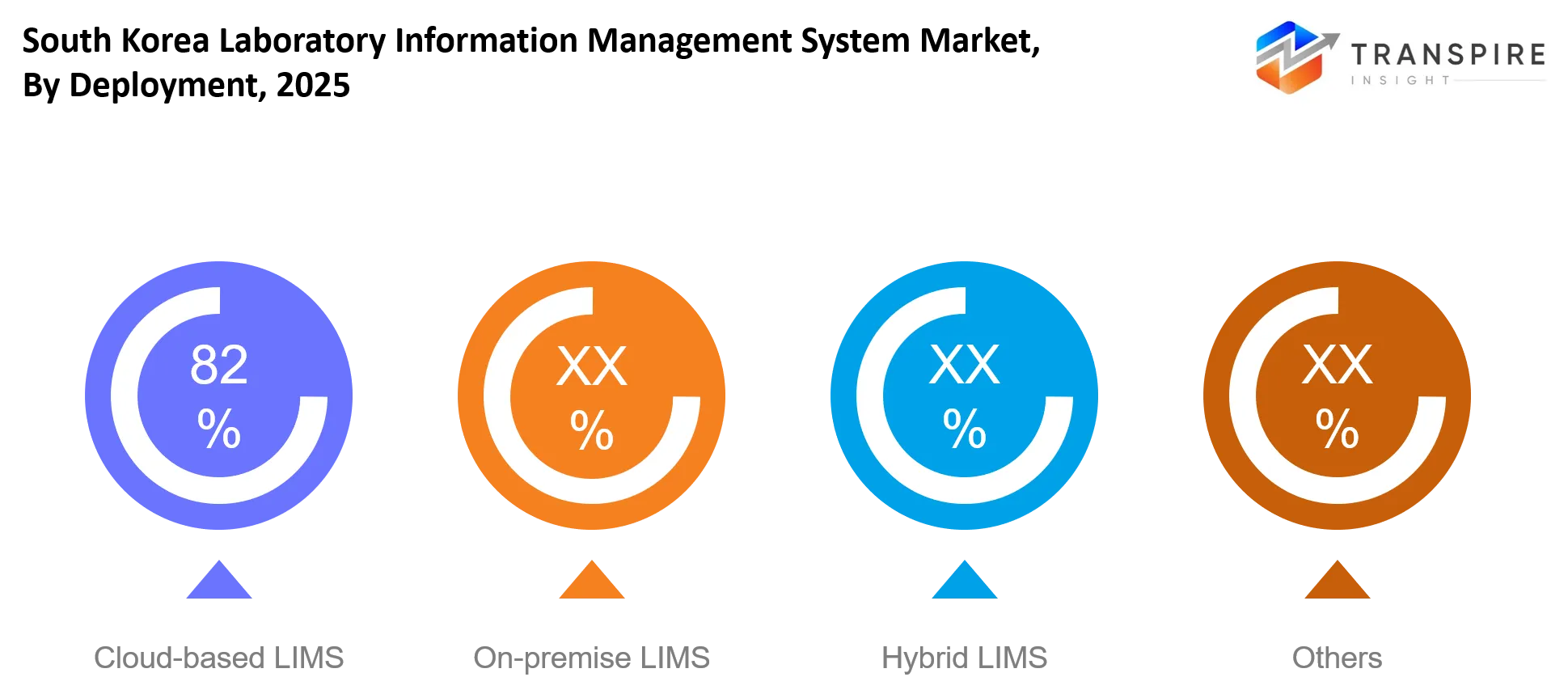
To learn more about this report, Download Free Sample Report
By Component
Software Solutions hold the dominant position in a very sort of direct way, because they sit right at the middle of sample tracking, workflow automation, and regulatory paperwork across laboratory environments. There is strong demand from pharmaceutical and biotechnology sectors which keeps pushing upgrades to the integrated platforms, even when budgets tighten a bit. Services keep a stable share , mostly because implementation, validation and system integration still are non-negotiable in regulated labs. Data management tools are also moving upward, since many labs now want structured data storage and smoother interoperability between research systems. The other components, by contrast, tend to stay limited to minor auxiliary system extensions, nothing too expansive.
Software Solutions continue to expand as labs shift toward fully digitized, and more AI-supported workflows. Services remain steady in relevance, because complex system validation and regulatory compliance still need continuous expert guidance, not just one-time onboarding. Data management tools grow faster too , mainly as interoperability between instruments, databases, and enterprise systems becomes increasingly essential in day-to-day operations. Other components stay fragmented because there is a lack of standardization across lab infrastructures, so companies do not always align their pieces. Over time, integrated software ecosystems will likely take over procurement choices, which will also reduce reliance on standalone modules, at least for most common deployments.
By Application
Sample Management has the dominant position because it sits in the middle of tracking labeling, and keeping traceability across pharmaceutical and clinical labs. Heavy regulatory pressure, make sure that structured sample workflows get used in a consistent way. Workflow Automation is also gaining strong traction , labs want to cut down manual mistakes and boost turnaround time, you know. Quality Control still counts as a critical portion, backed by strict testing standards in drug manufacturing and food safety. Compliance Management keeps expanding as audit frequency goes up and regulations get tighter. The other applications are more supplementary in nature, mostly.
Sample Management keeps anchoring demand as labs scale up high-throughput testing activities. Workflow Automation grows quickly, since digital transformation replaces manual documentation processes and such. Quality Control strengthens further due to more emphasis on precision and reproducibility inside regulated industries. Compliance Management expands steadily, as global regulatory alignment increases documentation needs. Other applications stay limited, though they slowly gain relevance in niche research and experimental environments. Over time, automation-driven workflows will reshape the way these applications rank across lab operations.
By End User
Pharmaceutical Laboratories keep the dominant position, mostly because there is a heavy reliance on validated data systems for drug development, clinical trials and regulatory submissions. There are strict compliance requirements, so LIMS adoption ends up being essential, not optional. Research Institutes are more or less a stable segment supported by government-funded scientific programs and long-term innovation projects. Food Testing Laboratories show a growing adoption curve, driven by safety regulations plus export quality standards. Hospitals maintain a steady need for diagnostic workflow control and patient sample tracking. Meanwhile, other end users stay pretty fragmented across specialized testing environments.
Pharmaceutical Laboratories keep leading, as regulatory complexity and R&D intensity ramp up across drug development pipelines. Research Institutes keep an even level of demand, backed by national innovation funding and academic collaboration networks. Food Testing Laboratories grow faster, due to tighter contamination monitoring and export compliance rules. Hospitals slowly integrate LIMS with digital health systems, aiming for better diagnostic accuracy and faster reporting. Other end users stay niche but start to matter more in environmental and industrial testing. In time, integrated healthcare ecosystems will deepen LIMS penetration across all these end-user categories.
By Industry
Healthcare kind of holds the dominant position because laboratory systems are used extensively for diagnostics, clinical research and across hospital networks. There is also strong regulatory oversight, plus patient safety requirements which push continuous digital adoption, maybe a little faster than expected sometimes.Biotechnology is turning into the fastest-growing industry segment, backed by more investment in precision medicine, and also biologics development. The Food and Beverage sector keeps steady adoption, mainly due to contamination control needs and export compliance requirements, which sounds simple but it’s pretty demanding. Environmental Testing is still a growing niche, supported by sustainability regulations and pollution monitoring initiatives that don’t really slow down. Other industries cover industrial and chemical testing applications, and those are often more specialized.
Healthcare keeps leading too, largely because more digitization of clinical workflows happens, alongside diagnostic automation. Biotechnology expands quickly as South Korea strengthens its standing in global bio-innovation, plus advanced therapeutics. Food and Beverage applications grow in a steady way because stricter safety enforcement keeps tightening, and international trade requirements keep coming up. Environmental Testing gains momentum as regulators tighten monitoring standards for air and water quality. Other industries stay smaller , but they increasingly adopt structured laboratory data systems.Over the forecast period, biotechnology will emerge as the strongest growth driver within the industry segmentation, even if some companies still take it slow at first.
What are the Key Use Cases Driving the South Korea Laboratory Information Management System Market?
So the main thing pushing adoption is pharmaceutical quality control and regulatory compliance management, basically where labs rely on LIMS to follow samples, wrangle test data, and keep documentation that’s ready for audits. In other words it helps labs stay in line with GMP expectations, and it also lowers the compliance hazards in drug manufacturing and in clinical research.
On the side, there are secondary use cases popping up more in biotech research labs and hospital diagnostic centers, in those places LIMS does a lot around high volume sample handling and it also connects with automated testing instruments. These setups usually need quicker turnaround windows, and cleaner data fidelity, and the platforms tend to deliver that using well organized workflows plus centralized data handling. It sounds simple but in practice it matters.
Then there are the emerging directions, like AI supported experimental data analysis , and also predictive maintenance for laboratory instruments. They’re still kind of maturing, but the momentum is growing , especially as more organizations move toward smart automation and cloud native research environments.
|
Report Metrics |
Details |
|
Market size value in 2025 |
USD 43.8 Million |
|
Market size value in 2026 |
USD 47.2 Million |
|
Revenue forecast in 2033 |
USD 80.5 Million |
|
Growth rate |
CAGR of 7.92% from 2026 to 2033 |
|
Base year |
2025 |
|
Historical data |
2021 - 2024 |
|
Forecast period |
2026 - 2033 |
|
Report coverage |
Revenue forecast, competitive landscape, growth factors, and trends |
|
Regional scope |
South Korea |
|
Key company profiled |
Thermo Fisher Scientific, LabWare, STARLIMS, Abbott Informatics, LabVantage Solutions, Siemens Healthineers, Agilent Technologies, Waters Corporation, PerkinElmer, Dassault Systèmes, SAP, IBM, Oracle, Autoscribe Informatics, Benchling |
|
Customization scope |
Free report customization (country, regional & segment scope). Avail customized purchase options to meet your exact research needs. |
|
Report Segmentation |
By Deployment (Cloud-based LIMS, On-premise LIMS, Hybrid LIMS, Others); By Component (Software Solutions, Services, Data Management Tools, Others); By Application (Sample Management, Workflow Automation, Quality Control, Compliance Management, Others); By End User (Pharmaceutical Laboratories, Research Institutes, Food Testing Laboratories, Hospitals, Others); By Industry (Healthcare, Biotechnology, Food & Beverage, Environmental Testing, Others) |
Which Regions are Driving the South Korea Laboratory Information Management System Market Growth?
Seoul Capital Area is basically in front in the South Korea Laboratory Information Management System Market , mainly because there’s a thick mix of pharmaceutical headquarters, biotech research centers , and regulatory agencies all packed in. A lot of big clinical trials and quality control labs run out of Seoul and Gyeonggi Province , and the heavy compliance enforcement there pushes people toward faster digital adoption. At the same time, stronger hospital networks plus global contract research organizations make the whole laboratory ecosystem feel really interlocked; it's built on real-time data traceability. Because of that, companies keep putting money into enterprise-grade LIMS platforms across regulated segments, so it’s kind of a loop.
Daejeon and Chungcheong region works more like a calm secondary hub , with government-funded research institutes and the Daedeok Innopolis innovation cluster as the anchor points. Unlike the more commercially driven take-up in Seoul, this area leans toward long-horizon scientific research and public-sector modernization. LIMS adoption here is supported by steady national R&D funding rather than private pharmaceutical competition. So the demand stays consistent, but it’s also more predictable, and it centers on laboratory digitalization tools used for advanced materials, life sciences, and even nuclear research facilities.
Then there’s Busan and Gyeongsang region, which is growing the quickest, mostly tied to export-driven manufacturing quality laboratories and food safety testing facilities , especially those connected to major port activity. Upgrades in logistics and industrial export compliance systems have raised the need for faster testing and better traceability solutions. Labs that support automotive, shipbuilding materials, and processed food exports are rapidly digitizing their workflows , trying to satisfy international certification requirements without delays.
Who are the Key Players in the South Korea Laboratory Information Management System Market and How Do They Compete?
The South Korea Laboratory Information Management System Market is moderately consolidated, with big global enterprise software providers battling it out alongside a few more specialized laboratory informatics vendors, and it kinda feels like everyone is trying to win the same deals. Competition is mostly pushed by system integration skill, regulatory compliance features and cloud scalability more than price alone. The established firms seem to be guarding their footing by tightening interoperability with pharmaceutical quality systems, while newer companies are inching into niche biotech and research workflows using flexible SaaS platforms that still feel easy to adopt. On top of that, the whole market is seeing a slow, gradual disruption, because AI-enabled lab automation tools are quietly changing how LIMS gets deployed.
Thermo Fisher Scientific leans into end-to-end laboratory ecosystems, by tying LIMS in with analytical instruments, and that helps it gain strong adoption in regulated pharmaceutical labs. LabWare goes with a highly configurable LIMS design, so laboratories can tailor workflows without too much heavy coding, which supports its position across multi-industry rollouts. LabVantage Solutions highlights cloud-native deployment and speedy implementation cycles, and it appeals especially to mid-sized biotech companies that want a faster digital transformation, without dragging it out.
Siemens Healthineers uses its diagnostic equipment ecosystem to embed data management inside clinical workflows, giving it a solid cross-selling edge. Dassault Systèmes BIOVIA stands out through simulation plus data modeling integration, so research-centric labs can connect experimental planning with execution data. Taken together, these moves crank up the rivalry around platform intelligence, integration depth, and long-term laboratory data lifecycle management.
Company List
- Thermo Fisher Scientific
- LabWare
- STARLIMS
- Abbott Informatics
- LabVantage Solutions
- Siemens Healthineers
- Agilent Technologies
- Waters Corporation
- PerkinElmer
- Dassault Systèmes
- SAP
- IBM
- Oracle
- Autoscribe Informatics
- Benchling
Recent Development News
In June 2025, Benchling announced a collaboration with Merck to unify bioanalytical workflows on a single cloud-native platform. The partnership strengthens LIMS-adjacent informatics capabilities by improving automated data capture, compliance tracking, and throughput in regulated laboratory environments that are increasingly mirrored in South Korea’s biotech sector.https://www.news-medical.net
What Strategic Insights Define the Future of the South Korea Laboratory Information Management System Market?
The South Korea Laboratory Information Management System Market is moving, structurally, toward fully integrated AI enabled laboratory ecosystems, where data just flows seamlessly across research, manufacturing,and regulatory platforms. This change is mainly pushed by more and more convergence between pharmaceutical R&D, clinical diagnostics, and industrial quality control, so everyone wants unified data governance frameworks, not these standalone lab systems. Over the next 5–7 years, cloud-native LIMS platforms will be the default setup as laboratories lean into scalability and cross-site collaboration.
There’s also a less loud risk, vendor concentration, where relying on a small group of global software providers could curtail customization flexibility and also bump up long term switching costs. And at the same time there’s a pretty real opportunity, AI-assisted compliance automation, especially for real time audit readiness in tightly regulated pharmaceutical settings. Market participants that go early on interoperable, AI augmented LIMS ecosystems will likely be better placed to win long-run enterprise contracts and expand across biotech clusters in South Korea.
South Korea Laboratory Information Management System Market Report Segmentation
By Deployment
- Cloud-based LIMS
- On-premise LIMS
- Hybrid LIMS
- Others
By Component
- Software Solutions
- Services
- Data Management Tools
- Others
By Application
- Sample Management
- Workflow Automation
- Quality Control
- Compliance Management
- Others
By End User
- Pharmaceutical Laboratories
- Research Institutes
- Food Testing Laboratories
- Hospitals
- Others
By Industry
- Healthcare
- Biotechnology
- Food & Beverage
- Environmental Testing
- Others
Frequently Asked Questions
Find quick answers to common questions.
The Expected South Korea Laboratory Information Management System Market size for the Market will be USD 80.5 Million in 2033.
Key Segments for the South Korea Laboratory Information Management System Market are By Deployment (Cloud-based LIMS, On-premise LIMS, Hybrid LIMS, Others); By Component (Software Solutions, Services, Data Management Tools, Others); By Application (Sample Management, Workflow Automation, Quality Control, Compliance Management, Others); By End User (Pharmaceutical Laboratories, Research Institutes, Food Testing Laboratories, Hospitals, Others); By Industry (Healthcare, Biotechnology, Food & Beverage, Environmental Testing, Others).
Major South Korea Laboratory Information Management System Market Players are Thermo Fisher Scientific, LabWare, STARLIMS, Abbott Informatics, LabVantage Solutions, Siemens Healthineers, Agilent Technologies, Waters Corporation, PerkinElmer, Dassault Systèmes, SAP, IBM, Oracle, Autoscribe Informatics, Benchling.
The Current South Korea Laboratory Information Management System Market size is USD 43.8 Million in 2025.
The South Korea Laboratory Information Management System Market CAGR is 7.92% from 2026 to 2033.
- Thermo Fisher Scientific
- LabWare
- STARLIMS
- Abbott Informatics
- LabVantage Solutions
- Siemens Healthineers
- Agilent Technologies
- Waters Corporation
- PerkinElmer
- Dassault Systèmes
- SAP
- IBM
- Oracle
- Autoscribe Informatics
- Benchling
About the Authors

Mayur Shinde
I am Mayur Shinde, a Senior Research Analyst at Transpire Insight, specializing in the Automotive & Transportation and Information & Communication Technology (ICT) Industry. My work focuses on analyzing emerging market trends, technological advancements, competitive landscapes, and industry developments to deliver accurate, data-driven insights. I am passionate about transforming complex market information into clear, actionable content that helps businesses, professionals, and decision-makers stay informed and make confident strategic decisions.

Chakradhar Khansole
Chakradhar serves as the Research Director at Transpire Insight, bringing over 8 years of experience in technology, innovation, and strategic market intelligence. He specializes in transforming complex market data into actionable business insights that enable organizations to make informed, growth-oriented decisions. Recognized for his strategic vision and analytical expertise, Chakradhar leads high-impact research initiatives, delivering comprehensive market assessments, competitive intelligence, and forward-looking industry analysis.
Recently Published Reports
-
Apr 2026
3D Optical Profiler Market
3D Optical Profiler Market Size, Share & Analysis Report By Type (Desktop 3D Optical Profiler, and Portable 3D Optical Profiler), By Technology (Confocal Technology, and White Light Interference), By End-Use Industry (Manufacturing, Research Institutions, Automotive, Aerospace and Defense, Medical Devices, and Other), and Geography (North America, Europe, Asia-Pacific, Middle East and Africa, South and Central America), 2021 - 2031
-
Apr 2026
Depth Sensor Market
Depth Sensor Market Size, Share & Analysis Report By Type (Infrared Depth Sensors, Time-of-Flight (ToF) Sensors, Stereo Vision Sensors, Structured Light Sensors, Ultrasonic Depth Sensors), By Application (Automotive, Robotics, Gaming, Consumer Electronics, Industrial Automation, Healthcare, Security & Surveillance, Others), By End Users (Automotive Manufacturers, Consumer Electronics Companies, Healthcare Providers, Industrial Companies, Security Agencies, Gaming Companies, Robotics Companies, Others), and Geography (North America, Europe, Asia-Pacific, Middle East and Africa, South and Central America), 2021 – 2031
-
Apr 2026
Digital Manufacturing Market
Digital Manufacturing Market Size, Share & Analysis Report By Component (Hardware, Software, and Services), By Technology (Robotics, 3D Printing, Internet of Things (IoT), and Others), By Application (Automotive and Transportation, Aerospace and Defense, Consumer Electronics, Industrial Machinery, and Others), By Process Type (Computer-Based Designing, Computer-Based Simulation, Computer 3D Visualization, Analytics, and Others), and Geography (North America, Europe, Asia-Pacific, Middle East and Africa, South and Central America), 2021 – 2031
-
Apr 2026
Digital Visa Services Market
Digital Visa Services Market Size, Share & Analysis Report By Type (Individual Travelers, Group Travelers), By Application (Tourism, Business Travel, Others), and Geography (North America, Europe, Asia-Pacific, Middle East and Africa, South and Central America), 2021 – 2031