

United Kingdom Manufacturing Automation Market Size & Forecast:
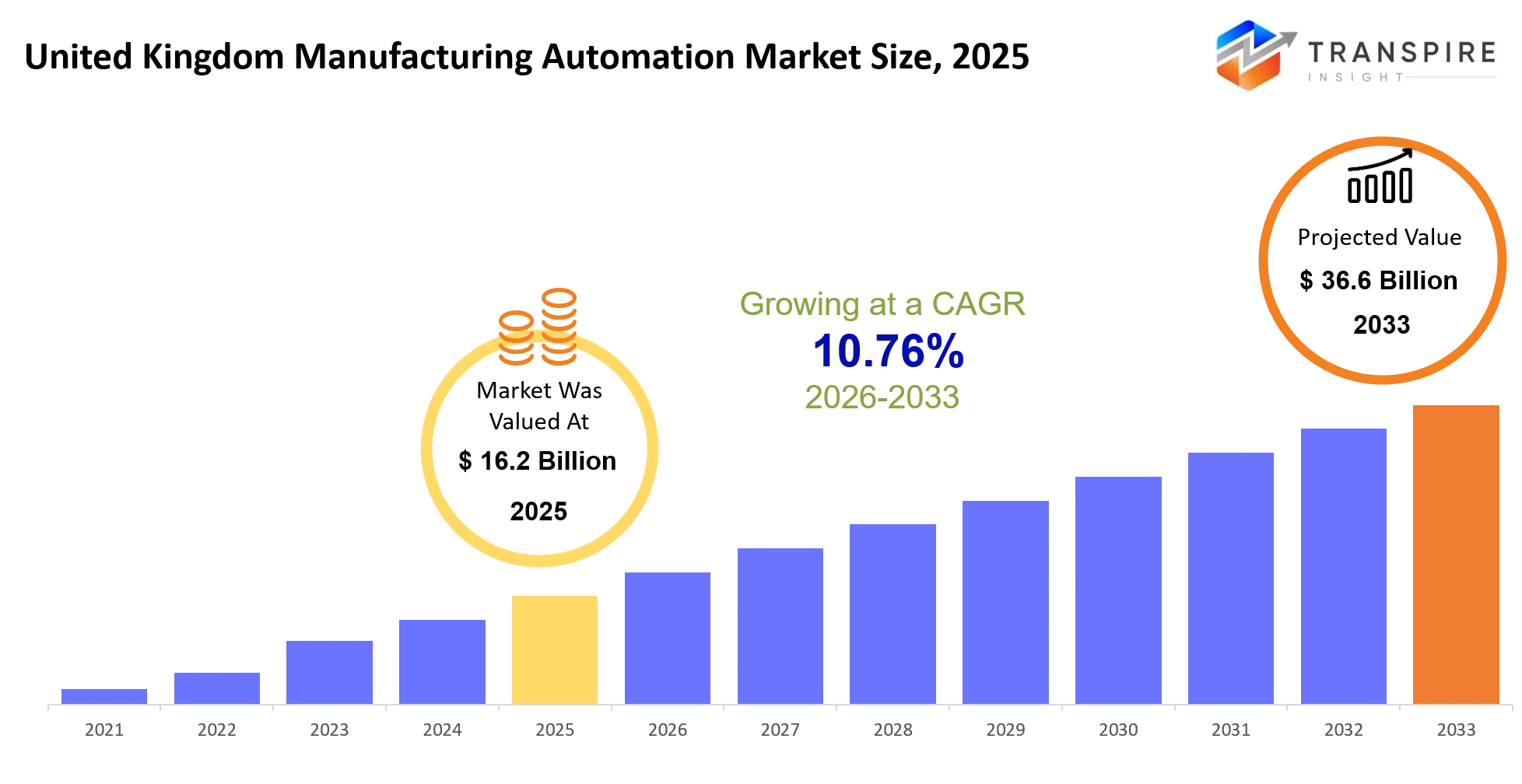
- United Kingdom Manufacturing Automation Market Size 2025: USD 16.2 Billion
- United Kingdom Manufacturing Automation Market Size 2033: USD 36.6 Billion
- United Kingdom Manufacturing Automation Market CAGR: 10.76%
- United Kingdom Manufacturing Automation Market Segments: By Component (Industrial Robots, PLC Systems, SCADA Systems, Sensors, Drives & Motors, Automation Software, HMI Systems, Others); By Technology (AI-enabled Automation, IoT-enabled Automation, Cloud Automation, Edge Automation, Digital Twin Systems, Predictive Maintenance Systems, Others); By Application (Assembly Automation, Process Automation, Packaging Automation, Warehouse Automation, Quality Inspection, Others); By End User (Automotive Industry, Electronics Industry, Food & Beverage Industry, Pharmaceuticals, Chemical Industry, Others)
To learn more about this report,  Download Free Sample Report
United Kingdom Manufacturing Automation Market Summary
The United Kingdom Manufacturing Automation Market was valued at USD 16.2 Billion in 2025. It is forecast to reach USD 36.6 Billion by 2033. That is a CAGR of 10.76% over the period.
The United Kingdom Manufacturing Automation Market has a critical part in helping makers boost productivity , lower day to day operational costs, and keep the same product quality across their production lines. In practice, automation techs like industrial robots, programmable logic controllers, machine vision setups, and industrial software let plants run with more exactness, even while they deal with labor shortages and the usual production complexity issues. In the last five years, the whole market basically went through a real structural turn toward smart manufacturing, and it was not just a small change. It’s been pushed forward by the joining up of Industrial Internet of Things (IIoT), artificial intelligence, and cloud linked production systems.
A big nudge behind this shift was the supply chain disruption that many organizations faced during and right after the COVID-19 pandemic, it really showed where the weak spots were in labor reliant manufacturing operations. Because of that, manufacturers ended up speeding up their spending on automated systems so they could keep running, and also stay more resilient. Also, this momentum didn’t stay only with big enterprises—automation adoption has moved into mid sized manufacturers too, and that opens up fresh revenue streams for technology providers . Overall, it supports a stronger long term growth outlook for the market.
Key Market Insights
- In 2025, England seemed to dominate the United Kingdom Manufacturing Automation Market, with about 72% market share, largely backed by its cluster of advanced manufacturing sites , or so the data suggests.
- Scotland is forecast to become the fastest-growing regional market through 2033, pushed forward by automation spending across energy electronics , and precision engineering.
- When it comes to product types, industrial robotics held close to 34% market share in 2025, so it is basically the top segment because it is being used everywhere in assembly lines and material handling workflows.
- Industrial control systems made up roughly 27% of industry revenue , mainly because older production infrastructure is being modernized, bit by bit.
- AI-enabled automation solutions are expected to show the quickest growth through 2033, since manufacturers are chasing predictive and more autonomous operations.
- For applications, automotive manufacturing accounted for nearly 29% of total demand in 2025, and it still keeps the leading spot as the main automation user.
- Food and beverage processing is starting to look like the fastest-growing application segment, driven by labor gaps and stricter quality rules , which is a little ironic given how much the sector already relies on skilled hands.
- Regarding company size, the larger enterprises were responsible for roughly 61% of market revenue in 2025, basically showing that bigger automation budgets and continuous digital transformation programs are really driving the numbers.
- Smaller to mid-sized manufacturers are moving toward collaborative robots and cloud based automation platforms faster than they used to with traditional systems, even if the rollout sequence is not always the same, like sometimes it is a bit out of order .
What are the Key Drivers, Restraints, and Opportunities in the United Kingdom Manufacturing Automation Market?
The main pull behind market expansion is basically the growing pressure for productivity upgrades across manufacturing sectors that are still dealing with persistent labor shortages, and also rising operating costs. In response, manufacturers are more often rolling out robotics, machine vision tools, and intelligent control platforms, to keep output steady while leaning less on manual handling.Then the shift toward Industry 4.0 kind of pushed it along too, because connected production setups create operational data that tends to enhance efficiency, quality monitoring, and asset utilization. All of those gains feed right into higher production volumes, and lower unit costs, so automation spending feels more and more financially reasonable.
Still, the most noticeable brake is the heavy capital outlay needed to actually implement automation. And it is not only about buying the hardware. Manufacturers also have to fund software integration, workforce training, cybersecurity, and in many cases production line redesign. This problem feels structural, since a lot of small to mid sized manufacturers run on tight capital allocations, and they still have aging infrastructure. Because of that, automation programs are frequently postponed or rolled out in steps , which slows down market penetration and can reduce the pace of revenue growth.
A strong opportunity is tied to the expansion of AI enabled smart factories , along with digital twin technologies. Manufacturers are increasingly backing virtual production environments that simulate the manufacturing workflow before anything is built on site. For instance, automotive and aerospace plants across the United Kingdom are using digital twins to fine tune production layouts, cut commissioning lead times, and boost day to day operational results.
What Has the Impact of Artificial Intelligence Been on the United Kingdom Manufacturing Automation Market?
Artificial intelligence has become a key enabler for next-generation manufacturing automation across the United Kingdom, kinda. Companies are using AI powered systems more and more, to automate things like production monitoring, quality inspection, process control, and inventory management. With computer vision platforms, defects can be spotted in real time, so production lines tend to stay on consistent quality tracks, while the need for manual inspection is reduced a lot.
On top of that, machine learning models are reshaping predictive maintenance approaches. When AI sifts through vibration signals, temperature readings, and other operational data from industrial machines, it can spot early warning signals of component failure, before you get unplanned downtime. A lot of manufacturers say they see better equipment availability, improved maintenance efficiency, and smoother production scheduling after predictive analytics are put in place. There are also optimization tools that drive energy management, production planning, and resource allocation in a smarter way, which helps factories lower operating costs, while the throughput improves in return.
Meanwhile advanced digital technologies—like digital twins, edge computing and industrial IoT platforms—are making production environments more adaptable. They keep looking at factory performance continuously, and then suggest process tweaks that boost efficiency, plus cut down waste, with less arguing.
Still, AI adoption has limits. Connecting AI with older manufacturing infrastructure can be pricey and technically messy. And many facilities simply do not have enough historical operational data to train machine learning models that are truly accurate, so predictive reliability can dip and implementation can move slower in some industrial areas.
Key Market Trends
- Industrial robot installations went up a lot between 2021 and 2025, mostly because manufacturers tried to cope with labor shortages, and they pushed production capacity too, so yeah more machines.
- AI-powered quality inspection systems, basically started replacing manual inspection routines across electronics and automotive plants. That shift cut defect rates and it also trimmed rework costs , in a pretty noticeable way.
- Cloud-connected manufacturing platforms saw broader adoption after 2022, and that let teams get real-time production visibility across many factory sites, not just one.
- Collaborative robot deployments grew by more than 20% each year, in several manufacturing areas, which helped enable more flexible, and often lower-cost automation projects.
- Manufacturers also leaned harder on digital twin technology, to run simulations of production processes before they touch the physical line. That approach reduced commissioning timelines, often by a meaningful margin.
- Meanwhile, supply chain disruptions kind of pushed reshoring strategies forward, so companies started investing in automated domestic manufacturing facilities, sooner than expected.
- Energy efficiency became a central procurement concern , so demand increased for intelligent motors, drives, and automated energy management systems.
- Predictive maintenance platforms expanded fast too, since factories wanted to reduce downtime, and raise equipment utilization rates without gambling on surprises.
- Big vendors, including Siemens , ABB, Schneider Electric and Rockwell Automation, increased spending on AI-enabled industrial software ecosystems.
- Cybersecurity budgets within industrial automation projects climbed substantially after 2023, mostly due to more connectivity in production systems , and the higher risk that comes with it.
United Kingdom Manufacturing Automation Market Segmentation
By Component
Industrial Robots still seem to have the leading position, mostly because manufacturers now more and more lean on robotic systems, to boost production efficiency, cut the labor dependency, and keep product quality steady, you know. You can see their widespread adoption across the United Kingdom in automotive, electronics, and other industrial manufacturing facilities , it’s pretty consistent. PLC Systems hold the next biggest spot, mainly because they are in charge of automated machinery and production workflows across varied manufacturing setups. SCADA Systems also take a noticeable portion, since manufacturers want real-time monitoring, plus centralized control over industrial operations , which is kind of the whole point.
Industrial Robots are expected to keep that top position as firms keep scaling up automation capabilities , to strengthen operational performance and production flexibility. Automation Software should grow the quickest, because manufacturers are pouring investment into data-driven production management, AI integration, and smart factory initiatives. Sensors, Drives & Motors, and HMI Systems continue enabling automation rollout by enhancing machine connectivity, precision control, and operator interaction. Other components are likely to gain too, thanks to ongoing modernization of manufacturing infrastructure and digital transformation programs, even if it’s slower in some places.
By Technology
IoT-enabled Automation keeps the dominant position, because tied together devices, and the industrial networks behind them, offer real time visibility into what’s happening in production, equipment behavior , and operational efficiency. Manufacturers are rolling out IoT platforms more and more, kind of to help better decision-making and also cut down on unplanned downtime. AI-enabled Automation stays in the second-largest spot, at least for now, since many orgs are adopting intelligent systems for process tuning, quality checks, and predictive analytics.
Cloud Automation is also moving forward , as companies look for scalable setups that still keep data accessible across several facilities.IoT-enabled Automation should keep a strong market stance since there are ongoing investments in connected manufacturing ecosystems. AI-enabled Automation is projected to grow the quickest, since machine learning tools are becoming more connected to production planning, maintenance management, and process control. Digital Twin Systems , plus Predictive Maintenance Systems, are gaining momentum, due to the way they can boost operational reliability and asset utilization. Edge Automation and other emerging technologies are expected to support what comes next in the market, mainly by letting data be processed faster and enabling stronger production responsiveness.
By Application
Assembly Automation keeps the most dominant spot, mainly because those high volume manufacturing setups need steady output speed, precision that doesn’t wobble, and dependable product quality. Automotive and electronics manufacturers in particular rely on automated assembly systems so they can hit efficiency targets and also keep operational expenses lower, not too high. Process Automation sits in the second-largest range, pretty broadly, because it’s been adopted widely across pharmaceuticals, chemicals, and food processing sites where uninterrupted operation is a big deal. Packaging Automation adds a lot as well, since companies want better throughput and more consistent packaging, all the way through.
Assembly Automation is likely to stay in the lead as manufacturers keep modernizing production lines and keep rolling out more robotics. Warehouse Automation, meanwhile, is projected to grow the fastest because demand keeps rising for automated material movement, inventory control, and logistics improvements. Quality Inspection is expanding on a steady path, driven by machine vision combined with AI based inspection tools, and that’s becoming a common choice. Other applications should also continue backing overall market momentum, since manufacturers push for higher productivity and a lot more operational flexibility, even when workflows change.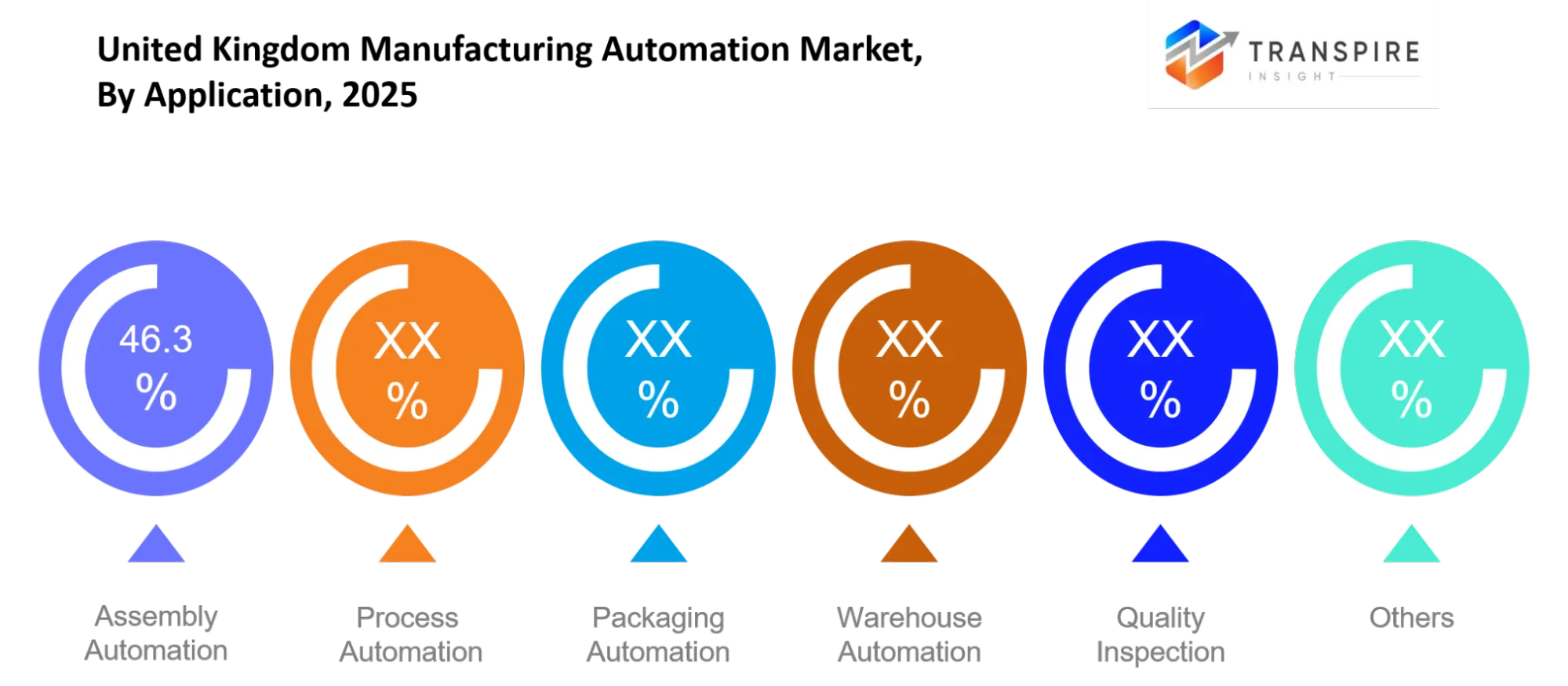
To learn more about this report, Download Free Sample Report
By End User
The Automotive Industry keeps the top spot because vehicle manufacturers stay, i mean they still are among the biggest users of robotics, machine vision systems, and advanced production technologies. Ongoing spending on electric vehicle manufacturing and “smart factory” initiatives, also kind of keeps pushing the automation demand upward inside this space.
The Electronics Industry is still in the second-largest position, mostly because it needs very precise manufacturing routines and an efficient way to produce complicated components. Food & Beverage manufacturers are also a notable portion, since they’re increasingly automating production, packaging, and quality assurance tasks too.
For the future , the Automotive Industry is likely to keep leading, since companies keep pouring money into advanced production lines and flexible manufacturing features. The Pharmaceuticals sector is forecasted to grow the quickest, because strict quality expectations, traceability requirements, and regulatory compliance obligations are essentially forcing automation investments. The Chemical Industry continues to lean into automation, aiming to boost process safety, operational efficiency, and production dependability. Other end users are expected to gain from wider Industry 4.0 rollout and smart plant solutions across the whole manufacturing environment.
What are the Key Use Cases Driving the United Kingdom Manufacturing Automation Market?
The biggest use case stays automated production plus assembly work inside automotive, electronics, and industrial manufacturing spaces. Makers are depending on robotics, motion control systems, and machine vision technologies, to get more consistent production, raise throughput, and cut down operational mistakes. In practice, these applications attract the most automation spending because they touch output and profitability, pretty directly.
Past assembly work, automation is also picking up in packaging, warehousing, and quality assurance activities, not just the obvious lines. Food and beverage manufacturers are rolling out automated packaging systems and inspection tech more and more, so they can stay within tight quality standards. Pharmaceutical manufacturers use automation just as often for precision handling, traceability, and regulatory compliance.
Newer directions include AI based autonomous production optimization, along with digital twin enabled manufacturing environments. In aerospace and other advanced engineering facilities, teams are starting to deploy virtual factory models, to help tune production planning and equipment utilization. Right now, adoption is still kind of early, but it should keep growing—especially as manufacturers chase fully connected smart factory operations, across the whole forecast period.
|
Report Metrics |
Details |
|
Market size value in 2025 |
USD 16.2 Billion |
|
Market size value in 2026 |
USD 17.9 Billion |
|
Revenue forecast in 2033 |
USD 36.6 Billion |
|
Growth rate |
CAGR of 10.76%from 2026 to 2033 |
|
Base year |
2025 |
|
Historical data |
2021 - 2024 |
|
Forecast period |
2026 - 2033 |
|
Report coverage |
Revenue forecast, competitive landscape, growth factors, and trends |
|
Regional scope |
United Kingdom |
|
Key company profiled |
Siemens, ABB, Schneider Electric, Rockwell Automation, Honeywell, Emerson Electric, FANUC, Mitsubishi Electric, Yokogawa Electric, Omron Corporation, Bosch Rexroth, Hitachi, Danfoss, Beckhoff Automation, General Electric |
|
Customization scope |
Free report customization (country, regional & segment scope). Avail customized purchase options to meet your exact research needs. |
|
Report Segmentation |
By Component (Industrial Robots, PLC Systems, SCADA Systems, Sensors, Drives & Motors, Automation Software, HMI Systems, Others); By Technology (AI-enabled Automation, IoT-enabled Automation, Cloud Automation, Edge Automation, Digital Twin Systems, Predictive Maintenance Systems, Others); By Application (Assembly Automation, Process Automation, Packaging Automation, Warehouse Automation, Quality Inspection, Others); By End User (Automotive Industry, Electronics Industry, Food & Beverage Industry, Pharmaceuticals, Chemical Industry, Others) |
Which Regions are Driving the United Kingdom Manufacturing Automation Market Growth?
England stays the most dominant part of the United Kingdom Manufacturing Automation Market, mostly because automotive, aerospace, pharmaceutical and advanced engineering sites are heavily concentrated there. It also kind of rides on the back of solid industrial policy backing, plus lots of adoption of Industry 4.0 programs, and then access to the big manufacturing hubs across the Midlands, Greater Manchester, and the South East. Big spends on smart factories, robotics integration and industrial software platforms are still pushing automation further into real production workflows. And honestly there’s also a mature ecosystem around it, with technology vendors, system integrators, research groups, and skilled engineering talent, which keeps England on top and helps long-term market expansion keep moving.
Scotland shows up as the second-largest contributor, though its growth pattern is a bit different than England’s manufacturing footprint. In Scotland, automation investments tend to connect more with precision engineering, renewable energy equipment, electronics manufacturing, and offshore industrial operations. There’s also stable public–private cooperation, and longer-run industrial modernization programs, so automation spending feels more dependable. That steadiness makes Scotland a meaningful revenue source especially for suppliers focused on industrial control systems, process automation, and advanced monitoring technologies.
Wales is starting to look like the fastest-growing regional market, since manufacturers are speeding up modernization in areas like electronics, semiconductors and high-value industrial production facilities. Newer investments into digital manufacturing infrastructure, supply chain resilience initiatives, and advanced production tech have boosted Wales overall competitiveness.
Who are the Key Players in the United Kingdom Manufacturing Automation Market and How Do They Compete?
Competition in the United Kingdom Manufacturing Automation Market stays moderately consolidated, and honestly global industrial technology companies still hold a lot of the high-value automation deals. Lately the battle feels less about equipment pricing, and more about software abilities, industrial AI integration, digital twin know-how, and lifecycle services that kind of follow the customer over time. Most big automation players are pushing harder into cloud connectivity, predictive analytics, and smart manufacturing ecosystems, while smaller niche vendors try to win with very specific industrial applications and more adaptable deployment models—sometimes more “install this here, scale that later” style.
Siemens sets itself apart via tight, almost end-to-end integration across automation software, digital twin tech, and industrial AI platforms. It keeps enlarging its industrial software portfolio through AI-centered partnerships, and those factory digitalization initiatives that make engineering and operations feel linked. The approach is basically about tying together engineering data, production signals, and operational information into a single industrial ecosystem, not just disconnected dashboards. Its more recent partnership expansion with NVIDIA also helps it, because the whole AI-driven manufacturing environment is becoming a more visible requirement.
ABB competes by leaning into robotics innovation, electrification know-how, and flexible automation systems that work for both major manufacturers and smaller industrial operators. Its collaborative robotics platforms help reduce programming friction and make automation feel more accessible for mid-sized manufacturers, without forcing everyone into the same workflow. At the same time, Rockwell Automation is more focused on connected manufacturing setups, where operational technology and industrial analytics come together in one direction.
Company List
• Siemens
• ABB
• Schneider Electric
• Rockwell Automation
• Honeywell
• Emerson Electric
• FANUC
• Mitsubishi Electric
• Yokogawa Electric
• Omron Corporation
• Bosch Rexroth
• Hitachi
• Danfoss
• Beckhoff Automation
• General Electric (GE)
Recent Development News
In January 2026, Siemens announced an expanded strategic partnership with NVIDIA to develop an Industrial AI Operating System. The collaboration combines industrial automation, digital twins, and AI-driven manufacturing technologies to accelerate deployment of adaptive smart factories and industrial AI solutions.
https://press.siemens.com
In April 2026, ABB Robotics launched the OmniVance Collaborative Surface Finishing Cell. The automated sanding and polishing platform reduces programming time by up to 90% and expands automation adoption among small and medium-sized manufacturers.
https://www.automate.org
In March 2026, Siemens expanded its partnership with Alibaba to bring advanced industrial simulation software and AI-enabled manufacturing tools to cloud environments. The initiative improves access to industrial digitalization technologies:https://press.siemens.com
What Strategic Insights Define the Future of the United Kingdom Manufacturing Automation Market?
The United Kingdom Manufacturing Automation Market is kinda drifting toward very connected, AI enabled production ecosystems, where automation platforms kinda act more like intelligent decision-support systems… not just stand alone machines. This is being pushed by chronic labor constraints, more production complexity than before, and the bigger push for resilient domestic manufacturing capacity. There’s also a quiet risk that people gloss over, like the tech gap getting wider between large manufacturers and smaller industrial firms. The big players can usually pay for advanced automation upgrades, but a lot of mid-sized manufacturers run into capital limits, plus integration headaches, and that can end up making adoption uneven and maybe slowing down the total productivity gains.
An emerging opportunity is showing up around industrial AI platforms that bring together digital twins, predictive analytics, and autonomous process optimization. Those capabilities are still early in their rollouts, but they seem to be set up to matter a lot across automotive, aerospace, and electronics manufacturing. Companies should focus more on scalable, software-driven automation approaches, rather than only pouring money into hardware. If firms build solid industrial data infrastructure and AI-ready production setups they’ll likely be in a better spot to lock in long-term competitive advantages as intelligent manufacturing becomes kind of the industry default.
United Kingdom Manufacturing Automation Market Report Segmentation
By Component
- Industrial Robots
- PLC Systems
- SCADA Systems
- Sensors
- Drives & Motors
- Automation Software
- HMI Systems
- Others
By Technology
- AI-enabled Automation
- IoT-enabled Automation
- Cloud Automation
- Edge Automation
- Digital Twin Systems
- Predictive Maintenance Systems
- Others
By Application
- Assembly Automation
- Process Automation
- Packaging Automation
- Warehouse Automation
- Quality Inspection
- Others
By End User
- Automotive Industry
- Electronics Industry
- Food & Beverage Industry
- Pharmaceuticals
- Chemical Industry
- Others
Frequently Asked Questions
Find quick answers to common questions.
The Expected United Kingdom Manufacturing Automation Market size for the Market will be USD 36.6 Billion in 2033.
Key Segments for the United Kingdom Manufacturing Automation Market are By Component (Industrial Robots, PLC Systems, SCADA Systems, Sensors, Drives & Motors, Automation Software, HMI Systems, Others); By Technology (AI-enabled Automation, IoT-enabled Automation, Cloud Automation, Edge Automation, Digital Twin Systems, Predictive Maintenance Systems, Others); By Application (Assembly Automation, Process Automation, Packaging Automation, Warehouse Automation, Quality Inspection, Others); By End User (Automotive Industry, Electronics Industry, Food & Beverage Industry, Pharmaceuticals, Chemical Industry, Others).
Major United Kingdom Manufacturing Automation Market players are Siemens, ABB, Schneider Electric, Rockwell Automation, Honeywell, Emerson Electric, FANUC, Mitsubishi Electric, Yokogawa Electric, Omron Corporation, Bosch Rexroth, Hitachi, Danfoss, Beckhoff Automation, General Electric.
The Current United Kingdom Manufacturing Automation Market size is USD 16.2 billion in 2025.
The United Kingdom Manufacturing Automation Market CAGR is 10.76% from 2026 to 2033.
• Siemens
• ABB
• Schneider Electric
• Rockwell Automation
• Honeywell
• Emerson Electric
• FANUC
• Mitsubishi Electric
• Yokogawa Electric
• Omron Corporation
• Bosch Rexroth
• Hitachi
• Danfoss
• Beckhoff Automation
• General Electric (GE)
About the Authors

Kartik bhong
I am Kartik Bhong, a Senior Research Analyst at Transpire Insight, specializing in the Packaging, Manufacturing, and Construction industry. My work focuses on analyzing market trends, emerging technologies, industry regulations, and competitive landscapes to deliver accurate, data-driven insights. I am passionate about transforming complex industry information into clear, practical content that helps businesses, professionals, and decision-makers stay informed and make confident strategic decisions. Through continuous research and a strong commitment to accuracy, I strive to create reliable, well-researched content that reflects the latest developments across these dynamic industries and supports the vision of Transpire Insight in delivering valuable market intelligence.

Chakradhar Khansole
Chakradhar serves as the Research Director at Transpire Insight, bringing over 8 years of experience in technology, innovation, and strategic market intelligence. He specializes in transforming complex market data into actionable business insights that enable organizations to make informed, growth-oriented decisions. Recognized for his strategic vision and analytical expertise, Chakradhar leads high-impact research initiatives, delivering comprehensive market assessments, competitive intelligence, and forward-looking industry analysis.
Recently Published Reports
-
Apr 2026
Handling and Lifting Equipment Market
Handling and Lifting Equipment Market Size, Share & Analysis Report By Product (Cranes and Hoists, Forklifts, Conveyor Systems, Aerial Work Platforms, Others), By Application (E-Commerce, Automotive and Railway, Food and Beverages, Aviation, Others), and Geography (North America, Europe, Asia-Pacific, Middle East and Africa, South and Central America), 2021 - 2031
-
Apr 2026
HVAC Equipment Market
HVAC Equipment Market Size, Share & Analysis Report By Heating Equipment Type (Boilers and Furnaces, Heat Pumps, and Unitary Heaters), By Ventilation Equipment (Air Handling Units, Humidifiers and Dehumidifiers, Air Filters, and Fan Coiling Units), By Air Conditioning Equipment (Unitary Air Conditioners, Room Air Conditioners, Packaged Terminal Air Conditioners, and Chillers), By End User (Commercial, Residential, Industrial, and others), and Geography (North America, Europe, Asia-Pacific, Middle East and Africa, South and Central America), 2021 – 2031
-
Apr 2026
Refrigeration Valves Market
Refrigeration Valves Market Size, Share & Analysis Report By Type (Solenoid Valves, Expansion Valves, Check Valves, Service Valves, Others), By Application (Commercial Refrigeration, Industrial Refrigeration, Transport Refrigeration, Residential Refrigeration, Air Conditioning Systems), By End User (Food and Beverage Industry, Pharmaceutical Industry, HVAC Industry, Chemical Industry, Others), and Geography (North America, Europe, Asia-Pacific, Middle East and Africa, South and Central America), 2021 – 2031
-
Apr 2026
E-Commerce Packaging Materials Market
E-Commerce Packaging Materials Market By Material Type (Corrugated Boxes, Paper & Paperboard, Foam & Cushioning Materials, Plastic Packaging, Flexible Packaging, Protective Packaging, Others), By Product(Primary Packaging, Secondary Packaging, Tertiary Packaging), By Packaging Function (Protective Packaging, Branding & Presentation Packaging, Transit & Logistic Packaging, Sustainable Packaging, Tamper Evidence Packaging), By End-User (Retail & Consumer Goods, Electronic Appliances, Food & Beverages, Healthcare & Pharmaceutical, Fashion & Apparel, Home & Furnishing, Others); By Industry Analysis, Size, Share, Growth, Trends, and Forecasts 2021-2033