

Europe Plant Biotechnology Market Size & Forecast:
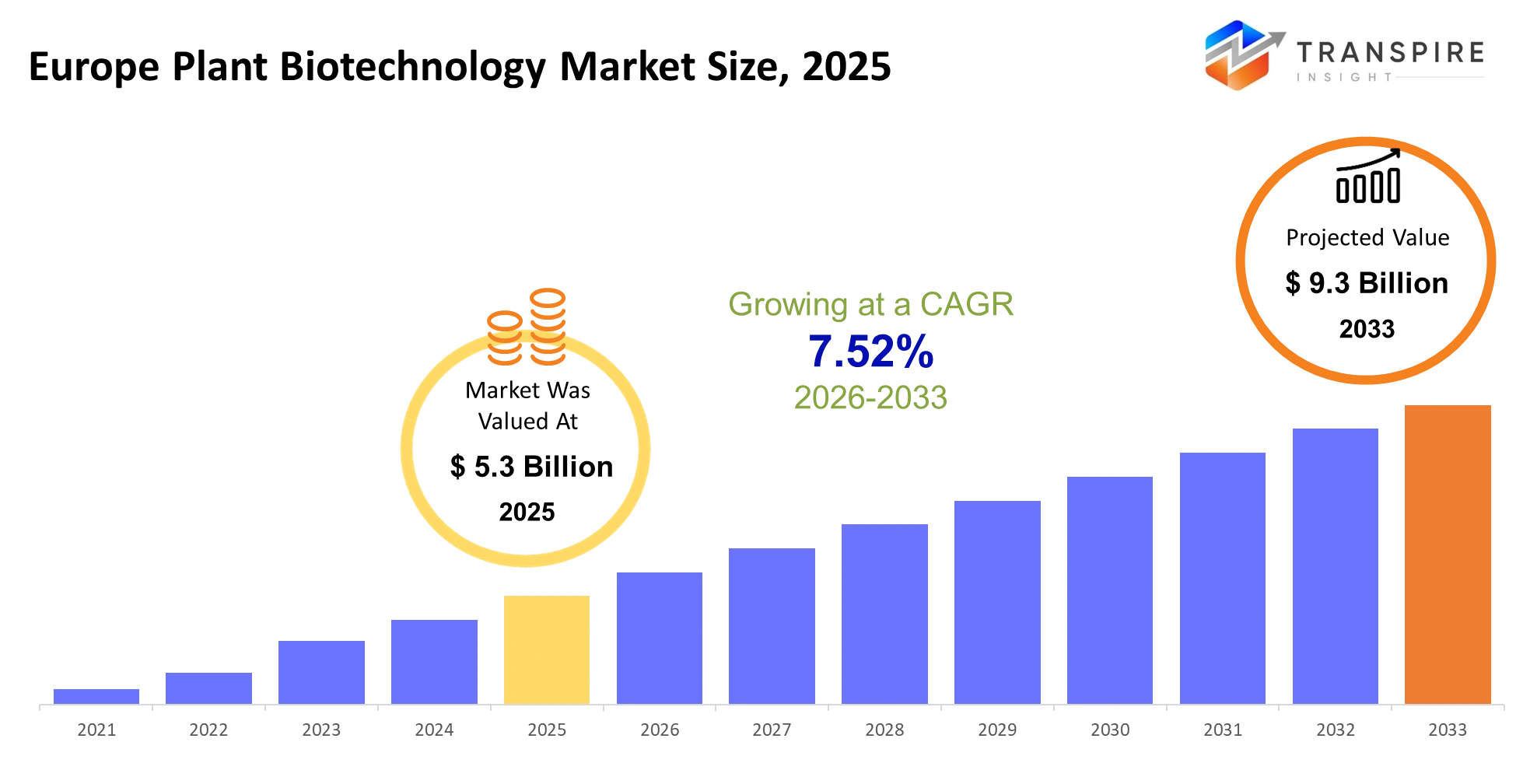
- Europe Plant Biotechnology Market Size 2025: USD 5.3 Billion
- Europe Plant Biotechnology Market Size 2033: USD 9.3 Billion
- Europe Plant Biotechnology Market CAGR: 7.52%
- Europe Plant Biotechnology Market Segments: By Type (Genetic Engineering, Tissue Culture, Molecular Breeding, Genome Editing, Others); By Application (Crop Improvement, Disease Resistance, Yield Enhancement, Biofuel Production, Nutritional Enhancement, Others); By End-User (Agricultural Companies, Research Institutes, Seed Companies, Universities, Government Agencies, Others); By Technology (CRISPR, RNAi, Marker-assisted Selection, Gene Cloning, Others).
To learn more about this report,  Download Free Sample Report
Europe Plant Biotechnology Market Summary:
The Europe Plant Biotechnology Market size is estimated at USD 5.3 Billion in 2025 and is anticipated to reach USD 9.3 Billion by 2033, growing at a CAGR of 7.52% from 2026 to 2033. The Europe Plant Biotechnology Market functions at the intersection of three fields which are agriculture, food security, and industrial bio-production because it helps farmers and agribusinesses achieve better crop results with improved climate performance and reduced resource use. The system helps farmers minimize their crop losses while maximizing their land productivity and maintaining sustainable raw material sources which benefit both food processing and bio-based production.
The market has experienced a structural transformation during the last three to five years because it now emphasizes gene editing and precision breeding methods while moving away from traditional GM technologies as European regulatory systems begin to relax their restrictions. The supply shock which originated from the Russia–Ukraine conflict served as a major trigger because it showed Europe how much it depended on imported grain products. The disruption created a need for investment in crop traits that can withstand drought conditions while producing high-yield results.
Governments and agribusinesses increase their adoption of biotechnology because supply insecurity and climate stress conditions create a cause-and-effect relationship which leads to increased research spending and product deployment.
Key Market Insights
- The Europe Plant Biotechnology Market for 2024 is expected to be led by Western Europe which will maintain more than 45% market share because of its strong research development facilities and financial support.
- The agricultural sector in Eastern Europe will experience its highest growth rate until 2030 because farmers are modernizing their operations which leads them to use biotech seeds and traits.
- The market for genetically modified seeds will reach a 40% share in 2024 because these seeds deliver better crop yields and protect against pests.
- Plant tissue culture technology stands as the second biggest market segment which scientists use to produce plants at high speed while creating pathogen-free agricultural products.
- The market segment for gene editing technologies which includes CRISPR-based solutions will experience the fastest growth rate between 2025 and 2030 because regulations permit more flexible usage of these technologies.
- The Europe Plant Biotechnology Market will reach its largest share from crop production which will represent approximately 55% of the market in 2024.
- The market for biofuel and industrial crop applications is developing quickly because of sustainability requirements and renewable energy goals.
- Agribusiness companies control more than 50% of the market because they use biotechnology to enhance their crop yields and protect their supply chain operations.
- The end-user market segment for research institutes and biotech startups will experience its fastest expansion because innovation funding and public-private partnerships drive growth in this area.
What are the Key Drivers, Restraints, and Opportunities in the Europe Plant Biotechnology Market?
The European Plant Biotechnology Market develops through two main factors which include post-regulatory reevaluation of new genomic techniques and the increasing preference for gene editing methods. The new regulations allow policymakers to treat gene-edited crops as separate entities from conventional GMOs which simplifies the approval process. The necessity for food systems to withstand disruptions caused by the Russia–Ukraine war created this urgent need for change. Companies now allocate their research and development funds toward CRISPR-based traits because these traits achieve market readiness with faster results and reduced expenses. The process brings more products into development while decreasing the duration needed to bring products to market which results in increased licensing income and faster implementation by commercial farmers who need to maintain consistent crop yields.
The existing obstacle in Europe stems from its divided and hesitant rules which govern genetically modified organisms. The member states maintain different approval processes which involve extensive risk evaluation and public review despite ongoing changes to their systems. This complex system requires time to complete because it depends on both political agreement and public opinion. The outcome creates delayed testing in fields which restricts product introduction while increasing regulatory expenses. Companies tend to move their research activities outside of Europe which results in lost potential income for the region and creates delays in spreading homegrown technological advancements.
Climate-resilient crop development for Southern and Eastern Europe represents a major opportunity because their regions experience increasing drought conditions. The field of precision breeding combined with gene editing now enables scientists to create specific traits which include heat resistance for wheat and water-saving traits for maize. Public and private funding for agricultural modernization in Spain and Romania shows an upward trend as these two countries work to enhance their agricultural systems.
What Has the Impact of Artificial Intelligence Been on the Europe Plant Biotechnology Market?
The process of plant biotechnology now uses artificial intelligence and advanced digital technologies to automate laboratory operations and develop agricultural products. AI-driven systems handle high-throughput phenotyping and gene sequencing analysis and tissue culture monitoring tasks, which enables researchers to conduct experiments with less manual work and quicker experimental outcomes. The automated control systems in greenhouses and growth chambers maintain consistent operations through real-time adjustments of light and temperature and nutrient distribution systems which results in reduced resource consumption.
Machine learning models improve their ability to predict outcomes throughout both the breeding process and the production phase. The algorithms use genomic and environmental data analysis to predict trait performance and disease resistance and yield outcomes before conducting field trials. The process reduces the time needed for product development while increasing the chances of successful product launches for commercial seeds. Companies achieve operational improvements through faster research and development processes and decreased input expenses and enhanced precision in trait identification which results in better research return on investment and smoother product market entry.
The main challenge in this domain exists because researchers need access to standardized high-quality biological data which remains unavailable. AI models require large validated datasets yet the inconsistent field conditions across Europe together with the fragmented data infrastructure create obstacles that limit model performance and development.
Key Market Trends
- The regulatory discussions about new genomic techniques which started in 2021 have changed their policy approach to allow faster field tests and shorter approval periods for gene-edited crops.
- European buyers began to spend more on domestic crop resilience solutions which included drought-resistant and high-yield seed technologies after the 2022 Russia-Ukraine conflict.
- Bayer AG and BASF SE have shifted their research and development funds to support their CRISPR projects which has decreased their product development time by multiple years.
- Plant breeding companies adopted AI-based phenotyping systems between 2020 and 2024 which enabled them to select traits more quickly while achieving better prediction results during their initial test phases.
- Since 2022 Eastern European markets became important growth markets as governments increased their agricultural biotech investments to update outdated agricultural methods.
- Seed companies have moved away from selling seeds based on volume toward licensing agreements based on specific traits which generate ongoing income linked to how well seeds perform rather than the quantity produced.
- Since 2021, collaboration models have changed because more than 30% of new biotechnology projects now involve public-private partnerships which connect universities with commercial seed development companies.
- European retailers in specific markets started testing gene-edited foods which use clear product labeling after consumers began to accept GM crops.
- Digital agriculture platforms allow farmers to monitor their crops in real time and they provide farmers with information about how biotechnology traits improve their farm productivity.
Europe Plant Biotechnology Market Segmentation
By Type
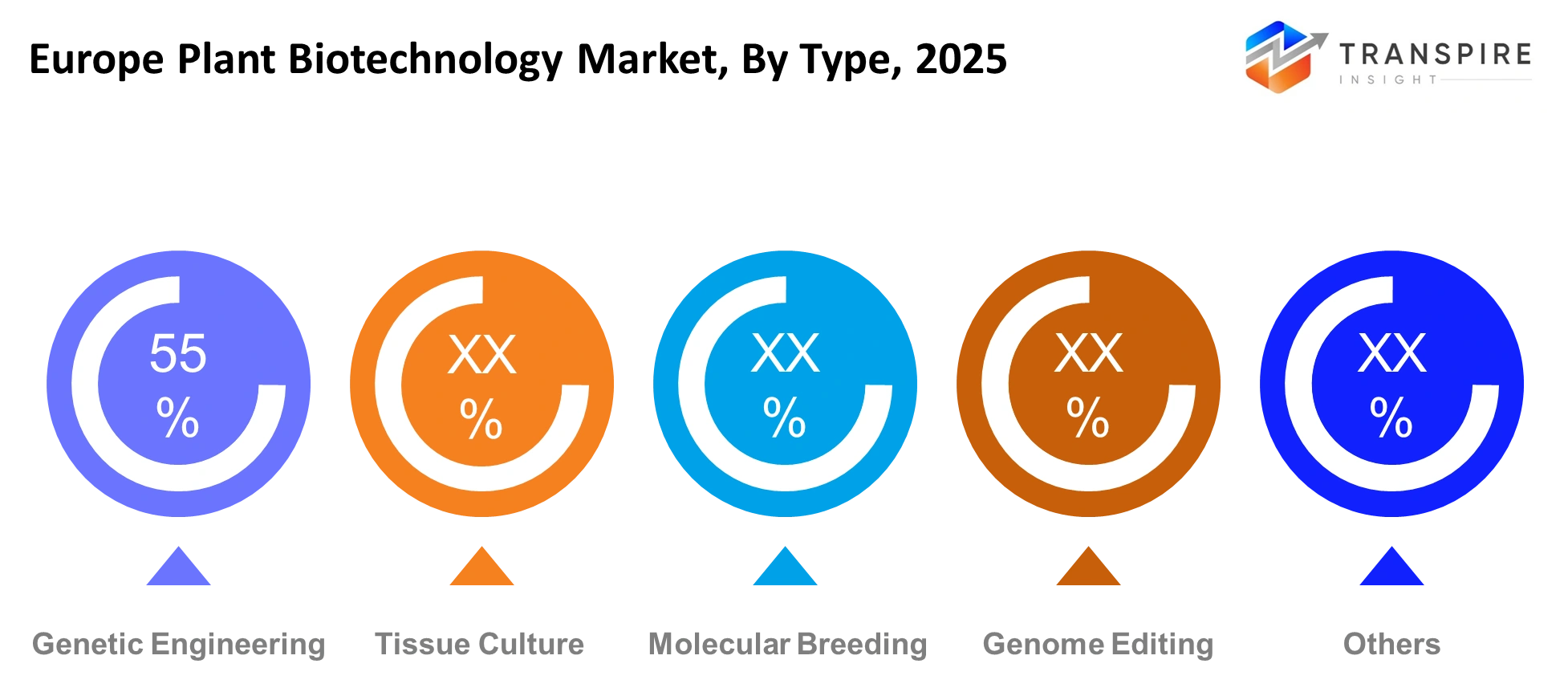
The market for genetic engineering and genome editing technologies exists because these processes create precise traits that companies can use for commercial purposes. Commercial growers depend on tissue culture because it provides them with fast and safe methods to produce disease-free plants which they need for their operations. Companies use molecular breeding to develop new products because they want small improvements that do not need approval from regulatory bodies. CRISPR-based genome editing methods are becoming more popular because recent policy talks showed that government officials will apply more flexible rules.
The market demands technologies which help companies shorten their product development cycles while decreasing their operational expenses. Organizations need to establish clear regulations about transgenic methods because these unclear rules prevent wider implementation of these methods. The future will develop a hybrid system which combines genome editing with molecular breeding methods to create a system which allows manufacturers to achieve their operational goals while meeting their control obligations. Investors will choose to invest in platforms which provide quick validation of traits and support large-scale seed production.
To learn more about this report, Download Free Sample Report
By Application
The primary agricultural application of crop improvement research which leads to increased crop yields provides essential food resources to guarantee food supply security. The second most important research area focuses on disease resistance and yield improvement which European farmers need because they face climate change and pest difficulties. Food companies today value nutritional improvement because it enables them to create unique products that customers will pay more for. The biofuel industry operates as a specialized market which is growing because energy diversification regulations are being enforced.
Different applications require distinct growth patterns because most funding goes to staple crops which provide quick financial benefits. People choose to adopt food-related technologies based on their understanding of regulations and how they perceive those technologies. Scientists predict that future agricultural development will create crops which combine improved nutritional value with advanced breeding methods. This new approach to seed development will lead farmers to create seed collections which can deliver both production benefits and competitive advantages in sales.
By End-User
The agricultural companies and seed producers control commercialization and distribution because they operate the business through their distribution channels. Research institutes and universities perform essential tasks which help develop new technologies because they receive public funding and utilize collaborative programs. Government agencies create adoption barriers through their regulatory system and their financial allocation policies. Biotech startups expand their business operations by developing market offerings that include specialized technologies and niche trait capabilities.
Large agribusinesses concentrate on established scalable solutions while research organizations dedicate their efforts to developing new technologies according to demand patterns. Research funding sources and regulatory approval processes create obstacles which delay the transition from research activities to commercial applications. The upcoming period will require private companies and academic institutions to create stronger partnerships which will help speed up research development into products for the market. The current trend creates a system which enables various organizations to work together for their innovation efforts.
By Technology
The technology of CRISPR, together with marker-assisted selection enables efficient trait development through its ability to shorten breeding cycles. RNA interference together with gene cloning remains important for their use in pest resistance and functional gene research. The breeding method of marker-assisted selection attracts breeders because it enables them to achieve better results without having to deal with complex government regulations. The cost of CRISPR technology has decreased while its precision has improved because of increasing financial support for research.
Companies require data-driven breeding technologies because they use digital tools to conduct biological research. The system faces two main restrictions because it handles fragmented data while different regions have different standards for their regulatory practices. Gene editing technology and digital analytics will join together to create predictive breeding systems which will speed up the process of product development. Manufacturers and investors are expected to align strategies around integrated technology platforms that combine biology with data intelligence.
What are the Key Use Cases Driving the Europe Plant Biotechnology Market?
The primary application of crop improvement exists because European agricultural systems require reliable crop yields to withstand drought conditions and high temperatures and pest infestations. The seed industry together with major agricultural companies relies on biotechnology to achieve stable production while maintaining profitability during unpredictable growing conditions.
Food processors and agribusiness companies that want to create unique and expensive products now show interest in disease-resistant crops and nutritional improvement applications. Energy-related agricultural businesses are developing biofuel crops as they work to meet the requirements of renewable fuel policies.
Current use cases investigate climate-adaptive features through research on carbon-efficient agricultural plants and soil-improving crop varieties. Research institutions together with biotech startups investigate these fields to achieve compliance with emerging sustainability regulations while pursuing lasting agricultural development objectives.
|
Report Metrics |
Details |
|
Market size value in 2025 |
USD 5.3 Billion |
|
Market size value in 2026 |
USD 5.6 Billion |
|
Revenue forecast in 2033 |
USD 9.3 Billion |
|
Growth rate |
CAGR of 7.52% from 2026 to 2033 |
|
Base year |
2025 |
|
Historical data |
2021 - 2024 |
|
Forecast period |
2026 - 2033 |
|
Report coverage |
Revenue forecast, competitive landscape, growth factors, and trends |
|
Regional scope |
Europe (Germany, United Kingdom, France, Italy, Spain and Rest of Europe) |
|
Key company profiled |
Bayer, Syngenta, Corteva, BASF, Limagrain, KWS, Takii, Sakata, Rijk Zwaan, Vilmorin, Advanta Seeds, DLF Seeds, Bioceres, Arcadia Biosciences, Evogene. |
|
Customization scope |
Free report customization (country, regional & segment scope). Avail customized purchase options to meet your exact research needs. |
|
Report Segmentation |
By Type (Genetic Engineering, Tissue Culture, Molecular Breeding, Genome Editing, Others); By Application (Crop Improvement, Disease Resistance, Yield Enhancement, Biofuel Production, Nutritional Enhancement, Others); By End-User (Agricultural Companies, Research Institutes, Seed Companies, Universities, Government Agencies, Others); By Technology (CRISPR, RNAi, Marker-assisted Selection, Gene Cloning, Others). |
Which Regions are Driving the Europe Plant Biotechnology Market Growth?
The market currently sees Western Europe as its leading region because it possesses both established regulatory systems and sufficient public funding which supports agricultural research. Biotech regulations in Germany France and the Netherlands establish structured systems which enable controlled use of biotechnological products and their commercial development. Research institutes together with seed companies and agritech firms maintain a research ecosystem which develops new products through ongoing innovative activities. The existing supply chains together with capital availability provide the region with advantages which support its market leadership and speed up the implementation of new agricultural technologies.
Northern Europe shows stable economic development through its continuous contributions which Denmark and Sweden use to achieve their environmental sustainability objectives. The region uses biotechnology to develop its agricultural systems through a gradual process which differs from Western European countries that use biotechnological methods to expand their agricultural operations. The public sector together with the private sector invests because the country shows strong economic stability and its government maintains consistent rules. The process of implementation develops at a steady pace which creates dependable outcomes that generate income throughout the year without experiencing major fluctuations.
Agricultural modernization together with increased funding has resulted in Eastern Europe becoming the fastest-growing region since 2022. The governments from Poland and Romania have increased their investment activities in advanced seeds together with biotechnology solutions which help drive productivity improvements. The current shift occurred because supply chain breakdowns revealed the dangerous dependence on foreign products and demonstrated the necessity of establishing domestic supply chain capacity. The expansion of this region between 2026 and 2033 will provide fresh business opportunities for companies and investors who want to establish operations in this market.
Who are the Key Players in the Europe Plant Biotechnology Market and How Do They Compete?
The Europe Plant Biotechnology Market exhibits a semi-consolidated market structure which results from multinational agriscience corporations controlling essential seed technologies while small biotech firms and research-focused startups develop specific technological advancements. The existing companies maintain their market positions through extensive research development projects and their established distribution networks while new market players create disruptions in specialized markets that include gene editing and specialty traits. The primary competitive factor for businesses centers on their technological capabilities while regulatory compliance and ability to adapt to different regions serve as secondary competitive elements. Companies that can shorten development cycles and secure approvals faster gain a measurable commercial edge.
Bayer AG combines its integrated trait development approach with digital farming platforms which enable farmers to monitor their performance at the farm level. The integration of seed genetics with yield outcome measurement creates a unique value proposition for Bayer that helps the company maintain customer loyalty. BASF SE focuses on developing specific traits through its stress tolerance innovations while using its extensive European regulatory knowledge to expedite product development through approval processes. The Syngenta Group develops its business by forming partnerships with local distributors while funding hybrid seed research that develops climate-specific seeds for various European agricultural markets.
Corteva Agriscience focuses on developing gene editing technologies while its research partnerships with academic institutions help it achieve faster market entry for its products. KWS SAAT SE establishes its market niche through its extensive involvement in European cereal production and it invests significant resources into developing breeding programs that meet local soil and climate needs.
Company List
- Bayer
- Syngenta
- Corteva
- BASF
- Limagrain
- KWS
- Takii
- Sakata
- Rijk Zwaan
- Vilmorin
- Advanta Seeds
- DLF Seeds
- Bioceres
- Arcadia Biosciences
- Evogene
Recent Development News
In April 2026, the EU Biotech Act: The European Commission’s landmark proposal to strengthen biotechnology in Europe: The European Commission has advanced the EU Biotech Act, a landmark policy aimed at strengthening biotech innovation across Europe, including plant biotechnology and agricultural biotech applications. The Act introduces faster approvals for strategic biotech projects and stronger funding pathways to reduce Europe’s dependency on external innovation ecosystems. This is expected to directly benefit agri-biotech and plant science companies operating in Europe.
Source: https://www.whitecase.com
In March 2026, EU biotech funding reforms focus on scaling plant and industrial biotech SMEs: European institutions have expanded discussions on biotech SME funding mechanisms, emphasizing improved access to capital for startups working in plant biotechnology, bio-based materials, and sustainable agriculture technologies. The reform push aims to close Europe’s commercialization gap, where early-stage biotech firms struggle to scale despite strong research output.
Source: https://www.europabio.org
What Strategic Insights Define the Future of the Europe Plant Biotechnology Market?
The Europe Plant Biotechnology Market is moving toward precision-based shorter innovation cycles which rely on gene editing and data-driven breeding methods. The main driver behind this development process emerges from two factors which include relaxation of rules regarding new genomic methods and farmers requirement to maintain stable crop production during climate change. The market will favor platforms which combine biological research with digital testing because these platforms enable companies to launch products more quickly while achieving better business results.
The market faces an invisible danger because a few technology companies dominate the industry by controlling essential gene editing instruments and their corresponding trait databases. The market situation risks creating power disparities which would hinder smaller companies from participating in the market while it hampers overall industry growth. An opportunity has emerged to develop climate-adaptive crops which European Southern and Eastern regions need because funding and regulatory frameworks have become more accessible.
Market participants should invest in collaborative R&D models that combine local agronomic expertise with advanced gene editing capabilities to secure both regulatory acceptance and regional relevance.
Europe Plant Biotechnology Market Report Segmentation
By Type
- Genetic Engineering
- Tissue Culture
- Molecular Breeding
- Genome Editing
- Others
By Application
- Crop Improvement
- Disease Resistance
- Yield Enhancement
- Biofuel Production
- Nutritional Enhancement
- Others
By End-User
- Agricultural Companies
- Research Institutes
- Seed Companies
- Universities
- Government Agencies
- Others
By Technology
- CRISPR
- RNAi
- Marker-assisted Selection
- Gene Cloning
- Others
Frequently Asked Questions
Find quick answers to common questions.
The approximate Europe Plant Biotechnology Market size for the market will be USD 9.3 Billion in 2033.
The key segments of the Europe Plant Biotechnology Market are By Type (Genetic Engineering, Tissue Culture, Molecular Breeding, Genome Editing, Others); By Application (Crop Improvement, Disease Resistance, Yield Enhancement, Biofuel Production, Nutritional Enhancement, Others); By End-User (Agricultural Companies, Research Institutes, Seed Companies, Universities, Government Agencies, Others); By Technology (CRISPR, RNAi, Marker-assisted Selection, Gene Cloning, Others).
Major players in the Europe Plant Biotechnology Market are Bayer, Syngenta, Corteva, BASF, Limagrain, KWS, Takii, Sakata, Rijk Zwaan, Vilmorin, Advanta Seeds, DLF Seeds, Bioceres, Arcadia Biosciences, Evogene.
The current market size of the Europe Plant Biotechnology Market is USD 5.3 Billion in 2025.
The Europe Plant Biotechnology Market CAGR is 7.52%.
- Bayer
- Syngenta
- Corteva
- BASF
- Limagrain
- KWS
- Takii
- Sakata
- Rijk Zwaan
- Vilmorin
- Advanta Seeds
- DLF Seeds
- Bioceres
- Arcadia Biosciences
- Evogene
Recently Published Reports
-
Apr 2026
Cord Blood Banking Services Market
Cord Blood Banking Services Market Size, Share & Analysis Report By Type of Service (Collection, Processing, Storage), By Bank Type (Private Banks, Public Banks, and Hybrid Banks), By Component (Cord Blood, and Cord Tissue), By End User (Hospitals, Research Institutions, Biotechnology Companies, and Others) and Geography (North America, Europe, Asia-Pacific, Middle East and Africa, South and Central America), 2021 - 2031
-
Apr 2026
ELISA Processors Market
ELISA Processors Market Size, Share & Analysis Report By Type (Optical Filter ELISA Analyzer, and Optical Grating ELISA Analyzers), By Mode (Automated ELISA Analyzers, and Semi-Automated ELISA Analyzers), By Applications (Immunology, Vaccine development, Drug Monitoring, and Others), By End Users (Biotechnology Companies, Pharmaceutical Companies, Contract Research Organization, and Diagnostic Laboratories) and Geography (North America, Europe, Asia-Pacific, Middle East and Africa, South and Central America), 2021 - 2031
-
Apr 2026
Microscope Slide Scanner Market
Microscope Slide Scanner Market Size, Share & Analysis Report By Type (Portable Microscope Slide Scanner, and Desktop Microscope Slide Scanner), By Application (Biological Research, Medicine, Veterinary, and Other) and Geography (North America, Europe, Asia-Pacific, Middle East and Africa, South and Central America), 2021 - 2031
-
Apr 2026
Microwave Cookware Market
Microwave Cookware Market Size, Share & Analysis Report By Material Type (Plastic, Glass, Ceramic, Silicone, and Metal), By Application (Cooking, Reheating, and Defrosting), By End User (Household, Commercial (Restaurants, Hotels, and Cafes), and Food Service Industry), By Sales Channel (Online Retail, Offline Retail (Supermarkets, Hypermarkets, Specialty Stores), and Direct Sales (Company Outlets)) and Geography (North America, Europe, Asia-Pacific, Middle East and Africa, South and Central America), 2021 - 2031