
Asia Pacific Industrial Internet Of Things Market Size & Forecast:
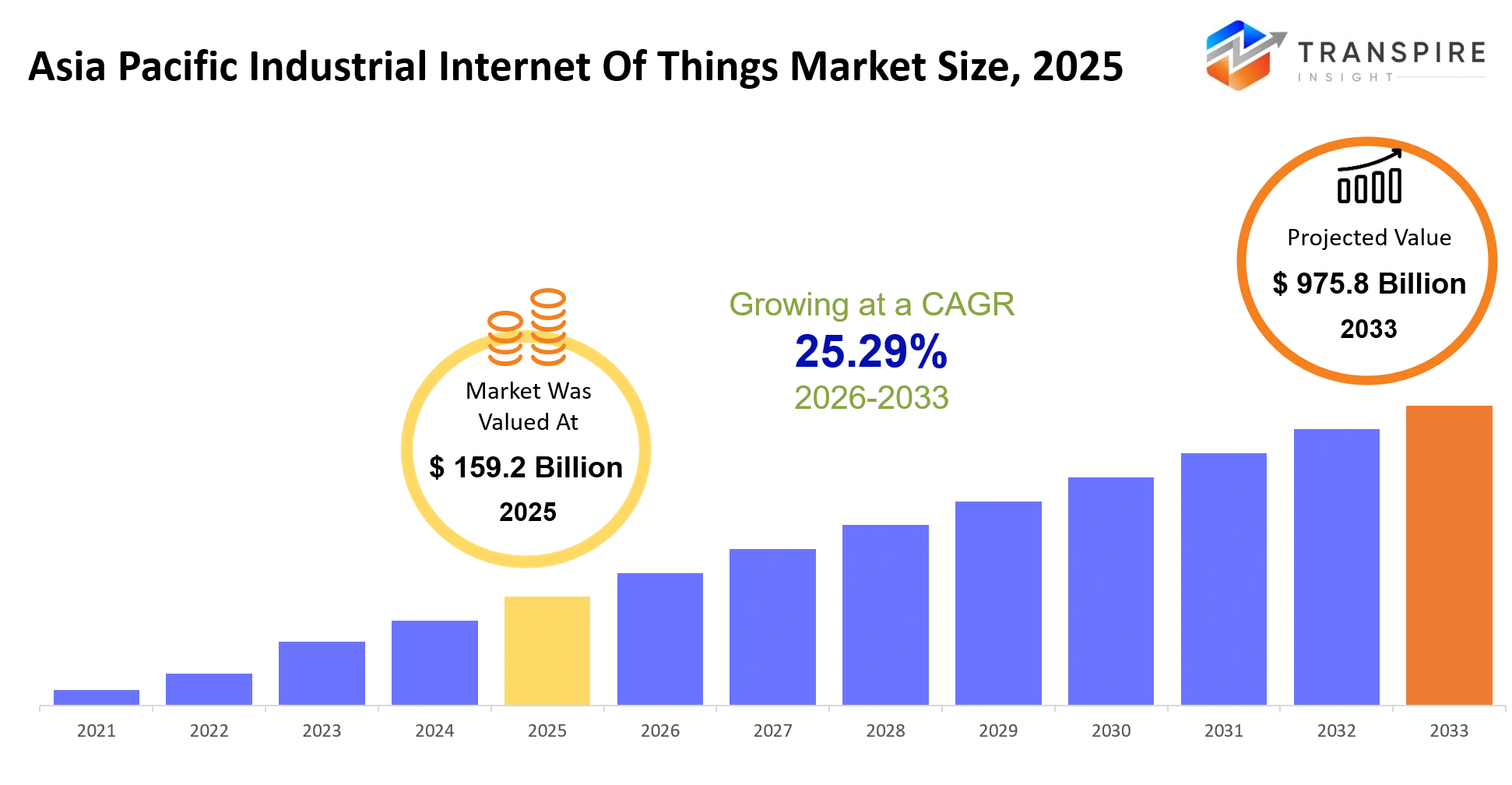
- Asia Pacific Industrial Internet Of Things Market Size 2025: USD 159.2 Billion
- Asia Pacific Industrial Internet Of Things Market Size 2033: USD 975.8 Billion
- Asia Pacific Industrial Internet Of Things Market CAGR: 25.29%
- Asia Pacific Industrial Internet Of Things Market Segments: By Component (Hardware, Software, Services, Sensors, Gateways, Platforms, Analytics, Others); By Application (Predictive Maintenance, Asset Management, Smart Manufacturing, Energy Management, Logistics, Others); By Deployment (Cloud, On-Premise, Hybrid, Edge Computing, Others); By End User (Manufacturing, Energy, Transportation, Healthcare, Others).
Asia Pacific Industrial Internet Of Things Market Summary
The Asia Pacific Industrial Internet Of Things Market was valued at USD 159.2 Billion in 2025. It is forecast to reach USD 975.8 Billion by 2033. That is a CAGR of 25.29% over the period.
The Asia Pacific Industrial Internet of Things (IIoT) market allows manufacturers, utilities, mining operations, and logistics operators to link their machines, sensors, and production lines to provide real-time monitoring, predictive failure, and optimize operations. The effect in the real time environment results in less unplanned downtime, decreased maintenance cost and increased efficiency of production across the complicated industrial area. During the last five years the market shifted from isolated automation implementations to integrated digital factories with integration of edge computing,
Artificial intelligence and cloud-based analysis. In reality the crisis of Covid-19 accelerated investment into remote operation and resilience in production systems and demonstrated many weaknesses in the labor intensive operations. IIoT deployments now are moving from pilot stages to whole enterprise platforms to provide recurrent revenue of software, connectivity and service to accompany hardware sale due to the customers endeavoring on higher productivity and flexible supply chains.
Key Market Insights
- Manufacturing using AI, cloud analytics and edge computing on shop floors and industrial equipment drives growth in the Asia Pacific Industrial Internet Of Things Market.
- Millions of sensor inputs are generated daily in connected factories leading to decisions being made in real-time, thus improving equipment uptime by 20% to 40%.
- China holds over 45% share in the regional market in 2025 with strong growth supported by China's vast manufacturing capacity along with its digitally-driven industry transformation.
- South East Asia is the fastest-growing segment through 2030 fueled by increased investments in industries across Vietnam, Indonesia, and Thailand.
- The solutions segment holds almost 55% share with the enterprise, focusing more on industrial software, analytics, and connected systems.
- The second highest share is held by the services segment due to its system integration, consulting and cybersecurity services.
- Edge computing and AI enabled analytics are the fastest growing segments and will increase adoption between 2025-2030 as demand grows for low latency industrial applications.
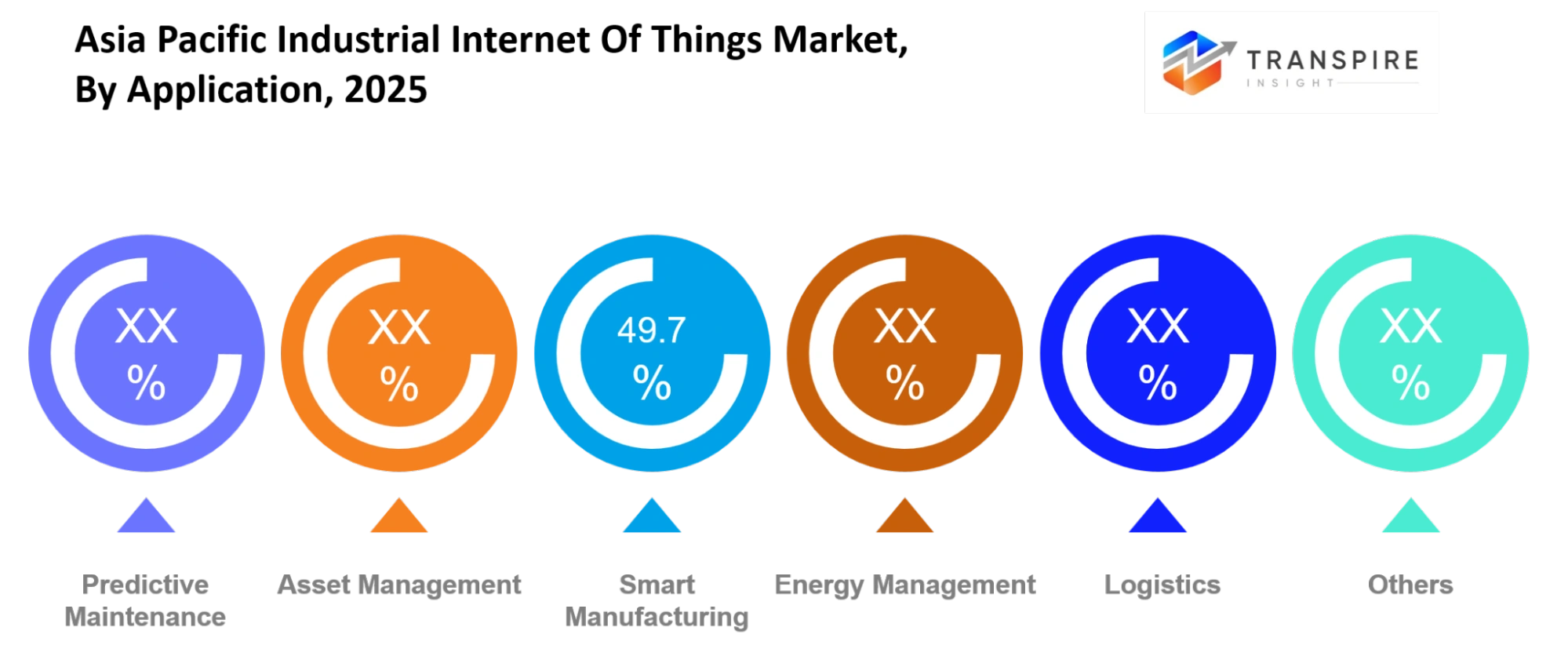
- Manufacturing continues to be the major application segment dominating about 35% revenue share in the Asia Pacific Industrial Internet Of Things Market in 2025.
- The energy and utilities sector is the fastest growing application as it focuses more on smart grid upgradation and predictive asset management is being identified as a key priority area.
- Large enterprise is expected to be the dominant player in adoption by owning more than 60% market share as these organizations are better equipped for investments and already have established digital ecosystem.
What are the Key Drivers, Restraints, and Opportunities in the Asia Pacific Industrial Internet Of Things Market?
The largest driver of the Asia Pacific Industrial Internet Of Things Market is the shift towards smart manufacturing and data-driven industrial activities. Government initiatives to modernize factories in China, Japan, South Korea, and India, in conjunction with decreasing sensor costs and the continued development of cloud computing, have reduced capital costs, increasing ROI. Manufacturers are increasingly implementing interconnected machines and advanced analytics to optimize uptime, reduce energy consumption, and increase production. The resulting increased output and growing recurrent revenues are attractive for both software and industrial service companies.
The primary restraint for the market is the unintegrated state of industrial facilities in the region. Companies in the region continue to use older industrial equipment that does not integrate with current IIoT infrastructure, requiring significant capital investment, long implementation periods and unique technical skillsets. This structural barrier limits enterprise-wide adoption and overall revenues within the market.
The most significant opportunity for the market is the increase in AI enabled edge computing throughout newly industrialized nations within Southeast Asia. Efforts to transform industrial sites into smart factories throughout Vietnam, Indonesia and Thailand are beginning to be implemented; and machines with edge technology are able to compute information locally, reducing latency and reliance on the network, creating a boom.
What Has the Impact of Artificial Intelligence Been on the Asia Pacific Industrial Internet Of Things Market?
In the Asia Pacific Industrial Internet Of Things market, the use of artificial intelligence enables the transition of industrial production from reactive to predictive and automated decisions.Manufacturers use AI in conjunction with industrial sensors and edge devices to automatically monitor manufacturing processes, inspect product quality, and control manufacturing processes. Computer vision systems help detect product defects in real-time, and AI-based control systems optimize machine output and minimize power consumption automatically.
Machine learning models are widely used in the predictive maintenance market. Operators of industrial facilities analyze data of vibration, temperature, acoustic readings to predict equipment failures, thereby lowering maintenance costs and ensuring equipment availability. Moreover, in such industries as energy and mining, AI algorithms can optimize equipment efficiency and maximize equipment uptime. They also reveal inefficiencies that may be overlooked by traditional monitoring systems.
In terms of operational benefits, unplanned downtime, production output and energy efficiency were enhanced throughout industrial factories. There is still one significant constraint to its application: The use of legacy equipment in many factories has generated non-uniform quality data for training AI models and high installation costs. Because of the current market, large firms currently absorb most of its advantages, while smaller manufacturers adopt them relatively slowly.
Key Market Trends
- 2020-2025: From pilot IIoT to enterprise wide IIoT as remote operation and operational resilience become boardroom agenda in the manufacturing space.
- China took further leads from 2021 with accelerated investment in smart factories while South East Asian countries rose as an alternate hub for manufacturing and digitalization in manufacturing operations.
- Dramatic rise in Edge Computing: Industrial operators moved data processing closer to machines reducing latency and enabling quick response for operational processes.
- Subscriptions gaining favor over hardware: Since 2022 buyers are leaning towards buying IIoT platforms as a service rather than buying just the hardware pushing vendors to create recurring software and analytics revenue streams.
- Increased spending in industrial cyber security: High profile ransomware attacks highlighted the weaknesses of smart factories and critical infrastructure in Asia forcing significant investment in the sector post 2021.
- AI-powered predictive maintenance moving to mainstream: It moved from a 'lab experimentation' capability to mainstream strategy and manufacturers could now claim reducing unplanned downtime by 20-40%.
- Pandemic driven supply chain disruptions catalyzed growth in real-time asset tracking, digital twins, and connected logistics across manufacturing ecosystems.
- Siemens, ABB, Honeywell, and Schneider Electric are increasingly competing on the basis of an integrated AI platform as opposed to a mere automation product.
- Governments in Japan, South Korea, China and India enhanced stimulus packages to promote smart manufacturing between 2021-2025 pushing the digital transformation initiatives further.
Asia Pacific Industrial Internet Of Things Market Segmentation
By Component:
The hardware elements of industrial connectivity consist of controllers, communication devices and embedded systems. The software applications allows the monitoring and automation of industrial devices and data visualization, whilst services provides system installation, repair and updates. Sensors are the core of data acquisition in the industry and provide the data from industrial machines, while the gateways provide reliable and safe data transmission between devices and networks.
The platforms provide a single environment for managing assets and connected applications. Analytics interprets the data from industrial processes to produce useful insights in order to enhance operational performance and planning. The other components of industrial connectivity solutions include security tools and communication elements used for stable industrial functioning and improved performance across industries.
By Application:
Predictive maintenance allows the industries to prevent machine failure, minimize downtime, and reduce maintenance costs. Asset management ensures optimal use and tracking of assets in a plant, while smart manufacturing enables the connection of systems and machines for optimizing manufacturing performance, product quality and operational awareness.
Energy management optimizes energy usage, and logistics enables movement of products in the warehouses, transportation, and inventory. Other applications include quality monitoring and remote operations.
By Deployment:
Cloud deployment solutions allow industrial applications to leverage cloud for elasticity and scalability along with remote accessibility of the system. Companies are adopting the cloud systems for storing the large volume of data, and to take advantage of analytical systems without the high investments on hardware infrastructure. The cloud deployment systems will ease the upgrades of the software. It also improves the level of cooperation between production units situated at different locations.
On-Premise deployment provides better security for sensitive information within industrial environments and is suited to the organizations having high security compliances. Hybrid deployment utilizes the cloud and on-premise capabilities for industrial applications. Edge computing, along with other deployment models such as on-premise, cloud, hybrid are all targeted for various operational, and technical necessities of industrial deployment systems.
By End User:
The Manufacturing sector constitutes a huge end-user base with increased adaptation of connectivity for efficiency enhancement, improvement in machine performance, in the factories. Power & energy utilities utilize connectivity for maintaining an eye over the power generating devices, managing the electricity distribution, and increasing efficiency and controlling costs. Logistics, and transport organizations also integrate connectivity for vehicle and operational fleet management, infrastructure, and safety monitoring.
Health care is an expanding end-user base where connected devices help them track equipment and maintain operational efficiency. Other end-users include the utilities sector, agriculture and mining where the use of industrial connectivity helps the companies increase their asset productivity, control the expenses.
What are the Key Use Cases Driving the Asia Pacific Industrial Internet Of Things Market?
Preventive maintenance has been the largest use case to date across the Asia Pacific Industrial Internet of Things market. This practice leverages the connected sensors and analytic tools used in the manufacturing industry to keep track of equipment conditions and identify problems at an early stage, minimizing unintended down time and decreasing maintenance costs while maintaining regular factory production schedules.
Asset and energy management use cases have increased among utility firms, transportation firms, and industrial companies as companies look to leverage the use of connected networks to monitor real-time equipment behavior, while tracking the use of electrical energy to help companies save on operating costs amid fluctuating electricity costs.
Emerging use cases such as the use of digital twins and AI-driven edge computing have begun to emerge, with the former used by manufacturers to prototype new operations before making real changes and with the latter allowing smart operations to remain functional when access to networks or servers is difficult.
|
Report Metrics |
Details |
|
Market size value in 2025 |
USD 159.2 Billion |
|
Market size value in 2026 |
USD 201.4 Billion |
|
Revenue forecast in 2033 |
USD 975.8 Billion |
|
Growth rate |
CAGR of 25.29% from 2026 to 2033 |
|
Base year |
2025 |
|
Historical data |
2021 - 2024 |
|
Forecast period |
2026 - 2033 |
|
Report coverage |
Revenue forecast, competitive landscape, growth factors, and trends |
|
Regional scope |
Asia Pacific (India, China, Japan, Australia, South Korea, Rest of Asia Pacific) |
|
Key company profiled |
Siemens, ABB, Schneider Electric, Bosch, Cisco, Honeywell, IBM, Microsoft, SAP, Oracle, Hitachi, Rockwell Automation, PTC, GE Vernova, Huawei. |
|
Customization scope |
Free report customization (country, regional & segment scope). Avail customized purchase options to meet your exact research needs. |
|
Report Segmentation |
By Component (Hardware, Software, Services, Sensors, Gateways, Platforms, Analytics, Others); By Application (Predictive Maintenance, Asset Management, Smart Manufacturing, Energy Management, Logistics, Others); By Deployment (Cloud, On-Premise, Hybrid, Edge Computing, Others); By End User (Manufacturing, Energy, Transportation, Healthcare, Others). |
Which Regions are Driving the Asia Pacific Industrial Internet Of Things Market Growth?
China's largest market leadership in Asia Pacific is sustained by aggressive government focus on digitalizing industrial operations and the region's largest manufacturing industry. Investment in smart factories, industrial automation, and connected production lines were pushed forward by programs like Made in China 2025 to speed up development for industries including electronics, automotive and heavy machinery. The large scale rollout of 5G technology and expansion of the cloud infrastructure have reinforced connectivity across industrial sites. And a mature network of equipment vendors, software firms, telecom operators and research bodies further consolidated its leading market position.
Japan, the second biggest player, shows significant differences in its growth dynamics when compared with China. Operational stability, precision manufacturing and gradual digitalization efforts instead of rapid expansion are the core themes for Japanese industrial companies to drive its development. Consistent investment in the development of robots, factory automation and predictive maintenance, drive consistent uptake in industries like automotive, machinery and electronics sectors. Japan will continue to be a strong and reliable revenue source in the region market, by long-term capital investments and top-quality industrial infrastructure.
Southeast Asia is identified as the fastest-growing region due to manufacturers’ supply chain diversifications and the establishment of new production facilities in countries including Vietnam, Indonesia, and Thailand. Government incentive to upgrade the factories, enhance industrial competitiveness and establish industrial parks and smart manufacturing plans has accelerated adoption of connected technologies across various sectors. The rapid growth of this sector between 2026-2033 will provide immense potential and attractive opportunity to solution vendors and investors who look to achieve early market gains in developing the industrial market in this region.
Who are the Key Players in the Asia Pacific Industrial Internet Of Things Market and How Do They Compete?
The competition in the Asia Pacific Industrial Internet Of Things Market is moderately consolidated. The global automation firms such as Siemens, ABB, Schneider Electric and Honeywell are competing with local technology players and cloud platform providers in Asia Pacific. Technology capability has emerged as the key basis of competition as users look for integrated solutions including sensor technology, connectivity, analytics, artificial intelligence and cyber security. Leading companies defend their market share with established customer base and relationships with major clients while newer entrants are entering the market by focusing on niche applications and flexible deployment options.
Siemens provides digital twin technology, an integrated industrial software which links factory equipment and cloud-based data analysis. Siemens has also been expanding its footprint across Asia through co-operations with manufacturers and investment in smart manufacturing centers demonstrating a wide array of automation capability. ABB is leveraging its capability in robotics, electrification and industrial automation by integrating manufacturing operations on a common platform for continuous monitoring and optimizing the assets.Schneider Electric enhances energy-efficient industrial processes by connected software platform and edge control system to support industrial automation for customers to lower operating expenses and Honeywell has bolstered its position by deploying the industrial cyber security and predictive maintenance solutions along with advanced analytic functions tailored for processing industries, Both are expanding the regional presence through partnership with system integrator.
Company List
- Siemens
- ABB
- Schneider Electric
- Bosch
- Cisco
- Honeywell
- IBM
- Microsoft
- SAP
- Oracle
- Hitachi
- Rockwell Automation
- PTC
- GE Vernova
- Huawei
Recent Development News
In June 2026, Schneider Electric entered a strategic partnership with Foxconn to develop and scale infrastructure for next-generation AI data centers. The collaboration combines Foxconn's manufacturing and AI expertise with Schneider Electric's power, cooling, and energy management technologies, strengthening industrial digitalization and connected infrastructure across Asia Pacific.
Source: https://www.reuters.com/
In February 2026, ABB launched Automation Extended, an open and modular industrial automation ecosystem designed for advanced analytics, AI, and Industrial Internet of Things integration. The launch expands ABB's software-centric automation portfolio and enables manufacturers to modernize operations while maintaining continuity across existing industrial systems.
Source: https://new.abb.com/
What Strategic Insights Define the Future of the Asia Pacific Industrial Internet Of Things Market?
The Asia Pacific Industrial Internet Of Things market is evolving toward software-driven and automated industrial ecosystems where AI, edge, and connected assets function as a collective layer over factories, utilities, and supply chains. The driver is no longer just about productivity increases, but about an operator's resilience to the supply chain's decentralization and decreasing dependence on labor intensive activities.
The risk that is not immediately apparent is the consolidation of the industrial data and software platforms within few technology providers, potentially escalating the switching cost and vendor dependency risk of the enterprises in the long run. The opportunity that is not yet prominent is AI enabled edge solutions in Southeast Asia (where new industrial park and smart manufacturing development create the need for on-premise data processing). It will be beneficial to address a higher emphasis on interoperability platform and on partnerships in this region for long-term competitiveness and mitigating technology dependency risks.
Asia Pacific Industrial Internet Of Things Market Report Segmentation
By Component
- Hardware
- Software
- Services
- Sensors
- Gateways
- Platforms
- Analytics
By Application
- Predictive Maintenance
- Asset Management
- Smart Manufacturing
- Energy Management
- Logistics
By Deployment
- Cloud
- On-Premise
- Hybrid
- Edge Computing
By End User
- Manufacturing
- Energy
- Transportation
- Healthcare
Frequently Asked Questions
Find quick answers to common questions.
The Asia Pacific Industrial Internet Of Things Market size is USD 975.8 Billion in 2033.
Key segments for the Asia Pacific Industrial Internet Of Things Market are By Component (Hardware, Software, Services, Sensors, Gateways, Platforms, Analytics, Others); By Application (Predictive Maintenance, Asset Management, Smart Manufacturing, Energy Management, Logistics, Others); By Deployment (Cloud, On-Premise, Hybrid, Edge Computing, Others); By End User (Manufacturing, Energy, Transportation, Healthcare, Others).
Major Asia Pacific Industrial Internet Of Things Market players are Siemens, ABB, Schneider Electric, Bosch, Cisco, Honeywell, IBM, Microsoft, SAP, Oracle, Hitachi, Rockwell Automation, PTC, GE Vernova, Huawei.
The Asia Pacific Industrial Internet Of Things Market size is USD 159.2 Billion in 2025.
The Asia Pacific Industrial Internet Of Things Market CAGR is 25.29% from 2026 to 2033.
- Siemens
- ABB
- Schneider Electric
- Bosch
- Cisco
- Honeywell
- IBM
- Microsoft
- SAP
- Oracle
- Hitachi
- Rockwell Automation
- PTC
- GE Vernova
- Huawei
About the Authors

Mayur Shinde
I am Mayur Shinde, a Senior Research Analyst at Transpire Insight, specializing in the Automotive & Transportation and Information & Communication Technology (ICT) Industry. My work focuses on analyzing emerging market trends, technological advancements, competitive landscapes, and industry developments to deliver accurate, data-driven insights. I am passionate about transforming complex market information into clear, actionable content that helps businesses, professionals, and decision-makers stay informed and make confident strategic decisions.

Chakradhar Khansole
Chakradhar serves as the Research Director at Transpire Insight, bringing over 8 years of experience in technology, innovation, and strategic market intelligence. He specializes in transforming complex market data into actionable business insights that enable organizations to make informed, growth-oriented decisions. Recognized for his strategic vision and analytical expertise, Chakradhar leads high-impact research initiatives, delivering comprehensive market assessments, competitive intelligence, and forward-looking industry analysis.
Recently Published Reports
-
Apr 2026
3D Optical Profiler Market
3D Optical Profiler Market Size, Share & Analysis Report By Type (Desktop 3D Optical Profiler, and Portable 3D Optical Profiler), By Technology (Confocal Technology, and White Light Interference), By End-Use Industry (Manufacturing, Research Institutions, Automotive, Aerospace and Defense, Medical Devices, and Other), and Geography (North America, Europe, Asia-Pacific, Middle East and Africa, South and Central America), 2021 - 2031
-
Apr 2026
Depth Sensor Market
Depth Sensor Market Size, Share & Analysis Report By Type (Infrared Depth Sensors, Time-of-Flight (ToF) Sensors, Stereo Vision Sensors, Structured Light Sensors, Ultrasonic Depth Sensors), By Application (Automotive, Robotics, Gaming, Consumer Electronics, Industrial Automation, Healthcare, Security & Surveillance, Others), By End Users (Automotive Manufacturers, Consumer Electronics Companies, Healthcare Providers, Industrial Companies, Security Agencies, Gaming Companies, Robotics Companies, Others), and Geography (North America, Europe, Asia-Pacific, Middle East and Africa, South and Central America), 2021 – 2031
-
Apr 2026
Digital Manufacturing Market
Digital Manufacturing Market Size, Share & Analysis Report By Component (Hardware, Software, and Services), By Technology (Robotics, 3D Printing, Internet of Things (IoT), and Others), By Application (Automotive and Transportation, Aerospace and Defense, Consumer Electronics, Industrial Machinery, and Others), By Process Type (Computer-Based Designing, Computer-Based Simulation, Computer 3D Visualization, Analytics, and Others), and Geography (North America, Europe, Asia-Pacific, Middle East and Africa, South and Central America), 2021 – 2031
-
Apr 2026
Digital Visa Services Market
Digital Visa Services Market Size, Share & Analysis Report By Type (Individual Travelers, Group Travelers), By Application (Tourism, Business Travel, Others), and Geography (North America, Europe, Asia-Pacific, Middle East and Africa, South and Central America), 2021 – 2031