
South Korea Analytics as a Service Market Size & Forecast:
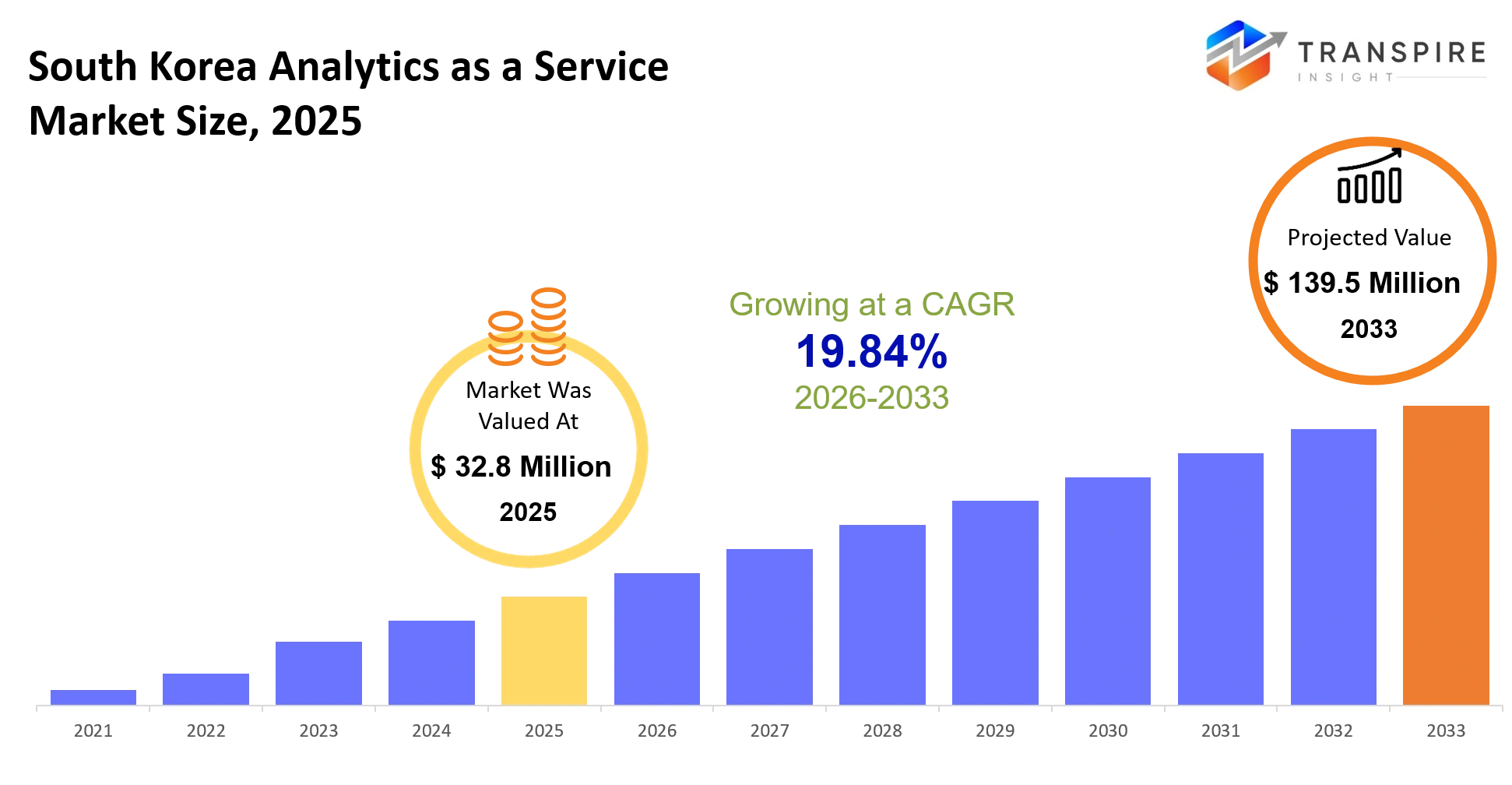
- South Korea Analytics as a Service Market Size 2025: USD 32.8 Million
- South Korea Analytics as a Service Market Size 2033: USD 139.5 Million
- South Korea Analytics as a Service Market CAGR: 19.84%
- South Korea Analytics as a Service Market Segments: By Deployment (Public Cloud, Private Cloud, Hybrid Cloud, Others); By Analytics Type (Predictive Analytics, Descriptive Analytics, Prescriptive Analytics, Others); By End User (BFSI, Retail, Healthcare, Manufacturing, Others)
To learn more about this report,  Download Free Sample Report
South Korea Analytics as a Service Market Summary
The South Korea Analytics as a Service Market was valued at USD 32.8 Million in 2025. It is forecast to reach USD 139.5 Million by 2033. That is a CAGR of 19.84% over the period.
South Korea’s Analytics as a Service (AaaS) market is basically helping enterprises turn huge amounts of operational , customer , financial and manufacturing data into “use it now” insights, w/out having to build a big internal analytics setup. In real life it lets manufacturers fine-tune their production lines, banks catch fraud a bit quicker , retailers sharpen demand forecasting, and telecom companies boost network performance using cloud-delivered analytics platforms, kind of like a ready-to-go toolkit.
Over the last five years , the market sort of moved away from the older on-premise business intelligence tools and more toward cloud-native analytics, and then sprinkle in artificial intelligence along with machine learning . One key reason for that shift was the operational disruption during and right after the COVID-19 period, which kinda showed the weaknesses in scattered data systems. And that pushed most firms to adopt the cloud faster , sometimes in a more pragmatic, not always fully planned way. When organizations started digitizing workflows and connecting more devices, data volumes grew quickly. That made the subscription-based analytics services argument much stronger, so adoption expanded , revenue became more recurring, and analytics got more deeply stitched into everyday decision-making across industries.
Key Market Insights
- Seoul Capital Area is pretty much running the South Korea Analytics as a Service market, making up around 55% and more of enterprise analytics spending, mostly because tech concentration is really thick there.
- Gyeonggi Province looks like the fastest improver during the forecast window, and it is backed by ongoing semiconductor, manufacturing, and AI infrastructure investments.
- When it comes to offerings, the Solutions part takes the lead with the biggest market share, since companies keep leaning on predictive analytics, reporting dashboards, and business intelligence tools.
- Services sit right behind it in the rankings, and that holds true due to the need for consulting work, implementation help, integration support and managed analytics assistance.
- Between 2025 and 2030, Managed and AI enabled analytics services are the quickest moving slice, because organizations want elastic know-how and scalable expertise, without having to build everything in-house.
- BFSI basically dominates the applications space , with something like an estimated 25%+ share, largely from fraud detection , risk analytics , customer intelligence, and those regulatory reporting workflows .
- Meanwhile manufacturing analytics is actually the fastest-growing category, pushed by smart factories, predictive maintenance, and industrial AI roll-outs.
- In terms of who buys, large enterprises tend to lead adoption, roughly around 60%+ of analytics platform spending, because they deal with huge data volumes , and pretty involved operations.
- SMEs, on the other hand, are the fastest-growing end user group , using subscription-based analytics platforms to curb both infrastructure expenses and that hard-to-find talent cost.
What are the Key Drivers, Restraints, and Opportunities in the South Korea Analytics as a Service Market?
The main thing pushing the South Korea Analytics as a Service Market forward is basically the fast stitching together of cloud computing and artificial intelligence inside everyday enterprise workflows. In the last several years, South Korean companies have been gradually moving away from secluded on‑premise data setups, since cloud infrastructure matured and AI tooling became actually usable on the market. This shift got an extra push from government led digital transformation programs, plus big spending on data foundations. When organizations start producing larger amounts of operational data and customer info, cloud based analytics services can roll out quicker and they usually need less upfront money than trying to build everything internally from scratch. Because of that, more companies—like banks, manufacturers, retailers, and telecom firms—are adopting these solutions, and service providers end up with steady subscription income, sort of month after month.
Still, data governance and regulatory compliance are the biggest structural hurdle for wider market growth. A lot of enterprises have tight rules around data protection, privacy obligations, and how data is handled across borders. In heavy regulated arenas such as banking, healthcare, and public administration, moving sensitive datasets to external analytics platforms means going through complicated compliance checks and sometimes redesigning whole systems. And honestly, these issues don’t just disappear fast, because they call for long term investments in security design, ongoing staff upskilling, and careful regulatory alignment. So deployment schedules can stretch quite a bit, which slows down adoption and tends to cap the revenue upside.
The strongest future opportunity is kind of in AI driven analytics for smart manufacturing, not just a side thing. South Korea keeps pushing investment into advanced semiconductor production, along with industrial automation, and connected factory infrastructure. so that overall environment is sort of ideal for predictive analytics to show measurable operational gains. More and more manufacturers are rolling out machine learning models to boost equipment utilization, cut down downtime, and fine tune production planning. And as smart factory initiatives grow larger, analytics as a service providers can snag new revenue by offering industry specific platforms that are shaped for industrial data environments.
What Has the Impact of Artificial Intelligence Been on the South Korea Analytics as a Service Market?
Artificial intelligence and advanced digital technologies are quietly changing the South Korea Analytics as a Service market, in the sense that organizations can stop doing everything as retrospective reporting only, and start making real-time operational decisions. Cloud based analytics platforms now increasingly use AI to automate data collection, anomaly detection, workflow monitoring, and compliance reporting across manufacturing plants, logistics networks, utilities, and financial institutions. Instead of depending on manual analysis, enterprises can keep watching operational metrics nonstop and get automated recommendations when performance drifts away from expected thresholds.
Machine learning models are gettin makin predictive abilities way stronger, these days. South Korean manufacturers are using predictive analytics to lift equipment failures before they really happen, which helps trim those unplanned downtime events, and ends up improving overall asset utilization. In logistics, and supply chain activities, AI models can forecast demand swings, figure out the right inventory requirements, and spot transportation bottlenecks ahead of time, so companies can fine tune resource allocation more efficiently. Then in finance, institutions roll out predictive algorithms to detect fraud patterns sooner, plus to evaluate credit risks with better precision, rather then wait till it’s too late.
All of these uses are showing clear, measurable operational wins. Many organizations report higher system uptime, quicker decision cycles, reduced maintenance costs, and more efficient use of resources. AI powered analytics also helps with regulatory compliance, because continuous monitoring and automated reporting features make the process more consistent.
However, one big limit stays there, the difficulty of blending AI models into older, legacy enterprise systems. A lot of organizations still run on disconnected data environments, almost like a patchwork, and that can dial down model accuracy. it also tends to stretch deployment timelines and push up implementation costs, before any real business value shows up in a meaningful way.
Key Market Trends
- Since 2021, South Korean enterprises have been moving away from on-premise analytics setups towards cloud-native platforms, largely to speed up deployment times, and cut down on infrastructure costs, even if the migration itself wasn’t always simple.
- After 2023, AI-powered analytics adoption really picked up steam, because many businesses started weaving generative AI, machine learning, and automated decision support into day to day operational workflows, not just standalone experiments.
- In manufacturing, companies have gone past the usual historical reporting too, and they’re deploying predictive maintenance models which can spot equipment failures before production disruptions actually happen.
- Meanwhile, financial institutions have been expanding their cloud analytics use from 2022 through 2025, aiming to improve fraud detection, risk management, and regulatory reporting readiness with less friction.
- Big tech providers Microsoft, Google Cloud, IBM, and Amazon Web Services — have also been boosting localized service offerings and upping partnership activity, kind of in step with that broader market shift.
- And organizations, more and more, prefer subscription based analytics platforms instead of heavy capital intensive software deployments, which ends up supporting more durable recurring-revenue models for the providers.
- In semiconductor and advanced manufacturing, smart factory investments have pushed analytics spending toward real-time operational intelligence and process optimization.
- At the same time, data governance requirements became much more influential after enterprises expanded cloud adoption, so the demand for secure, compliance-first analytics architectures grew noticeably.
- Also, companies are increasingly tying analytics platforms to IoT devices, letting them do continuous monitoring, and enabling faster operational responses across industrial environments. I
- In the end, competitive differentiation seems less about dashboard features, and more about AI automation, industry tuned analytics models, and tighter integration with the enterprise cloud ecosystem, so yeah the bar moved.
South Korea Analytics as a Service Market Segmentation
By Deployment :
Public Cloud is basically analytics platforms that are delivered via shared cloud infrastructure, which is handled by third party providers. In practice it lets teams get things running fast, scale up and down, and avoid big initial costs so it fits organizations who want analytics access sooner rather than later. On the other hand, Private Cloud uses dedicated infrastructure, so you get much more say over how data is managed, plus tighter security and compliance rules.
Then there is Hybrid Cloud, which mixes pieces from both public and private setups. That means a company can choose where workloads go depending on operational needs and regulatory conditions. It’s sort of a balance between flexibility and control , especially when sensitive information is involved. The Others category covers specialized deployment approaches, kinda designed for unusual operational situations, technical demands, or industry specific constraints that don’t really match the usual cloud patterns.
By Analytics Type :
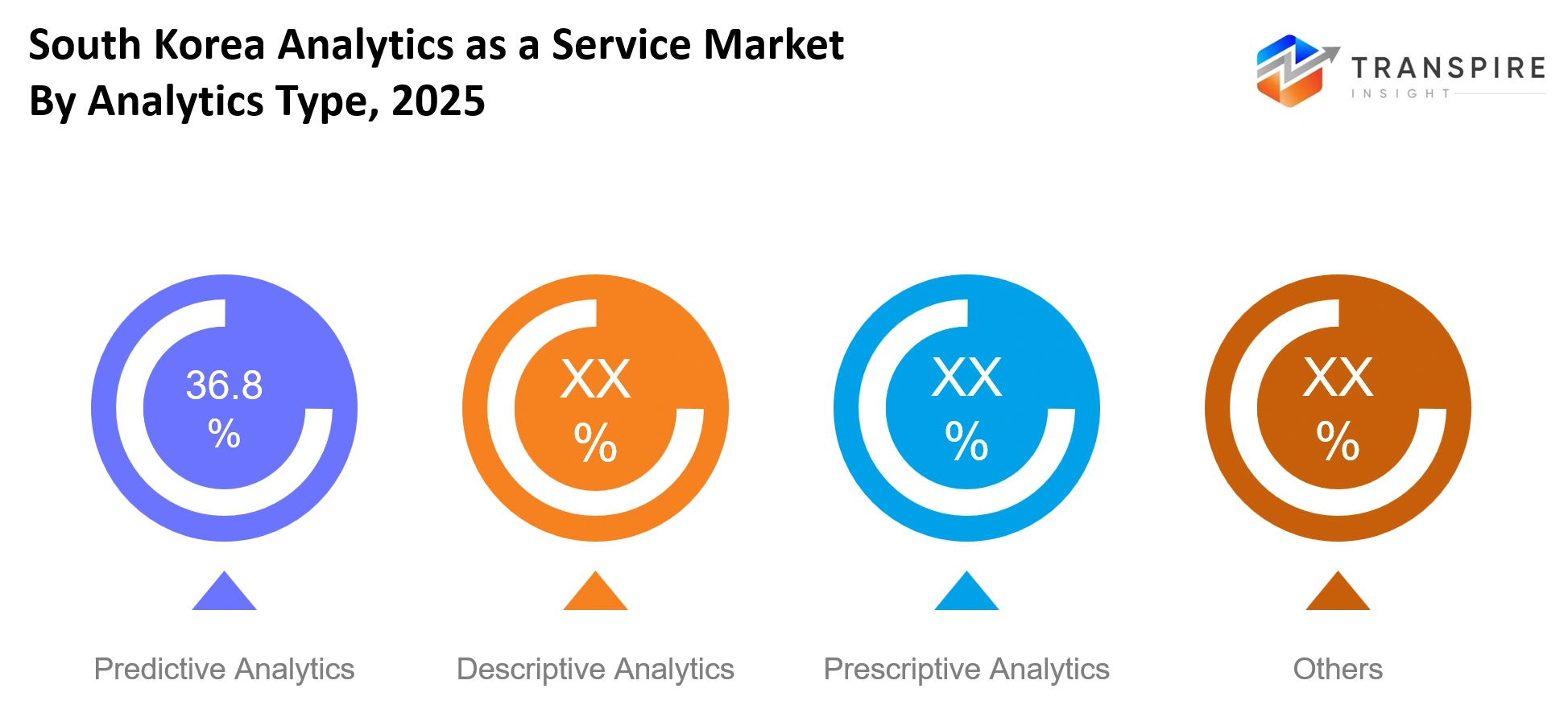
Predictive Analytics uses past and present data, and tries to spot patterns to estimate what might happen next. Companies lean on it for forecasting, risk evaluation, maintenance scheduling, and process upgrades. Descriptive Analytics is more about looking back and taking stock of current performance, so organizations can recognize trends, judge outcomes, and review what’s been happening across business activities.
Prescriptive Analytics takes it further than prediction. Instead of only saying what could happen, it also suggests what to do, so outcomes can be improved. With advanced algorithms and data models, it helps surface responses that match particular scenarios. The Others category here includes newer and more specialized analytics methods, meant for particular business problems—methods that can support deeper decision making across various industries.
To learn more about this report, Download Free Sample Report
By End User :
BFSI, which is a banking , financial services, and insurance organization, kinda leans on analytics solutions for fraud detection, customer insights , risk management, compliance monitoring, and financial planning . Retail businesses often use analytics to try and make sense of purchase behavior, support inventory control, tweak pricing methods, and strengthen customer engagement across various sales channels .
Healthcare outfits use analytics to back patient management, boost operational efficiency, handle resource allocation better, and support clinical decision making. Manufacturing companies depend on analytics so they can improve production planning, keep track of equipment performance, cut down downtime, and raise overall operational productivity too. The “Others” bucket covers sectors like telecommunications, education, logistics, government , and a bunch of service related industries where analytics is used to improve efficiency and enable data driven decisions.
What are the Key Use Cases Driving the South Korea Analytics as a Service Market?
The main use case in the South Korea Analytics as a Service Market is business intelligence mixed with operational analytics inside big enterprises, especially across BFSI. Financial institutions lean on cloud based analytics platforms to catch fraud, measure risk exposure, keep an eye on transactions, and also tighten up customer targeting. These activities pull in strong demand because they basically shape revenue protection , regulatory compliance, and even customer retention.
After financial services, the adoption is also starting to grow in manufacturing and retail, though it feels a bit more uneven in practice. In other words, manufacturers typically use these analytics platforms for predictive upkeep, production timing, and quality checking, whereas retailers pull in advanced analytics for demand projection, inventory equilibrium, and very targeted marketing.Together these efforts let companies react a bit faster to shifting market conditions, and day to day operational hurdles.
New use cases are starting to show up around AI driven decision automation and industrial IoT analytics. Smart factories are starting to connect equipment data, then blend it with machine learning models to optimize output in real time. One more interesting track is sustainability analytics, where organizations watch energy usage, emissions, and resource efficiency in order to hit corporate targets, and regulatory needs.
|
Report Metrics |
Details |
|
Market size value in 2025 |
USD 32.8 Million |
|
Market size value in 2026 |
USd 39.3 Million |
|
Revenue forecast in 2033 |
USD 139.5 Million |
|
Growth rate |
CAGR of 19.84% from 2026 to 2033 |
|
Base year |
2025 |
|
Historical data |
2021 - 2024 |
|
Forecast period |
2026 - 2033 |
|
Report coverage |
Revenue forecast, competitive landscape, growth factors, and trends |
|
Country scope |
South Korea |
|
Key company profiled |
IBM, Microsoft, Google Cloud, AWS, Oracle, SAP, SAS, Salesforce, Accenture, Deloitte, Cognizant, TCS, Infosys, HCLTech, Wipro |
|
Customization scope |
Free report customization (country, regional & segment scope). Avail customized purchase options to meet your exact research needs. |
|
Report Segmentation |
By Deployment (Public Cloud, Private Cloud, Hybrid Cloud, Others); By Analytics Type (Predictive Analytics, Descriptive Analytics, Prescriptive Analytics, Others); By End User (BFSI, Retail, Healthcare, Manufacturing, Others) |
Which Regions are Driving the South Korea Analytics as a Service Market Growth?
The Seoul Capital Area leads the South Korea Analytics as a Service Market, mostly because it pulls together the biggest financial institutions and technology firms , plus telecommunications providers and relevant government agencies. With national digital transformation programs in motion, and cloud infrastructure adoption staying strong, organizations in the region tend to pour more investment into advanced analytics platforms. Large data centers, research organizations and AI development hubs then form a kind of working ecosystem that helps teams keep innovating and rolling out enterprise deployments. Put together, this mix of technology spend, capable talent, and corporate headquarters keeps the region at the top, overall market wise.
The Southeast industrial belt including Busan, Ulsan, and Changwon acts as the second-largest regional contributor. Here, unlike the Seoul Capital Area, the pace of growth feels more anchored to manufacturing, logistics, automotive production, and other industrial operations, rather than financial services. Firms across this area have been taking up analytics tools to sharpen operational efficiency, strengthen supply chain visibility, and improve production scheduling. Long-standing industrial clusters and steady corporate investment make a durable base for continued market revenue, month after month, year after year.
In Chungcheong, the region is showing up as the fastest growing place for analytics service take up lately. With new investments going into semiconductor facilities, research parks, and the kind of advanced tech infrastructure that really matters, the pressure is rising for cloud based analytics, and AI driven insights. At the same time government support for digital innovation keeps getting expanded, and that has nudged organizations to modernize their data stewardship , and their day to day decision making. From 2026 to 2033, all this pace should keep building into real, promising chances for analytics providers, cloud vendors, as well as investors looking for exposure to those high growth technology markets.
Who are the Key Players in the South Korea Analytics as a Service Market and How Do They Compete?
Competition in the South Korea Analytics as a Service Market is moderately concentrated, with global cloud and analytics providers trading places in the arena with local technology firms. The market does not really pivot around pricing, so the whole thing is more about capability than cost, and yes it can feel a bit messy. Instead, firms tend to vie on artificial intelligence skills, the robustness of their cloud infrastructure, data protection features, industry-focused solutions, and also integration services that actually connect to what clients already run. More established players keep defending their positions via platform expansion and ecosystem development. Meanwhile newer entrants lean toward niche analytics applications and AI-driven automation, trying to stand out in a more targeted way.
Microsoft competes by leaning heavily on tight integration across Azure cloud services, analytics platforms, and generative AI tools. That setup lets organizations bring data management, analytics, and AI workflows into one shared workspace. Microsoft also pushes adoption through partnerships with enterprise customers and ongoing investments in AI infrastructure. Amazon Web Services differentiates with scalable cloud architecture and a wide portfolio of analytics services. This breadth supports businesses from early-stage startups to big enterprise groups. Ongoing expansion of cloud features plus AI offerings helps pull in organizations that want flexible deployment options, without too much friction.
Google Cloud leans heavily into advanced data analysis stuff, along with machine learning and real time processing capabilities. The whole strength in AI research kind of helps it provide rather sophisticated analytics functions, the sort that really pull in data heavy industries. IBM, on the other hand, puts a lot of attention on hybrid cloud environments and governance centered analytics, which ends up being especially useful for regulated areas like banking and healthcare . And then there’s Samsung SDS, they use solid local relationships and industry know how to push analytics solutions that are tailored for manufacturing, logistics, and enterprise digital transformation projects. That kind of nearby market awareness gives them an edge, because operational needs that are unique to South Korean organizations tend to be tricky.
Company List
- IBM
- Microsoft
- Google Cloud
- AWS
- Oracle
- SAP
- SAS
- Salesforce
- Accenture
- Deloitte
- Cognizant
- TCS
- Infosys
- HCLTech
- Wipro
Recent Development News
In April 2026, Samsung SDS secured an investment commitment from KKR through the purchase of US$820 million in newly issued convertible bonds. The investment includes strategic advisory support for mergers and acquisitions and expansion of Samsung SDS’s AI and analytics solutions portfolio, strengthening South Korea’s enterprise analytics and AI services ecosystem. Source https://www.reuters.com/
What Strategic Insights Define the Future of the South Korea Analytics as a Service Market?
The South Korea Analytics as a Service Market is kind of moving toward highly automated , AI native analytics ecosystems where data processing, forecasting, and decision support happen in real time, not so much through periodic reporting cycles. The real underlying driver for this change is the growing convergence of artificial intelligence, cloud infrastructure, industrial IoT, and overall enterprise digitization. As companies create bigger amounts of operational data, the competitive edge will depend less on just collecting it, and more on how well they can translate that data into immediate business actions.
There’s also a less obvious risk here, it’s about how analytics workloads are slowly concentrating among a smaller set of cloud and AI platform providers. That kind of setup can boost efficiency and speed up innovation, but it can also quietly amplify vendor dependency, raise switching costs, and make organizations more exposed to platform level disruptions or even policy shifts.
At the same time, a meaningful emerging opportunity is showing up with industry specific AI analytics platforms meant for semiconductor manufacturing, advanced electronics, and smart factory environments. These uses are still relatively early in adoption, but they’re well placed to matter more as industrial automation spending accelerates. Market players should probably focus on vertical specialization over broad platform offerings, building solutions tailored to specific operational pain points, where measurable productivity improvements can deliver stronger long term customer retention.
South Korea Analytics as a Service Market Report Segmentation
By Deployment
- Public Cloud
- Private Cloud
- Hybrid Cloud
By Analytics Type
- Predictive Analytics
- Descriptive Analytics
- Prescriptive Analytics
By End User
- BFSI
- Retail
- Healthcare
- Manufacturing
Frequently Asked Questions
Find quick answers to common questions.
The expected South Korea Analytics as a Service Market size is USD 139.5 Million in 2033.
Key segments for the South Korea Analytics as a Service Market are By Deployment (Public Cloud, Private Cloud, Hybrid Cloud, Others); By Analytics Type (Predictive Analytics, Descriptive Analytics, Prescriptive Analytics, Others); By End User (BFSI, Retail, Healthcare, Manufacturing, Others).
Major South Korea Analytics as a Service Market players are IBM, Microsoft, Google Cloud, AWS, Oracle, SAP, SAS, Salesforce, Accenture, Deloitte, Cognizant, TCS, Infosys, HCLTech, Wipro.
The South Korea Analytics as a Service Market size is USD 32.8 Million in 2025.
The South Korea Analytics as a Service Market CAGR is 19.84% from 2026 to 2033.
- IBM
- Microsoft
- Google Cloud
- AWS
- Oracle
- SAP
- SAS
- Salesforce
- Accenture
- Deloitte
- Cognizant
- TCS
- Infosys
- HCLTech
- Wipro
About the Authors

Mayur Shinde
I am Mayur Shinde, a Senior Research Analyst at Transpire Insight, specializing in the Automotive & Transportation and Information & Communication Technology (ICT) Industry. My work focuses on analyzing emerging market trends, technological advancements, competitive landscapes, and industry developments to deliver accurate, data-driven insights. I am passionate about transforming complex market information into clear, actionable content that helps businesses, professionals, and decision-makers stay informed and make confident strategic decisions.

Chakradhar Khansole
Chakradhar serves as the Research Director at Transpire Insight, bringing over 8 years of experience in technology, innovation, and strategic market intelligence. He specializes in transforming complex market data into actionable business insights that enable organizations to make informed, growth-oriented decisions. Recognized for his strategic vision and analytical expertise, Chakradhar leads high-impact research initiatives, delivering comprehensive market assessments, competitive intelligence, and forward-looking industry analysis.
Recently Published Reports
-
Apr 2026
3D Optical Profiler Market
3D Optical Profiler Market Size, Share & Analysis Report By Type (Desktop 3D Optical Profiler, and Portable 3D Optical Profiler), By Technology (Confocal Technology, and White Light Interference), By End-Use Industry (Manufacturing, Research Institutions, Automotive, Aerospace and Defense, Medical Devices, and Other), and Geography (North America, Europe, Asia-Pacific, Middle East and Africa, South and Central America), 2021 - 2031
-
Apr 2026
Depth Sensor Market
Depth Sensor Market Size, Share & Analysis Report By Type (Infrared Depth Sensors, Time-of-Flight (ToF) Sensors, Stereo Vision Sensors, Structured Light Sensors, Ultrasonic Depth Sensors), By Application (Automotive, Robotics, Gaming, Consumer Electronics, Industrial Automation, Healthcare, Security & Surveillance, Others), By End Users (Automotive Manufacturers, Consumer Electronics Companies, Healthcare Providers, Industrial Companies, Security Agencies, Gaming Companies, Robotics Companies, Others), and Geography (North America, Europe, Asia-Pacific, Middle East and Africa, South and Central America), 2021 – 2031
-
Apr 2026
Digital Manufacturing Market
Digital Manufacturing Market Size, Share & Analysis Report By Component (Hardware, Software, and Services), By Technology (Robotics, 3D Printing, Internet of Things (IoT), and Others), By Application (Automotive and Transportation, Aerospace and Defense, Consumer Electronics, Industrial Machinery, and Others), By Process Type (Computer-Based Designing, Computer-Based Simulation, Computer 3D Visualization, Analytics, and Others), and Geography (North America, Europe, Asia-Pacific, Middle East and Africa, South and Central America), 2021 – 2031
-
Apr 2026
Digital Visa Services Market
Digital Visa Services Market Size, Share & Analysis Report By Type (Individual Travelers, Group Travelers), By Application (Tourism, Business Travel, Others), and Geography (North America, Europe, Asia-Pacific, Middle East and Africa, South and Central America), 2021 – 2031