
Asia Pacific Aerospace Parts Manufacturing Market Size & Forecast:
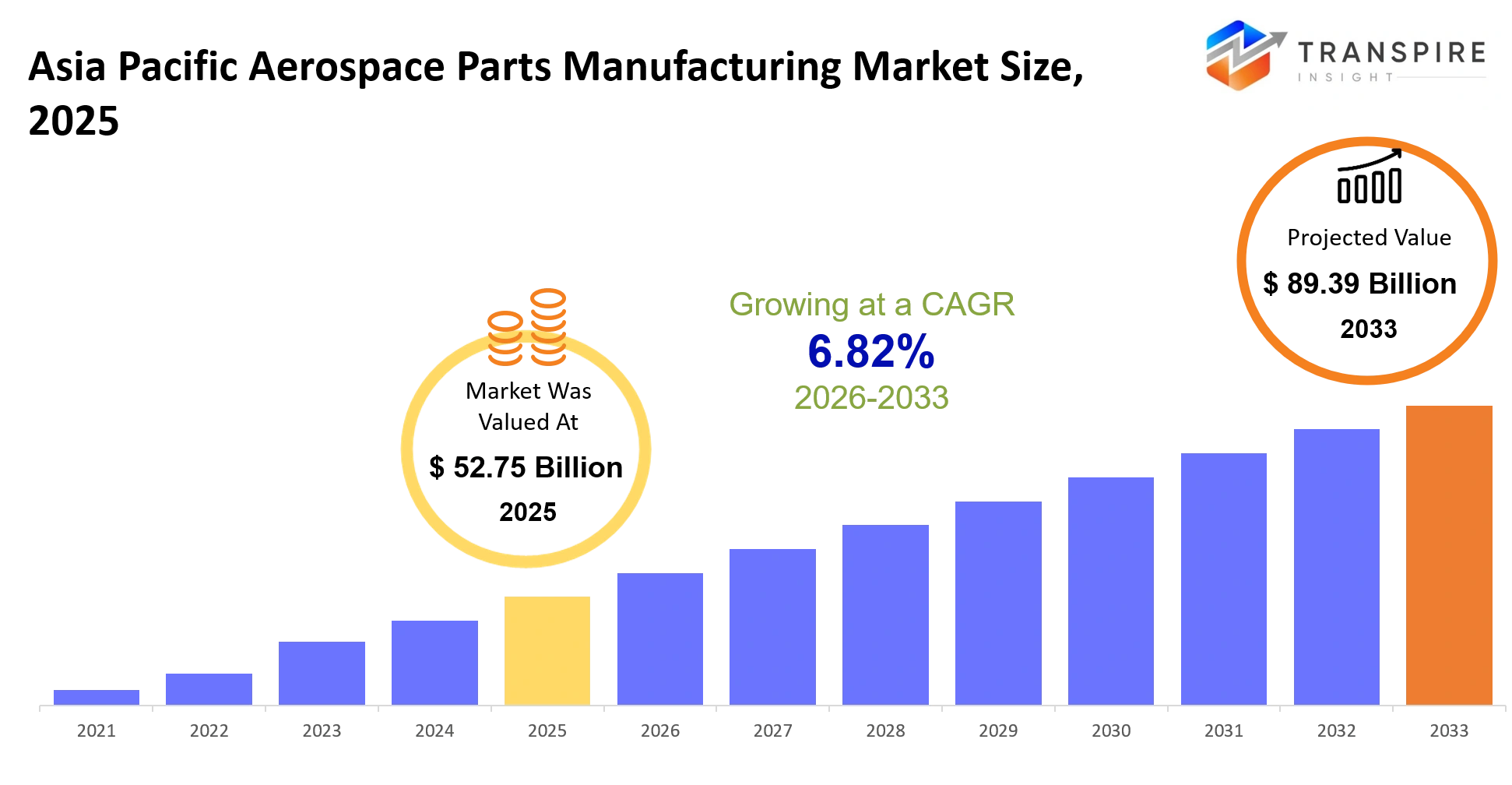
- Asia Pacific Aerospace Parts Manufacturing Market Size 2025: USD 52.75 Billion
- Asia Pacific Aerospace Parts Manufacturing Market Size 2033: USD 89.39 Billion
- Asia Pacific Aerospace Parts Manufacturing Market CAGR: 6.82%
- Asia Pacific Aerospace Parts Manufacturing Market Segments: By Part Type (Engine Components, Airframe Parts, Landing Gear Components, Avionics Components, Cabin Interior Parts, Fasteners, Composite Parts, Others); By Material (Aluminum Alloys, Titanium Alloys, Composite Materials, Steel Alloys, Nickel Alloys, Thermoplastics, Advanced Ceramics, Others); By Aircraft Type (Commercial Aircraft, Military Aircraft, Business Jets, Helicopters, UAVs, Regional Aircraft, Cargo Aircraft, Others); By End User (OEMs, MRO Providers, Defense Organizations, Airlines, Aircraft Leasing Companies, Space Agencies, Component Suppliers, Others).
Asia Pacific Aerospace Parts Manufacturing Market Summary
The Asia Pacific Aerospace Parts Manufacturing Market was valued at USD 52.75 Billion in 2025. It is forecast to reach USD 89.39 Billion by 2033. That is a CAGR of 6.82% over the period.
Asia Pacific aerospace parts manufacturing creates precision components including engine parts, airframes structures, landing gear assemblies and avionics housing that supports the commercial and defense aircraft throughout the life cycle: production, maintenance, and overhaul. Over the last 3-5 years, market has structurally moved toward localized and regionalized supply chain as OEMs and tier suppliers move away from single source Western centers. However, the logistic vulnerability has been further amplified by the COVID-19 pandemic, which resulted in intensified investments on domestic machining capacity, additive manufacturing, and certified supplier bases in countries such as India, Japan and China. This is evident in shorter qualification cycle time, longer order book coverage and enhanced transparency for regional vendors. Fleet renewal, and defense requirements are now becoming the drivers, as carriers resume growth and nation-states focus on defense self-sufficiency. This means that revenues growth is moving away from being driven by cyclical recovery and becoming more correlated with stable localized supply chain production network that satisfies long-term aerospace demand.
Key Market Insights
- China has the largest market share in the Asia Pacific Aerospace Parts Manufacturing Market with about 38% share in 2025, driven by extensive OEM integration and enhancement of defense manufacturing capabilities.
- India will grow at a significant pace between 2024-2030 and the fastest region, which will be fueled by investments in Make in India aerospace manufacturing.
- Strong precision engineering exports from Japan and South Korea ensure a robust high-value aerospace component production ecosystem.
- Airframe components will dominate with around 41% market share in 2025 due to continuous demand for commercial aircraft production by Asia Pacific Aerospace manufacturing industry.
- Engine components will stand as the second largest segment, aided by long-term maintenance contracts and efficiency upgrade of turbines.
- Additive manufacturing parts account for the highest growing segment until 2030 attributed to the adoption of light weight materials.
- The commercial aviation market accounts for approximately 55% share in the market which is primarily due to increasing traffic of regional air passengers.
- Defense aviation captures the highest growing application owing to the increasing procurement and native fighter aircraft development.
- OEM manufacturers contribute to the highest market share which accounts to ~48% driven by established integrated manufacturing systems in Asia Pacific Aerospace Parts Manufacturing Market.
- MRO providers contribute to the highest growing end user group with an increasing aging aircraft fleet and frequency of aircraft maintenance cycle.
What are the Key Drivers, Restraints, and Opportunities in the Asia Pacific Aerospace Parts Manufacturing Market?
Rapid airframe structure, engine module and precision machining parts manufacturing growth, fueled by the quickening replacement cycle of the airline and military fleet as a result of capacity crunch post pandemic is a key driver. The larger order sizes placed by airliners to replace the older fleet are expected to strengthen the long-term sourcing outlook of regional vendors and boost capacity utilization of manufacturing clusters in China, India and Japan.
High level of certification barriers coupled with complexity to comply with aerospace-grade manufacturing standards will remain a significant constraint for the market, supplier approval cycles may stretch over many years as the certification process requires validation with regards to safety critical aspects, traceability, and vendor specific OEM specifications. This is a structural constraint that creates an entry barrier for new entrants into the market and leads to revenue realization delays even after having the production capacity.
Growth of additive manufacturing in certified flight components-particularly in India and Southeast Asia-- represents a significant opportunity. Investment in 3D printing of metals (metal 3D printing centers, investment in digital twin enabled design validation) will bring down the time to build prototypes and to locally produce complicated geometries. This trend, in turn, will boost production velocity and new high margin market segments.
What Has the Impact of Artificial Intelligence Been on the Asia Pacific Aerospace Parts Manufacturing Market?
The Asia Pacific Aerospace Parts Manufacturing Market is evolving due to AI technology implementation within its production and maintenance framework through its integrated use of predictive analysis, automation, and digital twins. Manufacturers are employing AI enabled visual detection systems for inspection automation on turbine blades, fuselage components, landing gear assemblies, and more to quickly analyze and flag potential failures, dramatically shortening quality inspection time with higher consistency in high volume environments.
Machine learning algorithms are increasingly implemented for predictive maintenance for both manufacturing equipment and individual aircraft parts that predict future component failures based on worn patterns within the part. AI enabled digital twin systems are currently utilized within advanced aerospace clusters like Japan and Singapore to test stress loads and flight performance within individual components during varied flight scenarios. This reduces prototyping iteration times and enables optimized design solutions for aerodynamic components to enable fuel efficiency and saves about 20-30% on prototyping iterations.
The implementation of AI has also seen increased operational efficiency in production up-time and decreasing maintenance inspection costs through automation of Non-Destructive Testing processes and real-time anomaly detection; though the overall cost associated with implementing AI technology in a legacy aerospace manufacturing infrastructure can still be an obstacle. Many current facilities rely on disparate data structures which hinders the ability of the model to achieve real-time training or scalability.
Key Market Trends
- Asian Pacific Aerospace manufacturers diversified from imported parts sourcing to integrated manufacturing hubs for components from 2020 to 2025.
- OEM's doubled their dual-sourcing strategies post 2021 supply shortage events; they reduced their dependence on single western suppliers for critical aerospace components.
- The uptake of digital manufacturing gained momentum post 2022, AI-powered inspection systems replaced manual quality control of precision machining lines.
- Defense procurement booms for India and South Korea post 2023, accelerated indigenous engine and avionics component manufacturing need.
- Additive manufacturing has transitioned from trials to certified production applications for lightweight structural components post 2020 by 2025.
- Supply chain regionalization expanded post Covid-19, and Japan and Malaysia developed as Tier-2 aerospace machining & assembly hubs.
- Rolls Royce & Safran broadened their Asia Pacific suppliers partnership base post 2022 to ensure long-term continuity for engine component supply.
- Reduced aerospace certification timelines have occurred post 2023 due to standardized quality processes across ASEAN manufacturing centers.
- Airline fleet renewal post 2021 ramped up airframe component demand for precision components, replacing high-tolerance older fleets.
- The Asia Pacific aerospace sector sees cross-border partnerships bloom post 2022 with increasing JV between Japanese and Indian firms in producing advanced components.
Asia Pacific Aerospace Parts Manufacturing Market Segmentation
By Part Type:
The components that are mainly manufactured under the Asia Pacific Aerospace Parts Manufacturing Market are Engine Components, Airframe Components, Landing Gear Components, Avionics Components, Cabin Interior Components, Fasteners, Composite Components and Other precision components. High stress levels and regular replacement cycles would keep Engine Components as one of the primary product groups, while Airframe components and composite structures will grow in prominence on account of growing emphasis on lightweight design for improved fuel efficiency in both commercial and defense aerospace programs within the Asia Pacific region.
Landing Gear Components and Avionics Systems will have relatively steady growth on the back of safety upgrades and newer navigation requirements. Passenger comfort needs of newly delivered aircraft deliveries would lead to growth in demand for Cabin Interior components. With a continuing shift towards high-strength and corrosion-resistant materials, Fasteners and Composite Components will keep on growing.
By Material:
Aluminum Alloys, Titanium Alloys, Composite Materials, Steel Alloys, Nickel Alloys, Thermoplastics, Advanced Ceramics and Other engineered materials dominate the Asia Pacific Aerospace Parts Manufacturing Market production processes. Aluminium Alloys are expected to remain on the top with its cost-effectiveness and structural flexibility, while titanium alloys will have an upward trend for its application on high performance engine components and high stress structural requirements of an airframe for its heat resistance and strength.
Composites will likely be the fastest expanding category as a result of aircraft manufacturers’ increasing interest in adopting lightweight materials. Steel and nickel alloys are indispensable in engine high stress parts and landing systems whereas thermoplastics and advanced ceramics will slowly be adopted in interior and thermal protection parts of aircraft structures.
By Aircraft Type:
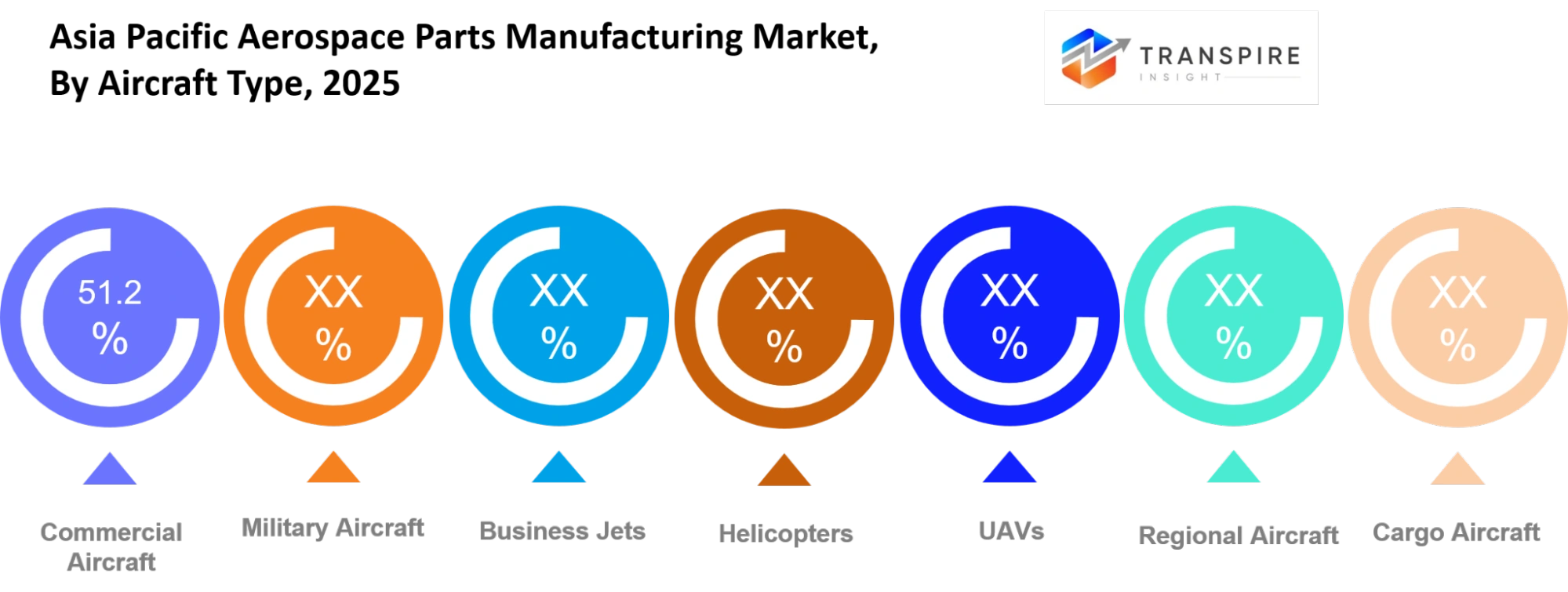
Demand in the Asia Pacific Aerospace Parts Manufacturing Market will be defined by the type of aircraft such as commercial aircraft, military aircraft, business jets, helicopters, UAVs, regional aircraft, cargo aircraft and others. The market share of the commercial aircraft will be dominant due to the rise in passenger traffic and increasing fleet across China, India, and Southeast Asian region, which will drive the market growth.
Market for the military aircraft will rise due to ongoing military modernization programs, and increased local manufacturing capabilities across the Asia Pacific. The market for the UAVs will rise with increased application of unmanned systems in logistics and surveillance activities, and also in the defense sector at the highest pace among the other segments. Helicopters and regional aircraft markets will remain steady and support the increased connectivity in the remote areas across the region and demand for cargo aircraft is anticipated to rise with the e-commerce logistics expansion. Diversification of the aircraft type will maintain a strong manufacturing stability across the economic cycles.
By End User:
The Asia Pacific Aerospace Parts Manufacturing Market is driven by the OEMs, MROs, Defense organizations, airlines, Aircraft leasing companies, Space agencies, component suppliers and others. Market share of OEMs will be major among all the end users due to the presence of Integrated production facilities and high assembly production.
Market for the MROs will witness steady increase, as demand will be increasing for the components in maintenance of the aged fleets. Market demand for defense organizations will also increase due to growing investment on the indigenous aircraft and programs for sophisticated weapons systems. Steady demand for the spare parts will be recorded by the airline companies and aircraft leasing companies, while the market for space agencies and component suppliers will slowly gain traction on account of growth of satellite applications and aerospace programs.
What are the Key Use Cases Driving the Asia Pacific Aerospace Parts Manufacturing Market?
The Asia Pacific Aerospace Parts Manufacturing Market is dominated by the commercial aircraft manufacturing segment due to increasing passenger volume and steady fleet replacements undertaken by most of the major airline operators. The airframe structure and related engine parts segments represent a stronger demand, due to high emphasis on fuel efficiency, airworthiness compliance, and longer life. Original Equipment Manufacturer (OEM) driven assembly programs across China, India, and Southeast Asia still represent bulk purchases for precision aerospace parts.
The growth of secondary use cases includes defense aviation and maintenance, repair and overhaul activities. Military upgrading programs across India, South Korea, and Japan boost the requirement for avionic updates, landing gears and replacement engine modules. Also, MRO (Maintenance, Repair and Overhaul) service providers are increasing operations as an increasing number of aircraft fleets require part replacements and system upgrades.
A number of emerging, high growth use cases include unmanned aerial vehicles and space applications. Production of unmanned aerial vehicles (UAVs) is being ramped up for surveillance and logistics, whereas satellite program development, during the forecast period, drives growth for lightweight composites and performance thermal parts.
|
Report Metrics |
Details |
|
Market size value in 2025 |
USD 52.75 Billion |
|
Market size value in 2026 |
USD 56.34 Billion |
|
Revenue forecast in 2033 |
USD 89.39 Billion |
|
Growth rate |
CAGR of 6.82% from 2026 to 2033 |
|
Base year |
2025 |
|
Historical data |
2021 - 2024 |
|
Forecast period |
2026 - 2033 |
|
Report coverage |
Revenue forecast, competitive landscape, growth factors, and trends |
|
Regional scope |
Asia Pacific (India, China, Japan, Australia, South Korea, Rest of Asia Pacific) |
|
Key company profiled |
Boeing, Airbus, Safran, GE Aerospace, RTX, Spirit AeroSystems, Honeywell, Rolls-Royce, Triumph Group, GKN Aerospace, Mitsubishi Heavy Industries, Kawasaki Heavy Industries, Collins Aerospace, Leonardo, Thales. |
|
Customization scope |
Free report customization (country, regional & segment scope). Avail customized purchase options to meet your exact research needs. |
|
Report Segmentation |
By Part Type (Engine Components, Airframe Parts, Landing Gear Components, Avionics Components, Cabin Interior Parts, Fasteners, Composite Parts, Others); By Material (Aluminum Alloys, Titanium Alloys, Composite Materials, Steel Alloys, Nickel Alloys, Thermoplastics, Advanced Ceramics, Others); By Aircraft Type (Commercial Aircraft, Military Aircraft, Business Jets, Helicopters, UAVs, Regional Aircraft, Cargo Aircraft, Others); By End User (OEMs, MRO Providers, Defense Organizations, Airlines, Aircraft Leasing Companies, Space Agencies, Component Suppliers, Others). |
Which Regions are Driving the Asia Pacific Aerospace Parts Manufacturing Market Growth?
The market is dominated by China owing to its high volume of aircraft production and robust support from the state-backed industrial policy. The country has advantages from tightly integrated supply chains that link raw material processing, precision machining and assembly in large aerospace clusters, and demand for the same high volume from commercial aviation and defense aviation. Continued investment into airport expansion and fleet renewal, aircraft buying programs are also increasing sustained demand for aerospace parts across the entire ecosystem.
The stable and highly dependable market is Japan. The country stands out with a very strong foundation of high precision manufacturing, combined with extremely stringent quality controls, instead of mass production in China, Japan focuses on niche high-value components for air and space crafts, long term relationship between the manufacturers and global OEM companies also ensure sustained demand for the country’s products in turbine parts, avionics, and structures. Strong industrial automation and persistent regulatory compliance ensure that Japan is a stable income generating supplier of high-specification parts to air and space OEMs worldwide.
India is a very rapidly growing region on the back of extensive defense modernization, and booming domestic commercial aviation, local production of airframe and engine parts are steadily increasing in this nation of hundreds of people under recent policy interventions to foster local manufacturing; fresh investment into aerospace parks and joint ventures with international OEMs is fostering the growth of its own manufacturing base. This shows significant potential for new entrants between 2026 and 2033 in the second and third tiers of supply chains in the market.
Who are the Key Players in the Asia Pacific Aerospace Parts Manufacturing Market and How Do They Compete?
While it's the top tier of the supply chains, it is still moderately consolidated; the mid-tier supply chain remains somewhat fragmented with regional pockets of suppliers in Asia Pacific. Competitive factors include ability to obtain certifications, precision engineering competence, and proximity to OEM assembly lines. The established aerospace players protect their markets through existing long-term contracts and technology integration, and emerging players try to challenge with competitive price point manufacturing and faster production turnaround times. Entry barriers are quite high as approval processes require rigorous certification and quality checks, allowing players with existing certifications to retain their share.
Hindustan Aeronautics Limited- The company primarily competes in the defense aerospace manufacturing sector with a strong specialization in aircraft structures and engine assembly in various domestic defense programs. The company strengthens its presence through modernization contracts awarded by the government which is aimed at fostering self-reliance in the domestic aerospace industry and joint production arrangements with other players. Hindustan Aeronautics Limited's strength lies in its extensive integration into defense purchasing systems and its long-term contract visibility for existing and new defense platforms.
Mitsubishi Heavy Industries- Mitsubishi competes through its high precision engineering and high precision manufacturing of aircraft components for both commercial and defense aircraft. The company strengthens its positions by forging technology alliances with leading global OEMs, as well as continuous investment in automated manufacturing lines. Safran- The company specializes in manufacturing propulsion systems and engine components for the aerospace industry; its strengthening strategy is centered on formation of joint ventures with Asian players and securing long-term contracts for engine component supply to all major Asian airlines. Rolls- Royce- Rolls-Royce draws its strength from advanced technology for high efficiency engines, along with service contracts ensuring sustained recurring revenue through aftermarket support for engine components. RTX Corporation and Honeywell- these companies leverage their strength in avionics, sensor systems and integrated aerospace electronics to bolster their position, and their strategies are driven by extending their networks and local partnerships in the region.
Company List
- Boeing
- Airbus
- Safran
- GE Aerospace
- RTX
- Spirit AeroSystems
- Honeywell
- Rolls-Royce
- Triumph Group
- GKN Aerospace
- Mitsubishi Heavy Industries
- Kawasaki Heavy Industries
- Collins Aerospace
- Leonardo
- Thales
Recent Development News
In February 2025, Safran and Hindustan Aeronautics Limited expanded their LEAP engine supply chain partnership by signing a new agreement to produce forged rotating parts in India. The deal strengthens local manufacturing capacity and supports Safran’s strategy to diversify production sourcing closer to high-demand Asia Pacific aviation markets. It also increases India’s role in high-value aerospace component production under long-term engine programs.
Source: https://www.safran-group.com/
In April 2026, Rolls-Royce secured a ₹3,800 crore aerospace parts supply contract with Hyderabad-based Sigma Advanced Systems to deliver components over seven years. The agreement integrates Indian suppliers deeper into Rolls-Royce’s global sourcing network and expands long-term export opportunities for precision aerospace manufacturing. It reflects the continued shift toward regionalized supply chains and higher-value production roles for Asia Pacific aerospace firms.
Source: https://m.economictimes.com/
What Strategic Insights Define the Future of the Asia Pacific Aerospace Parts Manufacturing Market?
The Asia Pacific Aerospace Parts Manufacturing Market is shifting towards higher degrees of regional self-sufficiency underpinned by localized supply chains, digitized production systems, and sustained long-term fleet growth (commercial and defense). In the next 5-7 years, rather than demand cycle volatility for new aircraft, manufacturing sovereignty-driven shifts will define market expansion as governments focus on domestic capability development and less on external sourcing.
A more subtle risk that could hinder scalability even in an environment of strong demand signals is a certification bottleneck and material dependency (on limited Titanium/advanced composite suppliers). A primary emerging opportunity will be certified additive manufacturing for flight critical parts and it will bloom in India/Southeast Asia, where certification approaches will gradually come into line with international aerospace standards.
Participants in the Asia Pacific Aerospace Parts Manufacturing market should focus on developing vertically integrated supplier ecosystems tied to regional OEM programs as control over certification channels and sourcing of materials will be the defining elements of margin consistency and overall competitiveness in the coming years.
Asia Pacific Aerospace Parts Manufacturing Market Report Segmentation
By Part Type
- Engine Components
- Airframe Parts
- Landing Gear Components
- Avionics Components
- Cabin Interior Parts
- Fasteners
- Composite Parts
By Material
- Aluminum Alloys
- Titanium Alloys
- Composite Materials
- Steel Alloys
- Nickel Alloys
- Thermoplastics
- Advanced Ceramics
By Aircraft Type
- Commercial Aircraft
- Military Aircraft
- Business Jets
- Helicopters
- UAVs
- Regional Aircraft
- Cargo Aircraft
By End User
- OEMs
- MRO Providers
- Defense Organizations
- Airlines
- Aircraft Leasing Companies
- Space Agencies
- Component Suppliers
Frequently Asked Questions
Find quick answers to common questions.
The Asia Pacific Aerospace Parts Manufacturing Market size is USD 89.39 Billion in 2033.
Key segments for the Asia Pacific Aerospace Parts Manufacturing Market are By Part Type (Engine Components, Airframe Parts, Landing Gear Components, Avionics Components, Cabin Interior Parts, Fasteners, Composite Parts, Others); By Material (Aluminum Alloys, Titanium Alloys, Composite Materials, Steel Alloys, Nickel Alloys, Thermoplastics, Advanced Ceramics, Others); By Aircraft Type (Commercial Aircraft, Military Aircraft, Business Jets, Helicopters, UAVs, Regional Aircraft, Cargo Aircraft, Others); By End User (OEMs, MRO Providers, Defense Organizations, Airlines, Aircraft Leasing Companies, Space Agencies, Component Suppliers, Others).
Major Asia Pacific Aerospace Parts Manufacturing Market players are Boeing, Airbus, Safran, GE Aerospace, RTX, Spirit AeroSystems, Honeywell, Rolls-Royce, Triumph Group, GKN Aerospace, Mitsubishi Heavy Industries, Kawasaki Heavy Industries, Collins Aerospace, Leonardo, Thales.
The Asia Pacific Aerospace Parts Manufacturing Market size is USD 52.75 Billion in 2025.
The Asia Pacific Aerospace Parts Manufacturing Market CAGR is 6.82% from 2026 to 2033.
- Boeing
- Airbus
- Safran
- GE Aerospace
- RTX
- Spirit AeroSystems
- Honeywell
- Rolls-Royce
- Triumph Group
- GKN Aerospace
- Mitsubishi Heavy Industries
- Kawasaki Heavy Industries
- Collins Aerospace
- Leonardo
- Thales
About the Authors

Tejashri Dhatrak
I am Tejashri Dhatrak, a Senior Research Analyst at Transpire Insight, specializing in the Aerospace and Defence sector. My work focuses on analyzing industry trends, defence technologies, market developments, and emerging innovations that shape the global aerospace and security landscape. At Transpire Insight, I research complex topics, evaluate credible sources, and transform technical insights into accurate, well-structured, and easy-to-understand content for industry professionals and decision-makers. My goal is to provide reliable, research-backed information that helps readers stay informed about defence capabilities, aerospace advancements, strategic developments, and the evolving dynamics of the global defence ecosystem.

Chakradhar Khansole
Chakradhar serves as the Research Director at Transpire Insight, bringing over 8 years of experience in technology, innovation, and strategic market intelligence. He specializes in transforming complex market data into actionable business insights that enable organizations to make informed, growth-oriented decisions. Recognized for his strategic vision and analytical expertise, Chakradhar leads high-impact research initiatives, delivering comprehensive market assessments, competitive intelligence, and forward-looking industry analysis.
Recently Published Reports
-
Apr 2026
Aerospace Fluoropolymers Market
Aerospace Fluoropolymers Market Size, Share & Analysis Report By Type (PTFE, FEP, PFA, ETFE, and Others), By Application (Electrical Insulation, Seals & Gaskets, Coatings, and Others), By End User (Commercial Aviation, Military Aviation, General Aviation, and Others), and Geography (North America, Europe, Asia-Pacific, Middle East and Africa, South and Central America), 2021 - 2031
-
Apr 2026
Airborne SATCOM System Market
Airborne SATCOM System Market Size, Share & Analysis Report By Type (SATCOM Terminals, Transceivers, Airborne Radio, Modems and Routers, SATCOM Radomes, and Other), By Application (Government and Defense and Commercial), and Geography (North America, Europe, Asia-Pacific, Middle East and Africa, South and Central America), 2021 – 2031
-
Apr 2026
Ship Leasing Market
Ship Leasing Market Size, Share & Analysis Report By Vessel Type (Container Ships, Bulk Carriers, Tankers, and Specialized Vessels), By Lease Duration (Short-Term Lease (Less than 1 year), Medium-Term Lease (1-5 years), and Long-Term Lease (More than 5 years)), By Lease Type (Bareboat Charter, Time Charter, Financial Lease, and Others), By End-User Industry (Oil and Gas, Manufacturing and Industrial, Automotive, Agriculture and Food, Retail and Consumer Goods, and Others), and Geography (North America, Europe, Asia-Pacific, Middle East and Africa, South and Central America), 2021 – 2031
-
Apr 2026
Thread Rolling Dies Market
Thread Rolling Dies Market Size, Share & Analysis Report By Type (Flat Thread Rolling Dies, Circular (Cylindrical) Dies, Tangential Thread Rolling Dies, Planetary Thread Rolling Dies, and Other Types), By Material Type (High-Speed Steel (HSS), Carbide, Tool Steel, Alloy Steel, and Other Specialized Alloys), By Distribution Channel (Direct Sales, Distributors and Dealers, and Online Platforms), By Application (Automotive Industry, Aerospace and Defense, Construction and Infrastructure, Industrial Machinery, Electronics and Electrical Components, Medical Devices, and Fastener Production), and Geography (North America, Europe, Asia-Pacific, Middle East and Africa, South and Central America), 2021 – 2031
Our Clients





