Europe Military Aircraft Market Size & Forecast:
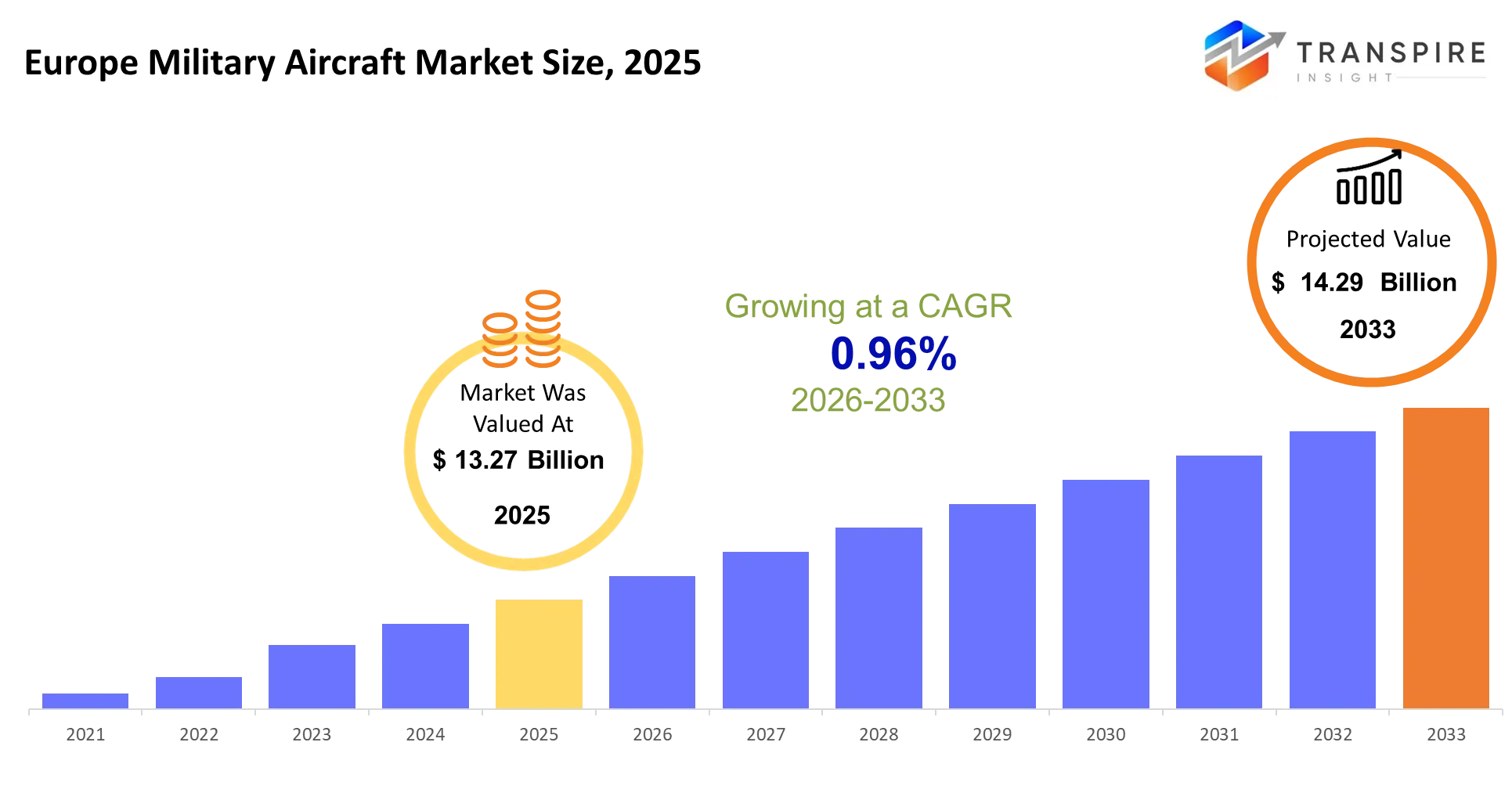
- Europe Military Aircraft Market Size 2025: USD 13.27 Billion
- Europe Military Aircraft Market Size 2033: USD 14.29 Billion
- Europe Military Aircraft Market CAGR: 0.96%
- Europe Military Aircraft Market Segments: By Type (Fighter Aircraft, Transport Aircraft, Helicopters, UAVs, Surveillance Aircraft, Others), By Application (Defense Operations, Surveillance, Transport, Combat Missions, Training, Others), By End-User (Air Forces, Defense Organizations, Government, Aerospace Firms, Defense Contractors, Others), By Technology (Stealth, Avionics Systems, Autonomous Systems, Advanced Materials, Others).
To learn more about this report,  Download Free Sample Report
Europe Military Aircraft Market Summary:
The Europe Military Aircraft Market size is estimated at USD 13.27 Billion in 2025 and is anticipated to reach USD 14.29 Billion by 2033, growing at a CAGR of 0.96% from 2026 to 2033. European military aircraft systems provide essential support to national defense through their capabilities for monitoring airspace and executing emergency operations and conducting military operations in hostile territories. The aircraft operate as border control systems that enable joint military operations while delivering real-time operational intelligence to commanders.
The sector has experienced structural changes during its three to five-year period yet has developed multi-role aircraft systems that combine their multiple functions with modern avionics and artificial intelligence systems and their ability to work together with NATO forces. Governments are no longer procuring single-purpose aircraft but investing in adaptable fleets that reduce lifecycle costs and improve mission flexibility. The Russia–Ukraine conflict has created a situation that forced European nations to increase their defense budgets because it revealed their military shortfalls.
The combination of these elements has created new patterns for procurement processes. Countries are accelerating their programs to update aircraft fleets while they focus on building up their capacity to manufacture essential components. The company generates revenue through high-value upgrades and long-term service agreements and the creation of next-generation platforms rather than through increasing production output.
Key Market Insights
- The Western European military aircraft market controls 60% of the European market because defense expenditures from the UK and France and Germany will drive market growth in 2025.
- Eastern Europe shows the fastest expansion as defense budgets experience annual growth between 8 and 10 percent during the period from 2024 to 2030 because of increasing geopolitical conflicts.
- The fighter aircraft segment will account for more than 45 percent of the market in 2025 because of fleet replacement needs and multi-role combat aircraft procurement activities.
- The transport aircraft segment serves as the second largest market segment because NATO operations require tactical mobility and humanitarian mission capabilities.
- The unmanned aerial vehicle market shows the fastest growth because ISR missions create operational risk reductions that will drive industry expansion until 2030.
- Nations assign combat operations to 50 percent of their missions while they focus on achieving air dominance and developing quick-response systems for their strategic operations.
- Intelligence surveillance and reconnaissance technology experiences the fastest growth because real-time data needs and AI-based mission systems are driving its development.
- Air forces dominate the market as the main customer group and they will generate 70 percent of the market share by 2025 because they continue to modernize their aircraft fleets.
- The joint defense forces and allied command units emerge as a new customer group that focuses on developing air capabilities which can function together with different systems.
What are the Key Drivers, Restraints, and Opportunities in the Europe Military Aircraft Market?
The Europe Military Aircraft Market experiences its primary growth driver through defense budget expansions which result from ongoing conflicts between Russia and Ukraine. European governments assessed their air combat capabilities after they identified shortcomings in their military aircraft fleet size and system interoperability and their ability to respond quickly. The next-generation fighter platforms and surveillance aircraft and support fleet systems obtained multi-year funding agreements. Countries now dedicate their resources to advanced avionics and stealth technology and integrated systems which results in extended contract durations and larger contract values. The company generates revenue through bundled contracts which provide maintenance services and system upgrades and digital solutions instead of selling individual products.
European defense procurement systems face two major barriers because of their segmented defense acquisition process and their aircraft development procedures which require extensive approval processes. Defense programs need 10 to 15 years to complete because they must manage collaboration among different nations and various regulatory authorities and defense manufacturers. The system operates as multiple separate components which make it difficult to reach decisions while causing expenses to rise particularly in programs which need political agreement between participating nations. The defense sector uses its capital more slowly when budgets rise which causes a delay in aircraft induction processes and produces an immediate drop in manufacturer revenue.
The Future Combat Air System project represents a crucial business opportunity for the development of next-generation combat systems. The initiative aims to create a unified operational system which combines manned and unmanned vehicles for future military operations. The increasing financial backing for AI-driven mission systems and drone swarms and secure data links development has resulted in an extra value component which creates permanent income streams from software and integration and lifecycle service packages.
What Has the Impact of Artificial Intelligence Been on the Europe Military Aircraft Market?
The military aviation system of Europe undergoes transformation through artificial intelligence and advanced digital technologies which establish automation systems for both aircraft operations and their support functions. AI mission computers now enable automated flight control adjustments and threat detection and sensor fusion which decreases pilot workload and enhances response times during complicated combat situations. The digital platforms located on the ground provide operators with real-time tracking capabilities to monitor fleet compliance and maintenance schedules and mission readiness which enables better asset management across various bases.
Machine learning serves as the core technology that enables predictive maintenance. The algorithms analyze engine vibration data together with component wear patterns and historical failure logs to forecast faults before they occur. The implementation of this approach resulted in an estimated 10 to 20 percent increase in aircraft availability rates which also decreased unplanned maintenance expenses. AI performance optimization tools improve fuel efficiency through their ability to optimize flight paths and load management systems which produce measurable cost savings throughout extended operational periods.
The combination of these technologies creates system uptime improvements which extend the operational lifespan of aircraft while delivering dependable performance for missions. The process of retrofitting legacy fleets encounters challenges because high integration costs and complex implementation requirements create major obstacles for organizations. Many European air forces operate aging platforms where data infrastructure is limited which makes it difficult to implement AI-driven insights because of restricted access to accurate information.
Key Market Trends
- European governments began replacing entire aircraft fleets in 2022 which resulted in shorter procurement times and larger contract values
- NATO member countries developed aircraft systems that can work together because more than 70% of their new equipment supports joint operations and shared mission data environments
- Airbus and BAE Systems have shifted their product development toward multi-role aircraft after they established their stronghold on single-mission aircraft which they had used for military procurement until 2020
- UAV systems have become the preferred option because military organizations now use unmanned systems to conduct surveillance operations and low-risk combat missions which have seen a 30% increase in procurement between 2021 and 2025
- European defense strategies have increasingly prioritized domestic production because countries now spend more money on local manufacturing to decrease their dependence on foreign suppliers
- The use of advanced avionics together with AI technology now serves as a mandatory requirement for new aircraft contracts which enable 60% of contracts to use digital and autonomous technologies
- Future Combat Air System and other collaborative programs have developed since 2020 because they create an environment where multiple countries work together to develop shared technologies
- The defense industry now uses long-term service agreements as its main maintenance method because lifecycle support contracts have become more important than initial aircraft sales for total program revenue generation.
- Manufacturers developed new supply chain strategies to handle 2020 disruptions by implementing dual sourcing methods and establishing larger inventory reserves which help them manage both geopolitical and logistical challenges.
Europe Military Aircraft Market Segmentation
By Type
Fighter aircraft operate as the primary military aircraft across European nations because these nations consider air supremacy and deterrent power to be their most essential military requirements. Governments allocate large portions of defense budgets to replace aging fleets with multi-role fighters that integrate advanced combat and surveillance functions. The second position for transport aircraft maintains its stability because NATO operations require both troop movement and logistics support and humanitarian missions.
Helicopters serve their tactical purpose for search and rescue missions and battlefield support operations, but their growth potential remains limited because of their expensive upkeep requirements. Unmanned aerial vehicles experience the fastest growth because these systems offer permanent surveillance capabilities while minimizing the need for human operators. The demand for intelligence has made surveillance aircraft more popular. The military services will develop their future operations through hybrid fleets that enable staff to control both manned and unmanned systems simultaneously. This development will prompt manufacturers to create platform systems that allow flexible operation through their modular component upgrades.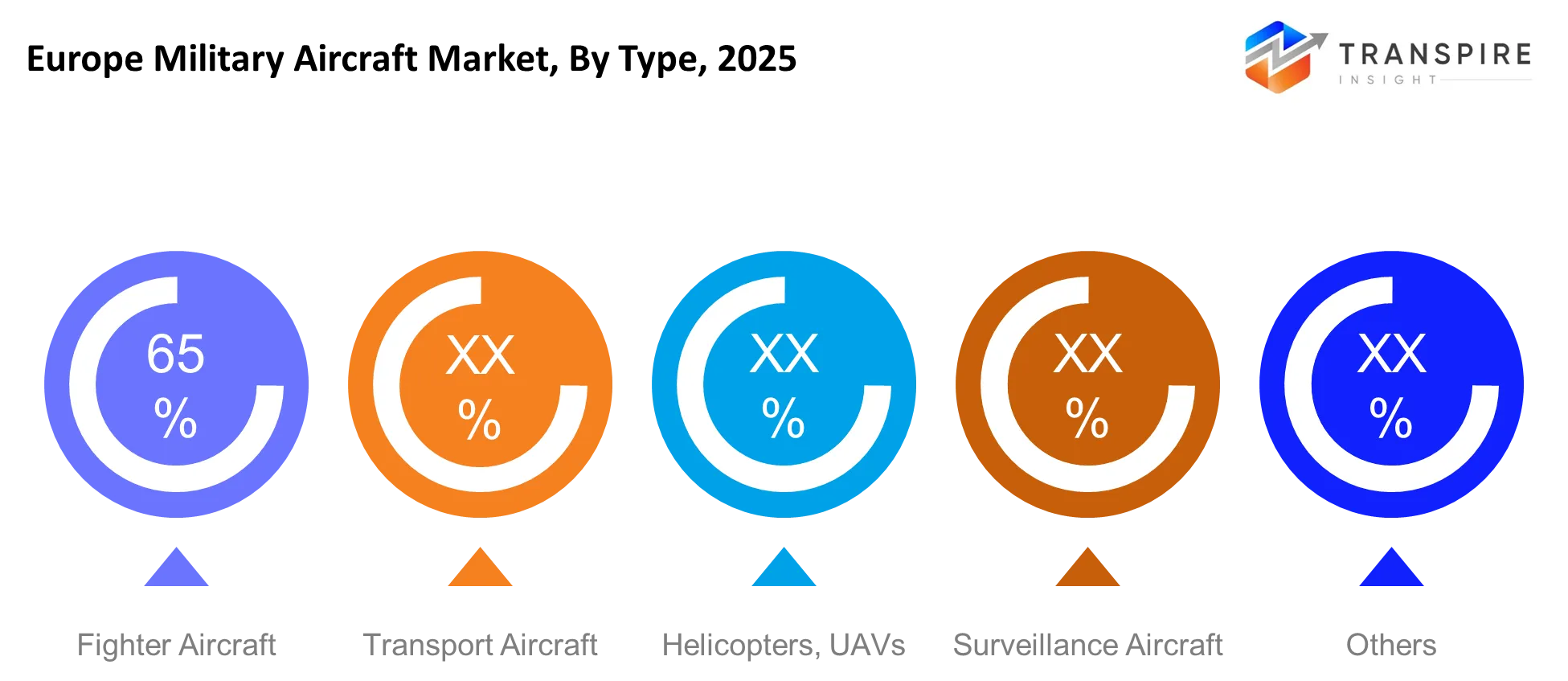
To learn more about this report, Download Free Sample Report
By Application
The defense sector identifies combat missions as its primary operational method because it needs to establish fast-response capabilities and maintain ongoing mission readiness. European countries have increased their military aircraft purchases because they face ongoing geopolitical conflicts which require them to develop combat capabilities. The demand for surveillance applications has grown because organizations need real-time intelligence for both border monitoring and threat detection purposes.
Transport applications maintain their consistent need because multinational military operations and disaster response logistics provide ongoing support. The development of training applications progresses at a slow pace because new aircraft technologies require pilots to have advanced training through specific preparation systems. The shift to integrated mission planning shows multiple functions now operate from a single platform across all applications. The upcoming developments between combat and surveillance functions will lead to more investments in multi-functional aircraft systems which improve mission efficiency while decreasing operational complexity.
By End-User
The air forces hold the largest market share among end-users because they track aerial defense operations and they manage fleet modernization initiatives. The defense organizations alongside government agencies maintain essential functions because they finance procurement activities while they define long-term strategic goals. Defense contractors and aerospace companies establish new demand trends through their collaborative development activities which involve government and private partnership agreements.
Countries nowadays increase their domestic manufacturing capability through their partnerships with private companies to decrease their need for international resources. The new procurement system establishes tighter connections between users and design teams because it lets users enter design processes before actual development starts. The demand for joint defense units and multinational command structures is growing because organizations need to develop interoperability capabilities. The future will create stronger relationships between end-users and manufacturers which will result in businesses that provide tailored products together with extended maintenance contracts that start after customers buy their first aircraft.
By Technology
The avionics systems which operate modern aircraft depend on their advanced navigation systems and communication systems and sensor systems to complete their missions. Stealth technology holds significant importance in high-end fighter programs which require aircraft to remain undetected during operations in contested environments. The fastest-growing segment of autonomous systems is supported by the increasing use of unmanned platforms and AI-based decision support systems.
The usage of advanced materials like composites and lightweight alloys is expanding because these materials enhance fuel efficiency and product longevity. The technology segments of the industry show a tendency to shift toward performance improvement and cost reduction throughout the entire lifespan of aircraft. Digital systems will become more integrated with all platforms in the future which will lead manufacturers to focus on developing software products and hardware solutions while operators will achieve better operational performance and lower upkeep expenses.
What are the Key Use Cases Driving the Europe Military Aircraft Market?
The primary application of military operations research combats because national air forces need to complete their missions through quick fighter response and air dominance together with accuracy in their aerial attacks. Continuous global political conflicts have compelled nations to focus on fighter aircraft development which creates ongoing defense acquisitions and aircraft modernization programs.
Joint defense organizations and border security agencies both show increased demand for surveillance and reconnaissance operations. NATO operations now depend more on unmanned aerial vehicles and surveillance planes to conduct intelligence operations and maritime security missions and cross-border monitoring activities.
The development of autonomous swarm missions together with AI-powered electronic warfare systems represents new operational applications. The defense sector has not yet fully implemented these technologies which possess high potential for future success through ongoing network-centric and unmanned combat system development.
|
Report Metrics |
Details |
|
Market size value in 2025 |
USD 13.27 Billion |
|
Market size value in 2026 |
USD 13.37 Billion |
|
Revenue forecast in 2033 |
USD 14.29 Billion |
|
Growth rate |
CAGR of 0.96% from 2026 to 2033 |
|
Base year |
2025 |
|
Historical data |
2021 - 2024 |
|
Forecast period |
2026 - 2033 |
|
Report coverage |
Revenue forecast, competitive landscape, growth factors, and trends |
|
Regional scope |
Europe (Germany, United Kingdom, France, Italy, Spain and Rest of Europe) |
|
Key company profiled |
Lockheed Martin, Boeing, Airbus, Dassault Aviation, BAE Systems, Saab, Leonardo, Northrop Grumman, Embraer, Textron, HAL, Sukhoi, Mitsubishi Heavy Industries, KAI, AVIC |
|
Customization scope |
Free report customization (country, regional & segment scope). Avail customized purchase options to meet your exact research needs. |
|
Report Segmentation |
By Type (Fighter Aircraft, Transport Aircraft, Helicopters, UAVs, Surveillance Aircraft, Others), By Application (Defense Operations, Surveillance, Transport, Combat Missions, Training, Others), By End-User (Air Forces, Defense Organizations, Government, Aerospace Firms, Defense Contractors, Others), By Technology (Stealth, Avionics Systems, Autonomous Systems, Advanced Materials, Others) |
Which Regions are Driving the Europe Military Aircraft Market Growth?
The defense market in Western Europe exists because the United Kingdom France and Germany sustain their defense budgets while aligning with defense policies. The governments of this region use structured procurement programs and long-term capability planning to support their fleet modernization efforts. The aerospace manufacturing industry maintains its leadership position because its established supply chains and advanced research facilities enable ongoing technological development. NATO framework collaborations improve interoperability between member states which develops a dependable system that produces continuous high-value contract requirements.
Southern Europe demonstrates economic growth through defense investments which develop the region's military capabilities. The defense procurement system of Italy and Spain enables both countries to maintain their military balance while developing their domestic aerospace sector. The government funding of this region remains consistent while its international programs bring financial relief because they distribute costs more effectively than projects which need full local financing. The market remains resilient because manufacturers receive ongoing income through their upgrade cycles and lifecycle maintenance contracts which generate revenue over extended periods.
Eastern Europe experiences its most rapid growth because of recent defense spending increases and necessity for fleet upgrades. The countries of Poland and Romania expedited their procurement procedures after 2022 because of enhanced security dangers in their region. The defense sector experienced increased demand for advanced systems because of new aircraft platform investments and infrastructure development initiatives. The period between 2026 and 2033 will present strong market entry opportunities for investors who want to establish profitable platform supply businesses together with local manufacturing operations.
Who are the Key Players in the Europe Military Aircraft Market and How Do They Compete?
The European military aircraft market exhibits moderate consolidation because a small number of major aerospace companies maintain control over the majority of valuable contracts. The competition between companies depends on their technological expertise and their ability to establish partnerships and provide ongoing support services instead of focusing solely on pricing. The existing companies maintain their market position through long-term government agreements which provide them with aircraft and software and maintenance services.
The certification process requires substantial financial investments and complicated procedures, which create major difficulties for new market entrants, but unmanned systems and digital subsystems have started to disrupt markets through their specific autonomy and data capabilities.
Airbus uses its A400M program to enhance European military interoperability through its cooperation with other countries and the development of common operational platforms. BAE Systems establishes its market position through its advanced combat systems which include electronic warfare capabilities and its close relationships with both national defense organizations and international commercial customers. Dassault Aviation develops the Rafale platform into a high-performance fighter which provides countries with manufacturing independence and flexible operational capabilities.
Saab AB uses the Gripen fighter to create a cost-effective innovation system which enables smaller air forces to achieve operational flexibility through reduced overall costs. Leonardo S.p.A. establishes itself as a systems integrator through its expansion into multiple aircraft categories, which includes developing avionics and helicopters and sensor systems. The companies maintain their central operations through partnerships and joint development programs and regional production investments, which enable them to adapt to new defense needs while securing government contracts.
Company List
- Lockheed Martin
- Boeing
- Airbus
- Dassault Aviation
- BAE Systems
- Saab
- Leonardo
- Northrop Grumman
- Embraer
- Textron
- HAL
- Sukhoi
- Mitsubishi Heavy Industries
- KAI
- AVIC
Recent Development News
In April 2026, Lockheed Martin secures major U.S. defense production expansion contracts: Lockheed Martin signed new U.S. Department of Defense agreements alongside Boeing and other OEMs to expand weapons and aerospace production capacity amid global demand pressures.
These production increases directly support aircraft avionics, missile systems, and combat aircraft subsystems used across European military aviation platforms.
Source: https://www.manufacturingdive.com
In April 2026, U.S. Space Force awards $3.2B missile defense contracts: The U.S. Space Force awarded up to $3.2 billion in prototype contracts to 12 firms including Lockheed Martin and RTX to develop space-based interceptor systems under the “Golden Dome” program. This strengthens U.S. aerospace-defense production ecosystems that directly supply NATO-aligned air and missile defense aircraft integration programs.
Source: https://www.investing.com
What Strategic Insights Define the Future of the Europe Military Aircraft Market?
The military aircraft market in Europe is transitioning toward network-centric systems which enable crewed aircraft to operate together with unmanned vehicles and software-based systems. The requirement for rapid decision-making processes together with immediate access to data and the ability of allied forces to work together drives this development. The upcoming five to seven years will witness a shift in value from individual aircraft purchases toward complete systems that merge physical products with AI-powered software and ongoing maintenance support.
The supply chain risk emerges from essential components which include semiconductors and advanced materials. Defense spending increases create budget constraints yet production schedules experience delays because of supply shortages which create additional costs for programs. The development of autonomous collaborative systems is now underway which includes drone swarms that work together with advanced fighter systems. Investments in these capabilities will transform operational economics.
Market participants should establish modular design systems which work with digital integration methods to create upgrade paths while decreasing reliance on restricted supply channels that meet current defense procurement standards.
Europe Military Aircraft Market Report Segmentation
By Type
- Fighter Aircraft
- Transport Aircraft
- Helicopters
- UAVs
- Surveillance Aircraft
- Others
By Application
- Defense Operations
- Surveillance
- Transport
- Combat Missions
- Training
- Others
By End-User
- AirForces
- Defense Organizations, government
- Aerospace Firms
- Defense Contractors
- Others
By Technology
- Stealth
- Avionics Systems
- Autonomous Systems
- Advanced Materials
- Others
Frequently Asked Questions
Find quick answers to common questions.
The Approximate Europe Military Aircraft Market size for the Market will be USD 14.29 Billion in 2033.
The key Segments of the Europe Military Aircraft Market are By Type (Fighter Aircraft, Transport Aircraft, Helicopters, UAVs, Surveillance Aircraft, Others), By Application (Defense Operations, Surveillance, Transport, Combat Missions, Training, Others), By End-User (Air Forces, Defense Organizations, Government, Aerospace Firms, Defense Contractors, Others), By Technology (Stealth, Avionics Systems, Autonomous Systems, Advanced Materials, Others).
Major Players in the Europe Military Aircraft Market are Lockheed Martin, Boeing, Airbus, Dassault Aviation, BAE Systems, Saab, Leonardo, Northrop Grumman, Embraer, Textron, HAL, Sukhoi, Mitsubishi Heavy Industries, KAI, AVIC.
The Current Market size of the Europe Military Aircraft Market is USD 13.27 Billion in 2025.
The Europe Military Aircraft Market CAGR is 0.96%.
- Lockheed Martin
- Boeing
- Airbus
- Dassault Aviation
- BAE Systems
- Saab
- Leonardo
- Northrop Grumman
- Embraer
- Textron
- HAL
- Sukhoi
- Mitsubishi Heavy Industries
- KAI
- AVIC
Recently Published Reports
-
Apr 2026
Aerospace Fluoropolymers Market
Aerospace Fluoropolymers Market Size, Share & Analysis Report By Type (PTFE, FEP, PFA, ETFE, and Others), By Application (Electrical Insulation, Seals & Gaskets, Coatings, and Others), By End User (Commercial Aviation, Military Aviation, General Aviation, and Others), and Geography (North America, Europe, Asia-Pacific, Middle East and Africa, South and Central America), 2021 - 2031
-
Apr 2026
Airborne SATCOM System Market
Airborne SATCOM System Market Size, Share & Analysis Report By Type (SATCOM Terminals, Transceivers, Airborne Radio, Modems and Routers, SATCOM Radomes, and Other), By Application (Government and Defense and Commercial), and Geography (North America, Europe, Asia-Pacific, Middle East and Africa, South and Central America), 2021 – 2031
-
Apr 2026
Ship Leasing Market
Ship Leasing Market Size, Share & Analysis Report By Vessel Type (Container Ships, Bulk Carriers, Tankers, and Specialized Vessels), By Lease Duration (Short-Term Lease (Less than 1 year), Medium-Term Lease (1-5 years), and Long-Term Lease (More than 5 years)), By Lease Type (Bareboat Charter, Time Charter, Financial Lease, and Others), By End-User Industry (Oil and Gas, Manufacturing and Industrial, Automotive, Agriculture and Food, Retail and Consumer Goods, and Others), and Geography (North America, Europe, Asia-Pacific, Middle East and Africa, South and Central America), 2021 – 2031
-
Apr 2026
Thread Rolling Dies Market
Thread Rolling Dies Market Size, Share & Analysis Report By Type (Flat Thread Rolling Dies, Circular (Cylindrical) Dies, Tangential Thread Rolling Dies, Planetary Thread Rolling Dies, and Other Types), By Material Type (High-Speed Steel (HSS), Carbide, Tool Steel, Alloy Steel, and Other Specialized Alloys), By Distribution Channel (Direct Sales, Distributors and Dealers, and Online Platforms), By Application (Automotive Industry, Aerospace and Defense, Construction and Infrastructure, Industrial Machinery, Electronics and Electrical Components, Medical Devices, and Fastener Production), and Geography (North America, Europe, Asia-Pacific, Middle East and Africa, South and Central America), 2021 – 2031
Our Clients