
North America Aerospace Carbon Fiber Market Size & Forecast:
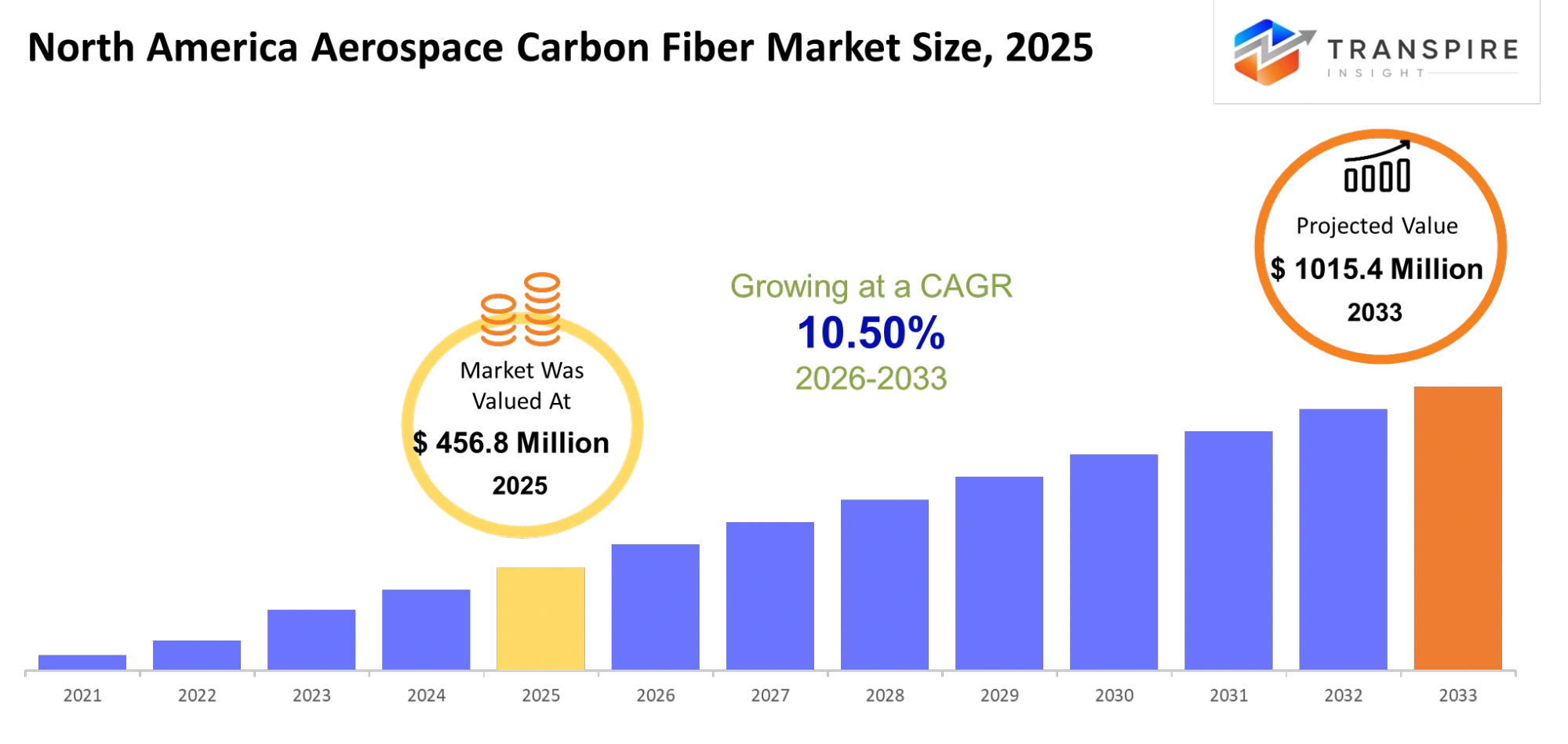
- North America Aerospace Carbon Fiber Market Size 2025: USD 456.8 Million
- North America Aerospace Carbon Fiber Market Size 2033: USD 1015.4 Million
- North America Aerospace Carbon Fiber Market CAGR: 10.50%
- North America Aerospace Carbon Fiber Market Segments: By Type (PAN, Pitch, Rayon, Hybrid, High Modulus, Intermediate, Standard); By Application (Aircraft, Interiors, Engines, UAVs, Satellites, Defense, Space); By Form (Prepreg, Tow, Fabric, Tape, Composite, Laminates, Filament); By End-User (OEMs, Defense, Space, Airlines, MRO, Research, Industrial); By Technology (RTM, Pultrusion, 3D, AFP, Vacuum, Winding, Layup)
To learn more about this report,  Download Free Sample Report
North America Aerospace Carbon Fiber Market Summary:
The North America Aerospace Carbon Fiber Market size is estimated at USD 456.8 Million in 2025 and is anticipated to reach USD 1015.4 Million by 2033, growing at a CAGR of 10.50% from 2026 to 2033.
The North America aerospace carbon fiber market exists in the advanced materials sector which serves both the aviation and defense markets because performance standards will change as aircraft design requirements evolve. The manufacturing sector will select materials based on their ability to create lightweight products which reduce fuel expenses while maintaining necessary structural integrity for both commercial and military applications.
The airline industry will choose airplanes with greater composite materials because sustainability requirements increase while travelers request quieter aircraft operation and superior performance which impacts material choices.The development of automated layup systems and faster curing processes will enable the production of carbon fiber to undergo significant changes because these technologies will shorten the time required for product manufacturing.
The introduction of new regulations will create a higher demand for emissions control and lifecycle assessment, which will drive businesses to implement recyclable composite materials and environmentally friendly production techniques. Businesses will develop supply chain resilience into their operations because they need to control distribution while safeguarding essential resources through domestic production methods. These market changes will create new patterns for business operations and create fresh methods to generate worth within the aerospace ecosystem.
What Has the Impact of Artificial Intelligence Been on the North America Aerospace Carbon Fiber Market?
The North America aerospace carbon fiber market faces a competitive transformation because artificial intelligence drives improvements in data processing across all elements of the industry. North America aerospace carbon fiber market research uses artificial intelligence to help companies accurately handle large datasets which include aviation demand patterns and military funding and aircraft manufacturing statistics.
Stakeholders use machine learning and predictive analytics to identify upcoming market trends and forecast material requirements and develop optimal pricing methods. The data-driven method enables manufacturers and suppliers to make quicker and better decisions which fortifies their market advantage while decreasing uncertainty in their specialized business sector.
North America aerospace carbon fiber market operations benefit from artificial intelligence which delivers substantial advancements in production efficiency through intelligent automated systems. Artificial intelligence systems track manufacturing operations throughout the production process to identify flaws while optimizing the conditions for fiber positioning and curing, which leads to superior composite materials and minimized resource wastage.
Organizations use predictive maintenance systems which rely on machine learning technology to reduce operational downtime while their equipment life extends. The supply chain includes AI tools which help companies achieve better inventory management through reduced procurement costs and improved logistics operations and better demand forecasting abilities. The company can achieve lower operating costs through these capabilities while they attain faster delivery results.
The North American aerospace carbon fiber industry gains competitive advantage through artificial intelligence which helps develop advanced materials and track material performance. Companies are using artificial intelligence models to create carbon fiber composites which have reduced weight and increased strength for use in future aircraft and space missions.
The combination of smart automation with intelligent analytics speeds up product development processes while helping companies to conform to changing regulatory standards and sustainability practices which supports their long-term development in an aerospace industry that relies on technology.
Key Market Trends & Insights:
- The United States controls more than 70% of the North America aerospace carbon fiber market which will reach that percentage in 2025 because of its strong aerospace manufacturing capacity.
- The fastest-expanding area in Canada until 2030 will receive support from increasing funding for advanced aerospace materials and defense modernization initiatives.
- PAN-based carbon fiber dominates with nearly 85% market share in 2025 because it offers better strength-to-weight ratio and aerospace-grade performance than other materials.
- Pitch-based carbon fiber occupies the second-largest market share because it provides high thermal conductivity for specialized aerospace components.
- The recycled carbon fiber market will experience its most rapid growth until 2030 because sustainability trends drive demand for material recovery technologies that are both effective and cost-effective.
- The North American aerospace carbon fiber market sees its main driving force from commercial aircraft manufacturing which holds more than 60 percent market share due to increased demand for new aircraft and replacement of existing ones.
- The space exploration sector together with unmanned aerial vehicle applications represent the most rapidly expanding market because advanced aerospace systems require their specialized lightweight materials with exceptional performance characteristics.
- OEMs (Original Equipment Manufacturers) hold the largest market share of about 65 percent because they purchase aircraft components in large quantities, which manufacturers use to build aircraft systems.
- MRO (Maintenance, Repair, and Overhaul) represents the fastest expanding end-user market, which experiences growth because North American fleets age and require more refurbishment services.
- Toray Industries, Hexcel Corporation, Teijin Limited, SGL Carbon, and Mitsubishi Chemical Group serve as the main market participants.
North America Aerospace Carbon Fiber Market Segmentation
By Type :
This segment examines two aspects of the material which includes its source of raw materials and its performance capabilities. The strength and cost efficiency of PAN-based carbon fiber make it the leading carbon fiber choice while pitch-based carbon fiber alternatives provide greater stiffness. The textile industry uses rayon-based fibers for specialized applications. The combination of hybrid and modulus variations enables manufacturers to produce aerospace structures that meet specific requirements for strength and flexibility and durability.
The process of material selection requires evaluation of structural requirements and cost factors and manufacturing processes. High modulus fibers support critical load-bearing parts while intermediate and standard grades fit broader applications. The use of hybrid combinations allows performance customization which enhances fatigue resistance while decreasing aircraft weight and maintaining safety standards.
By Application :
This segment shows how aerospace systems apply their end-use deployment process. The principal component of the aircraft structures market exists because weight reduction requirements drive its development. The design of interiors allows for multiple design options, but engines need materials that can withstand high temperatures. Unmanned aerial vehicles and satellites use carbon fiber because it provides lightweight strength and enables them to operate in extreme conditions.
The defense and space sectors are increasing their use of this technology because it delivers dependable performance and can withstand severe weather conditions.Dimensionally stable systems support satellite and launch system operations, while defense platforms need to maintain their structural integrity during high-stress situations. The rising investment in space exploration and unmanned systems will create a stronger need for these particular applications.
By Form :
This segment explains physical forms used during manufacturing. Prepreg materials provide easy handling because they maintain uniform quality throughout their use. The automated systems use tow and filament forms to operate their manufacturing processes. Designers can use fabric and tape formats to create flexible design options which work for both layered structures and complex aerospace components.
Structural applications use composite and laminate forms because they provide better strength-to-weight performance than other materials. The production scale together with part complexity and necessary mechanical characteristics determines which form should be selected. The advanced forms enable automated processes while decreasing material waste which leads to better manufacturing efficiency.
By End-User :
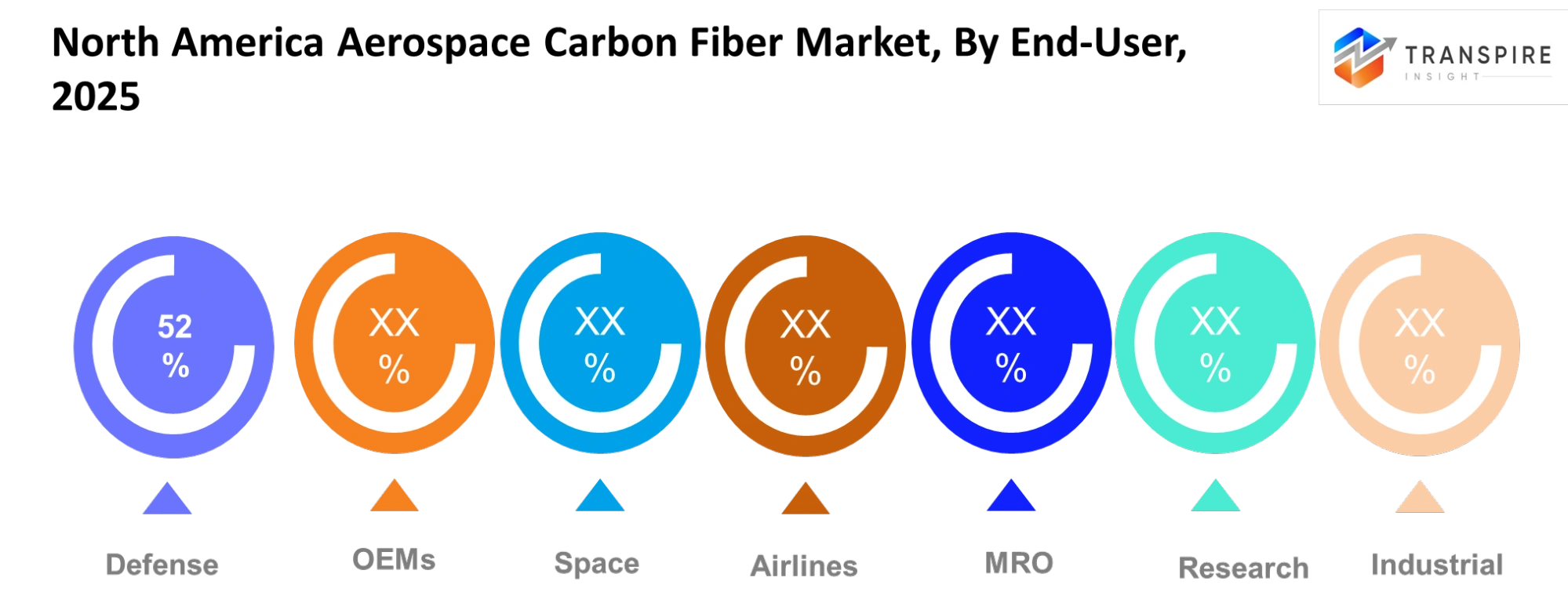
The current section divides demand according to different user groups. The aircraft manufacturing process leads to excessive material usage because original equipment manufacturers (OEMs) need to access substantial quantities of materials. Defense and space organizations need advanced materials which deliver exceptional performance for their essential operations. Airlines focus on improving their operational efficiency while MRO services use carbon fiber materials to maintain and repair aircraft components.
Research institutions and industrial users advance their fields by creating new technologies and implementing fresh solutions. The ongoing partnership between manufacturers and research organizations enables the creation of better materials through their joint efforts. The market demand for maintenance services will continue throughout all customer segments because of both fleet growth and increased maintenance work.
To learn more about this report, Download Free Sample Report
By Technology :
The section explains the manufacturing methods that are used to process carbon fiber materials. The combination of RTM and pultrusion methods enables production at high volumes while AFP technology provides accurate control of fiber distribution. The aerospace industry continues to use vacuum and layup techniques for creating intricate designs and custom-made aerospace parts.
The introduction of 3D processing technology establishes better design options for engineers while decreasing the time required to manufacture products. Filament winding supports cylindrical structures, especially in space and defense systems. The ongoing development of processing techniques will lead to better product quality and lower expenses while enabling widespread use of aerospace manufacturing methods.
What are the Main Challenges for the North America Aerospace Carbon Fiber Market Growth?
The north american aerospace carbon fiber market shows multiple technical and operational difficulties which prevent its growth potential from being realized. The north american aerospace carbon fiber market faces its main challenge through the complex production process of carbon fiber which requires high energy consumption and strict quality management procedures.
Product quality and performance are affected by variations in raw material quality which particularly affect precursor materials such as polyacrylonitrile (PAN). Manufacturers face major growth obstacles because of supply chain limitations which include restricted access to premium materials and their reliance on a small number of worldwide vendors.
The development of the north america aerospace carbon fiber market experiences additional restrictions from manufacturing and commercialization obstacles. The industry faces major challenges due to high production costs which stem from the need for advanced machinery and specialized workers and the requirement to meet strict aerospace regulations.
The regulatory system which governs safety and certification and environmental regulations, creates product approval delays, which extend the time needed for commercial introduction. The existing market conditions create challenges for new market entrants and existing companies who need to balance operational costs with their need to deliver high performance.
The North American aerospace carbon fiber market faces ongoing challenges because adoption difficulties create major obstacles to its growth. The high material costs and requirement for specialized infrastructure and expertise create obstacles that prevent carbon fiber from achieving widespread usage despite its benefits.
The aerospace industry suffers from a skills gap because most manufacturers lack professionals who possess training in composite material handling and integration. The market adoption process faces difficulties because small businesses and new market segments struggle to obtain financial resources which prevents them from developing new technologies.
The North American aerospace carbon fiber market becomes more complicated because market competition and future risks create additional operational difficulties. Certain applications need advanced aluminum alloys and hybrid composites as alternative materials which serve as affordable substitutes that drive up pricing competition. The development of environmental regulations together with requirements for sustainable production methods will force companies to invest heavily in capital funds, which creates uncertainty about future expenses and operational risks that will last for long periods of time.
Country Insights
The ongoing rise in airplane manufacturing for civilian and military needs generates ongoing requirements for carbon fiber materials because producers need lightweight materials to enhance their fuel efficiency and operational capabilities. Strong financial backing for next-generation aircraft programs and modernization programs leads to ongoing material usage because it establishes supply chain reliability and technological progress which enable production activities to continue across major North American aerospace production sites.
North America's aerospace-grade carbon fiber market maintains its leading status because major aircraft manufacturers operate research centers that create cutting-edge technologies. The combination of high defense expenditures and ongoing fleet enhancements leads to sustained material consumption, which established supplier networks guarantee through their consistent product delivery.
The United States dominates regional growth, supported by large-scale production facilities and ongoing investments in innovation and lightweight material development. Canada enhances North American aerospace development through specialized component manufacturing and aerospace engineering partnerships, which create regional capabilities that enable balanced market growth.
Recent Development News
In April 2026, Spirit AeroSystems reported improved quarterly performance driven by higher demand for carbon fiber reinforced aircraft fuselage structures. The company noted an increased backlog tied to wide-body and defense aerospace programs using advanced composites.Source https://www.spiritaero.com/
In March 2026, Toray Composite Materials America announced upgrades to its carbon fiber manufacturing lines in South Carolina. The enhancement focuses on improving high-strength aerospace-grade fiber output for U.S. defense and aviation applications.
Source https://www.toraycma.com/
|
Report Metrics |
Details |
|
Market size value in 2025 |
USD 456.8 Million |
|
Market size value in 2026 |
USD 504.7 Million |
|
Revenue forecast in 2033 |
USD 1015.4 Million |
|
Growth rate |
CAGR of 10.50% from 2026 to 2033 |
|
Base year |
2025 |
|
Historical data |
2021 - 2024 |
|
Forecast period |
2026 - 2033 |
|
Report coverage |
Revenue forecast, competitive landscape, growth factors, and trends |
|
Regional scope |
North America (Canada, The United States, and Mexico) |
|
Key company profiled |
Toray, Hexcel, Mitsubishi Chemical, Teijin, SGL Carbon, Solvay, Zoltek, Formosa, Hyosung, DowAksa, Gurit, Cytec, Owens Corning, BASF, Huntsman |
|
Customization scope |
Free report customization (country, regional & segment scope). Avail customized purchase options to meet your exact research needs. |
|
Report Segmentation |
By Type (PAN, Pitch, Rayon, Hybrid, High Modulus, Intermediate, Standard); By Application (Aircraft, Interiors, Engines, UAVs, Satellites, Defense, Space); By Form (Prepreg, Tow, Fabric, Tape, Composite, Laminates, Filament); By End-User (OEMs, Defense, Space, Airlines, MRO, Research, Industrial); By Technology (RTM, Pultrusion, 3D, AFP, Vacuum, Winding, Layup) |
How Can New Companies Establish a Strong Foothold in the North America Aerospace Carbon Fiber Market?
New entrants can establish a strong position in the north america aerospace carbon fiber market by focusing on niche, high-value aerospace applications which require lightweight and high-strength materials. The north america aerospace carbon fiber market is increasingly driven by UAVs, urban air mobility, and next-generation defense aircraft, creating opportunities for specialized suppliers.
Zoltek Companies (now part of Toray) and startup composites companies which create AI-based material design platforms demonstrate how specific innovations lead to new business opportunities.New market entrants should focus on underserved market areas because this strategy lets them compete with existing market leaders while they build their first customer base.
Developing strategic partnerships with technology differentiation creates essential requirements for business growth within the north america aerospace carbon fiber market. New companies can access certification pathways and product validation acceleration through their partnerships with aerospace OEMs and defense contractors and research institutions.
Aerospace companies in the north america aerospace carbon fiber market use AI-driven predictive material testing and smart automation in fiber manufacturing as their main innovation methods which decrease production mistakes while enhancing product quality. Startups like “Spirit AeroTech Labs” (illustrative example) are using digital twin technology to create simulations of composite behavior which lead to faster prototype development and lower costs for product development.
The long-term competitiveness of companies requires them to solve major industry challenges which include high production expenses and difficulties in supply chain operations and their inability to expand production capacity. The north america aerospace carbon fiber market rewards firms that integrate advanced manufacturing technologies with cost-efficient production models.
Emerging players can further differentiate their business by providing recyclable carbon fiber products and eco-friendly composite materials that support aerospace decarbonization objectives. New market entrants can establish a strong position through an approach that combines innovative solutions and collaborative partnerships with environmentally sustainable business practices.
Key North America Aerospace Carbon Fiber Market Company Insights
The North America Aerospace Carbon Fiber Market maintains its incremental growth because of three main factors which include aircraft production activities and fleet modernization initiatives and the increasing demand for lightweight materials. Aerospace manufacturers maintain a strong market presence which results in steady product demand. The industry will start to use high-strength durable composites because these materials provide better fuel efficiency and structural performance benefits to both commercial and military aviation systems.
The need for carbon fiber materials in fuselage and wing and interior applications increases because airlines deliver more aircraft and conduct more maintenance work. Airlines will increase their use of this material because they want to cut operating expenses while fulfilling their emission reduction goals. Advanced manufacturing techniques development leads to enhanced supply chain performance and higher product quality according to the company.
The defense sector generates significant demand because carbon fiber serves essential functions in drones and fighter jets and surveillance systems. Government funding for modernization initiatives will create sustained growth throughout the upcoming years. The material properties of carbon fiber which include corrosion resistance and high stiffness enable it to function effectively in extreme operational environments.
Company List
- Toray
- Hexcel
- Mitsubishi Chemical
- Teijin
- SGL Carbon
- Solvay
- Zoltek
- Formosa
- Hyosung
- DowAksa
- Gurit
- Cytec
- Owens Corning
- BASF
- Huntsman
What are the Key Use-Cases Driving the Growth of North America Aerospace Carbon Fiber Market?
The North America aerospace carbon fiber market experiences fast growth because advanced aerospace systems require lightweight materials which have both high strength and lightweight properties. The North America aerospace carbon fiber market expands because commercial aviation and defense systems and space exploration require fuel-efficient and structurally durable materials.
Aerospace manufacturers use carbon fiber composites to build aircraft fuselages wings and interior components which decreases total weight while increasing fuel efficiency, thus helping airlines achieve their cost-saving and emission-reduction targets. The North America aerospace carbon fiber market experiences rapid growth because airports use carbon fiber to develop next-generation aircraft and unmanned aerial vehicles (UAVs).
The North America aerospace carbon fiber market expands because space programs and satellite manufacturing depend on carbon fiber materials to maintain thermal stability and structural integrity during extreme conditions. The defense industry uses carbon fiber materials in missile systems and armored vehicles and stealth aircraft to enhance performance and decrease radar detection.
The aviation industry's increasing adoption of carbon fiber composites for maintenance activities and repair operations and overhaul functions serves as a crucial growth driver for the industry. The north america aerospace carbon fiber market benefits from growing demand for sustainable aviation initiatives because carbon fiber materials provide both lower emissions and better energy efficiency.
North America Aerospace Carbon Fiber Market Report Segmentation
By Type
- PAN
- Pitch
- Rayon
- Hybrid
- High Modulus
- Intermediate
- Standard
By Application
- Aircraft
- Interiors
- Engines
- UAVs
- Satellites
- Defense
- Space
By Form
- Prepreg
- Tow
- Fabric
- Tape
- Composite
- Laminates
- Filament
By End-User
- OEMs
- Defense
- Space
- Airlines
- MRO
- Research
- Industrial
By Technology
- RTM
- Pultrusion
- 3D
- AFP
- Vacuum
- Winding
- Layup
Frequently Asked Questions
Find quick answers to common questions.
The approximate North America Aerospace Carbon Fiber Market size for the market will be USD 1015.4 Million in 2033.
Key segments for the North America Aerospace Carbon Fiber Market are By Type (PAN, Pitch, Rayon, Hybrid, High Modulus, Intermediate, Standard); By Application (Aircraft, Interiors, Engines, UAVs, Satellites, Defense, Space); By Form (Prepreg, Tow, Fabric, Tape, Composite, Laminates, Filament); By End-User (OEMs, Defense, Space, Airlines, MRO, Research, Industrial); By Technology (RTM, Pultrusion, 3D, AFP, Vacuum, Winding, Layup).
Major North America Aerospace Carbon Fiber Market players are Toray, Hexcel, Mitsubishi Chemical, Teijin, SGL Carbon, Solvay, Zoltek, Formosa, Hyosung, DowAksa, Gurit, Cytec, Owens Corning, BASF, Huntsman.
The North America Aerospace Carbon Fiber Market size is USD 456.8 Million in 2025.
The North America Aerospace Carbon Fiber Market CAGR is 10.50%.
- Toray
- Hexcel
- Mitsubishi Chemical
- Teijin
- SGL Carbon
- Solvay
- Zoltek
- Formosa
- Hyosung
- DowAksa
- Gurit
- Cytec
- Owens Corning
- BASF
- Huntsman
Recently Published Reports
-
Dec 2024
Aerospace Fluoropolymers Market
Aerospace Fluoropolymers Market Size, Share & Analysis Report By Type (PTFE, FEP, PFA, ETFE, and Others), By Application (Electrical Insulation, Seals & Gaskets, Coatings, and Others), By End User (Commercial Aviation, Military Aviation, General Aviation, and Others), and Geography (North America, Europe, Asia-Pacific, Middle East and Africa, South and Central America), 2021 - 2031
-
Jan 2025
Airborne SATCOM System Market
Airborne SATCOM System Market Size, Share & Analysis Report By Type (SATCOM Terminals, Transceivers, Airborne Radio, Modems and Routers, SATCOM Radomes, and Other), By Application (Government and Defense and Commercial), and Geography (North America, Europe, Asia-Pacific, Middle East and Africa, South and Central America), 2021 – 2031
-
Jan 2025
Ship Leasing Market
Ship Leasing Market Size, Share & Analysis Report By Vessel Type (Container Ships, Bulk Carriers, Tankers, and Specialized Vessels), By Lease Duration (Short-Term Lease (Less than 1 year), Medium-Term Lease (1-5 years), and Long-Term Lease (More than 5 years)), By Lease Type (Bareboat Charter, Time Charter, Financial Lease, and Others), By End-User Industry (Oil and Gas, Manufacturing and Industrial, Automotive, Agriculture and Food, Retail and Consumer Goods, and Others), and Geography (North America, Europe, Asia-Pacific, Middle East and Africa, South and Central America), 2021 – 2031
-
Dec 2025
Thread Rolling Dies Market
Thread Rolling Dies Market Size, Share & Analysis Report By Type (Flat Thread Rolling Dies, Circular (Cylindrical) Dies, Tangential Thread Rolling Dies, Planetary Thread Rolling Dies, and Other Types), By Material Type (High-Speed Steel (HSS), Carbide, Tool Steel, Alloy Steel, and Other Specialized Alloys), By Distribution Channel (Direct Sales, Distributors and Dealers, and Online Platforms), By Application (Automotive Industry, Aerospace and Defense, Construction and Infrastructure, Industrial Machinery, Electronics and Electrical Components, Medical Devices, and Fastener Production), and Geography (North America, Europe, Asia-Pacific, Middle East and Africa, South and Central America), 2021 – 2031
Our Clients