
Middle East and Africa Advanced Ceramics Market Size & Forecast:
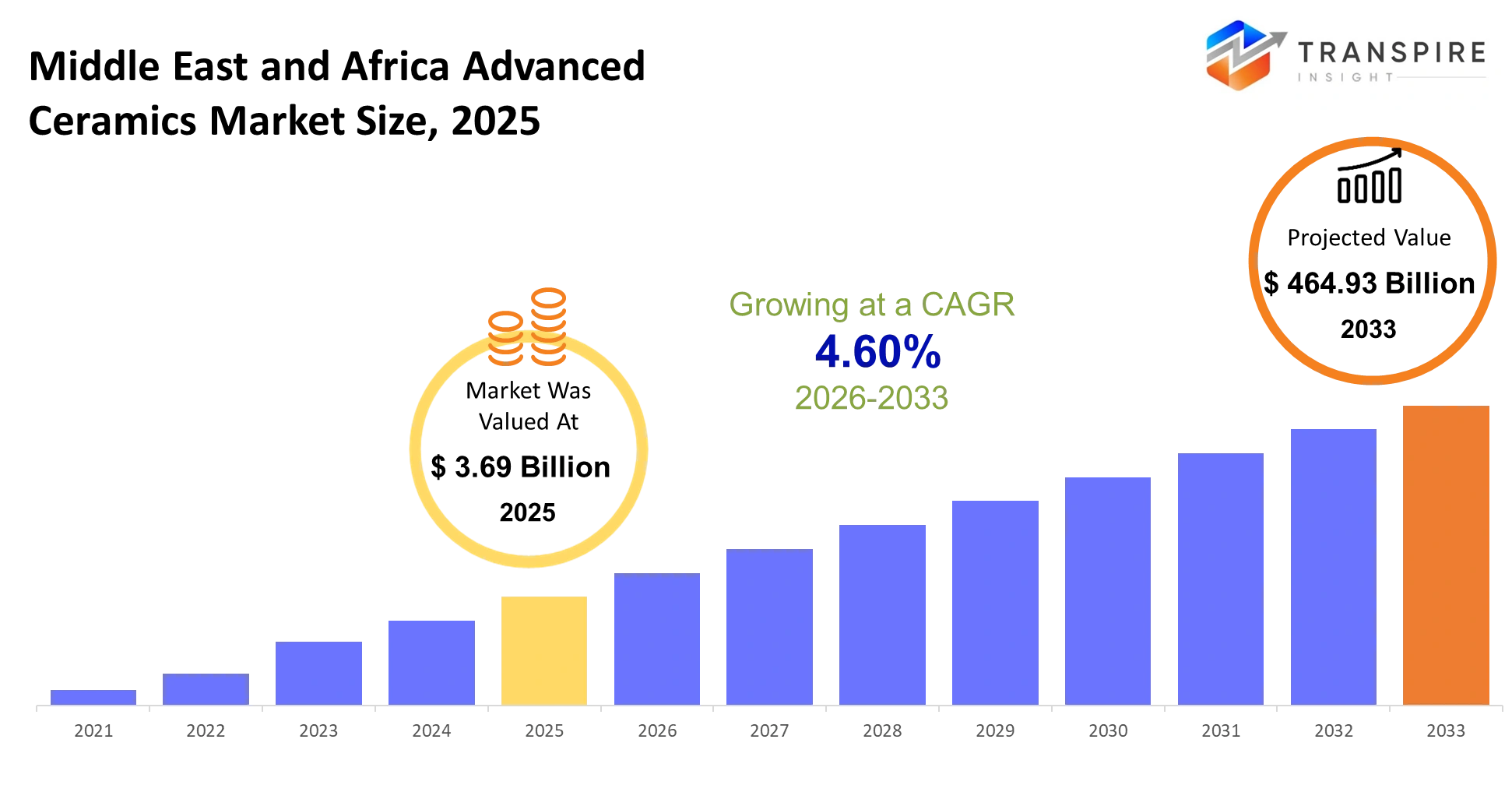
- Middle East and Africa Advanced Ceramics Market Size 2025: USD 3.69 Billion
- Middle East and Africa Advanced Ceramics Market Size 2033: USD 464.93 Billion
- Middle East and Africa Advanced Ceramics Market CAGR: 4.60%
- Middle East and Africa Advanced Ceramics Market Segments: By Material (Alumina, Zirconia, Silicon Carbide, Silicon Nitride), By Product (Monolithic, CMC), By Function (Structural, Functional), By Form (Powder, Solid), By Application (Electronics, Automotive, Medical), By End-User (Industrial Manufacturers, OEMs)
To learn more about this report,  Download Free Sample Report
Middle East and Africa Advanced Ceramics Market Summary:
The Middle East and Africa Advanced Ceramics Market size is estimated at USD 3.69 Billion in 2025 and is anticipated to reach USD 5.278 Billion by 2033, growing at a CAGR of 4.60% from 2026 to 2033. The advanced ceramics market in Middle Eastern countries and African countries which include Saudi Arabia and United Arab Emirates and South Africa and other Middle Eastern and African countries. The industry is growing due to increased demand for durable products that can withstand high temperatures and maintain precise measurements across three fields. Buyers will increasingly favor components that extend lifecycle and reduce maintenance costs, especially in harsh operating environments common in the region.
The advancement of powder processing, additive manufacturing and nano-ceramic formulations will establish new manufacturing standards which enable the production of intricate designs with uniform product quality. The regulatory frameworks governing energy efficiency and industrial emissions will drive the adoption of advanced ceramic systems for filtration, insulation, and clean energy applications. The evolving industrial requirements will be met through regional infrastructure investments and local manufacturing operations which create supply chain connections.
What Has the Impact of Artificial Intelligence Been on the Middle East and Africa Advanced Ceramics Market?
The implementation of AI technologies in market operations for advanced ceramics in the Middle East and Africa is helping transform how the market functions through data-driven techniques used for advanced ceramics development and manufacturing. The adoption of artificial intelligence in the Middle East and Africa advanced ceramics market operations is facilitating market research and identifying changes and emerging trends in various industries.
Artificial intelligence in the Middle East and Africa advanced ceramics market manufacturing is also transforming production efficiency through smart automation. The AI-powered systems operate in real time to monitor kiln temperatures and material consistency and defect detection which delivers improved accuracy while decreasing waste. The manufacturing process achieves operational savings through this level of automation which improves product quality and provides manufacturers with a competitive advantage. The combination of AI supply chain optimisation, improved inventory planning, enhanced supplier coordination, and enhanced logistics management will result in reduced delays and cost overruns.
Artificial intelligence technology is used in manufacturing operations, while advanced ceramics manufacturing processes across the Middle East and Africa use AI to develop new materials, thereby reducing product development times. The manufacturers will test various ceramic formulations through advanced simulations and digital twins before starting production to achieve faster development times. The technologies these companies adopt will create a competitive advantage because their industry is experiencing ongoing market expansion.
Key Market Trends & Insights:
- Saudi Arabia leads the Middle East & Africa advanced ceramics market with close to 30% market share owing to the efforts made in terms of industrial diversification and infrastructure development.
- The UAE will be leading the regions in terms of growth, recording a CAGR of over 8% until 2030 on the back of increased adoption of smart manufacturing in the region.
- The market share held by Monolithic Ceramics is above 45%, owing to the increasing need for ceramics in high temperature and structural uses.
- Ceramic Matrix Composites hold the second largest market share, witnessing an increasing demand from the aerospace and defense industries.
- In terms of ceramic types having significant growth prospects, Nano Ceramics are the most dominant, expected to increase up until 2030.
- Electronics dominates in the applications category, accounting for around 35% market share due to growing demand for semiconductors and insulators.
- Medical applications are leading the segments in terms of growth, with a CAGR of over 9% due to high usage in implants and diagnostics.
- The energy & power sector remains dominant with a share of close to 40%, owing to the role of ceramics in thermal insulation.
- Healthcare end-user segment leads the growth curve, owing to the increased usage of precision materials and ceramic biocompatibility.
Middle East and Africa Advanced Ceramics Market Segmentation
By Material
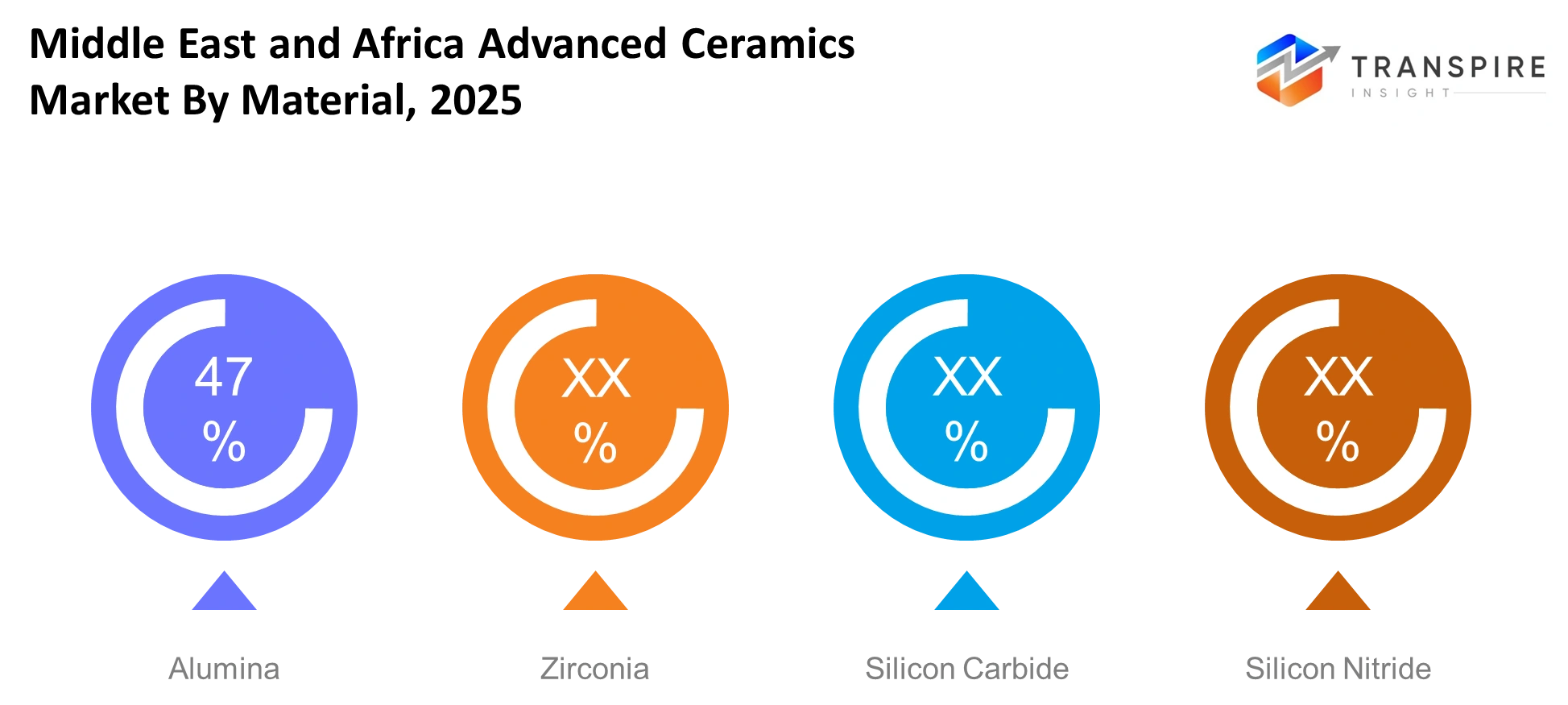
The material segmentation would illustrate how performance requirements influence choices in different sectors. Alumina will continue to be used for its economic value and excellent abrasion and heat resistance. Zirconia would attract more attention due to its exceptional durability and crack resistance characteristics. The use of silicon carbide and silicon nitride would become common in applications requiring high thermal stability and strength.
The choice of materials across industries depends on application requirements and expected lifecycle. The electronics and medical industries require precise parts with reliable performance, driving increased demand for zirconia and alumina. The heavy industries would opt for silicon-based ceramics that can withstand heavy loads.
To learn more about this report, Download Free Sample Report
By Product
Product segmentation will highlight distinctions between conventional and modern composite ceramics. Monolithic ceramics will be favored because of their simple construction, economy, and reliability. The monolithic ceramic products will have an application in cases where the material is required for its hardness and durability and not much attention will be paid to the design aspect.
The CMC products will find applications in various industries like aerospace and military applications where lightness and strength are desirable. With better mechanical properties and thermal shock resistance, CMC products will gain traction. Industry players will put more effort into improving the manufacturing processes for composite ceramics to make them more reliable.
By Function
Functional classification distinguishes between load-bearing and performance-oriented applications. Structural ceramics will resist mechanical loads and provide strength, hardness, and toughness. They will be crucial in automobile and industrial machinery parts. Functional ceramics will utilize electrical, thermal, and chemical attributes.
Functional ceramic applications will include sensors, capacitors, and insulators. The demand will increase due to growth in electronics and intelligent systems. Advances in material science will improve conductivity. This combination of strength and performance will set the trend for usage in the advanced ceramics market of the Middle East and Africa.
By Form
Form-based segmentation will reveal the impact of processing technologies on the ultimate utilization of the material. Ceramic powder will be considered the initial stage in the process of creating a more sophisticated shape. The process of additive manufacturing and mold shaping will necessitate the use of ceramic powder that is refined and pure. This form will allow for versatility in terms of design and complicated shapes.
The solid form of ceramic will be crucial for end products that need to be applied immediately. Industries will require robust materials for structural strength. The demand for pre-shaped components will persist.
By Application
Segmentation of ceramics applications would depend on how the ceramics are used by different industries for various performance purposes. The electronics industry would dominate because of the need for insulation and conductive control in addition to miniaturization. The electronic components, including semiconductors and substrates, require advanced ceramic properties.
In the automotive industry, ceramics will be increasingly used owing to their heat resistance and lightweight properties. The medical industry would adopt ceramics due to the growing need for biocompatibility and durability. There would be increased use of ceramics for implants, dentistry, and diagnostics. Reliability and high safety standards will influence the choice of materials.
By End-User
The end-user segmentation will show the differences in the impact of various user groups on manufacturing and innovation. The industrial manufacturers will be a significant part of use because of big volumes of their activities. Companies operating in heavy machinery, energy, and processing sectors will be interested in using ceramics for their reliability. Cost control and performance improvement will determine the choice of purchasing.
OEMs will constitute a new and growing market segment focused on incorporating ceramics into products. Manufacturers dealing with the automotive, electronics, and health care industries will be interested in the customisation of ceramic components. OEMs will collaborate more often with suppliers.
What are the Main Challenges for the Middle East and Africa Advanced Ceramics Market Growth?
Some of the major technical and operational hurdles that still limit the widespread adoption of the middle east and africa advanced ceramics market include technical complexities in the process. Advanced ceramics require precise control over their processing parameters, as even slight changes in temperature or material composition can affect performance and stability. The materials become less dependable for critical applications in aerospace and energy because their behavior under extreme conditions remains difficult to predict.
On the other hand, manufacturing and regulatory barriers also pose serious impediments to the middle east and africa advanced ceramics market growth. High capital requirements to manufacture advanced ceramics, coupled with the use of specialized equipment, can drive up production costs significantly. Moreover, regulatory restrictions, particularly those related to the use of advanced ceramics in electronic devices and biomedical devices, will delay their market introduction. Cost sensitivity among end-users is another key impediment in regional industries.
Adoption difficulties persist due to infrastructure and technical expertise shortcomings in certain areas of the region. The market for advanced ceramics in the Middle East and africa relies heavily on external technology and experts, hindering innovation. Insufficient financing and poor cooperation between companies and institutions of learning delay advancements in product creation. Market constraints hinder the speed of adoption of advanced ceramics in the industrial sector.
The market faces challenges from both their operational costs and their product development requirements. The materials provide better financial benefits through lower costs and simpler usage which results in specific operational advantages. The Middle East and Africa Advanced Ceramics Market faces business uncertainties because of two factors: evolving regulations and emerging technological innovations which require ongoing financial commitment.
Regional Insights
Saudi Arabia will demonstrate strong demand because its industrial sector diversifies and its infrastructure projects expand. The energy and manufacturing and defense sectors will drive higher demand for materials that can withstand heat and last for an extended period. The country will increase its ability to produce goods locally which will lead to decreased dependency on foreign products while providing steady industrial supply.
Industrial policies will promote the use of advanced materials that operate effectively under high-temperature, high-load conditions. The expansion of oil refining operations together with renewable energy initiatives will create additional demand for materials. Regional development will drive continuous growth in the advanced ceramics market in the Middle East and Africa.
The United Arab Emirates will become a rapidly developing center which will specialize in cutting-edge manufacturing and intelligent technological solutions. The electronics, aerospace, and healthcare sectors will see increased demand for advanced ceramic products due to strong investments in those industries. Government programs which promote new ideas will drive businesses to implement contemporary manufacturing methods. The development of research facilities together with international business partnerships will enhance our technical abilities. The need for precise applications will continue to increase across all industries. The United Arab Emirates will become a major player in the advanced ceramics market which serves the Middle East and Africa region.
The mining industry and automobile manufacturing and industrial processing operations will create ongoing demand from South Africa. Heavy industries will require materials which have high resistance and extreme durability. The basic demand will be met through local production but ceramic products with special applications will still need to be imported.
The industrial development needs will control the implementation speed while cost factors will decide the material adoption rate. The initiatives aimed at improving industrial performance will increase material demand.
Other areas will also see gradual growth in relation to industrialization in smaller economies. The demand for construction, energy, and basic manufacturing industries, which need durable products, will increase. Local production capacity will remain low, leading to reliance on foreign products.
Future investment in infrastructure development will aid in acceptance of the product. Development in logistics and technical knowledge will improve the participation in the market. These changes will help in expanding the Middle East and Africa Advanced Ceramics Market.
Recent Development News
In April 2026, Mantec Technical Ceramics announced a strategic collaboration with the Abu Dhabi-based Technology Innovation Institute to design and deliver advanced ceramic filtration systems, strengthening its presence in the Middle East industrial ceramics segment.https://advancedceramicsshow.com
In March 2026, the AMRICC Centre launched new industry-backed training programs in advanced ceramics and refractories, expanding partnerships with industrial players and enhancing workforce capabilities relevant to global (including MEA-linked) ceramics supply chains.https://advancedceramicsshow.com
|
Report Metrics |
Details |
|
Market size value in 2025 |
USD 3.69 Billion |
|
Market size value in 2026 |
USD 3.852 Billion |
|
Revenue forecast in 2033 |
USD 5.278 Billion |
|
Growth rate |
CAGR of 4.60% from 2026 to 2033 |
|
Base year |
2025 |
|
Historical data |
2021 - 2024 |
|
Forecast period |
2026 - 2033 |
|
Report coverage |
Revenue forecast, competitive landscape, growth factors, and trends |
|
Regional scope |
Middle East and Africa (Saudi Arabia, United Arab Emirates, South Africa, Rest of Middle East and Africa) |
|
Key company profiled |
Kyocera, CoorsTek, CeramTec, Morgan Advanced Materials, Saint-Gobain, NGK Insulators, 3M, Rauschert, McDanel, Blasch, Ortech, Elan, Superior Ceramics, LSP Industrial Ceramics, Advanced Ceramics Manufacturing |
|
Customization scope |
Free report customization (country, regional & segment scope). Avail customized purchase options to meet your exact research needs. |
|
Report Segmentation |
By Material (Alumina, Zirconia, Silicon Carbide, Silicon Nitride), By Product (Monolithic, CMC), By Function (Structural, Functional), By Form (Powder, Solid), By Application (Electronics, Automotive, Medical), By End-User (Industrial Manufacturers, OEMs) |
How Can New Companies Establish a Strong Foothold in the Middle East and Africa Advanced Ceramics Market?
New entrants aiming to build a presence in the middle east and africa advanced ceramics market need to develop specific strategies which will enable them to compete successfully against broader market rivals. The medical implants industry and energy insulation sector and semiconductor components market will enable smaller companies to establish their unique market positions. The new companies will establish their business operations by solving industrial plant heat resistance problems and healthcare biocompatibility requirements.
The Middle East and Africa advanced ceramics market will depend on innovation for its business growth. Entrepreneurial organisations that manage their resources using state-of-the-art technologies such as additive manufacturing and nanoceramics would be the winners because of their superior performance and cost-effectiveness. Ceramic Materials Solutions produces custom ceramic materials while Nanoe is engaged in providing solutions for nano-powders. Young enterprises should devise these innovation strategies to meet the requirements of their industrial clientele.
Strategic partnerships will establish stronger market-entry pathways by providing access to vital distribution systems and specialised technical knowledge. The product validation process will become faster because of partnerships with regional manufacturers, research institutions and OEMs. New companies will achieve cost reductions and better customer service through technology differentiation and local production methods and supply chain improvements. The businesses that match their innovation efforts with actual industry requirements will create a sustainable market presence in the middle east and africa advanced ceramics industry.
Key Middle East and Africa Advanced Ceramics Market Company Insights
Positioning would rely heavily on specializing in high-performing applications like electronics, medical equipment, and energy systems. Specialization would revolve around emphasizing quality, durability, and precision for the company to stand out. Clearly defined, industry-specific value offerings would be critical for establishing long-term sustainability and stability amid competitive pressures.
Branding consistency and product reliability would foster customer trust in their products. Focusing on niche markets would limit any competition with major industry players. It would help to create a solid market foothold in the Middle East and the African advanced ceramics market.
Competitive advantage would be fostered through continuous innovation in materials and processing methods. Investing in nanotechnology, additive manufacturing, and high-temperature applications would give a market edge. Improving product performance would attract precision and durable products.
Research and development would make production more efficient. Product testing and simulation would improve reliability of products. These strategies would enable companies to stay ahead in the middle east and africa advanced ceramics market.
The partnerships will give organizations access to advanced technologies together with new methods of distributing products and their regional expertise. The company will develop new products and enter new markets through its partnerships with original equipment manufacturers and research institutes and local producers. Cooperation is important for risk reduction and commercialization acceleration.
Joint ventures will help increase efficiency in supply chain operations and expand market coverage. Knowledge exchange will benefit technological advancement and innovation. Such kind of collaboration will be crucial for competition shaping within the Middle East and the African advanced ceramics market.
The company expansion activities will be related to entering new regions with high potential for growth and creating local manufacturing sites. Local industrial centers with great potential for growth will become the focus of the companies. This will affect the competitive dynamics in the advanced ceramics market in the Middle East and Africa.
There is no doubt that technological differentiation will be of utmost importance in attaining competitive advantage. Companies will use intelligent manufacturing processes, automation, and AI-based systems for quality assurance purposes.
The application of advanced materials engineering would allow the development of customized solutions according to the requirements of the industry. Constant advancements in production techniques would boost productivity and efficiency. This emphasis on technology would help gain a stronger foothold in the Middle East and the African advanced ceramics market.
Company List
- Kyocera
- CoorsTek
- CeramTec
- Morgan Advanced Materials
- Saint-Gobain
- NGK Insulators
- 3M
- Rauschert
- McDanel
- Blasch
- Ortech
- Elan
- Superior Ceramics
- LSP Industrial Ceramics
- Advanced Ceramics Manufacturing
What are the Key Use-Cases Driving the Growth of the Middle East and Africa Advanced Ceramics Market?
The middle east and Africa advanced ceramics market will develop through robust applications in the electronics sector, as high-quality materials can be used to provide insulation, heat management, and reduced sizes. Application of advanced ceramics can be seen in the production of semiconductors, circuits, and sensors where they operate at high temperatures and voltage levels. The need for digitalization and advancements in technology will fuel the demand for advanced ceramics.
Usage of advanced ceramics in the healthcare industry is one of the reasons why the demand for advanced ceramics is going to increase, with products such as dentistry, orthopedics, and diagnostics being made possible by them.These materials are biocompatible and durable, ensuring their successful implementation in precision medicine solutions. Investments made in healthcare facilities will serve as a catalyst for growing demand in the middle east and Africa advanced ceramics market.
Finally, the development of automotive and energy sectors will increase requirements for the use of advanced ceramics. Various components used in engines, thermal barriers, and battery solutions will require materials that offer heat resistance and lightweight construction. The emergence of alternative solutions such as electric cars and renewable energy generation will ensure stable demand for materials under consideration.
Additionally, manufacturing processes and industry will utilize ceramic materials for wear-resistant instruments, cutting machinery, and coating materials that protect surfaces. This will increase production efficiency and decrease costs, making it commercially beneficial. In the context of industry striving for efficiency and sustainability, ceramic materials will be widely implemented across various applications.
Middle East and Africa Advanced Ceramics Market Report Segmentation
By Material
- Alumina
- Zirconia
- Silicon Carbide
- Silicon Nitride
By Product
- Monolithic
- CMC
By Function
- Structural
- Functional
By Form
- Powder
- Solid
By Application
- Electronics
- Automotive
- Medical
By End-User
- Industrial Manufacturers
- OEMs
Frequently Asked Questions
Find quick answers to common questions.
The approximate Middle East and Africa Advanced Ceramics Market size for the market will be USD 5.278 Billion in 2033.
Key segments for the Middle East and Africa Advanced Ceramics Market are By Material (Alumina, Zirconia, Silicon Carbide, Silicon Nitride), By Product (Monolithic, CMC), By Function (Structural, Functional), By Form (Powder, Solid), By Application (Electronics, Automotive, Medical), By End-User (Industrial Manufacturers, OEMs).
Major Middle East and Africa Advanced Ceramics Market players are Kyocera, CoorsTek, CeramTec, Morgan Advanced Materials, Saint-Gobain, NGK Insulators, 3M, Rauschert, McDanel, Blasch, Ortech, Elan, Superior Ceramics, LSP Industrial Ceramics, Advanced Ceramics Manufacturing.
The Middle East and Africa Advanced Ceramics Market size is USD 3.69 Billion in 2025.
The Middle East and Africa Advanced Ceramics Market CAGR is 4.60%.
- Kyocera
- CoorsTek
- CeramTec
- Morgan Advanced Materials
- Saint-Gobain
- NGK Insulators
- 3M
- Rauschert
- McDanel
- Blasch
- Ortech
- Elan
- Superior Ceramics
- LSP Industrial Ceramics
- Advanced Ceramics Manufacturing
Recently Published Reports
-
Dec 2024
Handling and Lifting Equipment Market
Handling and Lifting Equipment Market Size, Share & Analysis Report By Product (Cranes and Hoists, Forklifts, Conveyor Systems, Aerial Work Platforms, Others), By Application (E-Commerce, Automotive and Railway, Food and Beverages, Aviation, Others), and Geography (North America, Europe, Asia-Pacific, Middle East and Africa, South and Central America), 2021 - 2031
-
Feb 2025
HVAC Equipment Market
HVAC Equipment Market Size, Share & Analysis Report By Heating Equipment Type (Boilers and Furnaces, Heat Pumps, and Unitary Heaters), By Ventilation Equipment (Air Handling Units, Humidifiers and Dehumidifiers, Air Filters, and Fan Coiling Units), By Air Conditioning Equipment (Unitary Air Conditioners, Room Air Conditioners, Packaged Terminal Air Conditioners, and Chillers), By End User (Commercial, Residential, Industrial, and others), and Geography (North America, Europe, Asia-Pacific, Middle East and Africa, South and Central America), 2021 – 2031
-
Feb 2025
Refrigeration Valves Market
Refrigeration Valves Market Size, Share & Analysis Report By Type (Solenoid Valves, Expansion Valves, Check Valves, Service Valves, Others), By Application (Commercial Refrigeration, Industrial Refrigeration, Transport Refrigeration, Residential Refrigeration, Air Conditioning Systems), By End User (Food and Beverage Industry, Pharmaceutical Industry, HVAC Industry, Chemical Industry, Others), and Geography (North America, Europe, Asia-Pacific, Middle East and Africa, South and Central America), 2021 – 2031
-
Dec 2025
E-Commerce Packaging Materials Market
E-Commerce Packaging Materials Market By Material Type (Corrugated Boxes, Paper & Paperboard, Foam & Cushioning Materials, Plastic Packaging, Flexible Packaging, Protective Packaging, Others), By Product(Primary Packaging, Secondary Packaging, Tertiary Packaging), By Packaging Function (Protective Packaging, Branding & Presentation Packaging, Transit & Logistic Packaging, Sustainable Packaging, Tamper Evidence Packaging), By End-User (Retail & Consumer Goods, Electronic Appliances, Food & Beverages, Healthcare & Pharmaceutical, Fashion & Apparel, Home & Furnishing, Others); By Industry Analysis, Size, Share, Growth, Trends, and Forecasts 2021-2033