

United Kingdom Jewelry Market Size & Forecast:
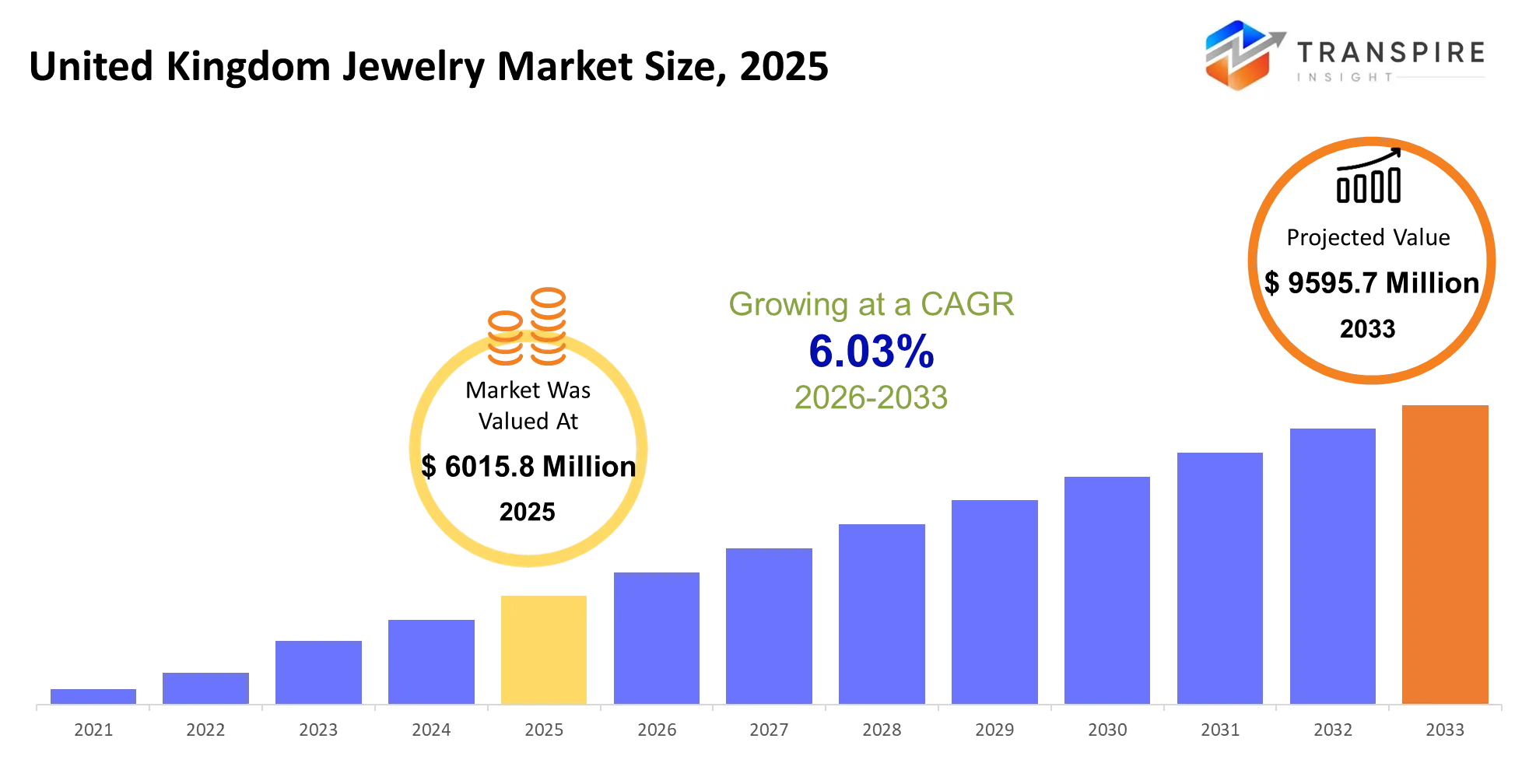
- United Kingdom Jewelry Market Size 2025: USD 6015.8 Million
- United Kingdom Jewelry Market Size 2033: USD 9595.7 Million
- United Kingdom Jewelry Market CAGR: 6.03%
- United Kingdom Jewelry Market Segments: By Type (Gold Jewelry, Diamond Jewelry, Silver Jewelry, Platinum Jewelry, Fashion Jewelry, Others); By Application (Daily Wear, Wedding, Investment, Gifting, Luxury, Others); By End-User (Women, Men, Unisex, Retail Consumers, Luxury Buyers, Others); By Distribution (Online, Retail Stores, Specialty Stores, Jewelry Chains, Auctions, Others)
To learn more about this report,  Download Free Sample Report
United Kingdom Jewelry Market Summary
The United Kingdom Jewelry Market was valued at USD 6015.8 Million in 2025. It is forecast to reach USD 9595.7 Million by 2033. That is a CAGR of 6.03% over the period.
The United Kingdom Jewelry Market works like a value-preservation and identity forward retail place, where people take disposable income and turn it into pieces they wear, signals of status, and purchases that feel culturally meaningful. It kinda links mining supply lines, global gemstone trading centers and local shop networks, then funnels everything into a high-margin consumer goods channel that’s held together by trust, certification, and design differentiation.
Over the past 3 to 5 years, the market has been shifting in a more structural way , from buying that starts in stores, to purchasing that’s steered by digital discovery and omnichannel habits. This shift sped up after pandemic-era retail disruptions, when many sellers had to move fast with virtual try ons , online configurators, and direct-to-consumer shipping at scale. Meanwhile price swings in gold and diamonds, tied to wider global supply chain issues, made more shoppers lean toward lab-grown options, and recycled materials, so the product mix changed and so did the margin math too.
Because of all that, revenue growth has held up better, since addressable demand is broader, and younger buyers are buying more often. But now the growth is less about opening more physical locations, and more about digital trust infrastructure, stronger traceability systems, and personalized design capability, that turns online browsing into high value transactions.
Key Market Insights
- London and the South East kind of dominate the scene, with almost 42% share in 2025, mostly pushed by luxury retail clusters, tourism inflows and that dense high income shopper vibe.
- The Midlands seems the fastest mover, running through 2026–2033, backed by e-commerce expansion, along with rising needs for budget friendly fashion and lab grown jewelry.
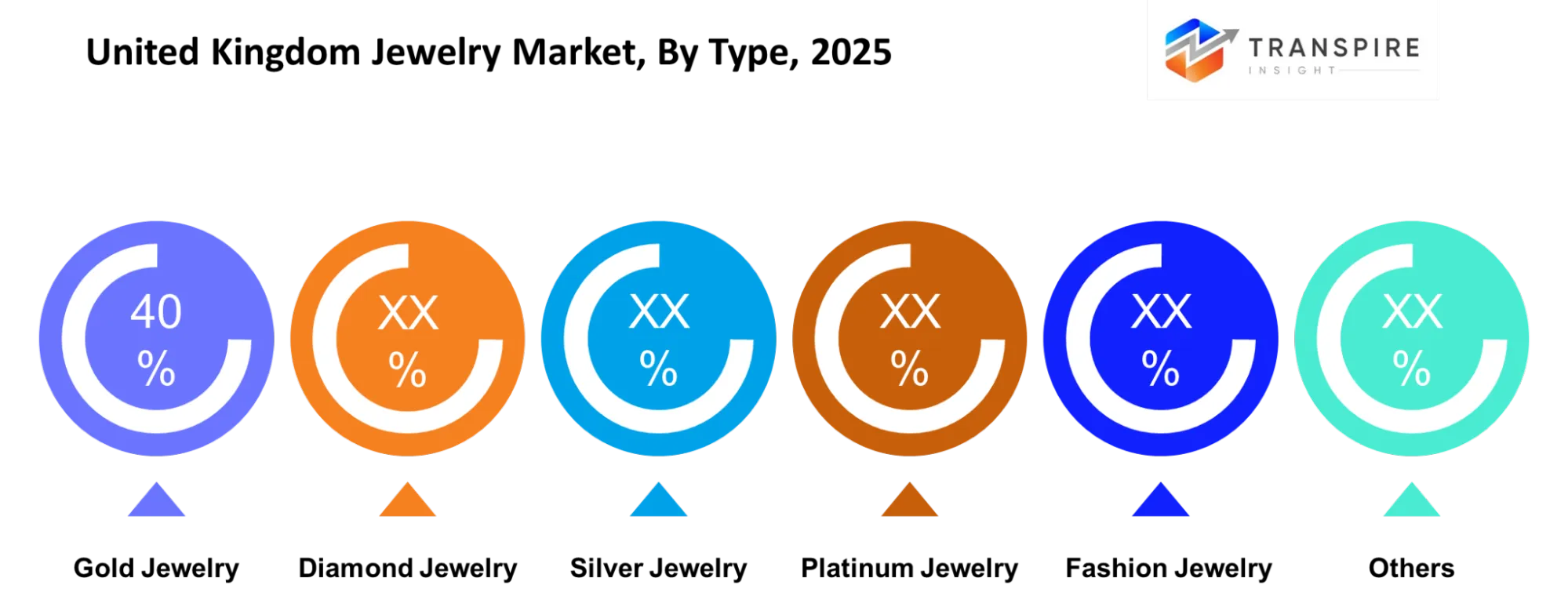
- On the product side, gold jewelry takes the lead for segmentation, at about 35% share, it stays strong because of cultural preference, perceived investment value and also that inflation hedging behavior people do.
- Fashion jewelry is the quicker grower segment, Gen Z shoppers leaning into trend based, low cost accessories, they get nudged by social media cycles, you know.
- For application demand, wedding jewelry is close to 40% share, it holds steady due to established cultural spending habits, plus high value bridal purchases.
- Self purchase plus gifting jewelry is the fastest growing application, that is supported by climbing disposable income and lifestyle led buying patterns.
- When it comes to end users, women remain the main group, with over 55% share, and it’s anchored in bridal, gifting, and personal luxury consumption trends.
- Men’s jewelry is the fastest growing end user category, helped by changing fashion norms and the wider take up of minimalist design, really.
- Cartier and Tiffany & Co are all about ultra luxury exclusivity, doing more boutique expansion , plus leaning hard into heritage branding to keep that premium pricing power going.
- De Beers meanwhile pushes lab grown diamonds through Lightbox, it kinda shifts how people see the value, especially in those mid tier diamond segments.
What are the Key Drivers, Restraints, and Opportunities in the United Kingdom Jewelry Market?
Driver in the United Kingdom Jewelry Market is basically happening because retail is doing this big digital-first turn, plus more people are getting comfortable with lab grown diamonds and with certified recycled metals. It kinda speeded up after gold and diamonds went through some real price rollercoasters, so shoppers started thinking about value per carat more than brand heritage , or whatever is traditionally supposed to matter. Then naturally online configurators, AR try-on bits and direct-to-consumer storefronts began lifting conversions, especially around bridal and fashion, and this lifted transaction volumes for mid-tier retailers too, like noticeably.
Restraint is still tied to fragmented provenance checks, happening across the entire supply chain, which is messy in a way that doesn’t really help. Hallmarking gives a decent baseline assurance, yet full end to end traceability across mined gold , polished diamonds and recycled inputs is inconsistent , particularly with smaller suppliers. That structural gap makes transparency efforts more expensive for retailers, and at the same time it slows down scalability for independent jewellers who don’t have the same certified sourcing pathways. So digital adoption ends up delayed, and pricing efficiency ends up uneven across different regions
Opportunity is starting to show up through AI enabled customization platforms that connect to lab-grown diamond certification hubs, plus blockchain style tracking systems for materials. London luxury retailers are already piloting on-demand design tools, and they can create bespoke rings within 48 hours or less, using parametric design engines. If this expands into secondary cities like Manchester and Birmingham it could open up fresh demand, especially for younger buyers who want affordability speed, and verified ethical sourcing, all folded into a single integrated purchase journey.
What Has the Impact of Artificial Intelligence Been on the United Kingdom Jewelry Market?
AI and advanced digital systems are kinda reshaping exhaust gas cleansing and scrubber performance management, through real time sensor analytics and automated control loops. Ship operators increasingly roll out AI-enabled monitoring platforms to tweak scrubber water flow, pH balance, and even fuel switching call s, which helps with MARPOL sulfur compliance while cutting down manual touch time. Computer vision, plus IoT sensor fusion setups, now keep an eye on corrosion, fouling, and system inefficiencies across marine emission control tech, so centralized dashboards can steer fleet wide compliance risks.
Also, machine learning models show up in predictive maintenance, where old vibration, temperature, and exhaust variability records help forecast scrubber failures before they happen. This boosts operational availability by supporting condition-based servicing instead of staying stuck on rigid maintenance cycles, so unexpected downtime drops and the whole operational disruption cost gets smaller. Emissions forecasting tools go further, optimizing route choices by simulating fuel use and sulfur output across different routings and engine load scenarios, which in turn improves fuel economy and regulatory alignment across shipping fleets.
Still, there are limitations to all this, because data quality can be inconsistent when legacy sensor systems are involved, and the harsh sea environment makes measurement less reliable. Connectivity gaps offshore also block smooth, real-time model refreshes, so teams end up relying partly on delayed updates or batch processed analytics, and that reduces the level of full autonomy in emission control optimization.
Key Market Trends
- Lab-grown diamond use in UK jewellery retail, sort of doubled from 2020 to 2025, since cost-aware shoppers slowly moved on from mined stones.
- After the covid pause there was also a sort of lag then momentum, so in 2021 UK jewellers started weaving omnichannel retailing more seriously, mixing Hatton Garden boutiques with faster e-commerce growth, not just adding sites but actually integrating them.
- After 2022 sustainability expectations jumped quite noticeably, and that basically forced brands to switch toward recycled gold sourcing, plus publish clearer supply chain details across the UK market, like it’s not optional anymore.
- At the same time luxury consolidation got stronger, with LVMH and Richemont expanding their UK footprint, and that put extra pressure on smaller independent jewellers to differentiate through special craft techniques and sharper branding.
- Second-hand and vintage jewellery platforms also grew quickly after 2021, which nudged consumer tastes toward resale worth and a more circular way of buying luxury, kinda like buying again without the guilt.
- Then in 2023, AI personalization tools started showing up more, helping UK retailers recommend custom, tailored designs and estimate customer style leanings with better accuracy than before.
- Gold price swings starting around 2022 pushed makers toward lighter jewellery styles, and even toward alternative materials, because affordability matters for mass buyers.
- Finally, Buy Now Pay Later options expanded across jewellery purchases for younger UK shoppers, and since around 2020 that helped lift average order values across online retail channels, so carts got bigger.
United Kingdom Jewelry Market Segmentation
By Type
Gold jewelry is still basically holding the dominant spot in the UK jewelry world, mainly because of long-standing cultural preference , its investment type appeal and then that strong resale value belief among shoppers. Diamond jewelry keeps a premium share too, and it’s helped a lot by engagement and bridal demand, while silver jewelry and fashion jewelry seem to pick up momentum especially in younger , price-sensitive groups. Platinum stays kind of niche , not because it is irrelevant , but more because of higher price points and limited day-to-day adoption across broad mass retail channels.
For gold jewelry, demand feels like it is shaped by inflation sensitivity and gold price volatility, which kind of locks in its dual role as both adornment and store-of-value asset. Diamond jewelry momentum is increasingly tied to ethical sourcing verification and also lab-grown substitution, and that is starting to rework what used to be the traditional mined diamond demand. Fashion jewelry rides fast-fashion cycles and social media influence, so trends move quicker, the turnover becomes faster, and product lifespans end up shorter.
What’s coming next seems to lean toward more substitution toward lab-grown diamonds and also more design innovation in lightweight gold products. Manufacturers are expected to diversify material sourcing strategies to handle price instability , not just react after the fact. Product developers will likely focus on modular, affordable luxury options that try to keep the look attractive while still preserving that investment perception.
To learn more about this report, Download Free Sample Report
By Application
Wedding jewelry keeps showing up as the strongest application segment, due to deep cultural tradition and high spending intensity around bridal moments. Daily wear jewelry sits in a steady mid-range area, mainly because urban working populations keep buying at a consistent pace. Investment demand stays stable, but it moves in cycles, while gifting and luxury segments can shift more, largely based on seasonal spending and how confident people feel about income.
Purchases that are driven by weddings get a lot of their steam from ceremonial meaning and long planning timeframes , so buyers tend to commit to higher value items and they also lean toward premium materials. For everyday wear, demand is more about lifestyle fit, with people usually wanting designs that are simple, hard-wearing, and meant for work spaces or professional atmospheres. When the economy feels shaky , investment minded buying tends to rise, especially if gold prices keep climbing and show stronger upward momentum.
Looking ahead, growth should show up in daily wear , and in gifting as well, since consumers are starting to buy for themselves more often , instead of waiting for “only” special occasions. Wedding jewelry is also expected to move further into personalization, including digital design tools, so brands can stand out. Retailers will likely push more experience led selling models and offer flexible pricing setups, to catch those mixed use purchase patterns.
By End-User
In the UK jewelry ecosystem, women are still the main shopper group, they drive most buys across bridal , fashion , and daily wear categories. Luxury customers are smaller in number , but they carry big value, focusing on branded options and pieces with high craftsmanship. Men and unisex offerings are growing slowly too , helped by shifting fashion expectations and wider acceptance of minimalist jewelry styles.
Women’s dominance links back to familiar gifting setups and the fact that they strongly influence what households spend more freely. Luxury buyers tend to favor legacy brands, verified credentials , and a sense of exclusivity , which supports the premium pricing muscle of established companies. Men’s adoption moves forward through wider category choices , like bracelets, chain necklaces, and rings, often shaped by celebrity culture and sports narratives.
Future trends seem to show more people picking unisex design, plus stronger male involvement in fashion-led jewelry, like not just “accessory” stuff but actual statement pieces. Luxury shoppers will probably start to ask for more provenance clarity, and real sustainability proof, not vague words. Brands are expected to broaden gender-neutral collections as well as offer more tailor-made options to pull in a wider range of customers, with a sort of steady expansion in what counts as “mainstream.”
By Distribution
Retail stores still hold a real advantage, mostly because there’s trust, you can hold and check the product, and buyers feel safer when spending higher ticket amounts in person. Online channels keep growing fast, largely for convenience, bigger assortment exposure, and digital try-on tools that make browsing feel less risky. Specialty stores and jewelry chains remain relevant through careful curation and environments where brands can really control the vibe, and yes even the presentation. Auctions also keep their place, but more for niche buyers who see jewelry like an investment , especially when they want something rare or vintage.
Retail stores keep leading for higher-value purchases , because consumers want physical inspection for diamonds and gold jewelry, period. Online growth stays strong thanks to better return terms, augmented reality previews , and direct-to-consumer pricing approaches that limit extra middle steps. Specialty stores lean into differentiation through artisan framing and customization services, so people feel it’s not just “mass made.”
Going forward, distribution will likely move toward hybrid omnichannel patterns, meaning online discovery turns into offline completion for premium items. Auction platforms may draw more attention from investment-oriented shoppers hunting hard-to-find pieces. Retailers will also put more effort into unified inventory setups and digital personalization, so the customer experience feels connected across every channel, not split up or inconsistent.
What are the Key Use Cases Driving the United Kingdom Jewelry Market?
Wedding , and bridal jewelry still seems to be the main use case in the United Kingdom jewelry market, sort of driven by strong cultural habits, a lot of emotional weight, and heavy spending that bunches up around engagement and marriage moments. People tend to focus on diamond rings and gold sets because they feel those materials mean permanence, social standing, and better long term value keeping.
At the same time , daily wearable jewelry and self purchase items are steadily growing as urban professionals and younger women start mixing lighter weight gold, silver, and even fashion oriented pieces into their normal routines. On top of that, gifting days—like anniversaries and seasonal celebrations—help keep demand fairly stable. This is especially true through retail boutiques and jewelry chains, where customers can get curated collections more easily, with the added comfort of “known” sellers and trust.
There’s also a newer style of consumption around resale and investment minded buying, supported by auctions and certified pre owned platforms that underline value preservation. Lab grown diamonds are being adopted more, and digital-first personalization tools are creating fresh pathways too, mainly for unisex buyers and younger consumer groups who want ethical options and a more customized fit, without feeling like they are locked into one traditional route.
|
Report Metrics |
Details |
|
Market size value in 2025 |
USD 6015.8 Million |
|
Market size value in 2026 |
USD 6370.5 Million |
|
Revenue forecast in 2033 |
USD 9595.7 Million |
|
Growth rate |
CAGR of 6.03% from 2026 to 2033 |
|
Base year |
2025 |
|
Historical data |
2021 - 2024 |
|
Forecast period |
2026 - 2033 |
|
Report coverage |
Revenue forecast, competitive landscape, growth factors, and trends |
|
Regional scope |
United Kingdom |
|
Key company profiled |
Tiffany & Co., Cartier, Pandora, Swarovski, Signet Jewelers, Chow Tai Fook, Bulgari, Graff, De Beers, Harry Winston, Rolex, Richemont, H Samuel, Beaverbrooks, Links of London |
|
Customization scope |
Free report customization (country, regional & segment scope). Avail customized purchase options to meet your exact research needs. |
|
Report Segmentation |
By Type (Gold Jewelry, Diamond Jewelry, Silver Jewelry, Platinum Jewelry, Fashion Jewelry, Others); By Application (Daily Wear, Wedding, Investment, Gifting, Luxury, Others); By End-User (Women, Men, Unisex, Retail Consumers, Luxury Buyers, Others); By Distribution (Online, Retail Stores, Specialty Stores, Jewelry Chains, Auctions, Others) |
Which Regions are Driving the United Kingdom Jewelry Market Growth?
London and the broader South East essentially runs the United Kingdom Jewelry Market, mainly because there is so much luxury retail packed in close, plus strong tourism, and an ecosystem that’s really tuned for high-end buying . Areas like Mayfair and Hatton Garden are well known too, they hold real artisan circuits alongside big global luxury flagship stores. You also get a strong financial services layer which helps keep disposable income high, and then the strict hallmarking rules basically add confidence, especially around precious metals and gemstones . Put it together, and you get sustained leadership in premium diamonds , and even in bespoke jewelry demand.
Scotland and Northern England bring in a steadier secondary share, backed by stable spending among middle income households and older retail habits that never really went away. Cities like Edinburgh, Manchester, and Leeds still carry a lot of tradition. But unlike the premium-heavy South East, this part leans more on mid-range gold and silver jewelry demand, the kind people wear daily, or buy as gifts during regular life moments. The economic footing feels more durable here thanks to varied industrial foundations and consistent household outlays, rather than relying on luxury tourism traffic. Independent jewelers stay very relevant too, they keep loyalty through long term community ties , and service approaches that feel dependable and repeatable.
The Midlands and Northern Ireland are showing the quickest growth, mostly because online jewelry retail is expanding fast, and logistics are improving so delivery works across the country. Newer investments in e-commerce fulfillment hubs and digital storefronts have widened access to both fashion jewelry and lab-grown diamond collections . Younger buyers in this area are gravitating toward price-conscious choices, plus trend-led styling, and that shift is pushing demand for modern pieces pretty hard. This growth signals strong entry opportunities for digital-first brands and investors targeting scalable omnichannel distribution between 2026 and 2033.
Who are the Key Players in the United Kingdom Jewelry Market and How Do They Compete?
Competition is still kinda moderately fragmented , where the big global luxury houses sit alongside specialist boutiques and mid-market chains, all sort of fighting in separate price bands. The longtime incumbents hold onto share using heritage branding and certified sourcing, but the disruption keeps ramping up , especially from lab-grown diamonds and digital retailers that sell straight to the consumer. Competitive edge now depends more on omnichannel know-how, properly traceable supply chains, and dependable after-sales support, not just on pure pricing strength. In premium areas you see retail consolidation, while online-first challengers keep popping up fast , chasing younger shoppers with more direct digital journeys.
Signet Jewelers, basically anchors the mid-market lane with H Samuel and Ernest Jones, leaning on scale store networks , in-store financing options, and repair services to push that volume-driven growth. Pandora leans into design-led sterling silver and this “accessible luxury” stance, and it sharpens differentiation via recycled metals while also widening lab-grown diamond assortments across UK locations. Watches of Switzerland Group plays in the higher-end distribution space by securing exclusive deals with Rolex and Cartier, using a concierge-style retail interaction, and it also grows showrooms in tourist-heavy areas, plus selective acquisitions in the US.
Graff goes after ultra-luxury buyers through vertical integration, meaning it steers diamond sourcing, cutting, and the retail presentation end-to-end , so exclusivity and margin control stay intact. De Beers, via its Lightbox lab-grown diamond program, uses fixed transparent pricing and industrial-scale production, which presses against how mined diamond pricing has traditionally worked. Both groups broaden reach by adding global boutique networks and selective retail collaborations, that together reinforce control over premium diamond positioning, even when tastes shift.
Company List
- Tiffany & Co.
- Cartier
- Pandora
- Swarovski
- Signet Jewelers
- Chow Tai Fook
- Bulgari
- Graff
- De Beers
- Harry Winston
- Rolex
- Richemont
- H Samuel
- Beaverbrooks
- Links of London
Recent Development News
In December 2025, Cartier reported sales surpassing £251 million for the 2024–25 financial year, driven by strong growth in luxury watch and jewellery demand. The brand expanded exclusive boutique experiences in high-footfall luxury districts and reinforced its dominance in ultra-premium bridal and high jewellery categories.https://www.professionaljeweller.com
What Strategic Insights Define the Future of the United Kingdom Jewelry Market?
The United Kingdom Jewelry Market is kind of moving toward a structurally hybrid mode, where digital-first discovery and certified physical verification are basically running as one integrated value chain. Growth will be pushed by personalization technologies , circular economy adoption, and a growing taste for transparent sourcing rather than just pure material ownership. Over the next 5 to 7 years, competitive advantage will shift to companies that can manage both data driven design systems and trusted authentication infrastructure across omnichannel networks.
There is also a less visible risk, from the tightening of provenance and sustainability regulation which could lift compliance costs sooner than pricing power can actually keep up. Smaller retailers might see margin compression as traceability requirements expand across gold and diamond supply paths , which could speed up consolidation toward bigger, properly certified networks. Meanwhile, reliance on global diamond polishing hubs brings continuity risk too, especially if geopolitical trade restrictions get more intense or last longer.
On the other side, a strong emerging chance is in AI enabled bespoke jewelry design, together with lab-grown gemstone certification ecosystems, and this looks especially relevant in secondary cities around the UK where digital adoption is accelerating. Market players should put money into vertically integrated traceability platforms that connect with real-time customization tools. This could help them capture a higher price point, reduce inventory risk, and also reinforce longer term customer loyalty.
United Kingdom Jewelry Market Report Segmentation
By Type
- Gold Jewelry
- Diamond Jewelry
- Silver Jewelry
- Platinum Jewelry
- Fashion Jewelry
- Others
By Application
- Daily Wear
- Wedding
- Investment
- Gifting
- Luxury
- Others
By End-User
- Women
- Men
- Unisex
- Retail Consumers
- Luxury Buyers
- Others
By Distribution
- Online
- Retail Stores
- Specialty Stores
- Jewelry Chains
- Auctions
- Others
Frequently Asked Questions
Find quick answers to common questions.
The expected United Kingdom Jewelry Market size is USD 9595.7 Million in 2033.
Key segments for the United Kingdom Jewelry Market are By Type (Gold Jewelry, Diamond Jewelry, Silver Jewelry, Platinum Jewelry, Fashion Jewelry, Others); By Application (Daily Wear, Wedding, Investment, Gifting, Luxury, Others); By End-User (Women, Men, Unisex, Retail Consumers, Luxury Buyers, Others); By Distribution (Online, Retail Stores, Specialty Stores, Jewelry Chains, Auctions, Others).
Major United Kingdom Jewelry Market players are Tiffany & Co., Cartier, Pandora, Swarovski, Signet Jewelers, Chow Tai Fook, Bulgari, Graff, De Beers, Harry Winston, Rolex, Richemont, H Samuel, Beaverbrooks, Links of London.
The United Kingdom Jewelry Market size is USD 6015.8 Million in 2025.
The United Kingdom Jewelry Market CAGR is 6.03% from 2026 to 2033.
- Tiffany & Co.
- Cartier
- Pandora
- Swarovski
- Signet Jewelers
- Chow Tai Fook
- Bulgari
- Graff
- De Beers
- Harry Winston
- Rolex
- Richemont
- H Samuel
- Beaverbrooks
- Links of London
Recently Published Reports
-
Apr 2026
Bottled Water Market
Bottled Water Market Size, Share & Analysis Report By Product Type (Still Bottled Water, Carbonated Bottled Water, Functional Bottled Water, and Others), By Packaging (PET, Cans, and Others), By Sales Channel (Supermarkets/Hypermarkets, Convenience Stores/Drug Stores, Grocery Stores/Club Stores, Foodservice, and Others) and Geography (North America, Europe, Asia-Pacific, Middle East and Africa, South and Central America), 2021 - 2032
-
Apr 2026
Color Cosmetic Packaging Market
Color Cosmetic Packaging Market Size, Share & Analysis Report By Application (Mascara Packaging, Liquid Packaging, and Liquid Face), By Type (Tubes & Bottles, Pens & Markers, Compacts & Containers, and Droppers & Pumps), and Geography (North America, Europe, Asia-Pacific, Middle East and Africa, South and Central America), 2021 - 2031
-
Apr 2026
External Microphone For Camera Market
External Microphone For Camera Market Size, Share & Analysis Report By Type (Shotgun Microphone, Lavalier Microphone, and Others), By Application (Digital Camera, Professional Video Camera, and Others), and Geography (North America, Europe, Asia-Pacific, Middle East and Africa, South and Central America), 2021 - 2031
-
Apr 2026
Foot Orthotic Insoles Market
Foot Orthotic Insoles Market Size, Share & Analysis Report By Type (Pre-fabricated, and Custom-made), By Material (Thermoplastic, Composite Carbon Fiber, and Others), By Distribution Channel (Drug Stores, Hospitals & Clinics, and Others), and Geography (North America, Europe, Asia-Pacific, Middle East and Africa, South and Central America), 2021 - 2031