
South Korea Bauxite Mining Market Size & Forecast:
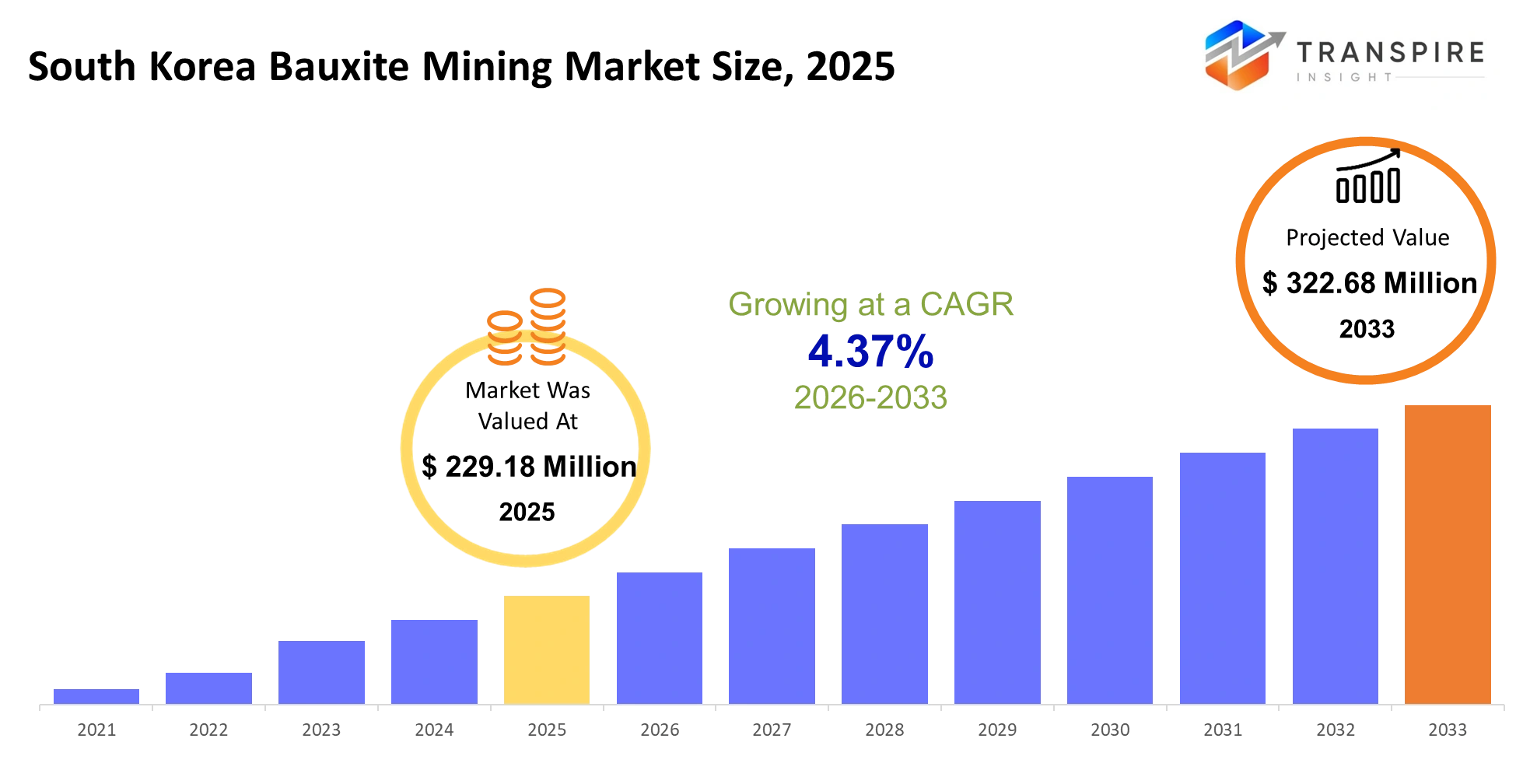
- South Korea Bauxite Mining Market Size 2025: USD 229.18 Million
- South Korea Bauxite Mining Market Size 2033: USD 322.68 Million
- South Korea Bauxite Mining Market CAGR: 4.37%
- South Korea Bauxite Mining Market Segments: By Mining Type (Open-pit Mining, Underground Mining, Strip Mining, Others); By Grade (Metallurgical Grade, Refractory Grade, Abrasive Grade, Cement Grade, Others); By Application (Aluminum Production, Refractory Materials, Abrasives, Cement Manufacturing, Others); By End User (Metallurgy Industry, Construction Industry, Automotive Industry, Aerospace Industry, Others); By Form (Lumps, Powder, Calcined Bauxite, Others).
To learn more about this report,  Download Free Sample Report
South Korea Bauxite Mining Market Summary
The South Korea Bauxite Mining Market was valued at USD 229.18 Million in 2025. It is forecast to reach USD 322.68 Million by 2033. That is a CAGR of 4.37% over the period.
The South Korea Bauxite Mining Market kinda works less like a simple domestic extraction thing and more like an upstream supply engine that keeps raw material feedstock flowing for the country’s aluminum smelters and then all those downstream manufacturing pockets, automotive, shipbuilding, and electronics packaging. In the real world it helps lock in consistent access to alumina production inputs, so the energy intensive refining, plus alloy production, can keep going without stopping and like, not get thrown off track.
Over the past five years, the whole market picture has changed in a structural way toward overseas asset acquisition and long term offtake agreements, as Korean refiners try to lower their exposure to concentrated suppliers. One big trigger was Indonesia’s 2023 move restricting raw bauxite exports, which tightened global supply and bumped price volatility up.
To deal with that, firms have pushed harder into Guinea and Australia, while also rolling out digital ore tracking, and ESG tied sourcing practices. So yeah, this kind of supply security pressure has raised investment intensity, and it’s also made revenue stick more to strategic procurement, rather than just mining output.
Key Market Insights
- Asia Pacific is basically leading the South Korea Bauxite Mining Market , with around 70% import dependence. This is coming through Australia and Guinea supply chain connections in 2025 and, yeah, it really shows.
- Guinea looks like the fastest-growing sourcing region going into 2026 , mainly because export ramp ups are happening and because of the long-term Korean offtake deals.
- For South Korea, the whole situation leans on external mining areas, so the focus becomes strategic import corridors, not so much domestic extraction capacity.
- When it comes to grade, metallurgical-grade bauxite is the big one, holding an estimated 80% share in the South Korea Bauxite Mining Market, and it basically backs alumina refining operations.
- After that, non-metallurgical bauxite lands in second place , and it is used for abrasives plus refractories across industrial manufacturing.
- Alumina refining is still the main thing, it makes up something like over 85% of the whole demand, in the South Korea bauxite mining Market ecosystem.
- For aluminum alloy production, that one is growing faster, kind of fueled by automotive lightweighting and also shipbuilding efficiency requirements, even though the mix can look different by year.
- Industrial ceramics, plus refractories, are kind of a stable secondary base, so they keep consumption steady enough.
- When it comes to end-use demand, aluminum manufacturers show the lead with around 65% share, mostly because they keep smelting and alloy production running continuously.
- And construction and infrastructure, they keep giving consistent demand for aluminum based materials.
What are the Key Drivers, Restraints, and Opportunities in the South Korea Bauxite Mining Market?
The real main driver is South Korea’s accelerating move to lock in steady alumina feedstock for those energy intense aluminum making operations. This momentum got even stronger after 2023, when Indonesia started tightening its raw bauxite export policies, which then kinda forced refiners to secure longer term supply deals with Australia and Guinea. So procurement volumes connected to multi-year agreements have gone up, giving global suppliers better revenue sight, while at the same time keeping input costs more steady for Korean smelters that feed automotive and shipbuilding.
The big restraint is that there just isn’t a solid domestic bauxite base. So the South Korea Bauxite Mining Market stays fully import dependent. That reliance is a problem because refiners get hit by freight swings , geopolitical disruptions, and sudden spot price surges in the seaborne bauxite trade. Since new mining capacity can’t be built locally, this limits margin growth again and again, and slows down the quick scale up of downstream aluminum output.
For an emerging opportunity, there’s the digitalized approach plus ESG aligned sourcing frameworks that Korean conglomerates are starting to use. POSCO Holdings, for example, is putting money into traceable supply chains and low carbon alumina procurement coming from Australia’s Pilbara region. With this shift, companies can often support premium pricing schemes, and they can also reach green aluminum contracts with global automotive OEMs.
What Has the Impact of Artificial Intelligence Been on the South Korea Bauxite Mining Market?
Artificial intelligence, and more sophisticated digital systems are getting quietly embedded across the South Korea Bauxite Mining Market value chain, especially in logistics, processing optimization, and emissions compliance. This is basically tied to alumina supply chains, and in practice you’ll see it everywhere, even if people don’t always notice.
In real operations, AI supported scrubber performance systems are used to keep track, more or less nonstop, of how well exhaust gas cleaning is working on bulk carriers. Those ships haul bauxite from Australia and Guinea into Korean ports. The setup tends to automate anomaly detection, and it can tune operating parameters in real time, so it cuts down on manual inspection work, and it also strengthens compliance tracking when maritime emission requirements get stricter.
Also, machine learning models are being rolled out for predictive maintenance on loading equipment, conveyor lines, and vessel engines. Operators look at vibration signatures, fuel usage trajectories, plus data linked to weather, then they can reduce sudden outages and improve overall fleet readiness. In a number of deployments shipping operators mention improvements in the range of 8–12% for fuel efficiency, and as much as around 15% fewer maintenance related delays, mostly because early fault spotting works better and routing gets more dialed in.
Still, adoption has limits. It’s not just one thing, but limited real world training data in corrosive marine conditions, plus ore transport conditions that can shift a lot. When extreme weather hits, or when shipping schedules become irregular, model accuracy can drop, which then leads to more manual overrides. So full automation is kind of capped. Even so, digital optimization keeps pushing better cost efficiency and steadier regulatory compliance across the bauxite supply chain that feeds South Korea’s aluminum production ecosystem.
Key Market Trends
- South Korean refiners shifted almost 60% of their procurement away from spot buys and more into long term contracts after Indonesia got more strict with bauxite export controls in 2023.
- Australia’s Pilbara area basically doubled down on its position, growing its share in the South Korea Bauxite Mining Market supply chains through 2024 using steadier off take agreements, which kept the flow more predictable.
- Guinea’s exports jumped a lot after 2024, once infrastructure upgrades kicked in , and that changed the sourcing routes while also lowering the dependence on a single country concentration risk.
- POSCO Holdings then brought in digital traceability tools during 2025, so ESG compliance visibility got better across alumina procurement networks, not just paper reporting.
- Shipping companies also started using AI based scrubber monitoring systems starting in 2024, helping improve emissions compliance tracking for bulk carriers that move bauxite.
- Then machine learning predictive maintenance cut vessel downtime by as much as 15%, between 2024 and 2026 across big Korean shipping fleets.
- On the global side, miners like Rio Tinto kept contract terms tighter after the 2023 volatility, and they moved the pricing model toward indexed long-term agreements.
- Finally, regulatory tightening on marine emissions in 2025 sped up the take up of exhaust gas cleaning systems across bauxite transport logistics chains, pretty quickly too.
South Korea Bauxite Mining Market Segmentation
By Mining Type:
Open-pit mining, underground mining, strip mining, and other extraction ways end up shaping the whole supply access for alumina production. Open-pit mining will likely keep being the main route because ore recovery is easier , and the operational cost structure stays lower. Underground mining stays kinda limited, mostly because of geological boundaries and also because extraction is way more complex. Strip mining helps with selective ore removal in particular deposits, especially where the geology cooperates a bit.
For now, open-pit operations still back large-scale bauxite output which then feeds import-dependent refining setups. In practice this approach keeps the input stream steady, supporting aluminum production value chains. Strip mining also comes into play where layered deposits let you remove material in a more controlled way, and that helps optimize recovery while cutting down waste formation.
By Grade:
Then you have the different usage grades, like metallurgical grade, refractory grade, abrasive grade, cement grade, and some specialized types. These grades basically define quality for downstream industries. Metallurgical grade tends to dominate, mostly due to strong demand from aluminum refining processes. Refractory grade fits high temperature industrial applications, while abrasive and cement grades support more niche manufacturing needs.
Metallurgical-grade bauxite still matters a lot for alumina conversion, which is needed in aluminum smelting. Refractory grade bauxite gets used for furnace linings in heavy industry settings. Materials that sit at lower grades get routed into cement production related to construction and also into surface finishing uses, keeping industrial consumption fairly consistent over time.
By Application:
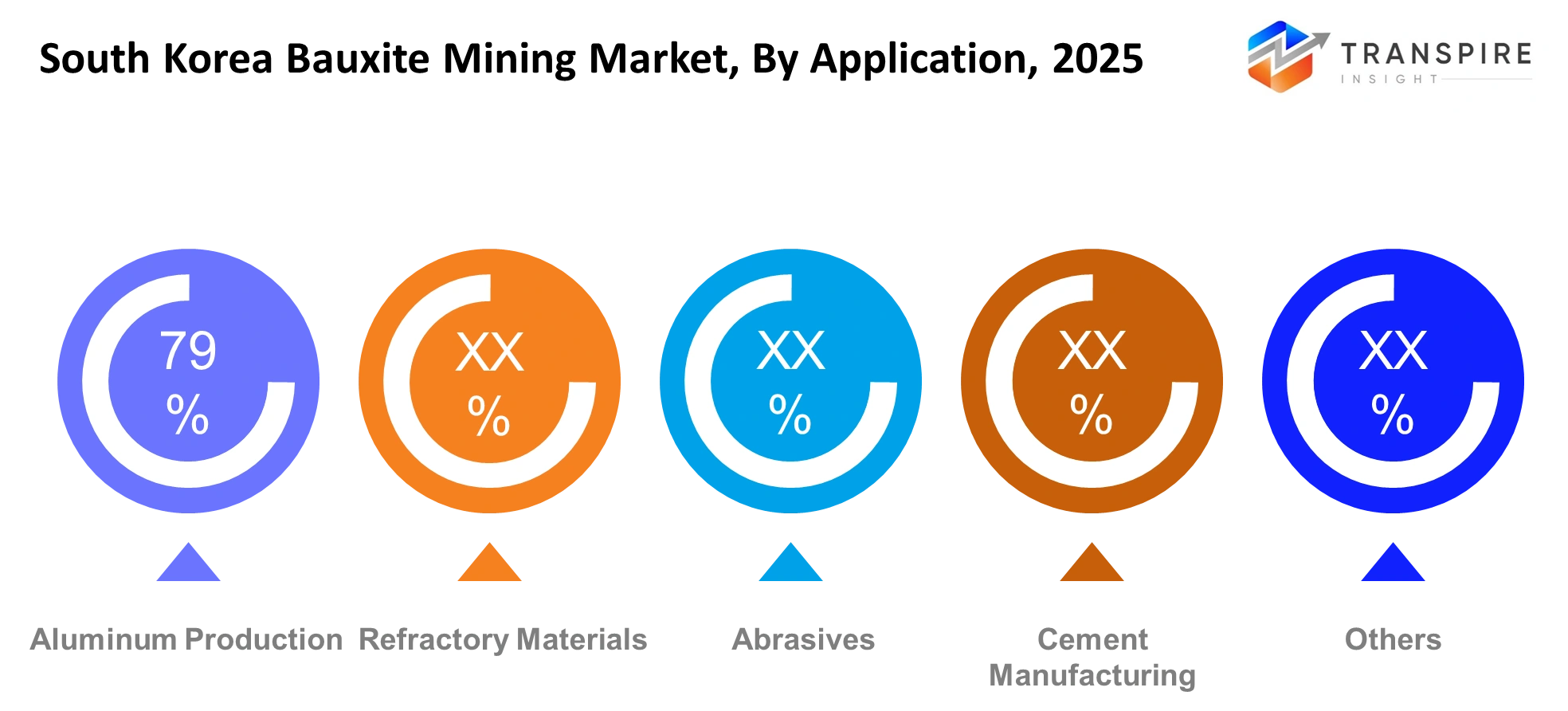
End-use demand patterns are shaped by aluminum production, refractory materials, abrasives, cement manufacturing and a bunch of other industrial uses, so the overall picture kinda depends on that mix. Aluminum production is set to stay the main application, mostly because there’s still a strong reliance on imported alumina. Refractory materials and abrasives, in a way, back up the industrial processing needs across various manufacturing sectors, even when the product lines shift a little.
Aluminum production basically pulls most of the bauxite demand, since it ends up feeding the supply chains for automotive, electronics, and infrastructure. Refractory applications help support the high-temperature processing gear used in steel and chemical industries. Cement manufacturing on the other hand uses lower-grade inputs, which is about boosting durability and strengthening structural materials tied to construction activity.
To learn more about this report, Download Free Sample Report
By End User:
The consumption base comes from the metallurgy industry, construction industry, automotive industry, aerospace industry, and several other segments that keep buying into the flow. The metallurgy industry will dominate, since refining operations are pretty continuous and they don’t really pause much. Automotive and aerospace sectors are expected to show quicker growth, because lightweight material adoption keeps trending upward.
Metallurgy stays the core consumer, because aluminum smelting depends on steady alumina input, not just “some” input. Automotive demand grows alongside vehicle lightweighting trends, which helps with fuel efficiency improvements. Aerospace applications expand more gradually, since advanced alloys need high-purity aluminum feedstock for structural components.
By Form:
Lumps, powder, calcined bauxite, and a bunch of other processed kinds really end up defining how handling and overall processing efficiency turns out. Lumps sort of will dominate, mostly because of easier transport and direct use inside the refining steps. Meanwhile, powdered and calcined forms help with more specialized industrial uses that need refined, more specific material properties.
Lump bauxite helps a lot with efficient shipping as well as storage across long-distance import lanes coming into South Korea. Powdered forms go into controlled industrial processing setups. Calcined bauxite is used for high-performance applications, it needs enhanced hardness and thermal resistance for manufacturing operations.
What are the Key Use Cases Driving the South Korea Bauxite Mining Market?
In the South Korea Bauxite Mining Market, aluminum production keeps being the main use case, but it’s really tied to the constant alumina refining demand that feeds downstream manufacturing. Basically the smelters want reliable feedstock, so consistent bauxite availability becomes a big deal and that’s why large-scale import flows keep going. Without that, they can’t hold output steady for automotive parts, electronics components, and those infrastructure-grade aluminum products that people already expect.
Then, refractory materials and abrasive applications are kind of catching up, especially across metallurgy and construction. Steel furnaces, cement kilns, and other industrial processing units depend on bauxite-derived inputs, mainly because of high-temperature resistance plus long-lasting durability. So you get more secondary consumption, and it shows up with industrial end users year after year.
More recently, the emerging use cases are low-carbon aluminum production, and also ESG-compliant sourcing programs that connect to aerospace and advanced automotive supply chains. On top of that, digital traceability systems are gaining traction, helping with regulatory reporting, and letting importers confirm origin, emissions info, across bauxite shipment routes—sometimes even faster than before.
|
Report Metrics |
Details |
|
Market size value in 2025 |
USD 229.18 Million |
|
Market size value in 2026 |
USD 239.19 Million |
|
Revenue forecast in 2033 |
USD 322.68 Million |
|
Growth rate |
CAGR of 4.37% from 2026 to 2033 |
|
Base year |
2025 |
|
Historical data |
2021 - 2024 |
|
Forecast period |
2026 - 2033 |
|
Report coverage |
Revenue forecast, competitive landscape, growth factors, and trends |
|
Country scope |
South Korea |
|
Key company profiled |
Rio Tinto, Alcoa Corporation, South32, Norsk Hydro, Rusal, Alumina Limited, Bosai Minerals Group, Hindalco Industries, Chalco, Emirates Global Aluminium, Imerys, LKAB Minerals, Saint-Gobain, Mineracao Curimbaba, Ashapura Group. |
|
Customization scope |
Free report customization (country, regional & segment scope). Avail customized purchase options to meet your exact research needs. |
|
Report Segmentation |
By Mining Type (Open-pit Mining, Underground Mining, Strip Mining, Others); By Grade (Metallurgical Grade, Refractory Grade, Abrasive Grade, Cement Grade, Others); By Application (Aluminum Production, Refractory Materials, Abrasives, Cement Manufacturing, Others); By End User (Metallurgy Industry, Construction Industry, Automotive Industry, Aerospace Industry, Others); By Form (Lumps, Powder, Calcined Bauxite, Others). |
Which Regions are Driving the South Korea Bauxite Mining Market Growth?
Asia Pacific i n general leads the South Korea Bauxite Mining Market, mostly because it’s tightly wired with big exporting countries like Australia and Indonesia . Over there, the port setup in Busan and Gwangyang is already there , so bulk handling is smoother and the alumina feedstock moves faster toward domestic refining clusters. On top of that, long-term supply contracts plus steady shipping networks keep reinforcing the dominance. There’s also a government-backed industrial policy component, so raw material sourcing for aluminum production stays more secure. And because the logistics ecosystem is mature, throughput stays consistent and it reduces the chance of supply disruption around the region.
North America on the other hand stays a steady contributor. It’s driven by structured industrial demand and by mining-export systems that are well regulated in Canada and the United States . Compared with Asia Pacific, North America leans more on contractual price stability instead of pushing ultra high-volume throughput efficiency. Shipowners and industrial buyers tend to value predictable procurement schedules, backed by strong financial frameworks. Environmental compliance rules are gradually enforced, but they don’t suddenly trigger supply shocks. This kind of steadiness helps maintain consistent revenue streams and it also supports long-run trade relationships with Korean aluminum processors.
Africa is the fastest-growing region here, aided by major infrastructure investments in Guinea and Sierra Leone. Those upgrades expanded export capacity after 2024 . New port builds and railway corridors have eased inland transport constraints, which then accelerates bauxite shipment volumes.Also, policy reforms that help foreign mining investment have improved production scalability, in a way that seems to matter more than before. For investors, that trajectory signals wider sourcing diversification windows somewhere between 2026 and 2033. And the early entrants should be set up to lock in strategic access to higher grade reserves, plus sign longer run supply agreements too.
Who are the Key Players in the South Korea Bauxite Mining Market and How Do They Compete?
The South Korea Bauxite Mining Market looks pretty consolidated, like only a few big global players really manage most of the export flow that ends up feeding Korean refining. You can tell competition is not so much about how broken up the mining sites are, but more about long-run contract security, steady logistics performance, and how well companies handle ESG commitments. Most established names keep their position by tightening multi year offtake agreements, and anyone trying to enter newer runs into trouble because capital needs are heavy and it’s hard to access higher quality reserves. In practice, cost efficiency across extraction steps and shipping lanes stays the main thing people compete on, but carbon reporting expectations and supply chain transparency things Korean buyers keep asking for come right after.
Rio Tinto keeps adding weight with large scale low cost production out of places like Amrun in Australia, which helps keep volumes consistent and freight routes pretty stable into Asia. Alcoa Corporation leans more into refining alignment and low carbon alumina processing know-how, and it differentiates by using sustainability tied supply contracts with industrial customers. South32 builds its edge by tuning its Worsley Alumina operations, plus pushing energy efficiency improvements so the operating cost burden drops across export routes.United Company RUSAL kind of leans on its Guinea bauxite resources , to keep cost advantages in place and to spread geopolitical risk as well , mainly through longer supply deals. Meanwhile, POSCO Holdings is beefing up the downstream side by landing more strategic offtake arrangements, and kind of stitching procurement into its broader steel and aluminum value chain, so Korean manufacturing keeps on getting dependable input supply .
Company List
- Rio Tinto
- Alcoa Corporation
- South32
- Norsk Hydro
- Rusal
- Alumina Limited
- Bosai Minerals Group
- Hindalco Industries
- Chalco
- Emirates Global Aluminium
- Imerys
- LKAB Minerals
- Saint-Gobain
- Mineracao Curimbaba
- Ashapura Group
Recent Development News
In May 2026, JKL Investment completed its exit from Sama Aluminium after a multi-year equity investment in aluminium value-chain materials.
The divestment highlights continued capital recycling in Korea-linked aluminium and upstream material investments, reinforcing ongoing financial activity in the broader aluminium supply ecosystem tied to bauxite-derived inputs.
Source: https://biz.chosun.com/
In January 2026, Gaw Capital Partners acquired Korea Environmental Technology Co. (Koentec) for approximately US$500 million. The acquisition strengthens Korea’s industrial waste and materials infrastructure, supporting circular-economy processing systems that increasingly interact with mineral processing and alumina refining value chains.
Source: https://sustainablebusinessmagazine.net/
What Strategic Insights Define the Future of the South Korea Bauxite Mining Market?
The South Korea Bauxite Mining Market is kind of structurally moving toward tighter integration of supply security frameworks with ESG compliant sourcing over the next five to seven years. It’s coming from Korea’s continued dependence on imported alumina inputs, plus the growing need for predictable low carbon material flows for aluminum hungry industries. So procurement is going to drift away from pure price driven spot exposure, and more toward contract based , traceable supply ecosystems that actually tie into environmental reporting standards.
There’s also a quieter risk that doesn’t get much attention. Supply concentration is leaning on a smaller set of exporting regions , especially Australia and parts of West Africa. If any coordinated policy tightening happens, or logistics get disrupted along those corridors, input cost volatility for Korean refiners can jump fast, even when the headline supply volumes look stable. This geographic concentration risk is often under estimated, because long term contracts make the underlying exposure less obvious.
On the upside, there’s an emerging opportunity around commercializing verified low carbon bauxite to alumina supply chains. These can connect to green aluminum certification programs in automotive manufacturing. It’s picking up steam as global OEMs tighten their Scope 3 emission requirements. Market participants should probably prioritize early investment in digital traceability platforms and multi region sourcing flexibility , because the procurement edge will gradually move to suppliers who can bundle secure volume access with credible sustainability credentials.
South Korea Bauxite Mining Market Report Segmentation
By Mining Type
- Open-pit Mining
- Underground Mining
- Strip Mining
By Grade
- Metallurgical Grade
- Refractory Grade
- Abrasive Grade
- Cement Grade
By Application
- Aluminum Production
- Refractory Materials
- Abrasives
- Cement Manufacturing
By End User
- Metallurgy Industry
- Construction Industry
- Automotive Industry
- Aerospace Industry
By Form
- Lumps
- Powder
- Calcined Bauxite
Frequently Asked Questions
Find quick answers to common questions.
The South Korea Bauxite Mining Market size is USD 322.68 Million in 2033.
Key segments for the South Korea Bauxite Mining Market are By Mining Type (Open-pit Mining, Underground Mining, Strip Mining, Others); By Grade (Metallurgical Grade, Refractory Grade, Abrasive Grade, Cement Grade, Others); By Application (Aluminum Production, Refractory Materials, Abrasives, Cement Manufacturing, Others); By End User (Metallurgy Industry, Construction Industry, Automotive Industry, Aerospace Industry, Others); By Form (Lumps, Powder, Calcined Bauxite, Others).
Major South Korea Bauxite Mining Market players are Rio Tinto, Alcoa Corporation, South32, Norsk Hydro, Rusal, Alumina Limited, Bosai Minerals Group, Hindalco Industries, Chalco, Emirates Global Aluminium, Imerys, LKAB Minerals, Saint-Gobain, Mineracao Curimbaba, Ashapura Group.
The South Korea Bauxite Mining Market size is USD 229.18 Million in 2025.
The South Korea Bauxite Mining Market CAGR is 4.37% from 2026 to 2033.
- Rio Tinto
- Alcoa Corporation
- South32
- Norsk Hydro
- Rusal
- Alumina Limited
- Bosai Minerals Group
- Hindalco Industries
- Chalco
- Emirates Global Aluminium
- Imerys
- LKAB Minerals
- Saint-Gobain
- Mineracao Curimbaba
- Ashapura Group
Recently Published Reports
-
May 2026
Healthcare Polymer Packaging Market
Healthcare Polymer Packaging Market Size, Share & Analysis Report By Packaging Type (Syringes, IV Bottles and Pouches, Clamshells, Blisters, Bottles & Jars, Containers, Tubes, IV Parental Packaging, Others), By Type (Regulated, Non-regulated), By Polymer Type (LDPE (Low-Density Polyethylene), HDPE (High-Density Polyethylene), Homo-polymer (Homo), Random Copolymer (Random), Block Copolymer (Block), PET, Polystyrene, Polyvinyl Chloride, Polyamide/EVOH, Others), and Geography (North America, Europe, Asia-Pacific, Middle East and Africa, South and Central America), 2021 - 2031
-
Apr 2026
Hydrophilic Tape (Waterstop) Market
Hydrophilic Tape (Waterstop) Market Size, Share & Analysis Report By Type (Bentonite-Based Hydrophilic Tape, Rubber-Based Hydrophilic Tape), By Application (Residential Buildings, Commercial Buildings, Infrastructure Projects), and Geography (North America, Europe, Asia-Pacific, Middle East and Africa, South and Central America), 2021 - 2031
-
Apr 2026
Metalens Market
Metalens Market Size, Share & Analysis Report By Type (Visible Light Metalens, and Infrared Metalens), By Application (Consumer Electronics, Automotive Electronics, Industrial, Medical, and Others), and Geography (North America, Europe, Asia-Pacific, Middle East and Africa, South and Central America), 2021 - 2031
-
Apr 2026
PBT Resin Market
PBT Resin Market Size, Share & Analysis Report By Type (Reinforced PBT Resin, Unreinforced PBT Resin), By Processing Method (Injection Molding, Extrusion, Blow Molding, Others), By End-User (Automotive, Electrical & Electronics, Consumer Appliances, Industrial Machinery, Medical Devices, Packaging, Others), and Geography (North America, Europe, Asia-Pacific, Middle East and Africa, South and Central America), 2021 - 2031