
South Korea Automotive Electronics Market Size & Forecast:
- South Korea Automotive Electronics Market Size 2025: USD 4.52 Billion
- South Korea Automotive Electronics Market Size 2033: USD 8.69 Billion
- South Korea Automotive Electronics Market CAGR: 8.50%
- South Korea Automotive Electronics Market Segments: By Component (ECU, Sensors, Infotainment, ADAS, Others); By Vehicle Type (Passenger Cars, Commercial Vehicles, EVs, Others); By Application (Safety Systems, Powertrain, Body Electronics, Others)
South Korea Automotive Electronics Market Summary
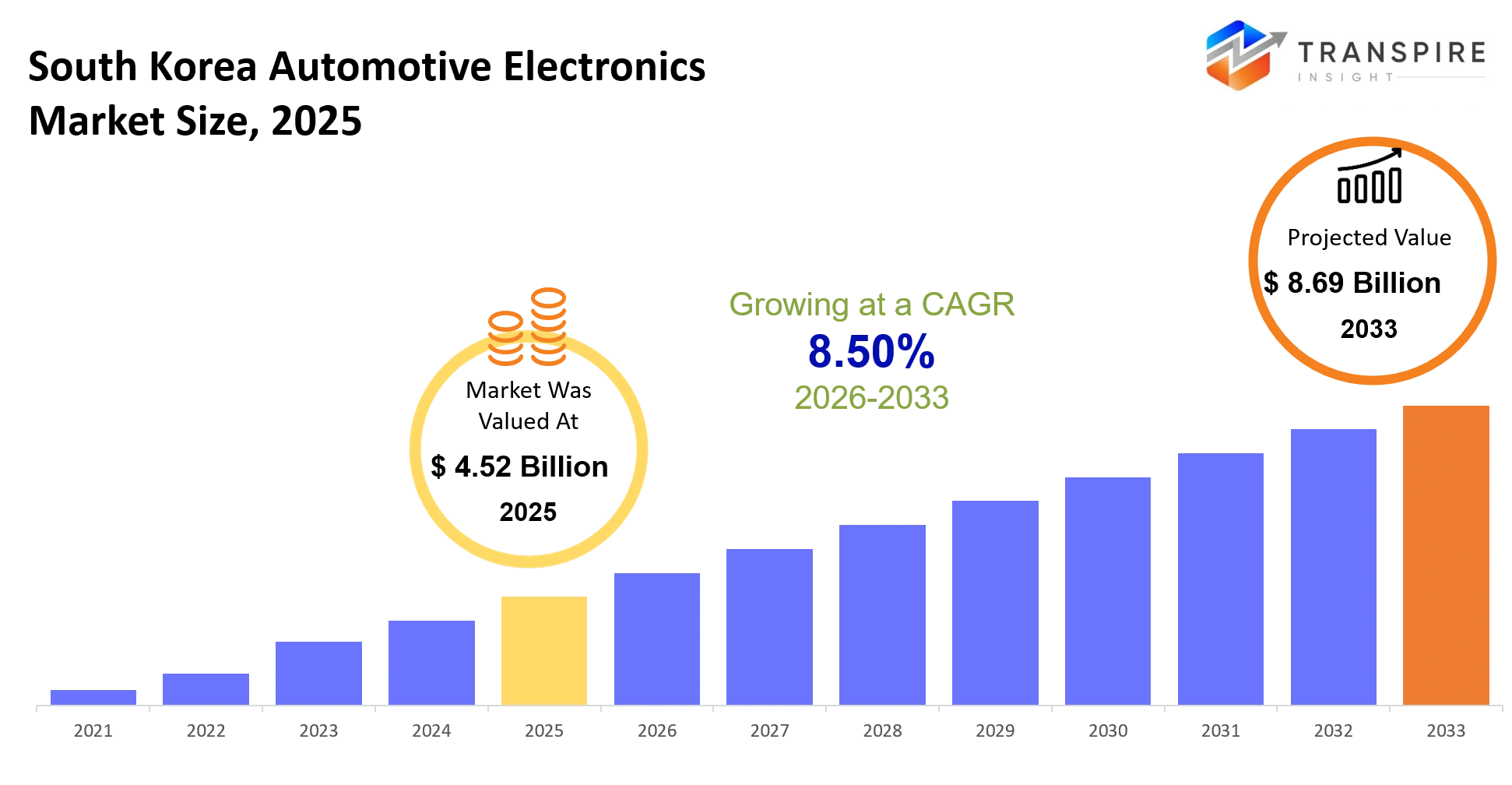
The South Korea Automotive Electronics Market was valued at USD 4.52 Billion in 2025. It is forecast to reach USD 8.69 Billion by 2033. That is a CAGR of 8.50% over the period.
The South Korean automotive electronics market is at the heart of the modern automobile's functionality, linking together powertrain controls, safety systems, infotainment systems, battery management systems, and advanced driver assistance functions into an interconnected system. In practice these technologies make cars safer, more fuel-efficient, and more software-centric. Over the past 3-5 years the market has structurally transformed from hardware-centric car architectures to centralized electronic architectures and software-defined platforms. The acceleration of this transformation came with the global semiconductor shortage which highlighted vulnerabilities in the automotive supply chain, forcing car manufacturers to revise their purchasing strategy and electronics architectures to reduce future risk. As cars are increasingly becoming electric and connected, car manufacturers are spending more on every car in terms of sensors, processors, and control units, leading to new revenue streams for all parts of the value chain and pushing high-value electronic content more deeply into both domestic output and exports.
Key Market Insights
- South Korea Automotive Electronics Market will expand at a rapid pace due to increase in electronic content per vehicle in EVs, premium cars and autonomous driving platforms.
- Demand for vehicle electrification is the major driver with the adoption of Battery Management System and Power Electronics reaching highest in between 2025 and 2032.
- Seoul Metropolitan Region will dominate with almost 45% share in 2025 attributed to the large presence of Automotive manufacturing and Semiconductor Ecosystem.
- Southeastern industrialized cities like Ulsan, Busan will grow the fastest during the forecast period with a surge in production of electric vehicles.
- Advanced driver assistance systems will capture the largest market share with nearly 32% in 2025 driven by the demand from safety regulations and the growing luxury vehicle sector.
- Infotainment and connected vehicle modules will be the second largest product segment owing to high demand for digital cockpit and connectivity options.
- Power electronics will grow at the fastest rate through 2032 driven by rapid acceleration in production of Electric Vehicles and implementation of high-voltage architecture.
- Passenger vehicles will hold the largest application demand with nearly 72% share in 2025 with mounting integration of sensors, processors, and safety electronics.
- Electric vehicles applications will emerge as fastest growing with strong government incentives and infrastructure investment.
- Original equipment manufacturers (OEMs) will contribute the largest end-user share, beyond 78% in 2025, due to increasing electronics integration during the assembly of vehicles.
What are the Key Drivers, Restraints, and Opportunities in the South Korea Automotive Electronics Market?
The largest market driver will be South Korea's speedy adoption of electric and software-defined vehicles, which was ignited when OEMs began significantly increasing spending on dedicated EV platforms, while governments simultaneously implemented incentives for clean vehicles. EVs utilize significantly higher electronics content than conventional automobiles (e.g., Battery Management Systems, inverters, sensors and control modules) which provides directly higher revenue streams to electronics providers, while it also broadens the served market size to semiconductors, power devices and automotive software providers.
The semiconductor supply chain remains the greatest structural constraint to growth. Because of lengthy qualification cycles in automotive chips, as well as ongoing global tensions and manufacturing concentration, continued supply chain risks will always delay vehicle production schedules and create cost inflation, hurting near term revenue growth. There are no short term solutions as establishing new fabrication facilities is costly and takes multiple years.
The next big wave of market growth will be defined by software defined vehicles (SDVs) and AI powered automotive systems, driven by increasing OEM investments in centralized computing architectures for over-the-air updates, autonomous capabilities and integrated personal and digital services, fueling growth in automotive AI chips and High Performance Computing Systems and therefore enhancing Korea's presence in the future of mobility.
What Has the Impact of Artificial Intelligence Been on the South Korea Automotive Electronics Market?
AI is a disruptive technology for South Korean automotive electronics. It enhances vehicles' smarts and its production and prediction accuracy. Automakers and components manufacturers adopt AI algorithms for automating automotive electronic controls, automating production lines, and optimizing the accuracy of quality inspections. ML algorithms collect vehicle sensor data to enable ML-based batteries, electric motors, and power electronics predictive maintenance to reduce the number of vehicle malfunctions.
AI is essential for advanced driver assistance systems. Using computer vision and deep learning, cars are equipped with more accurately automated lane keeping, collision prevention, driving monitoring, and adaptive speed control functions. In the automotive production line, AI-based analytics provides energy efficiency optimization, production yield improvement, and defect detection time shortening in the process, enhancing operational efficiency. Connectivity technologies also adopt AI to improve customized information features and electric vehicles energy management in the intelligent vehicle.
However, there are limitations to AI applications in automotive electronics, especially for small component suppliers. High integration cost and sophisticated validation requirements for AI software, along with the necessity of a high volume of well-labeled driving data, can hinder further development
Key Market Trends
- As of 2020, South Korean automakers made aggressive inroads to EV platforms, enabling electronic contents per unit to grow by >40% in premium vehicles.
- As consumer demand for ADAS grows, manufacturers are ramping up the integration of camera, radar, and sensors in mid-market vehicles in 2022.
- Hyundai Mobis and LG electronics have progressed from supplying auto parts to investing on the SDV platform and the AI-based cockpit since 2021.
- Domestic semiconductor makers are raising investments in automotive chip capacity, following the supply disruption in 2021-2022, which illustrated dependency on foreign chip capacity.
- The evolution of vehicle connectivity is marked by the inclusion of over-the-air updates in electric and premium vehicles manufactured since 2023.
- Regulatory focus shifted from basic safety requirements to intelligent mobility, which allows a wider use of driver monitoring and collision avoidance technology.
- The increasing localization of battery management and power electronics production has contributed to lower imports and bolstered supply chains, since 2022.
- Competition among auto parts makers have gained momentum, where established parts makers and tech firms have forged ties to develop AI processors, high-performance computing platforms and self-driving solutions.
- Mechanical superiority is gradually being trumped by the customer's need for a digital user experience; automakers are hence increasing their spending on infotainment systems, voice assistants and in-car services.
- The players of the South Korea automotive electronics market are establishing extensive strategic alliances throughout the world; enabling accelerated commercialization of next-generation mobility solutions and connected vehicle ecosystems.
South Korea Automotive Electronics Market Segmentation
By Component :
Key drivers for demand include electronic control units, sensors, infotainment modules, and ADAS. As EV production expands from 2022, ECU use increases in vehicles; likewise sensor demand grows due to safety regulation enhancements and self-driving technology development in the South Korean automotive manufacturing space. Increased onshoring of semiconductor ECUs and high performance sensors cuts out reliance on imports post-2021 supply shock.
Automotive manufacturers move towards a digital connected cockpit infotainment system and increase the spread of ADAS into mid-market vehicles, as safety regulation intensifies and real-time driving assistance capabilities gain consumer favor within the South Korean automotive production environment.
By Vehicle Type :
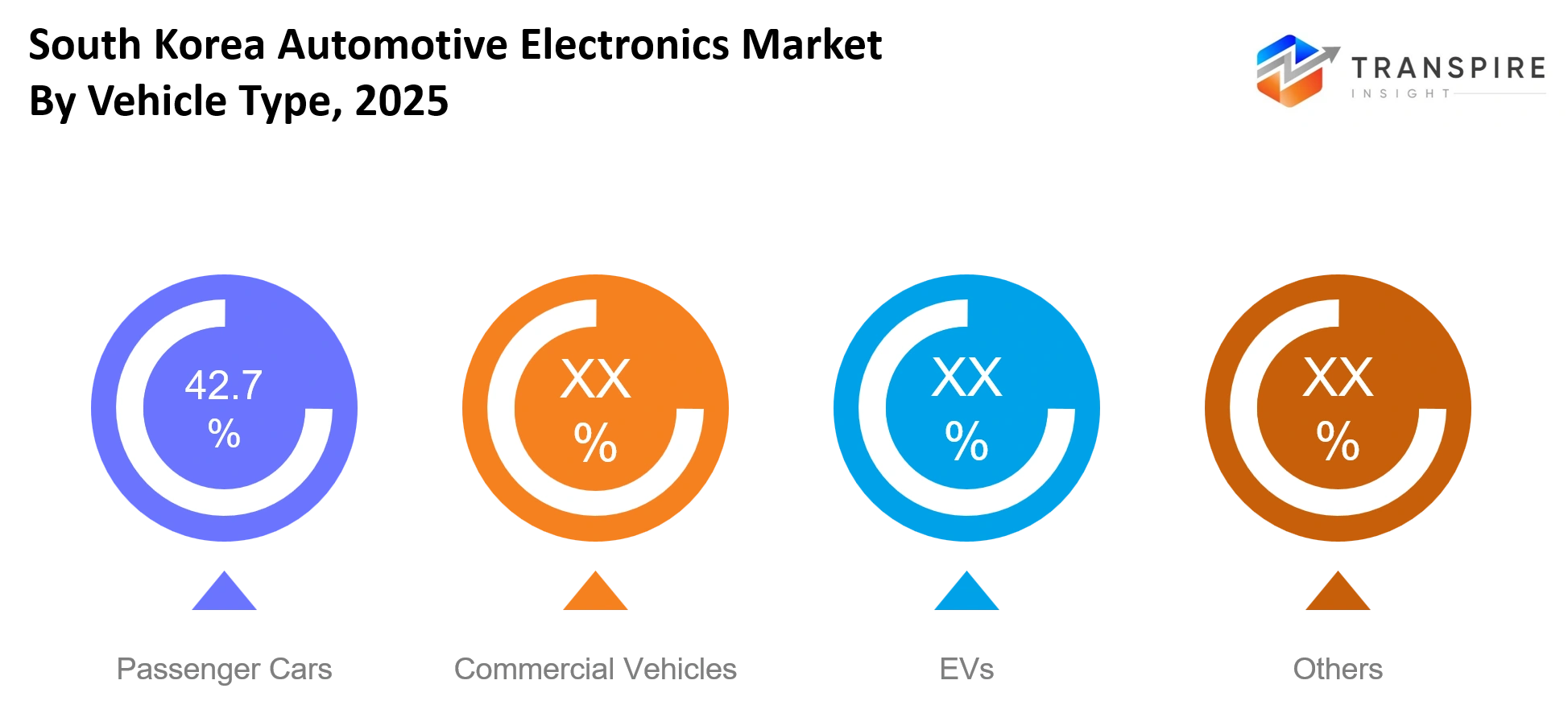
Passenger cars are the largest consumers of electronic integration technology, stemming from increased investment in both infotainment systems and safety solutions since 2020. The commercial segment focuses on telematics and fleet management technology for improvements in logistics efficiency. Electric vehicles rapidly push the increase in use of semiconductors, battery management systems and high voltage electronics across the South Korea Automotive Electronics Market manufacturing sector rapidly.
Demand for EVs as part of overall automotive electronics is anticipated to surge past 2022, as incentives for electric vehicles are implemented. High levels of ADAS integration in passenger vehicles continues as the commercial segment gradually incorporates connected technologies. General electrification is expected to drive persistent cycles of upgrading all automotive electronics and software-driven automotive platform integration.
By Application :
South Korea Automotive Electronics Market demand is driven by safety systems after stricter collision avoidance regulations were imposed and driver monitoring systems implemented since 2021. The Powertrain electronics segment grew due to the increased adoption of electrification and consequently higher demand for inverters and battery control modules. Body electronics has gained increased traction by way of advanced comfort functions which include the climate control and access control systems across evolving platforms as vehicles modernize.
Rapid increase of advanced safety applications and their penetration within passenger cars post-2022 has been driven by regulatory imposition and insurance driven incentives while powertrain systems shift towards electrification architectures, and body electronics towards smart connectivity and automation-driven efficiencies across the automotive electronic domain.
What are the Key Use Cases Driving the South Korea Automotive Electronics Market?
The primary use case for the South Korea Automotive Electronics Market revolves around intelligent driver assistance systems (ADAS) and in-vehicle safety. Automakers deploy radar sensors, camera modules and electronic control units to minimize the possibility of driving accidents. Robust safety standards coupled with increasing consumer demand for smarter driving capabilities encourage OEMs to build ADAS functions into standard passenger vehicle configurations and ensure a steady, higher-valued stream of demand throughout the production processes.
Secondary use cases for the market involve the implementation of connected infotainment systems and powertrain optimization. Widely used in passenger cars and electric vehicles, automakers and Tier-1 suppliers utilize such systems to enhance the overall comfort of the driving experience, offer real-time navigation and optimize energy consumption on electric vehicle platforms, particularly within urban mobility fleets and luxury vehicle classes.
Emerging use cases include AI-based autonomous driving modules and predictive vehicle diagnostics based on artificial intelligence. Although such use cases are still nascent, many top manufacturers are starting to look into developing such technologies as highways and defined urban areas begin further experimentation and highway testing of autonomous functions becomes more prevalent. Increasing investments into software-defined vehicles will facilitate their gradual integration into future automotive ecosystems.
|
Report Metrics |
Details |
|
Market size value in 2025 |
USD 4.52 Billion |
|
Market size value in 2026 |
USD 4.91 Billion |
|
Revenue forecast in 2033 |
USD 8.69 Billion |
|
Growth rate |
CAGR of 8.50% from 2026 to 2033 |
|
Base year |
2025 |
|
Historical data |
2021 - 2024 |
|
Forecast period |
2026 - 2033 |
|
Report coverage |
Revenue forecast, competitive landscape, growth factors, and trends |
|
Country scope |
South Korea |
|
Key company profiled |
Hyundai Mobis, LG Innotek, Samsung Electronics, Bosch, Continental, Denso, Aptiv, Valeo, Panasonic, ZF, Magna, Hitachi Astemo, Infineon, NXP, Renesas |
|
Customization scope |
Free report customization (country, regional & segment scope). Avail customized purchase options to meet your exact research needs. |
|
Report Segmentation |
By Component (ECU, Sensors, Infotainment, ADAS, Others); By Vehicle Type (Passenger Cars, Commercial Vehicles, EVs, Others); By Application (Safety Systems, Powertrain, Body Electronics, Others) |
Which Regions are Driving the South Korea Automotive Electronics Market Growth?
Seoul Capital Area exhibits dominance in regional growth due to its sheer concentration of automotive OEM headquarters, semiconductor design firms, and administrative authorities. Strict enforcement of vehicle safety regulations encourages rapid adoption of driver-assistance systems and other high-tech automotive electronics components. Furthermore, it boasts a mature research & development ecosystem for sensor technologies, ECU design and prototyping, and development of integrated automotive infotainment systems. Sustained collaborations between OEMs and automotive electronics manufacturers in this area keep the OEM-OEM and OEM-supplier innovation cycles short and the region at the cutting-edge of the market.
The southeastern industrial belt centered on Ulsan and Busan is growing steadily. This region's dominance lies in being a mature automotive production base which focuses largely on vehicle assembly and export-oriented manufacturing rather than design and software innovation. Consistent investment flows into powertrain electronics and automotive body electronics from major automakers enable steady development in these components. Mature OEM-supplier relationships and long production cycles maintain stable growth patterns.
The quickest growth will be centered on Gyeonggi Province due to a recent upsurge of EV component manufacturers, as well as semiconductor packaging plants. Following a recent upswing in investment since 2023 in EV infrastructure, along with test zones for smart mobility vehicles, Gyeonggi Province is transforming into an integrated EV electronics hub. Driven by government- supported manufacturing relocation initiatives and large-scale private sector EV adoption plans, Gyeonggi will attract new players between 2026 to 2033 who are centered on battery systems, automotive control modules, and software-defined vehicles.
Who are the Key Players in the South Korea Automotive Electronics Market and How Do They Compete?
The South Korea Automotive Electronics Market is moderately fragmented. It is dominated by a few large technology-based groups that have core system integration capabilities. The smaller suppliers then compete in specific components and segments. The main competition drivers for the South Korea Automotive Electronics Market is technology capabilities, particularly in semiconductor integration, ADAS software and vehicle connectivity solutions. Traditional suppliers defend market share through long-term OEM agreements, whilst large electronics groups are expanding their presence into mobility systems and putting more pressure on established tier-1 vendors.
Hyundai Mobis is pursuing leadership through integrating a few sensors, ECUs and software systems into fully integrated ADAS module components that serve Hyundai Motor Group vehicles. LG Electronics is expanding market share by providing cockpit electronics and vehicle infotainment systems leveraging their experience in displays and consumer electronics for enhanced user interface designs. Samsung Electronics is further reinforcing their stance in the market through the production of automotive semiconductors and advanced computing chips that support advanced driver assistance and autonomous features. Mando Corporation's strength is in the domain of braking and steering control systems where it is enhancing its advantages with safety-certified components and the ability to integrate deeply with global OEMs. Continental's competitive strategy is centered on localized manufacturing partnerships and a suite of modular safety systems that can be deployed flexibly onto both passenger and electric vehicle platforms.
Company List
- Hyundai Mobis
- LG Innotek
- Samsung Electronics
- Bosch
- Continental
- Denso
- Aptiv
- Valeo
- Panasonic
- ZF
- Magna
- Hitachi Astemo
- Infineon
- NXP
- Renesas
Recent Development News
In January 2026, Hyundai Mobis entered a comprehensive SDV partnership with Qualcomm Technologies to co-develop advanced driver assistance and software-defined vehicle architectures, strengthening ADAS integration across next-generation mobility platforms and accelerating AI-enabled cockpit deployment. Sourcehttps://www.qualcomm.com/
In February 2026, Hyundai Mobis formed a global alliance with ZEISS, tesa, and automotive glass suppliers to develop holographic windshield display systems, expanding next-generation in-vehicle display technology adoption and shifting cockpit design toward immersive digital interfaces. Sourcehttps://www.prnewswire.com/
What Strategic Insights Define the Future of the South Korea Automotive Electronics Market?
In the next 5-7 years, the structure of the South Korean Automotive Electronics market will structurally transition toward software-defined, AI-embedded vehicles, where rapid electrification of cars, alongside increase in desire for real-time driving intelligence, becomes the main drivers. The overall market growth would increasingly rely on high-performance semiconductors, central computing platforms and over-the-air software updates instead of over-the-air hardware upgrades, and is actively being supported by OEM product plans emphasizing digital cockpit and autonomous drive functions as unique selling propositions.
The covert risk could arise from over-concentration of semiconductor dependence on few providers of advanced chip technology to support the growth of advanced features-this dependence will make the product scalability and pricing more vulnerable, and thus it could further increase the product innovation lag at times of supply shock or geopolitical crisis.
The new opportunities are of enabling V2X communication services with commercialized function around the Seoul and Gyeonggi smart mobility zone in urban test road and it is expected that infrastructure is quickly put into operation with accelerated investment around them; for participants who endeavor to compete on a long-term basis it would be vital to vertically integrate both software and semiconductor strengths by collaborating with chip design companies and AI platform providers.
South Korea Automotive Electronics Market Report Segmentation
By Component
- ECU
- Sensors
- Infotainment
- ADAS
By Vehicle Type
- Passenger Cars
- Commercial Vehicles
- EVs
By Application
- Safety Systems
- Powertrain
- Body Electronics
Frequently Asked Questions
Find quick answers to common questions.
The South Korea Automotive Electronics Market size is USD 8.69 Billion in 2033.
Key segments for the South Korea Automotive Electronics Market are By Component (ECU, Sensors, Infotainment, ADAS, Others); By Vehicle Type (Passenger Cars, Commercial Vehicles, EVs, Others); By Application (Safety Systems, Powertrain, Body Electronics, Others).
Major South Korea Automotive Electronics Market players are Hyundai Mobis, LG Innotek, Samsung Electronics, Bosch, Continental, Denso, Aptiv, Valeo, Panasonic, ZF, Magna, Hitachi Astemo, Infineon, NXP, Renesas.
The South Korea Automotive Electronics Market size is USD 4.52 Billion in 2025.
The South Korea Automotive Electronics Market CAGR is 8.50% from 2026 to 2033.
- Hyundai Mobis
- LG Innotek
- Samsung Electronics
- Bosch
- Continental
- Denso
- Aptiv
- Valeo
- Panasonic
- ZF
- Magna
- Hitachi Astemo
- Infineon
- NXP
- Renesas
About the Authors

Mayur Shinde
I am Mayur Shinde, a Senior Research Analyst at Transpire Insight, specializing in the Automotive & Transportation and Information & Communication Technology (ICT) Industry. My work focuses on analyzing emerging market trends, technological advancements, competitive landscapes, and industry developments to deliver accurate, data-driven insights. I am passionate about transforming complex market information into clear, actionable content that helps businesses, professionals, and decision-makers stay informed and make confident strategic decisions.

Chakradhar Khansole
Chakradhar serves as the Research Director at Transpire Insight, bringing over 8 years of experience in technology, innovation, and strategic market intelligence. He specializes in transforming complex market data into actionable business insights that enable organizations to make informed, growth-oriented decisions. Recognized for his strategic vision and analytical expertise, Chakradhar leads high-impact research initiatives, delivering comprehensive market assessments, competitive intelligence, and forward-looking industry analysis.
Recently Published Reports
-
Apr 2026
ATV & UTV Market
ATV & UTV Market Size, Share & Analysis Report By Type (ATV, and UTV), By Variants (Less Than 400 CC, 400 CC To 800 CC, and More Than 800 CC), and Geography (North America, Europe, Asia-Pacific, Middle East and Africa, South and Central America), 2021 - 2031
-
Apr 2026
Automotive Central Gateway Module Market
Automotive Central Gateway Module Market Size, Share & Analysis Report By Type (Ethernet Central Gateway Module, CAN Central Gateway Module, LIN Central Gateway Module, and FlexRay), By Application (Powertrain Control, Body Control, Infotainment System, Advanced Driver Assistance Systems (ADAS), and Others), By End User (Passenger Vehicles, and Commercial Vehicles), and Geography (North America, Europe, Asia-Pacific, Middle East and Africa, South and Central America), 2021 - 2031
-
Apr 2026
Automotive Engine Oil Filter Market
Automotive Engine Oil Filter Market Size, Share & Analysis Report By Filter Type (Fuel Filter, Engine Oil Filter, Hydraulic Oil Filter, and Others), By Filter Media (Cellulose, Synthetic, and Micro), By Sales Channel (OEMs, and Aftermarket), By Vehicle Type (Passenger Cars, Light Commercial Vehicles, Heavy Duty Trucks, Buses and Coaches, and Off-road Vehicles), and Geography (North America, Europe, Asia-Pacific, Middle East and Africa, South and Central America), 2021 - 2031
-
Apr 2026
Automotive Parts Aluminium Die Casting Market
Automotive Parts Aluminium Die Casting Market Size, Share & Analysis Report By Production Process (Pressure Die Casting, Vacuum Die Casting, Squeeze Die Casting, Gravity Die Casting), By Application (Body Parts, Engine Parts, Transmission Parts, Battery And Related Components, Other Application Types), and Geography (North America, Europe, Asia-Pacific, Middle East and Africa, South and Central America), 2021 - 2031
Our Clients



