

Asia Pacific Automotive Motor Market Size & Forecast:
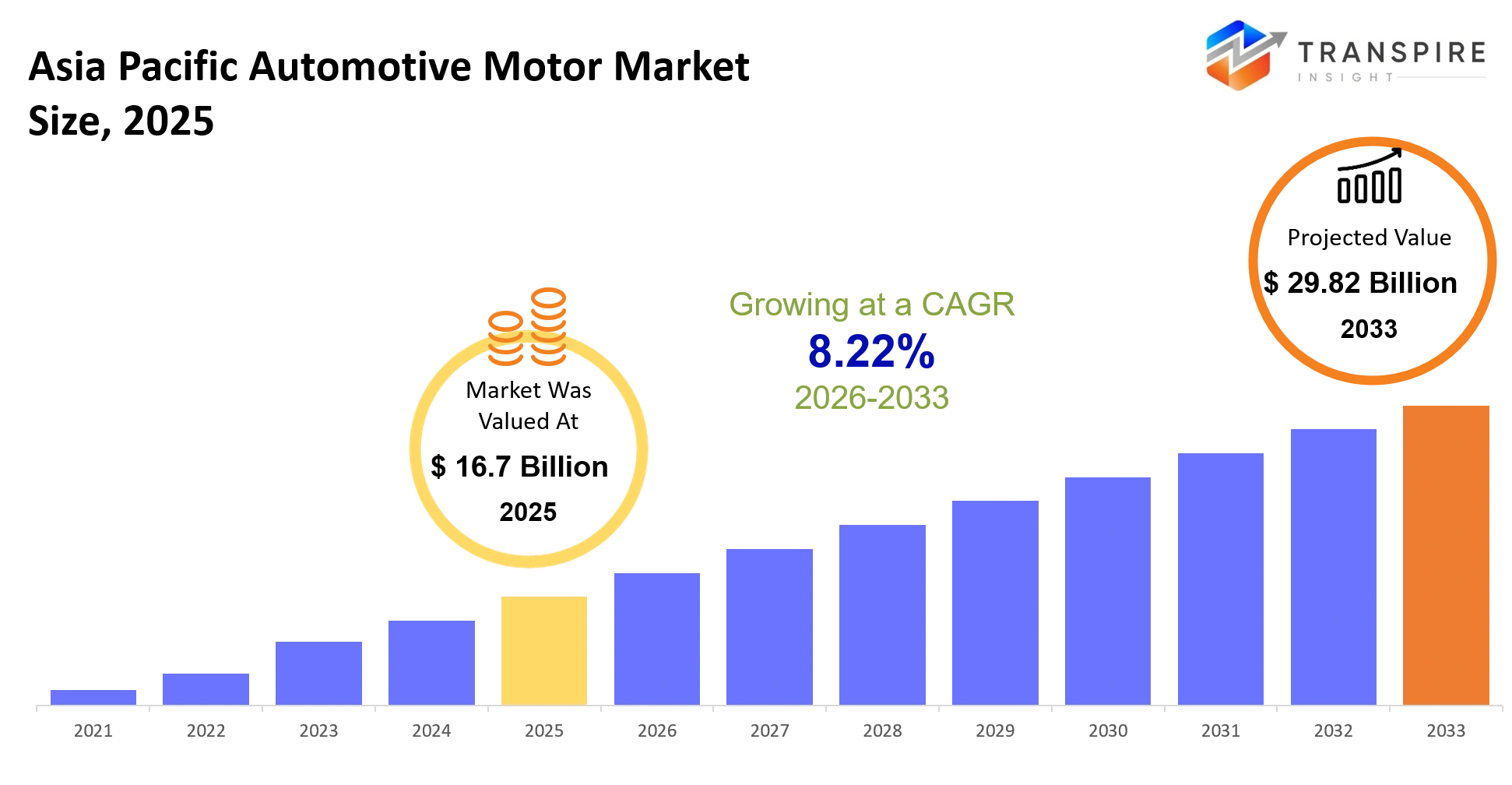
- Asia Pacific Automotive Motor Market Size 2025: USD 16.7 Billion
- Asia Pacific Automotive Motor Market Size 2033: USD 29.82 Billion
- Asia Pacific Automotive Motor Market CAGR: 8.22%
- Asia Pacific Automotive Motor Market Segments: By Motor Type (DC Motors, AC Motors, BLDC Motors, Stepper Motors, Traction Motors, Servo Motors, Hub Motors, Others); By Vehicle Type (Passenger Cars, Commercial Vehicles, Electric Vehicles, Hybrid Vehicles, Two-Wheelers, Buses, Off-Road Vehicles, Others); By Application (Power Steering, Power Windows, HVAC Systems, Traction Systems, Wipers, Seat Adjustment Systems, Cooling Fans, Others); By End User (OEMs, Aftermarket Suppliers, Fleet Operators, EV Manufacturers, Bus Operators, Commercial Vehicle Makers, Automotive Integrators, Others)
Asia Pacific Automotive Motor Market Summary
The Asia Pacific Automotive Motor Market was valued at USD 16.7 Billion in 2025. It is forecast to reach USD 29.82 Billion by 2033. That is a CAGR of 8.22% over the period.
The electromechanical component known as automotive motors in Asia Pacific convert electrical energy to kinetic energy in a vehicle. Electric/hybrid vehicles use motors for propulsion along with for accessory systems such as steering, brake-assist, thermal management and battery-cooling etc. Motors become core components in the system making it less reliant upon the accessory devices. As per a study software-defined vehicle demands enhanced mechanical-electrical integration.
There has been an evolution in the structure of industry in the last 3-5 years from the integration of internal combustion-dependent subsystems towards highly-efficient motors such as permanent-magnet-synchronous-motors and high-voltage architecture. Semiconductor shortage and logistics issue during the pandemic was the major reason which revealed the vulnerability of dispersed supply chains, OEMs and suppliers moved towards localization of motors and their components in the Asia Pacific manufacturing hub. Demand is thus moving from the replacement cycle demand towards a platform-based redesign demand boosting revenue visibility.
Key Market Insights
- China captured over 40% of the Asia Pacific Automotive Motor Market in 2025 owing to mass electric vehicle production and supply chain consolidation.
- India is the fastest growing region by 2030 with EV incentives and proliferation of 2-wheelers electricification program.
- Southeast Asia's presence in manufacturing grows due to the low cost assembly ecosystem and export focused automotive clusters.
- Traction motors secured leading market share as the drivetrain integration with electric vehicles became standard in new platforms.
- Brushless DC motors acquired second position due to their application in the auxiliary vehicle system.
- Axial flux motor is the fastest growing motor as it offers compact footprint and higher power density benefits in electric vehicles.
- EV propulsion systems accounted for over 45% of the Asia Pacific Automotive Motor Market in 2025.
- Battery thermal management and steering assist systems registered fastest growth with widespread implementation of software defined vehicles.
- OEM's acquired the highest market share as motor integration is shifting to factory level EV platform design.
- Aftermarket electrification retrofits and replacement motors segment are the fastest growing market.+
What are the Key Drivers, Restraints, and Opportunities in the Asia Pacific Automotive Motor Market?
The primary driver in the Asia Pacific Automotive Motor Market is the swift movement towards standard electric vehicle platforms, driven by stricter emission rules and the drop in battery prices beneath crucial commercial levels. This has compelled Chinese, Japanese, and Indian OEMs to build architectures based around integrated motors instead of bolting-on parts later. This in turn leads to increased revenue dependent on EV sales figures and higher efficiency motor adoption rather than the replacement business cycle.
The most significant restraint is the over-reliance on supply chains based on the use of rare earth minerals that are required for high-efficiency permanent magnet motors. This limitation is structural as extraction and refining of these rare earth minerals cannot rapidly increase due to geographically clustered capacities and thus causes fluctuating prices and slow to implement capacity, leading to slower market penetration of high-efficiency motor designs in cost-sensitive markets like Southeast Asia.
The most important opportunity for growth is in indigenous design of axial flux and reduced rare earth mineral motors especially due to India's developing EV manufacturing landscape. Initial investments into the domestic cluster of motor manufacturing units as well as collaborations and joint ventures with international firms have created a conducive environment for innovative and cost-competitive designs to take shape which could, if implemented in an appropriate scale, create further growth in mid-priced EVs and electric commercial vehicles in the Asia Pacific Automotive Motor Market.
What Has the Impact of Artificial Intelligence Been on the Asia Pacific Automotive Motor Market?
AI technology is transforming the Asia Pacific Automotive Motor Market by advancing how motors are designed, controlled, and maintained across various EV platforms. AI-enabled motor controls help to real-time control of torque output and energy usage to yield better EV efficiency and smoother power delivery during varied operating situations. ML is being integrated in production processes for optimizing motor winding to minimize defects, hence increasing motor reliability.
Predictive maintenance is an important area where AI algorithms use motor vibration, heat, and load to identify the wear of motors before a failure occurs. This contributes to decreasing unexpected service disruptions and lowering the lifetime cost for commercial EV users. AI-optimization techniques have been shown to achieve improvements in efficiency in the high single-digit to low double-digit range.
The high cost of integration and the inconsistent data quality encountered under varying road conditions, climate factors, and sensor technology standardization have slowed down the comprehensive implementation of AI in Asia Pacific automotive motors for lower-cost models.
Key Market Trends
- China moved from fragmented motor sourcing to integrated EV motor supply chain (2021-25), consolidating OEM power over components.
- India’s EV motor uptake accelerated with two-wheeler electrification plans in 2022, supported by FAME-II incentives and local manufacturing growth.
- Rare earth price volatility since 2023 compelled automakers to find non-rare earth (ferrite, magnet-free) motor alternatives, reshaping motor sourcing.
- Rapid SiC power electronics adoption (2021-25) boosted EV motor efficiency and permitted higher-voltage platforms throughout the Asia-Pacific region.
- Axial flux motor designs post-2022 were a result of automakers’ drive for space-efficient, high-performance motor solutions for future EV architectures.
- The "Component supplier to EV platform co-development partner" role of suppliers like Robert Bosch GmbH, DENSO Corporation, Nidec Corporation, and Valeo was established post-2022.
- The integration of software-defined vehicles post-2023 permitted real-time control of motors to improve their energy efficiency and torque characteristics across EV fleets.
- Demand for aftermarket motor retrofitting intensified post-2021 owing to the growing push towards EV fleet usage, especially in the Southeast Asia logistics sector and the two-wheeler conversion segment.
- Stricter emission regulations enacted between 2020 and 2025 in Japan, China, and India drove the OEM efforts to develop integrated propulsion systems with better motor solutions.
Asia Pacific Automotive Motor Market Segmentation
By Motor Type:
DC, AC, BLDC, stepper, traction, servo, hub motors, and others, among many types, are employed in vehicles for their propulsion, power delivery, or system supporting duties. High-efficiency BLDC and traction motors have gained significant traction, and replaced existing combustion-centric designs, since EV platforms evolved. By the period 2021-2025, OEMs reduced dependency on existing DC motor based systems owing to high power losses in DC motors and their maintenance constraints.
The efficiency benefits of traction and BLDC motors; the better thermal capacity; along with their improved integration with batteries made them the preferred choice over DC systems.AC motors are employed in industrial grade requirements and robust vehicles where size constraint is of less concern. Hub motors are becoming a new segment of development for compact EVs and two-wheelers where space efficiency matters.Servo and stepper motors continue to maintain importance in precise control applications, like automotive steering and seat control systems; driving adoption in advanced vehicle features.
By Vehicle Type:
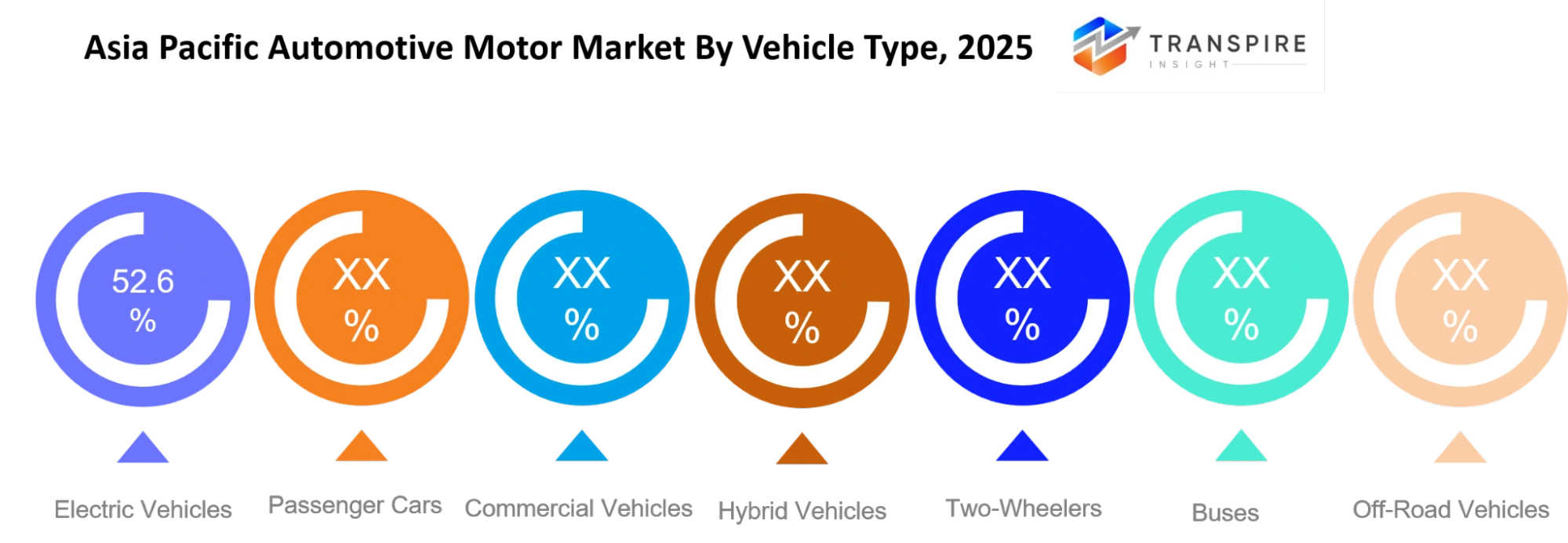
Passenger cars, commercial vehicles, electric vehicles, hybrid vehicles, two-wheelers, buses, off-road vehicles, etc. Represent regional market segments and drive market dynamics. Electric vehicles are gradually being adopted across mainstream since 2022 and taking precedence over other types of vehicles which are replacing combustion related vehicles; this leads to increase in adoption of high-voltage and compact vehicle motor systems. The passenger cars segment holds a larger volume share, but is likely to lose some momentum of growth to electric two-wheelers and light commercial electric vehicles.
Hybrid vehicles are steadily reducing their market share in few urban areas as electrical vehicle infrastructure continues to improve. India and Southeast Asian two-wheeler segment is seeing accelerated electrification, supported by subsidies and growing need for urban mobility; this is also increasing demand for EV motors. Commercial vehicles and buses are progressing on slower side owing to higher price sensitivity and poor infrastructure, although many fleet operators are experimenting with EVs owing to reduced running cost and environmental norms.
By Application:
Examples such as power steering, power windows, air-conditioning, traction control systems, wipers, seat adjustments, cooling fans, and others show motors fulfilling functions that support both propulsion and comfort within a vehicle. Traction control systems have now evolved to take on the highest strategic importance for the application of motors as vehicle electrification caused the roles of motors to shift from auxiliary function to primary propulsion function. The design of motors for applications such as power steering and air conditioning is also more power-efficient since 2021 to decrease the energy draw on an electric vehicle battery.
Cooling fans and thermal management systems are increasing due to growing requirements for cooling vehicle batteries in highly urbanized driving conditions and conditions of urban stop-start driving. Seat adjustment systems and comfort systems are constantly being upgraded as the market for luxury vehicles increases in China and South Korea, and window/wiper systems remain stagnant yet have begun to use more low-power and quiet motors as electric vehicle and general automotive industry trends lean towards a focus on quiet and efficient designs.
By End User:
The major customer base for automotive motors includes original equipment manufacturers (OEMs), aftermarket suppliers, fleet operators, EV manufacturers, bus manufacturers, commercial vehicle manufacturers, automotive integrators, and so on. OEMs have continued to consolidate their dominant position, now including the motor components during the design phase of a vehicle platform instead of having to replace and repair motor components after the vehicle has already been produced. The purchasing of motors from EV manufacturers has increased significantly since 2022 with the addition of numerous vehicle models throughout China and India.
Fleet operators are continuously upgrading to electric power plants to cut costs for fuel usage and meet government standards, particularly for ride-sharing and logistics companies. Aftermarket suppliers are now adjusting to the decreasing amount of traditional motor sales while trying to enter the market of replacement EV compatible motor parts, as automotive integrators and commercial vehicle manufacturers look towards system-wide energy efficiency by integrating with motor suppliers for customized, efficient parts suitable to platform specifications.
What are the Key Use Cases Driving the Asia Pacific Automotive Motor Market?
Electric vehicle traction motor is the Asia Pacific Automotive Motor Market’s primary use case because the traction motor directly drives the battery-electric platforms. In passenger EVs as well as lightweight commercial vehicles the demand is the highest since OEMs rethink complete drivetrains, optimizing motor range, performance and efficiency.
Other important secondary applications – automotive power steering systems and electric vehicles (EV) climate control, are broadly used by both OEMs and EV manufacturers to lower energy wastage in vehicles and boost driver comfort. Electric two-wheelers and fleet owners are also broadening the application for motor based propulsion in urban mobility solutions, thereby driving cost efficient means of transportation.
Newer applications which use hub motor based in-wheel motor drive in micro-urban EVs, integrated actuators in self driving and connected vehicle platforms, as well as nascent applications which drive motor optimisation coupled with wireless charging technologies have been introduced as a result of regulatory tailwinds towards low- emission transport in major cities throughout the Asia Pacific region.
|
Report Metrics |
Details |
|
Market size value in 2025 |
USD 16.7 Billion |
|
Market size value in 2026 |
USD 18.04 Billion |
|
Revenue forecast in 2033 |
USD 29.82 Billion |
|
Growth rate |
CAGR of 8.22% from 2026 to 2033 |
|
Base year |
2025 |
|
Historical data |
2021 - 2024 |
|
Forecast period |
2026 - 2033 |
|
Report coverage |
Revenue forecast, competitive landscape, growth factors, and trends |
|
Regional scope |
Asia Pacific (India, China, Japan, Australia, South Korea, Rest of Asia Pacific) |
|
Key company profiled |
Bosch, Denso, Nidec, Mitsubishi Electric, Continental, Valeo, Hitachi Astemo, Mahle, Aisin, Hyundai Mobis, Johnson Electric, BorgWarner, ZF, Schaeffler, Siemens |
|
Customization scope |
Free report customization (country, regional & segment scope). Avail customized purchase options to meet your exact research needs. |
|
Report Segmentation |
By Motor Type (DC Motors, AC Motors, BLDC Motors, Stepper Motors, Traction Motors, Servo Motors, Hub Motors, Others); By Vehicle Type (Passenger Cars, Commercial Vehicles, Electric Vehicles, Hybrid Vehicles, Two-Wheelers, Buses, Off-Road Vehicles, Others); By Application (Power Steering, Power Windows, HVAC Systems, Traction Systems, Wipers, Seat Adjustment Systems, Cooling Fans, Others); By End User (OEMs, Aftermarket Suppliers, Fleet Operators, EV Manufacturers, Bus Operators, Commercial Vehicle Makers, Automotive Integrators, Others) |
Which Regions are Driving the Asia Pacific Automotive Motor Market Growth?
The Asia Pacific Automotive Motor Market is driven by China, which has the largest EV manufacturing base, with government support backing aggressive electrification initiatives. The strict emission goals and rapid EV adoption have driven the mass adoption of highly efficient traction motors from OEMs. An expanded local supplier ecosystem in China reinforces its dominance with local supply clusters of magnets, windings, and power electronics driving down imports. The sheer scale of fleet size and the widespread implementation of EVs in cities provide a steady demand for motors across both passenger and commercial applications.
Japan and South Korea are reliable and technology-centric regions of the Asia Pacific Automotive Motor Market and are supported by an excellent automotive engineering infrastructure, as well as long OEM investment cycles. Instead of following China's volume-based growth, these regions focus on efficient and accurate motor designs, reliability, and hybrid system improvements. Supported by excellent manufacturing and an effective rollout of fuel-efficiency standards, the region has steady BLDC and servo motor demand. The export-driven auto industry continues to provide for stability of motor demand across its international supply chain.
The growth rate in India has been accelerated by recent government policies implemented through national EV development programs and the increased demand for transportation solutions in cities. These factors have fueled exponential motor demand since 2022 and in particular through an increased adoption in two and light commercial EV vehicles, driven by post-2022 incentives. The improvement in charging infrastructure, along with local manufacturing capabilities has eased the path for OEMs. The period between 2026 and 2033 offers considerable market opportunities in India for any new suppliers focused on efficient and inexpensive motor designs and strong supply chain alliances.
Who are the Key Players in the Asia Pacific Automotive Motor Market and How Do They Compete?
The Asian Pacific Automotive Motor market is moderately consolidated, featuring global Tier-1 suppliers alongside substantial local players. Price is a key deciding factor, but the major differentiators have evolved beyond that and focus on aspects like energy efficiency and the ability to integrate with the EV platform as well as local manufacturing expertise. Established suppliers have been aggressively protecting market share by forming deep alliances with OEMs, while new Asian competitors are vying for market share with cost-optimized electric motor configurations and the ability to quickly adapt to EV platforms.
Robert Bosch GmbH competes using highly efficient motor systems tied with an advanced control electronics suite and a focused effort on OEM collaboration with EV platforms across India and China. They have leveraged a combination of software controlled motor technology with hardware reliability for enhanced energy optimization and compact EV design, further building out their position through joint development initiatives with regional manufacturers, enhancing their grip on electrified passenger vehicle platforms.
DENSO Corporation and Mitsubishi Electric focus on highly precision motor engineering along with hybrid systems, and dominate Japan's strong hybrid vehicle segment. Nidec Corporation has aggressive expansion plans centered around increasing high volume electric motor production volumes with key Asian production facility expansions, targeting both EV and industrial vehicle markets. Valeo is distinguished by their approach to integrated E-drive modules, integrating both a motor and a gearbox with their inverter technology, while ZF Friedrichshafen AG continues to enhance its portfolio by extending its strong integration capabilities within the drivetrain of premium EV platforms and electric commercial vehicles.
Company List
- Bosch
- Denso
- Nidec
- Mitsubishi Electric
- Continental
- Valeo
- Hitachi Astemo
- Mahle
- Aisin
- Hyundai Mobis
- Johnson Electric
- BorgWarner
- ZF
- Schaeffler
- Siemens
Recent Development News
In April 2026, Hyundai Motor announced a major China-focused product expansion strategy, planning 20 new models over five years to regain EV market share. The move strengthens Asia Pacific automotive motor demand through localized EV drivetrain integration and platform redesign. Sourcehttps://www.reuters.com/
In April 2026, Archion became operational in Japan following the Mitsubishi Fuso and Hino Motors integration, consolidating truck manufacturing and advancing zero-emission drivetrain development. The restructuring strengthens commercial vehicle motor innovation focused on electrification and hydrogen-based systems. Sourcehttps://en.wikipedia.org/
What Strategic Insights Define the Future of the Asia Pacific Automotive Motor Market?
The Asia Pacific Automotive Motor market is undergoing a paradigm shift towards deeply integrated, software-driven EV electric drivetrain systems, where motors transition from standalone components to integrated EV propulsion platforms. Factors contributing to this transformation include rapid EV adoption in China and India as well as escalating efficiency and emission regulations, compelling OEMs to re-engineer their vehicle architecture instead of retrofitting their legacy systems. While value creation over the next 5–7 years will center around high-efficiency traction motors and smart control integration rather than just the motor unit, it would be imprudent to overlook the growing risk associated with over-reliance on an even narrower group of rare earth supply chains.
The latter exposes market participants to geopolitical disruptions and pricing volatility, which can swiftly alter their economics of production. Opportunities emerge from the exploration of rare-earth-free motor technologies and regionalized supply chain networks within India and Vietnam, driven by the favorable policy ecosystem and comparatively lower manufacturing costs in those regions. Market participants should strategically leverage their capabilities for vertical integration with power electronics as well as localizing their supply chains for reduced input costs while positioning themselves to win long-term platform-level OEM supply agreements.
Asia Pacific Automotive Motor Market Report Segmentation
By Motor Type
- DC Motors
- AC Motors
- BLDC Motors
- Stepper Motors
- Traction Motors
- Servo Motors
- Hub Motors
By Vehicle Type
- Passenger Cars
- Commercial Vehicles
- Electric Vehicles
- Hybrid Vehicles
- Two-Wheelers
- Buses
- Off-Road Vehicles
By Application
- Power Steering
- Power Windows
- HVAC Systems
- Traction Systems
- Wipers
- Seat Adjustment Systems
- Cooling Fans
By End User
- OEMs
- Aftermarket Suppliers
- Fleet Operators
- EV Manufacturers
- Bus Operators
- Commercial Vehicle Makers
- Automotive Integrators
Frequently Asked Questions
Find quick answers to common questions.
The Asia Pacific Automotive Motor Market size is USD 29.82 Billion in 2033.
Key segments for the Asia Pacific Automotive Motor Market are By Motor Type (DC Motors, AC Motors, BLDC Motors, Stepper Motors, Traction Motors, Servo Motors, Hub Motors, Others); By Vehicle Type (Passenger Cars, Commercial Vehicles, Electric Vehicles, Hybrid Vehicles, Two-Wheelers, Buses, Off-Road Vehicles, Others); By Application (Power Steering, Power Windows, HVAC Systems, Traction Systems, Wipers, Seat Adjustment Systems, Cooling Fans, Others); By End User (OEMs, Aftermarket Suppliers, Fleet Operators, EV Manufacturers, Bus Operators, Commercial Vehicle Makers, Automotive Integrators, Others).
Major Asia Pacific Automotive Motor Market players are Bosch, Denso, Nidec, Mitsubishi Electric, Continental, Valeo, Hitachi Astemo, Mahle, Aisin, Hyundai Mobis, Johnson Electric, BorgWarner, ZF, Schaeffler, Siemens.
The Asia Pacific Automotive Motor Market size is USD 16.7 Billion in 2025.
The Asia Pacific Automotive Motor Market CAGR is 8.22% from 2026 to 2033.
- Bosch
- Denso
- Nidec
- Mitsubishi Electric
- Continental
- Valeo
- Hitachi Astemo
- Mahle
- Aisin
- Hyundai Mobis
- Johnson Electric
- BorgWarner
- ZF
- Schaeffler
- Siemens
About the Authors

Mayur Shinde
I am Mayur Shinde, a Senior Research Analyst at Transpire Insight, specializing in the Automotive & Transportation and Information & Communication Technology (ICT) Industry. My work focuses on analyzing emerging market trends, technological advancements, competitive landscapes, and industry developments to deliver accurate, data-driven insights. I am passionate about transforming complex market information into clear, actionable content that helps businesses, professionals, and decision-makers stay informed and make confident strategic decisions.

Chakradhar Khansole
Chakradhar serves as the Research Director at Transpire Insight, bringing over 8 years of experience in technology, innovation, and strategic market intelligence. He specializes in transforming complex market data into actionable business insights that enable organizations to make informed, growth-oriented decisions. Recognized for his strategic vision and analytical expertise, Chakradhar leads high-impact research initiatives, delivering comprehensive market assessments, competitive intelligence, and forward-looking industry analysis.
Recently Published Reports
-
Apr 2026
ATV & UTV Market
ATV & UTV Market Size, Share & Analysis Report By Type (ATV, and UTV), By Variants (Less Than 400 CC, 400 CC To 800 CC, and More Than 800 CC), and Geography (North America, Europe, Asia-Pacific, Middle East and Africa, South and Central America), 2021 - 2031
-
Apr 2026
Automotive Central Gateway Module Market
Automotive Central Gateway Module Market Size, Share & Analysis Report By Type (Ethernet Central Gateway Module, CAN Central Gateway Module, LIN Central Gateway Module, and FlexRay), By Application (Powertrain Control, Body Control, Infotainment System, Advanced Driver Assistance Systems (ADAS), and Others), By End User (Passenger Vehicles, and Commercial Vehicles), and Geography (North America, Europe, Asia-Pacific, Middle East and Africa, South and Central America), 2021 - 2031
-
Apr 2026
Automotive Engine Oil Filter Market
Automotive Engine Oil Filter Market Size, Share & Analysis Report By Filter Type (Fuel Filter, Engine Oil Filter, Hydraulic Oil Filter, and Others), By Filter Media (Cellulose, Synthetic, and Micro), By Sales Channel (OEMs, and Aftermarket), By Vehicle Type (Passenger Cars, Light Commercial Vehicles, Heavy Duty Trucks, Buses and Coaches, and Off-road Vehicles), and Geography (North America, Europe, Asia-Pacific, Middle East and Africa, South and Central America), 2021 - 2031
-
Apr 2026
Automotive Parts Aluminium Die Casting Market
Automotive Parts Aluminium Die Casting Market Size, Share & Analysis Report By Production Process (Pressure Die Casting, Vacuum Die Casting, Squeeze Die Casting, Gravity Die Casting), By Application (Body Parts, Engine Parts, Transmission Parts, Battery And Related Components, Other Application Types), and Geography (North America, Europe, Asia-Pacific, Middle East and Africa, South and Central America), 2021 - 2031
Our Clients



