
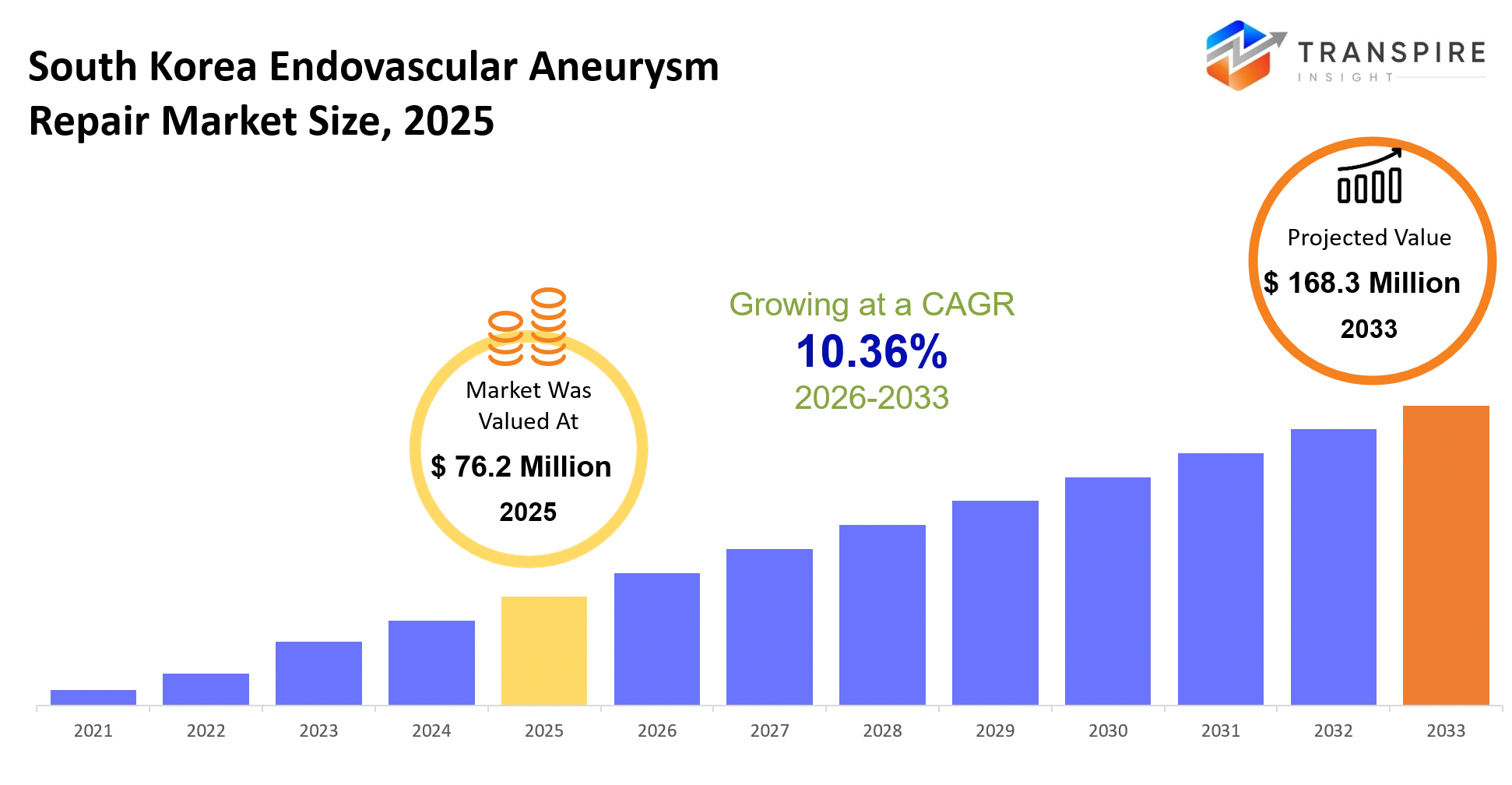
South Korea Endovascular Aneurysm Repair Market Size & Forecast:
- South Korea Endovascular Aneurysm Repair Market Size 2025: USD 76.2 Million
- South Korea Endovascular Aneurysm Repair Market Size 2033: USD 168.3 Million
- South Korea Endovascular Aneurysm Repair Market CAGR: 10.36%
- South Korea Endovascular Aneurysm Repair Market Segments: By Product Type (Abdominal Aortic Stent Grafts, Thoracic Aortic Stent Grafts, Fenestrated Stent Grafts, Others); By Application (Abdominal Aortic Aneurysm Repair, Thoracic Aortic Aneurysm Repair, Complex Aneurysm Repair, Others); By Material (Nitinol Stent Grafts, Polyester Grafts, ePTFE Grafts, Others); By End User (Hospitals, Cardiac Centers, Specialty Clinics, Others); By Procedure Type (Elective EVAR Procedures, Emergency EVAR Procedures, Minimally Invasive Procedures, Others)
To learn more about this report,  Download Free Sample Report
South Korea Endovascular Aneurysm Repair Market Summary
The South Korea Endovascular Aneurysm Repair Market was valued at USD 76.2 Million in 2025. It is forecast to reach USD 168.3 Million by 2033. That is a CAGR of 10.36% over the period.
In South Korea, the Endovascular Aneurysm Repair Market centers on minimally invasive care paths that aim to fix weakened or bulging blood vessels, mostly abdominal aortic aneurysms, by placing stent grafts through catheters, instead of doing open surgery. In day to day hospital routines, these platforms are used to lessen surgical trauma, tighten up ICU durations , and bring down complication odds especially for cardiovascular patients who are considered high risk, with the aging population playing a big role here.
In the last 3–5 years, the market has moved in a noticeable, structural way, away from open surgical repair and toward image guided endovascular interventions, supported by more capable hybrid operating rooms. One big push behind this shift was the post pandemic backlog of postponed cardiovascular procedures, which sort of forced hospitals to choose shorter recovery routes and higher throughput treatment schedules. At the same time, broader reimbursement coverage for endovascular procedures, enabled through national insurance programs, made the whole process more doable financially. Because of that combination, adoption has been picking up steadily , and hospitals are now putting more focus into premium stent graft systems and imaging integrated surgical workflows that boost accuracy, and also strengthen procedural outcomes.
Key Market Insights
- South Korea Endovascular Aneurysm Repair Market is seeing strong, kinda steady adoption in tertiary hospitals, it’s basically around 45–50% of the procedure concentration in 2025.
- The Capital region leads the South Korea Endovascular Aneurysm Repair Market with roughly a 55% share because it has advanced cardiovascular infrastructure, and you can feel that in day-to-day care.
- Busan and Daegu are showing the fastest growth, these regional procedural hubs are getting boosted by expansion of cardiac center capacity through the 2033 forecast period.
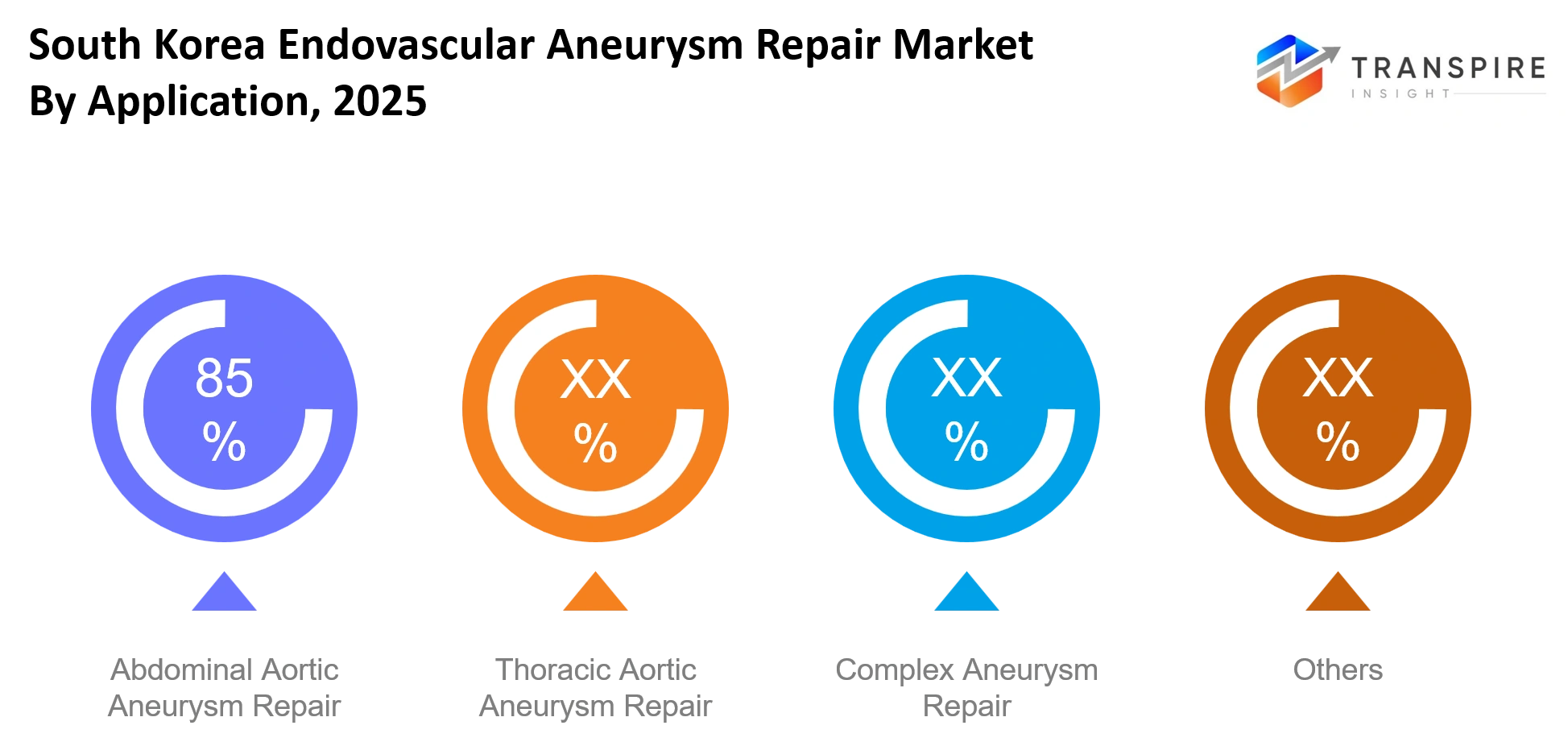
- Abdominal aortic aneurysm repair is still the main segment, it contributes nearly 60% of all endovascular aneurysm repair procedures across South Korea.
- Thoracic endovascular repair is the fastest-growing portion, fueled by more frequent diagnosis of complex aortic disease, plus imaging advancements that make it easier to map what’s going on.
- Hospitals dominate the end-user landscape with over 70% share, mainly due to higher procedural complexity, and the need for hybrid operating rooms.
- Ambulatory surgical centers are starting to gain momentum too, emerging demand is building as minimally invasive vascular procedures become safer and faster.
- Key players named in the competitive field include Medtronic, W. L. Gore & Associates, Cook Medical, Terumo Corporation, and Abbott Laboratories.
- Strategic expansion efforts are leaning toward next-generation stent graft durability , lower-profile delivery systems, and better imaging integration.
- And increasingly, competitive advantage comes from AI-assisted procedural planning, plus real-time intraoperative navigation systems that help clinicians guide each case with more confidence.
What are the Key Drivers, Restraints, and Opportunities in the South Korea Endovascular Aneurysm Repair Market?
The main driver of the South Korea Endovascular Aneurysm Repair Market is the steady rise in aortic aneurysms along with the quick take-up of minimally invasive cardiovascular treatment pathways. Many clinicians now lean toward endovascular repair rather than open surgery, because it can mean a lower mortality risk, fewer days in hospital, and a quicker post operative return to normal function . That movement is also reinforced by broader reimbursement frameworks, which in practice improved access to procedures at major tertiary hospitals. So basically, more hospitals are putting larger budget lines toward advanced stent graft systems and hybrid operating room upgrades, and this directly boosts both device sales and overall procedure counts .
The biggest restraint is still the steep procedural and device cost tied to advanced endovascular repair systems. Premium stent grafts plus imaging integrated operating environments come with major capital requirements, so smaller regional hospitals get stuck, at least compared to larger centers. On top of that, anatomical complexity in a segment of patients limits how widely the approach can be used, and in some clinical scenarios open surgery still has to happen. Because of that, market penetration doesn’t fully accelerate, even if the technology keeps moving forward.
A notable opportunity sits in next generation personalized stent graft design, built around patient specific imaging and 3D modeling.In Seoul, and also in other metro areas, hospitals are increasingly putting money into these advanced pre surgical planning platforms, like it’s not just a trend anymore. That creates some space for manufacturers to team up with custom fit devices, paired alongside digital surgical planning tools, hoping for improved outcomes and maybe even wider adoption. In other words, cases that used to be seen as too complicated, are being reconsidered now.
What Has the Impact of Artificial Intelligence Been on the South Korea Endovascular Aneurysm Repair Market?
Artificial intelligence is now starting to reshape the South Korea Endovascular Aneurysm Repair Market, mostly by making preoperative planning feel a little smoother , and less fussy, plus supporting intraoperative navigation and reinforcing post-procedural monitoring in a more dependable way. AI-powered imaging platforms take a look at CT angiography scans, then they run automatic vessel segmentation, after which they propose the most suitable stent graft sizing. This kind of automation trims planning time and also helps with placement precision, in a way that feels less “guessy” during real day to day workflows. In more advanced hospitals, AI-assisted navigation tools go further too, they assist surgeons during catheter based procedures by producing real-time vessel mapping, which then reduces that procedural uncertainty factor.
At the same time, machine learning models are being adopted more often for predictive risk assessment. They help clinicians estimate an aneurysm rupture probability, and also forecast patient-specific complication risks, kinda like offering a more nuanced, read-the-room view. With that, clinical decision-making improves, and patient selection can be tuned more precisely, for example when deciding between endovascular repair and open surgery. On the operational side, AI also backs procedural efficiency, cutting down operating time and keeping workflow consistency steadier across hybrid operating rooms.
Still, adoption isn’t really that smooth, because integration costs tend to be high and interoperability with older hospital imaging systems is limited too. Also, the patient imaging quality can vary quite a bit, and that alone can produce accuracy gaps in day to day clinical conditions. So model reliability may drop outside controlled datasets. Even with these constraints though, AI keeps pushing precision and efficiency forward in vascular intervention planning, and it’s expected to turn into a core component within advanced endovascular ecosystems.
Key Market Trends
- South Korea’s Endovascular Aneurysm Repair Market sort of shifted, from open surgery being the main choice to a more endovascular-first habit in big hospitals since 2022, and honestly it feels like the change happened fast.
- Hybrid operating room setups jumped by almost 30% from 2021 to 2025 across tertiary cardiovascular centers, not just a small uptick but a real, noticeable move.
- Meanwhile imaging-guided navigation systems were taken up much more widely, which improved procedural precision and also helped lower complication rates , mainly for those tricky aneurysm situations.
- Stent graft technology shifted toward lower-profile delivery systems, so more high-risk elderly patients could actually qualify for treatment.
- Procedure volumes in Seoul hospitals kept climbing, and by 2025 they were responsible for more than half of the nation’s endovascular interventions.
- Thoracic aneurysm repair expanded faster than abdominal cases, mainly because early diagnostic imaging rates got better, and that matters.
- Reimbursement policy updates in 2023 improved patient affordability, which sped up device adoption in public hospitals, even with the budget constraints.
- Medtronic and Terumo Corporation increased R&D spending on next-generation vascular graft systems, basically pushing development onward without hesitation.
- Digital surgical planning tools adoption rose too, letting teams do pre-procedure simulation and lowering how much operation time varies.
- Also, demand leaned more toward patient-specific treatment planning, helped by AI-enabled imaging and vascular modeling platforms that feel pretty tailored.
South Korea Endovascular Aneurysm Repair Market Segmentation
By Product Type
Abdominal Aortic Stent Grafts kinda take the leading spot, mostly because theyre already used a lot in routine aneurysm repair across most vascular treatment centers, and honestly high procedural volume among elderly cardiovascular patients also keeps adoption steady. This feels even more true where early-stage abdominal aneurysms get spotted through regular imaging workflows. Thoracic Aortic Stent Grafts are sort of in a secondary but still pretty solid spot, because theyre meant for the more complicated, higher risk aortic situations where advanced clinical know how really matters. Fenestrated Stent Grafts take up a smaller overall slice, but theyre moving quickly, pushed by the demand for very precise, tailored care in anatomically tricky aneurysms , especially when branch vessel preservation really has to stay in place. The rest of the product categories remain fairly niche, or they end up linked to experimental device arrangements, so they dont compete much at scale.
Abdominal Aortic Stent Grafts keep capturing procedural demand, since the clinical routines are fairly standard and the reimbursement coverage is already in place. Thoracic Aortic Stent Grafts continue to widen, in part due to imaging improvements that allow earlier recognition of thoracic aneurysms.Fenestrated systems are growing faster because more tertiary hospitals are adopting customized vascular repair methods, and that momentum is getting stronger over time. Other product types remain somewhat boxed in by limited standardization, so uptake is slower. Across the forecast window, innovation in modular graft design and smoother delivery mechanisms should blur some of the product gaps, and it will probably tilt in favor of manufacturers with solid imaging integration, plus customization strength.
By Application
Abdominal Aortic Aneurysm Repair kind of holds the dominant position , mostly because the incidence rate stays high and the treatment protocols are already well established, with minimally invasive stent graft implantation being the go to option. Also a strong clinical awareness and those routine screening programs help keep the procedural volumes pretty steady across the big hospitals. Thoracic Aortic Aneurysm Repair is showing up as a growing segment too , since better diagnostic imaging now spots more complex aortic conditions that need advanced intervention methods. Complex Aneurysm Repair is also emerging, but in a more specialized way , driven by the increasing use of fenestrated and branched stent graft systems in tertiary care centers. The other applications stay relatively limited, mainly tied to rare vascular conditions.
Abdominal Aortic Aneurysm Repair keeps dominating, and honestly it feels like it’s mostly due to predictable patient pathways, plus standardized surgical protocols. Thoracic repair procedures continue to rise, as clinicians lean toward earlier intervention strategies, especially for high-risk patients. Complex aneurysm repair seems to be expanding quickly too, because new device innovation supports treatment of anatomically challenging cases that used to be considered not operable. Other applications remain kind of niche, but they start to matter more in trauma related vascular interventions. Over time, as procedures get more intricate, hospitals will likely move toward integrated imaging and device ecosystems , which can support multi application vascular treatment planning.
To learn more about this report, Download Free Sample Report
By Material
Nitinol stent grafts kind of keep the top spot because they’re very flexible, they have shape memory, and they adapt better in tortuous vascular anatomy. because of that, they fit well with minimally invasive delivery setups that are used during endovascular repair procedures. Polyester grafts still hold a solid share , since they offer durability and strong long-term structural support for aortic interventions. ePTFE grafts are also getting more attention , mainly due to their biocompatibility and a lower risk of thrombosis in higher-risk vascular patients. the rest of the materials tend to stay limited to experimental routes or very specialized uses.
Nitinol-based systems keep leading as deployment precision improves and they work better with modern catheter driven procedures. Polyester grafts remain important in older well established surgical routines where structural strength is basically the main priority. ePTFE materials continue to expand , because clinicians are aiming for fewer complications and better patient outcomes. Other materials are still held back by limited clinical validation , plus adoption barriers that are hard to clear. Over the forecast period, material innovation will lean toward hybrid graft structures that combine flexibility with durability and better hemodynamic performance too.
By End User
Hospitals keep the dominant position because they have advanced infrastructure, plenty of hybrid operating rooms ,and the tendency to cluster high-risk cardiovascular procedures all in one place. There are also strong referral linkages and multidisciplinary surgical teams, which basically keeps procedural growth going without much pause. Cardiac Centers are sort of a specialized slice, mostly aimed at difficult vascular and aortic interventions where you really need high procedural know-how. Specialty Clinics are slowly getting a bigger part too ,mainly because minimally invasive procedures are getting safer, and patients often need shorter recovery periods. Meanwhile, other end users stay kind of fragmented and spread across diagnostic and outpatient environments.
Hospitals still dominate because they can manage both elective and emergency vascular interventions at scale. Cardiac centers also grow fairly steady, since they concentrate on high-precision work and they add more advanced imaging integration. Specialty clinics move forward gradually as minimally invasive technology improves and reduces how long someone has to stay hospitalized. Other end users are still limited ,but more of them are joining diagnostic and follow-up care pathways. Over time, there’s an expectation that decentralization in vascular care will take some of the procedural load and shift it toward specialized outpatient settings.
By Procedure Type
Elective EVAR Procedures keep the upper hand, sort of, because planned interventions happen after early aneurysm detection, and clinical evaluation stays controlled, on purpose. This kind of approach tends to bring lower complication rates and it also fits better with organized hospital scheduling systems. Emergency EVAR Procedures , by contrast, are a crucial segment that mainly comes from ruptured aneurysm cases, where you need intervention right away. Minimally Invasive Procedures seem to be preferred overall too, because recovery time is shorter, and patient outcomes look better compared with open surgery. Other procedure types stay kind of narrow , mostly hybrid options or experimental approaches.
Elective procedures keep showing dominance, mainly since screening programs are getting better at catching things early, and then teams can move into planned treatment without so much chaos. Emergency procedures still matter a lot, but they are pulled back by clinical urgency and also by the limited window to stabilize a patient. Minimally invasive techniques are spreading faster each year, because many hospitals now push for shorter stays and less surgical risk. The other procedure types are still niche, but they help when cases get complicated and need a mixed approach. Over the forecast period, minimally invasive adoption will keep reshaping procedural norms, and that helps reinforce endovascular-first treatment strategies across vascular care systems.
What are the Key Use Cases Driving the South Korea Endovascular Aneurysm Repair Market?
In the South Korea Endovascular Aneurysm Repair Market the main use case is basically the management of abdominal aortic aneurysms for older adults and people who are considered high-risk from a cardiovascular standpoint. And this one is what really drives demand, because it allows a minimally invasive repair approach through a catheter based stent graft placement . That means much less surgical disturbance and faster convalescence when you compare it with traditional open surgery.
Beyond that, there are expanding applications such as thoracic aneurysm repairs and more complicated aortic dissections, especially where tertiary cardiac centers are already set up with advanced imaging as well as hybrid operating rooms. In practice, these use cases are slowly getting more attention across cardiovascular specialty hospitals , and even in emergency vascular care units where quick decisions matter.
More emerging scenarios lean toward preventive aneurysm intervention planning, using sophisticated imaging analytics to pinpoint people at higher risk earlier, rather than waiting until the condition becomes more obvious. Also, the integration with AI diagnostic tools is making it possible to act more proactively, which could lead to broader intervention volumes during the forecast window.
|
Report Metrics |
Details |
|
Market size value in 2025 |
USD 76.2 Million |
|
Market size value in 2026 |
USD 84.4 Million |
|
Revenue forecast in 2033 |
USD 168.3 Million |
|
Growth rate |
CAGR of 10.36% from 2026 to 2033 |
|
Base year |
2025 |
|
Historical data |
2021 - 2024 |
|
Forecast period |
2026 - 2033 |
|
Report coverage |
Revenue forecast, competitive landscape, growth factors, and trends |
|
Regional scope |
South Korea |
|
Key company profiled |
Medtronic, Cook Medical, W. L. Gore & Associates, Terumo Corporation, Endologix, Bentley InnoMed, Becton Dickinson, Lombard Medical, MicroPort Scientific, Cordis, Johnson & Johnson, Artivion, Abbott Laboratories, Boston Scientific, Stryker Corporation |
|
Customization scope |
Free report customization (country, regional & segment scope). Avail customized purchase options to meet your exact research needs. |
|
Report Segmentation |
By Product Type (Abdominal Aortic Stent Grafts, Thoracic Aortic Stent Grafts, Fenestrated Stent Grafts, Others); By Application (Abdominal Aortic Aneurysm Repair, Thoracic Aortic Aneurysm Repair, Complex Aneurysm Repair, Others); By Material (Nitinol Stent Grafts, Polyester Grafts, ePTFE Grafts, Others); By End User (Hospitals, Cardiac Centers, Specialty Clinics, Others); By Procedure Type (Elective EVAR Procedures, Emergency EVAR Procedures, Minimally Invasive Procedures, Others) |
Which Regions are Driving the South Korea Endovascular Aneurysm Repair Market Growth?
The Seoul metropolitan region kind of leads the South Korea Endovascular Aneurysm Repair Market because it has this dense gathering of tertiary cardiovascular hospitals and advanced hybrid operating room infrastructure, you know, the kind that matters in practice. A lot of major university hospitals in Seoul do a high volume of complex aortic interventions, with rapid access to high resolution imaging and specialized vascular surgeons. On top of that, strong government funding aimed at smart hospital upgrades has kinda boosted procedural capacity, further reinforcing how much Seoul stands out. Also the presence of leading medical device distributors and training centers helps with early uptake of next generation stent graft systems, and that really strengthens Seoul’s dominance in national procedural output.
Busan sits as a fairly stable second tier region, mostly because its healthcare network is strong and its cardiovascular service capacity keeps growing across coastal medical centers. Compared with Seoul, Busan’s growth is less about technological concentration and more about consistent patient inflow from surrounding southern provinces. Regional hospitals in Busan are steadily improving imaging systems and expanding endovascular capabilities through phased investment cycles. This kind of steadiness makes Busan a reliable contributor to overall national procedure volumes, especially for standard abdominal aortic aneurysm cases that don’t demand very highly specialized intervention infrastructure.
Daegu is the fastest growing region, and it seems driven by a more recent expansion of regional cardiac specialty centers, plus better insurance coverage penetration in non metropolitan hospitals. The city has also seen more investment in catheterization labs and vascular imaging systems since 2023, so more complex procedures can happen locally. In effect, this shift lowers patient dependency on Seoul based hospitals and widens access to minimally invasive aneurysm repair, without so much delay.
Who are the Key Players in the South Korea Endovascular Aneurysm Repair Market and How Do They Compete?
The South Korea Endovascular Aneurysm Repair Market is kind of moderately consolidated, and the big global cardiovascular device makers have a pretty strong grip on pricing, innovation timing, and those hospital procurement contracts. Most of the competition seems to come from device performance delivery system flexibility and the actual clinical outcomes , not just cost by itself. The older players tend to keep their share by rolling out ongoing product upgrades plus surgeon training programs, while the newer groups usually try to land first in niche anatomical solutions, and specialized graft designs for tougher aortic cases.
Medtronic shows up with high-precision stent graft platforms and solid physician training networks, so hospitals can move faster especially in tertiary centers. Their approach is basically procedural reliability and wide anatomical coverage, kept alive by continuous product iteration. W. L. Gore & Associates differentiates by leaning into advanced graft material technology, which they say helps long term durability, so it becomes the preferred choice in complex aneurysm scenarios. Cook Medical leans more toward customized vascular solutions and modular device systems, expanding where clinicians need tailored interventions, and not just a one size plan.
Terumo Corporation leans on strong regional distribution routes across Asia, plus it pushes catheter-based system innovation, with the goal of better navigability in tortuous vessels. Abbott Laboratories is expanding through imaging-integrated cardiovascular platforms, which helps procedural precision, and also supports hybrid operating room adoption. Overall these companies are competing more and more via ecosystem integration , they combine devices imaging, and digital planning tools to lock in long term hospital relationships.
Company List
- Medtronic
- Cook Medical
- W. L. Gore & Associates
- Terumo Corporation
- Endologix
- Bentley InnoMed
- Becton Dickinson
- Lombard Medical
- MicroPort Scientific
- Cordis
- Johnson & Johnson
- Artivion
- Abbott Laboratories
- Boston Scientific
- Stryker Corporation
Recent Development News
In March 2025, W. L. Gore & Associates announced FDA approval and first commercial implant of its expanded large-diameter GORE® TAG® Conformable Thoracic Stent Graft system. The update expands treatment options for complex thoracic aortic aneurysms and improves procedural precision in endovascular repair workflows, supporting wider adoption across advanced cardiovascular centers.http://www.goremedical.com
In October 2025, Medtronic received FDA labeling approval for its Endurant™ stent graft system, removing the ruptured abdominal aortic aneurysm treatment warning. This regulatory change strengthens physician confidence in emergency EVAR procedures and broadens its clinical use in high-risk aneurysm cases.http://news.medtronic.com
What Strategic Insights Define the Future of the South Korea Endovascular Aneurysm Repair Market?
South Korea ’s Endovascular Aneurysm Repair Market is kinda headed toward very digitized, image-linked vascular intervention systems , where minimally invasive methods are becoming the main thing. The growth story is mostly pulled by hospitals pushing complex cardiovascular care outside Seoul, with better regional surgical capabilities and deeper diagnostic reach. Still, there is a less obvious risk: hospitals are starting to rely more heavily on a small cluster of global device suppliers, and if procurement terms get tighter then you can see pricing pressure and some supply concentration exposure, too.
One of the more interesting opportunities right now is the integration of AI-assisted preoperative planning together with patient-specific stent graft customization. It’s not mainstream yet, but it is picking up clinical attention fast. In practical terms, this may widen the group of patients that can be treated , because it can boost anatomical fit precision. For market participants, the smart move is to build ecosystem-style partnerships with hospitals, so imaging, planning, and device systems end up in a single operating workflow. That approach should help create long-term procedural stickiness and keep the competitive edge, rather than staying generic.
South Korea Endovascular Aneurysm Repair Market Report Segmentation
By Product Type
- Abdominal Aortic Stent Grafts
- Thoracic Aortic Stent Grafts
- Fenestrated Stent Grafts
- Others
By Application
- Abdominal Aortic Aneurysm Repair
- Thoracic Aortic Aneurysm Repair
- Complex Aneurysm Repair
- Others
By Material
- Nitinol Stent Grafts
- Polyester Grafts
- ePTFE Grafts
- Others
By End User
- Hospitals
- Cardiac Centers
- Specialty Clinics
- Others
By Procedure Type
- Elective EVAR Procedures
- Emergency EVAR Procedures
- Minimally Invasive Procedures
- Others
Frequently Asked Questions
Find quick answers to common questions.
The expected South Korea Endovascular Aneurysm Repair Market size for the market will be USD 168.3 Million in 2033.
Key segments for the South Korea Endovascular Aneurysm Repair Market are By Product Type (Abdominal Aortic Stent Grafts, Thoracic Aortic Stent Grafts, Fenestrated Stent Grafts, Others); By Application (Abdominal Aortic Aneurysm Repair, Thoracic Aortic Aneurysm Repair, Complex Aneurysm Repair, Others); By Material (Nitinol Stent Grafts, Polyester Grafts, ePTFE Grafts, Others); By End User (Hospitals, Cardiac Centers, Specialty Clinics, Others); By Procedure Type (Elective EVAR Procedures, Emergency EVAR Procedures, Minimally Invasive Procedures, Others)
Major South Korea Endovascular Aneurysm Repair Market players are Medtronic, Cook Medical, W. L. Gore & Associates, Terumo Corporation, Endologix, Bentley InnoMed, Becton Dickinson, Lombard Medical, MicroPort Scientific, Cordis, Johnson & Johnson, Artivion, Abbott Laboratories, Boston Scientific, Stryker Corporation
The South Korea Endovascular Aneurysm Repair Market size is USD 76.2 Million in 2025.
The South Korea Endovascular Aneurysm Repair Market CAGR is 10.36% from 2026 to 2033.
- Medtronic
- Cook Medical
- W. L. Gore & Associates
- Terumo Corporation
- Endologix
- Bentley InnoMed
- Becton Dickinson
- Lombard Medical
- MicroPort Scientific
- Cordis
- Johnson & Johnson
- Artivion
- Abbott Laboratories
- Boston Scientific
- Stryker Corporation
About the Authors

Pankaj Ghogare Patil
I am Pankaj Ghogare Patil, a Senior Research Analyst at Transpire Insight, specializing in the Pharmaceutical, Chemicals & Materials, Healthcare IT, and Biotechnology industry. My expertise lies in conducting comprehensive market research, analyzing industry trends, evaluating competitive landscapes, and translating complex data into actionable insights. At Transpire Insight, I closely follow emerging technologies, regulatory developments, and market innovations to create accurate, well-researched, and informative content that helps businesses and professionals make informed decisions. I am committed to producing credible, evidence-based articles that reflect industry best practices while making technical topics accessible and valuable for a broad audience.

Chakradhar Khansole
Chakradhar serves as the Research Director at Transpire Insight, bringing over 8 years of experience in technology, innovation, and strategic market intelligence. He specializes in transforming complex market data into actionable business insights that enable organizations to make informed, growth-oriented decisions. Recognized for his strategic vision and analytical expertise, Chakradhar leads high-impact research initiatives, delivering comprehensive market assessments, competitive intelligence, and forward-looking industry analysis.
Recently Published Reports
-
Apr 2026
AI in Diabetic Retinopathy Market
AI in Diabetic Retinopathy Market Size, Share & Analysis Report By Type (Screening AI Systems, Diagnostic AI Systems, and Predictive AI Models), By Application Segment (Hospitals, Ophthalmology Clinics, Diagnostic Centers, and Research and Development), and Geography (North America, Europe, Asia-Pacific, Middle East and Africa, South and Central America), 2021 - 2031
-
Apr 2026
Psychometric Tests Market
Psychometric Tests Market Size, Share & Analysis Report By Type (Personality Tests, Ability/Aptitude Tests, Skill/Knowledge Tests, and Others), By Application (Talent Acquisition and Talent Management), and Geography (North America, Europe, Asia-Pacific, Middle East and Africa, South and Central America), 2021 – 2031
-
Apr 2026
Rare Biological Sample Collection Market
Rare Biological Sample Collection Market Size, Share & Analysis Report By Type (Isolation Kits & Reagent, Blood Collection Tubes, and Others), By Application (Oncology, Transcriptomics, Pharmacogenomics, and Others), and Geography (North America, Europe, Asia-Pacific, Middle East and Africa, South and Central America), 2021 – 2031
-
Jul 2026
Diabetic Retinopathy Market
Diabetic Retinopathy Market Size, Share & Analysis Report By Type (Proliferative Diabetic Retinopathy, and Diabetic Macular Edema (DME)), By Treatment Type (Anti VEGF Drug, Steroid Implants, Laser Surgeries, and Vitrectomy), and Geography (North America, Europe, Asia-Pacific, Middle East and Africa, South and Central America), 2021 – 2031
Our Clients







