

North America Aortic Stent Grafts Market Size & Forecast:
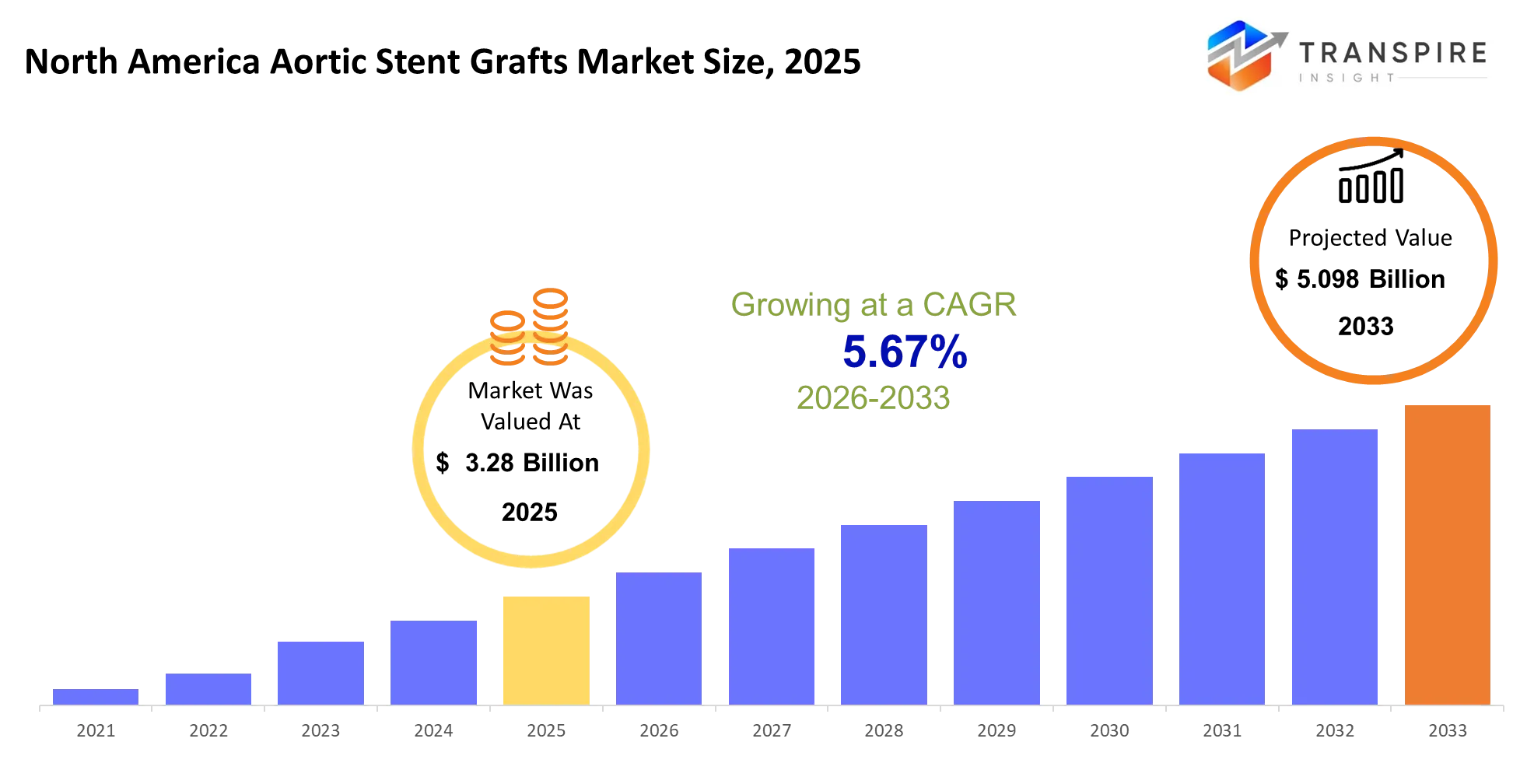
- North America Aortic Stent Grafts Market Size 2025: USD 3.28 Billion
- North America Aortic Stent Grafts Market Size 2033: USD 5.098 Billion
- North America Aortic Stent Grafts Market CAGR: 5.67%
- North America Aortic Stent Grafts Market Segments: By Product Type (Abdominal Aortic Stent Grafts, Thoracic Aortic Stent Grafts, Fenestrated Stent Grafts, Branched Stent Grafts, Others), By Procedure Type (Endovascular Aneurysm Repair, Thoracic Endovascular Aneurysm Repair, Hybrid Procedures, Others), By End User (Hospitals, Cardiac Centers, Ambulatory Surgical Centers, Others), By Material (Polyester Grafts, ePTFE Grafts, Hybrid Materials, Others).
To learn more about this report,  Download Free Sample Report
North America Aortic Stent Grafts Market Summary:
The North America Aortic Stent Grafts Market size is estimated at USD 3.28 Billion in 2025 and is anticipated to reach USD 5.098 Billion by 2033, growing at a CAGR of 5.67% from 2026 to 2033.North America Aortic Stent Grafts Market basically supports minimally invasive repair for life-threatening aortic aneurysms and dissections, these things can end up causing fatal internal bleeding if they’re not handled right away. In practice, hospitals and vascular centers are leaning more and more on these grafts because they can lower the amount of open-heart surgical exposure, speed up recovery time a bit, and generally help results especially for elderly, high-risk patients. Over the last few years the market seems to have changed in a noticeable way, moving away from standard endovascular repair toward something far more customized like fenestrated graft systems made for complicated anatomies. That shift has brought in more eligible patients and it has also pushed up procedural volumes, particularly at specialized cardiovascular centers.
One big reason for this momentum came from the post-pandemic backlog of cardiovascular procedures that got delayed. When healthcare systems started catching up on elective interventions, providers then began using advanced stent graft technologies faster. These newer options can reduce ICU use and also shorten the overall hospital stay duration. Meanwhile, stronger imaging integration and better physician training have helped people feel more certain during procedures, and that confidence is letting manufacturers win higher-value sales, often via premium device portfolios plus long-term service ecosystems.
Key Market Insights
- The United States sort of dominates the North America Aortic Stent Grafts Market, with something like over 78% market share in 2025, partly because of advanced cardiovascular infrastructure.
- Canada meanwhile looks like the fastest-rising regional slice through 2032, supported by expanding vascular surgery capacity, and also by improved reimbursement frameworks .
- High healthcare spending along with more aneurysm screening programs keep pushing regional industry size forward, so procedural adoption across North America stays strong.
- For products, abdominal aortic stent grafts take the lead, with close to 60% of the revenue share, mainly because abdominal aneurysms show up more often.
- Thoracic aortic stent grafts sit in the second place, and that’s largely tied to rising care for thoracic aortic dissections, plus trauma-related conditions too.
- Fenestrated and branched stent grafts are the quickest-growing segment from 2025 to 2032, basically because patients need patient-specific vascular solutions and hospitals keep asking for them.
- Customized endovascular devices are getting major traction lately, as hospitals put more weight on precision-based, minimally invasive interventions.
- When you look at application areas, abdominal aortic aneurysm repair stays the main one, bringing in more than 55% of North America Aortic Stent Grafts Market revenue.
- Thoracic aneurysm repair is becoming the fastest-growing application, driven by earlier detection thanks to advanced imaging technologies .
- Also, the growing preference for endovascular aneurysm repair procedures is continuing to speed up market growth rate, especially across tertiary cardiovascular centers.
- End users wise, hospitals basically hold around 70% market share, because procedural volumes are high, and specialized vascular departments are more established.
What are the Key Drivers, Restraints, and Opportunities in the North America Aortic Stent Grafts Market?
The strongest force pushing the North America Aortic Stent Grafts Market forward is, basically, the clinical move toward minimally invasive endovascular aneurysm repair instead of older open surgery. That shift really picked up speed once hospitals started feeling steady pressure to cut down intensive care time and also make post-operative recovery happen faster, especially after the COVID-19 backlog of cardiovascular procedures. Newer stent graft systems let physicians handle high-risk and elderly patients with less procedural disruption, and generally fewer complications. So, hospitals end up expanding vascular intervention programs which, in turn, boosts device procurement volumes, adds more recurring procedural income, and drives demand for premium fenestrated and branched graft technologies
Still, the market’s biggest structural obstacle is the sheer procedural complexity linked with advanced aortic repair. Proper deployment depends on specialized imaging support, hybrid operating rooms, and vascular surgeons with very specific training. Unfortunately these resources cluster in large urban cardiovascular centers, and they cannot be scaled quickly, because building physician know-how plus hospital capital commitments takes years. This mismatch then reduces access for smaller regional facilities, which slows down how quickly treatment gets adopted and ends up capping market penetration even when clinical demand stays high
At the same time, a growth opportunity is starting to show up, patient-tailored and AI-supported stent graft planning platforms. Firms are pouring investment into 3D imaging integration and into customized graft manufacturing, to raise precision for complicated aneurysm repair. If adoption spreads across Canada, and also into secondary U.S. healthcare networks, the market could reach more patients, and also support a higher-margin procedural ecosystem.
What Has the Impact of Artificial Intelligence Been on the North America Aortic Stent Grafts Market?
Artificial intelligence plus advanced digital technologies are, in a way, reworking the North America Aortic Stent Grafts Market, mostly because they can change how teams do procedural planning, device customization, and post-operative monitoring. Hospitals and vascular centers are starting to rely more on AI-driven imaging platforms that sort of automate aneurysm measurement, vessel mapping, and stent graft sizing ahead of endovascular repair procedures. With these systems, the whole manual planning time tends to drop, and surgeons can often pick stent configurations that fit complex anatomies more tightly.
A few cardiovascular centers also bring 3D reconstruction software together with robotic-assisted navigation tools. That combination helps with deployment precision during thoracic and abdominal aneurysm repair, and it feels more controlled than traditional workflows. On the modeling side, machine learning frameworks can add predictive capabilities too, because they analyze pre-operative imaging, patient history, and prior procedural results. The goal is to estimate complication risk and also long-term graft performance. This helps physicians spot patients who might have a higher chance of endoleaks, or possible graft migration, before surgery actually begins.
In day to day practice, these kinds of predictive systems support higher procedural success rates, fewer repeat interventions, and shorter hospital stays. That last part can reduce operational costs for healthcare providers. Digital monitoring platforms then help keep follow-up compliance stronger, through remote imaging analysis and automated patient tracking, which makes it easier to stay on schedule.
Still, AI adoption is not smooth everywhere, there is a major ceiling. The integration cost for advanced imaging infrastructure is high, and clinical data often ends up fragmented across hospital systems. Also, limited interoperability between imaging platforms and electronic health records keeps slowing down large-scale deployment in mid-sized healthcare facilities.
Key Market Trends
- Since 2021 hospitals have been sorta increasing the uptake of fenestrated stent grafts, even when physicians ran into more anatomically complex aneurysm situations that used to feel inoperable. Medtronic and W. L. Gore & Associates expanded their physician training initiatives after the whole post-pandemic procedure backlog thing picked up speed, which in turn accelerated endovascular intervention volumes.
- Hybrid operating room spending also went up in a bunch of major U.S. cardiovascular centers between 2022 and 2025, giving teams better imaging precision during thoracic aneurysm repairs.
- Over the last five years, hospitals have shown less preference for open surgical repair because endovascular procedures tend to trim average inpatient recovery timelines by several days.
- Then after 2023, AI powered imaging software adoption rose too, with vascular centers automating aneurysm sizing, graft selection, and procedural planning workflows—basically for higher accuracy.
- In Canada, the healthcare systems kind of expanded reimbursement support for minimally invasive aneurysm repair between 2021 and 2024, and that helped the regional adoption of those premium graft technologies quite a bit too.
- On the manufacturer's side, the companies shifted their supply chain strategies after pandemic era disruptions made it obvious how dependent they were on a small set of component suppliers for advanced catheter delivery systems.
- Branched and customized graft systems have moved forward more strongly since 2022, partly because aging patient populations are now more often needing personalized vascular repair solutions, not just the standard ones.
- At the same time, ambulatory surgical centers increased their involvement with vascular intervention services, because low profile delivery systems reduce procedural complexity and they also shortened discharge times.
- Finally, device makers started accelerating partnerships with imaging technology providers after 2023, aiming to improve intraoperative navigation and bring down secondary intervention rates after aneurysm repair.
North America Aortic Stent Grafts Market Segmentation
By Product Type
Abdominal aortic stent grafts are still kinda leading in the product type segment, mostly because abdominal aneurysms make up a bigger share of procedural volume across many North American cardiovascular centers. There’s strong physician familiarity too, plus established reimbursement routes, and also wider patient eligibility, so this category keeps that sustained dominance. Thoracic aortic stent grafts are holding the second-largest portion. That’s largely tied to more diagnoses of thoracic dissections and to trauma-related vascular problems. Meanwhile, fenestrated and branched stent grafts feel like the fastest-growing sub-segments, since hospitals are expanding their use of treatment options for anatomically intricate aneurysms that standard grafts really can’t handle as well.At the same time, demand for patient-specific setups has been pushing investments in imaging-guided planning, plus more customized manufacturing. Still, even with that momentum, higher pricing and procedural complexity can slow down adoption if you’re not in specialized vascular institutions.Looking ahead, the market seems to be moving toward low-profile delivery systems and more advanced customization platforms. That sets up opportunities for manufacturers who can balance procedural accuracy, clinical results, and scalable production efficiency—without turning the whole process into something too fragile or too slow to scale.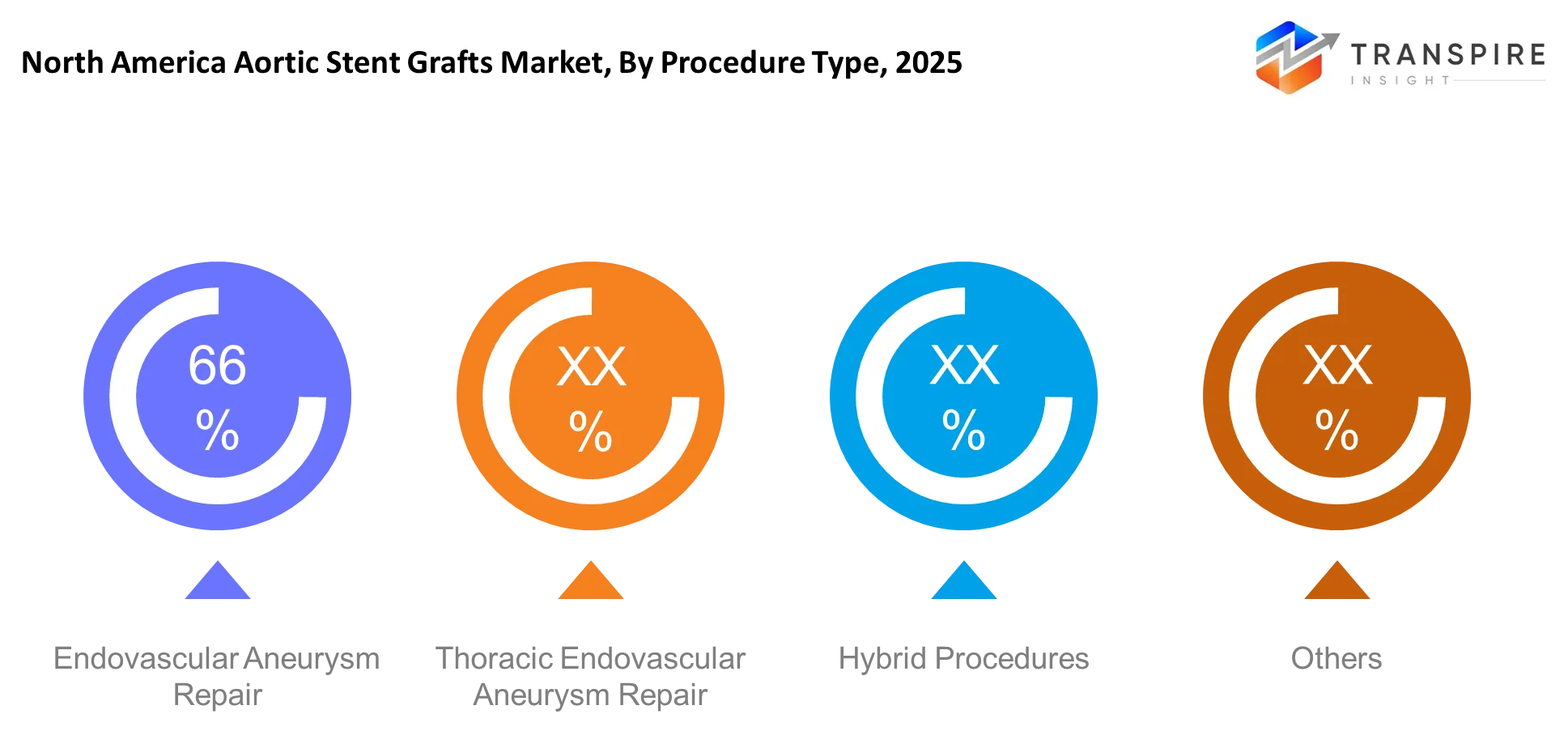
To learn more about this report, Download Free Sample Report
By Procedure Type
Endovascular aneurysm repair kinda leads the procedure type segment, mostly because healthcare providers are pushing harder toward minimally invasive moves that can shorten hospitalization and keep perioperative complications down, at least on paper. A lot of clinicians have taken up the approach over time, and the recovery story looks favorable, so procedural volumes keep rising especially among older patient groups. Also, thoracic endovascular aneurysm repair is getting a lot of traction since imaging technology and navigation systems have improved, which makes the work feel more precise in difficult thoracic situations. Hybrid procedures are still a smaller slice, but they’re kind of a big deal strategically, especially for people who need complex multi-stage efforts where open and endovascular techniques both come into play.
That said, these cases are not simple , they need advanced surgical infrastructure and a multidisciplinary skill set, so adoption stays mostly limited to tertiary hospitals and specialized cardiac centers. Meanwhile, tech upgrades—like more flexible catheters, better intraoperative imaging, and robotic-assisted navigation—keep lifting procedural success rates . Looking ahead, growth in this segment will probably depend on automation-assisted planning tools, plus broader use of AI-based imaging analytics, which could help streamline the treatment pathway and potentially make complex vascular repair more attainable.
By End-User
Hospitals hold the biggest share in the end-user segment , mostly because major cardiovascular procedures kind of require hybrid operating rooms, advanced imaging infrastructure, and also pretty solid intensive post-operative monitoring capabilities. Large hospital systems, they can usually pull higher reimbursement rates and they also get easier access to specialized vascular surgeons, which in turn helps procedural throughput stay stronger. Cardiac centers land as the second-largest category , and that’s largely due to the steady concentration of complex aneurysm treatment services inside dedicated cardiovascular institutions. Ambulatory surgical centers are showing up as the fastest-growing end-user sub-segment, mainly since minimally invasive procedures keep shrinking recovery time and making the whole process feel less complicated.
Progress with low-profile stent graft systems and outpatient monitoring protocols has nudged some selected vascular interventions to happen outside the classic inpatient settings , more often than before. Still, the absence of an emergency support infrastructure and advanced imaging equipment, these gaps keep on limiting wider ambulatory adoption, especially when you’re dealing with high-risk cases. Looking ahead, expansion will likely lean toward integrated care networks that sort of tie outpatient efficiency with specialized vascular know-how together, so clinicians get a real edge if they invest in coordinated cardiovascular treatment ecosystems.
By Material
Polyester grafts kinda dominate that whole material segment, mainly because long-term durability, structural stability and that very strong physician familiarity back up widespread use in abdominal and thoracic aneurysm repair procedures. The whole established manufacturing processes, plus proven clinical performance, have basically reinforced the preference for polyester-based systems in big-volume healthcare settings. ePTFE , also called expanded polytetrafluoroethylene, has picked up serious traction in recent years, mostly due to superior flexibility, reduced thrombogenicity and better compatibility with those more complex vascular anatomies.
Hybrid materials feel like the fastest-growing category, since manufacturers are trying to get a better balance between radial strength, flexibility and biocompatibility, for customized graft platforms. Research efforts are increasingly aimed at advanced coatings and multi layer material technologies, meant to reduce issues like endoleaks and graft migration. Even so, high production costs plus lengthy regulatory validation timelines keep, kind of, slowing down the commercial expansion for next generation material systems.So from there, competition in this segment will probably pivot around material innovation that improves long-term procedural durability, as well as still backing minimally invasive delivery and patient specific vascular reconstruction approaches.
What are the Key Use Cases Driving the North America Aortic Stent Grafts Market?
Abdominal aortic aneurysm repair is still the main thing that keeps pushing stent graft adoption across North American hospitals, and vascular surgery centers. You can see it too , in high aneurysm prevalence among aging populations, plus the general preference for a minimally invasive intervention, which keeps procedure numbers pretty solid.
For thoracic aneurysm repair and traumatic aortic injury, things are also shifting. Specialized cardiac centers and tertiary hospitals are gradually leaning in, because improved imaging systems plus hybrid operating rooms have made it feel more natural for physicians to treat complicated thoracic conditions using endovascular techniques, instead of going fully open.
There are also newer, emerging uses like patient-specific deployment with fenestrated grafts for those complex branch vessel aneurysms, and AI-assisted procedural planning in outpatient vascular programs. Right now these capabilities are mostly seen in advanced cardiovascular institutions , but the outlook looks good for the long run. This is especially true as customized manufacturing and digital imaging platforms keep maturing further.
|
Report Metrics |
Details |
|
Market size value in 2025 |
USD 3.28 Billion |
|
Market size value in 2026 |
USD 3.466 Billion |
|
Revenue forecast in 2033 |
USD 5.098 Billion |
|
Growth rate |
CAGR of 5.67% from 2026 to 2033 |
|
Base year |
2025 |
|
Historical data |
2021 - 2024 |
|
Forecast period |
2026 - 2033 |
|
Report coverage |
Revenue forecast, competitive landscape, growth factors, and trends |
|
Country scope |
North America (Canada, The United States, and Mexico) |
|
Key company profiled |
Medtronic, Cook Medical, W. L. Gore & Associates, Endologix, Terumo Corporation, Bentley Innomed, Cardinal Health, Becton Dickinson, CryoLife, MicroPort Scientific, Lombard Medical, JOTEC, Bolton Medical, Cordis, Abbott |
|
Customization scope |
Free report customization (country, regional & segment scope). Avail customized purchase options to meet your exact research needs. |
|
Report Segmentation |
By Product Type (Abdominal Aortic Stent Grafts, Thoracic Aortic Stent Grafts, Fenestrated Stent Grafts, Branched Stent Grafts, Others), By Procedure Type (Endovascular Aneurysm Repair, Thoracic Endovascular Aneurysm Repair, Hybrid Procedures, Others), By End User (Hospitals, Cardiac Centers, Ambulatory Surgical Centers, Others), By Material (Polyester Grafts, ePTFE Grafts, Hybrid Materials, Others) |
Which Regions are Driving the North America Aortic Stent Grafts Market Growth?
The United States comes out on top in the North America Aortic Stent Grafts Market, mostly because the cardiovascular infrastructure is more advanced, reimbursement frameworks are strong and there’s high procedural capacity in dedicated vascular centers. Bigger hospital groups keep putting money into hybrid operating rooms, plus robotic assisted imaging platforms, and also physician coaching programs , all of which help with the tougher aneurysm repair work. On top of that, federal healthcare spending and wider insurance help for minimally invasive vascular procedures have made it easier for patients to reach these endovascular options. Device makers, too, keep close research links with U.S. cardiovascular institutions , so the whole ecosystem feels tightly connected which in turn supports product development and faster go-to-market momentum.
Canada lands as the second largest regional contributor, supported by public healthcare funding that stays fairly steady and ongoing investment to modernize cardiovascular care. Yet, compared with the U.S. Canada tends to lean toward long term clinical efficiency and more centralized care pathways instead of simply expanding procedures at a quick pace. Provincial healthcare systems are still rolling out aneurysm screening initiatives and improving access to minimally invasive vascular repair across urban cardiac centers. This kind of careful , still dependable adoption pattern helps manufacturers predict procurement cycles , and it allows sustained revenue growth without intense pricing stress or overly fragmented reimbursement realities.
Mexico is coming up as the quickest-growing regional market, mainly because private healthcare funding is getting bigger and tertiary cardiovascular sites are being modernized. Lately the pace really sped up, when private hospital groups started pouring more resources into advanced imaging systems, and minimally invasive surgery skills, all to pull in medical tourism plus the rising need for focused cardiac care. On top of that, a lot of international device makers have widened their regional distribution deals, and also rolled out physician education efforts, which helps procedures get adopted more easily in the big metro healthcare hubs. For the stretch from 2026 to 2033, Mexico’s growth is expected to open meaningful chances for new entrants—especially those that bring cost-efficient stent graft platforms, practical training support for clinicians and localized distribution approaches.
Who are the Key Players in the North America Aortic Stent Grafts Market and How Do They Compete?
The North America Aortic Stent Grafts Market is, in a way, moderately consolidated , with a small cluster of multinational device manufacturers basically keeping a strong grip on a lot of the procedural volume across key cardiovascular centers. You can see competition moving more toward technological differentiation rather than pure pricing, because hospitals tend to favor procedural reliability, longer-term graft durability, and fit with those intricate aneurysm anatomies. Most of the time, incumbent manufacturers still defend their position by running physician training ecosystems, pushing advanced imaging integration, and offering customized graft platforms, which unintentionally (or not ) raises switching costs for healthcare providers. Meanwhile, smaller specialized players seem to chase narrower vascular applications, and also patient-specific repair solutions that the bigger standardized portfolios just can’t fully manage.
Medtronic competes with wide procedural coverage and integrated vascular care platforms, blending stent graft systems with imaging-guided navigation technologies, kind of as a bundle. Medtronic also leans hard on extensive physician education networks and keeps strong ties with large U.S. hospital systems that handle high procedural volumes. W. L. Gore & Associates , on the other hand, concentrates on device durability and material engineering, especially expanded polytetrafluoroethylene graft technology , which supports better flexibility in complex vascular geometries. Ongoing work on low-profile delivery systems has improved procedural access for high-risk patients and helped broaden adoption across minimally invasive repair programs.
Cook Medical kind of keeps a competitive edge by offering tailored fenestrated and branched graft solutions for those anatomically tricky aneurysm cases. Because of that specialization they’re better positioned within tertiary cardiovascular centers, where advanced vascular reconstruction procedures happen. Terumo Corporation meanwhile has been broadening its regional footprint, by reinforcing how catheters and guidewires fit together so the procedural precision is improved during endovascular repair. Endologix keeps leaning into minimally invasive abdominal aneurysm treatment platforms, with more streamlined deployment systems, that aim to cut down procedural complexity and boost physician workflow efficiency.
Company List
- Medtronic
- Cook Medical
- W. L. Gore & Associates
- Endologix
- Terumo Corporation
- Bentley Innomed
- Cardinal Health
- Becton Dickinson
- CryoLife
- MicroPort Scientific
- Lombard Medical
- JOTEC
- Bolton Medical
- Cordis
- Abbott
Recent Development News
In April 2026, Endospan Receives FDA Approval for Nexus Aortic Arch Stent Graft System: Endospan secured U.S. FDA approval for its Nexus aortic arch stent graft system, enabling commercial launch in the United States. The approval was backed by positive results from the TRIOMPHE IDE study focused on high-risk aortic arch patients, strengthening the minimally invasive treatment landscape in North America.
Source: https://vascularnews.com
In February 2026, Artivion Reports Positive Clinical Outcomes for Aortic Stent Systems at STS 2026: Artivion presented new clinical findings at the Society of Thoracic Surgeons (STS) Annual Meeting showing improved post-surgical outcomes from its aortic stent graft technologies. The results reinforced the company’s growing presence in advanced thoracic and aortic repair solutions across the U.S. market.
Source: https://www.clinicaltrialsarena.com
What Strategic Insights Define the Future of the North America Aortic Stent Grafts Market?
The North America Aortic Stent Grafts Market is structurally moving toward highly customized, image integrated and minimally invasive vascular repair ecosystems over the next five to seven years, at least that’s the direction many analysts are pointing too. Growth will increasingly come from complicated aneurysm treatment rather than the more “standard” abdominal repair procedures, pushed by aging populations, AI-assisted procedural planning, and broader adoption of fenestrated and branched graft technologies. In parallel, healthcare providers are also shifting procurement priorities toward integrated procedural platforms that bring imaging software, navigation systems, and patient specific device manufacturing together in one package.
One under-recognized risk lies in how market share can cluster around a small set of advanced material suppliers and specialized manufacturing facilities. If there’s some disruption in polymer supply, sterilization throughput, or regulatory sign-off timelines , then you can end up with procedural slowdowns and price wobble across hospital networks. And at the same time, there’s this kind of new opportunity emerging around outpatient friendly vascular interventional systems, kind of aimed at ambulatory surgical centers, particularly as low profile delivery tech continues to mature.
Market participants should prioritize investment in digital procedural ecosystems and physician training partnerships, rather than leaning mainly on device pricing alone. The longer term competitive edge will depend on procedural integration, clinical workflow efficiency, and how well the whole process fits together for real world care.
North America Aortic Stent Grafts Market Report Segmentation
By Product Type
- Abdominal Aortic Stent Grafts
- Thoracic Aortic Stent Grafts
- Fenestrated Stent Grafts
- Branched Stent Grafts
- Others
By Procedure Type
- Endovascular Aneurysm Repair
- Thoracic Endovascular Aneurysm Repair
- Hybrid Procedures
- Others
By End User
- Hospitals
- Cardiac Centers
- Ambulatory Surgical Centers
- Others
By Material
- Polyester Grafts
- ePTFE Grafts
- Hybrid Materials
- Others
Frequently Asked Questions
Find quick answers to common questions.
The Approximate North America Aortic Stent Grafts Market size for the Market will be USD 5.098 Billion in 2033.
The key Segments of the North America Aortic Stent Grafts Market are By Product Type (Abdominal Aortic Stent Grafts, Thoracic Aortic Stent Grafts, Fenestrated Stent Grafts, Branched Stent Grafts, Others), By Procedure Type (Endovascular Aneurysm Repair, Thoracic Endovascular Aneurysm Repair, Hybrid Procedures, Others), By End User (Hospitals, Cardiac Centers, Ambulatory Surgical Centers, Others), By Material (Polyester Grafts, ePTFE Grafts, Hybrid Materials, Others).
Major Players in the North America Aortic Stent Grafts Market are Medtronic, Cook Medical, W. L. Gore & Associates, Endologix, Terumo Corporation, Bentley Innomed, Cardinal Health, Becton Dickinson, CryoLife, MicroPort Scientific, Lombard Medical, JOTEC, Bolton Medical, Cordis, Abbott.
The Current Market size of the North America Aortic Stent Grafts Market is USD 3.28 Billion in 2025.
The North America Aortic Stent Grafts Market CAGR is 5.67%.
- Medtronic
- Cook Medical
- W. L. Gore & Associates
- Endologix
- Terumo Corporation
- Bentley Innomed
- Cardinal Health
- Becton Dickinson
- CryoLife
- MicroPort Scientific
- Lombard Medical
- JOTEC
- Bolton Medical
- Cordis
- Abbott
Recently Published Reports
-
May 2026
Biosimilars Market
Biosimilars Market By Product Type (Monoclonal Antibodies, Recombinant Hormones, Erythropoietin, G-CSF, Others), By Indication (Oncology, Autoimmune Diseases, Blood Disorders, Diabetes, Others), By Manufacturing Type (In-House Manufacturing, Contract Manufacturing), By Distribution Channel (Hospital Pharmacies, Retail Pharmacies, Online Pharmacies), By Industry Analysis, Size, Share, Growth, Trends, and Forecasts 2021-2033
-
Apr 2026
Gastrointestinal Endoscopy Market
Gastrointestinal Endoscopy Market By Type (Rigid Gastrointestinal Endoscope, Flexible Gastrointestinal Endoscopes, Disposable Gastrointestinal Endoscope), By Procedure Type (Colonoscopy, Gastroscopy, Duodenoscopy, Enteroscopy, Flexible Sigmoidoscopy, Others), By Application (Diagnosis, Treatment), By End-Users (Hospitals, Ambulatory Surgical Centers, Specialty Clinics, Laboratories, Others), By Industry Analysis, Size, Share, Growth, Trends, and Forecasts 2021-2033
-
Apr 2026
Rare Inherited Metabolic Disorder Drug Market
Rare Inherited Metabolic Disorder Drug Market By Drug Class (Enzyme Replacement Drugs, Gene Therapy Drugs, Substrate Reduction Drugs, Small Module Drugs, Protein Drugs), By Route of Administration(Parenteral, Oral, Intrathecal), By Clinical Development (Marketed Drugs, Late Stage Clinical Phase III, Early Stage Clinical Phase I-II, Preclinical Candidates), By Indication (Lysosomal Storage Disorders, Urea Cycle Disorders, Amino Acid Metabolic Disorders, organic Acidemias, Peroximal Disorders), By Industry Analysis, Size, Share, Growth, Trends, and Forecasts 2021-2033
-
Jan 2026
Pharmaceutical Cleanroom Technology Market
Pharmaceutical Cleanroom Technology Market By Product (Equipment, Consumables, Services); By Cleanroom Type (Standard Cleanrooms, Modular Cleanrooms); By End Use (Pharmaceutical Companies, Biotechnology Companies), By Industry Analysis, Size, Share, Growth, Trends, and Forecasts 2021-2033