

Japan Polyester Fibre Market Size & Forecast:
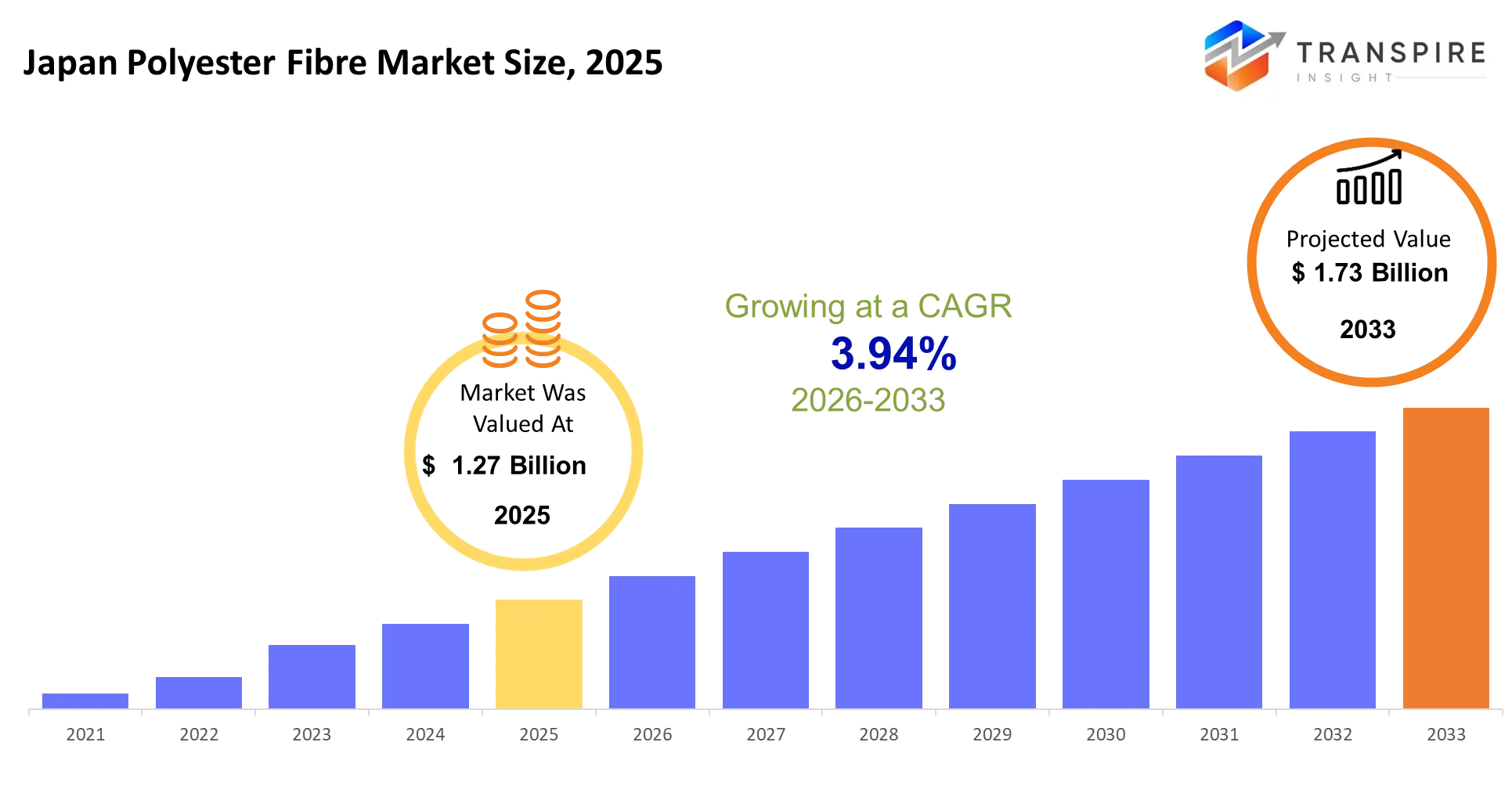
- Japan Polyester Fibre Market Size 2025: USD 1.27 Billion
- Japan Polyester Fibre Market Size 2033: USD 1.73 Billion
- Japan Polyester Fibre Market CAGR: 3.94%
- Japan Polyester Fibre Market Segments: By Type (Staple Fiber, Filament Yarn, Hollow Fiber, Microfiber, Others); By Application (Textiles, Apparel, Home Furnishing, Industrial Fabrics, Automotive, Others); By End-User (Textile Industry, Apparel Industry, Automotive Industry, Industrial Sector, FMCG Companies, Others); By Form (Fibers, Yarns, Chips, Others)
To learn more about this report,  Download Free Sample Report
Japan Polyester Fibre Market Summary
The Japan Polyester Fibre Market was valued at USD 1.27 Billion in 2025. It is forecast to reach USD 1.73 Billion by 2033. That is a CAGR of 3.94% over the period.
The Japan Polyester Fibre Market delivers synthetic fibers which manufacturers use to create clothing and automotive interiors and industrial fabrics and filtration media and maritime ropes that need to withstand high strength while resisting moisture and maintaining affordable production costs. The market has transformed during the last three to five years because manufacturers now use recycled polyester and circular production systems as their primary procurement method instead of relying on virgin petrochemical materials. The main transformation of the system involves companies adopting rPET as their standard material for their supply chains due to corporate environmental goals and Japan's stricter regulations on plastic waste management.
The transition received support from pandemic logistics disruptions and energy and crude oil price fluctuations in 2022 because these events revealed the risks of depending on imported raw materials. The recycling system now requires producers to build domestic recycling facilities while establishing secure sources of feedstock for the future. The current growth pattern demonstrates that companies expand their operations but also focus on developing higher technical fiber products which match OEM requirements for materials that can be traced back to their source while producing low carbon emissions.
Key Market Insights
- The Kanto region of Japan produces the largest market share of polyester fiber because its textile manufacturing centers create a high level of industrial production.
- The Kansai region experiences the fastest growth because of increasing demand for automotive materials and the development of its chemical recycling facilities.
- The Japan Polyester Fibre Market shows its highest market share with staple fibre reaching 55% due to strong demand from the apparel and home textile markets.
- Japan uses filament fibre as its second most significant material because industrial fabrics and high-strength performance applications require this material.
- The recycled polyester segment is the fastest-growing through 2030 because strict circular economy policies and ESG compliance requirements create increasing demand.
- The Japan Polyester Fibre Market shows apparel as its leading sector because fashion needs in the country remain steady throughout the year.
- Automotive interiors represent the fastest-growing market segment because lightweighting trends and electric vehicle material development needs drive their growth.
- About 50% of the market belongs to textile manufacturers because Japan possesses a complete system for producing fabric from raw materials.
- Industrial end-users represent the fastest-growing category, driven by filtration, safety materials, and engineering fabric demand expansion.
- Japanese companies achieve competitive advantages through their development of recycled polyester products and their efforts to increase rPET production capacity across the country.
What are the Key Drivers, Restraints, and Opportunities in the Japan Polyester Fibre Market?
The main factor driving expansion in the market stems from the rapid transition of organizations towards circular polyester systems which particularly require them to implement recycled PET across their textile and industrial supply networks. The new speed of progress started after Japan established more rigorous rules for reducing plastic waste which required manufacturers to use environmentally friendly raw materials for their production processes. The company has increased its use of recycled PET in both textile and automotive-grade materials which results in more reliable procurement processes and enables the business to charge higher prices for its certified sustainable textile products.
Japan faces a fundamental structural problem because it relies on imported petrochemical materials which include purified terephthalic acid. The reliance on these materials exposes producers to unpredictable international energy and crude oil market fluctuations which they cannot resolve quickly because their domestic feedstock options are restricted. The result creates profit losses for mid-sized companies while they experience delays in their capacity development processes which particularly affect their operations during times of currency value changes and increases in shipping expenses.
The next stage of expansion will occur through funding for chemical recycling technologies which focus on developing depolymerization systems that recover PET through their pilot projects in industrial areas of Kyushu. The systems enable chemical companies and fashion manufacturers to create high-quality fiber from waste materials through their ability to produce fiber that meets near-virgin standards. The commercial implementation of this solution would transform the Japan Polyester Fibre Market into a high-value circular materials center instead of its current status as an industry that depends on importing products for its volume-based operations.
What Has the Impact of Artificial Intelligence Been on the Japan Polyester Fibre Market?
The production operations of Japan's polyester fiber manufacturing industry now use artificial intelligence together with advanced digital technologies which transform the management methods used for production processes and chemical workflows and quality assurance practices. The implementation of AI-based automation systems in large polymerization and spinning operations enables precise management of temperature and extrusion speed and polymer viscosity during production operations which leads to consistent fiber quality results throughout different production runs. The production facilities have achieved higher operational efficiency because they experienced fewer interruptions during their production processes especially in their continuous manufacturing operations that produce high volumes of products.
Manufacturers are using machine learning models to predict when maintenance will be needed for their spinning machines and drying systems and filtration units. Manufacturers use vibration analysis together with thermal and energy consumption analysis to detect equipment failures that will occur before actual equipment breakdowns take place which results in improved system uptime and decreased unplanned maintenance expenses. Chemical plants now use emissions monitoring systems that employ AI-driven forecasting to monitor NOx and VOC emissions which enables operators to achieve compliance with stricter environmental regulations while they optimize their fuel and energy consumption.
The main obstacle to using AI systems in manufacturing lies in the excessive costs needed to connect these advanced technologies with existing manufacturing systems. The majority of mid-sized manufacturing companies operate with incomplete sensor systems, which creates data inconsistencies that cause their operational systems to work incorrectly during real-world conditions. The early adopters have demonstrated their ability to achieve measurable energy efficiency improvements while decreasing operational waste which indicates that digital transformation progresses at a slow yet consistent pace throughout the entire polyester fiber value chain in Japan.
Key Market Trends
- The Japan Polyester Fibre Market experienced rising rPET adoption after 2022 when new recycling regulations required stricter plastic recycling requirements for industrial manufacturers.
- The textile producers made a transition from using virgin polyester to adopting blended recycled fibres during the period from 2023 to 2025 which helped them decrease their dependency on imported materials while simultaneously decreasing their exposure to market price fluctuations.
- The funding for recycling projects received by Toray Industries during 2024 demonstrates its commitment to chemical recycling while the entire industry shifts toward closed-loop fibre production systems.
- Automotive suppliers increased their polyester fibre usage for interior components during 2023 because they wanted to achieve electric vehicle efficiency standards and emission reduction requirements through material weight reduction.
- The industrial sector required polymerization system upgrades because energy price changes during 2022 to 2023 created a need for equipment that operates more efficiently.
- The research and development activities of Teijin Limited which focus on bio-based polyester materials started to grow in 2023 because the company sought to develop sustainable fiber materials which would give them an edge in the market.
- The export-oriented fiber producers implemented supply chain modifications during 2024 because they wanted to reduce their reliance on imported petrochemical intermediates which created risks from currency exchange rate fluctuations.
- The introduction of automated spinning controls to industrial manufacturing facilities resulted in smart manufacturing systems becoming more popular after 2023 because these controls improved production reliability and reduced defect occurrence.
- The industrial sector adopted low-emission polyester production methods at mid-sized and large-scale plants because stricter emission regulations which took effect in 2025 required them to do so.
- Companies changed their competitive strategy from increasing production volume to producing specialty technical fibers which they planned to sell through specialized applications rather than standardized polyester products.
Japan Polyester Fibre Market Segmentation
By Type :
The Japan polyester fiber market will experience strong demand for staple fiber because it enables easy textile production and affordable clothing manufacturing. The textile industry will maintain constant use of filament yarn because it provides fabrics with both smooth texture and high strength which people require for everyday clothing and industrial textile production.
Comfort-based applications will use hollow fiber and microfiber materials while performance-based needs require lightweight filling and soft fabric applications. The different production materials will provide specialized solutions which meet the market requirement for specific strength and elasticity and finish standards.
By Application :
The textile and apparel sectors will drive strong polyester fiber demand because of increasing clothing production and the need for rapid fashion changes. The home furnishing industry will contribute to market expansion through its application in curtains and upholstery and bedding products which need to withstand wear and allow simple upkeep.
Polyester fiber will drive industrial fabric and automotive applications because it provides safety materials and seat fabrics and technical applications. The market will expand through various small-scale applications which drivers use for packaging and specialty products.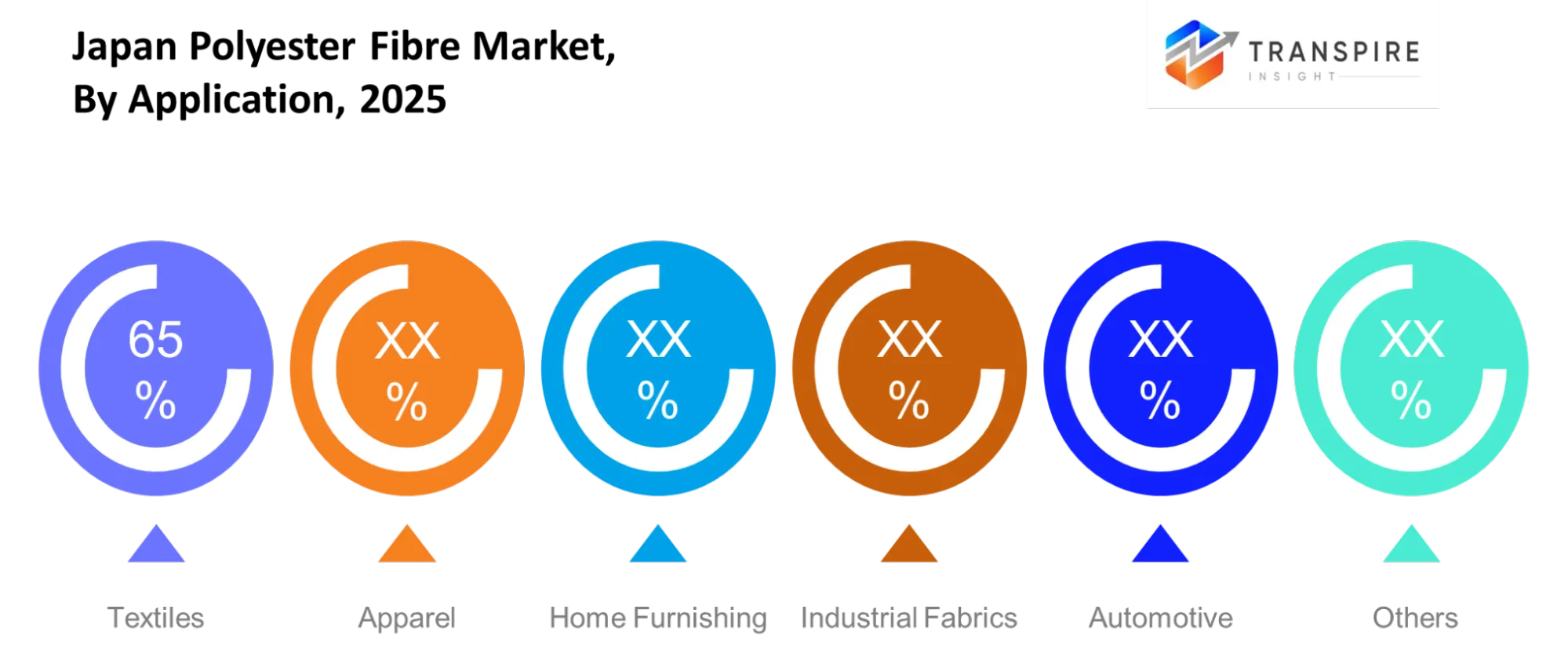
To learn more about this report, Download Free Sample Report
By End-User :
The textile industry will stay the largest end-user, driven by continuous fabric production and consistent fibre consumption. The apparel industry will also maintain strong demand due to high garment manufacturing and export activity, supporting stable fibre usage across production cycles.
The automotive industry and industrial sector will add steady growth through demand for durable and lightweight materials. The FMCG companies will use polyester fibre in packaging applications while small manufacturers will require flexible fibre solutions to meet their different product needs.
By Form :
The textile industry will maintain strong demand for fibers because they are essential for producing textiles and fabrics which create both apparel and home furnishing products. The textile industry depends on yarns to produce woven and knitted fabrics because these materials provide both strength and flexibility for creating different fabric structures.
Chips will act as the primary raw material which manufacturers will process further to produce fibers and yarns that enable ongoing production activities. Each form will contribute to maintaining supply balance and meeting demand across textile, industrial, and consumer product manufacturing needs in Japan.
What are the Key Use Cases Driving the Japan Polyester Fibre Market?
The Japan Polyester Fibre Market shows apparel and textile manufacturing as its main application because manufacturers use polyester fibres to produce standard clothing items and uniforms and home textile products. The material maintains demand because consumers regularly buy it and its durable characteristics and wrinkle-free nature and affordable manufacturing costs benefit fashion and institutional buyers who purchase in bulk.
The textile industry shows new ways to use materials for both automotive interior design and industrial textile applications. Automotive manufacturers use polyester fibres for their seat fabrics and insulation layers and trim materials because these fibres help them achieve lower vehicle weight and better fuel efficiency.Manufacturing plants and infrastructure maintenance operations use the materials for protective fabrics and industrial filtration systems which industrial end-users have adopted.
High-performance technical textiles for electric vehicles and advanced filtration media for emission control systems are developing into new use cases. The applications have not yet reached full adoption but they gain momentum because Japan enforces stricter environmental regulations and manufacturers search for materials that offer both thermal stability and recyclability and extended operational lifespan.
|
Report Metrics |
Details |
|
Market size value in 2025 |
USD 1.27 Billion |
|
Market size value in 2026 |
USD 1.32 Billion |
|
Revenue forecast in 2033 |
USD 1.73 Billion |
|
Growth rate |
CAGR of 3.94% from 2026 to 2033 |
|
Base year |
2025 |
|
Historical data |
2021 - 2024 |
|
Forecast period |
2026 - 2033 |
|
Report coverage |
Revenue forecast, competitive landscape, growth factors, and trends |
|
Country scope |
Japan |
|
Key company profiled |
Reliance Industries, Indorama Ventures, Toray, Teijin, Far Eastern New Century, Sinopec, SK Chemicals, Mitsubishi Chemical, Lotte Chemical, Hyosung, Nan Ya Plastics, Alpek, BASF, Dow, Eastman |
|
Customization scope |
Free report customization (country, regional & segment scope). Avail customized purchase options to meet your exact research needs. |
|
Report Segmentation |
By Type (Staple Fiber, Filament Yarn, Hollow Fiber, Microfiber, Others); By Application (Textiles, Apparel, Home Furnishing, Industrial Fabrics, Automotive, Others); By End-User (Textile Industry, Apparel Industry, Automotive Industry, Industrial Sector, FMCG Companies, Others); By Form (Fibers, Yarns, Chips, Others) |
Which Regions are Driving the Japan Polyester Fibre Market Growth?
The Japan Polyester Fibre Market currently has Kanto as its top region because this area contains numerous textile factories and chemical production facilities along with its state-of-the-art transportation systems. The strict industrial sustainability regulations that Tokyo and its neighboring prefectures have established have led to an urgent need for companies to adopt recycled polyester production technologies.
The region benefits from integrated supply chains that allow polymer producers to supply their products directly to apparel manufacturers and automotive original equipment manufacturers who require large quantities of their products.The facility uses its proximity to major ports like Yokohama to import petrochemical intermediates and export finished fibre products which strengthens its position as a market leader in value-added manufacturing.
Kansai functions as a stable secondary hub because its diverse industrial workforce supports its operations instead of using a single large industrial base. The polyester fibre market in Kansai depends on chemical manufacturing companies that have operated for years as well as mid-sized businesses while Kanto relies on foreign sales for its economic growth.
Domestic textile manufacturers and automotive component makers from Osaka and Hyogo maintain their investment activities in the region. The environmental compliance requirements for manufacturers in this area are made more manageable through gradual regulatory implementation. Kansai provides stable market supply which helps the national economy because it maintains consistent customer demand.
Kyushu is emerging as the fastest-growing region due to recent investments in chemical recycling and green manufacturing infrastructure. The region has attracted fibre producers to build rPET and depolymerization facilities because of government-backed industrial decarbonization programs which started in 2023. The region has experienced faster capacity expansion because companies now operate from industrial areas which offer cheaper land rights and direct access to modern energy-saving facilities. For market entrants and investors, Kyushu signals a strategic entry point for 2026–2033 growth, particularly in circular polyester production and advanced material processing.
Who are the Key Players in the Japan Polyester Fibre Market and How Do They Compete?
The Japan Polyester Fibre Market exhibits moderate consolidation because its primary market control rests with integrated chemical and textile companies while smaller specialized manufacturers create technical fibre products for specific market segments. The market competition has increased because existing players use recycled polyester production and high-performance product innovation to protect their market share. The company maintains its market advantage through superior chemical recycling technology and spinning efficiency, which produces better results than basic pricing, because it has strong business connections with Japanese automotive and apparel original equipment manufacturers.
Toray Industries uses technology to gain market leadership through its chemical recycling expansion and high-tenacity fibre development for automotive and industrial applications, which helps the company establish premium market status. Teijin Limited develops carbon-neutral polyester products through its closed-loop recycling systems and advanced sustainability certification process, which enables the company to differentiate itself from competitors. The company produces petrochemical products that serve as its upstream supply chain, which supports its fibre business and creates cost benefits, while it establishes strategic alliances with mobility and construction businesses throughout the Asia-Pacific region.
Toyobo develops specialized high-performance fibers that serve niche markets for medical textiles and filtration applications, which it offers through custom product development instead of large-scale production. The advanced polymer chemistry developed by Asahi Kasei enables the company to manufacture industrial-grade polyester, which maintains durability for use in automotive interior components and safety features. Indorama Ventures uses its global production network to build its Japan operations, while its acquisition strategy helps the company create a supply chain network that boosts its competitive edge in the commodity polyester market.
Company List
- Reliance Industries
- Indorama Ventures
- Toray
- Teijin
- Far Eastern New Century
- Sinopec
- SK Chemicals
- Mitsubishi Chemical
- Lotte Chemical
- Hyosung
- Nan Ya Plastics
- Alpek
- BASF
- Dow
- Eastman
Recent Development News
In **April 2026, Teijin Frontier Co., Ltd. announced the development of a new stretch polyester yarn offering exceptional compatibility with high-performance polyester materials. The innovation is designed to enable fully polyester-based stretch fabrics for sports and outdoor wear, replacing conventional polyurethane-based elastic fibers and improving recyclability and comfort performance in textile applications. Source https://www.teijin.com/
In **June 2025, Teijin Frontier Co., Ltd. announced plans to commercialize a recycled polyester fabric mimicking natural fibers for apparel applications. The material, built using advanced cross-section yarn technology, is aimed at expanding sustainable textile offerings in Japan, with sales beginning in fiscal 2025 and broader commercialization planned for 2026.
Source https://www.textiletradebuddy.com/
What Strategic Insights Define the Future of the Japan Polyester Fibre Market?
The Japan Polyester Fibre Market is currently switching from its existing operations to a new business model which uses recycled and special polyester fibres as its main income source into a value-based circular production system. The current transformation is driven by stricter environmental regulations together with increased lifecycle carbon emissions tracking requirements from original equipment manufacturers and the industrial need for materials that can be traced throughout automotive and textile supply chains. The next five to seven years will require businesses to use their technological advantages for growth instead of trying to increase their production capacity.
The main danger exists because advanced recycling technology has become concentrated within selected integrated chemical companies whose operations will result in supply shortages and unchanging prices when their raw material collection systems fail to develop. The market will experience a gradual decline in demand for lower-value products because bio-based materials will replace synthetic fibers in specialized markets which include niche apparel and packaging products.
The development of fiber regeneration hubs through depolymerization technology presents a new market opportunity for industrial centers situated in Kyushu because they benefit from government backing and reduced expenses. Market participants should prioritize investment in closed-loop partnerships with waste management networks and OEMs to secure long-term feedstock access and lock in premium circular fibre contracts before capacity becomes concentrated.
Japan Polyester Fibre Market Report Segmentation
By Type
- Staple Fiber
- Filament Yarn
- Hollow Fiber
- Microfiber
By Application
- Textiles
- Apparel
- Home Furnishing
- Industrial Fabrics
- Automotive
By End-User
- Textile Industry
- Apparel Industry
- Automotive Industry
- Industrial Sector
- FMCG Companies
By Form
- Fibers
- Yarns
- Chips
Frequently Asked Questions
Find quick answers to common questions.
The Japan Polyester Fibre Market size is USD 1.73 Billion in 2033.
Key Segments for the Japan Polyester Fibre Market are By Type (Staple Fiber, Filament Yarn, Hollow Fiber, Microfiber, Others); By Application (Textiles, Apparel, Home Furnishing, Industrial Fabrics, Automotive, Others); By End-User (Textile Industry, Apparel Industry, Automotive Industry, Industrial Sector, FMCG Companies, Others); By Form (Fibers, Yarns, Chips, Others).
Major Japan Polyester Fibre Market Players are Reliance Industries, Indorama Ventures, Toray, Teijin, Far Eastern New Century, Sinopec, SK Chemicals, Mitsubishi Chemical, Lotte Chemical, Hyosung, Nan Ya Plastics, Alpek, BASF, Dow, Eastman.
The Japan Polyester Fibre Market size is USD 1.27 Billion in 2025.
The Japan Polyester Fibre Market CAGR is 3.94% from 2026 to 2033.
- Reliance Industries
- Indorama Ventures
- Toray
- Teijin
- Far Eastern New Century
- Sinopec
- SK Chemicals
- Mitsubishi Chemical
- Lotte Chemical
- Hyosung
- Nan Ya Plastics
- Alpek
- BASF
- Dow
- Eastman
Recently Published Reports
-
Apr 2026
Healthcare Polymer Packaging Market
Healthcare Polymer Packaging Market Size, Share & Analysis Report By Packaging Type (Syringes, IV Bottles and Pouches, Clamshells, Blisters, Bottles & Jars, Containers, Tubes, IV Parental Packaging, Others), By Type (Regulated, Non-regulated), By Polymer Type (LDPE (Low-Density Polyethylene), HDPE (High-Density Polyethylene), Homo-polymer (Homo), Random Copolymer (Random), Block Copolymer (Block), PET, Polystyrene, Polyvinyl Chloride, Polyamide/EVOH, Others), and Geography (North America, Europe, Asia-Pacific, Middle East and Africa, South and Central America), 2021 - 2031
-
Apr 2026
Hydrophilic Tape (Waterstop) Market
Hydrophilic Tape (Waterstop) Market Size, Share & Analysis Report By Type (Bentonite-Based Hydrophilic Tape, Rubber-Based Hydrophilic Tape), By Application (Residential Buildings, Commercial Buildings, Infrastructure Projects), and Geography (North America, Europe, Asia-Pacific, Middle East and Africa, South and Central America), 2021 - 2031
-
Apr 2026
Metalens Market
Metalens Market Size, Share & Analysis Report By Type (Visible Light Metalens, and Infrared Metalens), By Application (Consumer Electronics, Automotive Electronics, Industrial, Medical, and Others), and Geography (North America, Europe, Asia-Pacific, Middle East and Africa, South and Central America), 2021 - 2031
-
Apr 2026
PBT Resin Market
PBT Resin Market Size, Share & Analysis Report By Type (Reinforced PBT Resin, Unreinforced PBT Resin), By Processing Method (Injection Molding, Extrusion, Blow Molding, Others), By End-User (Automotive, Electrical & Electronics, Consumer Appliances, Industrial Machinery, Medical Devices, Packaging, Others), and Geography (North America, Europe, Asia-Pacific, Middle East and Africa, South and Central America), 2021 - 2031