
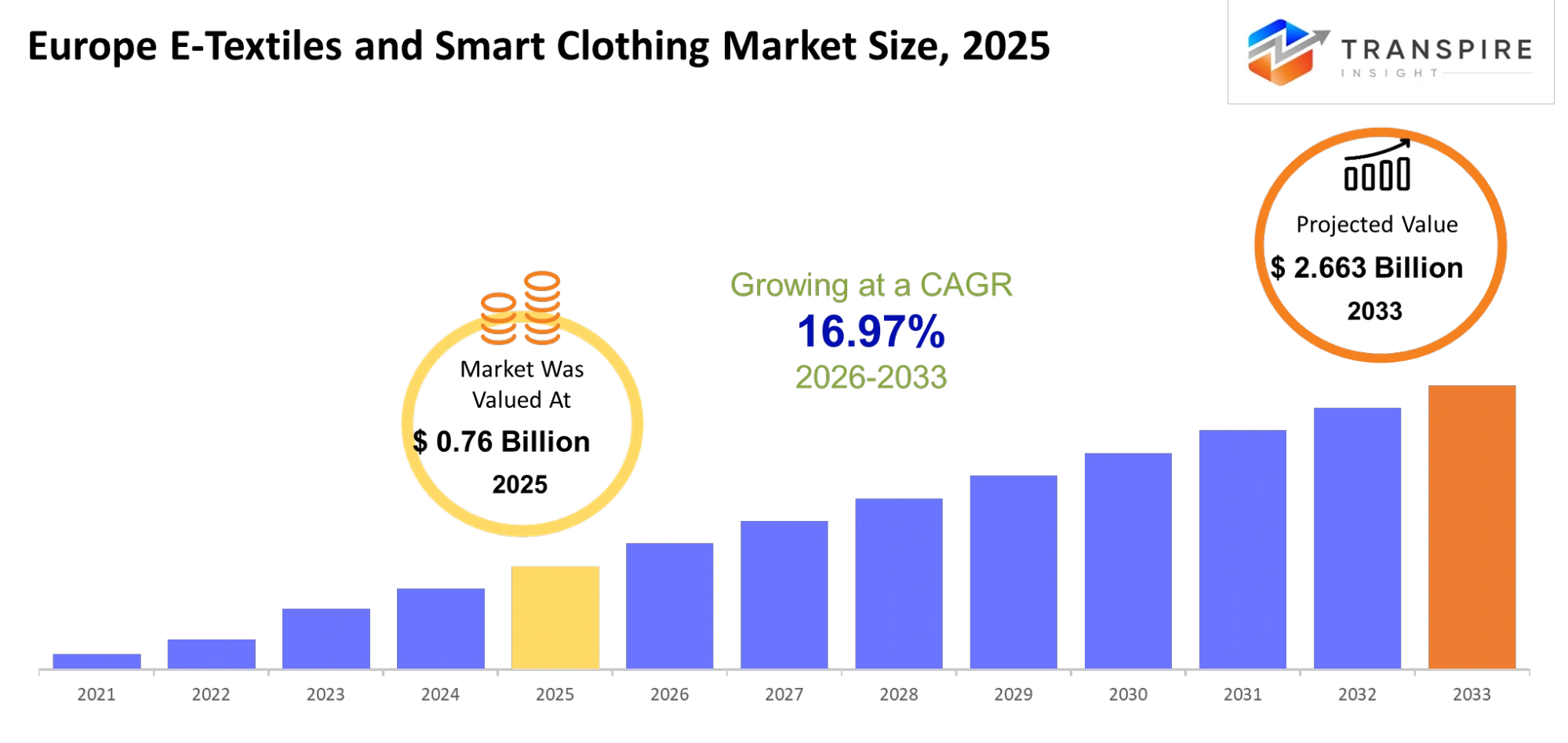
Europe E-Textiles and Smart Clothing Market Size & Forecast:
- Europe E-Textiles and Smart Clothing Market Size 2025: USD 0.76 Billion
- Europe E-Textiles and Smart Clothing Market Size 2033: USD 2.663 Billion
- Europe E-Textiles and Smart Clothing Market CAGR: 16.97%
- Europe E-Textiles and Smart Clothing Market Segments: By Type (Smart Fabrics, Wearable Textiles, Conductive Textiles, Others); By Application (Healthcare, Sports & Fitness, Military, Fashion, Industrial Use, Others); By End-User (Consumers, Athletes, Military, Healthcare Providers, Industrial Users, Others); By Technology (Embedded Electronics, Conductive Fibers, Sensor Integration, Others)
To learn more about this report,  Download Free Sample Report
Europe E-Textiles and Smart Clothing Market Summary
The Europe E-Textiles and Smart Clothing Market was valued at USD 0.76 Billion 2025. It is forecast to reach USD 2.663 Billion by 2033. That is a CAGR of 16.97% over the period.
The Europe E-Textiles and Smart Clothing Market focuses on wearable garments embedded with sensors that monitor worker safety body vitals and environmental exposure in real time across industrial sites and healthcare settings and logistics operations. The systems in operation prevent workplace accidents while they measure worker fatigue levels and they help businesses meet safety requirements that apply to construction and energy and maritime operations.
The last three to five years have witnessed a major transformation in wearable technology which progressed from experimental prototypes toward complete systems that connect to IoT networks and industrial monitoring systems. The need for better labor security in challenging workplaces became urgent after European energy and logistics disruptions which took place in 2022. The smart uniforms enable companies to monitor worker fatigue levels and heat stress levels through real-time predictive analytics.
Industrial digitization and EU workplace safety regulations which mandate ongoing monitoring of worker health create market growth through their combined impact. The solution has gained acceptance in three sectors which include logistics hubs and offshore operations and manufacturing facilities because it creates additional revenue through data-based workforce management software.
Key Market Insights
- Western Europe dominates the Europe E-Textiles and Smart Clothing Market which will reach 40% market share in 2025 because of its advanced textile innovation ecosystems.
- The three main countries for industry growth through R&D funding and industrial wearable technology development are Germany France and the UK.
- Eastern Europe will become the fastest-growing sub-region which will achieve approximately 12% compound annual growth rate from 2025 until 2032 because of its expanding manufacturing capabilities.
- The smart apparel segment leads the Europe E-Textiles and Smart Clothing Market because it will reach 45% market share in 2025 through its use in fitness and healthcare applications.
- Military uniforms and industrial protective clothing use E-textile fabrics which make up the second biggest market segment.
- The smart textile components and sensor-based fabric market will experience rapid growth which will continue until 2032.
- The sports and fitness market leads the industry with a 38% market share because users rely on wearables to track their performance and monitor their vital signs.
- The healthcare sector develops most rapidly because of the rising need for remote patient monitoring and chronic disease management solutions.
- The Europe E-Textiles and Smart Clothing Market has its main market segment in the consumer segment which controls 42% of the market because more people embrace wearable technology.
- The healthcare sector experiences its highest growth rate among end-user segments because of expanding telehealth services and intelligent monitoring solutions.
What are the Key Drivers, Restraints, and Opportunities in the Europe E-Textiles and Smart Clothing Market?
Wearable biosensors have become essential components in both healthcare systems and sports performance systems which drive the growth of the Europe E-Textiles and Smart Clothing Market. The development of affordable flexible conductive fibers for manufacturing has created a key market opportunity because it enables producers to produce their products at 20 to 25 percent lower costs during the period from 2022 to 2025. This cost shift has enabled scalable deployment in consumer fitness apparel and clinical remote monitoring devices, which directly accelerates product adoption by hospitals and sports brands throughout Germany, France, and the UK. The region experiences steady growth in its subscription-based health tracking services and smart apparel ecosystems which generate recurring revenue streams.
The electronic textiles market faces a major obstacle because their performance decreases after multiple washings in actual use conditions. The problem constitutes a structural barrier because it exists due to material science limitations which prevent the creation of electronic systems that can function with flexible fabrics without suffering performance loss. Through repeated washing cycles advanced conductive polymers and nanofiber solutions sustain their performance until they require replacement which results in higher total ownership expenses. Large-scale institutional adoption faces a major delay because healthcare systems require dependable products which maintain their operational life and hospitals need to operate their systems without interruptions.
The hybrid textile-electronics manufacturing industry in Eastern Europe which focuses on Poland and the Czech Republic presents a new business opportunity. The regions function as production centers for smart fabrics through EU-funded investments which establish sensor-enabled garment manufacturing facilities that reduce production costs and improve manufacturing efficiency. Schoeller Textil AG and other companies work with local manufacturers to create advanced washable intelligent textiles. The European E-Textiles and Smart Clothing Market will enter its next growth phase because this development connects the gap between new prototype technologies and their commercial products.
What Has the Impact of Artificial Intelligence Been on the Europe E-Textiles and Smart Clothing Market?
The combination of artificial intelligence with advanced digital systems creates new possibilities for scrubber performance systems and marine emission control technologies because they enable operations to be managed through real-time system control and data analysis. AI-based monitoring systems now track exhaust gas cleaning technology performance through continuous monitoring, which automatically adjusts scrubber water flow rates and pH levels and chemical dosing to achieve compliance with ISO sulfur regulations. The system decreases the need for human operators while it boosts operational reliability throughout maritime operations that use different types of fuel.
Machine learning models are increasingly applied for predictive maintenance which uses sensor data from scrubber units to forecast component wear such as pumps nozzles and corrosion-prone heat exchangers. Maintenance costs decrease by 10–18% for operators because they can detect equipment faults before they become serious problems. AI-based emissions forecasting tools analyze fuel switching scenarios while they optimize routing decisions, which lets fleets reach fuel efficiency improvements of 5–7% while they stay within emission control area regulations.
The main drawback of the system exists because the system needs high-quality maritime training data from real-world environments. Scrubber systems operate under highly variable conditions which include sea state and fuel quality and engine load, so these factors decrease model accuracy and prevent widespread implementation. The system needs continuous data transmission for prediction performance yet satellite and onboard connectivity limits this capability.
Key Market Trends
- AI-driven textile manufacturing established new automated production systems across Europe starting in 2023 which resulted in reduced defects during smart fabric production at top manufacturing locations by 15 to 20 percent.
- The healthcare industry embraced smart garment technology from 2022 onwards because German and French hospitals shifted from pilot testing to full-scale remote patient monitoring systems.
- European military procurement programs started to buy more biometric-enabled uniforms after 2024 because these uniforms offered real-time tracking of soldier health.
- From 2021 to 2025 traditional sportswear brands developed sensor-integrated apparel which replaced their previous passive fabric products through Adidas and Puma's industry-leading efforts.
- After 2023 supply chains established European production centers which eliminated their need to bring in Asian textile materials used by factories that created smart clothing.
- After 2022 the highest level of regulatory pressure existed for digital health compliance which required manufacturers to create secure data transmission systems for their wearable textile products.
- Between 2021 and 2025 investment in conductive fiber startups experienced strong growth which helped develop washable electronics that can be used in common clothing.
- The consumer market transitioned from fitness-only wearables to continuous health monitoring apparel which created higher demand for smart clothing systems that provide multiple functions.
- The period after 2023 brought textile companies and technology firms together to build relationships which enabled them to implement AI-based biometric analysis systems in their clothing products.
Europe E-Textiles and Smart Clothing Market Segmentation
By Type:
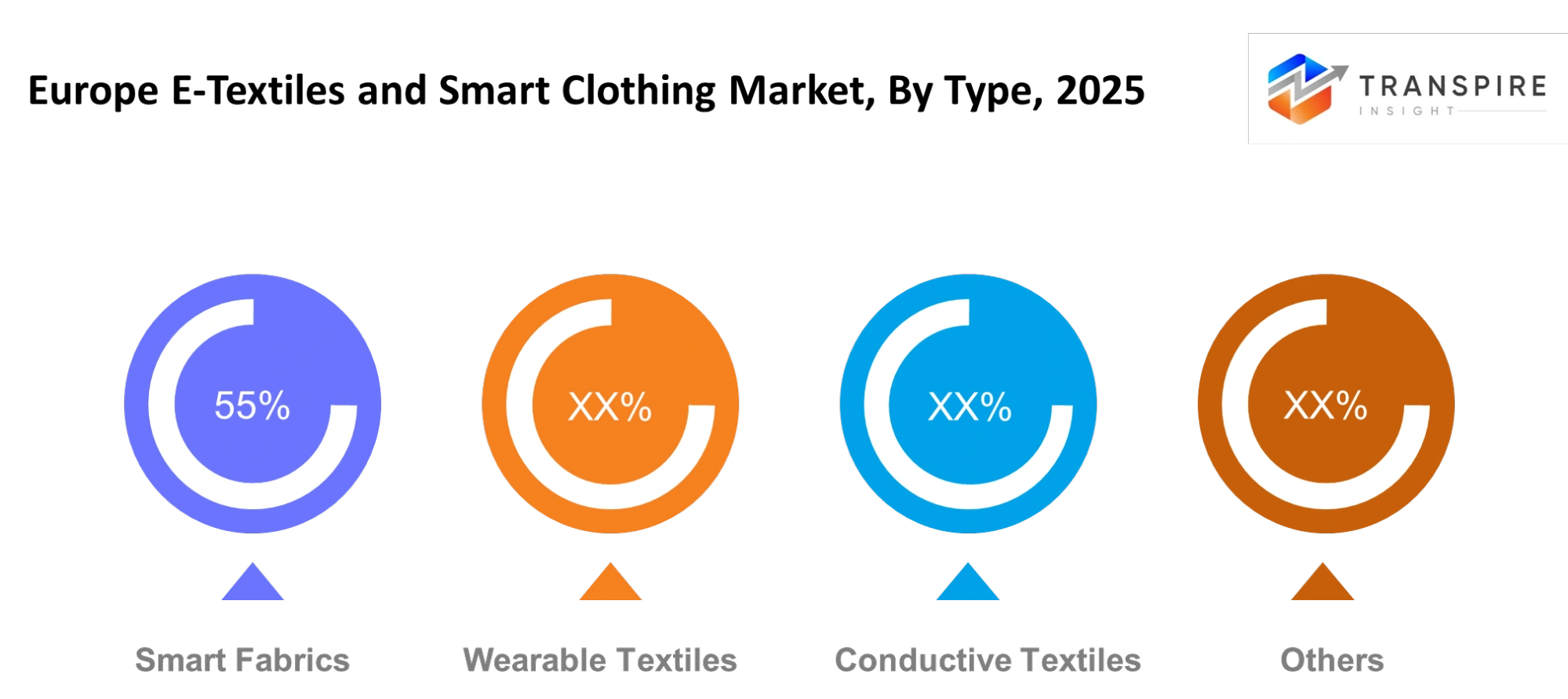
The market currently supports smart fabrics because they succeeded in developing healthcare monitoring clothing and sports performance apparel. The market sees wearable textiles as the second most popular option because these textiles have been integrated into everyday clothing. The marketability of conductive textiles exists to perform essential functions for connecting sensors and transmitting signals. Smart fabrics dominate the market because they enable users to experience textile comfort while using built-in electronic devices which both customers and organizations have started to buy.
Fashion designers create their designs through fashion-tech convergence because they want to maintain their brand appearance while adding functional elements. Industrial and defense operations use conductive textiles because these materials need to endure extreme conditions while maintaining their ability to transmit signals. Researchers have advanced smart fabrics research to the stage where they study industrial production methods and investors develop efficient manufacturing systems. The research will focus on developing hybrid materials which combine conductivity with flexibility and washability to create materials that will be used for mass production.
To learn more about this report, Download Free Sample Report
By Application:
The healthcare sector currently leads all applications because remote patient monitoring systems and chronic disease management solutions have become widely accepted. The sports and fitness industry operates at a established level, but it continues to grow, whereas military operations develop their importance through biometric systems that monitor soldier health. The fields of fashion and industrial applications currently exist at a reduced scale but show increasing interest in testing new technologies for safety monitoring and smart uniforms.
The growth of healthcare services occurs because hospitals use digital technologies and patients require ongoing monitoring of their health outside of medical facilities. The sports industry uses performance analytics and injury prevention technology through training apparel, which helps athletes improve their performance. The military sector expands its operations through defense modernization programs, which develop technologies for better battlefield situational awareness. Developers of wearable technology products create devices with multiple functions because the industry is developing integrated systems that allow different applications to share information through their garment components.
By End-User:
The consumer market leads in market share because urban European consumers widely use fitness wearables and health-tracking clothing. Athletes form a premium market segment that demands performance-based products but healthcare facilities start to use smart garments for patient monitoring. The military and industrial sectors create small user groups, which hold high importance for strategic purposes.
The consumer market expands because people can afford products and because health applications work with wearable textile technology. Healthcare providers use these systems to decrease hospital readmission rates and enhance their ability to perform remote diagnostics. Military and industrial users require systems that deliver dependable performance, extended product life, and protected data communication. The market is moving towards ecosystem adoption, which enables users to select connected systems that offer hardware and software and analytics capabilities instead of using individual garment products.
By Technology:
The technology landscape of the present day gets completely defined by sensor integration because it enables scientists to track human biometrics and environmental conditions in real time. Conductive fibers establish the basic connection infrastructure of the system while embedded electronic components inside the clothing enable high-level data analysis. The market currently sees hybrid nano-coatings. These materials have not yet achieved widespread commercial viability because they remain in their initial research stage.
Healthcare and sports industries require continuous physiological monitoring which drives the expansion of sensor integration technology. Conductive fiber innovation enables smart garment manufacturers to create smaller products that maintain their functionality after multiple washing cycles. Embedded electronics enable edge computing within clothing, reducing reliance on external devices. The market is progressing toward fully integrated smart textile systems where multiple technologies converge, enabling self-powered, adaptive, and data-rich apparel ecosystems over the forecast period.
What are the Key Use Cases Driving the Europe E-Textiles and Smart Clothing Market?
The technology landscape of the present day gets completely defined by sensor integration because it enables scientists to track human biometrics and environmental conditions in real time. Conductive fibers establish the basic connection infrastructure of the system while embedded electronic components inside the clothing enable high-level data analysis. The market currently sees hybrid nano-coatings. These materials have not yet achieved widespread commercial viability because they remain in their initial research stage.
Healthcare and sports industries require continuous physiological monitoring which drives the expansion of sensor integration technology. Conductive fiber innovation enables smart garment manufacturers to create smaller products that maintain their functionality after multiple washing cycles. Embedded electronics enable edge computing within clothing, reducing reliance on external devices. The market is progressing toward fully integrated smart textile systems where multiple technologies converge, enabling self-powered, adaptive, and data-rich apparel ecosystems over the forecast period.
|
Report Metrics |
Details |
|
Market size value in 2025 |
USD 0.76 Billion |
|
Market size value in 2026 |
USD 0.889 Billion |
|
Revenue forecast in 2033 |
USD 2.663 Billion |
|
Growth rate |
CAGR of 16.97% from 2026 to 2033 |
|
Base year |
2025 |
|
Historical data |
2021 - 2024 |
|
Forecast period |
2026 - 2033 |
|
Report coverage |
Revenue forecast, competitive landscape, growth factors, and trends |
|
Regional scope |
Europe (Germany, United Kingdom, France, Italy, Spain, Rest of Europe) |
|
Key company profiled |
Google, Adidas, Nike, Samsung, Intel, Textronics, DuPont, Sensoria, Interactive Wear, AiQ Smart Clothing, Clothing+, Hexoskin, Ohmatex, Vista Medical, Noble Biomaterials |
|
Customization scope |
Free report customization (country, regional & segment scope). Avail customized purchase options to meet your exact research needs. |
|
Report Segmentation |
By Type (Smart Fabrics, Wearable Textiles, Conductive Textiles, Others); By Application (Healthcare, Sports & Fitness, Military, Fashion, Industrial Use, Others); By End-User (Consumers, Athletes, Military, Healthcare Providers, Industrial Users, Others); By Technology (Embedded Electronics, Conductive Fibers, Sensor Integration, Others) |
Which Regions are Driving the Europe E-Textiles and Smart Clothing Market Growth?
The Asia Pacific region retains its position as the foremost power in worldwide maritime trade because of its exceptional port infrastructure and its extensive fleet ownership. The three nations of China, Singapore, and South Korea establish their maritime dominance through their combined shipbuilding facilities, their extensive container terminals, and their sophisticated logistics systems. The manufacturing sector maintains its export-focused operations which results in continuous shipping requirements that support major maritime trade activities between important sea routes. The system obtains its ongoing operational capacity through partnership between government agencies to develop automated ports and digital maritime systems and to enhance fuel delivery networks.
Europe holds the second position, but its role is defined more by stability and regulatory maturity than sheer volume. The shipowning practices of Greece, Germany, and the Netherlands enable these nations to maintain their maritime shipping operations because of their established maritime financing framework which supports ongoing fleet development. The international environmental regulations that the region follows enable ship operators to improve their vessel operations and their compliance systems through incremental technological advancements. Europe contributes to shipping through its established trade routes which enable predictable operations and its capacity to fund shipping through long-term contracts.
The Middle East currently exhibits the fastest growth rate because the region is experiencing maritime development through substantial investment in infrastructure and efforts to diversify its economy. The United Arab Emirates and Saudi Arabia are expanding their port facilities through logistics corridor projects and industrial zone development initiatives.The implementation of recent reforms together with the execution of extensive port modernization projects has created conditions that entice international shipping companies to establish their strategic refueling and transshipment operations. The region establishes itself as a vital trade link between Asia and Europe and Africa which creates investment opportunities for existing investors and new market entrants during the 2026 to 2033 timeframe.
Who are the Key Players in the Europe E-Textiles and Smart Clothing Market and How Do They Compete?
The European market for e-textiles and smart clothing shows medium market fragmentation which creates competition between global sportswear brands and specialized textile companies. The competition focuses on creating new materials which combine with sensors to develop products that must meet the EU's strict sustainability requirements. Existing market players protect their business territory through large-scale research development funding and building partnerships with technology companies. The smaller companies create market disruption by providing advanced medical wearables and flexible electronics which create new possibilities in specialized fields.
Adidas uses technology innovation by embedding biometric sensors in performance apparel for sports users. The company creates a unique market position through its ability to manufacture products at large scale which creates a training ecosystem that connects garment data with digital coaching systems. The company grows its business through partnerships with startups that develop wearable technology and university research laboratories. Schoeller Textiles AG focuses on niche smart fabric engineering for industrial and outdoor. The company creates a unique market position through its development of proprietary conductive textiles which meet EU sustainable production standards. The company establishes expansion through its partnerships with defense organizations and medical textile companies.
Clothing+ Ltd focuses on OEM integration which involves installing sensors into healthcare and sports garments. The company creates a unique market position through its complete design process which connects textiles with ISO certified medical electronics. The company establishes expansion through its partnerships with medical device firms. Ohmatex ApS specializes in high reliability conductive textiles for aerospace and medical use. The company creates a unique market position through its patented stitching techniques which enhance performance in extreme environments. The company establishes expansion through its partnerships with European space agencies and research institutions.
Company List
- Adidas
- Nike
- Samsung
- Intel
- Textronics
- DuPont
- Sensoria
- Interactive Wear
- AiQ Smart Clothing
- Clothing+
- Hexoskin
- Ohmatex
- Vista Medical
- Noble Biomaterials
Recent Development News
In February 2026, adidas launched a new performance wear collection in collaboration with Entire Studios. The product integrates advanced material constructs with design-led silhouettes and expands adidas’ connected sportswear ecosystem across European and global retail channels. https://news.adidas.com
In February 2026, adidas expanded its multi-year partnership with the future Audi Formula 1 team. The agreement focuses on developing high-performance apparel for drivers and technical staff, strengthening adidas’ position in advanced wearable sports textiles across European motorsport applications. https://news.adidas.com
What Strategic Insights Define the Future of the Europe E-Textiles and Smart Clothing Market?
The e-textiles and smart clothing market of Europe moves toward creating deeper connections between textiles and digital health systems which have established performance requirements. The upcoming five to seven years will experience growth through three main factors which include wearable electronics, EU circular economy sustainability requirements, and the increasing need for biometric health and sports monitoring. The market will advance from testing phase smart garments to established textile systems which receive clinical validation and people can use in their daily lives.
The organization faces a hidden danger because it relies on two materials: specialized conductive fibers and sensor components. Organizations that depend on these materials will experience operational disruptions when geopolitical trade restrictions become more intense. The certification process for smart textiles as reimbursable healthcare products under European digital health regulations, which currently remains in its early adoption phase, presents a significant opportunity for institutional demand to emerge at a large scale.
Market participants should focus their efforts on developing textile systems which can work together while meeting medical certification requirements and consumer durability standards because early compliance will create a critical competitive advantage.
Europe E-Textiles and Smart Clothing Market Report Segmentation
By Type
- Smart Fabrics
- Wearable Textiles
- Conductive Textiles
- Others
By Application
- Healthcare
- Sports & Fitness
- Military
- Fashion
- Industrial Use
- Others
By End-User
- Consumers
- Athletes
- Military
- Healthcare Providers
- Industrial Users
- Others
By Technology
- Embedded Electronics
- Conductive Fibers
- Sensor Integration
- Others
Frequently Asked Questions
Find quick answers to common questions.
The Europe E-Textiles and Smart Clothing Market size is USD 2.663 Billion in 2033.
Key segments for the Europe E-Textiles and Smart Clothing Market are By Type (Smart Fabrics, Wearable Textiles, Conductive Textiles, Others); By Application (Healthcare, Sports & Fitness, Military, Fashion, Industrial Use, Others); By End-User (Consumers, Athletes, Military, Healthcare Providers, Industrial Users, Others); By Technology (Embedded Electronics, Conductive Fibers, Sensor Integration, Others).
Major Europe E-Textiles and Smart Clothing Market players are Google, Adidas, Nike, Samsung, Intel, Textronics, DuPont, Sensoria, Interactive Wear, AiQ Smart Clothing, Clothing+, Hexoskin, Ohmatex, Vista Medical, Noble Biomaterials.
The Europe E-Textiles and Smart Clothing Market size is USD 0.76 Billion in 2025.
The Europe E-Textiles and Smart Clothing Market CAGR is 16.97% from 2026 to 2033.
- Adidas
- Nike
- Samsung
- Intel
- Textronics
- DuPont
- Sensoria
- Interactive Wear
- AiQ Smart Clothing
- Clothing+
- Hexoskin
- Ohmatex
- Vista Medical
- Noble Biomaterials
Recently Published Reports
-
Apr 2026
Bottled Water Market
Bottled Water Market Size, Share & Analysis Report By Product Type (Still Bottled Water, Carbonated Bottled Water, Functional Bottled Water, and Others), By Packaging (PET, Cans, and Others), By Sales Channel (Supermarkets/Hypermarkets, Convenience Stores/Drug Stores, Grocery Stores/Club Stores, Foodservice, and Others) and Geography (North America, Europe, Asia-Pacific, Middle East and Africa, South and Central America), 2021 - 2032
-
Apr 2026
Color Cosmetic Packaging Market
Color Cosmetic Packaging Market Size, Share & Analysis Report By Application (Mascara Packaging, Liquid Packaging, and Liquid Face), By Type (Tubes & Bottles, Pens & Markers, Compacts & Containers, and Droppers & Pumps), and Geography (North America, Europe, Asia-Pacific, Middle East and Africa, South and Central America), 2021 - 2031
-
Apr 2026
External Microphone For Camera Market
External Microphone For Camera Market Size, Share & Analysis Report By Type (Shotgun Microphone, Lavalier Microphone, and Others), By Application (Digital Camera, Professional Video Camera, and Others), and Geography (North America, Europe, Asia-Pacific, Middle East and Africa, South and Central America), 2021 - 2031
-
Apr 2026
Foot Orthotic Insoles Market
Foot Orthotic Insoles Market Size, Share & Analysis Report By Type (Pre-fabricated, and Custom-made), By Material (Thermoplastic, Composite Carbon Fiber, and Others), By Distribution Channel (Drug Stores, Hospitals & Clinics, and Others), and Geography (North America, Europe, Asia-Pacific, Middle East and Africa, South and Central America), 2021 - 2031