North America Abdominal Aortic Aneurysm Repair Market Size & Forecast:
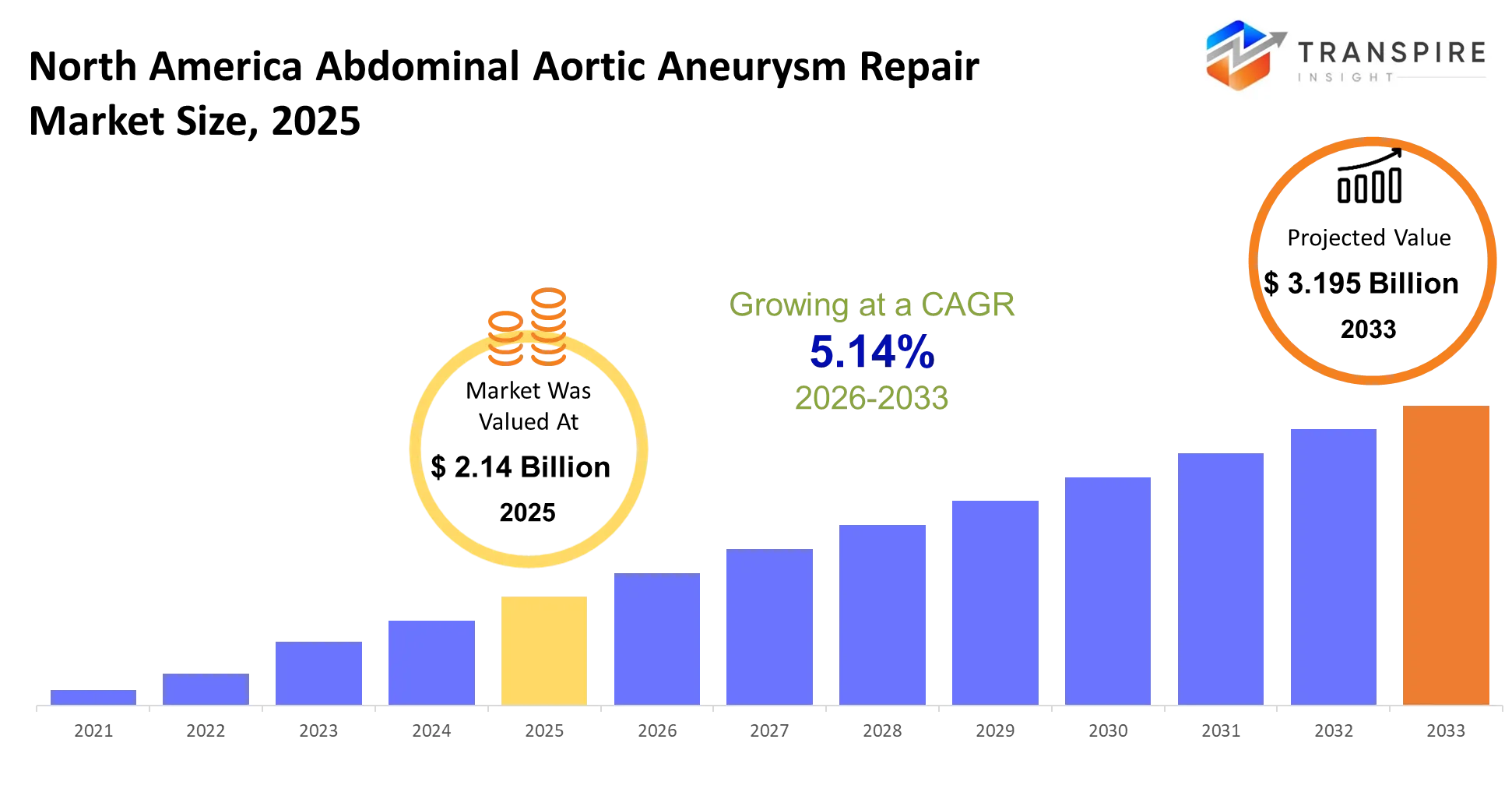
- North America Abdominal Aortic Aneurysm Repair Market Size 2025: USD 2.14 Billion
- North America Abdominal Aortic Aneurysm Repair Market Size 2033: USD 3.195 Billion
- North America Abdominal Aortic Aneurysm Repair Market CAGR: 5.14%
- North America Abdominal Aortic Aneurysm Repair Market Segments: By Type (Endovascular Repair, Open Surgical Repair, Hybrid Repair, Others), By Application (Infrarenal AAA, Thoracoabdominal AAA, Ruptured AAA, Others), By End-User (Hospitals, Clinics, Surgical Centers, Others), By Device (Stent Grafts, Catheters, Guidewires, Balloons, Others).
To learn more about this report,  Download Free Sample Report
North America Abdominal Aortic Aneurysm Repair Market Summary:
The North America Abdominal Aortic Aneurysm Repair Market size is estimated at USD 2.14 Billion in 2025 and is anticipated to reach USD 3.195 Billion by 2033, growing at a CAGR of 5.14% from 2026 to 2033.North America Abdominal Aortic Aneurysm Repair Market kinda sits where vascular surgery meets emergency care and also the whole aging population management problem. In real life, it helps hospitals avoid those really fatal aortic rupture events by mending weakened parts of the abdominal aorta, either via open surgery , or with minimally invasive endovascular approaches . People usually say endovascular aneurysm repair, EVAR , and that’s basically how many centers try to handle it now.
Over the last five years things have moved pretty clearly. Healthcare systems leaned away from very highly invasive repair tactics and went more toward EVAR, which shortens hospital stays, tends to reduce complication burden, and generally helps elderly patients bounce back sooner. The shift is not just a small operational tweak , it changes the way care pathways are built and managed.
A big push, came from the COVID-19 backlog around elective vascular procedures. When screenings for aneurysms got delayed, and surgeries got postponed, cases piled up until operations restarted. Then hospitals saw a jump in late-stage patients, and it all kind of forced faster imaging routines, hybrid operating room setups, and more device innovation. So today’s growth doesn’t only mean more procedures happening. It also looks like a broader move toward earlier diagnosis, more outpatient vascular intervention models, and ongoing revenue tied to advanced stent graft platforms, plus long-term surveillance plans for patients .
Key Market Insights
- The United States is basically running the North America Abdominal Aortic Aneurysm Repair Market, with something like 78% plus market share in 2025, give or take.
- Canada seems to be the quickest riser, mostly because vascular screening programs keep expanding, and hospitals are modernizing their infrastructure, through 2030.
- High healthcare spending, plus reimbursement rules that are pretty supportive, keeps propping up the North America abdominal aortic aneurysm repair industry size, and helps more patients actually get procedures.
- Demand across the region is also pulled forward by aging demographics , smoking linked vascular disease prevalence , and the rising use of advanced stent graft technologies.
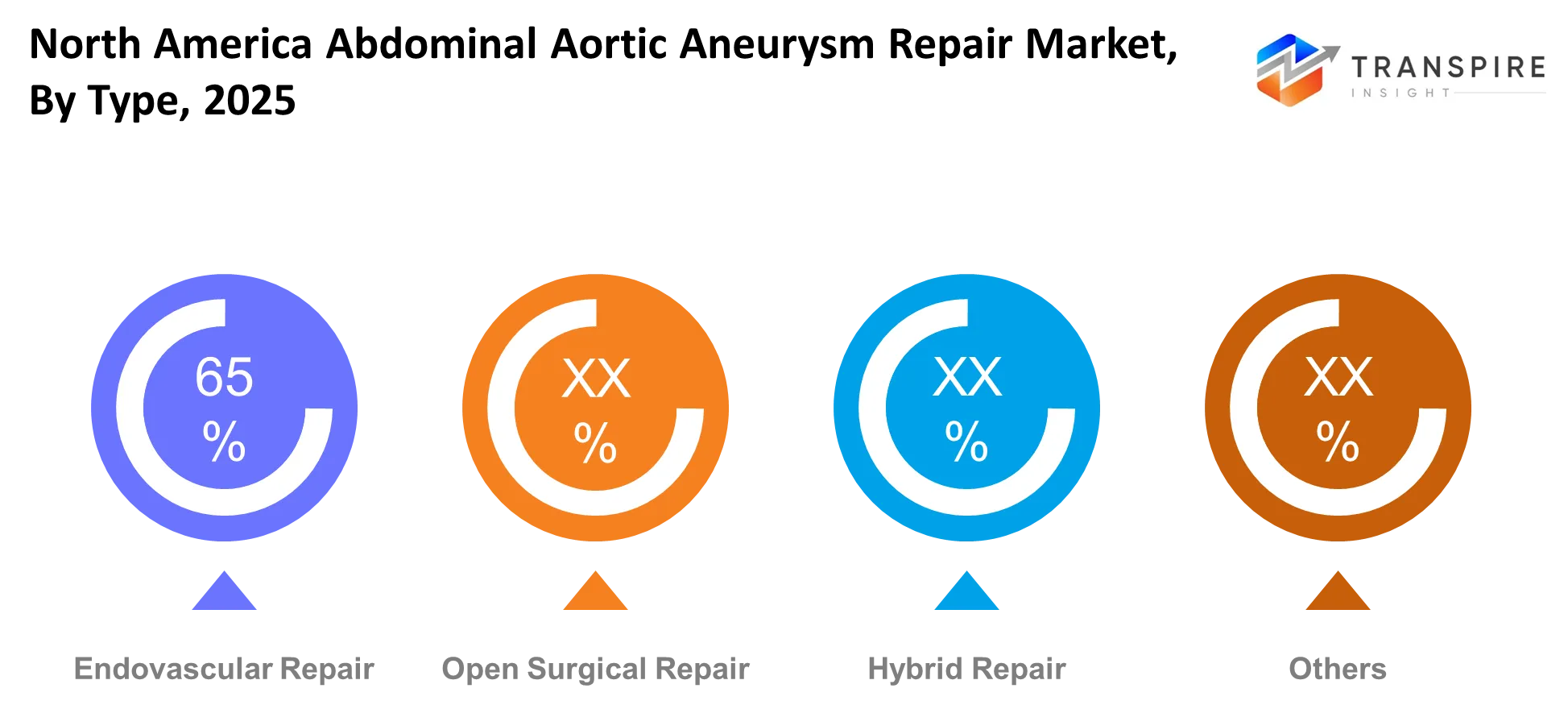
- Endovascular aneurysm repair (EVAR) is the main player in North America , taking nearly 65% of revenue share in 2025.
- Open surgical repair stays in the No.2 position, largely because hard aneurysm morphologies still need more conventional vascular reconstruction work.
- Fenestrated and branched stent graft systems are likely the fastest-growing product category over the 2025–2030 forecast period.
- Better imaging-guided repair tools are making procedures more accurate , which tends to shorten hospital stays, and it supports the market growth pace across tertiary care centers.
- Infrarenal abdominal aortic aneurysm treatment accounts for over 60% of total procedure demand, within the North America abdominal aortic aneurysm repair industry.
- Complex juxtarenal aneurysm repair is gaining traction quickly , as customized endovascular graft systems get adopted more often, and hybrid operating suites become more available.
- Elective aneurysm repair procedures bring in notable market revenue, since early detection supports diagnosis before emergency rupture episodes happen.
What are the Key Drivers, Restraints, and Opportunities in the North America Abdominal Aortic Aneurysm Repair Market?
The biggest force pushing the North America Abdominal Aortic Aneurysm Repair Market along is basically that fast move toward endovascular aneurysm repair, EVAR. After the clinical evidence kept showing lower perioperative mortality , fewer days in hospital , and a quicker return to normal for patients compared with open surgery, hospitals sort of leaned in more. The whole technology shift got even stronger when, in the United States, reimbursement frameworks increasingly favored minimally invasive vascular procedures that cut down on time in intensive care and also helped lower re admission costs. So naturally, hospitals started putting more money into hybrid operating rooms, and vascular centers bought more advanced stent graft systems, which then makes procedural volumes rise and lifts device revenues too.
Still, the market’s most rigid stumbling block is the not so large group of highly trained vascular surgeons and interventional specialists who can actually handle the harder aneurysm repair work. The preparation cycle takes years of hands-on advanced clinical exposure, and at the same time rural or mid-sized healthcare systems keep running into specialist gaps. That means care doesn’t reach people quickly enough, and the uptake of advanced fenestrated and branched EVAR is held back. This staffing issue also quietly caps income potential, because several hospitals cannot scale aneurysm programs that would be higher margin, even when patient demand keeps growing.
One of the most powerful forces pushing the North America Abdominal Aortic Aneurysm Repair Market forward is the quick move toward endovascular aneurysm repair, often called EVAR. Over time, hospitals started using EVAR more and more because the clinical numbers kept pointing in the same direction, lower perioperative mortality, briefer time in hospital and a quicker turn back to normal recovery routines than what open surgery tends to deliver. The shift didn’t just happen overnight, it sort of gathered steam as reimbursement rules in the United States increasingly nudged providers toward minimally invasive vascular interventions. The idea is that these approaches cut down intensive care use and also lower the costs tied to readmissions. So, in response, many hospitals put money into hybrid operating rooms and vascular centers began buying more advanced stent graft systems, which then lifts both procedure counts and the associated device revenues.
Still, the market has a stubborn structural problem that won’t really go away fast, namely the shortage of highly trained vascular surgeons and interventional specialists who can handle the more complicated aneurysm repair work. Getting ready for this kind of practice takes years of advanced clinical exposure, and at the same time rural care networks, and some mid sized health systems, keep running into specialist shortages. Due to that, patients can end up waiting longer for timely intervention, and the whole adoption of advanced fenestrated or branched EVAR techniques gets slowed down, a bit. On top of it all, this same skills gap can kinda mute the revenue upside too, because lots of hospitals cannot really scale high margin aneurysm programs , even while overall patient volumes keep rising.
What Has the Impact of Artificial Intelligence Been on the North America Abdominal Aortic Aneurysm Repair Market?
Artificial intelligence and advanced digital technologies are, at least in part, reshaping the North America Abdominal Aortic Aneurysm Repair Market. Mostly it happens by improving diagnostic accuracy, supporting surgical planning, and even helping long term patient monitoring stay more stable over time. In many hospitals and vascular centers now, AI-enabled imaging platforms are being used to automatically parse CT angiography scans, and from there they can spot aneurysm size progression and estimate rupture risk with more consistent results than manual review done by people alone. That in turn cuts down interpretation time for radiologists, and also helps surgeons decide which patients are truly high risk a bit faster, rather than dealing with every case in the same way.
Machine learning models are also quietly boosting predictive capability within endovascular aneurysm repair workflows. The advanced software can mimic blood-flow dynamics and even forecast how a stent graft might behave before surgery, so clinicians can pick a more tailored graft setup with higher procedural precision. A few vascular centers say they’re seeing slightly faster procedure durations and fewer reinterventions, after they rolled in 3D imaging reconstruction plus AI assisted surgical navigation, but it kind of feels more coordinated overall, like the whole aneurysm repair program is under one roof. On top of that, digital monitoring platforms continue the work after the operation by following graft migration, endoleaks, and aneurysm sac expansion using automated imaging comparisons.
In operational terms, these digital tools improve operating room utilization, lower repeat imaging costs, and can also support earlier discharge timelines for minimally invasive EVAR patients. Still, AI adoption has a big bottleneck because integrating imaging analytics platforms with older hospital infrastructure takes major capital, and it also demands highly standardized clinical datasets. Many mid-sized healthcare systems just don’t have that kind of standardized data in place, so the rollout tends to stall or move slowly.
Key Market Trends
- Since 2020, EVAR procedures have in practice gone over 65% of aneurysm repairs, as hospitals cut down ICU use and kind of sped up the whole recovery process, a bit quicker than before.
- Medtronic and Cook Medical also expanded their fenestrated stent graft lineups between 2021 and 2025, aiming at those more complex aneurysm anatomies that don’t fit the usual template.
- At the same time, hybrid operating room spending climbed across bigger U.S. hospital networks after COVID-19 left procedure backlogs behind, and it exposed where vascular surgery capacity was kind of maxed out.
- After 2022, AI-assisted CT angiography interpretation picked up real momentum, and it let vascular centers reduce time spent on aneurysm assessment , while also sharpening surgical plan accuracy.
- Specialty cardiovascular centers then grabbed higher procedural counts, because outpatient vascular intervention models became financially workable for lower-risk EVAR patients.
- During the 2021 supply chain disruptions, manufacturers started regionalizing stent graft distribution routes and they strengthened inventory resilience across North America too.
- FDA clearances for low-profile graft systems also helped speed adoption among older adults, many of whom were previously viewed as poor candidates for minimally invasive aneurysm repair.
- Meanwhile Canadian healthcare systems put more money into abdominal aortic aneurysm screening, partly because delayed pandemic-era diagnoses left more people with late-stage rupture risk.
- Between 2023 and 2025, more hospitals rolled out 3D vascular imaging reconstruction platforms to lower procedural complications , and reduce repeat interventions.
- Finally, the competition scene moved away from simple device pricing, toward long-run clinical performance , so manufacturers leaned on durability evidence and even post-operative monitoring capabilities.
North America Abdominal Aortic Aneurysm Repair Market Segmentation
By Type
Endovascular repair kind of leads the type segment here, because more hospitals are leaning toward minimally invasive vascular options that can speed up recovery timelines and lower those perioperative complications. At the same time, solid reimbursement backing plus physician familiarity with newer stent graft systems keeps pushing endovascular aneurysm repair forward across a lot of major healthcare networks. Open surgical repair still holds onto a noticeable share, since some aneurysm anatomies turn complicated, and in emergency rupture situations teams often need direct surgical intervention. Meanwhile hybrid repair is slowly picking up, mostly in tertiary centers, where surgeons blend open methods and catheter based techniques for tough vascular problems.
The demand rhythms are pretty different across these categories, because the less invasive routes help with faster patient turnover, while open repair really relies on specialist availability and how much intensive care capacity a hospital can handle. Looking ahead, the market direction seems to tilt toward wider adoption of fenestrated and branched graft technologies, and that should open up opportunities for device manufacturers, imaging software vendors, and hospital systems that are investing in advanced vascular intervention programs.
To learn more about this report, Download Free Sample Report
By Application
Infrarenal abdominal aortic aneurysm applications sort of dominate the procedural volume, because most aneurysms people find with imaging end up under the renal arteries and they line up pretty well with commercially available endovascular devices. And yeah, early screening programs plus better diagnostic imaging keeps nudging elective treatment rates upward for infrarenal aneurysms, across the US and Canada. Thoracoabdominal aneurysm repair is smaller in comparison, but it’s a lot more technically demanding , since surgical complexity is higher, and the procedural risk is elevated too. For ruptured aneurysm interventions there’s an urgent jump in demand, but delayed diagnosis and the high mortality rates kinda mean the long term procedural consistency stays limited.
Specialized vascular centers are increasingly leaning toward early elective intervention , because doing emergency rupture repair tends to bring higher treatment costs and worse survival results. Meanwhile market momentum is moving, slowly but clearly, toward more personalized aneurysm management, supported by AI assisted imaging analysis and graft configurations that are customized. Manufacturers that can handle complex aneurysm anatomies using lower-profile devices are likely to end up with stronger competitive positioning over the next few years.
By End-User
Hospitals take the largest share in the end user segment, kind of because advanced aneurysm repair really depends on hybrid operating suites, intensive post-operative monitoring and multidisciplinary vascular teams. Big academic medical centers keep expanding their minimally invasive vascular programs, partly to raise patient throughput and also to reduce the time people spend recovering as inpatients, a bit. Meanwhile surgical centers look like they're also a faster-growing category, because the lower-risk endovascular procedures are increasingly headed toward outpatient, short stay setups . Clinics still play a smaller role, because diagnostic screening and referral management stay more central, rather than actual procedural treatment.
The way growth moves across end users is closely linked to reimbursement models, how many specialists are available, and how much capital investment capacity there is. Large hospital systems tend to have better purchasing power for premium graft systems and imaging technologies, whereas smaller surgical centers lean into procedural efficiency and patient convenience. In the future, competitive advantage will probably hinge on integrated digital workflows, stronger advanced imaging infrastructure , and the ability to sustain long-term post-operative vascular monitoring.
By Device
Stent grafts are kinda the main thing in the device segment because endovascular repair procedures pretty much depend on long lasting graft systems that can seal aneurysms and keep blood flow steady, so yeah it matters a lot. Manufacturers keep putting money into lower profile, fenestrated, and branched graft designs to work around tricky vascular anatomies and to expand who can actually be treated. Catheters and guidewires keep showing strong procedural demand because essentially every minimally invasive intervention needs careful vascular navigation and reliable device delivery, no shortcuts there. Balloon systems also play an important role, mainly for vessel preparation and to help optimize graft deployment during aneurysm repair.
Over time, technological differentiation seems to steer buying choices more and more, since hospitals want devices that cut operating time, reduce complications, and support better long term durability outcomes. Looking ahead, the future segment growth will probably lean toward integrated device ecosystems that bring together imaging compatibility, navigation accuracy and AI assisted procedural planning. Investors and suppliers are expected to zero in on next generation vascular access technologies, helping physicians maintain tighter control while enabling faster and safer aneurysm intervention workflows.
What are the Key Use Cases Driving the North America Abdominal Aortic Aneurysm Repair Market?
Elective endovascular repair for infrarenal abdominal aortic aneurysms is still kind of the main use case pushing procedural demand across North America. Big hospital groups tend to favor these steps, because the minimally invasive repair cuts down on time in intensive care, helps people bounce back faster, and generally brings down post-operative complication rates in elderly cardiovascular patients.
More secondary applications are showing up too, especially in specialty cardiovascular centers handling complicated thoracoabdominal aneurysms and those high risk rupture situations. Academic medical centers are also using fenestrated stent graft systems , and sometimes hybrid surgical techniques, for patients who would have been judged not a fit for minimally invasive therapy before. At the same time, outpatient vascular programs are getting more attention for lower-risk EVAR follow-up work, which feels like a pretty practical expansion.
Then there are emerging use cases that look a bit different, like AI assisted aneurysm monitoring and tailored graft planning supported by advanced imaging analytics. A handful of U.S. and Canadian healthcare systems are running trials on remote vascular surveillance platforms. These platforms watch graft performance and flag endoleaks earlier, so they may open the door to longer term digital vascular care models during the forecast window period.
|
Report Metrics |
Details |
|
Market size value in 2025 |
USD 2.14 Billion |
|
Market size value in 2026 |
USD 2.25 Billion |
|
Revenue forecast in 2033 |
USD 3.195 Billion |
|
Growth rate |
CAGR of 5.14% from 2026 to 2033 |
|
Base year |
2025 |
|
Historical data |
2021 - 2024 |
|
Forecast period |
2026 - 2033 |
|
Report coverage |
Revenue forecast, competitive landscape, growth factors, and trends |
|
Country scope |
North America (Canada, The United States, and Mexico) |
|
Key company profiled |
Medtronic, Cook Medical, Gore Medical, Endologix, Lombard Medical, Terumo, Abbott, Boston Scientific, B. Braun, Cardinal Health, Siemens Healthineers, Philips, GE Healthcare, Stryker, AngioDynamics |
|
Customization scope |
Free report customization (country, regional & segment scope). Avail customized purchase options to meet your exact research needs. |
|
Report Segmentation |
By Type (Endovascular Repair, Open Surgical Repair, Hybrid Repair, Others), By Application (Infrarenal AAA, Thoracoabdominal AAA, Ruptured AAA, Others), By End-User (Hospitals, Clinics, Surgical Centers, Others), By Device (Stent Grafts, Catheters, Guidewires, Balloons, Others) |
Which Regions are Driving the North America Abdominal Aortic Aneurysm Repair Market Growth?
The United States is leading the North America Abdominal Aortic Aneurysm Repair Market , mostly because big healthcare networks are still putting money into minimally invasive vascular intervention plans and upgraded imaging infrastructure . Also, favorable Medicare reimbursement policies helped speed up the shift toward endovascular aneurysm repair procedures across major academic hospitals , and specialty cardiovascular centers. On top of that, active clinical research plus early FDA clearances for fenestrated and branched stent graft systems made the whole leadership position even stronger. There’s also a sort of mature support web of vascular surgeons, device manufacturers , AI imaging providers and hybrid operating facilities, and this keeps procedural numbers high while driving repeat device usage throughout the country.
Canada, meanwhile , shows up as the second-largest regional contributor , but the market behavior feels different in a noticeable way. In Canada, provincial healthcare systems tend to emphasize long term clinical results along with cost efficiency, so adoption is a bit more measured, yet still very steady for aneurysm repair technologies. National screening programs plus centralized hospital procurement help sustain consistent investment in advanced vascular treatment tools , even if the total number of procedures is lower. Finally , strong healthcare funding stability, and a gradual but real expansion of minimally invasive intervention programs , means Canada stays reliable as a contributor to regional market revenue .
Mexico is coming up as the fastest-growing market because of these recent moves—mostly private hospital infrastructure investments, and more access to advanced cardiovascular care, you know. Like, several big city healthcare systems rolled out modern hybrid operating rooms and, after 2022, they brought in next-generation stent graft technologies, which is helping with treatment availability for tricky aneurysm cases. At the same time medical tourism is climbing, and collaborations with U.S.-based device manufacturers are getting stronger, so technology transfer is landing faster in the major metropolitan hospitals. Overall, this push gives real opportunities for device suppliers, imaging software providers, and investors who are looking for expansion across underserved vascular care markets sometime between 2026 and 2033.
Who are the Key Players in the North America Abdominal Aortic Aneurysm Repair Market and How Do They Compete?
The competitive landscape of the North America Abdominal Aortic Aneurysm Repair Market is still kind of moderately consolidated, with a small cohort of incumbents holding most of the EVAR device demand. The established players stay in front by doing continuous product iteration , plus regulatory approvals, and also with solid clinical evidence that backs up long-term graft performance. Overall , competition seems to come more from technology differentiation than from pure price, since hospitals usually lean toward procedural safety, device durability, and lower complication rates, even if procurement cost looks a bit higher. Also the FDA regulatory thresholds are high, and the clinical trial expectations are extensive, so new entrants end up facing serious barriers , which in turn limits their influence and keeps incumbent dominance more or less intact.
Medtronic drives with integrated EVAR ecosystems that basically bundle stent graft platforms with imaging guidance along with surgeon training programs, this helps adoption spread across big hospital networks. W. L. Gore & Associates leans heavily into graft material innovation, they use advanced ePTFE technology to strengthen sealing performance and reduce endoleak risk, and that tends to support physician preference during long term follow up cases. Cook Medical differentiates by offering customized fenestrated and branched graft solutions for complex aneurysm anatomies, backed by close work with tertiary care hospitals , and hybrid operating rooms where teams can standardize workflows.
Terumo Corporation expands its footprint via catheter and guidewire “precision” sort of stuff that helps EVAR delivery run more efficient, and they keep pushing broader distribution growth across North American vascular access markets. Meanwhile Endologix stays focused on those niche EVAR systems , plus more streamlined device platforms for infrarenal aneurysms, trying to rebuild competitiveness through regulatory clearances and some strategic hospital partnerships. Both groups kind of stress procedural simplification and targeted innovation , aiming to capture share inside particular clinical segments instead of going head to head across the full product spectrum.
Company List
- Medtronic
- Cook Medical
- Gore Medical
- Endologix
- Lombard Medical
- Terumo
- Abbott
- Boston Scientific
- B. Braun
- Cardinal Health
- Siemens Healthineers
- Philips
- GE Healthcare
- Stryker
- AngioDynamics
Recent Development News
In March 2026, Medtronic Expands Neurovascular Portfolio Through Scientia Vascular Acquisition: Medtronic announced a $550 million acquisition of U.S.-based Scientia Vascular in March 2026. The deal strengthens Medtronic’s vascular intervention capabilities and is expected to reinforce its broader aortic and endovascular treatment portfolio in North America, including technologies relevant to abdominal aortic aneurysm (AAA) repair procedures.
Source: https://www.reuters.com
In January 2026, Medtronic Signals Additional Acquisition Activity in Cardiovascular and Aortic Segments: At a major healthcare conference in January 2026, Medtronic stated it had “significant firepower” for future acquisitions. Analysts noted the strategy could accelerate innovation and consolidation across minimally invasive vascular and AAA repair technologies in the North American market.
Source: https://www.reuters.com
What Strategic Insights Define the Future of the North America Abdominal Aortic Aneurysm Repair Market?
The North America Abdominal Aortic Aneurysm Repair Market is basically moving, kind of, toward precision-led minimally invasive vascular intervention ecosystems, where treatment decisions start to feel like a single stitched workflow: imaging, device selection, and post-operative monitoring all tied in together. In the coming years growth will hinge on how well hospitals and manufacturers line up endovascular aneurysm repair with AI-supported diagnostics, plus value based care frameworks, so that repeat interventions drop and long term outcomes look better.
There’s also a quieter type of risk, procedural concentration in high capability tertiary hospitals. If reimbursement pressure gets tighter, or regulatory scrutiny rises around high cost implantable devices, broader adoption might slow down. And on top of that, this same concentration means manufacturers can get hit by volume volatility, because the market is kind of dependent on a small set of institutional buyers.
A promising opportunity is adding predictive aneurysm rupture modeling, using longitudinal imaging datasets—especially across U.S. integrated health systems and Canadian provincial networks that are digitizing vascular records. With this kind of approach intervention timing can shift earlier, before the disease progresses too far. Market players should focus on interoperable imaging platforms and durable long term clinical data partnerships with hospital networks. That’s the sort of thing that can help secure ongoing device utilization and create a stronger procedural lock in, over the next 5–7 years.
North America Abdominal Aortic Aneurysm Repair Market Report Segmentation
By Type
- Endovascular Repair
- Open Surgical Repair
- Hybrid Repair
- Others
By Application
- Infrarenal AAA
- Thoracoabdominal AAA
- Ruptured AAA
- Others
By End-User
- Hospitals
- Clinics
- Surgical Centers
- Others
By Device
- Stent Grafts
- Catheters
- Guidewires
- Balloons
- Others
Frequently Asked Questions
Find quick answers to common questions.
The approximate North America Abdominal Aortic Aneurysm Repair Market size for the market will be USD 3.195 Billion in 2033.
The key segments of the North America Abdominal Aortic Aneurysm Repair Market are By Type (Endovascular Repair, Open Surgical Repair, Hybrid Repair, Others), By Application (Infrarenal AAA, Thoracoabdominal AAA, Ruptured AAA, Others), By End-User (Hospitals, Clinics, Surgical Centers, Others), By Device (Stent Grafts, Catheters, Guidewires, Balloons, Others).
Major players in the North America Abdominal Aortic Aneurysm Repair Market are Medtronic, Cook Medical, Gore Medical, Endologix, Lombard Medical, Terumo, Abbott, Boston Scientific, B. Braun, Cardinal Health, Siemens Healthineers, Philips, GE Healthcare, Stryker, AngioDynamics.
The current market size of the North America Abdominal Aortic Aneurysm Repair Market is USD 2.14 Billion in 2025.
The North America Abdominal Aortic Aneurysm Repair Market CAGR is 5.14%.
- Medtronic
- Cook Medical
- Gore Medical
- Endologix
- Lombard Medical
- Terumo
- Abbott
- Boston Scientific
- B. Braun
- Cardinal Health
- Siemens Healthineers
- Philips
- GE Healthcare
- Stryker
- AngioDynamics
Recently Published Reports
-
Apr 2026
AI in Diabetic Retinopathy Market
AI in Diabetic Retinopathy Market Size, Share & Analysis Report By Type (Screening AI Systems, Diagnostic AI Systems, and Predictive AI Models), By Application Segment (Hospitals, Ophthalmology Clinics, Diagnostic Centers, and Research and Development), and Geography (North America, Europe, Asia-Pacific, Middle East and Africa, South and Central America), 2021 - 2031
-
Apr 2026
Psychometric Tests Market
Psychometric Tests Market Size, Share & Analysis Report By Type (Personality Tests, Ability/Aptitude Tests, Skill/Knowledge Tests, and Others), By Application (Talent Acquisition and Talent Management), and Geography (North America, Europe, Asia-Pacific, Middle East and Africa, South and Central America), 2021 – 2031
-
Apr 2026
Rare Biological Sample Collection Market
Rare Biological Sample Collection Market Size, Share & Analysis Report By Type (Isolation Kits & Reagent, Blood Collection Tubes, and Others), By Application (Oncology, Transcriptomics, Pharmacogenomics, and Others), and Geography (North America, Europe, Asia-Pacific, Middle East and Africa, South and Central America), 2021 – 2031
-
May 2026
Patient Lift Pendant Market
Patient Lift Pendant Market By Product Type (Wired Pendants, Wireless, Programmable), By Operation Type(Manual, Electric), By End-Users (Healthcare Professionals, Patients), By Application (Hospitals, Homecare, Rehabilitation Centers, Others), By Industry Analysis, Size, Share, Growth, Trends, and Forecasts 2021-2033
Our Clients
.jpg)