
South Korea EMI Shielding Material Market Size & Forecast:
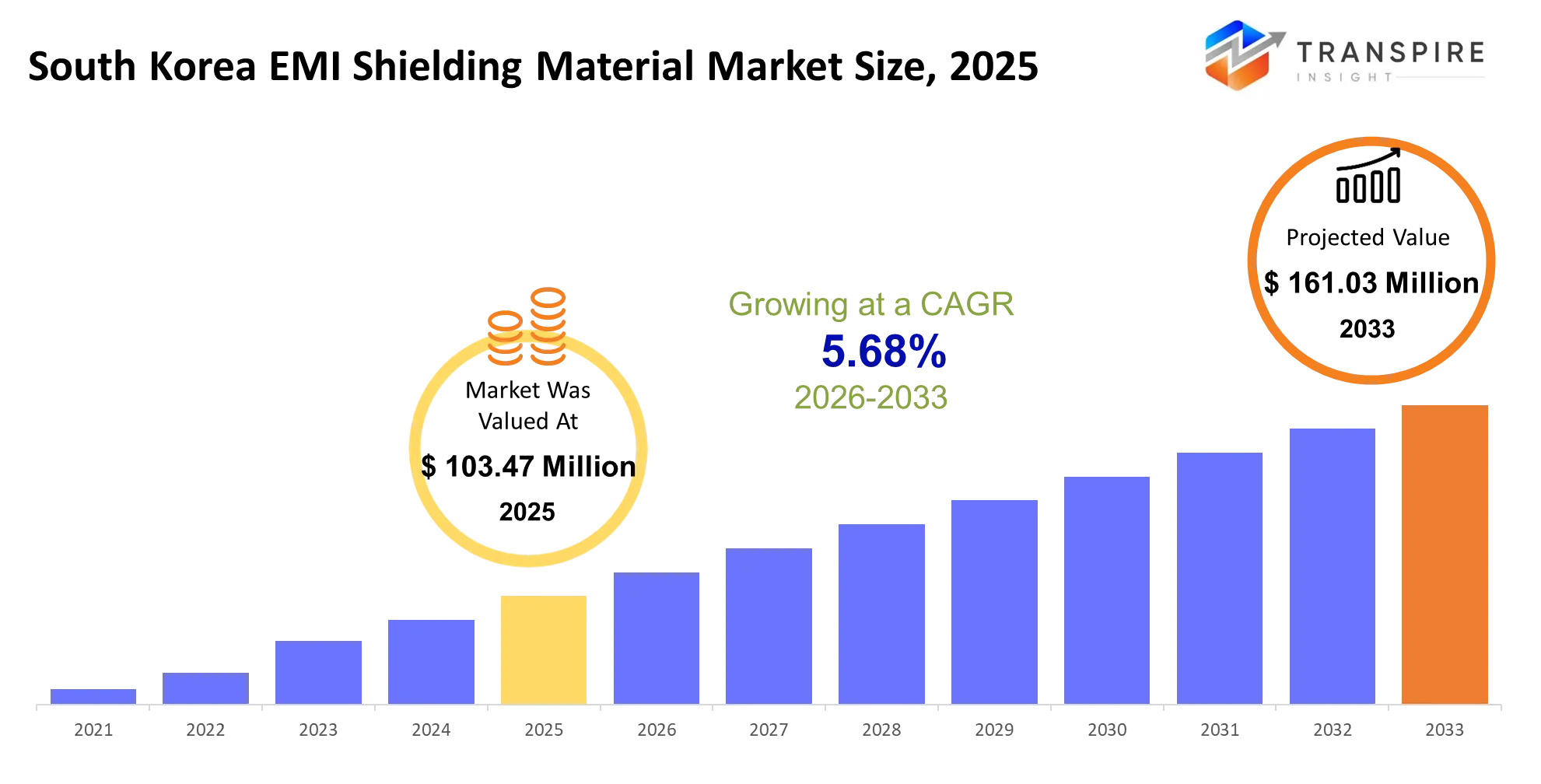
- South Korea EMI Shielding Material Market Size 2025: USD 103.47 Million
- South Korea EMI Shielding Material Market Size 2033: USD 161.03 Million
- South Korea EMI Shielding Material Market CAGR: 5.68%
- South Korea EMI Shielding Material Market Segments: By Material Type (Conductive Coatings, Conductive Polymers, Metal Shielding Materials, EMI Gaskets, Others); By Application (Consumer Electronics, Automotive Electronics, Telecommunications Equipment, Medical Devices, Others); By Shielding Type (Radiation Shielding, Conduction Shielding, Hybrid Shielding, Others); By End User (Electronics Industry, Automotive Industry, Aerospace & Defense, Healthcare Industry, Others); By Form (Films & Foils, Tapes, Coatings, Fabric-based Shielding, Others)
To learn more about this report,  Download Free Sample Report
South Korea EMI Shielding Material Market Summary
The South Korea EMI Shielding Material Market was valued at USD 103.47 Million in 2025. It is forecast to reach USD 161.03 Million by 2033. That is a CAGR of 5.68% over the period.
The South Korea EMI shielding material market plays a critical role in protecting electronic systems from electromagnetic interference , which can mess up signal transmission, lower device dependability, or weaken high-frequency communication. These materials are broadly used in electric vehicles, semiconductor equipment, smartphones, defense electronics, industrial automation, and 5G infrastructure, where uninterrupted signal fidelity has become commercially essential. In the past five years, the market has been leaning away from conventional conductive coatings toward lighter composite shielding materials, these are now compatible with compact, high density electronics and newer mobility platforms, not just “traditional” ones.
This change got faster after the global semiconductor supply chain disruptions of 2021–2022 , because that period highlighted how vulnerable high value electronics manufacturing is to component instability and signal-performance failures. South Korean manufacturers then reacted by investing in more localized sourcing for materials, plus advanced conductive polymer solutions. Now, as AI servers , autonomous systems, and high-frequency communication devices get more layered and demanding, the shielding performance ends up affecting product reliability , thermal handling, and the compliance requirements. That is, it is translating into higher adoption of these materials and stronger long-term contract revenues for suppliers, even when production timelines get tight.
Key Market Insights
- After 2022, the South Korea EMI Shielding Material Market kind of leaned more into lightweight conductive composite structures, because EV makers started cutting back on metal heavy shielding pieces .
- By 2025, manufacturing clusters in the Seoul metropolitan area were responsible for more than 45% of consumption for advanced electronics shielding materials, pretty much.
- Even so, conductive coatings stayed as the main product category, mainly due to wide use across smartphones, display modules, and also semiconductor packaging systems.
- Meanwhile, conductive tapes showed up as the fastest growing segment from 2025 to 2033, since compact devices tend to need flexible shielding blueprints.
- On the application side, consumer electronics took the biggest share, backed by Samsung and other local OEMs putting more money into high density device production.
- Automotive electronics then became the quickest expanding use case, since EV battery management systems and ADAS platforms call for stronger EMI protection layers.
- Also, semiconductor fabrication facilities ramped up buys of precision shielding films after RF interference incidents messed with high frequency testing conditions during 2023.
- South Korean suppliers, for their part, moved faster on collaborations with Japanese and U.S. chemical companies, to keep conductive polymer and silver flake material supply steadier.
- And in 2025, AI server rollouts pushed demand for thermal compatible EMI shielding materials that can be merged with advanced heat dissipation setups.
What are the Key Drivers, Restraints, and Opportunities in the South Korea EMI Shielding Material Market?
The strongest driver shaping the South Korea EMI shielding material market is this steady rush of electronic complexity across cars, semiconductor lines, and telecommunications manufacturing, like everything is getting more intricate, fast. With the rollout of 5G infrastructure and those advanced driver assistance systems moving into broader deployment, electromagnetic interference risks went up, especially inside densely packed electronic architectures. South Korean OEMs are now asking for better shielding efficiency so signal stability stays intact in compact devices that run at elevated frequencies. And this shift, kind of directly, increased buying of conductive coatings, shielding tapes, and metal-polymer composites because shielding performance got tied to product reliability, regulatory qualification, and overall export competitiveness.
The main restraint is more of a structural dependence on specialized conductive raw materials such as silver flakes, nickel powders, and engineered polymers, and these are sourced through concentrated global supply chains, so it’s not always flexible. Price volatility and geopolitical trade risks are still shaking procurement stability for domestic manufacturers. Smaller suppliers have a harder time absorbing the fluctuating input costs while also keeping the quality certifications that semiconductor and automotive customers require. Because of that, scaling is delayed and operating margins get squeezed, most visibly for mid-tier material processors.
A major opportunity is also showing up, mainly because of AI infrastructure and advanced mobility platforms. South Korea’s investment in high-performance computing, autonomous systems, and EV battery technologies is pushing demand for multifunctional shielding materials that do not only block EMI, but also support thermal management.
What Has the Impact of Artificial Intelligence Been on the South Korea EMI Shielding Material Market?
Artificial intelligence together with advanced digital manufacturing systems are, slowly but surely, changing production efficiency and quality control across the South Korea EMI shielding material industry. Electronics makers are moving toward AI assisted inspection setups, that can flag conductivity unevenness, coating thickness swings, and tiny microscopic imperfections while shielding film is being produced. With these automated methods the amount of scrap drops , and manufacturing precision tends to rise especially in high-frequency semiconductor and telecommunications use cases.
At the same time, machine learning models are helping with predictive maintenance inside electronics assembly plants where shielding integration is part of the everyday routine. Companies gather operational signals from coating devices and curing systems to guess when service should be done, or rather forecast maintenance timing before a failure disrupts the production flow. In semiconductor environments, AI simulation tools also assist engineers in estimating electromagnetic leakage patterns and tuning shielding arrangements before anything physical gets prototyped. As a result, development timelines get shorter , and compatibility with small form electronic architectures becomes easier to reach.
In day to day operations, these technologies support higher production uptime, more stable RF performance, and reduced costs that come from defects. Automotive electronics manufacturers are even trying AI enhanced thermal and EMI simulation platforms, to refine shielding layouts inside EV battery packs and autonomous driving modules.
Still, there are limits with adoption. The up front costs can be heavy, and there’s also a shortage of large scale real world electromagnetic performance datasets, which makes broader rollouts harder for small and mid-sized material suppliers.
Key Market Trends
- Since 2022, domestic electronics OEMs kind of reduced their dependence on imported shielding foils by expanding local conductive polymer processing capacity, a bit more than before.
- Between 2023 and 2025, EV battery manufacturers started putting thermal-integrated EMI shielding layers in place more often, to keep electronic stability steadier even when loads get high.
- Smartphone makers shifted toward ultra-thin graphite based shielding structures, and foldable device production moving faster across South Korea helped push that change.
- Also, semiconductor fabs broadened their cleanroom-grade shielding film procurement after higher-frequency chip testing effectively made interference management requirements feel much more strict.
- Meanwhile, material suppliers increased investment in silver-coated conductive adhesives as miniaturized electronics leave less room for traditional metal shielding housings.
- On the defense electronics side procurement got stronger too, with demand leaning toward ruggedized shielding composites that resist vibration, heat, and basically harsh electromagnetic surroundings.
- After 2024, collaborative R&D arrangements between Korean and Japanese material firms grew, to lock in those specialty conductive filler technologies.
- Industrial robotics manufacturers went with flexible shielding fabrics as well, to help safeguard automated systems running inside high-noise manufacturing environments.
- Companies like Parker Hannifin and Laird Performance Materials also expanded customized shielding solutions, mainly for AI data center infrastructure applications.
- And overall, buyers increasingly favored shielding materials that blend EMI absorption with thermal conductivity, rather than purchasing a single-function protective layer in isolation.
South Korea EMI Shielding Material Market Segmentation
By Material Type
Conductive Coatings hold the dominant market position because electronics manufacturers tend to use sprayable and printable shielding layers across smartphones, semiconductor parts, and communication devices. They keep getting traction thanks to faster processing speed, lighter material weight, and compatibility with compact electronic assemblies. Metal Shielding Materials still maintain a notable market share since high-frequency industrial and defense uses still need strong electromagnetic attenuation, plus structural durability that won’t quit. Conductive Polymers are steadily becoming more relevant due to the growing demand for lightweight shielding options in electric vehicles and flexible electronics systems.
Conductive Coatings keep expanding because advanced semiconductor packaging, and miniaturized consumer devices both push demand for thin but very effective shielding layers, that don’t add bulk to the device. Conductive Polymers pick up momentum from EV platform expansion and from foldable electronics manufacturing, where weight reduction matters, alongside more room for design. Metal Shielding Materials may see moderate growth limits because raw material costs are rising, and component miniaturization can reduce fit with next-generation compact electronics. EMI Gaskets keep fairly steady demand in industrial gear and telecommunications infrastructure where sealing performance, and long-term durability stay key. Others include carbon-based composites, conductive foams, and specialty hybrid materials that are developed for aerospace electronics and AI server systems, where multifunctional shielding performance is the main idea.
By Application
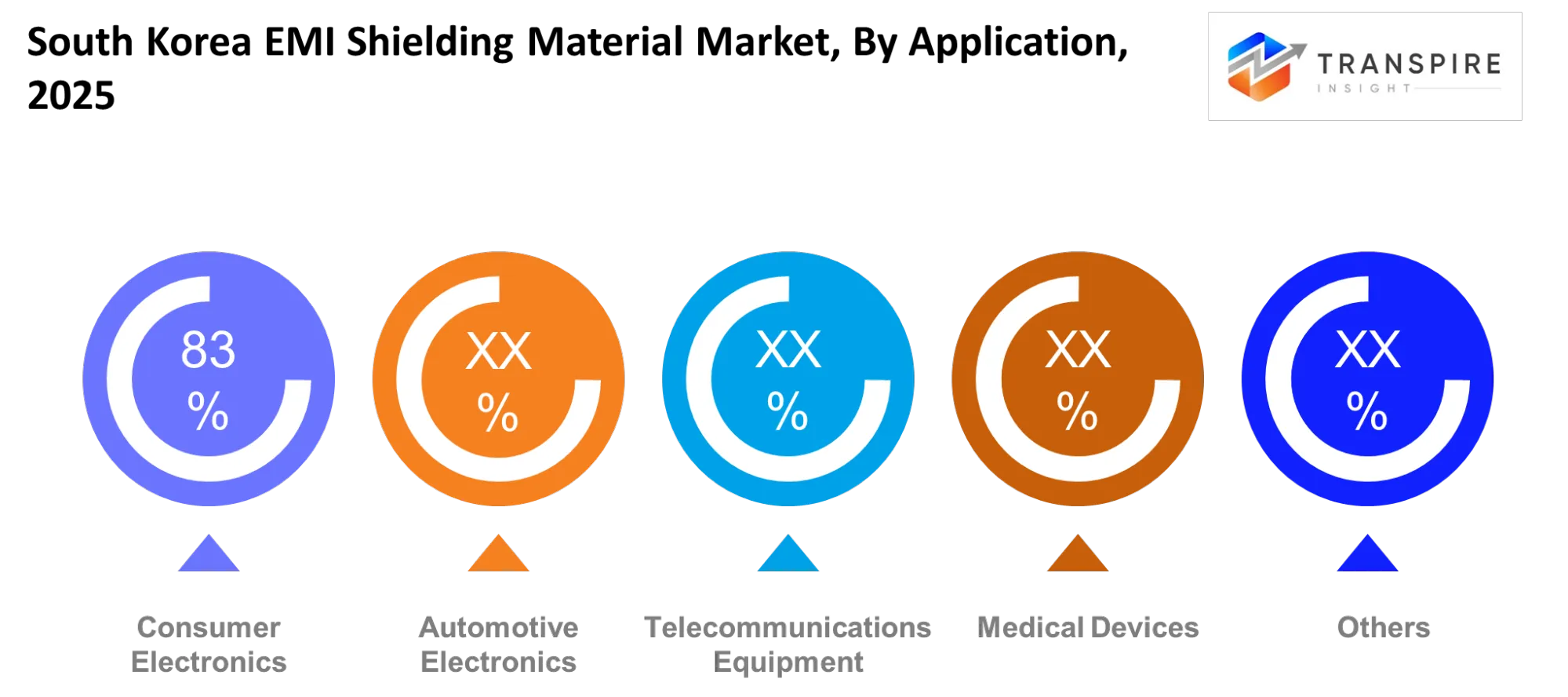
Consumer Electronics are basically the leading application segment in practice, because South Korea still has a strong production capacity in smartphones, display panels, wearable devices and semiconductor integrated electronics. When the electronic designs get higher density, the whole setup can create stronger electromagnetic interference risks, so shielding material consumption goes up directly across device manufacturing operations. Automotive Electronics also keep a solid market position, since electric vehicles, battery management systems and advanced driver assistance technologies depend on stable signal transmission plus electronic protection. Telecommunications Equipment stays relatively steady in demand through 5G infrastructure deployment and the ongoing growth of high frequency networking hardware.
Automotive Electronics are projected to show the quickest growth during the forecast period, as EV production sites keep expanding electronic integration across powertrain functions and autonomous driving systems. Consumer Electronics will keep being commercially relevant, because premium devices more and more need thinner shielding solutions that are also thermally compatible. Telecommunications Equipment gains from the steady rise of data traffic and AI driven connectivity infrastructure, which pushes networking equipment toward better electromagnetic stability. Medical Devices get more attention lately, since diagnostic systems and wearable monitoring technologies need reliable signal accuracy and interference protection, even inside smaller healthcare electronics. Others cover industrial robotics, renewable energy systems, and smart manufacturing equipment, where electronic precision and day to day operational reliability continue to shape purchasing choices.
To learn more about this report, Download Free Sample Report
By Shielding Type
Radiation Shielding holds the dominant market position, because wireless communication devices , semiconductor systems, and telecommunications equipment need protection from radiated electromagnetic waves that end up affecting signal integrity. Consumer electronics manufacturers broadly use radiation shielding materials inside compact units that are operating across several frequency bands, not just one. Conduction Shielding also keeps a notable market footprint, since industrial equipment and automotive systems demand controlled electrical grounding, plus interference suppression across connected circuits. Hybrid Shielding continues to climb in commercial relevance, mainly due to the growing need for multifunctional electronic protection systems, that kind of thing.
Hybrid Shielding is expected to see the fastest growth, since AI servers, EV platforms and high-frequency communication systems call for combined protection against both radiated and conducted interference. Product developers are starting to integrate layered shielding structures more often , which improves thermal management and signal performance at the same time, more or less. Radiation Shielding will likely keep long-term leadership too, because the expansion of wireless connectivity keeps pushing electronic noise density higher in both consumer and industrial spaces. Conduction Shielding stays essential for heavy industrial setups, factory automation hardware , and aerospace electronics, where stable electrical performance and grounding efficiency directly shape operational reliability.
Others cover customized shielding structures made for military electronics , satellite systems, and advanced semiconductor testing environments, where very specialized electromagnetic protection capabilities are required.
By End User
The Electronics Industry holds the main market position, mostly because South Korea keeps operating as a global manufacturing hub for semiconductors, smartphones, display technologies, and also advanced electronic assemblies. With large-scale output volumes, plus continuous device miniaturization , the need grows right away for conductive coatings , shielding films and precision EMI protection materials. The Automotive Industry follows pretty closely , since the expansion of electric mobility and the deeper integration of vehicle electronics keep pushing up shielding demands across EV battery systems, infotainment platforms, and autonomous driving technologies. Aerospace & Defense is smaller, but still strategically significant, largely due to strict electromagnetic compatibility expectations in mission-critical setups.
Over the forecast period, the Automotive Industry should show the strongest growth, as electric vehicle manufacturers continue folding in advanced sensing, connectivity, and battery management capabilities into next-generation vehicle platforms. Meanwhile, Electronics Industry will stay the commercial leader, because semiconductor fabrication and AI hardware manufacturing continue scaling up across domestic industrial clusters. The Healthcare Industry is also picking up momentum, driven by more adoption of wearable diagnostics, imaging systems, and connected medical equipment , all of which need reliable signal transmission and operational stability. Other segments cover industrial automation, renewable energy equipment, and telecommunications infrastructure initiatives, where overall electronic complexity keeps climbing and with it the procurement needs for shielding-related materials.
By Form
Films & Foils pretty much dominate the market because semiconductor packaging, smartphones, and telecommunications devices need thin plus lightweight shielding layers that still play nice with compact electronic assemblies. There’s also this push for strong flexibility, high conductivity, and easy integration, which keeps helping broad adoption in consumer electronics manufacturing. Coatings still hold a major market position too, mostly since automated spray and printable shielding techniques cut production time , and they also fit well with scalable electronics assembly workflows. And yes, tapes stay commercially important because people keep using them for cable shielding, connector protection, and precision component sealing, pretty often.
Films & Foils are expected to keep leading for the long term, because foldable devices, AI hardware systems, and high-density semiconductor packaging demand thinner shielding formats that also handle thermal efficiency better. Fabric-based Shielding is gaining traction in aerospace systems, industrial robotics, and wearable electronics, where flexibility and light mass performance really matter for day to day operation requirements. Coatings continue benefiting from smart manufacturing uptake, along with automated electronics assembly lines that want faster production plus tighter material precision. Other options include conductive foams, molded shielding components, and specialty laminated structures, made for customized industrial equipment, EV battery systems, and advanced defense electronics, where you really need application-specific electromagnetic protection solutions.
What are the Key Use Cases Driving the South Korea EMI Shielding Material Market?
Consumer electronics still feel like the main use case for EMI shielding materials in South Korea, frankly. Smartphone makers, semiconductor packaging firms, and display panel producers are leaning on conductive coatings plus shielding films to stop signal disruption in tight, high frequency devices. And yes, this kind of use tends to create the biggest demand because today’s gadgets pack multiple antennas, processors, and wireless communication modules into form factors that keep getting smaller, smaller.
Then there are automotive electronics and telecom infrastructure, which are growing kinda fast as secondary areas. Electric vehicle manufacturers put shielding materials inside battery management systems, inverters, and advanced driver assistance systems , since electromagnetic stability is tied straight to operational safety. Telecom providers are also rolling out added shielding layers in 5G base stations and in high speed networking hardware to keep signal transmission steady and predictable.
More emerging options show up too, like AI server infrastructure, aerospace electronics, and wearable medical devices. These setups need lightweight shielding materials that are thermally efficient, for long hours and tight spaces. They also have to work in crowded electronic environments where heat management AND signal protection both matter, for long term reliability.
|
Report Metrics |
Details |
|
Market size value in 2025 |
USD 103.47 Million |
|
Market size value in 2026 |
USD 109.35 Million |
|
Revenue forecast in 2033 |
USD 161.03 Million |
|
Growth rate |
CAGR of 5.68% from 2026 to 2033 |
|
Base year |
2025 |
|
Historical data |
2021 - 2024 |
|
Forecast period |
2026 - 2033 |
|
Report coverage |
Revenue forecast, competitive landscape, growth factors, and trends |
|
Regional scope |
South Korea |
|
Key company profiled |
3M, Parker Hannifin, Henkel, Laird Performance Materials, Kitagawa Industries, Chomerics, Panasonic, Samsung SDI, Shin-Etsu Chemical, RTP Company, PPG Industries, DuPont, Schaffner Holding, TDK Corporation, Toyochem |
|
Customization scope |
Free report customization (country, regional & segment scope). Avail customized purchase options to meet your exact research needs. |
|
Report Segmentation |
By Material Type (Conductive Coatings, Conductive Polymers, Metal Shielding Materials, EMI Gaskets, Others); By Application (Consumer Electronics, Automotive Electronics, Telecommunications Equipment, Medical Devices, Others); By Shielding Type (Radiation Shielding, Conduction Shielding, Hybrid Shielding, Others); By End User (Electronics Industry, Automotive Industry, Aerospace & Defense, Healthcare Industry, Others); By Form (Films & Foils, Tapes, Coatings, Fabric-based Shielding, Others) |
Which Regions are Driving the South Korea EMI Shielding Material Market Growth?
Seoul Capital Area kinda leads the South Korea EMI shielding material market because it holds, and also concentrates , the country’s biggest semiconductor, consumer electronics, and telecommunications manufacturing ecosystem. In there, major OEMs, advanced research institutes, and precision material suppliers sit in tightly connected industrial networks, and that really speeds up product development, plus it shortens procurement cycles a bit. The area also gains from smart-factory adoption that’s pretty strong, and from direct access to export oriented logistics infrastructure via Incheon and the nearby industrial corridors. Ongoing spending on AI hardware, high-frequency semiconductor fabrication, and advanced mobile device production keeps demand stable over the long term for these high-performance shielding materials.
Then the southeastern industrial region, with Busan, Ulsan, and Changwon at the anchor, adds growth but in a slightly different kind of structure, more like it’s centered on automotive electronics and the steadiness of industrial manufacturing. That part benefits from heavy-industry infrastructure that’s already established, plus long-term investment by automotive suppliers who are integrating advanced electronic systems into EV platforms. Here the demand picture stays more predictable, because purchasing is linked to multi-year automotive production programs, not those fast, frequent consumer electronics cycles. Industrial automation equipment makers also help support steady use of shielding films, conductive tapes, and ruggedized protective materials.
And the fastest growth, well it’s showing up from Chungcheong, especially around semiconductor and advanced packaging investment near Cheongju, plus the related technology corridors around it. Government-backed expansion programs for semiconductors, and AI computing infrastructure spending, pushed demand for precision shielding solutions after 2024.
Who are the Key Players in the South Korea EMI Shielding Material Market and How Do They Compete?
In the South Korea EMI shielding material market, competition feels moderately consolidated, mainly around multinational material science companies, electronics component suppliers, and those specialized conductive material manufacturers. Most of them go after customers using material performance, miniaturization capability, thermal integration, and long-term supply reliability, not price only—though of course that still comes up. Established brands mostly keep their share by leaning on proprietary formulations and application specific engineering support, while smaller suppliers kind of slip into emerging spaces, like EV electronics and AI infrastructure.
3M kind of sets itself apart with diversified conductive adhesive technologies and really broad integration across consumer electronics, plus industrial systems too. They keep expanding shielding tapes that are tuned for lightweight electronic assemblies and also compact wireless devices, which is… pretty important. Henkel leans heavily on conductive inks and high performance thermal-EMI hybrid materials, aiming them at advanced semiconductor packaging and automotive electronics integration.
TDK Corporation competes with precision electromagnetic absorption technologies, optimized for telecommunications and automotive systems that run at elevated frequencies, basically. Samsung SDI benefits from strong domestic integration with battery and electronics manufacturing ecosystems, so commercialization of customized shielding solutions for EV platforms can happen faster than for some others. DuPont, meanwhile, improves its standing through advanced polymer science capabilities and partnerships focused on flexible electronics and next generation semiconductor applications.
Company List
- 3M
- Parker Hannifin
- Henkel
- Laird Performance Materials
- Kitagawa Industries
- Chomerics
- Panasonic
- Samsung SDI
- Shin-Etsu Chemical
- RTP Company
- PPG Industries
- DuPont
- Schaffner Holding
- TDK Corporation
- Toyochem
Recent Development News
In May 2026, Henkel launched Bergquist TGF 2030APS and Loctite TLB 9270APS thermal interface materials for EV battery systems. The launch strengthened advanced conductive and thermal management solutions used in high-performance automotive electronics and EMI-sensitive battery architectures.https://www.henkel.in
In February 2026, Henkel showcased new conductive ink technologies and printed electronics material innovations at LOPEC 2026. The development expanded scalable EMI shielding and smart connectivity applications across automotive electronics, healthcare devices, and industrial electronics manufacturing.https://www.henkel.in
In April 2025, DuPont unveiled silver nanowire-based transparent EMI shielding technologies at Electronics Manufacturing Korea and Automotive World Korea in Seoul. The product expansion strengthened EMI protection solutions for ADAS, smart surfaces, automotive electronics, and advanced consumer electronic applications in South Korea.https://www.dupont.com
What Strategic Insights Define the Future of the South Korea EMI Shielding Material Market?
The South Korea EMI shielding material market is kinda moving, structurally, toward more than just protection, like multifunctional materials that merge electromagnetic defense with thermal control, some flexibility, and lightweight performance into one integrated setup. And yeah this shift is being pushed by semiconductor miniaturization, the rollout of AI hardware, plus the overall electronic complexity creeping up inside EV platforms. Over the next five to seven years, it looks like suppliers who can engineer application specific composite materials, not just sell commodity shielding products, will likely pull in the stronger margin growth.
There’s also a less talked about risk, the market’s dependence on concentrated raw material sourcing for conductive fillers like silver and certain specialty carbon compounds. If supply gets disrupted or export restrictions kick in, production economics can get squeezed pretty fast and delivery timelines for electronics manufacturers can get delayed.
At the same time, there’s an emerging opportunity that’s getting more visible in AI server infrastructure and in advanced semiconductor packaging, where high frequency signal integrity demands keep getting tighter. Companies should focus on hybrid shielding materials that work alongside thermal dissipation, while fitting compact electronics architecture without drama. Strategic partnerships with semiconductor fabs and EV system integrators will matter more over time, for locking in longer term design in commitments and for safeguarding future revenue.
South Korea EMI Shielding Material Market Report Segmentation
By Material Type
- Conductive Coatings
- Conductive Polymers
- Metal Shielding Materials
- EMI Gaskets
- Others
By Application
- Consumer Electronics
- Automotive Electronics
- Telecommunications Equipment
- Medical Devices
- Others
By Shielding Type
- Radiation Shielding
- Conduction Shielding
- Hybrid Shielding
- Others
By End User
- Electronics Industry
- Automotive Industry
- Aerospace & Defense
- Healthcare Industry
- Others
By Form
- Films & Foils
- Tapes
- Coatings
- Fabric-based Shielding
- Others
Frequently Asked Questions
Find quick answers to common questions.
The expected South Korea EMI Shielding Material Market size for the market will be USD 161.03 Million in 2033.
Key segments for the South Korea EMI Shielding Material Market are By Material Type (Conductive Coatings, Conductive Polymers, Metal Shielding Materials, EMI Gaskets, Others); By Application (Consumer Electronics, Automotive Electronics, Telecommunications Equipment, Medical Devices, Others); By Shielding Type (Radiation Shielding, Conduction Shielding, Hybrid Shielding, Others); By End User (Electronics Industry, Automotive Industry, Aerospace & Defense, Healthcare Industry, Others); By Form (Films & Foils, Tapes, Coatings, Fabric-based Shielding, Others).
Major South Korea EMI Shielding Material Market players are 3M, Parker Hannifin, Henkel, Laird Performance Materials, Kitagawa Industries, Chomerics, Panasonic, Samsung SDI, Shin-Etsu Chemical, RTP Company, PPG Industries, DuPont, Schaffner Holding, TDK Corporation, Toyochem.
The South Korea EMI Shielding Material Market size is USD 103.47 Million in 2025.
The South Korea EMI Shielding Material Market CAGR is 5.68% from 2026 to 2033.
- 3M
- Parker Hannifin
- Henkel
- Laird Performance Materials
- Kitagawa Industries
- Chomerics
- Panasonic
- Samsung SDI
- Shin-Etsu Chemical
- RTP Company
- PPG Industries
- DuPont
- Schaffner Holding
- TDK Corporation
- Toyochem
Recently Published Reports
-
May 2026
Healthcare Polymer Packaging Market
Healthcare Polymer Packaging Market Size, Share & Analysis Report By Packaging Type (Syringes, IV Bottles and Pouches, Clamshells, Blisters, Bottles & Jars, Containers, Tubes, IV Parental Packaging, Others), By Type (Regulated, Non-regulated), By Polymer Type (LDPE (Low-Density Polyethylene), HDPE (High-Density Polyethylene), Homo-polymer (Homo), Random Copolymer (Random), Block Copolymer (Block), PET, Polystyrene, Polyvinyl Chloride, Polyamide/EVOH, Others), and Geography (North America, Europe, Asia-Pacific, Middle East and Africa, South and Central America), 2021 - 2031
-
Apr 2026
Hydrophilic Tape (Waterstop) Market
Hydrophilic Tape (Waterstop) Market Size, Share & Analysis Report By Type (Bentonite-Based Hydrophilic Tape, Rubber-Based Hydrophilic Tape), By Application (Residential Buildings, Commercial Buildings, Infrastructure Projects), and Geography (North America, Europe, Asia-Pacific, Middle East and Africa, South and Central America), 2021 - 2031
-
Apr 2026
Metalens Market
Metalens Market Size, Share & Analysis Report By Type (Visible Light Metalens, and Infrared Metalens), By Application (Consumer Electronics, Automotive Electronics, Industrial, Medical, and Others), and Geography (North America, Europe, Asia-Pacific, Middle East and Africa, South and Central America), 2021 - 2031
-
Apr 2026
PBT Resin Market
PBT Resin Market Size, Share & Analysis Report By Type (Reinforced PBT Resin, Unreinforced PBT Resin), By Processing Method (Injection Molding, Extrusion, Blow Molding, Others), By End-User (Automotive, Electrical & Electronics, Consumer Appliances, Industrial Machinery, Medical Devices, Packaging, Others), and Geography (North America, Europe, Asia-Pacific, Middle East and Africa, South and Central America), 2021 - 2031