

Europe Green Coatings Market Size & Forecast:
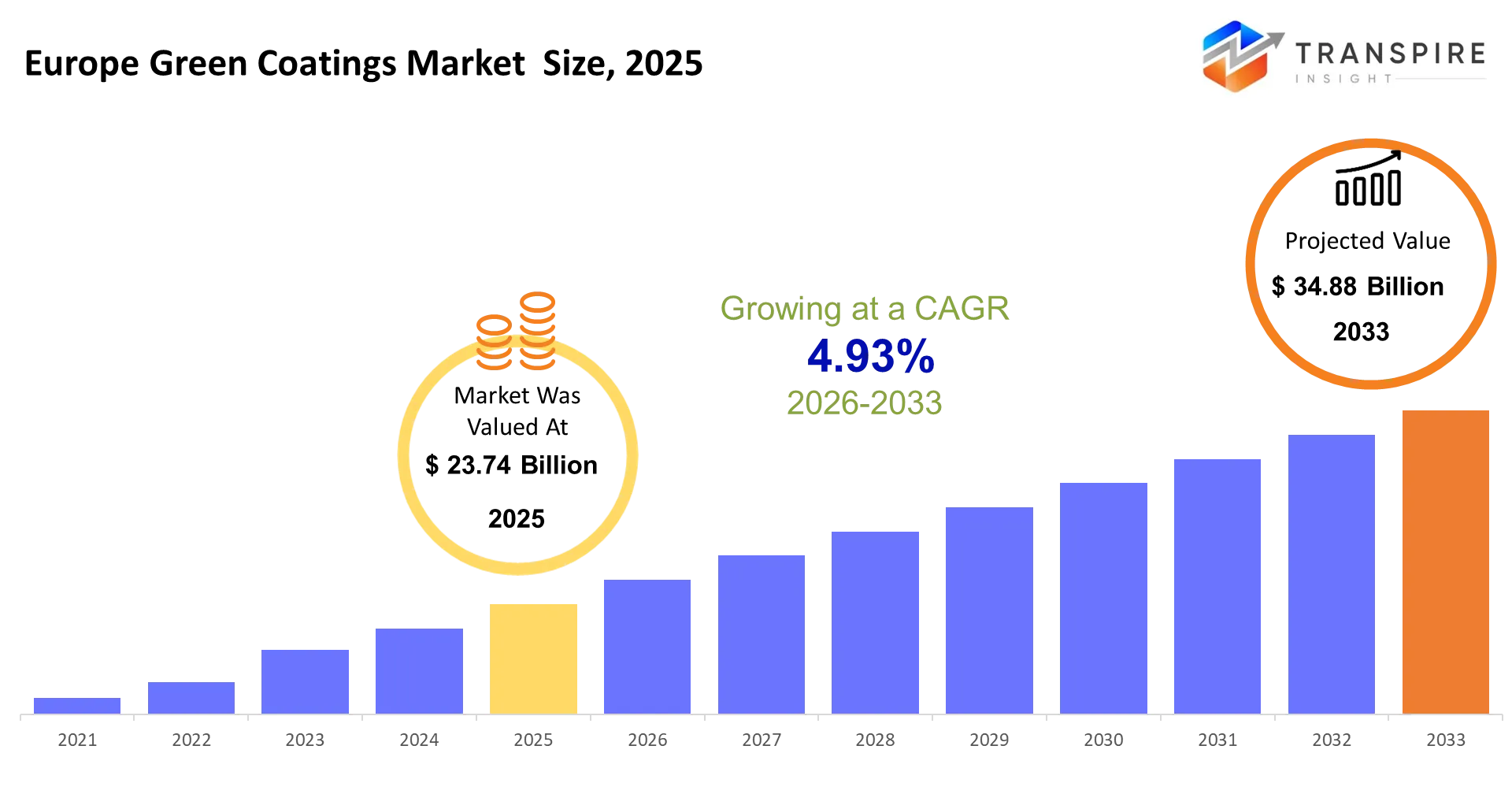
- Europe Green Coatings Market Size 2025: USD 23.74 Billion
- Europe Green Coatings Market Size 2033: USD 34.88 Billion
- Europe Green Coatings Market CAGR: 4.93%
- Europe Green Coatings Market Segments: By Type (Waterborne Coatings, Powder Coatings, UV-cured Coatings, Others), By Application (Automotive, Construction, Industrial, Packaging, Others), By End-User (Automotive Industry, Construction Sector, Industrial Sector, Others), By Resin (Acrylic, Epoxy, Polyurethane, Others).
To learn more about this report,  Download Free Sample Report
Europe Green Coatings Market Summary:
The Europe Green Coatings Market size is estimated at USD 23.74 Billion in 2025 and is anticipated to reach USD 34.88 Billion by 2033, growing at a CAGR of 4.93% from 2026 to 2033.Green coatings in Europe functionally protect ships and offshore structures and industrial machinery from three types of damage while they decrease their negative impact on the environment. The treaty helps ships through two main functions which include decreasing fuel requirements by lowering hydrodynamic resistance and stopping hazardous substances from entering aquatic environments. The industrial sector utilizes the materials to help businesses achieve two essential requirements which include emissions restrictions and workplace protection measures while maintaining product strength.
The market has undergone a fundamental transformation during the last three to five years because EU regulatory requirements and sustainability assessment criteria have created demand for water-based products with bio-based components and products that contain minimal volatile organic compounds. The environmental regulations drive companies to develop new products because they need to comply with REACH and IMO antifouling regulations which require them to eliminate outdated chemical compounds from their products.
The regulatory framework has created pressure which leads organizations to speed up the development of new products while upgrading existing ones. The suppliers establish pricing power because they offer specialized coatings which deliver high performance value to their customers, while asset owners work to achieve compliance and enhance their operational productivity.
Key Market Insights
- The Europe Green Coatings Market has been dominated by Western Europe since 2024 because its strong regulatory enforcement together with its industrial base gives the region more than 45% market share.
- The northern European region will experience its most rapid growth until 2030 because of its commitment to sustainability combined with improvements in its maritime industry.
- The waterborne coatings market maintains its leading position because the technology achieves low-VOC standards and industrial applications.
- Powder coatings function as the second most important market segment which shows increasing use in both automotive and heavy machinery industries.
- Bio-based coatings represent the most rapidly expanding market segment which will grow between 2025 and 2030 because companies will adopt renewable materials.
- The industrial coatings market leads with a 40% market share which manufacturing and energy and infrastructure sectors have created.
- The marine coatings market expands at the fastest pace because fuel efficiency standards and antifouling performance regulations drive its development.
- The manufacturing industry operates at the highest level because it holds more than 35% market share in 2024 through needs for compliance and requirements for efficient operations.
- The renewable energy sector experiences its fastest growth through wind and solar power infrastructure development which is currently taking place throughout Europe.
What are the Key Drivers, Restraints, and Opportunities in the Europe Green Coatings Market?
The European Green Coatings Market experiences its fastest growth because European regulations now enforce stricter operations. The REACH framework which restricts hazardous substances together with tighter VOC emission limits forced manufacturers to create new formulations that replaced their existing solvent-based coatings. The regulatory requirement ensured organizations complied with regulations but it also shortened product lifetimes and required asset managers to update their existing coatings before their scheduled replacement date. The coating industry generates continuous customer demand through mandatory system updates while premium products achieve high prices because they meet performance standards and regulatory requirements. The new technology drives faster implementation within marine operations and heavy industrial activities because organizations face shutdowns and fines for violating regulations.
The most significant barrier remains the cost-performance gap between green and conventional coatings in demanding environments. The development of advanced formulas demands companies to allocate more resources for special implementation methods which involve personnel training and controlled drying procedures. The structural issue exists because various European industrial regions need different raw material access and different formulation methods and different infrastructure development levels. The existing capital expenses force smaller companies to postpone their market entry which results in revenue losses while prolonging their entry into budget-conscious product markets.
A significant chance exists for bio-based and intelligent coating technologies which work together with predictive maintenance systems. Coatings that contain corrosion-sensing technology enable offshore wind facilities to achieve decreased unplanned work stoppages. European operators who develop renewable energy systems throughout the North Sea region focus on reducing their operational expenses through lifecycle cost optimization. The development of green coatings which provide environmental compliance together with operational cost reductions creates a new process for their implementation in value-based adoption.
What Has the Impact of Artificial Intelligence Been on the Europe Green Coatings Market?
The combination of artificial intelligence with advanced digital systems creates new methods to assess and manage green coatings which protect marine emission control systems and industrial assets. The operators use AI technology to operate coating performance platforms which enable them to track compliance requirements while they monitor scrubber systems and fleet management dashboards. The system performs continuous sensor data collection which monitors hull conditions and fouling rates and emission levels, thus allowing control rooms to identify vessels or assets which are not performing as expected at that moment. The process decreases the need for manual inspections and it enhances audit readiness according to European environmental regulations.
The machine learning models which use coating degradation patterns with salinity and temperature and vessel speed as operational parameters enable predictive maintenance capabilities. The operators employ these models to estimate maintenance periods while they enhance recoating procedures, which leads to service period extensions of 10 to 15 percent and better fuel efficiency through improved hull operations. The application of predictive analytics in industrial environments helps organizations sustain corrosion resistance which leads to decreased unexpected equipment failures and reduced total operational expenses.
A specific barrier prevents implementation. The system experiences dual challenges which include data differences and poor sea connectivity that affect model performance and decision-making processes. The remaining fleets operate with incomplete data systems, which creates difficulties for AI training while making it harder to predict outcomes in extreme maritime conditions.
Key Market Trends
- The European Union enforced stricter VOC limits from 2020 onward which required manufacturers to replace solvent-based coatings with waterborne technologies that needed to be implemented throughout industrial operations.
- Shipowners increasingly adopted advanced antifouling coatings because IMO compliance checks became more stringent which led to fuel efficiency improvements that reached 8% through better hull performance.
- Companies such as AkzoNobel and Hempel expanded their bio-based coating portfolios between 2021 and 2024 which demonstrated a renewable raw material approach.
- Heavy industry buyers now evaluate product performance through their entire lifespan instead of making purchases based on initial expenses.
- Large fleet operators used digital coating monitoring systems after 2022 to obtain real-time performance data which guided their purchasing choices.
- European manufacturers changed their supply chain operations after the pandemic by establishing local raw material sourcing methods which helped them achieve stable formulation results while decreasing their Asian material dependencies.
- The automotive industry started using powder coatings because they offered a better solution than liquid coatings for specific processes which helped to reduce solvent emissions and waste.
- Since 2021 offshore wind developers have increasingly selected green coatings that prevent corrosion because they support long-term asset protection and help cut down on expensive maintenance repairs.
- BASF and PPG developed new competitive approaches through their investments in nanotechnology-based coatings which enhanced product durability while establishing performance metrics for high-value contracts.
Europe Green Coatings Market Segmentation
By Type
Waterborne coatings provide the most effective solution for European markets because these coatings comply with strict VOC regulations and show compatibility with current industrial operations. The manufacturing industry adopted these new formulations after 2020 because tighter regulatory enforcement forced companies to stop using solvent-based systems. The second-largest market segment in the industry comes from powder coatings which automotive and heavy equipment industries use because these coatings offer permanent protection and minimize production waste.
The market for UV-cured coatings remains limited at present although they have strong potential to expand into specialized sectors that need quick drying times and energy-saving capabilities. The performance attributes and cost factors and compliance requirements create conflicting needs in every market segment. The upcoming business expansion will favor hybrid technologies which use waterborne chemistry together with improved durability because this will force suppliers to develop new product formulas and create efficient manufacturing systems.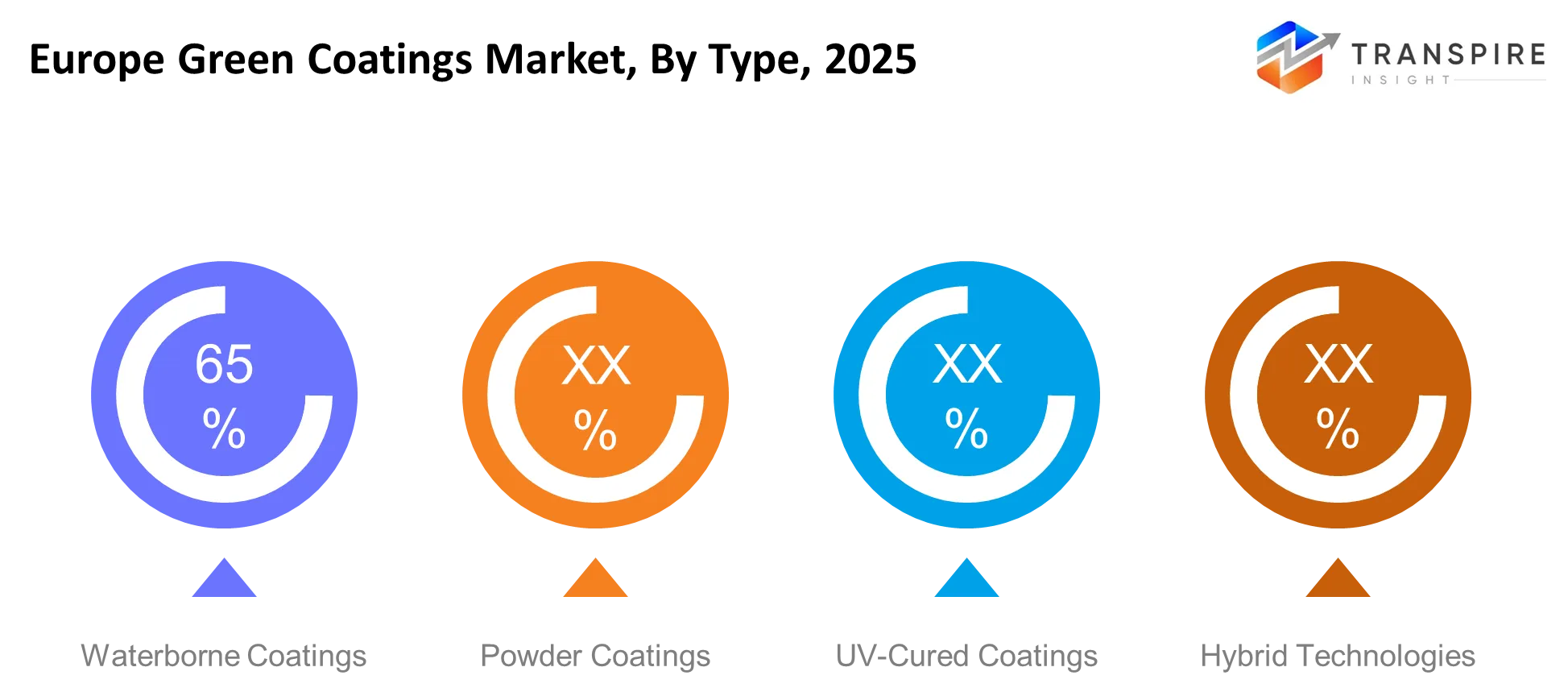
To learn more about this report, Download Free Sample Report
By Application
Industrial coatings take up the largest market share because their usage extends to multiple sectors including manufacturing and energy infrastructure and marine operations. Asset owners need to protect their assets from corrosion while getting lower operational costs which creates steady demand for this solution in different industry sectors. The automotive sector holds the second-largest market share which OEMs require because they need low-emission coatings with high surface quality.
Renovation activities and energy efficiency upgrades to buildings create continuous demand for construction coatings which remain in high demand throughout the year. Packaging remains a smaller yet continuously increasing segment because food-safe materials and low-toxicity materials now face regulatory requirements. Buyers choose coatings based on durability and compliance instead of initial expenses which shows that performance-based procurement has become the new standard while suppliers must create product solutions that meet specific industry needs.
By End-User
The industrial sector leads all other sectors because it has the highest usage of manufacturing and oil and gas and marine operations. Industrial purchasers seek advanced green coatings because they need to meet compliance standards and achieve operational efficiency goals through more durable products. The automotive industry follows behind because electrification trends and stricter environmental standards for production processes drive its growth.
The construction sector maintains its current status because refurbishment projects and insulation-based coatings that achieve sustainability targets drive its growth. Packaging and consumer goods represent small market shares from other end-users who demonstrate gradual market growth through stricter regulations. The upcoming demand will shift toward large industrial operators and OEMs who can take on substantial initial expenses to achieve permanent operational efficiencies.
By Resin
Acrylic coatings maintain their dominant market position through their ability to deliver multiple benefits at low production costs while delivering exceptional performance in water-based systems. Epoxy resins serve as essential materials for heavy-duty applications because they provide critical protection against corrosion and deliver high mechanical strength needed in marine and infrastructure projects. Polyurethane coatings establish themselves as a premium market segment because they deliver exceptional finishes combined with flexibility and weather protection for automotive and industrial applications.
Environmental regulations have caused niche applications for alkyd and polyester resin types to experience a gradual decrease in demand. The choice of resin materials has shifted towards requirements that need to be achieved through performance assessment. The upcoming research will concentrate on developing bio-based and hybrid resins because these materials enable compliance with regulatory standards while providing enduring strength and expanded use possibilities.
What are the Key Use Cases Driving the Europe Green Coatings Market?
Equipment owners apply green coatings for two reasons which include extending equipment lifespan and reducing maintenance downtime while meeting compliance requirements which results in continuous demand for their products and their products being used at regular times.
The automotive and construction industries show growth in their development of new applications. Automotive original equipment manufacturers implement low-VOC coatings in their production lines to achieve emission compliance, while construction companies use these coatings in renovation projects that need to meet energy efficiency standards and indoor air quality regulations.
The first operational modes for offshore wind turbines and electric vehicle battery storage systems have entered their initial development phase. The coatings used in these environments must provide protection against extreme marine conditions and intense thermal pressure which leads to the creation of sustainable high-performance coating solutions.
|
Report Metrics |
Details |
|
Market size value in 2025 |
USD 23.74 Billion |
|
Market size value in 2026 |
USD 24.91 Billion |
|
Revenue forecast in 2033 |
USD 34.88 Billion |
|
Growth rate |
CAGR of 4.93% from 2026 to 2033 |
|
Base year |
2025 |
|
Historical data |
2021 - 2024 |
|
Forecast period |
2026 - 2033 |
|
Report coverage |
Revenue forecast, competitive landscape, growth factors, and trends |
|
Regional scope |
Europe (Germany, United Kingdom, France, Italy, Spain and Rest of Europe) |
|
Key company profiled |
AkzoNobel, PPG Industries, Sherwin-Williams, BASF, Axalta, Nippon Paint, Kansai Paint, Jotun, Hempel, RPM International, Asian Paints, Berger Paints, Tikkurila, Masco, DAW SE |
|
Customization scope |
Free report customization (country, regional & segment scope). Avail customized purchase options to meet your exact research needs. |
|
Report Segmentation |
By Type (Waterborne Coatings, Powder Coatings, UV-cured Coatings, Others), By Application (Automotive, Construction, Industrial, Packaging, Others), By End-User (Automotive Industry, Construction Sector, Industrial Sector, Others), By Resin (Acrylic, Epoxy, Polyurethane, Others) |
Which Regions are Driving the Europe Green Coatings Market Growth?
Western Europe leads the market because it has strict regulatory enforcement and its industrial sector has reached full development. The German and Dutch and French governments implement VOC restrictions together with antifouling regulations which require high levels of compliance from their citizens. The combination of strong port facilities and extensive commercial shipping operations generates sustained demand for protective coatings used in marine and offshore equipment. The established system which consists of coating producers and research organizations and shipbuilding facilities enables both product innovation and quick market entry of new products.
Southern Europe follows with a different growth pattern shaped by maritime activity and tourism-linked shipping. The Italian and Spanish and Greek shipping industries depend on their fleets to maintain regular operational periods instead of needing strict enforcement of environmental regulations. The regional shipowners maintain their demand for existing coating products because they value both price stability and dependable business operations. The essential shipping centers maintain their economic strength which results in stable revenue generation for their operations despite Western Europe experiencing slower changes in its regulatory system.
Northern and Eastern Europe experience their most rapid development because renewable energy systems and new infrastructure projects are expanding throughout these regions. The North Sea and Baltic Sea offshore wind projects which developed after 2021 resulted in a rising need for protective coatings which offer advanced corrosion resistance. The Danish and Polish governments established financial incentives together with more demanding environmental requirements which resulted in faster technology usage among users. The strong market entry conditions will exist for suppliers between the years 2026 to 2033 because advanced coating technologies and bio-based coating technologies will emerge during that time.
Who are the Key Players in the Europe Green Coatings Market and How Do They Compete?
The Green Coatings Market in Europe shows moderate market consolidation because multiple global companies control major market shares while regional companies compete for smaller market segments. Current market players protect their market shares by developing new product formulas and creating products that meet regulatory requirements instead of using price-based competition. The main competitive factors in the market include technological superiority and compliance with regulations because customers choose coatings that fulfill strict European Union requirements and enhance their operational efficiency throughout the product's life span. New companies encounter substantial obstacles because they must meet certification standards complete testing processes and demonstrate their products' effectiveness under severe industrial and maritime operational conditions.
AkzoNobel develops technological solutions that set it apart from competitors through its development of waterborne and antifouling coating systems which enhance fuel efficiency while decreasing emissions. The company uses its strong ties with European shipyards to build digital coating monitoring systems which enhance its ability to develop long-term contracts for service. PPG Industries develops advanced material science solutions through its research on low-VOC coatings and high-durability coatings which include partnerships with automotive and aerospace OEMs to create new uses for their products.
BASF SE uses its combined chemical knowledge to develop bio-based resins and high-performance formulations which meet the changing regulatory requirements of EU legislation. Hempel A/S establishes its dominance in the marine and offshore wind markets by developing corrosion-resistant coatings which protect against extreme conditions and forming strategic alliances throughout Northern Europe. Sherwin-Williams develops its business advantage through its extensive distribution system which operates production facilities in various locations to provide swift service and personalized products to industrial customers throughout Europe.
Company List
- AkzoNobel
- PPG Industries
- Sherwin-Williams
- BASF
- Axalta
- Nippon Paint
- Kansai Paint
- Jotun
- Hempel
- RPM International
- Asian Paints
- Berger Paints
- Tikkurila
- Masco
- DAW SE
Recent Development News
In April 2026, BASF completes renewable electricity transition in European coatings production: BASF Coatings has fully switched its European production sites to renewable electricity as part of its carbon management roadmap. The move significantly reduces Scope-2 emissions and strengthens low-carbon coating manufacturing for automotive and industrial applications in Europe.
Source: https://www.basf.com
In April 2026, BASF Coatings expands sustainable packaging and recycling-focused coating systems: At Interpack 2026 in Düsseldorf, BASF showcased recycling-friendly adhesives and coating systems designed to improve circular packaging performance. The focus is on reducing environmental footprint in multilayer packaging and enabling easier material separation in Europe’s packaging supply chain.
Source: https://www.basf.com
What Strategic Insights Define the Future of the Europe Green Coatings Market?
The Europe Green Coatings Market is undergoing a structural change that leads to solutions which integrate performance and meet regulatory requirements because coatings have dual functions as protective materials and efficiency-enhancing instruments. The main driver of this trend exists because stricter environmental regulations combine with asset optimization needs to compel buyers to select coatings which provide verified fuel savings and extended maintenance intervals and digital performance assessment capabilities. Suppliers who merge material science expertise with data-driven service delivery will gain advantages from this transformation.
A hidden danger exists because bio-based and specialty resins depend on specific raw materials. Production costs for renewable feedstocks face interruption because supply shortages and price fluctuations make it difficult to achieve large-scale production, which affects industrial users who require cost-effective solutions. Offshore renewable energy infrastructure development creates new business potential for floating wind platforms which depend on advanced corrosion protection coatings that need next-generation solutions.
Market participants should invest in hybrid coating technologies that integrate durability with digital monitoring capabilities, while securing upstream supply chains to mitigate material risk and maintain pricing stability.
Europe Green Coatings Market Report Segmentation
By Type
- Waterborne Coatings
- Powder Coatings
- UV-cured Coatings
- Others
By Application
- Automotive
- Construction
- Industrial
- Packaging
- Others
By End-User
- Automotive Industry
- Construction Sector
- Industrial Sector
- Others
By Resin
- Acrylic
- Epoxy
- Polyurethane
- Others
Frequently Asked Questions
Find quick answers to common questions.
The Approximate Europe Green Coatings Market size for the Market will be USD 34.88 Billion in 2033.
The key Segments of the Europe Green Coatings Market are By Type (Waterborne Coatings, Powder Coatings, UV-cured Coatings, Others), By Application (Automotive, Construction, Industrial, Packaging, Others), By End-User (Automotive Industry, Construction Sector, Industrial Sector, Others), By Resin (Acrylic, Epoxy, Polyurethane, Others).
Major Players in the Europe Green Coatings Market are AkzoNobel, PPG Industries, Sherwin-Williams, BASF, Axalta, Nippon Paint, Kansai Paint, Jotun, Hempel, RPM International, Asian Paints, Berger Paints, Tikkurila, Masco, DAW SE.
The Current Market size of the Europe Green Coatings Market is USD 23.74 Billion in 2025.
The Europe Green Coatings Market CAGR is 4.93%.
- AkzoNobel
- PPG Industries
- Sherwin-Williams
- BASF
- Axalta
- Nippon Paint
- Kansai Paint
- Jotun
- Hempel
- RPM International
- Asian Paints
- Berger Paints
- Tikkurila
- Masco
- DAW SE
Recently Published Reports
-
Apr 2026
Healthcare Polymer Packaging Market
Healthcare Polymer Packaging Market Size, Share & Analysis Report By Packaging Type (Syringes, IV Bottles and Pouches, Clamshells, Blisters, Bottles & Jars, Containers, Tubes, IV Parental Packaging, Others), By Type (Regulated, Non-regulated), By Polymer Type (LDPE (Low-Density Polyethylene), HDPE (High-Density Polyethylene), Homo-polymer (Homo), Random Copolymer (Random), Block Copolymer (Block), PET, Polystyrene, Polyvinyl Chloride, Polyamide/EVOH, Others), and Geography (North America, Europe, Asia-Pacific, Middle East and Africa, South and Central America), 2021 - 2031
-
Apr 2026
Hydrophilic Tape (Waterstop) Market
Hydrophilic Tape (Waterstop) Market Size, Share & Analysis Report By Type (Bentonite-Based Hydrophilic Tape, Rubber-Based Hydrophilic Tape), By Application (Residential Buildings, Commercial Buildings, Infrastructure Projects), and Geography (North America, Europe, Asia-Pacific, Middle East and Africa, South and Central America), 2021 - 2031
-
Apr 2026
Metalens Market
Metalens Market Size, Share & Analysis Report By Type (Visible Light Metalens, and Infrared Metalens), By Application (Consumer Electronics, Automotive Electronics, Industrial, Medical, and Others), and Geography (North America, Europe, Asia-Pacific, Middle East and Africa, South and Central America), 2021 - 2031
-
Apr 2026
PBT Resin Market
PBT Resin Market Size, Share & Analysis Report By Type (Reinforced PBT Resin, Unreinforced PBT Resin), By Processing Method (Injection Molding, Extrusion, Blow Molding, Others), By End-User (Automotive, Electrical & Electronics, Consumer Appliances, Industrial Machinery, Medical Devices, Packaging, Others), and Geography (North America, Europe, Asia-Pacific, Middle East and Africa, South and Central America), 2021 - 2031