
South Korea Duty-Free Liquor Market Size & Forecast:
- South Korea Duty-Free Liquor Market Size 2025: USD 283.7 Million
- South Korea Duty-Free Liquor Market Size 2033: USD 640.5 Million
- South Korea Duty-Free Liquor Market CAGR: 10.72%
- South Korea Duty-Free Liquor Market Segments: By Product Type (Whisky, Vodka, Rum, Gin, Brandy, Wine, Others) | By Distribution Channel (Airport Duty-Free, Downtown Duty-Free, Online Duty-Free, Cruise Retail, Border Stores, Others) | By Price Range (Premium, Luxury, Mid-Range, Economy, Ultra-Premium, Others) | By Consumer Type (Tourists, Business Travelers, Domestic Travelers, High-Net-Worth Individuals, Others)
South Korea Duty-Free Liquor Market Summary
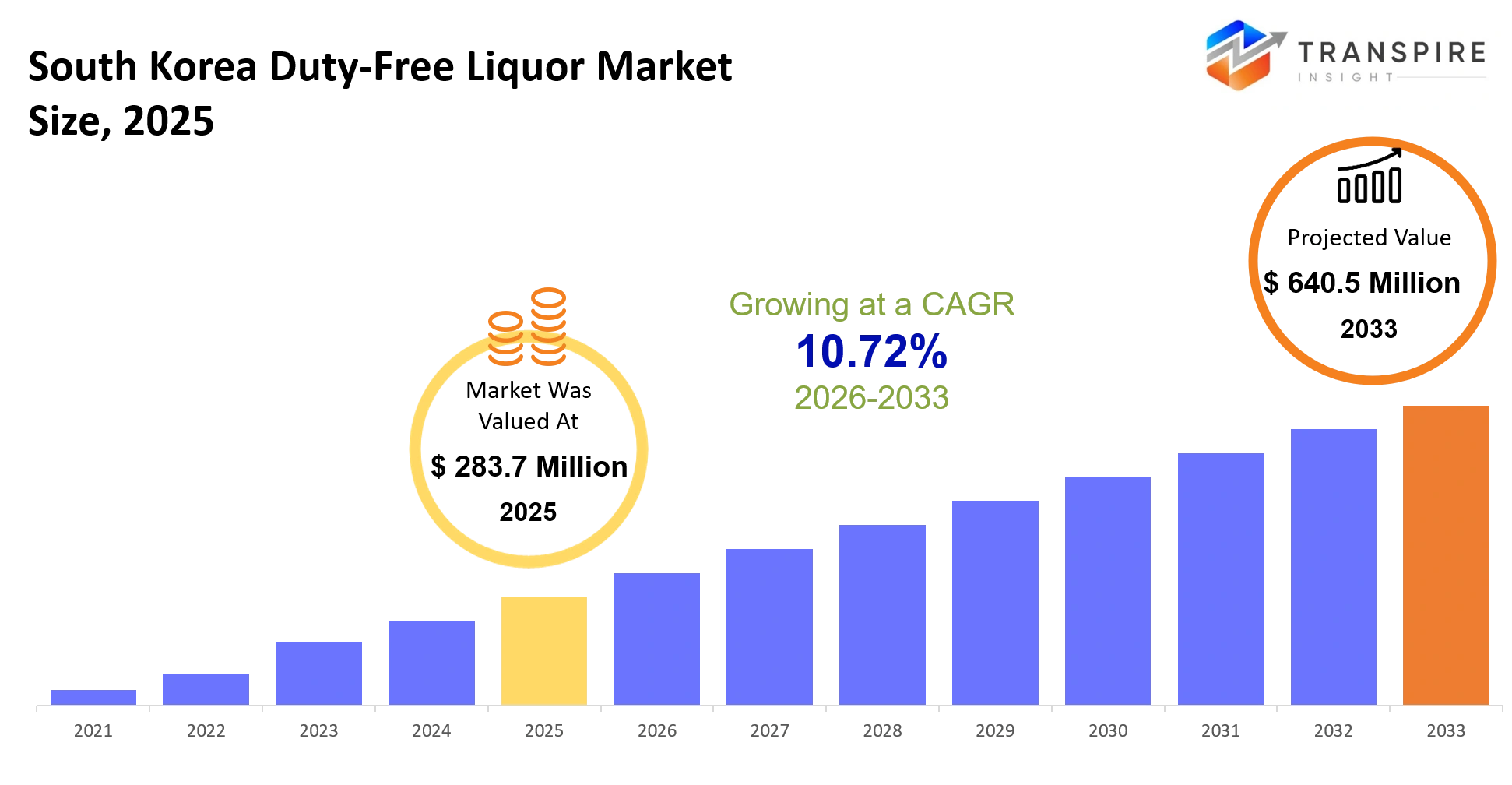
The South Korea Duty-Free Liquor Market was valued at USD 283.7 Million in 2025. It is forecast to reach USD 640.5 Million by 2033. That is a CAGR of 10.72% over the period.
South Korea's duty-free liquor market kind of lets international travelers grab alcoholic beverages at tax-exempt prices, mainly in airports, seaports, and also downtown duty-free shops, it’s more or less driven by tourism retail, plus gifting needs, and access to premium spirits with lower effective cost. Over the last five years, the market started moving away from pure transaction-led volume sales, and more toward experience-led premiumization, because retailers rolled out carefully selected whisky and cognac ranges, and they even stitched online pre-order tools into airport pickup routines. There’s also a noticeable structural change, the whole duty-free channels get digitized faster than before. Then COVID-19 kinda acted like a big trigger, it first crashed international travel, and after that, it sped up rebound spending when borders reopened. That rebound , paired with tighter global spirits supply, plus stronger outbound tourism from South Korea, has pushed up per-capita duty-free liquor spend, and it also kept airport retail, as this high-margin revenue engine.
Key Market Insights
- Airport duty-free channels still kind of dominate the whole scene, with an estimated 40%+ slice, and it’s mainly pushed by Incheon International Airport’s heavy passenger flow, plus how premium travelers tend to spend.
- The Seoul Incheon region basically stays the biggest hub, while regional airport duty-free outlets are forecast to grow the fastest through the 2026 window, so, yeah, momentum shifts a bit outside the main core.
- When it comes to spirits, the segment really leads, especially whisky and cognac, because premium gifting behavior is strong, and also travel retail exclusivity is positioned pretty deliberately.
- Wine is showing up as the fastest-growing category too, supported by younger travelers, who are gradually moving toward lighter alcoholic beverage preferences, rather than going all-in on heavier tastes.
- For applications, airport retail is the dominant one in South Korea’s duty-free liquor market, accounting for most sales. That’s driven by high footfall, plus impulse luxury buys that tend to happen on-site.
- Online pre-order duty-free liquor platforms are the fastest growing application, and they help lift conversion rates before passengers even depart, like they can decide earlier instead of last-minute.
- Outbound travelers are the leading end-user segment, they contribute the majority of demand, mainly from tourism recovery sticking around and business travel normalizing.
- Corporate gifting buyers are also growing quickly, especially during peak travel seasons, and around holiday-linked purchasing cycles where people buy in bulk.
- Key players include Lotte Duty Free, The Shilla Duty Free, Hyundai Duty Free, Dufry (Avolta), and Lagardère Travel Retail.
- Firms try to gain an edge through AI-driven personalization, exclusive brand partnerships, and expanding curated luxury spirit portfolios.
What are the Key Drivers, Restraints, and Opportunities in the South Korea Duty-Free Liquor Market?
The main driver is basically the rebound in global air travel after the pandemic restrictions eased in 2023, which kind of brought back passenger volumes at Incheon and Jeju airports. That rebound then translated into higher duty free liquor sales directly, since travelers started resuming more of that high margin discretionary spend. So premium whisky, cognac, and even limited edition spirits all benefited. Retailers leaned in too , by rolling out exclusive airport-only product lineups, and that helped conversion rates stay strong. At the same time per transaction value went up across the South Korea Duty-Free Liquor Market.
One notable structural restraint is that airport retail space is getting tighter, plus concession costs are rising, and because of that, mid tier liquor brands struggle to expand shelf presence. These limits basically dampen product variety, so operators end up leaning on high margin SKUs. The result is less accessibility for wider consumer groups and that slows the growth of longer tail revenues over time.
The best opportunity, in my view, sits in data driven personalization via digital pre order ecosystems that plug into airline booking platforms. For instance, Incheon Airport’s mobile duty free setup supports targeted whisky recommendations based on traveler profiles, which can lift conversion rates and also encourage repeat buying. This tends to show up across outbound routes, like toward Southeast Asia and Europe.
What Has the Impact of Artificial Intelligence Been on the South Korea Duty-Free Liquor Market?
Artificial intelligence is kinda reshaping the South Korea duty-free liquor market, not just by tweaking pricing, but also by adding a bit of personalization and making inventory decisions more sensible across the whole airport retail system. Machine learning models look at passenger profiles, travel patterns, and buying behavior, then they suggest premium spirits like whisky or cognac, kinda on the spot. That tends to lift conversion rates and also grows the average basket value.
Retailers are also leaning on AI based demand forecasting, so they can line up stock levels with the flight timetable. This cuts down the chance of having too much inventory for slower selling SKUs, and it improves working capital efficiency in a practical way. On top of that, dynamic pricing adjusts promotional packages based on passenger nationality, departure time, and seasonal demand shifts, which usually helps revenue per available customer.
On the operations side , AI helps catch fraud in duty-free transactions and it makes digital pre-order fulfillment smoother, so queues shrink and pickup goes faster at airport counters. Taken together these changes increase sales throughput and they also improve customer satisfaction in busy terminals.
Still, adoption is somewhat held back because data systems are pretty fragmented across airlines, retailers, and customs platforms. When data quality is inconsistent, and cross border sharing is restricted, model performance drops, especially for real time personalization at scale.
Key Market Trends
- Premium whisky plus cognac sales kinda jumped after 2023, travelers started spending more on high-value and limited edition duty free liquor bits, which was noticeable.
- Digital pre-order platforms grew fast since 2022, it eased airport queue friction a little and it also lifted conversion rates among outgoing passengers, especially when they were rushing.
- Incheon Airport rolled out more luxury liquor boutiques in 2024, which helped lock in South Korea Duty-Free Liquor Market leadership across the Asia-Pacific travel retail scene.
- Between 2023 and 2025 younger travelers leaned into wine and flavored spirits, and it reshaped the older whisky focused demand pattern, more or less.
- In 2025 airline linked duty-free tie ups expanded, so liquor promotions got baked directly into booking ecosystems… for better engagement, not just browsing.
- Worldwide travel retail operators then pushed harder into brand exclusivity agreements, grabbing limited edition drops that simply weren’t sold through domestic retail channels.
- AI based personalization tools improved liquor suggestions, and that apparently increased the average basket value inside airport duty-free stores.
- After the pandemic, tourism recovery from 2023 through 2026 brought back outbound volumes, so the duty-free liquor sales momentum basically got a direct boost.
- Corporate gifting routines got stronger too, which created seasonal bursts in premium liquor purchases across big South Korean airports.
- Competition got sharper, operators seemed more into experience driven retail spaces rather than only relying on price based duty free advantages.
South Korea Duty-Free Liquor Market Segmentation
By Product Type :
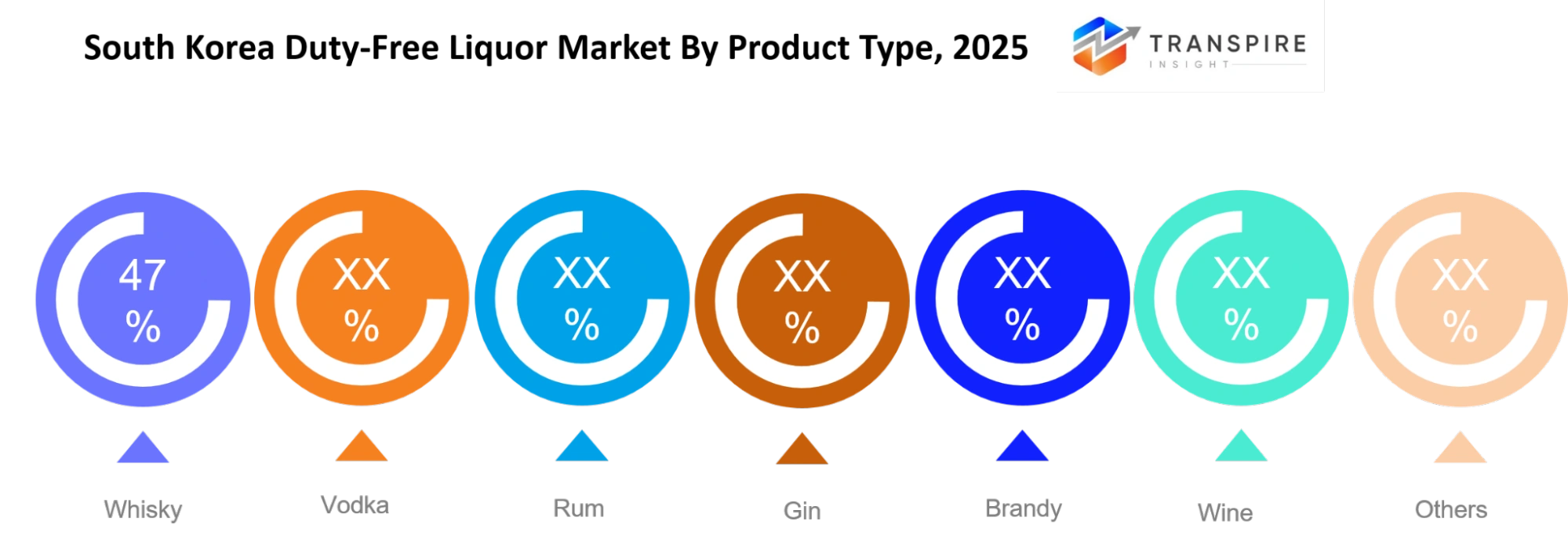
Whisky is leading the sales charts mostly because demand stays strong, especially for premium gifting things and those airport exclusives. Older-aged single malts, plus the blended options, will keep taking the biggest share in purchase choices for international travelers. The way the brands position themselves inside travel retail kind of helps justify higher pricing , and also makes repeat buys happen more often across the major airports.
Wine is still moving up at a steady pace, and it seems younger travelers lean toward lighter alcohol choices when they travel abroad. Vodka and brandy keep their footing in the mid-range segments and they don’t really wobble much. Gin and rum, on the other hand, show more of a niche growth angle, tied to flavored profiles and craft-style offerings. The “Others” bucket stays small , but it still gives room for a few limited seasonal launches now and then.
By Distribution Channel :
Airport duty-free remains the main route for sales, due to heavy passenger traffic and that very real impulse buying at departure terminals. In-store promos and exclusive product reveals will keep pushing conversion rates up across international lanes.
Online duty-free is growing fast, using pre-order setups that connect to flight bookings. Downtown duty-free spots remain relevant for local shoppers too, while cruise retail and border shops only add a smaller amount but it’s steady, supported by regional travel movement and packaged tourism services.
By Price Range :
Premium, luxury categories kind of just dominate here , mostly because people really want high value gifting and those collectible spirits, you know. Limited editions plus bottles that are only found in airports help protect margins , and you often see those seasonal spikes in sales volume across the biggest terminals.
The mid-range stuff stays pretty steady too, it’s mostly price sensitive travelers trying to get that sweet spot between decent quality and affordability, rather than going all in. The ultra-premium slice also keeps growing at a calm pace, powered by high-net-worth folks. Meanwhile, economy options feel more constrained in duty free settings, because the whole environment tends to push higher value transactions instead.
By Consumer Type :
Tourists are the largest consumer group overall, and that’s tied to outbound travel recovery and higher discretionary spend inside airport retail zones. Their buying tends to lean toward premium spirits and gift led alcohol choices right before international departures, like it’s planned.
Business travelers add consistent demand too, since their travel cycles are frequent and corporate gifting needs keep showing up. High-net-worth individuals pull ultra-premium upward, but domestic travelers don’t participate as much. The remaining segments are more of a niche mix, still they do support those occasional seasonal pushes and promotional buy patterns, sort of like background noise that matters.
What are the Key Use Cases Driving the South Korea Duty-Free Liquor Market?
The core use case in the South Korea Duty-Free Liquor Market kinda revolves around airport departure selling, where international passengers grab tax-free, top shelf spirits right before they board. The demand feels strong because of gifting rituals, noticeable price savings and also that slightly annoying reality that some airport-only items are limited and not really easy to find elsewhere.
Beyond that, the expansion is pretty tied to online pre order flows that connect with airline tickets, so travelers can reserve liquor earlier and, in theory, cut down that waiting around at the airport. On top of that, business travelers tend to keep buying again and again due to corporate gifting seasons, plus their steady stream of frequent international trips.
More newly emerging applications start to sound like AI driven personalization engines for airport retail, paired with biometric boarding integration so purchase validation is faster, and then there are digital customs pre clearance systems that help simplify how liquor is declared across borders. Over time, this also seems to improve compliance work ,and makes it more efficient overall.
|
Report Metrics |
Details |
|
Market size value in 2025 |
USD 283.7 Million |
|
Market size value in 2026 |
USD 314.1 Million |
|
Revenue forecast in 2033 |
USD 640.5 Million |
|
Growth rate |
CAGR of 10.72% from 2026 to 2033 |
|
Base year |
2025 |
|
Historical data |
2021 - 2024 |
|
Forecast period |
2026 - 2033 |
|
Report coverage |
Revenue forecast, competitive landscape, growth factors, and trends |
|
Country scope |
South Korea |
|
Key company profiled |
Lotte Duty Free, Shilla Duty Free, Shinsegae Duty Free, Heinemann Duty Free, DFS Group, Pernod Ricard, Diageo, Bacardi, Brown-Forman, Beam Suntory, Moët Hennessy, Campari Group, Rémy Cointreau, William Grant & Sons, Asahi Group |
|
Customization scope |
Free report customization (country, regional & segment scope). Avail customized purchase options to meet your exact research needs. |
|
Report Segmentation |
By Product Type (Whisky, Vodka, Rum, Gin, Brandy, Wine, Others) | By Distribution Channel (Airport Duty-Free, Downtown Duty-Free, Online Duty-Free, Cruise Retail, Border Stores, Others) | By Price Range (Premium, Luxury, Mid-Range, Economy, Ultra-Premium, Others) | By Consumer Type (Tourists, Business Travelers, Domestic Travelers, High-Net-Worth Individuals, Others) |
Which Regions are Driving the South Korea Duty-Free Liquor Market Growth?
Seoul–Incheon region kind of runs the South Korea Duty-Free Liquor Market because Incheon International Airport deals with the biggest stream of outbound travelers and it also has the most mature duty-free retail setup. On top of that, government backing for aviation and tourism stays strong so the international movement keeps looking steady, almost unbroken. Also there is a lot of retail floor space being assigned at the airport, so the premium liquor brands get strong visibility and even some exclusive launches. All of this ends up feeding continuous, higher-value buying by international shoppers.
Busan–Gyeongnam region is more like the steady side player , mainly because maritime links are solid and regional travel demand stays consistent. Compared with the capital area, the momentum here feels more tied to shipping-connected passenger flows and corporate itineraries rather than big mass tourism waves. Local economic resilience helps protect spending habits, so even when global travel patterns wobble a bit, the duty-free turnover doesn’t drop too hard. Duty-free shops in this region lean toward keeping reliable sales volume, rather than pushing aggressive expansion.
Jeju region looks like the fastest grower , pushed by rising leisure tourism and better flight coverage toward Southeast Asia and China. New airport improvements plus tourism promotion measures have lifted passenger numbers in a noticeable way. That change has created fresh interest in mid-to-premium liquor for short-haul visitors. For investors, it’s basically a signal for strong growth capacity through 2026–2033, since route diversification keeps widening over time, and that matters a lot.
Who are the Key Players in the South Korea Duty-Free Liquor Market and How Do They Compete?
South Korea Duty-Free Liquor Market still looks kinda moderately consolidated, with a handful of big operators basically controlling the airport retail space and at the same time pushing hard on exclusivity, brand alliances and digital integration. In practice the rivalry is more about landing better liquor allotments and turning travelers into buyers via pre-order tools, not so much price wars. Most incumbents try to hold their share by tying up long-term deals with airports and global spirit brands, while the smaller players often have trouble even getting access to the highest-traffic areas.
Lotte Duty Free sort of keeps its momentum with tough exclusivity pacts and broad airport coverage, mainly at Incheon, which means it gets solid control over those high-footfall liquor corners. The Shilla Duty Free feels more differentiated through premium store layout and a carefully chosen luxury spirit lineup, aimed at the high-spend international crowd. Hyundai Duty Free tends to go for selective expansion, plus partnerships with Korean brands to deepen how domestic travelers engage, rather than trying to spread everywhere at once. Dufry (Avolta) leans on global sourcing strength to stay competitive on price and roll out internationally recognizable liquor assortments.
Lagardère Travel Retail, meanwhile, expands through airport concession arrangements and travel retail concepts that feel more integrated, like combining liquor with broader duty-free moments for travelers, so it isn’t just a single category play.
Company List
- Lotte Duty Free
- Shilla Duty Free
- Shinsegae Duty Free
- Heinemann Duty Free
- DFS Group
- Pernod Ricard
- Diageo
- Bacardi
- Brown-Forman
- Beam Suntory
- Moët Hennessy
- Campari Group
- Rémy Cointreau
- William Grant & Sons
- Asahi Group
Recent Development News
In February 2026, Korea Customs Service confirmed Lotte Duty Free and Hyundai Duty Free as winners of key Incheon Airport liquor and tobacco concessions. The decision secured long-term operating rights at South Korea’s busiest duty-free hub and strengthened control over premium liquor retail space. Sourcehttps://moodiedavittreport.com/
In May 2025, Shinsegae Duty Free partnered with L’Oréal Travel Retail Asia Pacific to launch a premium beauty and travel retail activation at Incheon Airport. The initiative expanded cross-category duty-free engagement and increased liquor-adjacent footfall through bundled luxury shopping experiences. Sourcehttps://drinks-intel.com/
What Strategic Insights Define the Future of the South Korea Duty-Free Liquor Market?
The South Korea Duty-Free Liquor Market is moving kinda toward a more experience-led and digitally tied-up retail model, where airport ecosystems end up acting as curated luxury consumption hubs, not just straight-up tax-free sales stops. The next phase of growth will be driven mostly by ongoing outbound travel coming back, tighter competition for airport concession space, and a noticeable uptick in interest for premium spirits among younger international passengers. In the next 5 to 7 years, revenue will get more clustered around a handful of major airport operators, backed by exclusive brand arrangements, plus data-led personalization tools that push higher conversion right at departure.
There’s also a less obvious risk, that kind of hides in plain sight, which is over-reliance on passenger traffic. So if there’s any shift in visa rules, or regional aviation hiccups, sales volume can shrink fast, almost like overnight. But at the same time, a pretty clear opportunity is showing up in pre-travel digital commerce. Basically, airline booking platforms are starting to weave liquor reservations into loyalty ecosystems, letting travelers decide earlier before they even land or step into the terminal. Market players should really focus on building direct digital connections with airlines and put money into tailored recommendation systems, turning travel intent into pre-booked premium liquor sales. This approach should also cut down dependence on last-minute airport grab-and-go buying.
South Korea Duty-Free Liquor Market Report Segmentation
By Product Type
- Whisky
- Vodka
- Rum
- Gin
- Brandy
- Wine
By Distribution Channel
- Airport Duty-Free
- Downtown Duty-Free
- Online Duty-Free
- Cruise Retail
- Border Stores
By Price Range
- Premium
- Luxury
- Mid-Range
- Economy
- Ultra-Premium
By Consumer Type
- Tourists
- Business Travelers
- Domestic Travelers
- High-Net-Worth Individuals
Frequently Asked Questions
Find quick answers to common questions.
The South Korea Duty-Free Liquor Market size is USD 640.5 Million in 2033.
Key segments for the South Korea Duty-Free Liquor Market are By Product Type (Whisky, Vodka, Rum, Gin, Brandy, Wine, Others) | By Distribution Channel (Airport Duty-Free, Downtown Duty-Free, Online Duty-Free, Cruise Retail, Border Stores, Others) | By Price Range (Premium, Luxury, Mid-Range, Economy, Ultra-Premium, Others) | By Consumer Type (Tourists, Business Travelers, Domestic Travelers, High-Net-Worth Individuals, Others).
Major South Korea Duty-Free Liquor Market players are Lotte Duty Free, Shilla Duty Free, Shinsegae Duty Free, Heinemann Duty Free, DFS Group, Pernod Ricard, Diageo, Bacardi, Brown-Forman, Beam Suntory, Moët Hennessy, Campari Group, Rémy Cointreau, William Grant & Sons, Asahi Group.
The South Korea Duty-Free Liquor Market size is USD 283.7 Million in 2025.
The South Korea Duty-Free Liquor Market CAGR is 10.72% from 2026 to 2033.
- Lotte Duty Free
- Shilla Duty Free
- Shinsegae Duty Free
- Heinemann Duty Free
- DFS Group
- Pernod Ricard
- Diageo
- Bacardi
- Brown-Forman
- Beam Suntory
- Moët Hennessy
- Campari Group
- Rémy Cointreau
- William Grant & Sons
- Asahi Group
About the Authors

Chetan Dhatrak
I’m Chetan Dhatrak, a Senior Research Analyst at Transpire Insight, specializing in the Consumer Goods, Foods and Beverages industry. I focus on analyzing market trends, consumer behavior, competitive landscapes, and industry developments to deliver accurate, data-driven insights. My research at Transpire Insight is built on credible sources and in-depth analysis, helping businesses and readers better understand market dynamics, emerging opportunities, and evolving consumer preferences. I’m committed to creating reliable, well-researched content that supports informed decision-making and reflects the latest developments in the consumer goods and food & beverage sectors.

Chakradhar Khansole
Chakradhar serves as the Research Director at Transpire Insight, bringing over 8 years of experience in technology, innovation, and strategic market intelligence. He specializes in transforming complex market data into actionable business insights that enable organizations to make informed, growth-oriented decisions. Recognized for his strategic vision and analytical expertise, Chakradhar leads high-impact research initiatives, delivering comprehensive market assessments, competitive intelligence, and forward-looking industry analysis.
Recently Published Reports
-
Apr 2026
Baby Infant Formula Market
Baby Infant Formula Market Size, Share & Analysis Report By ype (Infant Milk, Follow On Milk, Specialty Baby Milk, Growing-Up Milk), By Ingredient (Carbohydrate, Fat, Protein, Minerals, Vitamins, and Others), By Product Form (Powder, Liquid, and Ready-to-feed), By Distribution Channels (Supermarket/Hypermarket, Specialty Store, Pharmacies, Online Retail, and Others), and Geography (North America, Europe, Asia-Pacific, Middle East and Africa, South and Central America), 2021 - 2031
-
Apr 2026
Edible Insects for Animal Feed Market
Edible Insects for Animal Feed Market Size, Share & Analysis Report By Type (Insect Powder, Insect Meal, Insect Bar, Insect Paste, Insect Oil, and Others), By Insect Type (Beetles, Cricket, Caterpillar, Hymenoptera, Orthoptera, Tree Bugs, and Others), By Application (Livestock, Pet Food, and Aquaculture), By Livestock Type (Poultry, Swine, and Others), and Geography (North America, Europe, Asia-Pacific, Middle East and Africa, South and Central America), 2021 - 2031
-
Apr 2026
Food Industry Disinfection and Bacterial Control Market
Food Industry Disinfection and Bacterial Control Market Size, Share & Analysis Report By Type (Chemical Disinfectants, Physical Disinfectants, and Biocides and Antimicrobials), By Application (Food Processing Equipment Surface Disinfection, Food Preparation Areas Surface Disinfection, Storage Areas Surface Disinfection, Anti-microbial Coatings Food Preservation, and Preservative Solutions Food Preservation), By End User (Meat and Poultry Processing, Dairy Processing, Seafood Processing, Bakery and Confectionery, Restaurants and Commercial Kitchens, and Food Service Providers), By Sales Channel (Online, Offline), and Geography (North America, Europe, Asia-Pacific, Middle East and Africa, South and Central America), 2021 - 2031
-
May 2026
Freeze Dried Food Market
Freeze Dried Food Market Size, Share & Analysis Report By Product Type (Fruits, Vegetables, Freeze-Dried Dairy Products, Freeze-Dried Meat and Seafood, Freeze-Dried Pet Food, and Prepared Meal), By Nature (Organic, and Conventional), By Form (Powdered, Granules, and Diced), By End Use (Breakfast Cereals, Dairy Products, Bakery & Confectionery, Nutritional Bars & Supplements, Powdered Beverages, Snacks, and Retail (Household)), and Geography (North America, Europe, Asia-Pacific, Middle East and Africa, South and Central America), 2021 - 2031