
Asia Pacific Travel Retail Market Size & Forecast:
- Asia Pacific Travel Retail Market Size 2025: USD 36.9 Billion
- Asia Pacific Travel Retail Market Size 2033: USD 65.8 Billion
- Asia Pacific Travel Retail Market CAGR: 7.52%
- Asia Pacific Travel Retail Market Segments: By Product Type (Perfumes & Cosmetics, Wines & Spirits, Fashion & Accessories, Electronics, Confectionery, Tobacco Products, Others); By Channel (Airports, Border Stores, Airlines, Ferries, Downtown Duty Free, Others); By Traveler Type (Business Travelers, Leisure Travelers, International Tourists, Others); By End User (Men, Women, Millennials, Others)
Asia Pacific Travel Retail Market Summary
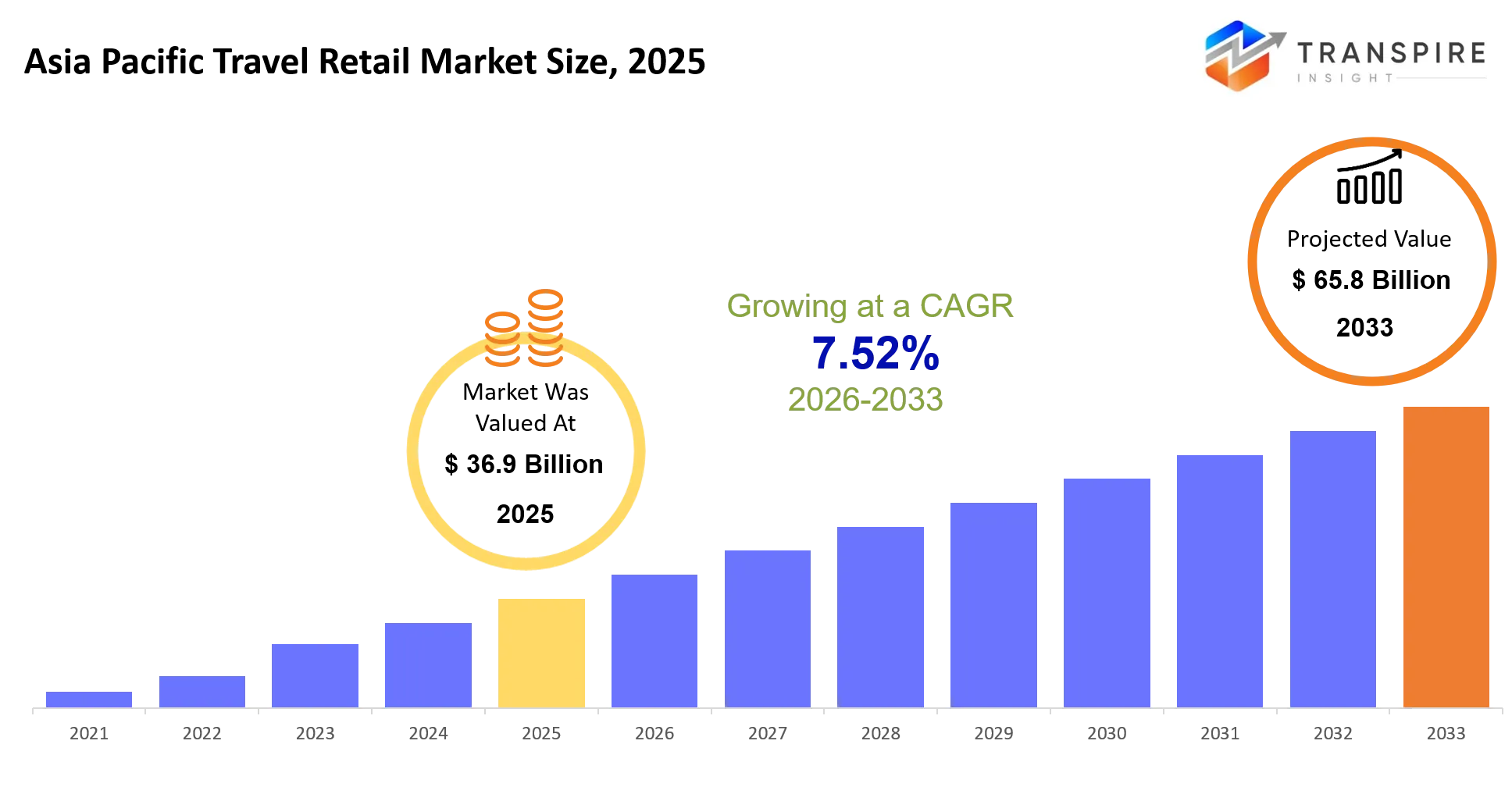
The Asia Pacific Travel Retail Market was valued at USD 36.9 billion in 2025. It is forecast to reach USD 65.8 billion by 2033. That is a CAGR of 7.52% over the period.
The Asia Pacific Travel Retail Market kind of supports travelers by giving access to premium goods, quick convenience items, local specialties, and luxury labels inside airports seaports border crossings ,and various transit hubs. For operators, airports, and transport authorities, travel retail is more like a critical non-aeronautical revenue stream that helps spread income sources, beyond the passenger fees and transport services.
In the last few years the whole market has moved away from a transaction centric duty-free scheme toward a digitally enabled retail ecosystem, where things like pre-ordering, mobile engagement, loyalty programs , and custom promotions work together. A big push behind this change was the disruption caused by the COVID-19 pandemic, which basically forced retailers and airport operators to rethink how they connect with customers and to speed up digital commerce skills. When international travel started to bounce back, retailers used traveler data and omnichannel platforms to boost conversion rates, and even lift basket sizes. That overall has helped grow revenue in key travel hubs, especially in China, South Korea, Singapore, and parts of Southeast Asia, while also nudging brands to roll out exclusive product assortments that fit high-spending international travelers.
Key Market Insights
- China is really big in the Asia Pacific Travel Retail Market. It has 35 to 40 percent of the market in 2025. This is because people from China and other countries are spending a lot of money when they travel.
- South Korea is also doing well. It sells a lot of cosmetics and skincare products and fancy clothes.
- The Southeast Asia region is growing fast from 2025 to 2030. This is because more people are traveling again and airports are being improved.
- Singapore is becoming a place for travel shopping. It has many luxury brands and people can shop online.
- People buy a lot of beauty and personal care products. These products make up about 30 to 35 percent of the market. People really want to buy skincare and cosmetics.
- Fashion and accessories are also very popular. International travelers like to buy luxury items.
- Food and local specialty products are going to be very popular until 2030.
- When new products are only available at airports people like to buy them.
- Airports have than 70 percent of the market. This is because many people travel through airports and they have a lot of shops.
- Downtown duty-free stores are also very popular, in China and South Korea.
What are the Key Drivers, Restraints, and Opportunities in the Asia Pacific Travel Retail Market?
The main thing pushing the Asia Pacific Travel Retail Market forward is kinda a mix of the recovery , and also expansion, of international passenger traffic together with the modernization of airport retail ecosystems. After the borders started reopening across many Asia Pacific economies, airport operators and retailers went in pretty hard on digital pre-order platforms, mobile payment systems, and those personalized shopping moments. And yeah, this tech shift has boosted conversion rates since travelers can browse and reserve items before they even land. At the same time luxury brands have grown their exclusive travel retail product portfolios , which sort of nudges spending per passenger upward. So the end result is more solid retail revenue generation and better profitability across airports, duty-free operators , and brand partners as well.
Still, the biggest obstacle is the market’s reliance on international travel flows plus aviation infrastructure. That’s kind of a structural constraint because travel retail results track passenger volumes in a pretty direct way, along with airline capacity, visa policies, and geopolitical stability. This is not like a problem you can fix overnight via pricing or marketing tactics, since these drivers are bigger than retailer decisions. If cross-border travel gets disrupted, customer footfall and transaction volumes can drop immediately. It also dampens revenue potential in developing markets where airport infrastructure expansion and international route development are moving slower, for example.
There’s a pretty big growth chance in widening travel retail across Southeast Asia, like honestly it’s starting to feel inevitable. Nations such as Vietnam, Indonesia and the Philippines are putting money into fresh airports and terminal upgrades, just to handle more tourism as well as corporate trips. And once you add AI- based personalization, plus omnichannel retail platforms that sync everything together, it kind of sets up the scenario for stronger traveler attention, and sure, more spending too. As regional passenger numbers keep climbing, retailers can reach new income streams outside the usual duty free areas, they can also build a firmer, longer lasting presence in those new travel hubs.
What Has the Impact of Artificial Intelligence Been on the Asia Pacific Travel Retail Market?
Artificial intelligence and advanced digital technologies are, pretty much, reworking travel retail operations at airports at duty free stores and transit hubs all across Asia Pacific. Retailers are more and more leaning on AI powered automation to handle inventory replenishment, tune product placement, and keep an eye on shopper flows in real time. With these smart retail platforms they can, almost automatically, shift promotions pricing, and stock distribution depending on passenger movement trends, which lets operators cut down on stockouts and raise sales conversion.
Also, machine learning models are making the predictive side stronger. When retailers study traveler profiles, flight timetables, purchase records and the usual seasonal demand rhythms, they get a clearer read on what people will buy, then they can optimize procurement decisions. This kind of predictive analytics helps luxury brands and duty-free operators align their inventory with the passenger volumes they expect, so there is less surplus sitting around, while product availability stays better. Some airport retailers have even seen improved inventory turnover, plus more efficient merchandising calls thanks to AI driven demand forecasting.
Operationally, digital technologies are kindof enhancing revenue generation via more personalized recommendations, mobile pre-order platforms, and focused marketing campaigns. they help raise customer engagement, boost basket sizes, and generally back higher conversion rates. And then AI-enabled loyalty programs, these can further strengthen traveler retention by delivering individualized offers across online as well as physical retail channels.
Still, though, there is a main limitation that kinda sticks around ,the high cost of integrating AI systems across fragmented airport, airline, and retail data settings. A lot of operators continue to run into problems with data quality, legacy infrastructure ,and cross platform interoperability which can end up reducing the reliability and scaling of advanced analytics efforts.
Key Market Trends
- Since 2021 big airport stores have started to let people order things before they get to the airport and pick them up when they arrive. This has changed the way people shop before they leave for their trip.
- Luxury beauty brands have moved their money to products that you can only get when you travel. They did this from 2022 to 2025 to get more people to buy things when they are traveling to countries.
- The way people from China spend money when they travel has changed a lot since the borders opened again. This has made stores want to sell more than makeup and fancy things.
- Airports in Singapore, South Korea and Thailand have put a lot of money into making it easier for people to shop online. This means people do not have to buy things in the store.
- After 2023 it became normal for stores to use tools that can tell what each person likes and what they have bought before. This helps stores send deals to people who might want to buy something.
- Now stores are competing to make the experience of shopping instead of just trying to have more stores. Companies like DFS Group, Avolta and Lotte Duty Free are spending a lot of money to make it easy for people to shop in different ways.
- Stores are working with brands to make special products that you can only get at the airport. This makes people want to buy things because they are special and not many people can get them.
- People have started to care more about the Earth after 2022 so brands are trying to use waste and make packaging that can be recycled. They are doing this in all the places where people travel.
- Airports, in Southeast Asia are becoming places for stores to expand to because a lot of people are traveling again.
- Between 2021 and 2025 more and more people started to use their phones to pay for things. This makes it easier for people to buy things when they are traveling to countries.
Asia Pacific Travel Retail Market Segmentation
By Product Type:
Beauty and personal care products keep doing really well, holding a leading spot across many travel retail locations in Asia Pacific, somehow. Premium skincare , cosmetics, fragrances and personal grooming items still pull strong spend from international travelers who want that exclusive selection and the travel-only stuff. Luxury brands often roll out limited- edition collections and airport-exclusive offerings, to lift purchase value a bit more and also boost brand recognition right there. Digital promotions, plus personalized suggestions, have also helped people find items faster inside big airport retail spaces , in a more seamless way.
Fashion and accessories are still a major part of what shoppers see, because interest stays high in luxury handbags , watches, jewelry and more lifestyle type products. Meanwhile, food , confectionery and regional specialty products get more attention too, as travelers increasingly prefer buys that feel tied to the destination, and for gift purposes. Wines, spirits, electronics and tobacco products continue contributing meaningful sales, even if the buying rhythm changes a lot depending on the country and the local rules, so it’s not fully one-size-fits-all. Product diversification stays crucial, because retailers want to balance premium categories with everyday convenience purchases , without losing anyone.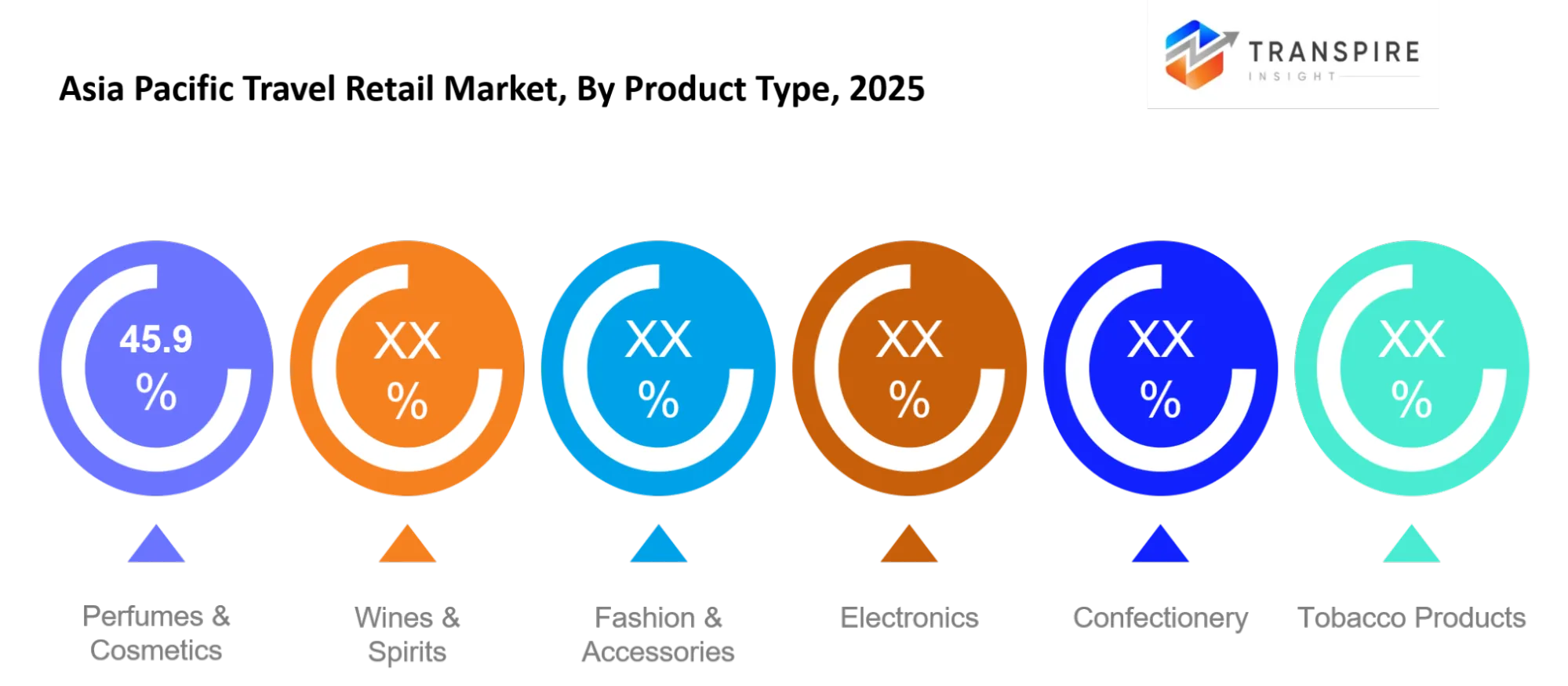
By Channel:
Airport retail is still, kind of the main sales channel, and it stays that way because of huge passenger volumes and lots of commercial infrastructure. Nowadays airports don’t just rely on traditional duty-free layouts anymore, they’ve started mixing in digital storefronts, mobile buying, and even pre-order services. It feels like the whole journey becomes more connected, so people spend not only while they’re traveling but also before the trip starts. Terminal upgrades also matter , because they tend to boost customer engagement across big regional hubs.
Meanwhile downtown duty-free shops keep pulling in visitors, especially in places where tourism and luxury retail go hand in hand. You also see border outlets and cruise terminal stores adding to overall sales, mainly by targeting certain traveler groups and transit routes. In the last few years online reservation platforms linked to physical locations have gotten more important . When digital and physical are integrated more smoothly, conversion rates usually improve, and the brand reach becomes wider too.
By Traveler Type:
Leisure travelers make up a pretty large share of the overall spending , because vacation time purchases tend to bundle luxury goods, gifts, cosmetics and those local specialty items that feel more personal. Basically the strong tourism momentum across destinations like Singapore, Thailand, South Korea, and Japan is still keeping transaction volumes steady. When there are exclusive product launches and destination focused merchandise, it pushes higher basket values for this group of travelers. Also, seasonal travel windows usually open up noticeable sales opportunities for retailers, sometimes almost like clockwork.
Then there’s the business travelers side too, which is a meaningful customer segment especially around big international airports and transit hubs. For them convenience driven buys, premium accessories, fragrances, and gifting products are often the norm for frequent flyers. On top of that, more people using digital payment systems combined with personalized promotions has made this group more engaged. Younger travelers are also starting to shape purchase patterns , they show up with mobile-first shopping habits and a stronger interest in branded experiences.
By End User:
International travelers are still basically the main end-user group, because when you go across borders, it really opens up the duty-free and travel-only buying moments. Premium product groups often do well with travelers who are hunting for well known global brands, and also those limited edition bits and pieces. Better air connectivity and more international routes keep pushing retail activity in the big transport hubs. At the same time, retail operators are using customer data more and more, so they can line up their product assortment with what travelers seem to want.
Domestic travelers are also getting more importance in a few specific markets, where airport retail infrastructure has been growing and tourism stays lively. Luxury shoppers keep adding meaningful, high value transactions, especially in places like beauty items, fashion add-ons, and premium gifts. Younger consumers are starting to steer the choices, not just by browsing but through digital engagement, and mobile shopping platforms. Ongoing investment in more personal in-store experiences is expected to help lock in repeat customers and lift spend, for different traveler groups all at once.
What are the Key Use Cases Driving the Asia Pacific Travel Retail Market?
The main use case moving adoption forward in the Asia Pacific Travel Retail Market is really airport based retailing, where international travelers pick up beauty products, luxury goods, fragrances and premium accessories while they are in transit. In practice this is the one that pulls the most demand, because airports stack a lot of high spending consumers into a short time window, which means there are strong chances for both impulse buys and more deliberate planned purchases too.
Beyond that, other applications are slowly getting louder through downtown duty-free stores and also through integrated digital shopping platforms. More and more leisure travelers lean on pre order services before departure while business travelers tend to stick to convenient purchasing options inside the transit hubs. Basically these routes let retailers interact with customers beyond the usual in store exchange, and that can lift overall conversion rates in the process.
Something newer is starting to show up as well, like AI driven personalized shopping experiences and location based promotions sent via mobile applications. Retailers are also testing virtual product discovery tools, and putting together more data centered loyalty ecosystems. As airport operators invest in smart infrastructure and digital commerce capabilities, these applications should open up fresh revenue streams and keep strengthening customer engagement across travel retail networks, over time.
|
Report Metrics |
Details |
|
Market size value in 2025 |
USD 36.9 Billion |
|
Market size value in 2026 |
USD 39.6 Billion |
|
Revenue forecast in 2033 |
USD 65.8 Billion |
|
Growth rate |
CAGR of 7.52% from 2026 to 2033 |
|
Base year |
2025 |
|
Historical data |
2021 - 2024 |
|
Forecast period |
2026 - 2033 |
|
Report coverage |
Revenue forecast, competitive landscape, growth factors, and trends |
|
Regional scope |
Asia Pacific (India, China, Japan, Australia, South Korea, Rest of Asia Pacific) |
|
Key company profiled |
DFS Group, Dufry, Lagardere Travel Retail, Lotte Duty Free, Shilla Duty Free, China Duty Free Group, King Power, JR Duty Free, Duty Free Americas, Heinemann, WH Smith, Flemingo, Sunrise Duty Free, Ever Rich, Duty Zero |
|
Customization scope |
Free report customization (country, regional & segment scope). Avail customized purchase options to meet your exact research needs. |
|
Report Segmentation |
By Product Type (Perfumes & Cosmetics, Wines & Spirits, Fashion & Accessories, Electronics, Confectionery, Tobacco Products, Others); By Channel (Airports, Border Stores, Airlines, Ferries, Downtown Duty Free, Others); By Traveler Type (Business Travelers, Leisure Travelers, International Tourists, Others); By End User (Men, Women, Millennials, Others) |
Which Regions are Driving the Asia Pacific Travel Retail Market Growth?
Asia Pacific kind of leads the market because it has a lot of major international airports, big passenger traffic numbers and also strong government backing for tourism and aviation development. China South Korea Singapore and Japan work as main travel retail hubs , largely because they have deep airport infrastructure and pretty well built duty-free environments. The policy moves that get people to spend more on tourism, and push airport commercial growth , have helped retail do better across the whole region . There’s also this mature mix of airport operators luxury brands travel retailers and digital commerce providers, and they keep supporting long-term leadership more or less.
Europe is the second-largest contributor, though the way it grows is a bit different than Asia Pacific. Market results are pushed by steady international travel , plus luxury retail networks that are already in place, and ongoing investment into airport modernization. Regional and international travelers usually bring solid purchasing power , which helps revenue stay dependable at many major airports. On top of that, the regulatory setup is well developed , and airport operators have long standing connections with global brands , so things stay stable even when the economy feels a little uncertain.
The Middle East looks like it’s turning into the fastest growing region, mainly because of huge airport expansion schemes and the ongoing push for tourism infrastructure investment. Countries such as the United Arab Emirates and Saudi Arabia have been really pushing hard to be seen as world class transit and visitor hotspots. Fresh terminal developments, plus wider airline networks, and more upmarket retail concepts, have in practice boosted commercial chances a lot at key travel hubs. With this kind of momentum continuing, it should lead to nice opportunities for retailers , luxury brands , and investors who are hunting for exposure to those high-growth travel corridors between 2026 and 2033.
Who are the Key Players in the Asia Pacific Travel Retail Market and How Do They Compete?
In the Asia Pacific Travel Retail Market, competition feels moderately consolidated, but it still looks like a small set of global and regional operators are basically holding the key positions, especially at the busiest airport and duty-free spots. Most of the rivalry isn’t really about price as much , it’s more about who can get the best retail frontage, win exclusive brand partnerships , build solid digital engagement, and deliver a smoother customer experience, you know. Even the established players keep trying to defend their share with long-term concession deals, along with continued investments into omnichannel retail platform s. At the same time, regional specialists are moving deeper into fresh travel hubs because airport infrastructure projects keep opening up more commercial possibilities.
DFS Group stands out by putting extra emphasis on luxury retail and those destination specific shopping moments in major tourism areas. They push customer engagement forward with carefully curated premium assortments, plus exclusive product releases made with well known luxury brands. Lotte Duty Free, meanwhile, relies on its very strong South Korea footprint and then the steadily growing international reach to pull in high spending travelers. It also keeps expanding via airport concessions and by teaming up strategically with brands. Shilla Duty Free competes by leaning into digital commerce integration, so travelers can browse, reserve, and purchase products across different channels before they even arrive on site.
Avolta kind of merges wide geographic reach with a lot of airport retail know how, and that gives it some advantages in managing large concessions and using customer data in a more… practical way. Lagardère Travel Retail meanwhile leans into a mix of retail ideas, that sort of blend duty-free with convenience, food, and even specialty retail inside transport hubs. China Duty Free Group is benefiting from a solid place inside the Chinese travel retail scene, and it keeps pushing forward via domestic tourism channels plus the backing of duty-free policy support. Lately these players also pour resources into personalization technologies , they use exclusive merchandise and regional expansion tactics too, and the goal is to boost loyalty and raise revenue per traveler, even when traffic patterns shift a bit.
Company List
- DFS Group
- Dufry
- Lagardere Travel Retail
- Lotte Duty Free
- Shilla Duty Free
- China Duty Free Group
- King Power
- JR Duty Free
- Duty Free Americas
- Heinemann
- WH Smith
- Flemingo
- Sunrise Duty Free
- Ever Rich
- Duty Zero
Recent Development News
Here are the entries with the full URLs included:
"In January 2026, China Tourism Group Duty Free (CTG Duty-Free) announced an agreement to acquire DFS Group's travel retail business in Hong Kong and Macau, along with intangible assets in Greater China. The approximately US$395 Billion transaction significantly strengthens CTG Duty-Free's position in the Greater China travel retail sector and expands its international footprint.https://www.reuters.com
"In March 2026, China Tourism Group Duty Free completed the acquisition of DFS Group's Greater China retail business through its subsidiary China Duty Free International Limited. The completion consolidated CTG Duty-Free's presence in Hong Kong and Macau and further strengthened its control over premium travel retail operations in the region.https://www.tradingview.com
"In January 2026, DFS Group and China Tourism Group Duty Free entered into a strategic transaction agreement that included a memorandum of understanding between CTG Duty-Free and LVMH for future retail collaboration. The arrangement creates opportunities for joint initiatives in product sales, store development, brand promotion, travel services, and customer experience across Greater China.https://www.lvmh.com
What Strategic Insights Define the Future of the Asia Pacific Travel Retail Market?
Over the next five to seven years, the Asia Pacific Travel Retail Market is expected to drift toward a highly integrated commerce model, where physical retail space, traveler data, and digital engagement kinda work as one ecosystem— not just separate parts that don’t talk. The main push behind this move is that retailers and airport operators are getting better and better at capturing, analyzing, and monetizing traveler behavior across the entire journey , instead of only focusing on the purchase moment. And it’s likely this shift will start to favor operators who can pair exclusive product assortments with more tailored digital experiences.
There’s also a risk that’s less visible, like market concentration. A bigger slice of revenue is coming from a relatively small group of major airports, travel corridors, and concession operators. So if anything disrupts passenger flows, concession renewals, or regulatory changes in those spots, the knock on effects could be way more than proportional for how the region performs financially .
On the upside, there’s an emerging opportunity around AI-driven retail ecosystems in secondary airports across Southeast Asia, especially in Vietnam, Indonesia , and the Philippines. As these markets add more aviation capacity, retailers should lean into partnerships with airport operators, and invest early in data- centered customer engagement platforms. The idea is to secure long-term competitive positioning before these hubs reach full maturity, or, you know, before they get too crowded and harder to enter.
Asia Pacific Travel Retail Market Report Segmentation
By Product Type
- Perfumes & Cosmetics
- Wines & Spirits
- Fashion & Accessories
- Electronics
- Confectionery
- Tobacco Products
- Others
By Channel
- Airports
- Border Stores
- Airlines
- Ferries
- Downtown Duty Free
- Others
By Traveler Type
- Business Travelers
- Leisure Travelers
- International Tourists
- Others
By End User
- Men
- Women
- Millennials
- Others
Frequently Asked Questions
Find quick answers to common questions.
The Expected Asia Pacific Travel Retail Market size for the Market will be USD 65.8 Billion in 2033.
Key Segments for the Asia Pacific Travel Retail Market are By Product Type (Perfumes & Cosmetics, Wines & Spirits, Fashion & Accessories, Electronics, Confectionery, Tobacco Products, Others); By Channel (Airports, Border Stores, Airlines, Ferries, Downtown Duty Free, Others); By Traveler Type (Business Travelers, Leisure Travelers, International Tourists, Others); By End User (Men, Women, Millennials, Others).
Major Asia Pacific Travel Retail Market Players are DFS Group, Dufry, Lagardere Travel Retail, Lotte Duty Free, Shilla Duty Free, China Duty Free Group, King Power, JR Duty Free, Duty Free Americas, Heinemann, WH Smith, Flemingo, Sunrise Duty Free, Ever Rich, Duty Zero.
The Current Asia Pacific Travel Retail Market size is USD 36.9 Billion in 2025.
The Asia Pacific Travel Retail Market CAGR is 7.52% from 2026 to 2033.
- DFS Group
- Dufry
- Lagardere Travel Retail
- Lotte Duty Free
- Shilla Duty Free
- China Duty Free Group
- King Power
- JR Duty Free
- Duty Free Americas
- Heinemann
- WH Smith
- Flemingo
- Sunrise Duty Free
- Ever Rich
- Duty Zero
About the Authors

Chetan Dhatrak
I’m Chetan Dhatrak, a Senior Research Analyst at Transpire Insight, specializing in the Consumer Goods, Foods and Beverages industry. I focus on analyzing market trends, consumer behavior, competitive landscapes, and industry developments to deliver accurate, data-driven insights. My research at Transpire Insight is built on credible sources and in-depth analysis, helping businesses and readers better understand market dynamics, emerging opportunities, and evolving consumer preferences. I’m committed to creating reliable, well-researched content that supports informed decision-making and reflects the latest developments in the consumer goods and food & beverage sectors.

Chakradhar Khansole
Chakradhar serves as the Research Director at Transpire Insight, bringing over 8 years of experience in technology, innovation, and strategic market intelligence. He specializes in transforming complex market data into actionable business insights that enable organizations to make informed, growth-oriented decisions. Recognized for his strategic vision and analytical expertise, Chakradhar leads high-impact research initiatives, delivering comprehensive market assessments, competitive intelligence, and forward-looking industry analysis.
Recently Published Reports
-
Apr 2026
Bottled Water Market
Bottled Water Market Size, Share & Analysis Report By Product Type (Still Bottled Water, Carbonated Bottled Water, Functional Bottled Water, and Others), By Packaging (PET, Cans, and Others), By Sales Channel (Supermarkets/Hypermarkets, Convenience Stores/Drug Stores, Grocery Stores/Club Stores, Foodservice, and Others) and Geography (North America, Europe, Asia-Pacific, Middle East and Africa, South and Central America), 2021 - 2032
-
Apr 2026
Color Cosmetic Packaging Market
Color Cosmetic Packaging Market Size, Share & Analysis Report By Application (Mascara Packaging, Liquid Packaging, and Liquid Face), By Type (Tubes & Bottles, Pens & Markers, Compacts & Containers, and Droppers & Pumps), and Geography (North America, Europe, Asia-Pacific, Middle East and Africa, South and Central America), 2021 - 2031
-
Apr 2026
External Microphone For Camera Market
External Microphone For Camera Market Size, Share & Analysis Report By Type (Shotgun Microphone, Lavalier Microphone, and Others), By Application (Digital Camera, Professional Video Camera, and Others), and Geography (North America, Europe, Asia-Pacific, Middle East and Africa, South and Central America), 2021 - 2031
-
Apr 2026
Foot Orthotic Insoles Market
Foot Orthotic Insoles Market Size, Share & Analysis Report By Type (Pre-fabricated, and Custom-made), By Material (Thermoplastic, Composite Carbon Fiber, and Others), By Distribution Channel (Drug Stores, Hospitals & Clinics, and Others), and Geography (North America, Europe, Asia-Pacific, Middle East and Africa, South and Central America), 2021 - 2031