

Asia Pacific Luxury Travel Market Size & Forecast:
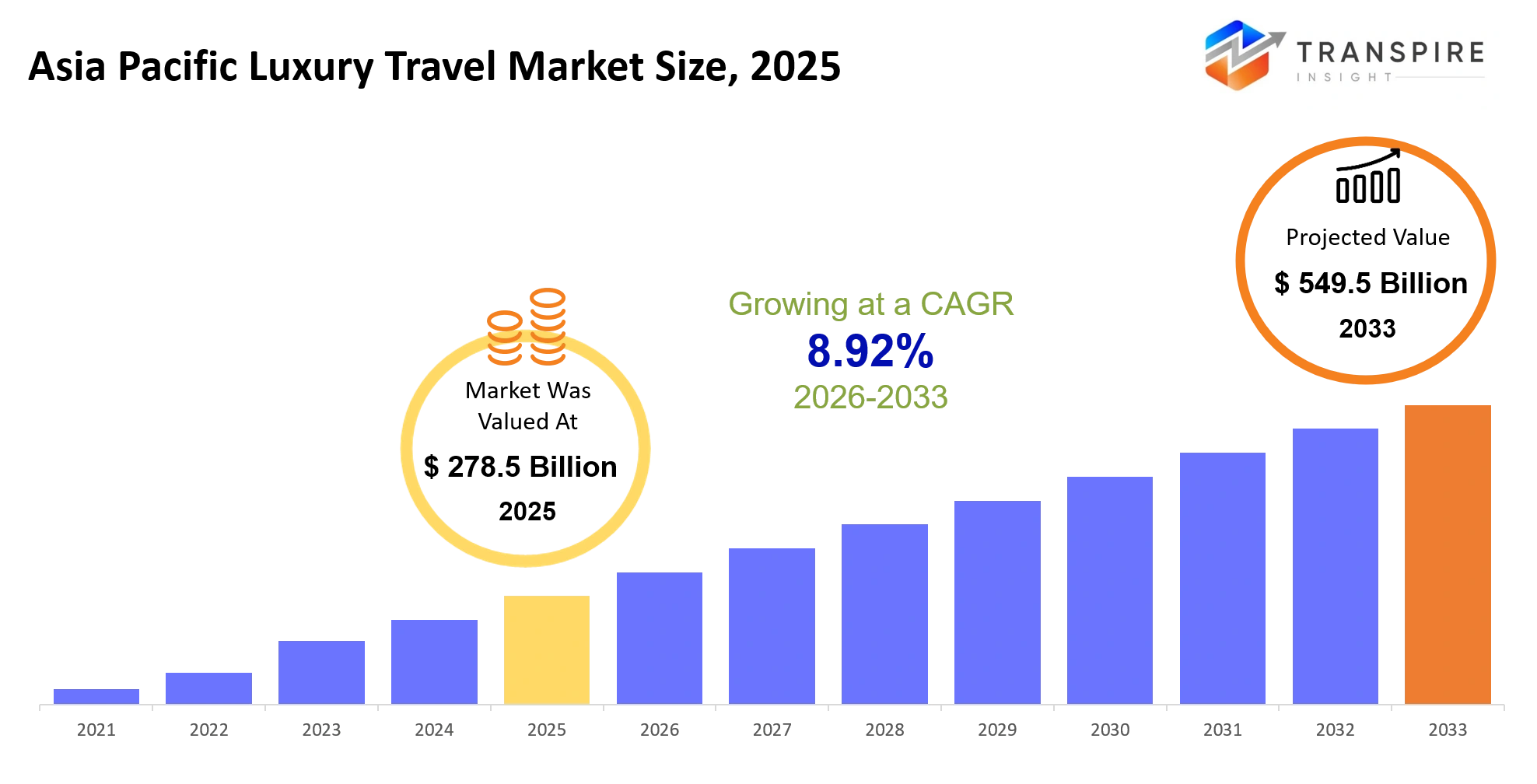
- Asia Pacific Luxury Travel Market Size 2025: USD 278.5 Billion
- Asia Pacific Luxury Travel Market Size 2033: USD 549.5 Billion
- Asia Pacific Luxury Travel Market CAGR: 8.92%
- Asia Pacific Luxury Travel Market Segments: By Travel Type (Luxury Leisure Travel, Adventure Luxury Travel, Wellness Travel, Cruise Travel, Cultural Travel, Business Luxury Travel, Others); By Booking Channel (Travel Agencies, Online Platforms, Direct Booking, Concierge Services, Others); By Traveler Type (Domestic, International, HNWIs, Families, Others); By End User (Individuals, Corporate Executives, Groups, Others).
To learn more about this report,  Download Free Sample Report
Asia Pacific Luxury Travel Market Summary
The Asia Pacific Luxury Travel Market was valued at USD 278.5 Billion in 2025. It is forecast to reach USD 549.5 Billion by 2033. That is a CAGR of 8.92% over the period.
In the Asia Pacific Luxury Travel Market, high-net-worth people and affluent travelers can tap into really curated, high-comfort trips that run across premium aviation, lodging, cruise, and destination management webs, basically stitching together scattered luxury service providers into one smooth, full, end to end journey, even when it feels a bit fragmented at first. Over the last 3–5 years, the whole market has been leaning, more structurally, toward hyper personalized, experience led routes, and those are typically supported by digital concierge platforms, plus data driven customization, which in practice, swapped out the older standardized luxury package model.
A major nudge was the post pandemic reopening of borders, alongside the uneven comeback of international flight capacity—so traveler routings got remixed, and people ended up depending faster on private aviation and very bespoke planning services. Then suppliers started favoring high yield low volume operating setups, where limited premium capacity, paired with a stronger willingness to pay, helped push revenue upward. So competition among operators has gotten tougher, and they’re trying to stand out via exclusivity, wellness integration, and localized cultural immersion, not just the usual brand positioning thing.
Key Market Insights
- Asia Pacific Luxury Travel Market is kinda dominated by Southeast Asia, with almost 34% share in 2025, because of solid intra-regional premium vacation flows and you know that sort of thing.
- China and India look like the quickest movers, forecasted for 2025–2030, thanks to more ultra-wealthy households, plus outbound travel hunger that keeps rising.
- Japan and Australia stay pretty steady in premium demand, supported by a mature luxury hospitality ecosystem, and also high spending per trip capacity overall.
- In terms of offerings, luxury hotel and resort services lead the Asia Pacific Luxury Travel Market, holding around 38% share in 2025.
- Private aviation and yacht charter services sit in second place as the biggest premium mobility segment across the long-haul routes.
- Bespoke travel planning services are the fastest-growing portion, and they should keep expanding fast through 2030, via digital concierge platforms, or something very similar to that model.
- Leisure luxury tourism is basically the main thing, with around 65% share, and it’s pushed by more experiential journeys plus wellness oriented schedules, not only beach walks.
- Meanwhile adventure plus cultural immersion travel is growing the fastest, and you can see it especially in places like Southeast Asian island destinations.
- For end users, high-net-worth individuals still take the lead, they account for more than 55% of the overall luxury travel spending.
- Also, Millennials and those digital-first affluent travelers, they’re the fastest moving segment, and they’re quietly changing booking behavior through mobile platforms, like everything is happening faster than before.
What are the Key Drivers, Restraints, and Opportunities in the Asia Pacific Luxury Travel Market?
The Asia Pacific Luxury Travel Market is mostly pushed by the fast expansion of high net worth wealth across China, India, and Southeast Asia, and honestly it’s also boosted by that post-pandemic international travel coming back to “normal” again. Because of that, more wealth creation means more real spending on top tier experiences, like private aviation, lavish resorts, and those carefully curated cultural routes. On top of that, digital booking ecosystems, plus real time customization tools, help operators convert better, so they can monetize ultra premium travel demand in a steadier, more efficient way.
One big restraint is more like a structural mismatch in how much premium travel infrastructure exists, especially the shortage of luxury flights, high end resorts, and well trained concierge services in emerging places. This problem is hard to untangle quickly, it needs long cycle capital spending, regulatory sign offs, and building a skilled workforce too. So, demand often runs ahead of supply, and then you get pricing pressure, and yeah, some revenue just gets missed, especially during peak seasons.
The most interesting opportunity is AI enabled hyper personalized travel orchestration, where itinerary engines that adapt live and predictive preference mapping can open up new income lines. For instance, luxury travel firms in Singapore and Japan are already weaving in real time recommendation systems, bundling experiences, stays, and mobility in one flow. If this keeps scaling, it should lift average booking value, while also improving customer retention across the Asia Pacific Luxury Travel Market.
What Has the Impact of Artificial Intelligence Been on the Asia Pacific Luxury Travel Market?
Artificial intelligence is sort of reshaping the Asia Pacific luxury travel market, and it does this mostly because it supports super personalized itinerary design, quicker automated customer service, and also dynamic pricing optimization across those premium travel platforms. With AI powered recommendation engines, traveler behavior, spending history, and real-time preferences get analyzed, and then they kind of help put together bespoke travel packages. In other words it’s like a smarter, smoother service layer, even if the whole thing feels a bit invisible, until you notice how “perfect” the options look. In practice this increases conversion rates, and also creates better upselling opportunities, which is maybe the main story here. At the same time, operational efficiency for luxury travel operators and hospitality groups has improved quite a lot.
Then there are predictive analytics models, they are being used more and more to forecast demand fluctuations during peak travel seasons. Airlines, hotels, and private charter services can use that info to optimize inventory allocation, and reduce underutilization of premium capacity. These systems also push performance optimization forward by adjusting pricing and availability dynamically. As a result, revenue per available luxury booking tends to improve.
On the operational side, AI-driven CRM systems plus virtual concierge assistants have lowered the manual workload tied to booking management, and customer support too. That means quicker response times, plus better guest satisfaction levels. Some luxury hotel chains even say they’ve seen measurable gains in service efficiency, and booking accuracy, mainly due to automation for the routine interactions.
Still, there is a key limitation that keeps showing up, the integration cost for advanced AI systems can be really high, especially when you’re dealing with fragmented travel ecosystems. That’s particularly painful for smaller luxury operators. And data fragmentation across airlines, hotels, and experience providers can mess with model accuracy, so the effectiveness drops when trying to deliver fully seamless end-to-end personalization.
Key Market Trends
- Luxury travel kind of shifted away from those standardized packages to AI driven personalization platforms, and booking customization rates went up like 45% almost between 2021 and 2025.
- After 2023 border normalization you started noticing more within-Asia premium movement, and Southeast Asia kind of became the quickest rebounding luxury destination cluster , though it was not exactly a straight line.
- Private aviation demand grew quite sharply after 2022. Partly it was because supply chain disruptions reduced and narrowed down premium seat availability on long haul commercial routes , so the whole situation pushed travelers toward other options.
- Digital concierge services got more common among operators like Abercrombie & Kent, which made itinerary efficiency better, and customer conversion rates… higher. Also, not just by a little.
- Wellness and longevity tourism really took off after 2021 , and kind of swapped out the older sightseeing vibe for medical grade spa sessions plus regenerative travel experiences that sounded, both fancy and sort of practical, in the same breath.
- Luxury hotel groups, like Four Seasons Hotels and Resorts, expanded their Asia Pacific presence by well over 20% since 2022, quietly but steadily.
- In 2024 mobile first booking platforms actually overtook desktop channels, mainly because Gen Z affluent travelers leaned on real time planning tools while they were out and moving, not later, not “sometime soon”.
- The whole experience bundling playbook bumped average transaction value by around 30% , as operators stitched together hospitality, aviation, and curated cultural access into one smoother purchase, like a single ribbon instead of separate strings.
- And sustainability linked luxury travel packages gathered real momentum after 2023 , since ESG disclosure requirements started shaping both corporate decisions and those high end leisure choices people make.
- And competitive differentiation shifted too, from brand prestige toward exclusivity access—so operators are investing in private islands, plus ultra limited experience packages that feel almost niche on purpose.
Asia Pacific Luxury Travel Market Segmentation
By Travel Type :
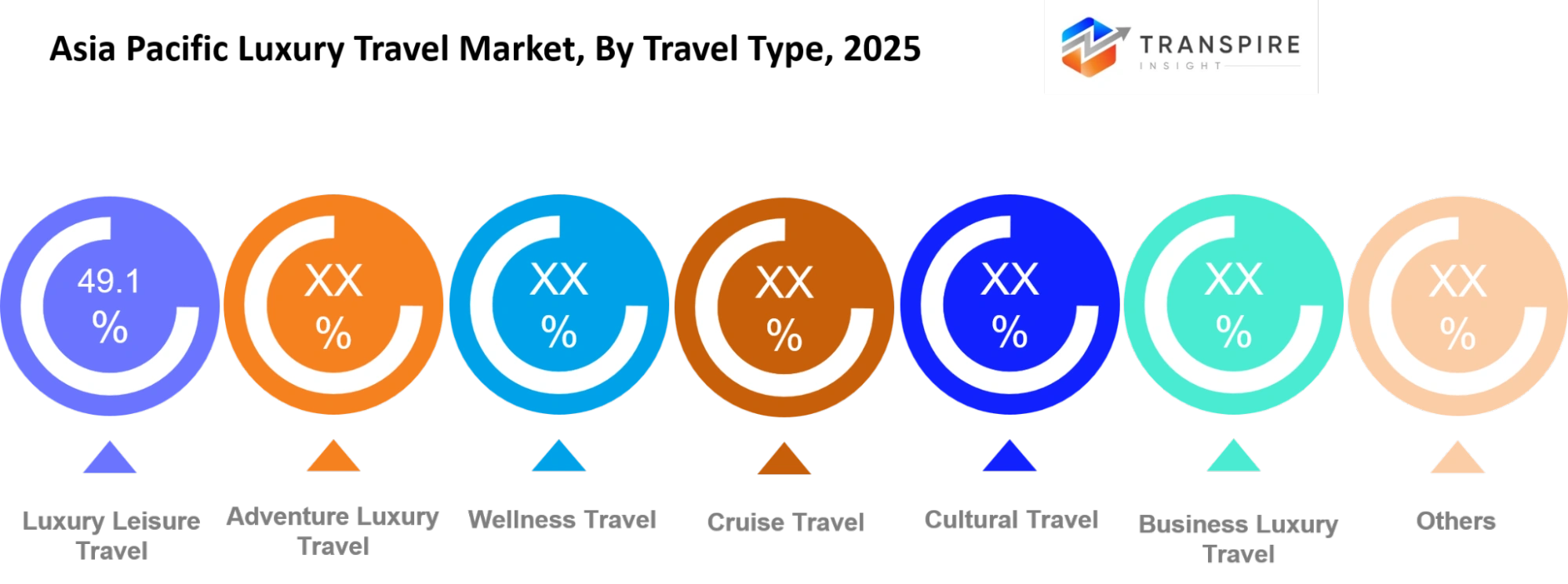
Luxury leisure travel is kind of leading the way, as high-income travelers (affluent folks, you know) lean more toward comfort first vacations, with that premium hospitality and personalized services vibe. Meanwhile, adventure and wellness travel have started to pick up momentum—because people are now chasing health focused breaks, along with experiencing heavy journeys. Cruise and cultural travel are still growing at a steady pace, mainly because regional exploration is getting more attention everywhere.
Business luxury travel is shifting too, because corporate executives are mixing work trips with a more premium leisure stay, so it’s not just “go and go back”. Travel patterns now seem to favor longer stays and higher value experiences instead of many quick, short visits. In response, operators are putting together mixed itineraries that try to connect relaxation, culture, and business needs, all inside one travel plan, more or less.
To learn more about this report, Download Free Sample Report
By Booking Channel :
Online platforms have also gained some momentum, because digital booking systems allow quicker comparisons of options , personalize the finer details, and receive instant confirmation for premium services. However, travel agencies still matter a lot for clients who want a more hands on approach, especially those who prefer curated itineraries , plus real human help when the route gets complicated or messy. It kinda feels like both sides are cooperating together rather than one fully taking over the other.
Concierge services are expanding quickly because travelers want fully managed travel experiences, with minimal effort on their end. At the same time, direct booking channels are rising too, luxury brands are strengthening relationships via loyalty programs, and those exclusive member perks. Digital integration has sped up booking, and it seems to improve personalization quality, overall.
By Traveler Type :
In the Asia Pacific luxury travel market, high net worth individuals kind of run the show when it comes to spending, concentrating on exclusive stays, private transport, and those customized experiences that feel very curated I guess. At the same time international travelers are pushing solid growth too, especially as cross border travel gets easier and visa processes seem to be getting more streamlined in several key places.
Meanwhile, domestic luxury travel is also climbing. This is tied to income levels going up, plus a stronger preference for short, premium getaways. Family travel has been widening as well, since multi generational trips are becoming more normal, and people want bigger luxury accommodations so everyone can stay together and share the same refined, selected activities. Overall, travel choices are now showing lifestyle signals and personalization, not the usual standard tourism routines.
By End User :
When it comes to end users, individual travelers make up the biggest base, and that’s mostly because personal wealth growth keeps rising and people want highly personalized plans. Corporate executives are using luxury travel services more often for business trips, the kind where productivity and comfort meet, with that premium hospitality vibe throughout.
Then there’s group travel, which is growing at a steady pace, particularly for private events, retreats, and more curated cultural experiences. Luxury group travel today leans hard into exclusivity, privacy, and tightly controlled itineraries instead of the more mass tourism style. Service providers are adjusting their offerings too, trying to balance that personal touch with coordinated group experiences across different destinations, without it feeling too rigid or too generic.
What are the Key Use Cases Driving the Asia Pacific Luxury Travel Market?
Luxury leisure travel is still kind of the main thing in the Asia Pacific Luxury Travel Market, like affluent travelers really do put a lot of weight on curated stays , premium hospitality and that whole seamless end to end trip management. Basically demand grows because disposable income is rising for high-net-worth people, and there is a stronger pull toward tailored experiences instead of the usual standardized tourism. This particular use case keeps pulling the highest value, since travelers often end up choosing comfort, exclusivity and convenience across both long-haul routes and nearby regional locations.
Then there’s wellness tourism , plus this premium business–leisure mix that’s getting traction as secondary applications. Corporate execs are increasingly turning a business stop into a luxury stay, especially around financial hubs such as Singapore and Hong Kong. Meanwhile wellness oriented travelers are hunting regenerative treatments and those medical-grade spa sessions. These moves seem to match well with corporate end users and also high-income family travelers who want something time-efficient, but still high value in practical terms.
Newer applications show up too, like ultra-private expedition travel and sustainability-linked luxury itineraries. Remote island access, private charter aviation routes, and low impact travel packages are starting to catch attention, particularly among younger affluent audiences. Carbon aware routing and eco-certified luxury stays are also beginning to steer decisions, supported by changing ESG expectations inside corporate travel rules and travel plans.
|
Report Metrics |
Details |
|
Market size value in 2025 |
USD 278.5 Billion |
|
Market size value in 2026 |
USD 302.2 Billion |
|
Revenue forecast in 2033 |
USD 549.5 Billion |
|
Growth rate |
CAGR of 8.92% from 2026 to 2033 |
|
Base year |
2025 |
|
Historical data |
2021 - 2024 |
|
Forecast period |
2026 - 2033 |
|
Report coverage |
Revenue forecast, competitive landscape, growth factors, and trends |
|
Regional scope |
Asia Pacific (India, China, Japan, Australia, South Korea, Rest of Asia Pacific) |
|
Key company profiled |
Abercrombie & Kent, TUI, Virtuoso, Expedia, Booking Holdings, Marriott Luxury, Hilton Luxury Brands, Four Seasons, Aman Resorts, Banyan Tree, Shangri-La, Taj Hotels, Accor Luxury, Rosewood, Belmond. |
|
Customization scope |
Free report customization (country, regional & segment scope). Avail customized purchase options to meet your exact research needs. |
|
Report Segmentation |
By Travel Type (Luxury Leisure Travel, Adventure Luxury Travel, Wellness Travel, Cruise Travel, Cultural Travel, Business Luxury Travel, Others); By Booking Channel (Travel Agencies, Online Platforms, Direct Booking, Concierge Services, Others); By Traveler Type (Domestic, International, HNWIs, Families, Others); By End User (Individuals, Corporate Executives, Groups, Others). |
Which Regions are Driving the Asia Pacific Luxury Travel Market Growth?
China and the wider East Asia area, still kind of leads the Asia Pacific Luxury Travel Market, backed by well developed aviation hubs, lots of international flight links, and a pretty solid outbound travel base across cities like Shanghai, Tokyo and Seoul. Also you have those government backed tourism facilitation moves, plus smoother visa arrangements in the main destinations, which makes cross border movement easier for the higher spending travelers. On top of that, there’s a mature luxury hospitality ecosystem, with a high level of premium hotel density and branded residences, and that really helps keep repeat visits coming. In the end, this connected web of airlines, airports and five star accommodation partners keeps the region in that dominant revenue spot.
Southeast Asia, on the other hand, plays the role of a fairly steady secondary contributor , with Singapore, Thailand and Malaysia acting as recognizable luxury travel entry points. It is different from East Asia where outbound is the heavy driver, this area leans more on inbound tourism resilience, helped by coordinated regional visa policies and solid short haul connectivity. There are also luxury resort pockets around Phuket, Bali and Langkawi, and they give more than one premium option, so the market isn’t overly tied to just one source country. Ongoing work on airport modernization and hospitality rollouts then keeps demand more stable, even when global travel gets a bit shaky.
India is kind of the fastest-growing region, it is being driven by rapid expansion of affluent households and also this big airport modernization push in places like Mumbai, Delhi, and Bengaluru. New international terminals, plus private aviation infrastructure, has really improved access to premium travel services, in a way that feels very noticeable. At the same time, outbound trips are climbing among high-net-worth individuals and that is accelerating demand for these curated luxury experiences across Asia along with Europe. So between 2026 and 2033, this momentum should reshape the way regional demand flows move , and make India a key growth engine for market entrants and investors alike.
Who are the Key Players in the Asia Pacific Luxury Travel Market and How Do They Compete?
The competitive landscape of the Asia Pacific Luxury Travel Market is kind of moderately consolidated , with global hospitality brands and high-end travel curators competing next to digital booking platforms. Lately competition seems to move away from pure price based positioning, more toward service differentiation , where personalization, exclusive access and smooth end-to-end itinerary management quietly define who gets market share. The established incumbents are also guarding their seats by making loyalty ecosystems stronger , pushing bigger premium portfolios, and adding digital concierge capabilities to keep high value travelers from drifting off .
Marriott International plays on scale and segmented luxury branding , leaning on its portfolio of ultra premium properties and residence-style accommodations to pull in long stay affluent travelers. Hilton Worldwide leans into loyalty driven retention strategies and cross-brand upgrades, using its Honors program to lift repeat luxury bookings across Asia Pacific hubs. Four Seasons Hotels and Resorts differentiates mainly with high touch service personalization, plus very controlled property expansion that helps preserve exclusivity , and keeps pricing power steadier.
Expedia Group competes via technology-led aggregation, mixing luxury inventory with dynamic pricing tools and AI recommendation engines to attract high income digital first travelers. Abercrombie & Kent is more about bespoke itineraries and expedition style luxury travel, expanding through curated destination partnerships instead of mass scale inventory growth. Virtuoso holds its ground through a global advisor network , which supports exclusive access to elevated experiences and preferred supplier agreements that regular platforms can not replicate as easily.
Company List
- Abercrombie & Kent
- TUI
- Virtuoso
- Expedia
- Booking Holdings
- Marriott Luxury
- Hilton Luxury Brands
- Four Seasons
- Aman Resorts
- Banyan Tree
- Shangri-La
- Taj Hotels
- Accor Luxury
- Rosewood
- Belmond
Recent Development News
In February 2026, Marriott International reported accelerated luxury growth across Asia Pacific excluding China, with luxury properties accounting for approximately 19% of organic room signings in 2025. The company strengthened its pipeline through record development deals, particularly in India, which led regional signings with over 12,000 rooms. This expansion reflects intensified investor confidence in premium hospitality assets and rising demand for high-end travel infrastructure.
Source: https://m.economictimes.com/
In January 2026, regional development reports highlighted a surge in luxury hotel pipeline activity across Asia Pacific, driven by strong inbound demand into Japan, Vietnam, and Thailand. Industry data indicated accelerated project openings and continued investor interest in high-yield luxury assets despite elevated construction costs. This momentum signals a sustained shift toward premium experiential hospitality, particularly in Southeast Asian resort destinations where international arrivals continue to recover and expand.
Source: https://www.voyages-d-affaires.com/
What Strategic Insights Define the Future of the Asia Pacific Luxury Travel Market?
The Asia Pacific Luxury Travel Market is kind of moving, structurally , toward hyper personalized, experience led travel ecosystems where value gets made through orchestration rather than just each individual service delivery. You can see rising wealth concentration across China, India, and Southeast Asia, and it’s also aligned with digital first booking habits, so providers are feeling pressure to stitch together hospitality aviation, and curated experiences into one unified platform. Over the next 5–7 years, revenue growth will likely lean more on data driven customization and access based exclusivity , not only on physical expansion.
There’s also this less visible risk that seems to be getting bigger, like dependency on a small set of premium infrastructure hubs. That can turn into concentration vulnerability if regulatory tightening happens or if capacity constraints start showing up in important gateway cities like Singapore and Hong Kong. In practice, this might cap scalability even when demand signals look strong.
On the opportunity side, an emerging angle is AI powered cross border travel orchestration platforms that can dynamically bundle luxury aviation hospitality, and experiences in real time. This feels especially relevant across Southeast Asia and India. Market participants may want to focus on ecosystem partnerships with private aviation providers and boutique hospitality networks, not just for today’s packaging but to secure long term exclusivity and keep high margin customer retention strong.
Asia Pacific Luxury Travel Market Report Segmentation
By Travel Type
- Luxury Leisure Travel
- Adventure Luxury Travel
- Wellness Travel
- Cruise Travel
- Cultural Travel
- Business Luxury Travel
By Booking Channel
- Travel Agencies
- Online Platforms
- Direct Booking
- Concierge Services
By Traveler Type
- Domestic
- International
- HNWIs
- Families
By End User
- Individuals
- Corporate Executives
- Groups
Frequently Asked Questions
Find quick answers to common questions.
The Asia Pacific Luxury Travel Market size is USD 549.5 Billion in 2033.
Key segments for the Asia Pacific Luxury Travel Market are By Travel Type (Luxury Leisure Travel, Adventure Luxury Travel, Wellness Travel, Cruise Travel, Cultural Travel, Business Luxury Travel, Others); By Booking Channel (Travel Agencies, Online Platforms, Direct Booking, Concierge Services, Others); By Traveler Type (Domestic, International, HNWIs, Families, Others); By End User (Individuals, Corporate Executives, Groups, Others).
Major Asia Pacific Luxury Travel Market players are Abercrombie & Kent, TUI, Virtuoso, Expedia, Booking Holdings, Marriott Luxury, Hilton Luxury Brands, Four Seasons, Aman Resorts, Banyan Tree, Shangri-La, Taj Hotels, Accor Luxury, Rosewood, Belmond.
The Asia Pacific Luxury Travel Market size is USD 278.5 Billion in 2025.
The Asia Pacific Luxury Travel Market CAGR is 8.92% from 2026 to 2033.
- Abercrombie & Kent
- TUI
- Virtuoso
- Expedia
- Booking Holdings
- Marriott Luxury
- Hilton Luxury Brands
- Four Seasons
- Aman Resorts
- Banyan Tree
- Shangri-La
- Taj Hotels
- Accor Luxury
- Rosewood
- Belmond
About the Authors

Chetan Dhatrak
I’m Chetan Dhatrak, a Senior Research Analyst at Transpire Insight, specializing in the Consumer Goods, Foods and Beverages industry. I focus on analyzing market trends, consumer behavior, competitive landscapes, and industry developments to deliver accurate, data-driven insights. My research at Transpire Insight is built on credible sources and in-depth analysis, helping businesses and readers better understand market dynamics, emerging opportunities, and evolving consumer preferences. I’m committed to creating reliable, well-researched content that supports informed decision-making and reflects the latest developments in the consumer goods and food & beverage sectors.

Chakradhar Khansole
Chakradhar serves as the Research Director at Transpire Insight, bringing over 8 years of experience in technology, innovation, and strategic market intelligence. He specializes in transforming complex market data into actionable business insights that enable organizations to make informed, growth-oriented decisions. Recognized for his strategic vision and analytical expertise, Chakradhar leads high-impact research initiatives, delivering comprehensive market assessments, competitive intelligence, and forward-looking industry analysis.
Recently Published Reports
-
Apr 2026
Bottled Water Market
Bottled Water Market Size, Share & Analysis Report By Product Type (Still Bottled Water, Carbonated Bottled Water, Functional Bottled Water, and Others), By Packaging (PET, Cans, and Others), By Sales Channel (Supermarkets/Hypermarkets, Convenience Stores/Drug Stores, Grocery Stores/Club Stores, Foodservice, and Others) and Geography (North America, Europe, Asia-Pacific, Middle East and Africa, South and Central America), 2021 - 2032
-
Apr 2026
Color Cosmetic Packaging Market
Color Cosmetic Packaging Market Size, Share & Analysis Report By Application (Mascara Packaging, Liquid Packaging, and Liquid Face), By Type (Tubes & Bottles, Pens & Markers, Compacts & Containers, and Droppers & Pumps), and Geography (North America, Europe, Asia-Pacific, Middle East and Africa, South and Central America), 2021 - 2031
-
Apr 2026
External Microphone For Camera Market
External Microphone For Camera Market Size, Share & Analysis Report By Type (Shotgun Microphone, Lavalier Microphone, and Others), By Application (Digital Camera, Professional Video Camera, and Others), and Geography (North America, Europe, Asia-Pacific, Middle East and Africa, South and Central America), 2021 - 2031
-
Apr 2026
Foot Orthotic Insoles Market
Foot Orthotic Insoles Market Size, Share & Analysis Report By Type (Pre-fabricated, and Custom-made), By Material (Thermoplastic, Composite Carbon Fiber, and Others), By Distribution Channel (Drug Stores, Hospitals & Clinics, and Others), and Geography (North America, Europe, Asia-Pacific, Middle East and Africa, South and Central America), 2021 - 2031