

Asia Pacific Heritage Tourism Market Size & Forecast:
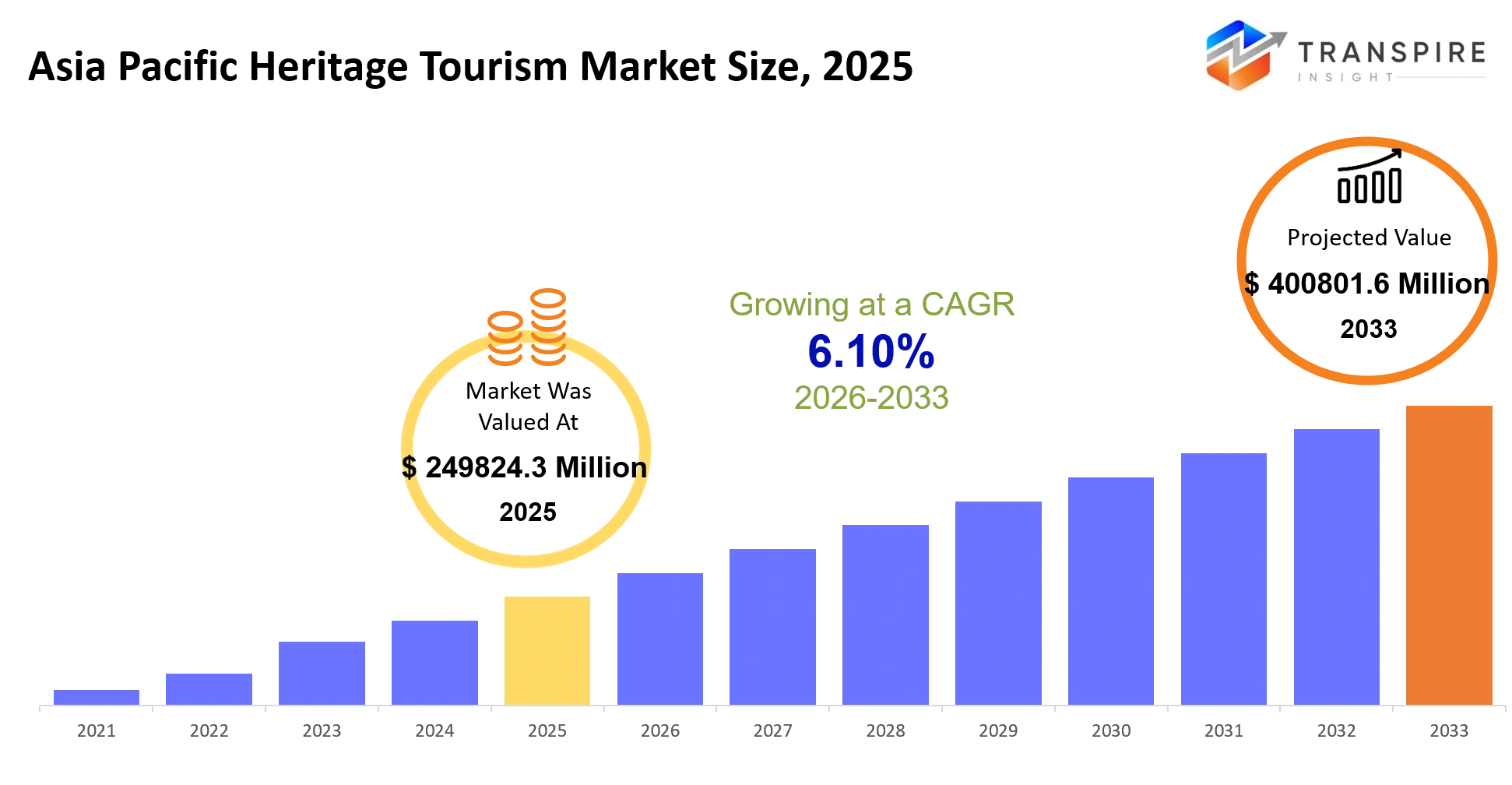
- Asia Pacific Heritage Tourism Market Size 2025: USD 249824.3 Million
- Asia Pacific Heritage Tourism Market Size 2033: USD 400801.6 Million
- Asia Pacific Heritage Tourism Market CAGR: 6.10%
- Asia Pacific Heritage Tourism Market Segments: By Tourism Type (Cultural Heritage, Religious Heritage, Archaeological Tourism, Historical Tourism, Museum Tourism, Architectural Tourism, Others); By Booking Channel (Travel Agencies, Online Platforms, Direct Booking, Others); By Traveler Type (Domestic Tourists, International Tourists, Students, Pilgrims, Others); By End User (Individuals, Groups, Educational Institutions, Others).
To learn more about this report,  Download Free Sample Report
Asia Pacific Heritage Tourism Market Summary
The Asia Pacific Heritage Tourism Market was valued at USD 249824.3 Million in 2025. It is forecast to reach USD 400801.6 Million by 2033. That is a CAGR of 6.10% over the period.
The Asia Pacific Heritage Tourism Market sort of links travelers with sites that are culturally important , plus historic quarters, archaeological landmarks, sacred monuments and those traditional communities. it helps destinations turn their cultural capital into real economic value while also keeping preservation in mind , and honestly that part matters. in day to day reality the market lets governments, tourism operators, and local partners monetize heritage assets through themed guided wanderings, lodging, transit support, and destination services.
Over the last three to five years, the market has shifted in a more structural way toward digitally enabled tourism, and also more experience centered. operators now more often rely on mobile interpretation aids, virtual guides, and analytics based visitor management systems to lift engagement, while simultaneously reducing risk to fragile or sensitive heritage areas. a big push was the pandemic era disruption of international movement which sped up domestic heritage tourism programs , and also made governments treat cultural places as a recovery lever for tourism. when cross border travel started to steady out again, these investments generally improved site access and visitor experience, which then fed into longer visits and stronger on the ground spending. this pattern is still growing, and it’s opening up new revenue channels across heritage attractions, hospitality groups, and wider tourism ecosystems across Asia Pacific .
Key Market Insights
- East Asia seems to be leading in the Asia Pacific Heritage Tourism Market, with a rough 38–42% share around 2025, mostly backed by China, Japan and South Korea .
It looks like cultural and historical site travel is still the main driver, making up about 45% of the industry revenue in 2025, so that part is pretty solid. - Religious and pilgrimage tourism stays near the top as well, basically the second-largest segment because visitor streams are already well established across India and Southeast Asia.
- And then there is this immersive heritage side that’s moving the quickest during the forecast window, likely helped by digital storytelling plus interactive attractions, kinda like a guided experience that feels more lively.
- Also heritage themed tour packages are slowly grabbing more share, since travelers are searching for curated cultural things, rather than just general sightseeing.
- Ok so, leisure tourism basically holds the lead, with about 60% of the market share, mainly because domestic and foreign visitors keep showing up.
- Meanwhile, educational and experiential travel is popping up as the fastest-growing use case up through 2030.
- Also those multi-destination heritage circuits are kinda doing their own thing, they bring in more money per visit and people tend to stay longer on average.
- In the Asia Pacific Heritage Tourism Market , independent travelers take the biggest slice, and in several important destinations they go beyond 50% of all bookings.
- And then there are young travelers, they’re looking for genuine cultural encounters, and they’re becoming the quickest-rising end-user group right now.
What are the Key Drivers, Restraints, and Opportunities in the Asia Pacific Heritage Tourism Market?
The main engine behind the Asia Pacific Heritage Tourism Market is basically government strategy and well, more money going into cultural backbones, preservation work and a tourism-led type of economic growth. You can see it in places like China, India, Japan, Thailand and Indonesia, where they have put extra funding into restoration undertakings, heritage corridors, museum modernization and even destination linkages. With these kinds of investments, visitor access gets better, and the overall experience quality tends to rise. That helps destinations pull in travelers of a higher tier, the ones who end up spending more on lodging, movement between areas, guided sessions and cultural activities. In a sense, when heritage sites become easier to use commercially while still protecting preservation goals, tourism income tends to climb and local economies feel it too
At the same time there’s a big constraint, more like a structural puzzle: trying to preserve heritage locations while also absorbing growing visitor volumes. A lot of historical monuments, archaeological zones, and cultural neighborhoods hit physical capacity limits, plus conservation rules that slow down any expansion. This is different from normal tourism infrastructure, because heritage assets can’t just be enlarged or tweaked on short notice without risking harm to their cultural wholeness. As a result, the visitor flow gets capped, seasonal congestion shows up, maintenance expenses tend to rise, and the revenue opportunities in popular places get muted.
A pretty big opportunity seems to be in how digital heritage experiences mix with smart tourism tools. Things like augmented reality, virtual interpretation platforms, multilingual mobile guides, and immersive narrative applications are changing how visitors stay engaged . In fact, destinations across Southeast Asia are more and more adopting these solutions, to make the overall experience richer while also easing up pressure on sensitive locations. And as the digital infrastructure keeps getting stronger, tourism operators can monetize the cultural narrative even when the people are not there physically, so new revenue streams open up. Plus , they can reach wider international audiences too, which is pretty helpful.
What Has the Impact of Artificial Intelligence Been on the Asia Pacific Heritage Tourism Market?
Artificial intelligence is kind of reshaping the Asia Pacific heritage tourism ecosystem, by improving visitor management, personalization, operational efficiency, and the preservation of cultural assets. Recently tourism authorities, museums, and heritage site operators have been leaning on AI powered analytics a lot, to sort of automate visitor flow tracking, ticketing optimization, crowd management, and even how resources are allocated. With these systems in place, operators can juggle visitor numbers across multiple sites much better, this can reduce congestion, and it usually makes the whole visitor experience feel more seamless, overall.
On the modeling side machine learning is now used for forecasting visitor demand, catching those high traffic intervals, and then adjusting staffing as well as maintenance schedules. When teams examine booking behavior, mobility habits, weather conditions, and event calendars, tourism organizations get a sharper picture for capacity planning ,and they can pull out more operational efficiency.On top of that, AI driven recommendation engines let travel platforms craft more personalized heritage routes, and that can increase visitor engagement, while also lifting spending on cultural experiences.
Then there is the conservation angle too, where advanced digital tools like computer vision together with predictive analytics help detect structural deterioration risks in monuments and older buildings before any visible damage shows up. This sort of early detection approach can cut maintenance costs, and it supports better long term asset preservation outcomes. Also, virtual guides and multilingual AI assistants make heritage access easier for international travelers, and they do it while reducing everyday operational burdens for the organizations running the sites.
Still, AI adoption stays kinda stuck, because the implementation costs are high, tourism data systems are fractured here and there, and digital infrastructure isn’t consistent across quite a few heritage destinations. When standardized cultural access and visitor datasets are hard to get, the model ends up less accurate, so scaling it up happens slower , even if the technology has big long-term promise.
Key Market Trends
- Since 2021, heritage destinations all over Japan, China, and India have been quietly ramping up digital interpretation platforms , which kinda boosts visitor engagement and it also lowers the need for so many physical guides.
- After the post-pandemic ripple started, domestic travel programs, in particular, got redirected tourism investment toward cultural landmarks , and a number of regional heritage places recovered faster than some attractions that were mostly reliant on international visitors only.
- Between 2022 and 2025, augmented reality experiences , for a time, were still treated like pilot trials but then they became more mainstream at museums, historic neighborhoods, and archaeological locations too.
- Heritage authorities started to adopt visitor-capacity management systems more often, after overcrowding concerns popped up at several well known UNESCO cultural destinations, you know the kind.
- These days travelers lean more toward experience-driven itineraries , with local traditions, handmade crafts, and cultural participation, rather than the older monument-only sightseeing packages that feel a bit generic.
- Tourism boards across Southeast Asia also increased collaborations with local communities, so more community centered heritage products appeared and tourism revenue got distributed in a wider way than before.
- AI powered travel platforms, including options from big operators like Trip.com Group, increasingly personalize cultural routes by using traveler behavior plus booking data, it’s pretty data heavy but effective.
- Governments have also stepped up restoration and conservation budgets since 2020, and they’re explicitly tying heritage tourism development to regional economic diversification plans.
- Digital ticketing and mobile booking became much more common after 2021 , and that helped operators improve visitor forecasting and sharpen operational planning accuracy.
- Competition has shifted from just destination promotion to an integrated cultural ecosystem idea, where heritage sites, local experiences, festivals, and smart tourism technologies are treated like one connected setup.
Asia Pacific Heritage Tourism Market Segmentation
By Tourism Type :
Cultural Heritage kind of focuses on traditions, local habits, festivals, artistic expressions, and community based get togethers that help keep cultural identity alive while also pulling in visitors who want the real thing. Religious Heritage is about going to temples, shrines, monasteries, churches, and other sacred places that carry spiritual plus cultural meaning . Archaeological Tourism is centered on old ruins , excavation spots, and historical leftovers that give people a window into earlier civilizations, and how societies evolved.
Historical Tourism takes you to spots tied to major historical events, monuments, battlefields, and heritage neighborhoods , basically places where regional history shows itself . Museum Tourism involves trips to museums, galleries, and exhibition centers where you can see artifacts, artworks and carefully kept cultural holdings . Architectural Tourism shines a light on traditional and modern buildings that are known for design, skilled craftsmanship, and heritage value . Other tourism options cover literary, industrial, and cultural landscape attractions, all of which add variety to the Asia Pacific Heritage Tourism Market.

To learn more about this report, Download Free Sample Report
By Booking Channel :
Travel Agencies offer organized travel set-ups, itinerary planning , lodging arrangements, transport services, and sometimes guided heritage walks or cultural trips. They still matter a lot for travelers who want ease , solid know-how , and cultural experiences that are more tailored. In many cases, package style deals make it simpler to reach different heritage locations during one single journey, without the hassle of stitching everything together.
Online Platforms give people a way to contrast destinations, book tickets, lock in accommodations , and also get virtual info through digital means. Direct Booking is when reservations happen straight through a destination website, a museum portal, heritage sites, or the tourism authority itself. Besides that, there are other ways to reserve such as local tour operators, education organizations , and community tourism networks, which help move heritage travel experiences around the region in a smoother way.
By Traveler Type :
Domestic Tourists are basically travelers who go to heritage places that are found inside their own country’s borders, and usually, they know the local culture quite well. Alongside that, better transportation networks , plus government tourism initiatives, tend to help people join in domestic heritage activities.
International Tourists, on the other hand, cross over national boundaries to see historical landmarks, cultural practices, and well known heritage attractions. In the Asia Pacific region, these visits can be pretty common, especially when the interest is tied to recognized heritage sites.
Students take part in education visits, meaning school driven trips that are meant to deepen learning by hands-on exposure to history, culture, archaeology, and architecture. Pilgrims travel mainly because of religious or spiritual reasons, and they often end up at sacred locations, joining local ceremonies or ritual gatherings.
Other groups of travelers also show up, like researchers, cultural enthusiasts, photographers, and special-interest visitors who are chasing more specific heritage-related experiences, not just a general sightseeing trip.
By End User :
People can be independent travelers, who sort out and go through heritage tourism stuff based on their own tastes, pace, and personal schedule. Their solo participation has moved a lot too, helped by digital booking tools, travel mobile apps, and “personalized suggestions” that kind of streamline trip arranging and the whole picking of destinations.
Then there are groups, which are basically organized travelers taking part in guided tours, cultural programs, and shared or communal travel experiences. Educational Institutions cover schools , colleges, universities, and research organizations, they coordinate heritage visits for learning goals and real world practice type activities. Other end users show up as cultural associations, corporate organizations, community groups, and non profit entities, all of them doing heritage linked travel and education activities across the Asia Pacific Heritage Tourism Market .
What are the Key Use Cases Driving the Asia Pacific Heritage Tourism Market?
Cultural and historical destination visits still feel like the main thing pushing the Asia Pacific Heritage Tourism Market forward. National tourism boards , local governments, and private operators end up putting money in heritage attractions, because those places pull big visitor numbers, keep people around for longer, and basically turn into a lot of spend across accommodation, transport dining and guided sessions, even when it’s not immediately obvious.
Educational travel alongside religious tourism has been picking up traction too, as secondary type applications. Schools, universities, and research organizations often run heritage based learning programs, while pilgrimage routes across countries like India, Japan , and Thailand keep pulling a consistent flow of travelers. On top of that, digital booking platforms have widened access, so more people can actually get into those niche trips without so much friction.
Some of the newer use cases involve more immersive heritage moments, powered by augmented reality and virtual guided interpretation technologies. Community led cultural tourism programs are also drawing attention, since destinations try to spread the tourism benefits beyond the big name landmarks. In practice, these approaches can unlock fresh revenue chances while also backing heritage preservation and local economic growth all the way across the region.
|
Report Metrics |
Details |
|
Market size value in 2025 |
USD 249824.3 Million |
|
Market size value in 2026 |
USD 264802.1 Million |
|
Revenue forecast in 2033 |
USD 400801.6 Million |
|
Growth rate |
CAGR of 6.10% from 2026 to 2033 |
|
Base year |
2025 |
|
Historical data |
2021 - 2024 |
|
Forecast period |
2026 - 2033 |
|
Report coverage |
Revenue forecast, competitive landscape, growth factors, and trends |
|
Regional scope |
Asia Pacific (India, China, Japan, Australia, South Korea, Rest of Asia Pacific) |
|
Key company profiled |
Trip.com, Expedia, Booking Holdings, MakeMyTrip, TUI, Thomas Cook, Kesari Tours, Intrepid Travel, G Adventures, Cox & Kings, Yatra, Klook, Traveloka, JTB, HIS Travel. |
|
Customization scope |
Free report customization (country, regional & segment scope). Avail customized purchase options to meet your exact research needs. |
|
Report Segmentation |
By Tourism Type (Cultural Heritage, Religious Heritage, Archaeological Tourism, Historical Tourism, Museum Tourism, Architectural Tourism, Others); By Booking Channel (Travel Agencies, Online Platforms, Direct Booking, Others); By Traveler Type (Domestic Tourists, International Tourists, Students, Pilgrims, Others); By End User (Individuals, Groups, Educational Institutions, Others). |
Which Regions are Driving the Asia Pacific Heritage Tourism Market Growth?
East Asia kind of represents the biggest share of the Asia Pacific Heritage Tourism Market, mainly because it has a big concentration of widely recognized cultural assets, plus extensive transport connections, and also ongoing government funding for heritage preservation. Places like China, Japan, and South Korea have folded cultural tourism into longer term economic development plans, so there’s strong institutional backing for heritage sites. Then you add high speed rail systems, modern airports, and newer visitor management technologies, which make access easier and they usually improve the whole guest experience. So in the end, the mix of infrastructure, preservation budgets and even more varied tourism offers keeps pushing the region into a clear leadership position.
South Asia sits as the second largest contributor, though the growth comes from somewhat different drivers. Religious tourism, cultural celebrations, and historical landmarks bring steady visitor movement year round, which means less dependence on purely seasonal travel. Also, big domestic tourism groups in countries such as India help keep things stable, even when international travel gets interrupted. Ongoing investment in destination connectivity, heritage restoration, and destination promotion programs, supports a reliable stream of tourism income across a range of visitor types, rather than only one kind of traveler.
Asia will be a fast growth region, as governments are now injecting more money into heritage restoration projects and improving tourism infrastructure. Many sites have introduced digital engagement mechanisms to enhance visitor experience and site management, as heritage restoration has broadened in several places. International travelers are looking for real experiences and attention is given to less exposed heritage sites in Asia. Investment opportunities will arise for market entry and service development around heritage tourism, technology and destinations in 2026–2033.
Who are the Key Players in the Asia Pacific Heritage Tourism Market and How Do They Compete?
The Asia Pacific heritage tourism market maintains a fragmented structure with global travel agencies, destination management companies, and heritage tourism experts vying for tourist dollars along with various Asia-Pacific based travel operators. While price competition remains relevant, market dynamics are shifting toward a battle of digital capabilities, destination accessibility, customized experiences and proprietary cultural information. Technologies that allow seamless journey planning, personalized recommendations and bundled booking services provide travelers with individualized heritage experiences as well as greater efficiency when booking.
Trip.com Group’s strong position is maintained through broad Asia Pacific coverage combined with an extensive network of transportation and accommodation suppliers and tourism organizations. Sophisticated data analytic tools and recommendation engines assist travelers in finding cultural sites aligned to their preferences, thereby extending access to a wider variety of heritages and emerging destinations to capture new traveler markets. Booking Holdings’ breadth of accommodation inventory and their comprehensive and user-friendly booking ecosystem also help in simplifying and streamlining multi-destination heritage travel experiences. They continue to innovate in mobile services and personalization to enhance traveler conversion and customer retention.
Expedia Group competes through all-inclusive bundled experiences such as packages that integrate flights, hotels and culture components in one booking thereby driving up traveler spending and length of stay. JTB Corporation’s approach emphasizes curation and deep heritage experience focused tour packages, leveraging robust connections to local communities to unlock difficult to replicate destinations. TUI Group also relies on strategic destination partnerships and experience-led tour products that combine a strong element of cultural discovery to build differentiators around standard sightseeing products.
Company List
- Trip.com
- Expedia
- Booking Holdings
- MakeMyTrip
- TUI
- Thomas Cook
- Kesari Tours
- Intrepid Travel
- G Adventures
- Cox & Kings
- Yatra
- Klook
- Traveloka
- JTB
- HIS Travel
Recent Development News
In December 2025, signed 18 partnership agreements with cultural tourism investment institutions and industry partners. The agreements support new tourism product development and cultural tourism projects, reinforcing investment activity across heritage and cultural travel destinations in the Asia Pacific region.
Source: https://www.prnewswire.com/
In March 2026, entered a partnership with . The agreement expands cooperation on sustainable tourism programs, heritage preservation initiatives, and destination development projects that support long-term growth in cultural and heritage tourism markets.
Source: https://www.unesco.org/en/
What Strategic Insights Define the Future of the Asia Pacific Heritage Tourism Market?
The Asia Pacific Heritage Tourism Market is increasingly evolving toward a more integrated approach whereby heritage conservation, digital participation and economic development for the region become more inextricably linked. It is projected that over the next 5-7 years, competitive advantages in the market will be tied more to how heritage assets are turned into high-value, deeply immersive experiences rather than a matter of owning numerous heritage sites. The underlying impetus for this shift comes from an increasing tendency of tourism over destinations towards experiences, where a tourist expects more interaction with a heritage value as opposed to its being simply as a landmark of the destination.
An "under-estimated risk" is the concentration of tourism demand on a limited set of heritage monuments (i.e. Flagship monuments). If a market becomes over-reliant on a small number of popular destinations for traffic and revenue streams, there may be an associated increase in costs associated with heritage preservation, wear-and-tear on a small cluster of popular monuments, and a constraint on income diversification into other tourist-serving networks.
An "emerging opportunity" involves the application of artificial intelligence, augmented reality, and digital heritage platforms in the numerous smaller cities and cultural niches scattered across Southeast Asia. It would be important to invest in joint ventures and partnerships with communities and technology providers, to develop replicable heritage experiences that distribute traffic widely and preserve the heritage assets in the process.
Asia Pacific Heritage Tourism Market Report Segmentation
By Tourism Type
- Cultural Heritage
- Religious Heritage
- Archaeological Tourism
- Historical Tourism
- Museum Tourism
- Architectural Tourism
By Booking Channel
- Travel Agencies
- Online Platforms
- Direct Booking
By Traveler Type
- Domestic Tourists
- International Tourists
- Students
- Pilgrims
By End User
- Individuals
- Groups
- Educational Institutions
Frequently Asked Questions
Find quick answers to common questions.
The Asia Pacific Heritage Tourism Market size is USD 400801.6 Million in 2033.
Key segments for the Asia Pacific Heritage Tourism Market are By Tourism Type (Cultural Heritage, Religious Heritage, Archaeological Tourism, Historical Tourism, Museum Tourism, Architectural Tourism, Others); By Booking Channel (Travel Agencies, Online Platforms, Direct Booking, Others); By Traveler Type (Domestic Tourists, International Tourists, Students, Pilgrims, Others); By End User (Individuals, Groups, Educational Institutions, Others).
Major Asia Pacific Heritage Tourism Market players are Trip.com, Expedia, Booking Holdings, MakeMyTrip, TUI, Thomas Cook, Kesari Tours, Intrepid Travel, G Adventures, Cox & Kings, Yatra, Klook, Traveloka, JTB, HIS Travel.
The Asia Pacific Heritage Tourism Market size is USD 249824.3 Million in 2025.
The Asia Pacific Heritage Tourism Market CAGR is 6.10% from 2026 to 2033.
- Trip.com
- Expedia
- Booking Holdings
- MakeMyTrip
- TUI
- Thomas Cook
- Kesari Tours
- Intrepid Travel
- G Adventures
- Cox & Kings
- Yatra
- Klook
- Traveloka
- JTB
- HIS Travel
About the Authors

Chetan Dhatrak
I’m Chetan Dhatrak, a Senior Research Analyst at Transpire Insight, specializing in the Consumer Goods, Foods and Beverages industry. I focus on analyzing market trends, consumer behavior, competitive landscapes, and industry developments to deliver accurate, data-driven insights. My research at Transpire Insight is built on credible sources and in-depth analysis, helping businesses and readers better understand market dynamics, emerging opportunities, and evolving consumer preferences. I’m committed to creating reliable, well-researched content that supports informed decision-making and reflects the latest developments in the consumer goods and food & beverage sectors.

Chakradhar Khansole
Chakradhar serves as the Research Director at Transpire Insight, bringing over 8 years of experience in technology, innovation, and strategic market intelligence. He specializes in transforming complex market data into actionable business insights that enable organizations to make informed, growth-oriented decisions. Recognized for his strategic vision and analytical expertise, Chakradhar leads high-impact research initiatives, delivering comprehensive market assessments, competitive intelligence, and forward-looking industry analysis.
Recently Published Reports
-
Apr 2026
Bottled Water Market
Bottled Water Market Size, Share & Analysis Report By Product Type (Still Bottled Water, Carbonated Bottled Water, Functional Bottled Water, and Others), By Packaging (PET, Cans, and Others), By Sales Channel (Supermarkets/Hypermarkets, Convenience Stores/Drug Stores, Grocery Stores/Club Stores, Foodservice, and Others) and Geography (North America, Europe, Asia-Pacific, Middle East and Africa, South and Central America), 2021 - 2032
-
Apr 2026
Color Cosmetic Packaging Market
Color Cosmetic Packaging Market Size, Share & Analysis Report By Application (Mascara Packaging, Liquid Packaging, and Liquid Face), By Type (Tubes & Bottles, Pens & Markers, Compacts & Containers, and Droppers & Pumps), and Geography (North America, Europe, Asia-Pacific, Middle East and Africa, South and Central America), 2021 - 2031
-
Apr 2026
External Microphone For Camera Market
External Microphone For Camera Market Size, Share & Analysis Report By Type (Shotgun Microphone, Lavalier Microphone, and Others), By Application (Digital Camera, Professional Video Camera, and Others), and Geography (North America, Europe, Asia-Pacific, Middle East and Africa, South and Central America), 2021 - 2031
-
Apr 2026
Foot Orthotic Insoles Market
Foot Orthotic Insoles Market Size, Share & Analysis Report By Type (Pre-fabricated, and Custom-made), By Material (Thermoplastic, Composite Carbon Fiber, and Others), By Distribution Channel (Drug Stores, Hospitals & Clinics, and Others), and Geography (North America, Europe, Asia-Pacific, Middle East and Africa, South and Central America), 2021 - 2031