
Asia Pacific Educational Tourism Market Size & Forecast:
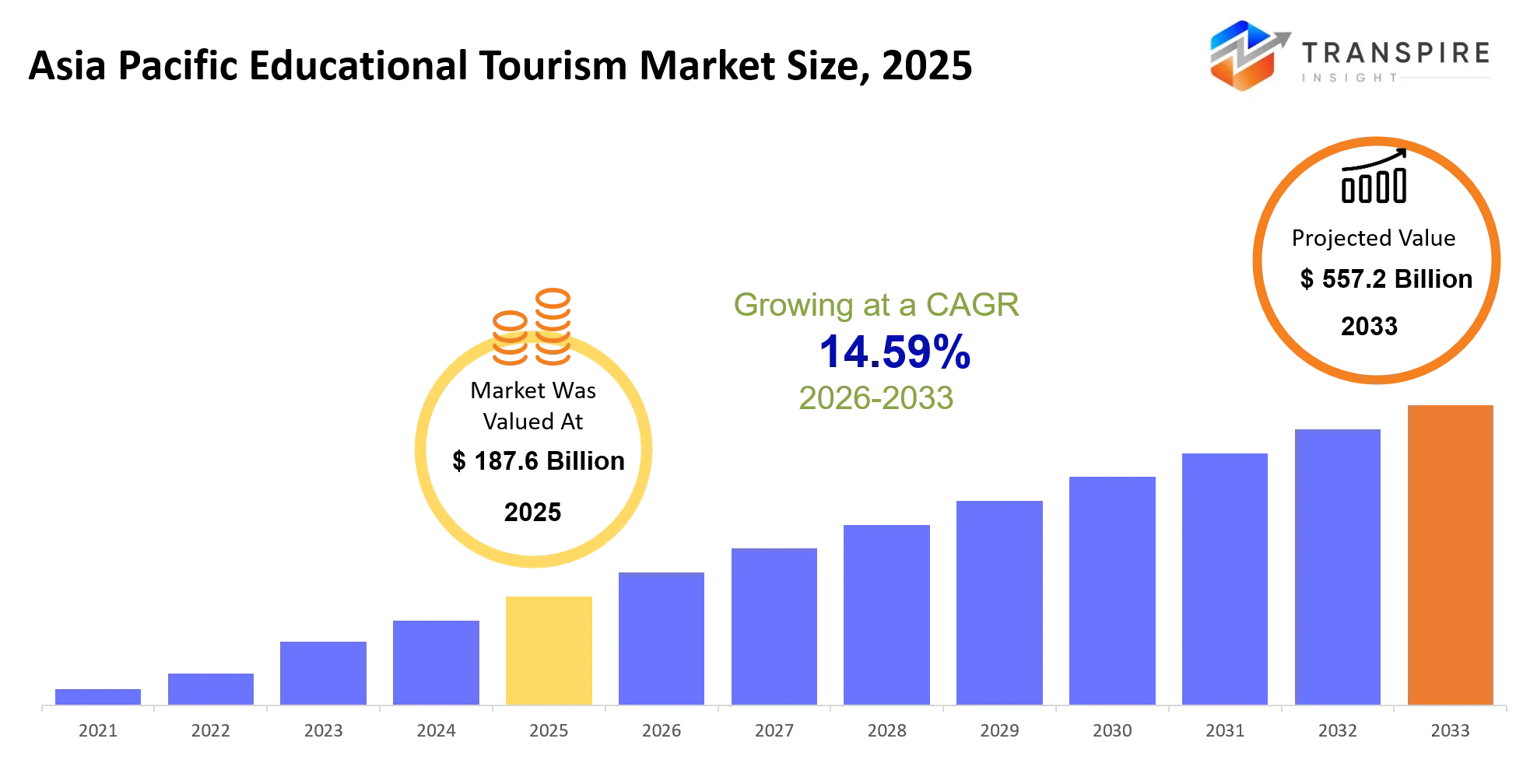
- Asia Pacific Educational Tourism Market Size 2025: USD 187.6 Billion
- Asia Pacific Educational Tourism Market Size 2033: USD 557.2 Billion
- Asia Pacific Educational Tourism Market CAGR: 14.59%
- Asia Pacific Educational Tourism Market Segments: By Program Type (Language Learning, Student Exchange, Higher Education, Vocational Training, Cultural Tours, STEM Programs, Research Programs, Others); By Traveler Type (Students, Professionals, Researchers, Teachers, Others); By Duration (Short-term, Semester, Annual, Others); By Destination Type (Universities, Training Institutes, Cultural Centers, Others)
To learn more about this report,  Download Free Sample Report
Asia Pacific Educational Tourism Market Summary
The Asia Pacific Educational Tourism Market was valued at USD 187.6 Billion in 2025. It is forecast to reach USD 557.2 Billion by 2033. That is a CAGR of 14.59% over the period.
In the Asia Pacific Educational Tourism Market, institutions, travel operators and training providers sorta coordinate cross-border learning trips, academic exchanges, and short term study programs,so students can get credited exposure abroad while destinations pull in education tied tourism revenue. It kinda connects higher education with the wider travel ecosystem, and turns universities plus cities into experience based learning hubs,not just “academic stops” on a map.
Over the last five years, the whole sector has been nudged into a digital first recruitment and program delivery mode, where universities market and manage international cohorts using online platforms before any physical travel happens. This shift got a lot quicker after post pandemic border reopening policies, along with more flexible student visa frameworks in places like Australia and Japan. At the same time airline connectivity bounced back fast. Once movement barriers eased, that pent up desire for travel turned into more concentrated outbound flows, and institutions started widening partnerships and packaging study tour offerings more aggressively. Net result, universities got stronger revenue diversification, and tourism connected education services picked up across the region.
Key Market Insights
- The Asia Pacific Educational Tourism Market seems to be led by Australia, holding around 32% share in 2025, because of the strong international student inflows.
- Meanwhile China and India together push a lot of outbound demand , helped by the rising education spending from the middle-class.
- Vietnam feels like the fastest-growing regional hub right now, with forecast expansion expected to keep climbing through 2030.
- In 2025, short-term study tours dominate the Asia Pacific Educational Tourism Market, taking nearly 38% share. Academic exchange programs show up as the second-largest segment, largely powered by university partnerships.
- And for the quickest growth, language training tourism is moving ahead, supported by hybrid learning models, plus mobility recovery trends that are coming back.
- Higher education exchange programs kind of dominate, with something like 40% market share in 2025.
- Skill certification and vocational learning travel is the fastest growing application through 2026–2030, even if forecasts vary a bit.
- Universities and colleges are still the leading end user segment, thanks to strong institutional partnerships that keep repeating themselves.
- Education travel agencies are the fastest growing category due to bundled program demand and digital reservation systems.
What are the Key Drivers, Restraints, and Opportunities in the Asia Pacific Educational Tourism Market?
The Asia Pacific Educational Tourism Market kinda gets pushed along most by the post-pandemic mobility normalization, plus simplified student visa frameworks over in Australia, Japan and South Korea. After that, governments rolled out faster visa processing systems and also expanded work study permissions, which in practice boosts international student arrivals, and then the education-linked tourism money grows. Universities meanwhile now mix academic programs with travel and cultural immersion, sort of turning it into higher value stuff that lifts enrollment conversion rates and supports cross-border revenue streams, for both education and travel businesses
One big restraint is that visa policy can be kinda uneven and jumpy across Asia Pacific countries, where sudden regulatory shifts or quota tweaks throw off long term planning. Because of that uncertainty universities end up spending more on administration, and cross-border programs are harder to scale, or at least they scale slower. It also messes with enrollment cycles, so education tourism operators don’t get the clean revenue predictability they want, and mid-income international students lose confidence, since they really depend on stable approval pathways.
A big opening is showing up with AI powered student mobility platforms and digital first recruitment ecosystems, kinda like it all sits in the same place. These tools let students streamline university selection, visa prep, and even travel coordination, in one flow ,so there’s less back and forth. Vietnam and India are starting to appear as high volume outbound education hubs, where higher internet penetration and newer financing models back scalable digital onboarding. If that trend stays, it can unlock the next phase of growth for the Asia Pacific Educational Tourism Market by cutting friction in cross border enrollment, and also widening access to mid tier institutions.
What Has the Impact of Artificial Intelligence Been on the Asia Pacific Educational Tourism Market?
Artificial intelligence and advanced digital tools are currently, kind of reshaping the Asia Pacific Educational Tourism Market, by streamlining how institutions design, market, and manage cross-border learning stays. Universities as well as education travel providers now lean on AI powered automation to take care of student recruitment workflows, including application screening, eligibility matching, and more tailored program suggestions. In practice this cuts down on the hand work processing time and seems to boost conversion rates for international admissions journeys.
Predictive analytics models are also being used more often to anticipate enrollment demand by country, season, and course category, so institutions can fine tune capacity planning and coordinate travel linked program timing. On top of that, machine learning solutions help with performance improvement in student mobility programs by examining past travel rhythms, early dropout risks, and even visa approval odds. That tends to raise overall program results while supporting operational efficiency.
When measured, education providers that introduce AI based admissions and engagement platforms often mention quicker application turnaround times and better enrollment efficiency. Meanwhile, digital itinerary systems cut down on administrative coordination expenses, and they help keep student experience continuity smoother across multiple destinations.
Still, there is a main snag that does not fully go away: the uneven quality and fragmentation of training data across the Asia Pacific Educational Tourism Market. Variations in visa rules, institutional databases, and travel records can lower model accuracy, and this in turn restricts how far predictive tools can scale in places where education ecosystems are less digitized.
Key Market Trends
- Between 2022 and 2025 , university recruitment kinda moved away from those offline recruiters and more into AI-enabled platforms, like ApplyBoard, and that generally improved the way international applications convert, yeah more efficiently.
- Visa processing in Australia and Japan kind of leaned toward quicker digital approval flows after 2023, so student processing delays went down a little, and there were fewer administrative backlogs just floating around.
- When things reopened after the pandemic in 2022, Asia Pacific student travel bounced back pretty hard, and by 2024 airlines had restored about 85% of the pre 2019 education routes, overall.
- After 2023 , Vietnam showed up as the fastest-growing outbound education hub, mostly because middle class incomes kept rising plus there were more scholarship collaborations, and joint offerings with global universities.
- From 2023 onward, many institutions started using AI-based forecasting models to estimate enrollment demand , which helped with capacity planning accuracy. It also reduced the number of underused seats in programs that were kinda sitting there.
- In 2024 , Navitas expanded university pathway partnerships across Asia Pacific, and that supported blended learning models while making the international student pipeline feel more steady, not so up and down.
- Language tourism after 2022 shifted toward hybrid learning setups, so instead of only one thing, it mixed online prep work with short-term immersion travel programs across Asia, kind of like a short sprint plus preparation.
- Then in 2025 , ApplyBoard scaled up AI-driven matching systems, cutting down student-to-program mismatch rates and speeding up cross-border enrollment decisions a lot, like noticeably.
Asia Pacific Educational Tourism Market Segmentation
By Program Type :
Language learning programs keep leading, because students stay locked in on conversation skills for global jobs, you know, like real-world exchange. Student exchange programs went up after 2022, as universities reopened their international partnerships. STEM programs also picked up stronger adoption since 2023, mainly due to industry pull for technical know-how. Vocational training rose too, since employers prefer more job-ready credentials tied with overseas exposure, sort of direct-to-work outcomes.
Higher education programs stay fairly steady as long-term degree mobility keeps moving across Australia, Japan, and Singapore. Cultural tours, and brief academic exposure trips, grew once travel felt normal again especially for school groups and undergraduates. Research programs followed as well, gaining traction through tighter university collaborations and better funding support, which supports academic mobility between institutions across the Asia Pacific.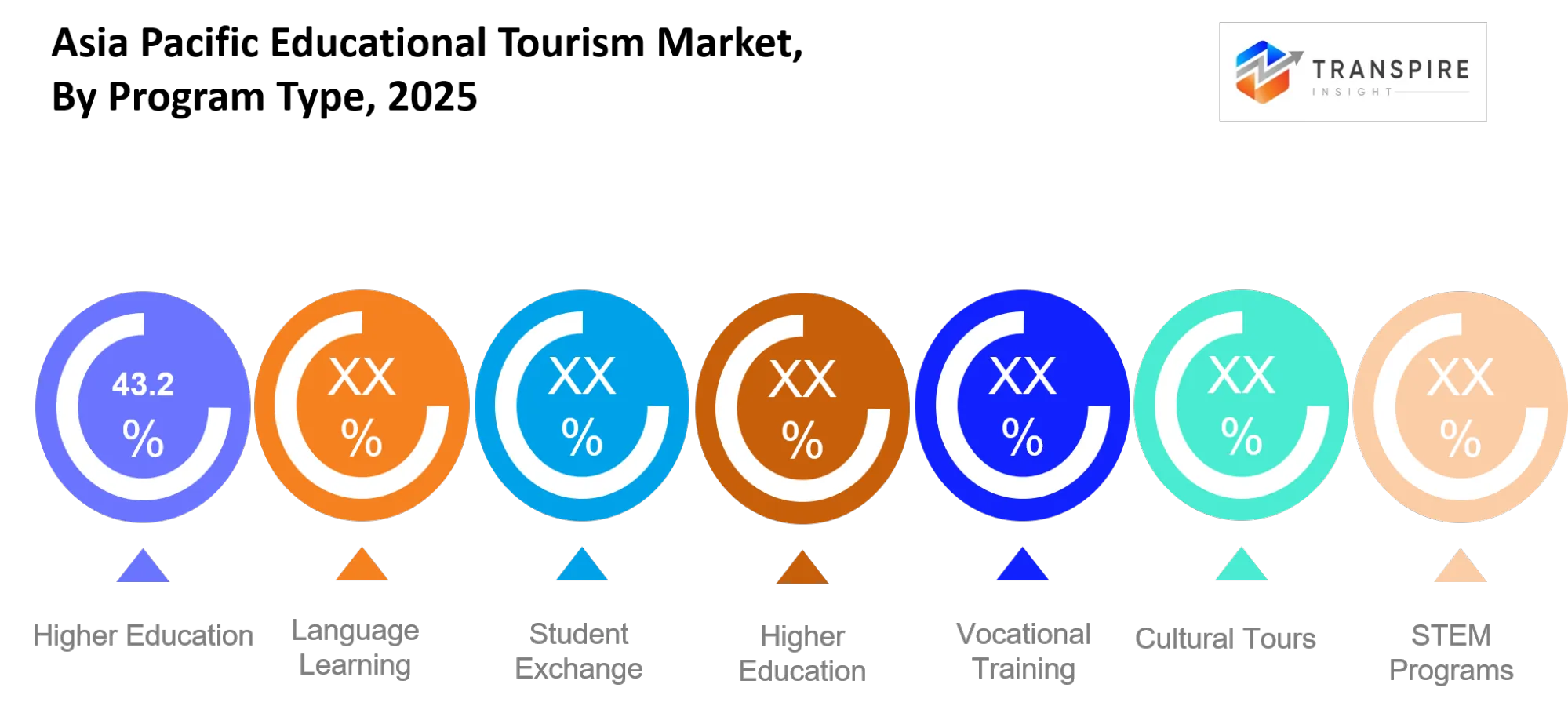
To learn more about this report, Download Free Sample Report
By Traveler Type :
Students are still the biggest group, backed by climbing cross-border education demand and easier scholarship access across Asia Pacific countries. Professionals are increasingly joining short, certification-style programs to sharpen ability, especially in management and technology lanes. Researchers expanded participation after 2023, largely because of stronger institutional collaboration between global universities and regional research centers, which helps them move more easily.
Teachers, for their part, join exchange and training programs to refine teaching methods and curriculum exposure. Other travelers may include academic coordinators and education consultants who help with program rollout and planning, sort of like guiding the process. Overall, participation trends kind of shifted toward skill centered mobility rather than only degree based travel, which seems to mirror more career oriented education tourism behavior.
By Duration :
After 2022, short-term programs expanded quite strongly ,not just because interest rose, but because students seemed to prefer learning that feels flexible ,while still getting the travel exposure sort of built-in. Even with that shift, semester-based programs stay widely used at universities, especially where structured exchange agreements link Asia Pacific institutions. Annual programs keep doing their job too, supporting full academic mobility for degree students who are looking at longer international education routes.
Short-term mobility also jumped as cost barriers eased and visa approvals became simpler in multiple countries. Semester programs grew alongside better credit transfer systems between universities. As for annual programs , they keep a steady pull from students who want durable academic progress and clearer international career options, typically through recognized qualifications and formal institutional partnerships.
By Destination Type :
Universities are still, kind of, the big destination overall mainly because there are structured degree tracks plus exchange programs that pull in the most student volume. Training institutes, on the other hand gained a bit more visibility after 2023, because demand went up for skill-focused learning and also certification pathways that are linked to employment results across Asia Pacific markets.
Cultural centers meanwhile support shorter immersion formats , those designed around language practice and heritage exploration, especially for international learners. Other places include research facilities and specialized academies that offer more niche academic exposure. Demand also moved toward multi-destination learning paths, where students blend university studies with training institutes and cultural exposure, so the whole experience feels broader in a practical way.
What are the Key Use Cases Driving the Asia Pacific Educational Tourism Market?
International student exchange and higher education mobility keep being the core use case in the Asia Pacific Educational Tourism Market, like it’s still the main story, mostly driven by structured credit transfer systems and cross-border degree pathways. Demand keeps climbing, as students look for global employability and qualifications that actually get recognized.
Also, the wider applications are showing up in language learning, plus vocational training for professionals and for teachers, and this is aided by education providers along with different agencies. These parts are growing when employers push for skill upgrades and when institutions craft short term international learning programs across the Asia Pacific area.
Then there are newer use cases too, such as AI driven matching and predictive enrollment planning. On top of that, there are hybrid travel models that blend virtual preparation with brief study visits in person. Overall, these changes boost how accurate the selection process is, and they also widen the personalized cross-border education pathways, for more types of learners.
|
Report Metrics |
Details |
|
Market size value in 2025 |
USD 187.6 Billion |
|
Market size value in 2026 |
USD 214.8 Billion |
|
Revenue forecast in 2033 |
USD 557.2 Billion |
|
Growth rate |
CAGR of 14.59% from 2026 to 2033 |
|
Base year |
2025 |
|
Historical data |
2021 - 2024 |
|
Forecast period |
2026 - 2033 |
|
Report coverage |
Revenue forecast, competitive landscape, growth factors, and trends |
|
Regional scope |
Asia Pacific (India, China, Japan, Australia, South Korea, Rest of Asia Pacific) |
|
Key company profiled |
IDP Education, Navitas, Study Group, Kaplan, EF Education First, INTO University, Shorelight, Crimson Education, Cambridge Education, Pearson, QS, GUS, AECC, Leverage Edu, SI-UK |
|
Customization scope |
Free report customization (country, regional & segment scope). Avail customized purchase options to meet your exact research needs. |
|
Report Segmentation |
By Program Type (Language Learning, Student Exchange, Higher Education, Vocational Training, Cultural Tours, STEM Programs, Research Programs, Others); By Traveler Type (Students, Professionals, Researchers, Teachers, Others); By Duration (Short-term, Semester, Annual, Others); By Destination Type (Universities, Training Institutes, Cultural Centers, Others) |
Which Regions are Driving the Asia Pacific Educational Tourism Market Growth?
Australia, and the whole Oceania area, basically leads the Asia Pacific Educational Tourism Market, mostly because of pretty strong education policies and student visa processes that are getting more streamlined. Australia has a long-running university system, and it keeps working with outside, global institutions for exchange pathways, and also degree mobility initiatives. The education facilities are high-quality, and the post study work rights stay pretty consistent, so that continues pulling in a big flow of international students. There is also a solid fit between what the government wants and how universities recruit, so it kind of keeps the long term edge in place in the region.
East Asia, Japan included, plus South Korea and China, stays a steady contributor to the Asia Pacific Educational Tourism Market, largely due to continuous institutional funding and academic partnerships that are more structured. However compared with the leading region, here the expansion feels more like domestic university growth and tighter, controlled outbound student movement, rather than depending on big scale immigration channels. Japan and South Korea push campus internationalization through English-taught programs, and exchange agreements. China keeps a steady outbound education appetite because households are willing to invest in overseas degrees in a fairly consistent way.
Southeast Asia is the fastest growing portion of the market, and this is driven by higher middle class income, along with more access to international scholarships and education financing options. Places like Vietnam, Malaysia and Thailand have recently widened their partnerships with foreign universities, to both attract students and send them abroad. With better aviation links, and with visa procedures that got simplified after 2023, movement barriers have dropped noticeably, even if it’s not always perfectly smooth. This quick take off, points to meaningful entry opportunities for education providers and investors, especially those aiming at high-growth student-origin markets, through 2033.
Who are the Key Players in the Asia Pacific Educational Tourism Market and How Do They Compete?
The competitive landscape of the Asia Pacific educational tourism market looks somewhat fractured, like there are several players, not just one or two. You’ll see established education providers right next to digital recruitment platforms. Most of the rivalry seems to be driven by things like technology uptake, institutional collaborations, and global student sourcing networks, not only price. Traditional education groups are holding their ground, but AI based platforms are also quickly changing how enrollments happen. For many market players, tying together the whole journey of recruitment, placement, and actual program delivery has turned into a real differentiator, almost like a quiet advantage you can feel.
IDP Education works with big counseling networks along with digital student recruitment platforms, helping learners connect to universities in multiple countries. ApplyBoard leans into algorithmic matching that lowers application friction and helps partner institutions see better conversion outcomes. Navitas, for its part, stays strong through university pathway programs, where language preparation is stitched directly into degree entry. EF Education First separates itself by running immersive language travel programs, mixing short term mobility with cultural learning experiences. Study Group grows by partnering with universities to run foundation and pre degree programs in major Asia Pacific destinations.
Company List
- IDP Education
- Navitas
- Study Group
- Kaplan
- EF Education First
- INTO University
- Shorelight
- Crimson Education
- Cambridge Education
- Pearson
- QS
- GUS
- AECC
- Leverage Edu
- SI-UK
Recent Development News
In January 2026, Pacific Asia Travel Association (PATA) renewed its preferred partnership with Euromonitor International. The collaboration strengthens data-driven tourism intelligence and supports enhanced market insights and forecasting for Asia-Pacific educational and travel tourism stakeholders, improving strategic planning and cross-border educational tourism programs across the region. Sourcehttps://www.ttgasia.com/
In January 2026, Pacific Asia Travel Association (PATA) extended its agreement with Euromonitor International. The partnership focuses on delivering analytical content and destination forecasts for Asia-Pacific tourism markets, enabling improved decision-making for education-linked travel and study-tour operators in the region.
Source https://www.hotelnewsresource.com/
What Strategic Insights Define the Future of the Asia Pacific Educational Tourism Market?
The Asia Pacific Educational Tourism Market looks like it is moving, in a kind of structural way, toward a digitally mediated mobility ecosystem where student recruitment, program design, and travel coordination are becoming more platform-driven each year . Growth won’t be driven only by physical movement anymore, or at least not that much, but by how well institutions take international interest and turn it into enrolled learners via connected digital pipelines and also cross-border academic partnerships . This change is being pulled forward by steady demand for globally recognized qualifications and by tighter competition among universities for international cohorts.
There is a quiet risk though, and it comes from how some institutions are getting more dependent on a small circle of digital recruitment platforms. That dependence could slowly concentrate pricing power and also shrink institutional autonomy in student acquisition approaches . And if regulations get stricter around data use, or if visa-linked digital screening tightens, enrollment flows could get disrupted faster than anyone first thinks.
At the same time, an opportunity is starting to show up . In Southeast Asia, AI-enabled “end-to-end mobility ecosystems” are beginning to expand, with more students going outbound and with digital infrastructure improving, which makes scalable adoption conditions. Market participants should place bets on localized platform collaborations, and also reinforce direct university-to-student pathways, to limit intermediary dependence and keep enrollment steadier over the long run .
Asia Pacific Educational Tourism Market Report Segmentation
By Program Type
- Language Learning
- Student Exchange
- Higher Education
- Vocational Training
- Cultural Tours
- STEM Programs
- Research Programs
By Traveler Type
- Students
- Professionals
- Researchers
- Teachers
By Duration
- Short-term
- Semester
- Annual
By Destination Type
- Universities
- Training Institutes
- Cultural Centers
Frequently Asked Questions
Find quick answers to common questions.
The Expected Asia Pacific Educational Tourism Market size is USD 557.2 Billion in 2033.
Key Segments for the Asia Pacific Educational Tourism Market are By Program Type (Language Learning, Student Exchange, Higher Education, Vocational Training, Cultural Tours, STEM Programs, Research Programs, Others); By Traveler Type (Students, Professionals, Researchers, Teachers, Others); By Duration (Short-term, Semester, Annual, Others); By Destination Type (Universities, Training Institutes, Cultural Centers, Others).
Major Asia Pacific Educational Tourism Market Players are IDP Education, Navitas, Study Group, Kaplan, EF Education First, INTO University, Shorelight, Crimson Education, Cambridge Education, Pearson, QS, GUS, AECC, Leverage Edu, SI-UK.
The Current Asia Pacific Educational Tourism Market size is USD 187.6 Billion in 2025.
The Asia Pacific Educational Tourism Market CAGR is 14.59% from 2026 to 2033.
- IDP Education
- Navitas
- Study Group
- Kaplan
- EF Education First
- INTO University
- Shorelight
- Crimson Education
- Cambridge Education
- Pearson
- QS
- GUS
- AECC
- Leverage Edu
- SI-UK
About the Authors

Chetan Dhatrak
I’m Chetan Dhatrak, a Senior Research Analyst at Transpire Insight, specializing in the Consumer Goods, Foods and Beverages industry. I focus on analyzing market trends, consumer behavior, competitive landscapes, and industry developments to deliver accurate, data-driven insights. My research at Transpire Insight is built on credible sources and in-depth analysis, helping businesses and readers better understand market dynamics, emerging opportunities, and evolving consumer preferences. I’m committed to creating reliable, well-researched content that supports informed decision-making and reflects the latest developments in the consumer goods and food & beverage sectors.

Chakradhar Khansole
Chakradhar serves as the Research Director at Transpire Insight, bringing over 8 years of experience in technology, innovation, and strategic market intelligence. He specializes in transforming complex market data into actionable business insights that enable organizations to make informed, growth-oriented decisions. Recognized for his strategic vision and analytical expertise, Chakradhar leads high-impact research initiatives, delivering comprehensive market assessments, competitive intelligence, and forward-looking industry analysis.
Recently Published Reports
-
Apr 2026
Bottled Water Market
Bottled Water Market Size, Share & Analysis Report By Product Type (Still Bottled Water, Carbonated Bottled Water, Functional Bottled Water, and Others), By Packaging (PET, Cans, and Others), By Sales Channel (Supermarkets/Hypermarkets, Convenience Stores/Drug Stores, Grocery Stores/Club Stores, Foodservice, and Others) and Geography (North America, Europe, Asia-Pacific, Middle East and Africa, South and Central America), 2021 - 2032
-
Apr 2026
Color Cosmetic Packaging Market
Color Cosmetic Packaging Market Size, Share & Analysis Report By Application (Mascara Packaging, Liquid Packaging, and Liquid Face), By Type (Tubes & Bottles, Pens & Markers, Compacts & Containers, and Droppers & Pumps), and Geography (North America, Europe, Asia-Pacific, Middle East and Africa, South and Central America), 2021 - 2031
-
Apr 2026
External Microphone For Camera Market
External Microphone For Camera Market Size, Share & Analysis Report By Type (Shotgun Microphone, Lavalier Microphone, and Others), By Application (Digital Camera, Professional Video Camera, and Others), and Geography (North America, Europe, Asia-Pacific, Middle East and Africa, South and Central America), 2021 - 2031
-
Apr 2026
Foot Orthotic Insoles Market
Foot Orthotic Insoles Market Size, Share & Analysis Report By Type (Pre-fabricated, and Custom-made), By Material (Thermoplastic, Composite Carbon Fiber, and Others), By Distribution Channel (Drug Stores, Hospitals & Clinics, and Others), and Geography (North America, Europe, Asia-Pacific, Middle East and Africa, South and Central America), 2021 - 2031