
North America Cosmetic Medical Tourism Market Size & Forecast:
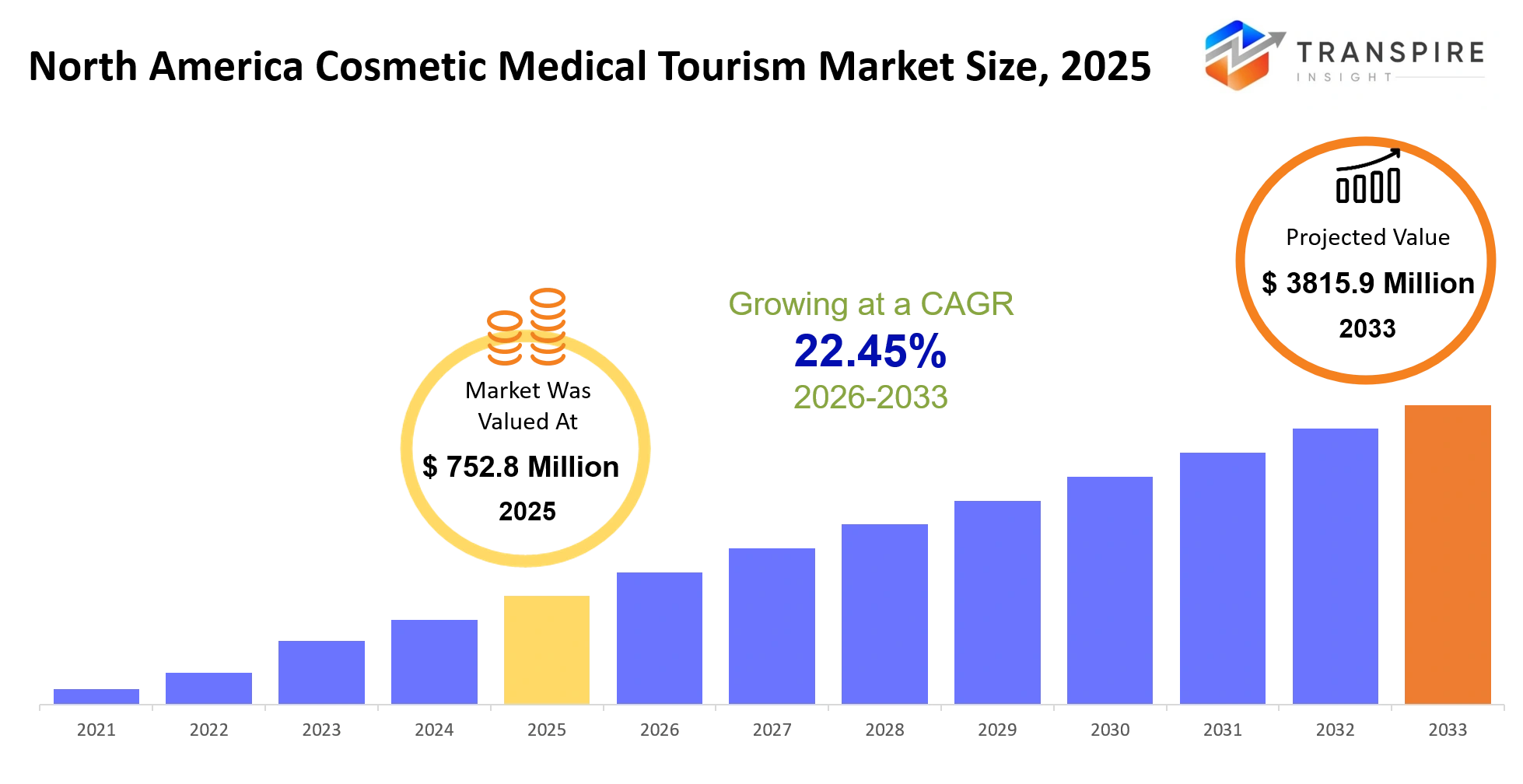
- North America Cosmetic Medical Tourism Market Size 2025: USD 752.8 Million
- North America Cosmetic Medical Tourism Market Size 2033: USD 3815.9 Million
- North America Cosmetic Medical Tourism Market CAGR: 22.45%
- North America Cosmetic Medical Tourism Market Segments: By Procedure Type (Facial Procedures, Body Contouring, Dental Cosmetic Procedures, Hair Transplantation, Others), By Application (Aesthetic Enhancement, Reconstructive Procedures, Anti-aging Treatments, Others), By End User (Hospitals, Cosmetic Clinics, Medical Spas, Others), By Tourism Type (Domestic Medical Tourism, International Medical Tourism, Others).
To learn more about this report,  Download Free Sample Report
North America Cosmetic Medical Tourism Market Summary:
The North America Cosmetic Medical Tourism Market size is estimated at USD 752.8 Million in 2025 and is anticipated to reach USD 3815.9 Million by 2033, growing at a CAGR of 22.45% from 2026 to 2033.The North America Cosmetic Medical Tourism Market kind of serves folks who want elective aesthetic procedures but they don’t always stay close to their home location , so they can reach specialized knowledge, faster waiting periods, a broader set of treatments, or sometimes just better procedure costs. In general, it kind of blends patients with clinics , surgeons, travel facilitators, and also post procedure care providers , so you end up with this mix of healthcare and travel system that feels pretty connected .
In the last three to five years, the whole market has shifted in a structural way toward digitally enabled patient acquisition and consultation styles. Things like virtual consultations, AI-assisted treatment planning, and coordination across borders have lowered the usual decision hurdles, and they also helped providers extend their presence beyond nearby local areas. The COVID-19 pandemic was a big nudge here, it disrupted travel for a while but at the same time it pushed telehealth adoption forward, and it changed how patients get engaged before and during care.
Right now, the market’s growth seems to come from several sides at once: the return of pent-up demand for aesthetic procedures, more transparency around provider outcomes, and smoother cross-border care routes. As more patients feel comfortable checking options and booking from a distance, clinics can tap into a larger regional audience, which supports bigger procedure volumes, better occupancy levels, and more revenue chances throughout the cosmetic care value chain too.
Key Market Insights
- The United States basically dominates the North America Cosmetic Medical Tourism Market, taking more than 70% of the regional share in 2025, kind of like it just stays ahead.
- Canada is the second-largest market , and it keeps getting attention due to premium beauty clinics plus the rising interest in less-invasive procedures that people can go back to their routines with.
- Mexico still acts as the fastest-growing destination during the forecast period, mainly because pricing for treatments is competitive and it’s very close to U.S. patients so travel feels easier.
- Cross-border patient movement keeps swelling the regional industry footprint, backed by upgraded healthcare infrastructure, and better travel accessibility, overall it helps things move.
- Surgically based cosmetic procedures hold the biggest market slice, bringing in roughly 45% of total revenue in 2025.
- Face-focused aesthetic treatments are the next major segment , influenced by steady demand for rhinoplasty, facelifts and eyelid procedures, you know the usual.
- Meanwhile, non-surgical aesthetic services are the fastest-growing segment through 2032, pushed forward by new technology and shorter recovery periods than before.
- Medical spas and combo treatment bundles are also showing up as noticeable demand catalysts across the North America Cosmetic Medical Tourism Market.
- On the application side, cosmetic enhancement procedures lead the way, accounting for nearly 60% of overall market revenue in 2025.
- Facial rejuvenation keeps a meaningful share because consumers tend to prefer minimally invasive interventions, and that habit doesn’t really go away.
- Body contouring applications are some of the fastest moving categories, with a steady pull from innovation in laser systems and other energy based technologies, you know.
- Hair restoration services are gaining steam too, because international patients are looking for specialized know how, plus treatment costs that feel a bit more competitive then before.
What are the Key Drivers, Restraints, and Opportunities in the North America Cosmetic Medical Tourism Market?
The strongest force pushing the North America Cosmetic Medical Tourism Market forward is the digital shift in how patients are acquired and how treatment plans get mapped out. Once telehealth platforms became common, along with virtual consultations and AI-assisted imaging tools, the usual friction tied to cross-border cosmetic work started to fade. Now patients can review surgeons, get recommendations, and compare prices before they even travel. This kind of change was sped up because healthcare providers put more money into remote engagement capabilities during, and after the pandemic. So, clinics can pull in patients from a wider geographic area, nudge conversion rates upward , and raise procedure volumes, which then feeds revenue growth across the whole medical tourism ecosystem.
Regulatory fragmentation still feels like the markets biggest structural snag. Licensing rules, malpractice structures, patient protection expectations, and post-operative care requirements vary from one jurisdiction to another. Those differences create doubt for both providers and patients, and they cannot be smoothed over quickly because they’re stuck inside national and regional healthcare systems. The knock-on effects are slower decisions by patients, higher administrative workload , and lost revenue chances as people postpone or walk away from procedures due to legal worries or continuity-of-care concerns.
A big future opportunity is in integrated cosmetic tourism platforms, where treatment planning sort of merges with travel logistics, financing stuff, and then post-procedure monitoring too. If investments go into AI-powered patient management systems and remote recovery tracking, the care journey can feel more seamless, like no real gaps between steps. Mexico, in particular, is coming up as a high-potential destination where upgrading healthcare infrastructure, keeping pricing competitive, and being close to the United States help providers take a larger slice of international cosmetic procedure spending.
What Has the Impact of Artificial Intelligence Been on the North America Cosmetic Medical Tourism Market?
Artificial intelligence and advanced digital technologies are, kinda transforming the North America Cosmetic Medical Tourism Market—well at least that’s what clinics are saying these days—by improving how they bring in patients, plan treatments, and coordinate care across borders. More and more clinics are leaning on AI-powered imaging platforms, to automate facial and body assessments, create treatment simulations, and generally smooth out consultation workflows. In practice this reduces the amount of manual evaluation time, and it also lets providers handle bigger patient volumes without raising staffing expenses in the same way, or at all.
On another level, machine learning models are boosting predictive capabilities. Providers look at patient characteristics, procedure histories, and recovery data, then they try to forecast treatment outcomes, spot possible complications earlier, and adjust post-operative care plans to fit the person. Digital patient management systems can even flag higher-risk cases before surgery, which supports better clinical decisions and can cut down on expensive revisions or extra follow-ups.
From an operations standpoint these technologies tend to improve conversion rates from the first consultation to booked procedures, speed up administrative processing, and keep care more continuous through remote monitoring applications. Virtual consultation platforms and AI-assisted scheduling systems also make it easier for clinics to attract international patients, more quickly, which in turn helps utilization rise and revenue trends look stronger.
Still, AI adoption has a big catch. Bringing together advanced analytics, imaging software, and patient management platforms takes serious investment, plus access to large high-quality clinical datasets. Quite a few providers don’t have enough historical outcome data, and that can reduce model reliability. It also slows down how fast they can deploy more sophisticated predictive tools across the cosmetic medical .
Key Market Trends
- Since 2020, virtual consultations kind of moved from this niche kind of thing into a standard practice, which cuts down on those pre-treatment travel needs and also speeds up patient onboarding… a lot.
- Between 2021 and 2025, clinics started using AI-based facial imaging tools more and more, helping people better “see” the possible results, and that in turn boosted the consultation-to-procedure conversion rate, pretty noticeably.
- Also the demand shifted toward minimally invasive treatments. So injectables, laser therapies, and skin rejuvenation procedures are taking up a bigger piece of patient spending these days, rather than the heavier options.
- Providers increasingly bundle surgery, accommodation, transportation and recovery services together, so it doesn’t really feel like a single appointment anymore, more like a full comprehensive medical travel experience.
- Mexico, after 2022, got stronger as a preferred destination by expanding internationally accredited facilities and actively targeting U.S. cross-border patients.
- Meanwhile, big-name organizations like Mayo Clinic, Cleveland Clinic, and Johns Hopkins Medicine expanded digital engagement strategies, aiming at patients who are spread out geographically but still want access.
- Since 2021, online reputation management and verified patient outcome reporting have turned into major competitive differentiators for cosmetic tourism providers, like it’s not optional anymore.
- Clinics are also using predictive analytics more frequently to tailor treatment plans, and that’s helping reduce post-procedure complications while improving long-term patient satisfaction scores.
- Partnerships between healthcare providers, travel facilitators, and hospitality companies grew a lot after the pandemic disruptions, because those disruptions showed coordination gaps that everyone then tried to fix.
- Finally, cross-border providers have increased investment in multilingual support and remote follow-up platforms, which improves continuity of care once patients return home.
North America Cosmetic Medical Tourism Market Segmentation
By Procedure Type
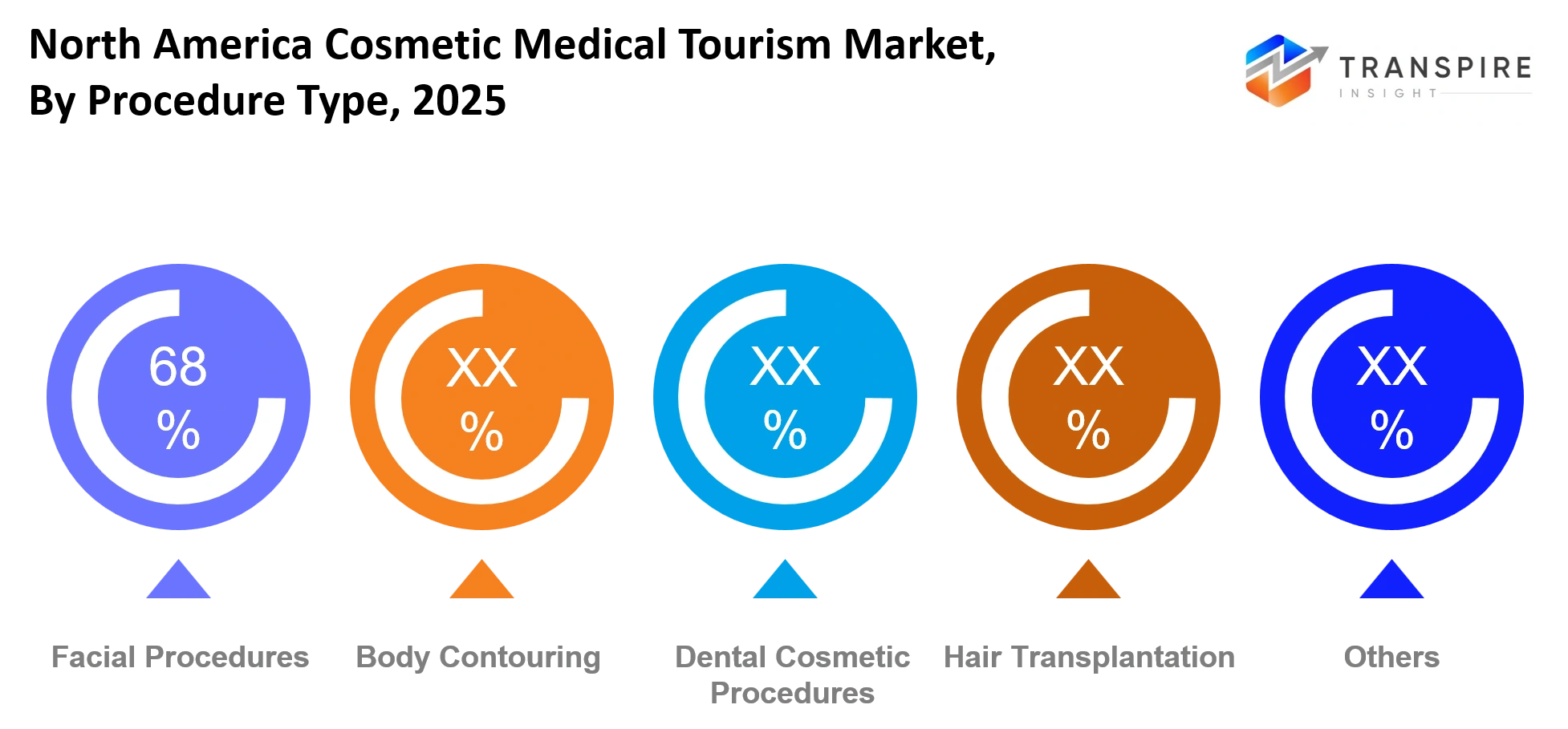
Facial procedures still hold the leading position in the procedure type segment, mainly because people keep showing a steady, almost obsessive interest in rhinoplasty, eyelid surgery, facelifts, and those non-surgical facial enhancement options. The outcomes are basically very visible, and patients seem quite willing to spend on anything appearance-related , so the market share leadership stays strong. Body contouring procedures are another big category too, and they keep getting helped by progress in liposuction and skin-tightening technologies. Hair transplantation has also been gaining momentum, as providers adopt robotic approaches and minimally invasive techniques, which help with better procedural precision, and honestly also with recovery experiences.
Dental cosmetic procedures attract medical travelers as well, especially those looking for specialized work while also getting cost advantages. Looking ahead, the market growth should tilt toward procedures that are less invasive, since they cut down recovery time yet still keep aesthetic results. That overall shift will likely push providers to invest in advanced imaging systems, treatment planning platforms , and more personalized care models. In turn, it should create new opportunities for investors and service providers that are focused on procedural innovation.
To learn more about this report, Download Free Sample Report
By Application
Aesthetic enhancement still seems like the biggest use case, because most cosmetic travelers really want appearance driven interventions that show results, visible and measurable. Facial refinement, body shaping, and smile enhancement procedures keep pulling in the highest patient volumes across regional destinations. Anti aging treatments also feel especially active right now, partly because longer life expectancy and more discretionary healthcare spending push consumers toward preventive and upkeep oriented aesthetic services.
Reconstructive procedures are smaller, but they hold a steady place, since there are post trauma, congenital, and post surgical correction needs. These demand profiles look pretty different too, aesthetic procedures are often guided by lifestyle preferences, while reconstructive options depend more on clinical necessity. Looking forward, treatment providers will probably broaden their integrated service portfolios, mixing aesthetic enhancement with wellness plus recovery programs. That should make more differentiated offerings, appealing to a wider patient base and supporting stronger long term revenue streams.
By End-User
Cosmetic clinics, well they kind of dominate the end user landscape since these specialized facilities usually bring focused know how, a smoother overall patient journey, and more pliable pricing arrangements. Dedicated cosmetic centers have also pushed their international outreach, so sort of engagement with potential patients can happen well before anyone even boards a flight. Hospitals still take up a large place in the mix, particularly when it comes to complicated surgical procedures that demand advanced infrastructure, multidisciplinary teams, and dependable post operative monitoring. At the same time, medical spas keep widening their footprint by leaning into non invasive and minimally invasive treatment options , which feels like it matches people who want a faster recovery, or at least a shorter convalescence, compared to traditional care.
Operational differences do shape distinct competitive strengths across each end user group. Clinics tend to lean into specialization plus speed, hospitals center on procedural difficulty and safety, and medical spas lean toward easy access plus repeat visits. Looking ahead, future market growth is likely to nudge these kinds of facilities toward partnerships, which would support broader service bundling and a more seamless patient journey. That kind of cooperation could raise capacity utilization too, while also strengthening patient loyalty and improving lifetime value in a more consistent way.
By Tourism Type
International medical tourism right now feels like the most impactful kind of tourism because travelers crossing borders often look for specialized know-how, premium treatment standards, or sometimes just a cheaper cost structure that they can’t really find back home. There are established travel routes between the United States, Canada, and Mexico that keep helping patient movement along, and they also keep procedure numbers steady. At the same time, domestic medical tourism still matters a lot, since patients also move inside their own country to reach acclaimed surgeons, niche clinics, or upgraded treatment technologies. Pricing differences, how respected the provider feels, and whether certain procedures are even on the menu, all of that tends to drive the choices in both situations.
When it comes to international trips there can be regulatory hurdles, messy logistics, and the usual follow-up care problems, you know after everything is done. With domestic travel, continuity of care is usually simpler, more straightforward, less complicated. Looking ahead, growth seems likely to lean on digital consultation platforms, remote monitoring tools, and travel coordination services that are actually integrated. Those improvements should help clinics and hospitals reach broader patient pools, strengthen investor confidence, and make it easier for people shopping for cosmetic treatment to compare options across several destinations without too much hassle.
What are the Key Use Cases Driving the North America Cosmetic Medical Tourism Market?
The primary use case is more or less around facial aesthetic procedures like rhinoplasty , facelifts and eyelid surgery. In practice these tend to end up with the highest patient volumes because results are really easy to see, the specialist know-how differs a lot between providers, and patients frequently make a trip to reach well known surgeons and more advanced treatment approaches.
The secondary applications are body contouring and hair restoration services, and yeah they are picking up momentum via specialized cosmetic clinics and dedicated aesthetic centers. Also, the better minimally invasive technologies have, in many cases, cut down the recovery window, so travel based treatment plans are becoming more practical for a wider range of patients.
More emerging use cases involve integrated anti aging programs that blend cosmetic procedures, wellness offerings, and individualized recovery support. There’s also AI assisted treatment planning, plus remote follow up monitoring after procedures , which opens up fresh opportunities, especially for international patients wanting continuous care even after they go back home. These digital care models may expand a provider’s reach and help improve longer term patient engagement over time.
|
Report Metrics |
Details |
|
Market size value in 2025 |
USD 752.8 Million |
|
Market size value in 2026 |
USD 924.6 Million |
|
Revenue forecast in 2033 |
USD 3815.9 Million |
|
Growth rate |
CAGR of 22.45% from 2026 to 2033 |
|
Base year |
2025 |
|
Historical data |
2021 - 2024 |
|
Forecast period |
2026 - 2033 |
|
Report coverage |
Revenue forecast, competitive landscape, growth factors, and trends |
|
Country scope |
North America (Canada, The United States, and Mexico) |
|
Key company profiled |
Allergan Aesthetics, Galderma, Merz Pharma, Sientra, Candela Medical, Cynosure, Lumenis, InMode, Alma Lasers, Cutera, BTL Industries, Revance Therapeutics, Solta Medical, Sciton, Venus Concept. |
|
Customization scope |
Free report customization (country, regional & segment scope). Avail customized purchase options to meet your exact research needs. |
|
Report Segmentation |
By Procedure Type (Facial Procedures, Body Contouring, Dental Cosmetic Procedures, Hair Transplantation, Others), By Application (Aesthetic Enhancement, Reconstructive Procedures, Anti-aging Treatments, Others), By End User (Hospitals, Cosmetic Clinics, Medical Spas, Others), By Tourism Type (Domestic Medical Tourism, International Medical Tourism, Others). |
Which Regions are Driving the North America Cosmetic Medical Tourism Market Growth?
The United States still shows up as the leading region in the market, mostly because it brings together internationally recognized surgeons, advanced healthcare infrastructure, and a mature regulatory framework that really supports high value cosmetic procedures. There are strong accreditation rules and a lot of use of digital consultation platforms, which in turn boosts patient confidence, and makes cross border conversations feel smoother. It also helps that there’s a dense web of specialty clinics, hospitals, and recovery service providers. Together they back those more complex treatment journeys, so providers can bring in both local patients and international ones, while keeping premium pricing and steady procedure volumes.
Canada comes next as the second biggest regional contributor, though the growth story is a bit different than the United States. Market steadiness is driven by steady healthcare investment, solid consumer spending power, and a well formed pool of cosmetic specialists. In many cases patients care more about quality, safety, and continuity of care, rather than hunting for the widest menu of procedure options. So overall these conditions support a dependable revenue stream, and make Canada a steady contributor to long term industry performance.
Mexico is showing up as one of the fastest-growing areas because more private healthcare money keeps flowing in, and also because international awareness around cosmetic surgery providers has been steadily climbing. Over the last few years the image of the market seems to have shifted, kinda, thanks to better clinic accreditation, more up to date treatment spaces, and smoother cross border patient services. On top of that, competitive fees plus the obvious geographic nearness to the United States has helped push patient arrivals forward, not only for surgical options but also for non-surgical procedures as well. That combined momentum then opens up promising chances for investors, clinic operators, and medical tourism facilitators who are trying to grow specifically between 2026 and 2033.
Who are the Key Players in the North America Cosmetic Medical Tourism Market and How Do They Compete?
The competitive landscape is still, pretty moderately fragmented, with competition happening between internationally recognized healthcare systems, specialized cosmetic surgery groups, and destination focused medical tourism providers. Price is still a big factor, but honestly the contest is moving more toward clinical outcomes, surgeon reputation, digital patient engagement, and the ability to deliver fairly seamless cross border care. Established providers keep trying to hold their ground using brand credibility and multidisciplinary know how, while specialized clinics, sort of counter with personalized service models, plus faster treatment pathways. In the end, the ability to coordinate consultations, procedures, accommodation, and post operative support has become a real differentiator, whether people notice it or not.
Mayo Clinic, differentiates itself through an integrated care model that kinda blends advanced diagnostics, specialist collaboration and comprehensive patient management. This style tends to attract international patients who want high clinical confidence for complicated aesthetic and reconstructive procedures. Cleveland Clinic follows a similar strategy, though it leans more into multidisciplinary treatment planning and technology enabled patient coordination. Ongoing investment in virtual consultations, and international patient services helps both organizations extend their geographic reach, without needing to rely only on physical expansion.
Johns Hopkins Medicine competes by leaning hard on research driven clinical insight plus access to advanced surgical methods, that help with complicated reconstructive as well as cosmetic care, kind of a full stack approach. Mount Sinai Health System meanwhile leans into a dense network of specialists and digital health tools, to pull in patients who want a more tailored treatment route. Beverly Hills Plastic Surgery Group is more niche, it concentrates on aesthetic procedures, and it uses things like surgeon branding, procedure innovation, and that premium patient experience vibe to stand apart from bigger healthcare organizations .
Lately, expansion efforts also start to include cross border referral arrangements, digital advertising platforms, and remote check ups, basically stronger patient sourcing and better long term staying power, even when people aren’t local.
Company List
- Allergan Aesthetics
- Galderma
- Merz Pharma
- Sientra
- Candela Medical
- Cynosure
- Lumenis
- InMode
- Alma Lasers
- Cutera
- BTL Industries
- Revance Therapeutics
- Solta Medical
- Sciton
- Venus Concept
Recent Development News
In June 2026, US CDC flags health risks linked to travel-related cosmetic procedures: The U.S. Centers for Disease Control and Prevention (CDC) issued a warning after reviewing more than 2,100 reports related to travel-associated cosmetic procedures. The agency highlighted infections, serious complications, and deaths linked to patients traveling for cosmetic surgery, including trips to Mexico and other destinations frequently used by North American medical tourists. This development is significant for cosmetic medical tourism providers because it may influence patient decision-making and regulatory oversight.
Source: https://www.reuters.com
In April 2026, Doctors sound alarm on dangers of 'medical tourism' for cosmetic surgeries abroad: Plastic surgeons and healthcare specialists publicly warned about complications associated with cosmetic procedures performed abroad. The coverage cited growing patient demand for lower-cost treatments outside the United States while emphasizing concerns regarding practitioner qualifications, follow-up care, and safety standards. The discussion directly affects companies operating within the North American cosmetic medical tourism ecosystem.
Source: https://nypost.com
What Strategic Insights Define the Future of the North America Cosmetic Medical Tourism Market?
The North America Cosmetic Medical Tourism Market seems to be drifting toward a more integrated, digitally coordinated style of care where the whole thing, like which treatment to pick, how it gets financed, the travel logistics, and even the after-procedure check ins, all run on connected platforms instead of isolated providers. What’s pushing this shift, is the rising emphasis on patient ease and clear visibility into outcomes. In other words, providers that can make the cross-border experience feel continuous will likely win more of the better paying cosmetic treatments over time.
There is also a quieter danger, kind of, market concentration around a smaller group of very recognizable surgeons, clinics, and destination hubs. Since patient acquisition is getting more dependent on digital reputation and online discoverability, the smaller operators may have trouble competing. That can reduce market variety and at the same time lift customer acquisition expenses for everyone, or at least for much of the industry.
One noticeable opportunity is AI-enabled longitudinal aesthetic care plans, where virtual consults and predictive treatment design, basically come together with remote recovery oversight. This approach is still not fully adopted, but it matches what patients are starting to expect. Market participants should put money into integrated digital ecosystems and also strategic collaborations across healthcare, hospitality, and travel services, so they can craft patient journeys that competitors find hard to copy, or harder than they first think.
North America Cosmetic Medical Tourism Market Report Segmentation
By Procedure Type
- Facial Procedures
- Body Contouring
- Dental Cosmetic Procedures
- Hair Transplantation
- Others
By Application
- Aesthetic Enhancement
- Reconstructive Procedures
- Anti-aging Treatments
- Others
By End User
- Hospitals
- Cosmetic Clinics
- Medical Spas
- Others
By Tourism Type
- Domestic Medical Tourism
- International Medical Tourism
- Others
Frequently Asked Questions
Find quick answers to common questions.
The approximate North America Cosmetic Medical Tourism Market size for the market will be USD 3815.9 Million in 2033.
The key segments of the North America Cosmetic Medical Tourism Market are By Procedure Type (Facial Procedures, Body Contouring, Dental Cosmetic Procedures, Hair Transplantation, Others), By Application (Aesthetic Enhancement, Reconstructive Procedures, Anti-aging Treatments, Others), By End User (Hospitals, Cosmetic Clinics, Medical Spas, Others), By Tourism Type (Domestic Medical Tourism, International Medical Tourism, Others).
Major players in the North America Cosmetic Medical Tourism Market are Allergan Aesthetics, Galderma, Merz Pharma, Sientra, Candela Medical, Cynosure, Lumenis, InMode, Alma Lasers, Cutera, BTL Industries, Revance Therapeutics, Solta Medical, Sciton, Venus Concept.
The current market size of the North America Cosmetic Medical Tourism Market is USD 752.8 Million in 2025.
The North America Cosmetic Medical Tourism Market CAGR is 22.45%.
- Allergan Aesthetics
- Galderma
- Merz Pharma
- Sientra
- Candela Medical
- Cynosure
- Lumenis
- InMode
- Alma Lasers
- Cutera
- BTL Industries
- Revance Therapeutics
- Solta Medical
- Sciton
- Venus Concept
About the Authors

Pankaj Ghogare Patil
I am Pankaj Ghogare Patil, a Senior Research Analyst at Transpire Insight, specializing in the Pharmaceutical, Chemicals & Materials, Healthcare IT, and Biotechnology industry. My expertise lies in conducting comprehensive market research, analyzing industry trends, evaluating competitive landscapes, and translating complex data into actionable insights. At Transpire Insight, I closely follow emerging technologies, regulatory developments, and market innovations to create accurate, well-researched, and informative content that helps businesses and professionals make informed decisions. I am committed to producing credible, evidence-based articles that reflect industry best practices while making technical topics accessible and valuable for a broad audience.

Chakradhar Khansole
Chakradhar serves as the Research Director at Transpire Insight, bringing over 8 years of experience in technology, innovation, and strategic market intelligence. He specializes in transforming complex market data into actionable business insights that enable organizations to make informed, growth-oriented decisions. Recognized for his strategic vision and analytical expertise, Chakradhar leads high-impact research initiatives, delivering comprehensive market assessments, competitive intelligence, and forward-looking industry analysis.
Recently Published Reports
-
Apr 2026
AI in Diabetic Retinopathy Market
AI in Diabetic Retinopathy Market Size, Share & Analysis Report By Type (Screening AI Systems, Diagnostic AI Systems, and Predictive AI Models), By Application Segment (Hospitals, Ophthalmology Clinics, Diagnostic Centers, and Research and Development), and Geography (North America, Europe, Asia-Pacific, Middle East and Africa, South and Central America), 2021 - 2031
-
Apr 2026
Psychometric Tests Market
Psychometric Tests Market Size, Share & Analysis Report By Type (Personality Tests, Ability/Aptitude Tests, Skill/Knowledge Tests, and Others), By Application (Talent Acquisition and Talent Management), and Geography (North America, Europe, Asia-Pacific, Middle East and Africa, South and Central America), 2021 – 2031
-
Apr 2026
Rare Biological Sample Collection Market
Rare Biological Sample Collection Market Size, Share & Analysis Report By Type (Isolation Kits & Reagent, Blood Collection Tubes, and Others), By Application (Oncology, Transcriptomics, Pharmacogenomics, and Others), and Geography (North America, Europe, Asia-Pacific, Middle East and Africa, South and Central America), 2021 – 2031
-
Jul 2026
Diabetic Retinopathy Market
Diabetic Retinopathy Market Size, Share & Analysis Report By Type (Proliferative Diabetic Retinopathy, and Diabetic Macular Edema (DME)), By Treatment Type (Anti VEGF Drug, Steroid Implants, Laser Surgeries, and Vitrectomy), and Geography (North America, Europe, Asia-Pacific, Middle East and Africa, South and Central America), 2021 – 2031
Our Clients







