
Asia Pacific Online Travel Agencies Market Size & Forecast:
- Asia Pacific Online Travel Agencies Market Size 2025: USD 117.19 Billion
- Asia Pacific Online Travel Agencies Market Size 2033: USD 275.98 Billion
- Asia Pacific Online Travel Agencies Market CAGR: 11.30%
- Asia Pacific Online Travel Agencies Market Segments: By Service Type (Flight Booking, Hotel Booking, Holiday Packages, Car Rental, Cruise Booking, Travel Insurance, Activities Booking, Others); By Platform (Web-Based, Mobile Apps, AI Travel Assistants, Others); By Traveler Type (Business Travelers, Leisure Travelers, Solo Travelers, Family Travelers, Others); By End User (Individuals, Corporate Clients, Travel Groups, Others)
Asia Pacific Online Travel Agencies Market Summary
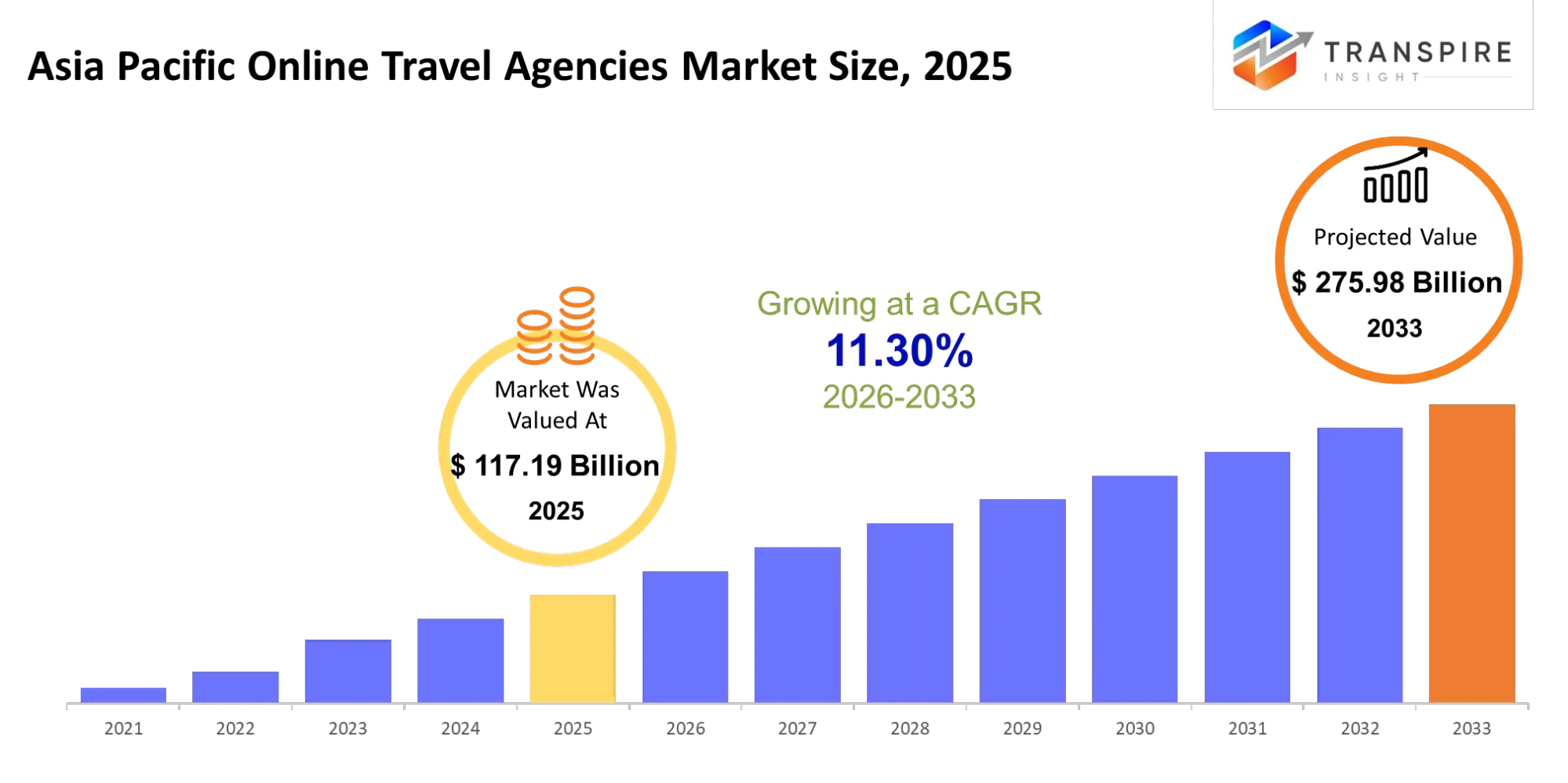
The Asia Pacific Online Travel Agencies Market was valued at USD 117.19 Billion in 2025. It is forecast to reach USD 275.98 Billion by 2033. That is a CAGR of 11.30% over the period.
The online travel agency market in Asia Pacific acts as the interface that aggregates airlines, hotels and transportation operators to end customers via a common digital layer which covers search, comparison, booking and after sales services like cancellation and re-booking. It removes the reliance on offline agents and suppliers through dynamic pricing and distribution, enabling optimization in occupation and yield. Within the last 5 years, the market is moving towards mobile-first super-app ecosystems and tighter API integrations with airlines and hotels chains to facilitate dynamic inventory and customized bundles.
A prominent catalyst is the COVID-19 pandemic; while it saw cross border travel collapse temporarily, it has induced greater digital penetration as consumers opt for DIY bookings when recovering and opening up travel again. Consequently, revenue growth in this space is predominantly based on greater digital penetration and improved booking conversion efficiencies, driven by growth in intra-Asian cross-border leisure travel that needs digitally powered aggregation given the dispersed region.
Key Market Insights
- China's dominance in the Asia Pacific Online Travel Agencies Market with a share of over 35% owing to super-app integration and adoption of mobile bookings.
- South East Asia being the fastest growing segment during 2024-2030, backed by growth of low-cost carriers and increased usage of digital payments.
- Flight booking services contribute a nearly 40% share, highest revenue in the Asia Pacific Online Travel Agencies Market.
- Hotel aggregation & accommodation booking the second biggest segment and fastest growing segment in the urban tourist destinations corridor.
- Package bundling services are gaining momentum and are the fastest growing segment in the market, driven by increasing demand for flexible pricing and individual tours.
- Leisure travel leads, holding around 55% share of the market and recovering regional travel post pandemic.
- Booking platforms are the fastest growing application segment in business travel as hybrid working arrangements settle mobility of corporation business travels.
- Individual is the largest end user segment with more than 60% share for individual travel bookings via digital platforms.
- Individual SME travel management solutions are the fastest growing category in the market as SME companies adopt centralization of bookings, cost saving features etc.
What are the Key Drivers, Restraints, and Opportunities in the Asia Pacific Online Travel Agencies Market?
Rapid transformation to a digital-first travel booking ecosystem on account of mobile-first platform access, smartphone proliferation and payment transaction infrastructure is a major driver for the Asia Pacific Online Travel Agencies Market. Such shifts picked up momentum post-pandemic where both consumers and supply side were nudged to adopt self-service booking channels. Airlines and hotels rely on OTA's for reducing distribution costs and improving occupancies through pricing mechanisms. This has structurally led to a re-allocation of transaction volumes from the offline agents to online aggregators thus translating to better capture of platform revenues and driving commissions to higher numbers.
Price competition and a high customer acquisition cost is still a major constraint as it is structurally entrenched within the Asia Pacific Online Travel Agencies Market. Platforms across both developed and emerging Asia Pacific countries are already giving deep subsidies to users on account of discounts and offers, thus thinning out the margins of these aggregators. In addition to that, reliance on suppliers is a huge constraint, as Airlines and Hotels are encouraging more bookings to their direct channels thus negating the pricing power of OTA's and weakening long term revenue stability.
AI driven hyper-personalized ecosystems are a substantial opportunity especially across the emerging countries of South East Asia and India. With predictive itinerary builders, dynamic bundles and payment infrastructure embedded within the platforms, they have potential to deliver better conversion rates. Integrated models like travel, experiences and fintech services on a super app are carving out revenue layers beyond mere booking commissions.
What Has the Impact of Artificial Intelligence Been on the Asia Pacific Online Travel Agencies Market?
The AI's transformation in the Asia Pacific OTA market has facilitated real time personalization, dynamic pricing optimization and automated customer service to digital travel networks. ML algorithms are commonly deployed by OTA platforms to facilitate optimal search ranking, customized itineraries and dynamic price adjustment based on demand elasticity, seasonal changes, and user behavior signals; thus significantly optimizing conversion efficiency and booking yield per user session in various key online platforms.
Operationally, the majority of customer inquiries can be responded by AI powered chatbots and virtual assistants in the market, which have lowered service cost and improved response time, while predictive analytics are deployed to accurately forecast demand spikes in a market and enabling platforms to allocate their inventory more efficiently, thus preventing booking failure. AI powered fraud detection systems also improve transaction security and reduce transaction leakage especially during a high volume of cross-border booking transactions.
However, inconsistent quality of training data across dispersed markets across the region is one of the crucial limitations that affects the AI transformation in Asia Pacific OTA market; inconsistent travel behavior, various languages, regulations etc. Result in lower prediction accuracy for some of the specific corridors in Southeast Asia. Additionally, high cost of integration makes it unaffordable for small & mid-sized OTA players to integrate such sophisticated AI infrastructures into their OTA platforms, resulting in uneven and incomplete digital transformation across the whole OTA market.
Key Market Trends
- Post-2022, mobile-first booking surpassed desktop as over 70% of all travel transactions took place on mobile across Southeast Asia.
- Post-2023, AI-based recommendation engines superseded static search ranking, increasing conversion rate on Asia Pacific Online Travel Agencies Market top platforms.
- Post-2021 saw rapid growth in super-app ecosystems across China and Indonesia, integrating travel booking with payment, messaging and other lifestyle services.
- Sharp increase in dynamic pricing from 2020 to 2025 provided Airlines and hotels the ability to maximize their revenues through optimized yields on an ongoing basis across OTA channels.
- Post-2022 reopening has significantly increased demand for travel, leading to an increase in dependence on OTAs for coordination of fragment regional itinerary planning.
- Post-2023 saw increasing direct booking channels for Airlines, compelling OTAs such as Trip.com Group to develop more compelling loyalty and bundling program to stay competitive.
- Low cost carrier expansion across Southeast Asia from 2021 has led to increased booking volume with OTAs due to price sensitive, high frequency leisure traveling patterns.
- Digital wallet transaction volume surpassed credit card transactions in multiple markets by 2024 which improved checkout completion rate for OTA platform.
- Post-2023 saw emergence of personalized travel packing services, shifting from the previously fixed bundle of tours to tailor-made itinerary driven by user behaviour and seasonal factor, provided by OTAs and third-party companies.
Asia Pacific Online Travel Agencies Market Segmentation
By Service Type :
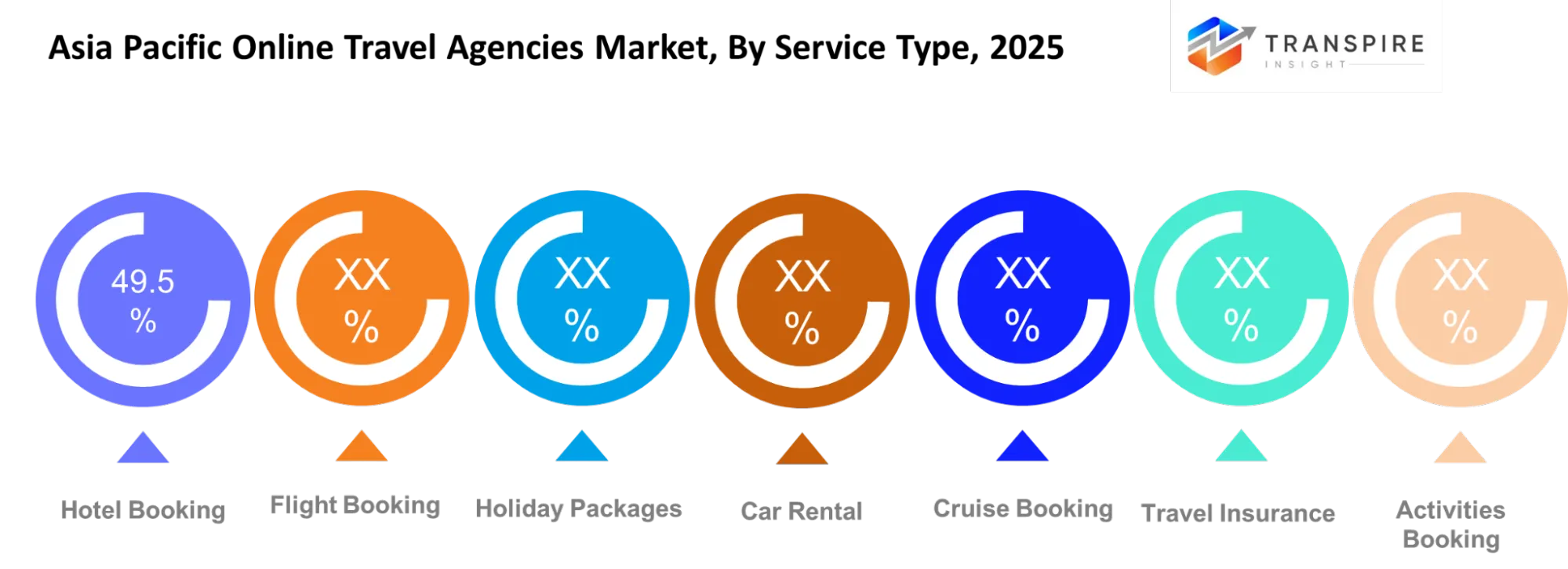
In terms of online booking, flight booking takes the top place as high frequency, while the airline network expands extensively in Asia Pacific routes. Hotel booking is still performing as customers would choose to compare several places before booking their hotel.
Holiday package also catches users attention due to its ability to simplify planning while being more budget friendly as it comprises bundled services and can help travelers save costs. Rental cars and cruise booking maintain a stable usage at few selected destinations where interconnectivity among regions is high while others are minimal. Travel insurance and activities booking have also increased steadily as users increasingly want travel plans including travel insurance and experience and travel related contents.
By Platform :
The increasing popularity in mobile apps has helped to boost in usage as smartphone proliferation extends throughout the urban and semi-urban areas, offering quick and easy booking convenience. Website based bookings continue to have relevance in areas such as comparing several information in detail and corporate bookings which need more defined workflows.
AI travel assistants offer an interactive platform that assists travelers in obtaining tailored travel information, real-time prices monitoring and helping to make decisions much more rapidly and other platforms like integrated super apps, offer users a single platform to pay, browse travel information and engage customer support so that users would spend more time on the platform.
By Traveler Type :
Leisure travelers are the largest category as the volume of regional tourism activity grows and travel patterns shift towards shorter distances. Business travelers continue to hold strong as companies need business travel to facilitate interactions and employees require flexible bookings under hybrid work models. The segment of solo travelers grows continuously as technological tools streamline the travel planning and security checks.
Family travelers demand packaged deals and lodging options suitable for families. Other categories of travelers can include specific segment users such as student and group tours that contribute additional booking volumes.
By End User :
Leisure travelers are the largest category as the volume of regional tourism activity grows and travel patterns shift towards shorter distances. Business travelers continue to hold strong as companies need business travel to facilitate interactions and employees require flexible bookings under hybrid work models. The segment of solo travelers grows continuously as technological tools streamline the travel planning and security checks.
Family travelers demand packaged deals and lodging options suitable for families. Other categories of travelers can include specific segment users such as student and group tours that contribute additional booking volumes.
What are the Key Use Cases Driving the Asia Pacific Online Travel Agencies Market?
The backbone of the Asia Pacific Online Travel Agencies Market's adoption remains in flight & hotel bookings where consumers are looking for ease of price comparison, real-time seat & room availability, instant confirmations and a convenient place to book. This phenomenon is highest among the leisure travel segment on major aviation routes that are plagued by non-unified airline networks and inconsistent flight prices.
Further applications span leisure-oriented activities that include booking pre-paid travel packages/tour bundles and services for the management of corporate travel (especially within businesses and with SME customers) that enable business travelers and companies to manage travel expenditures, automate authorizations, and track travel plans for employees. Activity bookings which fall within the domain of travel & leisure related activities are a newer use case being observed, driven by the increasing preference for localized and experience-driven traveling around the region.
Newer and developing use cases include use of AI for travel planning and the consolidation of travel-fintech services (including payments and insurance), which allow for seamless and all-inclusive travel booking experiences. The use of AI to dynamically adjust travel plans as well as proactive travel notifications is also gaining traction particularly with the emergence of mobile-centric ecosystems such as India and other South East Asian countries.
|
Report Metrics |
Details |
|
Market size value in 2025 |
USD 117.19 Billion |
|
Market size value in 2026 |
USD 130.43 Billion |
|
Revenue forecast in 2033 |
USD 275.98 Billion |
|
Growth rate |
CAGR of 11.30% from 2026 to 2033 |
|
Base year |
2025 |
|
Historical data |
2021 - 2024 |
|
Forecast period |
2026 - 2033 |
|
Report coverage |
Revenue forecast, competitive landscape, growth factors, and trends |
|
Regional scope |
Asia Pacific (India, China, Japan, Australia, South Korea, Rest of Asia Pacific) |
|
Key company profiled |
Booking Holdings, Expedia Group, Trip.com, MakeMyTrip, Traveloka, Agoda, Airbnb, Klook, Yatra, EaseMyTrip, Despegar, Hopper, Skyscanner, Cleartrip, Tripadvisor |
|
Customization scope |
Free report customization (country, regional & segment scope). Avail customized purchase options to meet your exact research needs. |
|
Report Segmentation |
By Service Type (Flight Booking, Hotel Booking, Holiday Packages, Car Rental, Cruise Booking, Travel Insurance, Activities Booking, Others); By Platform (Web-Based, Mobile Apps, AI Travel Assistants, Others); By Traveler Type (Business Travelers, Leisure Travelers, Solo Travelers, Family Travelers, Others); By End User (Individuals, Corporate Clients, Travel Groups, Others) |
Which Regions are Driving the Asia Pacific Online Travel Agencies Market Growth?
With the vast domestic travel market and a deeply embedded digital payment ecosystem, China is a dominant market in the Asia Pacific Online Travel Agencies Market. Driven by significant governmental support for digital commerce and massive smartphone penetration, booking is integrated across cities and tier-2 markets. Furthermore, super-app and fintech platforms, and robust domestic air and high-speed travel networks all contribute to a continuous travel demand and high user loyalty to platforms, which will provide more opportunities in mobile book and instant confirmation within a few seconds, such as, instant hotel and ticket bookings.
Consistent transaction volume driven by a high segment of income and corporate travelers, is how Japan remains a relatively stable market in the Asia Pacific Online Travel Agencies Market. Unlike the rapidly adopting digital ecosystem of China, Japan's online travel markets are penetrated with service-oriented users that embrace the gradual digital adoption while pursuing the reliability and planning efficiency. Stringent quality and strict government regulation on the service, which also drives a reliable experience for end consumers, create constant transaction flow without being promoted aggressively on the market expansion.
Fast growth from post 2022 recovery of tourism and expansion of Low Cost Carriers (LCC) are reshaping the way of travel in Southeast Asia. Thanks to the widespread use of mobile devices, rapid penetration of fintech and e-wallet in Indonesia, Vietnam and Thailand. Also easy travel plans such as relaxation of visa regulations and infrastructure investment, will boost cross-border leisure travel. With this growth tendency, this region can be considered a future expansion opportunity for the platform in the period of 2026-2033.
Who are the Key Players in the Asia Pacific Online Travel Agencies Market and How Do They Compete?
The competition within Asia Pacific Online Travel Agencies Market is on a moderate consolidated status among the leading firms, while regional players are competitive on local markets. The competitions are focused on algorithm pricing, mobile optimization, deep inventory, and localized products rather than simply the scale; platforms compete on providing tailored solutions and leveraging their strengths in supplier relationships to boost the booking conversion and retain users.
Trip.com Group is gaining an advantage from integrated offerings in terms of flight, hotel, cross-border activities, strong dominance in the China outbound travelers market as well as multilingual platform functions. Booking.com is concentrating on an immense travel inventory scale and optimal AI search mechanism in response to partnerships with many regional chains and expanded mobile booking ability. Expedia Group is leveraging a combination of travel bundles, loyalty schemes that keep the repeat users across different leisure trip segments to win their preference.
MakeMyTrip is gaining market strength in India with the integration of local payment gateways and favorable partnerships with many airlines serving local travel segments. The Agoda platform is trying its best to offer competitive hotel prices through efficient supplier management and on-time booking in the Southeast Asian region. The Airbnb platform is exploring the niche of the alternative accommodation supply, which meets the requirements of experiential travel needs, and penetrating strongly in a few cities' travel markets.
Company List
- Booking Holdings
- Expedia Group
- MakeMyTrip
- Traveloka
- Agoda
- Airbnb
- Klook
- Yatra
- EaseMyTrip
- Despegar
- Hopper
- Skyscanner
- Cleartrip
- Tripadvisor
Recent Development News
In December 2025, Expedia Group announced acquisition of Tiqets to expand its experience vertical. The deal strengthens Expedia’s shift toward activity-based travel monetization and enhances cross-selling across its Asia Pacific user base.
Source https://www.mordorintelligence.com/
In January 2026, the State Administration for Market Regulation in China initiated an antitrust investigation into Trip.com Group. The review focuses on ranking practices and merchant exclusivity, signaling tighter regulatory scrutiny on Asia’s largest OTA platform.
Source https://www.mordorintelligence.com/
What Strategic Insights Define the Future of the Asia Pacific Online Travel Agencies Market?
The Asia Pacific Online Travel Agencies market is undergoing a shift in its structure towards an intelligent and platform-led system whereby booking becomes a component integrated with digital lifestyle habits as opposed to being isolated as an activity in itself. Key drivers for growth in this landscape are predicted to be hyper-integrated super app platforms, AI-powered route planning, and integrated cross-border payment networks fueled by a proliferation of mobile-first practices and disparate regional supply chains. Value creation from simple booking commissions will move to a focus on predictive personalization and value-added, bundled service systems that encourage increased user loyalty and higher life-cycle value in the next 5-7 years.
A more latent threat concerns growing over-dependence on only a few of the dominant platforms which might invite greater antitrust regulation and mandatory changes in pricing/ranking algorithms; these may undermine the consistency of monetisation, in addition to a lessening of supplier leverage. Alternatively, a growth avenue has emerged with the development of real-time AI travel orchestration tools. These systems would automatically adjust itinerary elements in response to travel disruptions such as flight delays, dynamic fare increases, or inclement weather which will prove to be critical for transport networks in Southeast Asia.
All stakeholders are advised to focus on the creation of mutually compatible AI and API-enabled ecosystems which would increase traffic via more channels other than dedicated traffic streams, while simultaneously increasing integration with suppliers directly in order to enhance future longevity of operation.
Asia Pacific Online Travel Agencies Market Report Segmentation
By Service Type
- Flight Booking
- Hotel Booking
- Holiday Packages
- Car Rental
- Cruise Booking
- Travel Insurance
- Activities Booking
By Platform
- Web-Based
- Mobile Apps
- AI Travel Assistants
By Traveler Type
- Business Travelers
- Leisure Travelers
- Solo Travelers
- Family Travelers
By End User
- Individuals
- Corporate Clients
- Travel Groups
Frequently Asked Questions
Find quick answers to common questions.
The Asia Pacific Online Travel Agencies Market size is USD 275.98 Billion in 2033.
Key segments for the Asia Pacific Online Travel Agencies Market are By Service Type (Flight Booking, Hotel Booking, Holiday Packages, Car Rental, Cruise Booking, Travel Insurance, Activities Booking, Others); By Platform (Web-Based, Mobile Apps, AI Travel Assistants, Others); By Traveler Type (Business Travelers, Leisure Travelers, Solo Travelers, Family Travelers, Others); By End User (Individuals, Corporate Clients, Travel Groups, Others).
Major Asia Pacific Online Travel Agencies Market players are Booking Holdings, Expedia Group, Trip.com, MakeMyTrip, Traveloka, Agoda, Airbnb, Klook, Yatra, EaseMyTrip, Despegar, Hopper, Skyscanner, Cleartrip, Tripadvisor.
The Asia Pacific Online Travel Agencies Market size is USD 117.19 Billion in 2025.
The Asia Pacific Online Travel Agencies Market CAGR is 11.30% from 2026 to 2033.
- Booking Holdings
- Expedia Group
- MakeMyTrip
- Traveloka
- Agoda
- Airbnb
- Klook
- Yatra
- EaseMyTrip
- Despegar
- Hopper
- Skyscanner
- Cleartrip
- Tripadvisor
About the Authors

Mayur Shinde
I am Mayur Shinde, a Senior Research Analyst at Transpire Insight, specializing in the Automotive & Transportation and Information & Communication Technology (ICT) Industry. My work focuses on analyzing emerging market trends, technological advancements, competitive landscapes, and industry developments to deliver accurate, data-driven insights. I am passionate about transforming complex market information into clear, actionable content that helps businesses, professionals, and decision-makers stay informed and make confident strategic decisions.

Chakradhar Khansole
Chakradhar serves as the Research Director at Transpire Insight, bringing over 8 years of experience in technology, innovation, and strategic market intelligence. He specializes in transforming complex market data into actionable business insights that enable organizations to make informed, growth-oriented decisions. Recognized for his strategic vision and analytical expertise, Chakradhar leads high-impact research initiatives, delivering comprehensive market assessments, competitive intelligence, and forward-looking industry analysis.
Recently Published Reports
-
Apr 2026
3D Optical Profiler Market
3D Optical Profiler Market Size, Share & Analysis Report By Type (Desktop 3D Optical Profiler, and Portable 3D Optical Profiler), By Technology (Confocal Technology, and White Light Interference), By End-Use Industry (Manufacturing, Research Institutions, Automotive, Aerospace and Defense, Medical Devices, and Other), and Geography (North America, Europe, Asia-Pacific, Middle East and Africa, South and Central America), 2021 - 2031
-
Apr 2026
Depth Sensor Market
Depth Sensor Market Size, Share & Analysis Report By Type (Infrared Depth Sensors, Time-of-Flight (ToF) Sensors, Stereo Vision Sensors, Structured Light Sensors, Ultrasonic Depth Sensors), By Application (Automotive, Robotics, Gaming, Consumer Electronics, Industrial Automation, Healthcare, Security & Surveillance, Others), By End Users (Automotive Manufacturers, Consumer Electronics Companies, Healthcare Providers, Industrial Companies, Security Agencies, Gaming Companies, Robotics Companies, Others), and Geography (North America, Europe, Asia-Pacific, Middle East and Africa, South and Central America), 2021 – 2031
-
Apr 2026
Digital Manufacturing Market
Digital Manufacturing Market Size, Share & Analysis Report By Component (Hardware, Software, and Services), By Technology (Robotics, 3D Printing, Internet of Things (IoT), and Others), By Application (Automotive and Transportation, Aerospace and Defense, Consumer Electronics, Industrial Machinery, and Others), By Process Type (Computer-Based Designing, Computer-Based Simulation, Computer 3D Visualization, Analytics, and Others), and Geography (North America, Europe, Asia-Pacific, Middle East and Africa, South and Central America), 2021 – 2031
-
Apr 2026
Digital Visa Services Market
Digital Visa Services Market Size, Share & Analysis Report By Type (Individual Travelers, Group Travelers), By Application (Tourism, Business Travel, Others), and Geography (North America, Europe, Asia-Pacific, Middle East and Africa, South and Central America), 2021 – 2031