

United States Alcoholic Beverages Market Size & Forecast:
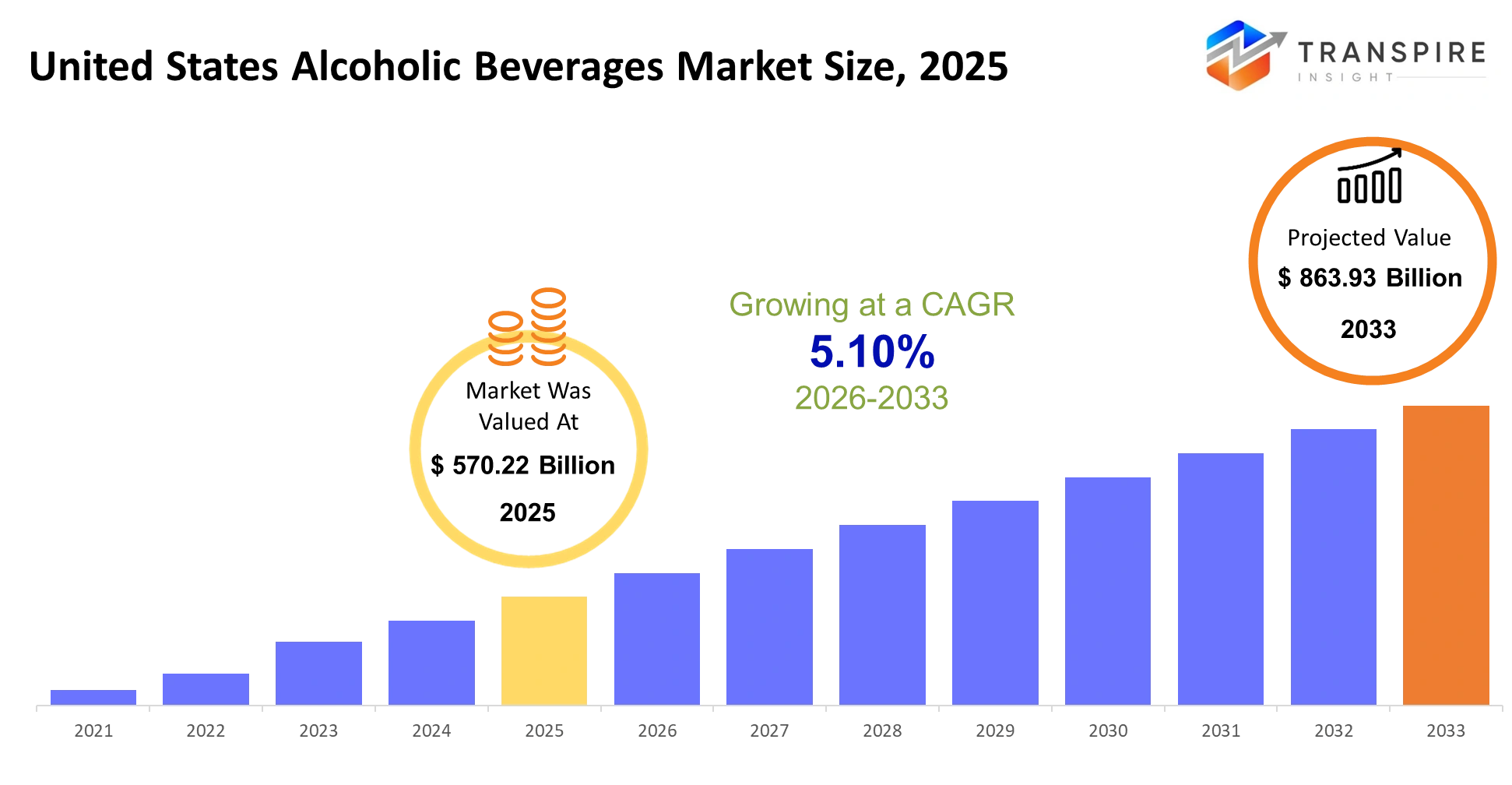
- United States Alcoholic Beverages Market Size 2025: USD 570.22 Billion
- United States Alcoholic Beverages Market Size 2033: USD 863.93 Billion
- United States Alcoholic Beverages Market CAGR: 5.10%
- United States Alcoholic Beverages Market Segments:By Type (Beer, Wine, Spirits, RTD), By Distribution Channel (Retail, On-trade, Online, Direct), By Packaging (Bottles, Cans, Kegs, Cartons), By Alcohol Content (Low, Medium, High, Premium), By End-User (Consumers, Bars, Restaurants, Retailers).
To learn more about this report,  Download Free Sample Report
United States Alcoholic Beverages Market Summary:
The United States alcoholic beverages market size is estimated at USD 570.22 billion in 2025 and is anticipated to reach USD 863.93 billion by 2033, growing at a CAGR of 5.10% from 2026 to 2033. The United States alcoholic beverage market shows ongoing evolution because consumer preferences and premiumisation trends continue to develop. The younger consumers who want diverse drinking options which are easy to access now drive up demand for craft spirits and flavoured beers and ready-to-drink cocktails. The public shows growing demand for products that emphasise health, which includes items with low alcohol content and organic certification. Companies use e-commerce and creative branding methods to develop new approaches for their distribution and marketing activities. The market demonstrates a traditional and innovative market balance as businesses work to create high-quality, sustainable products which provide customers with exceptional drinking experiences.
Key Market Trends & Insights:
- The current trend shows that people are prepared to pay higher prices for premium alcoholic beverages which offer superior quality. The demand for craft spirits and aged whiskies and artisanal beers has grown because people desire to experience special flavours during their drinking occasions.
- People choose RTD cocktails and hard seltzers because these products offer multiple drink options and simple drinking experiences. People seek tasty products which they can easily consume during their social events and busy workdays.
- People are showing interest in small breweries and distilleries because these businesses create authentic products and develop new ideas. Customers prefer to support nearby businesses while discovering unique flavours which belong to their local area.
- Businesses should focus on online sales and digital marketing efforts which have gained increasing importance. Brands use social media platforms together with e-commerce websites to establish direct contact with their customers while increasing customer interaction.
- The importance of sustainable packaging solutions and responsible material sourcing methods is on the rise. Consumers choose to shop with brands which adopt environmentally friendly practices because they have developed awareness about environmental effects.
- Marketers use distinctive product flavours and limited-time promotional items to create consumer interest. Through product experimentation brands create unique market positions which enable them to compete with their rivals through their special product offerings that feature exotic fruit infusions and bold botanical blends.
United States Alcoholic Beverages Market Segmentation
By Type
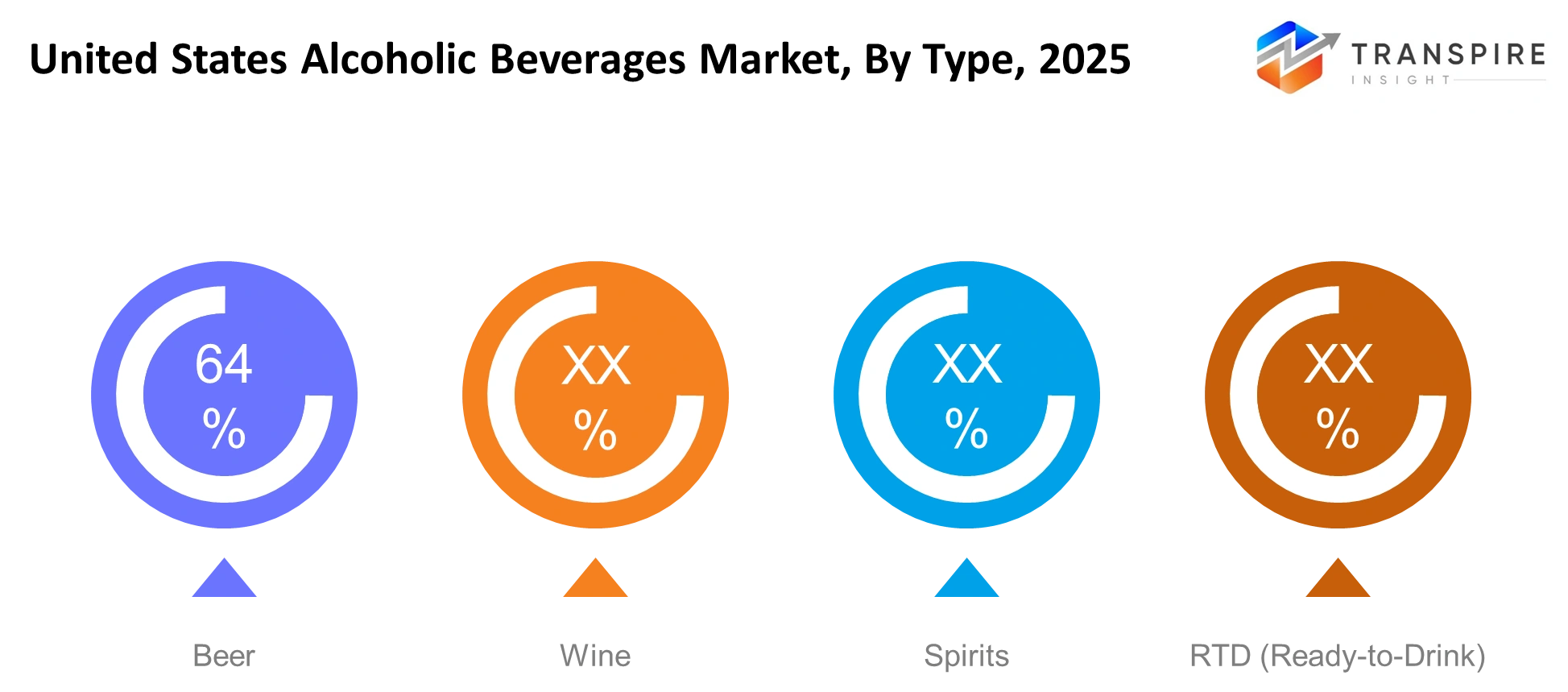
- Beer: The U.S. beer market sustains its operations through the distribution of both commercial beer products and craft beer products. Beer provides two primary advantages to consumers because it combines its affordable pricing with its wide selection of taste options. The craft beer movement continues to attract new supporters who desire to experience authentic local beers brewed with distinctive methods and traditional taste profiles.
- Wine: Wine drinking shows how people combine their established habits with their modern preferences. People who drink wine choose between premium wines and ordinary table wines which offer different levels of quality. Organic wines and low-sugar wines have become popular among health-conscious consumers and younger buyers, which affects their wine-buying choices.
- Spirits: The growth of cocktail culture together with increasing demand for high-quality spirits has resulted in significant expansion for the spirits industry.Consumers continue to show interest in whisky and vodka and tequila and gin while they explore the unique alcoholic beverages created by craft distilleries. People who host parties at their homes want access to premium spirits which they can use to create unique drinks.
- RTD (Ready-to-Drink): RTD beverages are gaining popularity as they present excellent ease of use and can be used in a bunch of ways. The pre-mixed drinks serve two types of customers, which are time-constrained users and those who want to drink in social settings. Young people who attend outdoor parties or social events prefer RTDs because they offer various flavours and drinks with lower alcohol content.
To learn more about this report, Download Free Sample Report
By Distribution Channel
- Retail: Retail stores function as the main location where customers buy alcoholic drinks because they provide both product accessibility and product selection. Supermarkets and liquor stores provide their customers with two different buying options, which include economical products and high-end products that customers can use for both their everyday needs and their large purchases.
- On-trade: Bar and restaurant operations function as on-trade channels that allow customers to experience their products. Customers partake in social activities within a venue that provides them with planned drink selections and a special atmosphere. Direct customer interaction drives this sector to establish premium brands and to introduce new products into the market.
- Online: The online alcohol market experiences continuous growth because customers value its product delivery service, which allows them to shop from home. Customers find it simple to explore products while comparing their features before making their purchases. Brands use digital platforms to reach extensive customer groups while generating custom product suggestions.
- Direct: The consumer market shows increasing interest in direct-to-consumer channels which include winery and distillery sales. Exclusive product access through this channel helps businesses create better brand connections with their clients. Consumers prefer to buy from producers because they want to get genuine products which help them build trust with the brand.
By Packaging
- Bottles: Bottles continue to serve as the most conventional packaging solution which people around the world commonly use. People associate glass bottles with premium quality, which makes them the preferred choice for wine and spirit packaging. Glass bottles maintain flavour while creating an attractive traditional display.
- Cans: The public are starting to favour cans because they provide both portable and convenient solutions. The product offers lightweight characteristics which make it simple to recycle and suitable for usage at outdoor functions. The use of cans has become common among brands which produce beers and RTDs because they want to satisfy customers who want to drink while travelling.
- Kegs: Bars and restaurants use kegs as their standard method of serving draft beer. The system enables restaurants to store large quantities of beer while serving customers with freshly brewed beer. Kegs function as an economical method for serving drinks at major events and public parties.
- Cartons: Cartons present a functional packaging solution which protects the environment when used for wine products. The products provide lightweight characteristics which make storage easy and usually cost less than other options. Consumers who want environmentally friendly products for their daily use are choosing carton packaging as their preferred choice.
By Alcohol Content
- Low: The health-conscious market currently shows increasing interest in low-alcohol beverages which provide social drinking options that limit excessive drinking. The younger demographic shows a strong preference for these products because they enable them to maintain their active lifestyles while practising responsible drinking.
- Medium: Medium alcohol content beverages provide a combination of taste and drinking power which delivers to their customers multiple drinking possibilities across different social settings. The product range includes various beers and wines which deliver pleasant drinking experiences through their mild flavour profiles.
- High: Consumers who want to experience intense drinking need high-alcohol beverages which deliver their desired effects. This category includes all types of spirits together with all types of fortified wines. The products get used during special events when people drink small amounts or create cocktails.
- Premium: Premium alcoholic beverages focus on delivering high-quality products which require expert craftsmanship together with advanced brand development. The premium market segment attracts customers who want exceptional taste together with exclusive product experiences. The market segment keeps expanding because people now seek authentic products which show their cultural roots through their use of premium natural components.
By End-User
- Consumers: Companies need to understand the needs of individual consumers who make up their largest customer base because these consumers base their product preferences on their personal tastes and their everyday life. The buying patterns of these consumers show increasing demand for home consumption products and their tendency to try out new things and their preference for high-end products.
- Bars: Bars serve as essential platforms which display their complete selection of alcoholic drinks. The establishment uses its drink selection and cocktail trends to shape which drinks customers will order. Bars provide social spaces with their unique atmosphere, which brands use for customer interaction and product promotion.
- Restaurants: Restaurants use alcoholic drinks to create dining experiences which increase customer satisfaction through better food matching. Restaurants increase their sales through wine and specialty drink promotions which result in greater brand recognition and higher sales of premium products.
- Retailers: Retailers serve as essential links between producers and consumers by maintaining product distribution and maintaining a diverse product range. Retailers use their marketing strategies and product placement methods and customer support to shape what customers decide to buy. Retailers help bridge the gap between producers and end consumers effectively.
Country Insights
The United States alcoholic beverage market shows a dynamic combination of established customs and contemporary advances and changing consumer preferences. The country displays wide-ranging drinking preferences which receive influence from various regional cultural and demographic factors. Urban areas show a preference for premium spirits and craft beers and new ready-to-drink products, whereas suburban and rural markets maintain constant demand for traditional beers and affordable items. The wine and craft beverage industry in California and New York develops through their strong local production facilities and active tourism sector. Southern and midwestern areas keep their regular consumption patterns for popular products.
The different state regulatory systems create distinct effects on distribution methods and sales processes, especially regarding online retail transactions. Seasonal patterns and festivals and sporting events establish drinking habits which spread throughout the entire country. The U.S. market shows strong market resilience because consumers increasingly demand high-quality products that offer them diverse drinking choices which match their personal lifestyle and value system.
Recent Development News
In March 2026, RTD Boom Drives Industry Shift in the U.S.: The ready-to-drink segment continues to reshape the U.S. alcohol market, with strong growth outperforming traditional categories like beer and wine. Younger consumers are driving demand for convenience and flavour innovation.
In March 2026, Four Loko Owner Explores Potential Sale Amid Market Changes: Phusion Projects is evaluating a possible sale of its Four Loko brand, reflecting increasing consolidation and investor interest in high-growth RTD categories across the U.S. beverage market.
|
Report Metrics |
Details |
|
Market size value in 2025 |
USD 570.22 Billion |
|
Market size value in 2026 |
USD 610.09 Billion |
|
Revenue forecast in 2033 |
USD 863.93 Billion |
|
Growth rate |
CAGR of 5.10% from 2026 to 2033 |
|
Base year |
2025 |
|
Historical data |
2021 – 2024 |
|
Forecast period |
2026 – 2033 |
|
Report coverage |
Revenue forecast, competitive landscape, growth factors, and trends |
|
Country scope |
United States |
|
Key company profiled |
Anheuser-Busch, Diageo, Molson Coors, Constellation Brands, Brown-Forman, E&J Gallo, Bacardi, Beam Suntory, Pernod Ricard, Heineken USA, Treasury Wine Estates, Remy Cointreau, Asahi Group, Kirin, Sazerac |
|
Customization scope |
Free report customization (country, regional & segment scope). Avail customized purchase options to meet your exact research needs. |
|
Report Segmentation |
By Type (Beer, Wine, Spirits, RTD), By Distribution Channel (Retail, On-trade, Online, Direct), By Packaging (Bottles, Cans, Kegs, Cartons), By Alcohol Content (Low, Medium, High, Premium), By End-User (Consumers, Bars, Restaurants, Retailers). |
Key United States Alcoholic Beverages Company Insights
The United States alcoholic beverage market exists because international beverage companies and new craft producers enter the market with their distinct business strengths. Established companies focus on expanding premium portfolios and strengthening distribution networks, while smaller brands emphasise their dedication to innovation and genuine product development and their capacity to serve local markets. Companies need to establish their main focuses through strategic partnerships and product diversification and sustainable practices development. Companies develop their digital marketing strategies together with direct-to-consumer programmes to create better customer connections which help their business growth in a market that experiences both intense competition and constant changes.
Company List
- Anheuser-Busch
- Diageo
- Molson Coors
- Constellation Brands
- Brown-Forman
- E&J Gallo
- Bacardi
- Beam Suntory
- Pernod Ricard
- Heineken USA
- Treasury Wine Estates
- Remy Cointreau
- Asahi Group
- Kirin
- Sazerac
United States Alcoholic Beverages Market Report Segmentation
By Type
- Beer
- Wine
- Spirits
- RTD
By Distribution Channel
- Retail
- On-trade
- Online
- Direct
By Packaging
- Bottles
- Cans
- Kegs
- Cartons
By Alcohol Content
- Low
- Medium
- High
- Premium
By End-User
- Consumers
- Bars
- Restaurants
- Retailers
Frequently Asked Questions
Find quick answers to common questions.
The Approximate United States Alcoholic Beverages Market size for the Market will be USD 863.93 Billion in 2033.
The key Segments of the United States Alcoholic Beverages Market are By Type (Beer, Wine, Spirits, RTD), By Distribution Channel (Retail, On-trade, Online, Direct), By Packaging (Bottles, Cans, Kegs, Cartons), By Alcohol Content (Low, Medium, High, Premium), By End-User (Consumers, Bars, Restaurants, Retailers).
Major Players in the United States Alcoholic Beverages Market are Anheuser-Busch, Diageo, Molson Coors, Constellation Brands, Brown-Forman, E&J Gallo, Bacardi, Beam Suntory, Pernod Ricard, Heineken USA, Treasury Wine Estates, Remy Cointreau, Asahi Group, Kirin, Sazerac.
The Current Market size of the United States Alcoholic Beverages Market is USD 570.22 Billion in 2025.
The United States Alcoholic Beverages Market CAGR is 5.10%.
- Anheuser-Busch
- Diageo
- Molson Coors
- Constellation Brands
- Brown-Forman
- E&J Gallo
- Bacardi
- Beam Suntory
- Pernod Ricard
- Heineken USA
- Treasury Wine Estates
- Remy Cointreau
- Asahi Group
- Kirin
- Sazerac
Recently Published Reports
-
Apr 2026
Baby Infant Formula Market
Baby Infant Formula Market Size, Share & Analysis Report By ype (Infant Milk, Follow On Milk, Specialty Baby Milk, Growing-Up Milk), By Ingredient (Carbohydrate, Fat, Protein, Minerals, Vitamins, and Others), By Product Form (Powder, Liquid, and Ready-to-feed), By Distribution Channels (Supermarket/Hypermarket, Specialty Store, Pharmacies, Online Retail, and Others), and Geography (North America, Europe, Asia-Pacific, Middle East and Africa, South and Central America), 2021 - 2031
-
Apr 2026
Edible Insects for Animal Feed Market
Edible Insects for Animal Feed Market Size, Share & Analysis Report By Type (Insect Powder, Insect Meal, Insect Bar, Insect Paste, Insect Oil, and Others), By Insect Type (Beetles, Cricket, Caterpillar, Hymenoptera, Orthoptera, Tree Bugs, and Others), By Application (Livestock, Pet Food, and Aquaculture), By Livestock Type (Poultry, Swine, and Others), and Geography (North America, Europe, Asia-Pacific, Middle East and Africa, South and Central America), 2021 - 2031
-
Apr 2026
Food Industry Disinfection and Bacterial Control Market
Food Industry Disinfection and Bacterial Control Market Size, Share & Analysis Report By Type (Chemical Disinfectants, Physical Disinfectants, and Biocides and Antimicrobials), By Application (Food Processing Equipment Surface Disinfection, Food Preparation Areas Surface Disinfection, Storage Areas Surface Disinfection, Anti-microbial Coatings Food Preservation, and Preservative Solutions Food Preservation), By End User (Meat and Poultry Processing, Dairy Processing, Seafood Processing, Bakery and Confectionery, Restaurants and Commercial Kitchens, and Food Service Providers), By Sales Channel (Online, Offline), and Geography (North America, Europe, Asia-Pacific, Middle East and Africa, South and Central America), 2021 - 2031
-
Apr 2026
Freeze Dried Food Market
Freeze Dried Food Market Size, Share & Analysis Report By Product Type (Fruits, Vegetables, Freeze-Dried Dairy Products, Freeze-Dried Meat and Seafood, Freeze-Dried Pet Food, and Prepared Meal), By Nature (Organic, and Conventional), By Form (Powdered, Granules, and Diced), By End Use (Breakfast Cereals, Dairy Products, Bakery & Confectionery, Nutritional Bars & Supplements, Powdered Beverages, Snacks, and Retail (Household)), and Geography (North America, Europe, Asia-Pacific, Middle East and Africa, South and Central America), 2021 - 2031