
Asia Pacific Luxury Goods Market Size & Forecast:
- Asia Pacific Luxury Goods Market Size 2025: USD 163.7 Billion
- Asia Pacific Luxury Goods Market Size 2033: USD 248.9 Billion
- Asia Pacific Luxury Goods Market CAGR: 5.3%
- Asia Pacific Luxury Goods Market Segments: By Product Type (Fashion & Accessories, Watches, Jewelry, Cosmetics, Leather Goods, Footwear, Others); By Distribution Channel (Brand Stores, Online Retail, Department Stores, Duty Free Stores, Others); By End User (Men, Women, Millennials, HNWIs, Others); By Price Range (Premium, Ultra-Luxury, Bespoke Luxury, Others).
Asia Pacific Luxury Goods Market Summary
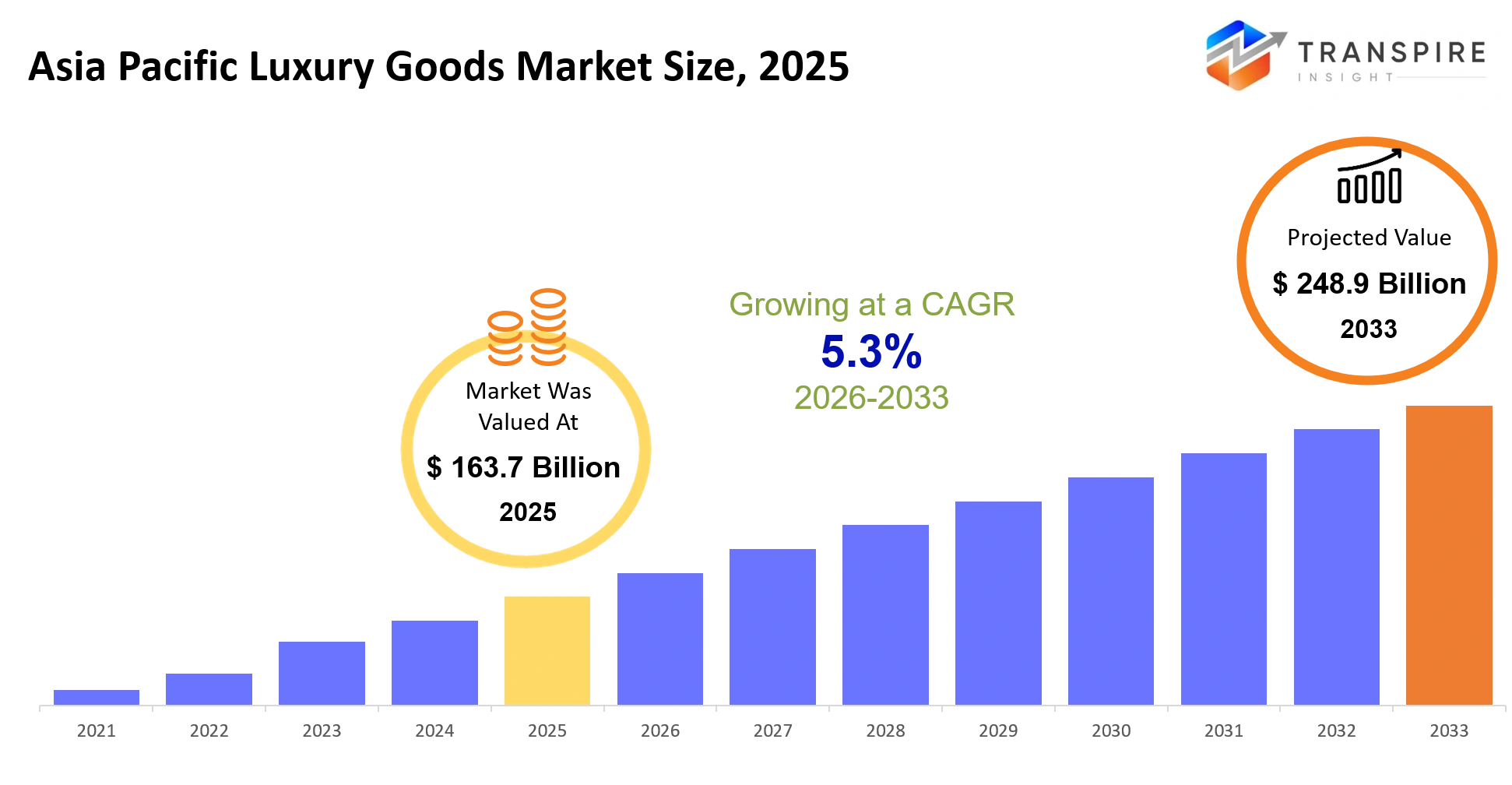
The Asia Pacific Luxury Goods Market was valued at USD 163.7 Billion in 2025. It is forecast to reach USD 248.9 Billion by 2033. That is a CAGR of 5.3% over the period.
The Asia Pacific Luxury Goods Market serves a role beyond discretionary spending by enabling consumers to express status, identity, craftsmanship preferences, and lifestyle aspirations through premium fashion, jewelry, watches, cosmetics, and leather goods. For brands, it functions as a high-margin ecosystem that combines exclusivity, heritage, and customer loyalty to generate long-term value.
Over the last five years, the market has undergone a structural shift toward digital-first luxury retail. Premium brands now integrate e-commerce, social commerce, and personalized customer engagement into their sales strategies, allowing them to reach affluent consumers beyond traditional flagship-store locations. The COVID-19 pandemic acted as a major trigger, disrupting international travel and duty-free shopping while accelerating online luxury purchases and domestic consumption across key Asian economies.
Current market expansion is driven by growing wealth creation, a larger base of affluent millennials and Gen Z consumers, and stronger demand for premium experiences linked to brand authenticity. This is pushing luxury companies to expand regional presence, invest in omnichannel capabilities, and introduce localized product offerings, translating into broader customer reach and higher revenue opportunities.
Key Market Insights
- China dominates the Asia Pacific Luxury Goods Market, accounting for approximately 38–42% market share in 2025, driven by affluent urban consumers.
- Japan holds a significant share, supported by strong demand for luxury watches, fashion accessories, and premium beauty products.
- India is the fastest-growing regional market during 2025–2030, fueled by expanding high-net-worth populations and premium retail development.
- Southeast Asian countries are witnessing emerging demand through luxury tourism, digital commerce, and premium lifestyle spending.
- Fashion and accessories lead the market with nearly 30–35% share in 2025, supported by strong brand loyalty and repeat purchases.
- Luxury watches and jewelry represent the second-largest segment, benefiting from investment-oriented and gifting-related purchases.
- Luxury cosmetics and skincare are the fastest-growing category through 2030, driven by premium beauty trends and younger consumers.
- Leather goods continue gaining market share as brands introduce limited-edition collections and localized product portfolios.
- Personal luxury consumption dominates with over 70% market share, reflecting strong spending on fashion, beauty, and accessories.
- Premium gifting is emerging as a fast-growing application, particularly across China, India, and Southeast Asia.
What are the Key Drivers, Restraints, and Opportunities in the Asia Pacific Luxury Goods Market?
The strongest force accelerating the Asia Pacific Luxury Goods Market is the rapid expansion of affluent and upper-middle-income consumer groups, particularly in China, India, and Southeast Asia. This shift has been amplified by sustained wealth creation in technology, finance, manufacturing, and entrepreneurship sectors over the past decade. At the same time, luxury brands have invested heavily in digital commerce, enabling consumers to access premium products without relying solely on flagship stores in major metropolitan areas. The combination of broader purchasing power and improved market access has expanded the customer base, increased transaction frequency, and generated stronger revenue streams across fashion, jewelry, beauty, and leather goods categories.
The most significant structural barrier is the market's dependence on exclusivity, premium pricing, and brand heritage. Luxury brands cannot rapidly scale production without risking dilution of brand value, while maintaining craftsmanship standards requires specialized skills and tightly controlled supply chains. These limitations cannot be resolved quickly because they are central to the luxury business model. As a result, supply constraints, high product costs, and limited availability restrict market penetration among aspirational consumers, suppressing potential revenue growth in emerging economies.
A major future opportunity lies in India's evolving luxury ecosystem. Rising high-net-worth populations, premium retail infrastructure investments, and expanding luxury e-commerce platforms are creating favorable conditions for market expansion. Brands that establish localized retail networks, digital clienteling capabilities, and region-specific product collections can capture significant untapped spending, positioning India as one of the most attractive growth markets in the region over the next decade.
What Has the Impact of Artificial Intelligence Been on the Asia Pacific Luxury Goods Market?
Artificial intelligence and advanced digital technologies are transforming the Asia Pacific luxury goods sector by improving customer engagement, inventory management, and operational efficiency across retail channels. Luxury brands increasingly use AI-powered recommendation engines to analyze browsing behavior, purchase history, and customer preferences, enabling highly personalized product suggestions and marketing campaigns. These systems help increase conversion rates and strengthen customer retention in both online and omnichannel environments.
Machine learning models are also being applied to demand forecasting and inventory optimization. By analyzing historical sales data, seasonal patterns, tourism flows, and social media signals, brands can predict product demand more accurately and allocate inventory across stores and e-commerce platforms. This reduces stock shortages for high-demand items while minimizing excess inventory, improving revenue performance and operational efficiency.
Digital authentication technologies, including AI-based image recognition and blockchain-supported traceability systems, are helping brands combat counterfeit products. These tools improve supply chain transparency and protect brand equity, particularly in high-value categories such as watches, jewelry, and leather goods.
Despite these benefits, a major limitation remains the high cost of integrating AI across fragmented retail, supply chain, and customer data systems. Many luxury brands also face challenges in maintaining data quality and preserving the personalized human service that remains central to premium customer experiences. As a result, AI adoption continues to advance, but implementation varies significantly across markets and brands.
Key Market Trends
- Since 2020, luxury brands have shifted significant marketing budgets toward social commerce and influencer-led campaigns, particularly across China and South Korea.
- Direct-to-consumer channels gained prominence after pandemic disruptions reduced dependence on department stores and international duty-free retail networks.
- AI-powered personalization tools expanded across major brands between 2021 and 2025, improving customer targeting, product recommendations, and repeat purchases.
- India emerged as a strategic expansion market as premium malls, luxury e-commerce platforms, and affluent consumer clusters expanded beyond major metros.
- Luxury cosmetics and skincare outpaced several traditional categories after younger consumers increasingly prioritized wellness, beauty, and self-care purchases.
- Leading players including Louis Vuitton, Gucci, and Chanel accelerated limited-edition launches to strengthen exclusivity and reduce direct price competition.
- Counterfeit prevention strategies evolved from conventional authentication methods toward blockchain-enabled traceability and digital product verification systems.
- Regional supply chains became more diversified after pandemic-era disruptions exposed risks associated with concentrated sourcing and manufacturing networks.
- Sustainability reporting gained greater importance as luxury houses increased investments in traceable materials, responsible sourcing, and circular product initiatives.
- Millennials and Gen Z consumers have become increasingly influential since 2020, shifting brand strategies toward digital engagement and experiential luxury offerings.
Asia Pacific Luxury Goods Market Segmentation
By Product Type:
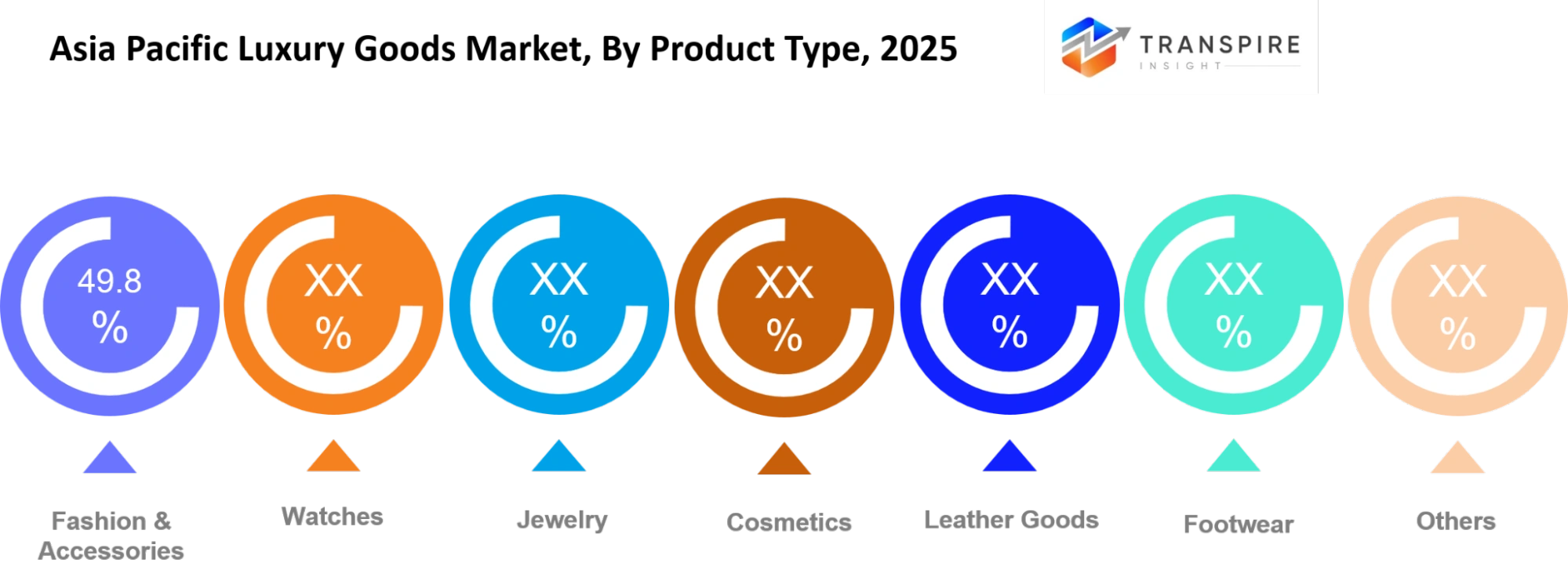
Fashion and accessories continue to hold a leading position because luxury consumers often make repeat purchases in apparel, handbags, eyewear, and related products. Strong brand recognition, seasonal collections, and product launches support steady sales across major economies. Premium fashion houses also benefit from a broad customer base that ranges from affluent buyers to aspirational consumers seeking entry-level luxury products.
Watches and jewelry maintain a strong presence due to long-term value, craftsmanship, and gifting demand. Luxury cosmetics and skincare have gained momentum as premium beauty routines become more common among younger consumers. Leather goods also contribute significantly, supported by demand for handbags, wallets, and travel accessories. Product innovation and limited-edition collections continue to influence purchasing decisions across several categories.
By Distribution Channel:
Brand stores remain an important sales channel because direct control over customer experience helps preserve exclusivity and brand identity. Flagship locations in major cities attract both domestic consumers and international visitors seeking premium shopping experiences. Personalized services, exclusive collections, and customer engagement programs strengthen loyalty and encourage repeat purchases.
Online retail has expanded considerably as digital platforms make luxury products accessible beyond traditional retail locations. Improved digital experiences, virtual consultations, and secure payment systems have encouraged greater adoption of e-commerce channels. Department stores continue to play a valuable role by offering multiple premium brands under one location. Duty-free stores also contribute to sales through travel-related luxury purchases, particularly in key tourism destinations.
By End User:
Women account for a substantial share of luxury spending, supported by strong purchases across fashion, cosmetics, jewelry, and accessories. Frequent product launches and expanding premium beauty portfolios continue to attract consumer interest. Luxury brands also invest heavily in personalized marketing strategies aimed at this customer group.
Men represent an important and expanding customer segment, particularly in watches, leather goods, footwear, and premium apparel. Growing interest in personal style and luxury lifestyle products supports category expansion. Millennials and Generation Z consumers are reshaping purchasing patterns through digital engagement and preference for unique brand experiences. High-net-worth individuals remain a key revenue source for exclusive collections and premium offerings.
By Price Range:
Premium luxury products occupy a significant portion of sales as consumers seek recognized brands while maintaining spending flexibility. This category appeals to both established luxury buyers and first-time customers entering the market. Product accessibility within premium price tiers supports broader market participation across different income groups.
Ultra-luxury products continue to attract affluent consumers seeking exclusivity, heritage, and exceptional craftsmanship. Limited production volumes and rare materials help maintain strong brand positioning within this category. Demand for bespoke products, high-end jewelry, and exclusive timepieces remains supported by wealth creation across major Asia Pacific economies. Distinctive product offerings and personalized services will continue to strengthen customer interest in higher price segments.
What are the Key Use Cases Driving the Asia Pacific Luxury Goods Market?
Personal consumption remains the primary use case supporting luxury goods sales across Asia Pacific. Premium fashion, accessories, jewelry, and beauty products are widely purchased as symbols of status, personal achievement, and lifestyle expression. This application generates the highest spending because purchases occur across multiple product categories and throughout the year.
Corporate gifting and premium gifting occasions are gaining traction across business, hospitality, and financial services sectors. Luxury watches, leather goods, and jewelry are increasingly selected for executive recognition programs and high-value client engagement. Affluent millennials and young professionals also contribute through premium beauty and lifestyle purchases.
Emerging use cases include digital luxury experiences and authenticated resale platforms. Brands are exploring AI-driven personalization, virtual product consultations, and exclusive online launches to reach younger consumers. Certified pre-owned luxury products and blockchain-based authenticity verification also show strong long-term potential as transparency and value retention become more important purchasing considerations.
|
Report Metrics |
Details |
|
Market size value in 2025 |
USD 163.7 Billion |
|
Market size value in 2026 |
USD 173.4 Billion |
|
Revenue forecast in 2033 |
USD 248.9 Billion |
|
Growth rate |
CAGR of 5.3% from 2026 to 2033 |
|
Base year |
2025 |
|
Historical data |
2021 - 2024 |
|
Forecast period |
2026 - 2033 |
|
Report coverage |
Revenue forecast, competitive landscape, growth factors, and trends |
|
Regional scope |
Asia Pacific |
|
Key company profiled |
Louis Vuitton, Gucci, Chanel, Hermès, Dior, Rolex, Cartier, Prada, Burberry, Tiffany & Co., Richemont, LVMH, Kering, Estée Lauder, Armani. |
|
Customization scope |
Free report customization (country, regional & segment scope). Avail customized purchase options to meet your exact research needs. |
|
Report Segmentation |
By Product Type (Fashion & Accessories, Watches, Jewelry, Cosmetics, Leather Goods, Footwear, Others); By Distribution Channel (Brand Stores, Online Retail, Department Stores, Duty Free Stores, Others); By End User (Men, Women, Millennials, HNWIs, Others); By Price Range (Premium, Ultra-Luxury, Bespoke Luxury, Others). |
Which Regions are Driving the Asia Pacific Luxury Goods Market Growth?
East Asia leads the Asia Pacific Luxury Goods Market, with China, Japan, and South Korea serving as the primary revenue generators. Strong wealth creation, a large concentration of affluent consumers, and mature luxury retail networks support market leadership across the region. China remains particularly influential due to its extensive base of luxury buyers and continued investment by global brands in flagship stores and digital commerce platforms. A well-developed ecosystem of premium shopping districts, luxury e-commerce channels, and established brand presence continues to sustain regional dominance.
Southeast Asia represents the second-largest contributor, but growth dynamics differ from East Asia. Market performance is supported by economic diversification, expanding tourism activity, and a growing population of upper-middle-income consumers rather than sheer market scale. Countries such as Singapore, Thailand, Malaysia, and Indonesia benefit from steady luxury spending and strong retail infrastructure. Consistent investments in premium shopping destinations and luxury hospitality assets make the region a reliable source of revenue for international brands.
South Asia is emerging as the fastest-growing region, driven largely by developments in India. Expansion of luxury retail infrastructure, rapid growth in high-net-worth populations, and greater adoption of digital luxury platforms have strengthened market opportunities in recent years. International luxury brands are increasing investments in physical stores, omnichannel strategies, and localized customer experiences to capture untapped demand. This momentum is expected to create attractive opportunities for market entrants and investors between 2026 and 2033 as luxury consumption expands beyond traditional metropolitan centers.
Who are the Key Players in the Asia Pacific Luxury Goods Market and How Do They Compete?
Competition in the Asia Pacific Luxury Goods Market is relatively concentrated among global luxury houses that control substantial brand equity, distribution networks, and customer loyalty. Market share is not primarily determined by pricing because exclusivity remains central to purchasing decisions. Instead, competition revolves around brand heritage, product craftsmanship, digital engagement capabilities, and the ability to deliver personalized customer experiences across multiple channels. While established brands continue to defend market positions, digitally focused luxury labels and premium niche brands are creating pressure in selected product categories and younger consumer segments.
Louis Vuitton differentiates itself through limited-edition collections, strong control over distribution channels, and frequent collaborations with artists and designers that create scarcity and consumer excitement. Gucci has strengthened competitive positioning by combining contemporary fashion trends with digital marketing strategies that resonate with younger luxury consumers. Both companies continue expanding through enhanced e-commerce capabilities, immersive retail experiences, and investments in high-growth Asian markets.
Hermès maintains a distinct advantage through tightly controlled production processes and limited product availability, particularly in leather goods. This approach supports exclusivity and preserves pricing power even during periods of economic uncertainty. Rolex differentiates through precision watchmaking, strong resale value, and long-standing consumer trust. Cartier continues expanding its presence through premium jewelry collections, targeted retail investments, and customer relationship programs designed to strengthen long-term engagement across Asia Pacific luxury markets.
Company List
- Louis Vuitton
- Gucci
- Chanel
- Hermès
- Dior
- Rolex
- Cartier
- Prada
- Burberry
- Tiffany & Co.
- Richemont
- LVMH
- Kering
- Estée Lauder
- Armani
Recent Development News
"In May 2026, Chanel announced plans to open 30 additional stores globally, including new fashion boutiques and beauty locations. The investment expands retail reach and strengthens direct customer engagement as luxury brands increase control over distribution and customer experience.
Source: https://www.reuters.com
What Strategic Insights Define the Future of the Asia Pacific Luxury Goods Market?
Over the next five to seven years, the Asia Pacific Luxury Goods Market is likely to move toward a more digitally integrated and experience-driven model rather than relying solely on traditional product ownership. The underlying force behind this shift is the changing profile of affluent consumers, particularly younger buyers who place greater value on personalization, exclusivity, and seamless engagement across physical and digital channels. As a result, competitive advantage will increasingly depend on customer data capabilities, localized brand experiences, and direct consumer relationships.
A less visible risk lies in market concentration. A significant portion of regional luxury spending remains tied to a limited number of metropolitan areas and consumer groups. Any prolonged slowdown in wealth creation, real estate activity, or consumer confidence within these concentrated markets could have an outsized impact on revenue growth across the industry.
An emerging opportunity is the expansion of authenticated luxury resale ecosystems supported by digital verification technologies and blockchain-based product authentication. Companies that invest early in certified resale platforms, digital identity solutions, and omnichannel customer engagement models will be better positioned to capture future value. Market participants should prioritize building integrated digital ecosystems that connect primary sales, resale channels, and personalized customer services into a unified luxury experience.
Asia Pacific Luxury Goods Market Report Segmentation
By Product Type
- Fashion & Accessories
- Watches
- Jewelry
- Cosmetics
- Leather Goods
- Footwear
- Others
By Distribution Channel
- Brand Stores
- Online Retail
- Department Stores
- Duty Free Stores
- Others
By End User
- Men
- Women
- Millennials
- HNWIs (High-Net-Worth Individuals)
- Others
By Price Range
- Premium
- Ultra-Luxury
- Bespoke Luxury
- Others
Frequently Asked Questions
Find quick answers to common questions.
The expected Asia Pacific Luxury Goods Market size for the market will be USD 248.9 Billion in 2033.
Key segments for the Asia Pacific Luxury Goods Market are By Product Type (Fashion & Accessories, Watches, Jewelry, Cosmetics, Leather Goods, Footwear, Others); By Distribution Channel (Brand Stores, Online Retail, Department Stores, Duty Free Stores, Others); By End User (Men, Women, Millennials, HNWIs, Others); By Price Range (Premium, Ultra-Luxury, Bespoke Luxury, Others).
Major Asia Pacific Luxury Goods Market players are Louis Vuitton, Gucci, Chanel, Hermès, Dior, Rolex, Cartier, Prada, Burberry, Tiffany & Co., Richemont, LVMH, Kering, Estée Lauder, Armani.
The Asia Pacific Luxury Goods Market size is USD 163.7 Billion in 2025.
The Asia Pacific Luxury Goods Market CAGR is 5.3% from 2026 to 2033.
- Louis Vuitton
- Gucci
- Chanel
- Hermès
- Dior
- Rolex
- Cartier
- Prada
- Burberry
- Tiffany & Co.
- Richemont
- LVMH
- Kering
- Estée Lauder
- Armani
About the Authors

Chetan Dhatrak
I’m Chetan Dhatrak, a Senior Research Analyst at Transpire Insight, specializing in the Consumer Goods, Foods and Beverages industry. I focus on analyzing market trends, consumer behavior, competitive landscapes, and industry developments to deliver accurate, data-driven insights. My research at Transpire Insight is built on credible sources and in-depth analysis, helping businesses and readers better understand market dynamics, emerging opportunities, and evolving consumer preferences. I’m committed to creating reliable, well-researched content that supports informed decision-making and reflects the latest developments in the consumer goods and food & beverage sectors.

Chakradhar Khansole
Chakradhar serves as the Research Director at Transpire Insight, bringing over 8 years of experience in technology, innovation, and strategic market intelligence. He specializes in transforming complex market data into actionable business insights that enable organizations to make informed, growth-oriented decisions. Recognized for his strategic vision and analytical expertise, Chakradhar leads high-impact research initiatives, delivering comprehensive market assessments, competitive intelligence, and forward-looking industry analysis.
Recently Published Reports
-
Apr 2026
Bottled Water Market
Bottled Water Market Size, Share & Analysis Report By Product Type (Still Bottled Water, Carbonated Bottled Water, Functional Bottled Water, and Others), By Packaging (PET, Cans, and Others), By Sales Channel (Supermarkets/Hypermarkets, Convenience Stores/Drug Stores, Grocery Stores/Club Stores, Foodservice, and Others) and Geography (North America, Europe, Asia-Pacific, Middle East and Africa, South and Central America), 2021 - 2032
-
Apr 2026
Color Cosmetic Packaging Market
Color Cosmetic Packaging Market Size, Share & Analysis Report By Application (Mascara Packaging, Liquid Packaging, and Liquid Face), By Type (Tubes & Bottles, Pens & Markers, Compacts & Containers, and Droppers & Pumps), and Geography (North America, Europe, Asia-Pacific, Middle East and Africa, South and Central America), 2021 - 2031
-
Apr 2026
External Microphone For Camera Market
External Microphone For Camera Market Size, Share & Analysis Report By Type (Shotgun Microphone, Lavalier Microphone, and Others), By Application (Digital Camera, Professional Video Camera, and Others), and Geography (North America, Europe, Asia-Pacific, Middle East and Africa, South and Central America), 2021 - 2031
-
Apr 2026
Foot Orthotic Insoles Market
Foot Orthotic Insoles Market Size, Share & Analysis Report By Type (Pre-fabricated, and Custom-made), By Material (Thermoplastic, Composite Carbon Fiber, and Others), By Distribution Channel (Drug Stores, Hospitals & Clinics, and Others), and Geography (North America, Europe, Asia-Pacific, Middle East and Africa, South and Central America), 2021 - 2031