

Market Summary
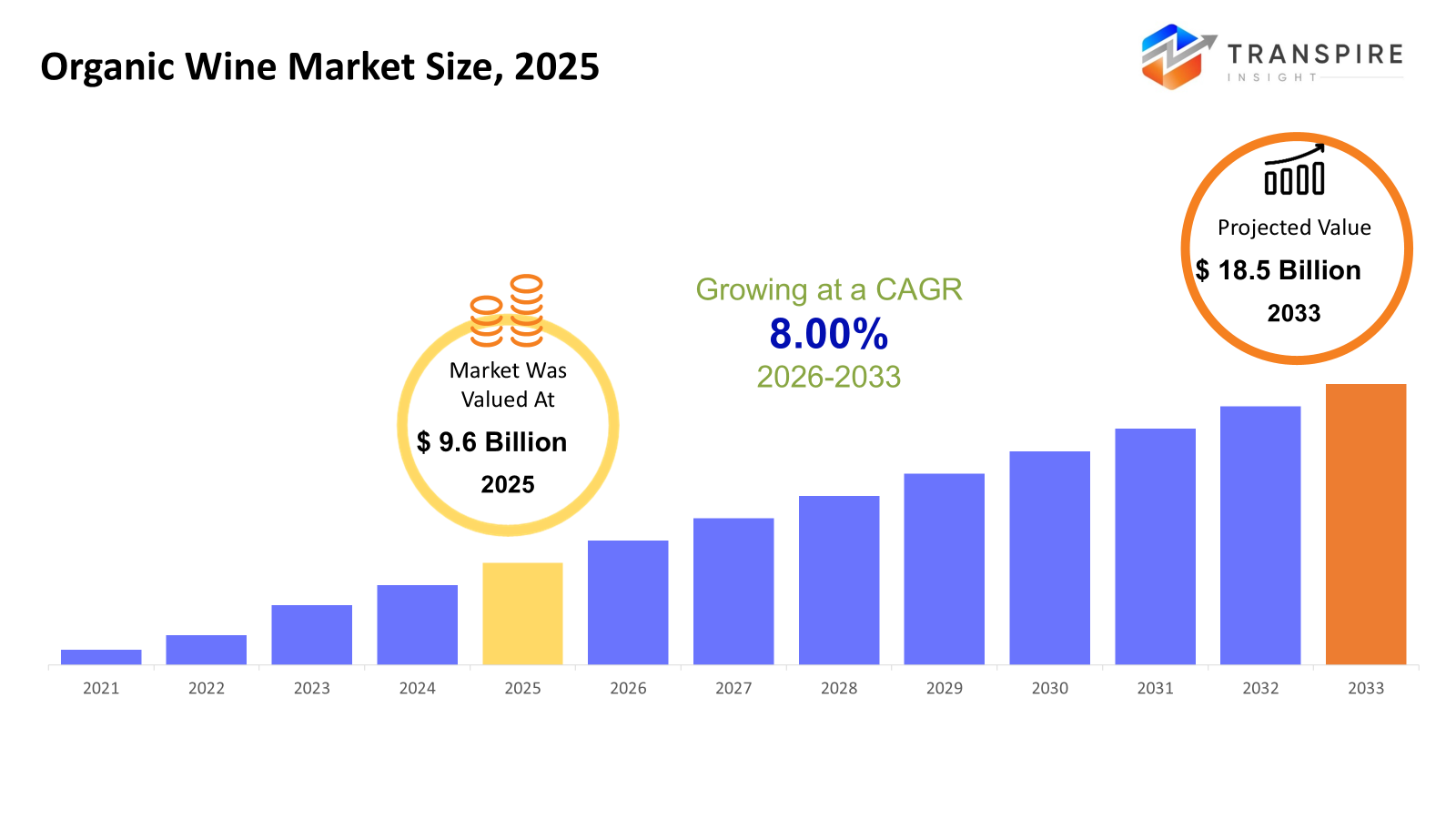
The global Organic Wine market size was valued at USD 9.6 billion in 2025 and is projected to reach USD 18.5 billion by 2033, growing at a CAGR of 8.00% from 2026 to 2033. The market for organic wine is growing steadily owing to the increasing preference for clean-label, chemical-free, and healthy wine among consumers. Rising awareness about sustainable wine production, measures being taken by the government for the encouragement of organic wine production, and the trend to opt for premium offerings in the alcoholic category is giving a boost to the market CAGR.
Market Size & Forecast
- 2025 Market Size: USD 9.6 Billion
- 2033 Projected Market Size: USD 18.5 Billion
- CAGR (2026-2033): 8.00%
- North America: Largest Market in 2026
- Asia Pacific: Fastest Growing Market
To learn more about this report,  Download Free Sample Report
Key Market Trends Analysis
- North America demonstrates high growth rate for organic red wine, particularly due to health-conscious eating habits and the inclination for premium eating. Nowadays, consumer perception for organic red wine emphasizes its health benefits from antioxidants and an eco-friendly life.
- The United States market exhibits a great deal of growth in the Canned Organic Wine segment. This can be attributed not only to convenience-based drinking but also socializations that engage the outdoors. Handy packaging meets the needs of new urban drinking patterns that are increasingly driven by e-commerce delivery.
- The region of Asia Pacific is witnessing an increasing trend towards the consumption of organic white wine sold in bottles. This trend is primarily observed in Japan, Australia, and metropolitan cities of China.
- Organic red wines are currently the most popular type segment because of their brand history, ageing, and higher margins. Brand history is more traceable through vineyards for red wines, making them more special for which consumers are willing to pay extra.
- Bottles continue to be a leading trend in terms of packaging, which can be attributed to preservation and upmarket perceptions. Apart from sustainability issues, glass packaging continues to be favored in packing organic wine, mainly because of recycling and alignment with consumption trends of conventional wine.
- Off-commerce leads by a wide margin thanks to enhanced organic offerings through supermarkets, specialty natural food stores, and e-commerce. This includes increased at-home drinking, specials pricing, and digital discovery platforms.
So, Organic wine market is defined as the market for wines made from organically grown grapes without the aid of any synthetic pesticide, herbicide, and fertilizer. It is based on the strict guidelines for organic wine production in terms of environmental and production sustainability and the low interventionist approach in winemaking.
The demand for organic wines arises due to health-conscious consumers focusing on consumer education, clean ingredients, and avoiding exposure to chemicals. Demand for organic wines can be spurred by consumer acceptance of organic alcohol, especially in urban, millennial, and high-end consumer segments. Traceability, authenticity, and honest labeling for organic wines have been recognized as influential in consumer purchasing. From the supply-side perspective, there is investment from producers in sustainable farming, green packaging, and region branding. Although the price of organic wines is more compared to traditional wines, pricing power and growing export demand drive better profits. The market is being driven by more investment in packaging technology, digital distribution, and growing on-trade availability, which makes organic wine an elevated yet approachable segment of the global wines market.
Organic Wine Market Segmentation
By Type
- Organic Red Wine
Organic Red Wine still leads the way in consumption, closely linked to the benefits of coronary heart health and antioxidant properties. Consumers feel that organic Red Wine variants are more authentic, rich, and connected to organic, wellness, and healthy living.
- Organic White Wine
Organically white wine has also become popular among young consumers and social drinkers in particular because it has a light taste compared to other wine varieties. Demand in warmer climates as well as pairing it with seafood food trends will drive its growth.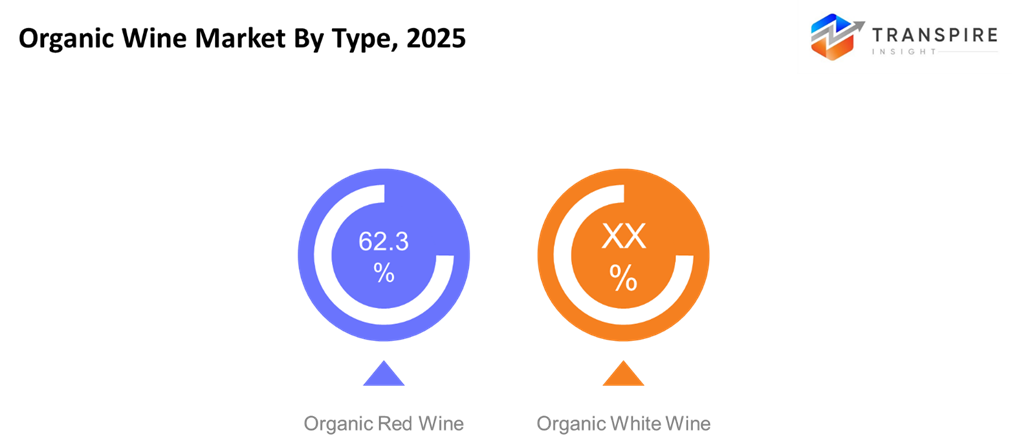
To learn more about this report, Download Free Sample Report
By Packaging
- Bottles
Glass bottles are the preferred packaging format, thanks to the enhanced positioning and wine-drinking rituals. Even sustainable consumers consider glass to be recyclable, inert, and ideal for maintaining organic wine quality.
- Cans
Organically canned wine continues to gain popularity in terms of convenience, portability, and demand for single-serve units. Millennials and outdoor-oriented consumers living in cities find canned wine to be a preferred option, and such demand is mainly evident in North America and Europe.
- Others
Other packaging options such as bag in box and tetra-pak packaging attract value-for-money and eco-conscious customers. Bag in box and tetra-pak packaging are eco-friendly and cut down on carbon emissions and packaging waste, making them attractive to household and emerging markets.
By Distribution Channel
- On-Trade
On-premise sales through hotels, restaurants, wine bars, and organic cafés also offer an important platform for new brand discoveries and for positioning in the premium space. The increasing demand for organic menus and eco-friendly experiences helps promote the visibility and trial of organic wine.
- Off-Trade
Off-trade sales lead overall sales as organic wines are more readily available and accessible through favorable prices. Supermarkets, specialty organic retailers, and online shopping platforms make it easier for consumers to discover various organic wine brands.
Regional Insights
North America’s organic wine market is marked by high awareness levels related to health and sustainable living, and the US market leads the way in both consumption and developments. Factors such as high disposable incomes, an established distribution framework, and the availability of certification schemes have facilitated adoption, and interest in premium brands is being registered in the Canadian and Mexican markets. In Europe, an age-old winemaking tradition, combined with highly stringent conditions for organic farming, provide strong support for market dominance. Large organic vineyards and strong domestic markets have been cultivated by major players like France, Italy, and Germany, whereas other regions, including the United Kingdom and Spain, support their markets with diverse imports. The Asia Pacific region is poised for the fast growth of premium and sustainably produced alcohol beverages. Australia and the domestic market of New Zealand are recognized for their mature levels of organic farming, while the markets of China, Japan, and South Korea demonstrate the growth of demand from the urban and high-income population. India and the Asia Pacific represent emerging markets. South America has very favorable conditions for viticulture, with Argentina and Brazil being leaders in organic wine production and consumption trends. In Middle East & Africa, South Africa is a major production center with exports, whereas Saudi Arabia and UAE are import-based niche markets for a quality experience. In all four regions, sustainability practices and adaptability in distribution channels are important factors for growth.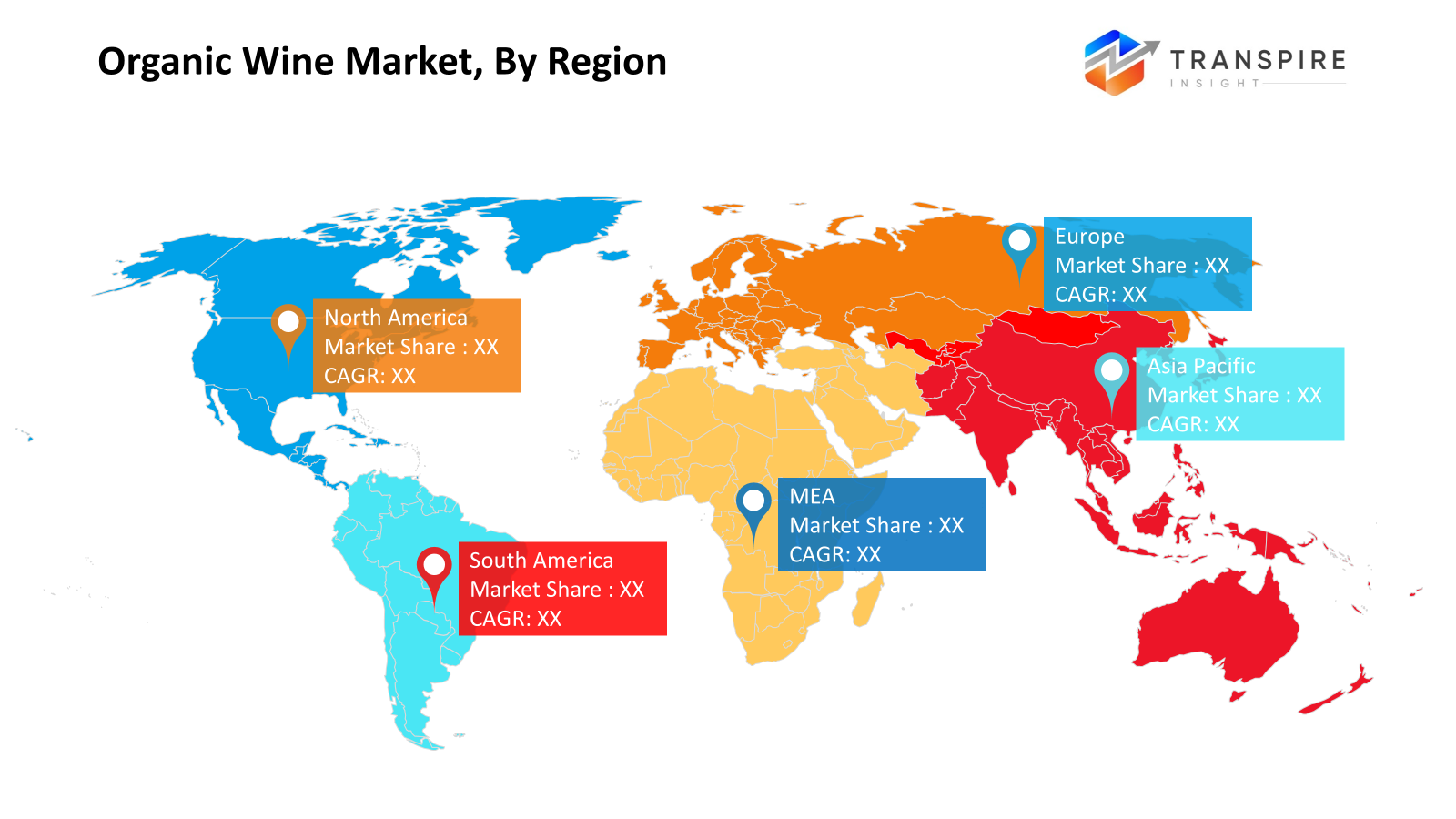
To learn more about this report, Download Free Sample Report
Recent Development News
- January 2026, A Trade Diversification Network has been launched by the federal government as part of its Accessing New Markets Initiative, which has a budget of $50 million, with 40 peak bodies chosen to take part, including the Australian Grape & Wine and the Australian Organic Limited.
- In December 2025, In the Rhone Valley, wine makers and trade experts have come to an agreement regarding a list of reference prices for organically grown and HVE-certified red wine with a Côtes-du-Rhône and Côtes-du-Rhône Village appellation. This project was organized by Inter Rhône and seeks to support vineyards that adopt environmentally sustainable farming practices but encounter difficulties because of increased costs.
|
Report Metrics |
Details |
|
Market size value in 2025 |
USD 9.6 Billion |
|
Market size value in 2026 |
USD 10.8 Billion |
|
Revenue forecast in 2033 |
USD 18.5 Billion |
|
Growth rate |
CAGR of 8.00% from 2026 to 2033 |
|
Base year |
2025 |
|
Historical data |
2021 – 2024 |
|
Forecast period |
2026 – 2033 |
|
Report coverage |
Revenue forecast, competitive landscape, growth factors, and trends |
|
Regional scope |
North America; Europe; Asia Pacific; Latin America; Middle East & Africa |
|
Country scope |
United States; Canada; Mexico; United Kingdom; Germany; France; Italy; Spain; Denmark; Sweden; Norway; China; Japan; India; Australia; South Korea; Thailand; Brazil; Argentina; South Africa; Saudi Arabia; United Arab Emirates |
|
Key company profiled |
E. & J. Gallo Winery, The Wine Group., Constellation Brands, Inc., Treasury Wine Estates, Castel Group, Pernod Ricard, Bonterra Organic Estates, Kendall-Jackson Winery, Château Maris, Emiliana Organic Vineyards, Frey Vineyards, King Estate Winery,Torres Family Wines, Domaine Leflaive, La Cantina Pizzolato |
|
Customization scope |
Free report customization (country, regional & segment scope). Avail customized purchase options to meet your exact research needs. |
|
Report Segmentation |
By Type (Organic Red Wine, Organic White Wine), By Packaging (Bottles, Cans, Others), By Distribution Channel (Offline, Online) |
Key Organic Wine Company Insights
Constellation Brands Inc. also has a significant presence in the organic wine category with their diversified range of certified organic and sustainably produced wines. The company’s strong distribution networks in North America and Europe help them gain better off-trade and on-trade presence. Their focus on vine sustainability initiatives, brand narratives, and superior packaging helps them differentiate themselves in the organic wine category. Their large scale enables them to efficiently deal with certification compliances while being capable of setting prices in the market. Their consistent premiumization of the portfolio according to evolving consumer trends for clean label beverages helps them remain differentiated in the global organic wine market.
Key Organic Wine Companies:
- E. & J. Gallo Winery
- The Wine Group
- Constellation Brands, Inc.
- Treasury Wine Estates
- Castel Group
- Pernod Ricard
- Bonterra Organic Estates
- Kendall-Jackson Winery
- Château Maris
- Emiliana Organic Vineyards
- Frey Vineyards
- King Estate Winery
- Torres Family Wines
- Domaine Leflaive
- La Cantina Pizzolato
Global Organic Wine Market Report Segmentation
By Type
- Organic Red Wine
- Organic White Wine
By Packaging
- Bottles
- Cans
- Others
By Distribution Channel
- On-Trade
- Off-Trade
Regional Outlook
- North America
- United States
- Canada
- Mexico
- Europe
- Germany
- United Kingdom
- France
- Spain
- Italy
- Rest of Europe
- Asia Pacific
- Japan
- China
- Australia & New Zealand
- South Korea
- India
- Rest of Asia Pacific
- South America
- Brazil
- Argentina
- Rest of South America
- Middle East & Africa
- Saudi Arabia
- United Arab Emirates
- South Africa
- Rest of the Middle East & Africa
Frequently Asked Questions
Find quick answers to common questions.
The approximate Organic Wine Market size for the market will be USD 18.5 billion in 2033.
Key segments for the Organic Wine Market are By Type (Organic Red Wine, Organic White Wine), By Packaging (Bottles, Cans, Others), By Distribution Channel (Offline, Online).
Major Organic Wine Market players are Constellation Brands, Inc., E. & J. Gallo Winery, Treasury Wine Estates, Pernod Ricard, Emiliana Organic Vineyards.
The North America region is leading the Organic Wine Market.
The CAGR of the Organic Wine Market is 8.00%.
- E. & J. Gallo Winery
- The Wine Group
- Constellation Brands, Inc.
- Treasury Wine Estates
- Castel Group
- Pernod Ricard
- Bonterra Organic Estates
- Kendall-Jackson Winery
- Château Maris
- Emiliana Organic Vineyards
- Frey Vineyards
- King Estate Winery
- Torres Family Wines
- Domaine Leflaive
- La Cantina Pizzolato
Recently Published Reports
-
Dec 2024
Baby Infant Formula Market
Baby Infant Formula Market Size, Share & Analysis Report By ype (Infant Milk, Follow On Milk, Specialty Baby Milk, Growing-Up Milk), By Ingredient (Carbohydrate, Fat, Protein, Minerals, Vitamins, and Others), By Product Form (Powder, Liquid, and Ready-to-feed), By Distribution Channels (Supermarket/Hypermarket, Specialty Store, Pharmacies, Online Retail, and Others), and Geography (North America, Europe, Asia-Pacific, Middle East and Africa, South and Central America), 2021 - 2031
-
Jan 2025
Edible Insects for Animal Feed Market
Edible Insects for Animal Feed Market Size, Share & Analysis Report By Type (Insect Powder, Insect Meal, Insect Bar, Insect Paste, Insect Oil, and Others), By Insect Type (Beetles, Cricket, Caterpillar, Hymenoptera, Orthoptera, Tree Bugs, and Others), By Application (Livestock, Pet Food, and Aquaculture), By Livestock Type (Poultry, Swine, and Others), and Geography (North America, Europe, Asia-Pacific, Middle East and Africa, South and Central America), 2021 - 2031
-
Jan 2025
Food Industry Disinfection and Bacterial Control Market
Food Industry Disinfection and Bacterial Control Market Size, Share & Analysis Report By Type (Chemical Disinfectants, Physical Disinfectants, and Biocides and Antimicrobials), By Application (Food Processing Equipment Surface Disinfection, Food Preparation Areas Surface Disinfection, Storage Areas Surface Disinfection, Anti-microbial Coatings Food Preservation, and Preservative Solutions Food Preservation), By End User (Meat and Poultry Processing, Dairy Processing, Seafood Processing, Bakery and Confectionery, Restaurants and Commercial Kitchens, and Food Service Providers), By Sales Channel (Online, Offline), and Geography (North America, Europe, Asia-Pacific, Middle East and Africa, South and Central America), 2021 - 2031
-
Jan 2025
Freeze Dried Food Market
Freeze Dried Food Market Size, Share & Analysis Report By Product Type (Fruits, Vegetables, Freeze-Dried Dairy Products, Freeze-Dried Meat and Seafood, Freeze-Dried Pet Food, and Prepared Meal), By Nature (Organic, and Conventional), By Form (Powdered, Granules, and Diced), By End Use (Breakfast Cereals, Dairy Products, Bakery & Confectionery, Nutritional Bars & Supplements, Powdered Beverages, Snacks, and Retail (Household)), and Geography (North America, Europe, Asia-Pacific, Middle East and Africa, South and Central America), 2021 - 2031