

South Korea Dental Cone Beam Computed Tomography Market Size & Forecast:
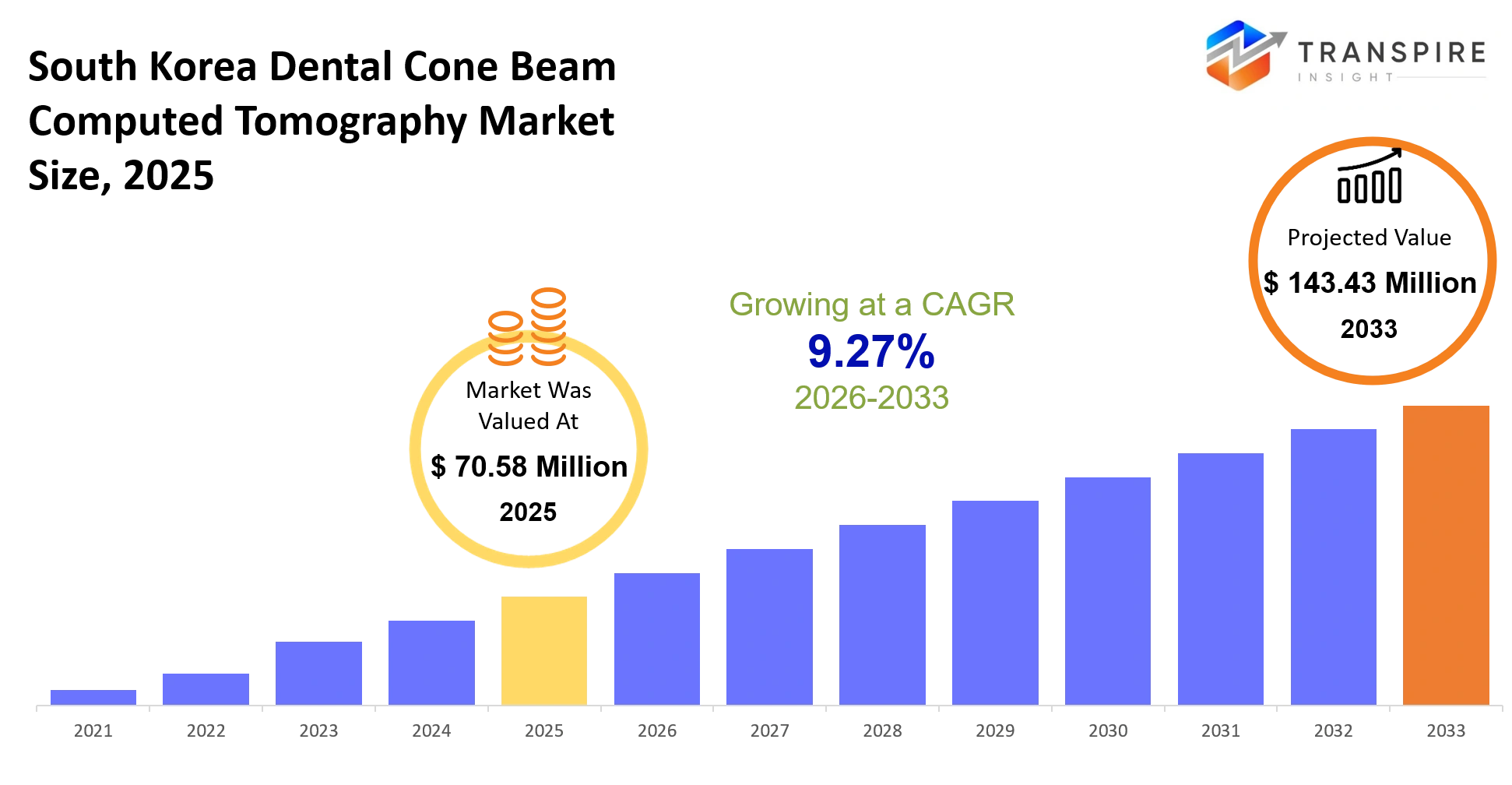
- South Korea Dental Cone Beam Computed Tomography Market Size 2025: USD 70.58 Million
- South Korea Dental Cone Beam Computed Tomography Market Size 2033: USD 143.43 Million
- South Korea Dental Cone Beam Computed Tomography Market CAGR: 9.27%
- South Korea Dental Cone Beam Computed Tomography Market Segments: By Product Type (Standalone CBCT, Integrated CBCT, Portable CBCT, Others); By Application (Implantology, Orthodontics, Endodontics, Oral Surgery, Others); By End User (Hospitals, Dental Clinics, Academic Institutes, Others)
To learn more about this report,  Download Free Sample Report
South Korea Dental Cone Beam Computed Tomography Market Summary
The South Korea Dental Cone Beam Computed Tomography Market was valued at USD 70.58 Million in 2025. It is forecast to reach USD 143.43 Millionby 2033. That is a CAGR of 9.27% over the period.
The South Korea Dental Cone Beam Computed Tomography Market kinda has a big role in making really precise 3D imaging possible for dental diagnosis, implant planning, and maxillofacial surgical procedures so clinicians can trade the guess work with a very accurate spatial view. In day to day situations it helps reduce surgical risks and it also tends to improve the treatment outcomes because dentists can map nerve pathways, bone density and even tooth alignment before they do anything.
Over the past 3–5 years, the market has shifted in a more structural way toward AI embedded imaging systems and low radiation CBCT units, mainly because patient safety expectations are getting more strict, and digital dentistry is spreading through urban clinics. One major trigger was the post pandemic rush of postponed dental care, which pushed demand for faster and more accurate diagnostic routines. So now hospitals and dental chains often back CBCT equipment that improves throughput and diagnostic confidence, and that loops back into stronger device adoption plus more room for service revenue growth.
Key Market Insights
- South Korea Dental Cone Beam Computed Tomography Market seems kinda concentrated in the big cities, with Seoul taking the lead, around nearly 40% share in 2025 because of advanced dental hospital clusters and all that hub like activity.
- Then Busan looks like the fastest riser, backed by increasing private dental chains, plus more medical tourism inflows that are expected to keep building through the 2032 forecast period, not too small of a shift either.
- On product side, standalone CBCT systems come out on top, holding over 45% share, mainly because hospitals still need level diagnostics, and there’s strong pressure for high imaging precision demand.
- Integrated CBCT systems are in the second position, and they’re used pretty widely in multi-specialty dental clinics since it helps workflow efficiency improvements and day to day coordination.
- Portable CBCT systems are showing the quickest growth as well, largely due to compact clinic adoption and lower capital expenditure requirements, so smaller setups can actually afford it.
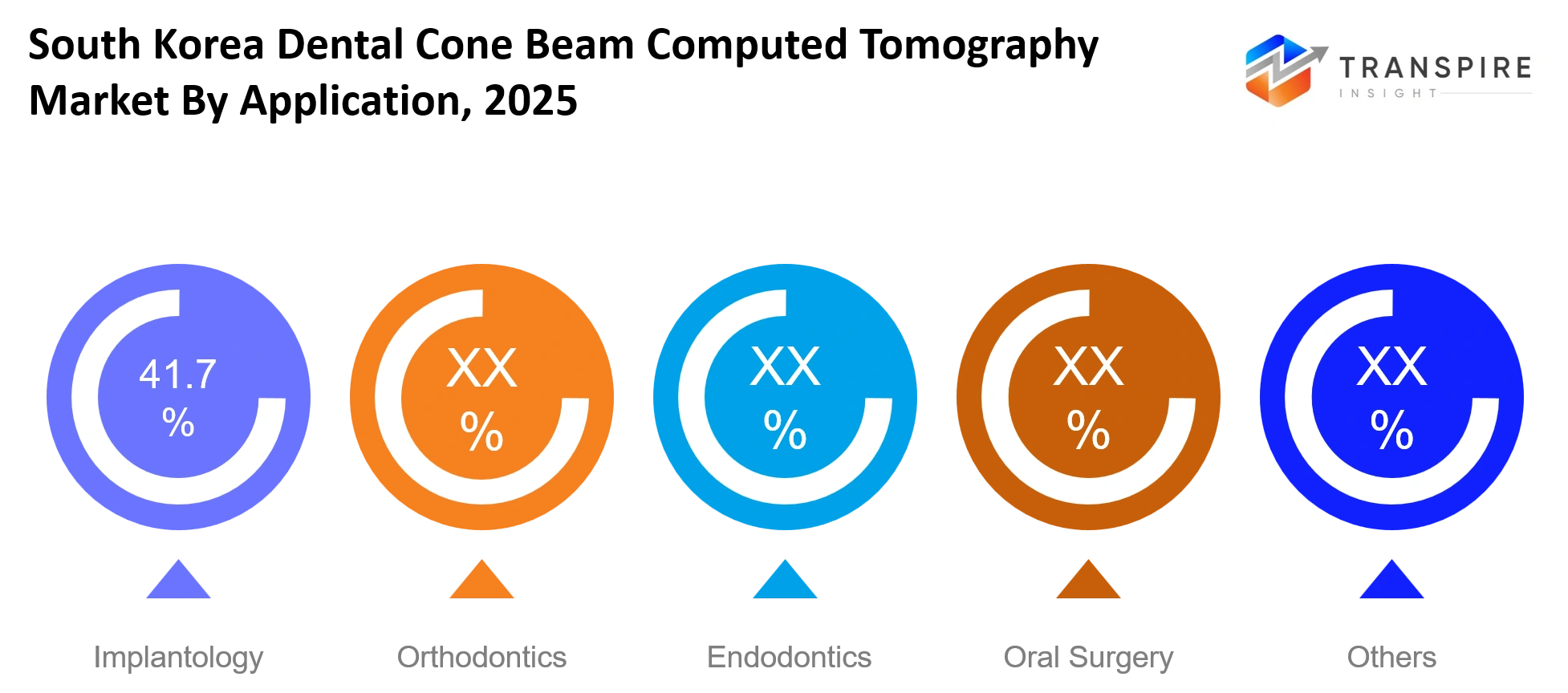
- For application, implantology remains dominant with nearly 38% share, fueled by rising cosmetic dentistry interest, and also the aging population needs that keep increasing.
- Orthodontics is emerging as the fastest-growing application, especially as digital alignment planning becomes standard practice in urban clinics where everything is more tech-first.
- Looking at end users, dental clinics lead that segment with over 55% share, supported by decentralized outpatient diagnostic expansion.
- Hospitals, meanwhile show the fastest adoption growth, mainly because surgical planning departments are integrating advanced imaging into their processes.
- In the competitive space, the landscape is led by Vatech, Dentsply Sirona, Carestream Dental, Planmeca, and J. Morita.
- They seem to be focusing on AI integration, better 3D reconstruction accuracy, and also regional distribution partnerships to keep coverage strong.
What are the Key Drivers, Restraints, and Opportunities in the South Korea Dental Cone Beam Computed Tomography Market?
The South Korea Dental Cone Beam Computed Tomography Market is mostly being pushed by a fairly clear tilt toward digitally assisted dental surgery planning, not just a tiny shift. Clinicians are leaning in harder on 3D imaging in daily implantology and orthodontic routines and that kind of precision usually helps cut down on procedural slipups, plus it can reduce the likelihood of repeat treatments. On top of that, hospitals and higher end dental clinics are now rolling CBCT units into broader upgrades for digital dentistry, so equipment refresh cycles happen more often and service revenues come back in a more recurring rhythm. Adoption keeps climbing too, because many teams want a faster diagnosis, and yes, less chair time, which then lets them manage patient flow more effectively
Still, the market runs into a stubborn sticking point acquisition and ongoing maintenance costs. This remains especially tough for small and medium clinics outside the main metropolitan zones, since CBCT devices require continuous calibration, regular software upgrades, and operators with the right hands on experience to run everything properly. So total cost of ownership keeps rising, and the gap between big hospital groups and independent practices gets wider. Because of this, uniform adoption across the country slows down and short term market penetration can stall.
One standout opportunity sits in AI assisted diagnostic imaging, plus cloud based CBCT data management platforms. In real terms these enable remote case review, speed up image reconstruction, and standardize diagnostic write ups in a more coherent way than before. Companies that combine AI lesion detection with automated treatment planning features are likely to unlock new revenue lines, particularly within multi clinic dental chains and tele dentistry networks.
What Has the Impact of Artificial Intelligence Been on the South Korea Dental Cone Beam Computed Tomography Market?
Artificial intelligence is kinda reshaping the South Korea Dental Cone Beam Computed Tomography Market, mostly by speeding up image reconstruction, boosting diagnostic accuracy, and doing a bunch of workflow automation inside dental imaging systems. Right now AI algorithms help with automated segmentation of teeth, nerves and bone structures, so the radiologists and dental surgeons spend less time on manual interpretation, even though it still feels like a careful job. In actual clinical practice, this tends to support quicker treatment planning in implantology and orthodontics, because precision there really does affect procedural outcomes, and it can also change patient recovery time too.
Machine learning models are getting used for predictive diagnostics too, where historical imaging data is leveraged to spot early-stage issues like bone loss or impacted teeth before symptoms get too obvious. That, in turn, strengthens preventive dental care uptake across urban clinics. On the operational side, AI-driven CBCT systems help keep scan quality more consistent, and they can reduce the retake frequency, which helps reduce radiation exposure, and it can lower day to day operating costs as well.
Still though, adoption hits a limitation, mostly due to integration complexity, plus the requirement for big, high-quality annotated dental datasets. A lot of smaller clinics also struggle when it comes to upgrading older imaging setups into AI-compatible platforms, which slows down the full rollout, even when the efficiency gains look pretty clear.
Key Market Trends
- From 2022 to 2025 the South Korea Dental Cone Beam Computed Tomography market kind of shifted, toward AI enabled imaging more and more, which was improving diagnostic speed and also reducing reliance on manual interpretation, not fully but quite a bit.
- Around 2024 cloud based CBCT data sharing started spreading across multi clinic networks, so centralized diagnostic decision making systems could work easier without too much friction.
- After 2023, implantology imaging demand increased quite a lot, partly because the elderly population is rising, and they still often need bone anchored dental solutions.
- Then in 2025 portable CBCT adoption went up too, as smaller clinics chose low cost imaging expansion instead of waiting for hospital referrals.
- Competition felt more aggressive as well, for example Vatech came out with low dose imaging systems aimed at patient safety compliance.
- And dental tourism growth in Seoul and Busan really accelerated, pushing for high speed CBCT scanning infrastructure during 2023–2026.
- By 2024 and after, premium clinics started treating integration of CBCT with CAD/CAM systems as basically standard, which helped prosthetic design accuracy.
- Orthodontic planning also changed direction, moving toward 3D imaging first workflows rather than depending on traditional 2D X ray records. Lastly in 2025 regulatory attention on radiation exposure reduction nudged manufacturers toward further low dose technology innovation.
South Korea Dental Cone Beam Computed Tomography Market Segmentation
By Product Type
Standalone CBCT systems take the lead in South Korea Dental Cone Beam Computed Tomography Market because there is strong,steady demand for exact 3D imaging during implant planning and surgery. In hospitals, procurement teams seem to favor full field imaging equipment, for those complicated diagnostic flows,and for managing high patient load at the same time. Replacement needs keep moving forward in tertiary dental centers too, mostly as clinics upgrade for better scan speed,along with clearer image detail. Because clinical accuracy expectations stay strict, investments in these more advanced standalone setups stay relatively consistent.
Integrated CBCT systems are picking up more traction in multi specialty dental clinics where imaging and treatment planning live on one shared platform. When workflows are unified, clinicians tend to save time, which matters in orthodontic and prosthodontic schedules where faster case preparation helps. Portable CBCT systems are also expanding,but in a slightly different way: compact clinics often prefer them due to easier installation and lower capital outlay. In addition, distributed dental service models across urban regions help drive continued equipment penetration, across basically all product categories,not just one segment.
By Application
Implantology takes the lead in South Korea’s Dental Cone Beam Computed Tomography market, mainly because there is a real need for precise bone mapping,and stable implant positioning. In addition to this, cosmetic dentistry keeps expanding, and with the aging population trend, more clinics rely on 3D imaging for surgical planning. Dental hospitals also treat advanced scans as a way to cut clinical risk during implant procedures. Because of that, the whole procedure workflow integration keeps supporting steady diagnostic revenue.
Orthodontics shows solid growth too, since digital alignment planning and jaw correction analysis are now treated as routine in many urban clinics. Endodontics adoption also climbs, driven by root canal visualization and infection detection in dedicated specialty centers. Oral surgery use cases broaden across maxillofacial trauma care and corrective treatments, especially inside larger hospital networks. Overall, the push for accurate diagnostic imaging keeps strengthening utilization across several clinical domains.
To learn more about this report, Download Free Sample Report
By End User
Dental clinics lead the South Korea Dental Cone Beam Computed Tomography Market sort of overall, mainly because there’s a steady flow of outpatient care and a lesser need for outside diagnostic centers. Many city clinics keep upgrading imaging systems, aiming for faster patient turnaround time and more exact diagnostic clarity. Also, the ongoing growth of private dental chains across metropolitan areas helps keep installations coming in a continuous stream. In general, patient centered care models basically push durable equipment uptake across clinic groups.
Hospitals still show strong adoption, especially where surgical departments need sophisticated imaging for complicated oral and maxillofacial work. Academic institutes meanwhile increase the usage for dental education, hands on training programs, and imaging based research efforts. When institutions invest in these tools, they often standardize imaging methods across both healthcare settings and education related environments. And when advanced diagnostic systems get integrated, long term technology adoption tends to strengthen across multiple sectors.
What are the Key Use Cases Driving the South Korea Dental Cone Beam Computed Tomography Market?
Implantology is still kinda the main use case for the South Korea Dental Cone Beam Computed Tomography market, and 3D imaging really backs precise bone mapping plus implant placement, so it can lower surgical complications. At the same time it helps overall success rates go up, not just a little.
Orthodontic planning and oral surgery are also widening in scope, because many clinics use CBCT to study jaw alignment. This also supports pre surgical visualization, particularly in multi specialty dental centers and hospital networks where workflows need to be consistent, or at least close enough.
And then there are newer use cases too, like temporomandibular joint disorder assessment and early stage pathology detection. Here, advanced imaging can help spot structural abnormalities before the clinical symptoms really intensify, which in turn supports preventive dental care models across urban healthcare systems.
|
Report Metrics |
Details |
|
Market size value in 2025 |
USD 70.58 Million |
|
Market size value in 2026 |
USD 77.12 Million |
|
Revenue forecast in 2033 |
USD 143.43 Million |
|
Growth rate |
CAGR of 9.27% from 2026 to 2033 |
|
Base year |
2025 |
|
Historical data |
2021 - 2024 |
|
Forecast period |
2026 - 2033 |
|
Report coverage |
Revenue forecast, competitive landscape, growth factors, and trends |
|
Regional scope |
South Korea |
|
Key company profiled |
Dentsply Sirona, Carestream Dental, Planmeca, Vatech, Envista, J Morita, Acteon, NewTom, Owandy, Asahi Roentgen, Yoshida Dental, Genoray, Cefla, Ray, PreXion |
|
Customization scope |
Free report customization (country, regional & segment scope). Avail customized purchase options to meet your exact research needs. |
|
Report Segmentation |
By Product Type (Standalone CBCT, Integrated CBCT, Portable CBCT, Others); By Application (Implantology, Orthodontics, Endodontics, Oral Surgery, Others); By End User (Hospitals, Dental Clinics, Academic Institutes, Others) |
Which Regions are Driving the South Korea Dental Cone Beam Computed Tomography Market Growth?
The Asia-Pacific region, leads the South Korea Dental Cone Beam Computed Tomography Market, mostly because dental infrastructure keeps expanding fast across South Korea, Japan and China. In South Korea there’s a kind of central gravity to it, with advanced digital dentistry adoption— supported by dense clinic presence around Seoul, and also backed by government focus on medical imaging modernization. Japan helps, through a long time integration of precision imaging inside dental hospitals, while China is more about widening demand via rapid dental hospital construction and higher counts of cosmetic dentistry cases. On top of that, there’s a strong manufacturer presence in the region which basically means quicker equipment deployment and ongoing technology upgrades. Also dental tourism in South Korea quietly boosts the regional lead, since patients from across borders come looking for high-precision implant work and orthodontic procedures, not just routine scans.
North America stays a steady contributor, powered by consistent investment in dental imaging upgrades across established private dental networks in the United States and Canada. Compared with Asia-Pacific, here growth leans more on replacement cycles, rather than adding new clinic locations. Strong reimbursement structures and fairly strict diagnostic standards keep adoption moving for advanced CBCT systems, both in hospitals and within dental chains. Regulatory clarity, especially around radiation safety and imaging protocols, helps make procurement cycles feel predictable. And long-term contracts between dental service organizations and imaging vendors help stabilize the revenue flow too, year after year.
The Middle East shows the fastest growth momentum, largely driven by big scale healthcare infrastructure investments in the United Arab Emirates and Saudi Arabia. New hospital expansion programs plus dental tourism initiatives generate serious demand for advanced diagnostic imaging systems.
Who are the Key Players in the South Korea Dental Cone Beam Computed Tomography Market and How Do They Compete?
In the South Korea Dental Cone Beam Computed Tomography market, competition is still pretty moderately consolidated, like not totally fragmented, but also not one single giant all the time. The established imaging makers basically hold the upper hand, they push differentiation via tech innovation and diagnostic precision, more than pure pricing and honestly that’s what seems to matter. Who leads mostly comes down to things like image resolution quality, how well radiation dose gets reduced, how smoothly software fits into daily use, and whether the whole workflow feels efficient and calm instead of tangled. Local vendors also keep a solid foothold in South Korea, while the global firms jump in with more mature software ecosystems, plus multi-specialty dental imaging platforms that can cover a lot of cases. In practice, product distinction and clinical accuracy really stay the main competitive levers, not the brochure-spec stuff only.
Vatech, for example, is reinforcing its position with low-dose CBCT systems and AI-assisted imaging software, aimed at high-volume dental clinics where throughput matters. The company keeps moving forward through partnerships with regional distributors, and it also continues upgrading 3D reconstruction accuracy, bit by bit. Dentsply Sirona leans into integrated digital dentistry platforms, where imaging works together with CAD/CAM and treatment planning tools, which helps it lock in multi-clinic networks.
Carestream Dental goes after customers with cloud-enabled imaging workflows that can support remote diagnostics, and give multi-site data access without too much friction. Planmeca differentiates more through premium imaging hardware, plus advanced customization options for specialty clinics that want more control over settings and output style. J. Morita keeps strength in precision-focused CBCT systems, and these are widely taken up in endodontic and surgical applications where clarity is critical. Envista, meanwhile, expands using bundled dental solutions that combine imaging with wider clinical workflow systems, which makes it easier to win institutional contracts and stay visible there.
Company List
- Dentsply Sirona
- Carestream Dental
- Planmeca
- Vatech
- Envista
- J Morita
- Acteon
- NewTom
- Owandy
- Asahi Roentgen
- Yoshida Dental
- Genoray
- Cefla
- Ray
- PreXion
Recent Development News
In February 2025, Carestream Dental introduced upgraded CBCT imaging solutions supported by AI-driven software enhancements focused on implant planning and diagnostic accuracy. The update improved workflow efficiency for multi-clinic dental networks by enabling faster image reconstruction and remote access capabilities.https://www.carestreamdental.com
What Strategic Insights Define the Future of the South Korea Dental Cone Beam Computed Tomography Market?
South Korea’s Dental Cone Beam Computed Tomography Market is likely to drift toward more fully integrated digital dentistry ecosystems where imaging, AI diagnostics, and treatment planning kinda work on one unified platform, not scattered tools. I mean the push here is basically because clinicians keep asking for faster call making and better procedural precision, especially in implantology and orthodontics.
At the same time there’s a quieter kind of risk too—technology concentration. Like if clinics get too tied to only a few global software ecosystems, then pricing flexibility can shrink, and the whole vendor lock-in feeling could rise over time.
But there’s also an opportunity that’s starting to look real. Think AI-powered remote diagnostic services that link smaller clinics in secondary cities with centralized dental imaging specialists around Seoul.
For market participants, the smart move is to build interoperable CBCT platforms that are able to mesh easily with hospital information systems and cloud based dental records. That’s what should help adoption last, across both top tier dental facilities and the mid range ones too.
South Korea Dental Cone Beam Computed Tomography Market Report Segmentation
By Product Type
- Standalone CBCT
- Integrated CBCT
- Portable CBCT
- Others
By Application
- Implantology
- Orthodontics
- Endodontics
- Oral Surgery
- Others
By End User
- Hospitals
- Dental Clinics
- Academic Institutes
- Others
Frequently Asked Questions
Find quick answers to common questions.
The expected South Korea Dental Cone Beam Computed Tomography Market size for the market will be USD 143.43 Million in 2033.
By Product Type (Standalone CBCT, Integrated CBCT, Portable CBCT, Others); By Application (Implantology, Orthodontics, Endodontics, Oral Surgery, Others); By End User (Hospitals, Dental Clinics, Academic Institutes, Others) .
Major South Korea Dental Cone Beam Computed Tomography Market players are Dentsply Sirona, Carestream Dental, Planmeca, Vatech, Envista, J Morita, Acteon, NewTom, Owandy, Asahi Roentgen, Yoshida Dental, Genoray, Cefla, Ray, PreXion.
The South Korea Dental Cone Beam Computed Tomography Market size is USD 70.58 Million in 2025.
The South Korea Dental Cone Beam Computed Tomography Market CAGR is 9.27% from 2026 to 2033.
- Dentsply Sirona
- Carestream Dental
- Planmeca
- Vatech
- Envista
- J Morita
- Acteon
- NewTom
- Owandy
- Asahi Roentgen
- Yoshida Dental
- Genoray
- Cefla
- Ray
- PreXion
About the Authors

Pankaj Ghogare Patil
I am Pankaj Ghogare Patil, a Senior Research Analyst at Transpire Insight, specializing in the Pharmaceutical, Chemicals & Materials, Healthcare IT, and Biotechnology industry. My expertise lies in conducting comprehensive market research, analyzing industry trends, evaluating competitive landscapes, and translating complex data into actionable insights. At Transpire Insight, I closely follow emerging technologies, regulatory developments, and market innovations to create accurate, well-researched, and informative content that helps businesses and professionals make informed decisions. I am committed to producing credible, evidence-based articles that reflect industry best practices while making technical topics accessible and valuable for a broad audience.

Chakradhar Khansole
Chakradhar serves as the Research Director at Transpire Insight, bringing over 8 years of experience in technology, innovation, and strategic market intelligence. He specializes in transforming complex market data into actionable business insights that enable organizations to make informed, growth-oriented decisions. Recognized for his strategic vision and analytical expertise, Chakradhar leads high-impact research initiatives, delivering comprehensive market assessments, competitive intelligence, and forward-looking industry analysis.
Recently Published Reports
-
Apr 2026
AI in Diabetic Retinopathy Market
AI in Diabetic Retinopathy Market Size, Share & Analysis Report By Type (Screening AI Systems, Diagnostic AI Systems, and Predictive AI Models), By Application Segment (Hospitals, Ophthalmology Clinics, Diagnostic Centers, and Research and Development), and Geography (North America, Europe, Asia-Pacific, Middle East and Africa, South and Central America), 2021 - 2031
-
Apr 2026
Psychometric Tests Market
Psychometric Tests Market Size, Share & Analysis Report By Type (Personality Tests, Ability/Aptitude Tests, Skill/Knowledge Tests, and Others), By Application (Talent Acquisition and Talent Management), and Geography (North America, Europe, Asia-Pacific, Middle East and Africa, South and Central America), 2021 – 2031
-
Apr 2026
Rare Biological Sample Collection Market
Rare Biological Sample Collection Market Size, Share & Analysis Report By Type (Isolation Kits & Reagent, Blood Collection Tubes, and Others), By Application (Oncology, Transcriptomics, Pharmacogenomics, and Others), and Geography (North America, Europe, Asia-Pacific, Middle East and Africa, South and Central America), 2021 – 2031
-
Jul 2026
Diabetic Retinopathy Market
Diabetic Retinopathy Market Size, Share & Analysis Report By Type (Proliferative Diabetic Retinopathy, and Diabetic Macular Edema (DME)), By Treatment Type (Anti VEGF Drug, Steroid Implants, Laser Surgeries, and Vitrectomy), and Geography (North America, Europe, Asia-Pacific, Middle East and Africa, South and Central America), 2021 – 2031
Our Clients







