
Europe Optical Coherence Tomography Market Size & Forecast:
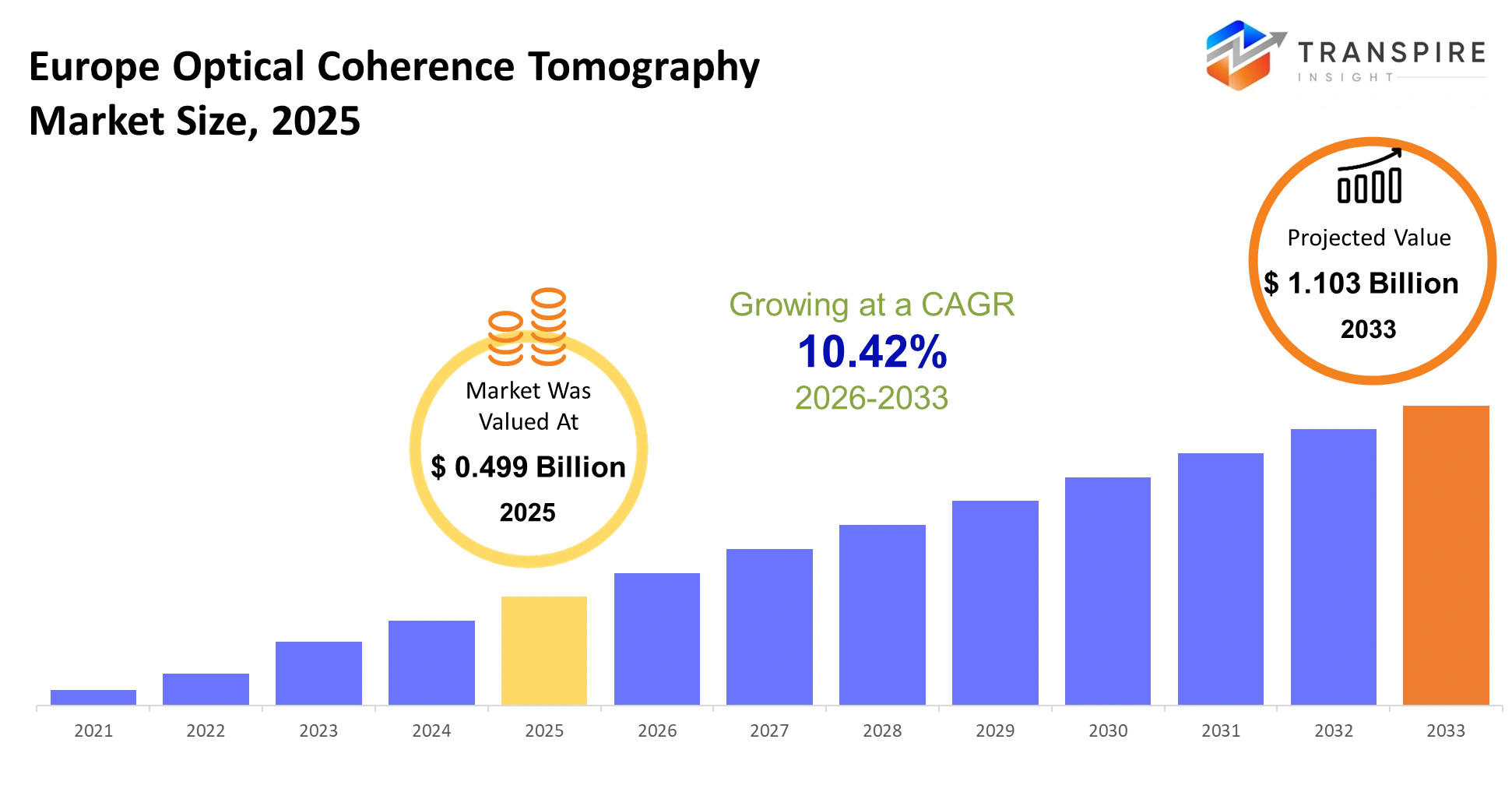
- Europe Optical Coherence Tomography Market Size 2025: USD 0.499 Billion
- Europe Optical Coherence Tomography Market Size 2033: USD 1.103 Billion
- Europe Optical Coherence Tomography Market CAGR: 10.42%
- Europe Optical Coherence Tomography Market Segments: By Type (Time-domain OCT, Spectral-domain OCT, Swept-source OCT, Others), By Application (Ophthalmology, Cardiology, Dermatology, Oncology, Others), By End-User (Hospitals, Clinics, Research Institutes, Others), By Technology (Handheld Devices, Tabletop Systems, Others).
To learn more about this report,  Download Free Sample Report
Europe Optical Coherence Tomography Market Summary:
The Europe Optical Coherence Tomography Market size is estimated at USD 0.499 Billion in 2025 and is anticipated to reach USD 1.103 Billion by 2033, growing at a CAGR of 10.42% from 2026 to 2033. The Europe Optical Coherence Tomography market exists at the point where precise diagnostic methods meet operational efficiency of medical procedures. The OCT systems enable ophthalmologists and cardiologists and research hospitals to obtain real-time tissue cross-sectional images which doctors use to identify retinal disorders and vascular abnormalities and early-stage diseases which lack visible symptoms. European healthcare systems require this diagnostic capability because they must reduce testing time during their efforts to treat their growing population of elderly citizens who develop diabetes-related eye illnesses.
The market has evolved during the past five years from using separate imaging technologies to adopting AI-powered cloud-based diagnostic systems which work with both electronic health record systems and telemedicine operations. The COVID-19 pandemic created a major disruption which led to increased use of remote diagnostic systems and decentralized medical screening methods throughout Europe.
Hospitals required better patient evaluation processes, so they adopted OCT systems which provide automatic image analysis and decrease the need for experts to handle image assessment. The organization currently generates additional income streams through its development of revenue streams which extend from tertiary medical facilities to outpatient treatment centers and eye care retail stores and health screening initiatives.
Key Market Insights
- Germany maintained its position as the leading force in Europe Optical Coherence Tomography Market by controlling 24 percent of the market in 2025 which resulted from its developed eye care centers and effective medical cost coverage systems.
- The UK represented the second-largest industry size, driven by hospital digitization and growing adoption of AI-enabled retinal imaging systems.
- Spain will experience continuous growth as its regional market expands until 2031 because of increasing preventive eye care programs and diabetic retinopathy screening needs.
- Portable OCT devices are becoming more popular among Nordic countries, which use them in their ambulatory care centers and teleophthalmology networks.
- The Europe Optical Coherence Tomography Market recognized spectral-domain OCT as its leading technology which generated about 48 percent of total market revenues in 2025 because it offered superior imaging speed and accuracy.
- The market for swept-source OCT reached its second-largest position because it enables better deep-tissue visualization used in cardiovascular and retinal diagnostics.
- The market for handheld and portable OCT systems will expand throughout the forecast period because clinics need to establish diagnostic processes that operate outside traditional medical settings.
- AI-based OCT solutions have started to spread throughout Europe because they provide automated image analysis solutions that help medical professionals complete their work faster.
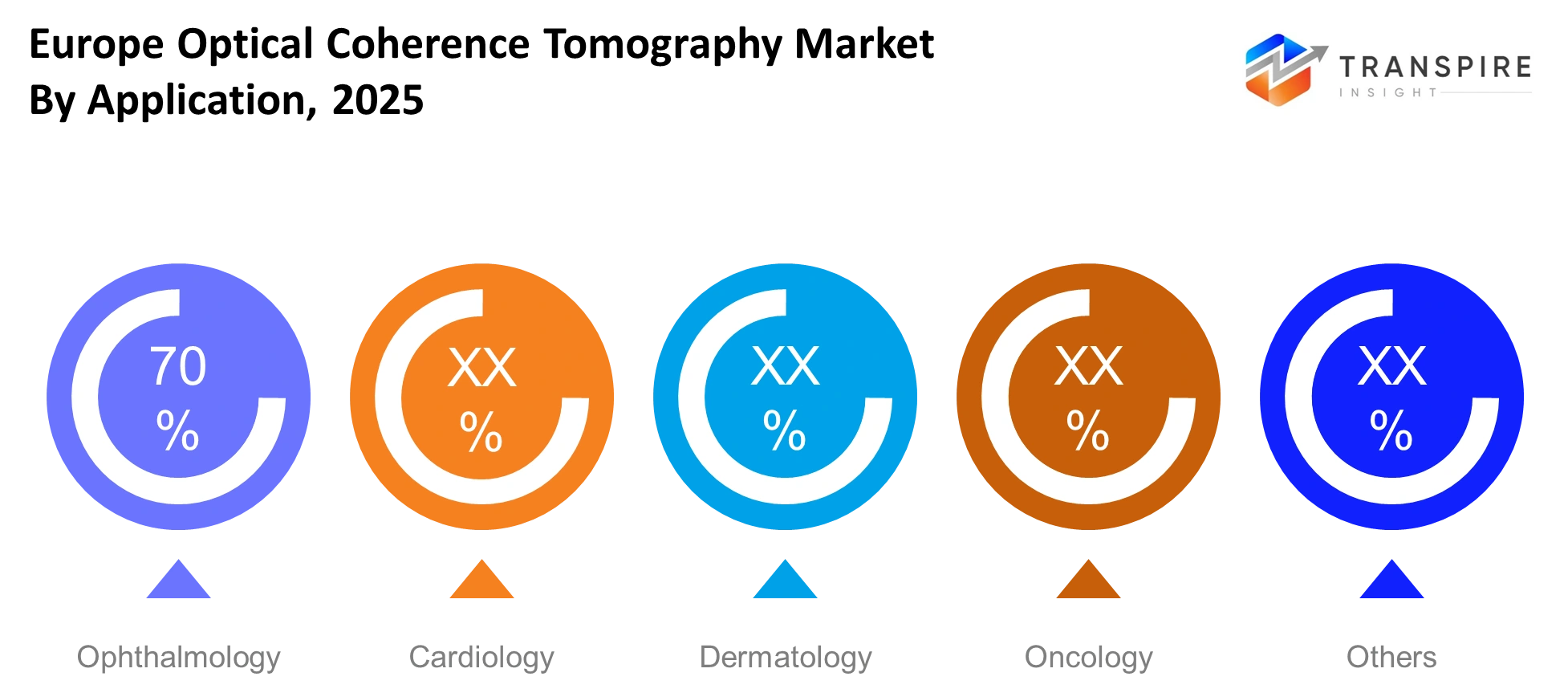
- Ophthalmology controlled the European Optical Coherence Tomography Market in 2025 because it generated more than 63 percent of market share through growing demand for glaucoma and macular degeneration testing.
- The fields of cardiology applications will experience their fastest expansion until 2031 because more medical professionals are using intravascular imaging during their minimally invasive procedures.
- Oncology research applications are emerging steadily as OCT technology improves real-time tissue characterization and surgical precision.
What are the Key Drivers, Restraints, and Opportunities in the Europe Optical Coherence Tomography Market?
The European Optical Coherence Tomography Market experiences its strongest growth because healthcare facilities now use AI-based diagnostic tools in their ophthalmology and hospital imaging systems. The healthcare systems of Germany the United Kingdom and France have experienced increasing demands to decrease specialist backlogs which result from their growing elderly population and rising cases of diabetes-related retinal disorders during the past five years. The medical system developed automated image analysis and cloud-based patient management solutions which healthcare facilities needed to implement their OCT systems. The operational capacity of clinics has increased because they can now handle more patients while their testing process needs have decreased which resulted in better equipment usage and added software income for manufacturers. The industry now requires healthcare facilities to connect their diagnostic systems which has resulted in more multi-year service contracts and platform upgrades.
The market’s largest structural barrier remains the high capital and integration cost associated with advanced OCT systems. The premium swept-source platforms together with AI-enabled systems demand substantial financial resources to cover both hardware and software development and data management plus medical staff education needs. Southern and Eastern European countries face financial challenges because their smaller hospitals and outpatient centers must use limited reimbursement systems. The current system limits replacement cycles which prevents healthcare networks from extending their services beyond major urban areas.
The development of portable and teleophthalmology-compatible OCT systems represents a significant opportunity for future growth. Nordic countries and rural healthcare networks are increasingly investing in decentralized diagnostic infrastructure which creates optimal conditions for deploying handheld OCT systems. The systems enable remote retinal screening and they provide accelerated chronic disease monitoring which is especially beneficial for diabetic patients who need medical care outside of major hospital facilities.
What Has the Impact of Artificial Intelligence Been on the Europe Optical Coherence Tomography Market?
The Europe Optical Coherence Tomography Market experiences transformation through artificial intelligence and advanced digital technologies which enhance diagnostic speed and image precision while streamlining clinical workflows through automated processes. Ophthalmologists use AI-powered OCT platforms which perform automated retinal layer segmentation and lesion detection together with disease classification to enable them to complete scan analysis within seconds instead of conducting manual review of extensive image collections.The integration of OCT systems with cloud-based diagnostic platforms and electronic health records has become essential for hospitals and specialty eye clinics throughout Germany and the UK and the Nordic region as they seek to enhance their patient management processes while decreasing their administrative workload.
Machine learning models enable healthcare providers to predict retinal disease progression and develop treatment plans more effectively. The advanced algorithms enable identification of subtle structural changes which occur in glaucoma diabetic retinopathy and macular degeneration before patients show any clinical symptoms. The system increases early intervention rates while healthcare providers use it to schedule specialists and allocate resources. Several European clinics achieve faster patient throughput and shorter diagnostic turnaround times after they implement AI-assisted imaging systems.
The complex nature of integration processes together with the need for standardized data creates a major obstacle that prevents organizations from adopting AI technology. Healthcare providers operate with disjointed imaging systems that contain different patient information which creates difficulties for developing algorithms and achieving interoperability between different platforms. Smaller clinics face difficulties because they need to spend large sums of money to implement AI-enabled OCT software into their current diagnostic procedures.
Key Market Trends
- The hospitals in Germany and the United Kingdom have implemented artificial intelligence-based optical coherence tomography systems since 2021 to handle increasing demands for diabetic retinopathy screening and glaucoma screening.
- The market share of spectral-domain systems began to decline after 2022 when customers preferred swept-source OCT systems because of their superior scanning speeds and deeper tissue imaging capabilities.
- The Nordic countries experienced a rise in portable OCT device usage from 2023 to 2025 as healthcare organizations developed decentralized programs for retinal screening.
- European medical clinics started to adopt subscription-based software models after 2020 which enabled imaging companies to create subscription-based revenue models.
- The two companies Carl Zeiss Meditec and Heidelberg Engineering increased their funding for artificial intelligence software development to enhance their imaging precision and automated operational processes.
- The COVID-19 pandemic led to an increase in outpatient diagnostic centers which now conduct more OCT procedures because hospitals need to complete patient appointments within shorter times.
- European healthcare organizations adopted cloud-enabled imaging systems after 2022 to achieve centralized management of patient information and enable healthcare specialists to work together remotely.
- The Eastern European clinics postponed their high-end OCT system upgrades because of payment restrictions which resulted in urban medical centers gaining more advanced technology than regional health systems.
- The use of artificial intelligence-based retinal segmentation tools in European specialty eye-care networks between 2022 and 2025 resulted in a 30 percent decrease of time required to manually interpret medical images.
- The period after 2023 saw an increase in partnerships between OCT manufacturers and teleophthalmology companies which aimed to enhance remote screening capabilities and improve chronic disease monitoring in rural areas.
Europe Optical Coherence Tomography Market Segmentation
By Type
The spectral-domain OCT system maintains its market dominance because healthcare facilities choose this system due to its ability to deliver high-resolution images and its quick scanning capability and its compatibility with AI diagnostic tools. The surgical centers and hospitals in Germany and France and the UK began to phase out their outdated time-domain systems which they had used until 2020 because those systems produced inferior imaging results and handled patient work at a reduced pace. Swept-source OCT technology achieved rapid growth during cardiovascular imaging studies and advanced retinal diagnostic procedures because it enables doctors to evaluate patients through deep tissue analysis.
The healthcare network adopts swept-source platforms because medical institutions find it difficult to handle the expensive costs that come with platform acquisition and system integration. Research and specialized clinical uses continue to depend on other OCT versions which provide advanced features that exceed their capability to capture images. The type segment will experience growth from multifunctional platforms which provide cloud connectivity and automatic interpretation and instant analytical capabilities. Manufacturers increasingly compete through software integration and diagnostic automation rather than hardware performance alone.
By Application
OCT imaging remains essential for diagnosing glaucoma diabetic retinopathy and macular degeneration which makes ophthalmology the leading application area. The last five years experienced increased retinal imaging volumes because European populations aged and diabetes screening programs expanded. Interventional cardiologists adopted intravascular OCT systems for their minimally invasive surgeries which made cardiology the second largest application area. Dermatology and oncology applications expanded at a slower pace because hospitals maintain different clinical standards and reimbursement systems restrict their operations.
Research institutions continue their assessment of OCT as a method for real-time tissue understanding and surgical assistance in oncology imaging research. The current growth trends show a preference for applications that enable preventive health assessments and outpatient care delivery systems. Buyers now want imaging platforms which allow them to upgrade their system capabilities through software updates and integrated analytics functions across multiple medical specialties. The transition creates permanent business prospects for system vendors who provide scalable solutions that extend beyond conventional ophthalmic applications.
To learn more about this report, Download Free Sample Report
By End-User
The hospital network maintains its strongest market position because it manages most patient cases through its ability to acquire advanced imaging systems. The specialty ophthalmology sector generates substantial revenue because private clinics now invest in advanced retinal testing equipment which enables them to provide same-day patient evaluations. The clinics showed significant growth after the pandemic because new outpatient treatment methods decreased demands on tertiary hospitals while they reduced patient waiting periods. Research institutes continue their technology development work through partnerships which focus on AI-based diagnostic systems and portable imaging devices and biomarker research projects.
The smaller healthcare facilities continue to encounter challenges which stem from the high costs of medical equipment and the difficulty of system integration and the lack of reimbursement options. The demand for diagnostic services is moving toward decentralized testing facilities which use imaging equipment to provide quick processing and remote doctor consultation. Healthcare systems will direct their future funds to outpatient clinics and ambulatory care centers because they believe these facilities offer economical solutions for treating patients with chronic diseases. The market will become more competitive when manufacturers develop compact systems which rely on software to operate in different healthcare settings.
By Technology
The technology of tabletop systems maintains its market leadership because hospitals and specialized medical centers select dependable imaging systems which deliver high-quality performance for their standard medical tests and surgical procedures. The systems deliver advanced image resolution together with extensive operational capabilities which hospitals can easily integrate into their existing information management systems. The fastest-growing technology segment in the market is handheld devices which have experienced growth because of the rising teleophthalmology programs and rural screening initiatives that are being implemented across Northern and Eastern Europe. The healthcare industry started using portable imaging systems after medical facilities began funding their decentralized care models and community diagnostic testing programs.
The highest adoption rates occur in pediatric imaging and mobile clinics and remote retinal screening because traditional tabletop systems do not provide the necessary operational flexibility. The market now sees the introduction of new technologies through hybrid imaging platforms and AI-connected devices which launch their first systems in pilot projects and special use cases. Future technology competition will increasingly focus on portability, cloud integration, and automated image interpretation rather than standalone imaging hardware. The industries of investors and manufacturers now focus their efforts on establishing digital ecosystems while they develop new device technologies.
What are the Key Use Cases Driving the Europe Optical Coherence Tomography Market?
The use of retinal imaging remains the primary reason why European hospitals adopt OCT technology. The hospitals and specialized ophthalmology clinics use OCT systems to detect and track glaucoma and diabetic retinopathy and macular degeneration. The growth of aging populations and diabetes treatment programs results in ongoing demand for equipment use and software updates.
Large hospitals and advanced diagnostic centers have continuously expanded their cardiology services. Intravascular OCT systems enable doctors to perform less invasive cardiac procedures because they deliver better visualization of arterial blockages which leads to better surgical outcomes. The use of OCT imaging for non-invasive tissue assessment and biopsy guidance has become more common in dermatology clinics and oncology research institutes.
AI-assisted teleophthalmology and portable retinal screening programs in rural healthcare networks represent new emerging use cases. The Northern European public healthcare modernization programs create new demand for handheld OCT devices which doctors can use to diagnose pediatric patients and monitor chronic diseases at home and conduct remote screenings.
|
Report Metrics |
Details |
|
Market size value in 2025 |
USD 0.499 Billion |
|
Market size value in 2026 |
USD 0.551 Billion |
|
Revenue forecast in 2033 |
USD 1.103 Billion |
|
Growth rate |
CAGR of 10.42% from 2026 to 2033 |
|
Base year |
2025 |
|
Historical data |
2021 - 2024 |
|
Forecast period |
2026 - 2033 |
|
Report coverage |
Revenue forecast, competitive landscape, growth factors, and trends |
|
Regional scope |
Europe (Germany, United Kingdom, France, Italy, Spain and Rest of Europe) |
|
Key company profiled |
Carl Zeiss Meditec, Topcon, Heidelberg Engineering, Canon Medical, NIDEK, Optovue, Thorlabs, Leica Microsystems, Agfa HealthCare, Philips, GE Healthcare, Abbott, Johnson & Johnson, Santec, Wasatch Photonics |
|
Customization scope |
Free report customization (country, regional & segment scope). Avail customized purchase options to meet your exact research needs. |
|
Report Segmentation |
By Type (Time-domain OCT, Spectral-domain OCT, Swept-source OCT, Others), By Application (Ophthalmology, Cardiology, Dermatology, Oncology, Others), By End-User (Hospitals, Clinics, Research Institutes, Others), By Technology (Handheld Devices, Tabletop Systems, Others) |
Which Regions are Driving the Europe Optical Coherence Tomography Market Growth?
Western Europe leads the Optical Coherence Tomography market because it has strong healthcare funding together with advanced ophthalmic infrastructure and its medical facilities first used AI-enabled diagnostic technologies. Germany, France, and the UK operate extensive networks of specialized eye hospitals and research centers which keep spending on advanced imaging technology. The combination of favorable reimbursement policies and government-funded digital health programs enables hospitals to modernize their equipment and install cloud-based diagnostic solutions. The region also enjoys advantages from major manufacturers who maintain training facilities and medical technology companies that work together with hospitals.
Northern Europe serves as the second most important regional contributor while its growth patterns differ from Western Europe because healthcare systems focus on decentralized diagnostics and preventive screening capabilities. Sweden, Denmark, and Finland developed their teleophthalmology programs through continuous growth of portable imaging systems throughout their rural healthcare networks. The consistent need for OCT systems develops from stable public healthcare funding together with ongoing efforts to manage chronic diseases.Regional buyers place significant importance on three factors which include system compatibility with other systems and security measures and ability to connect with national electronic health record systems.
Eastern Europe experiences its highest level of growth because recent investments in healthcare modernization and wider availability of diabetic retinopathy screening facilities. The countries of Poland Romania and the Czech Republic acquired advanced ophthalmic imaging technologies because they obtained higher levels of public funding and European Union healthcare support.
Who are the Key Players in the Europe Optical Coherence Tomography Market and How Do They Compete?
The Europe Optical Coherence Tomography Market serves as a platform for businesses to compete because they show their imaging capability through their technological progress and AI implementation and operational efficiency and ability to share data with other systems. The major players in the imaging industry maintain their position in the market through their software solutions and extended partnerships with hospitals while startup companies develop revolutionary portable medical equipment and remote eye diagnosis technologies. Competitive pressure intensified after 2021 as healthcare providers demanded cloud-connected diagnostics and automated image analysis to reduce specialist workload. The ability to provide high-resolution imaging together with digital platforms that can be expanded creates a competitive edge for vendors which is stronger than that of businesses which rely solely on hardware performance.
Carl Zeiss Meditec develops a unique market position through its complete ophthalmology systems which link OCT imaging with surgical planning and digital patient management systems. The company used AI retinal analytics and cloud-based workflow tools to build its presence in Europe, which helps hospitals manage their operations in large hospital networks. Heidelberg Engineering operates a business model which concentrates on high-resolution retinal imaging together with clinical validation through research studies. The company maintains its customer relationships by working with research hospitals to develop advanced diagnostic software solutions.
Topcon Corporation uses its multimodal imaging systems, which combine OCT technology with digital eye-care management software, to compete in outpatient clinics and screening programs. The company expanded partnerships with teleophthalmology providers to strengthen access to decentralized healthcare markets across Northern and Eastern Europe.
Company List
- Carl Zeiss Meditec
- Topcon
- Heidelberg Engineering
- Canon Medical
- NIDEK
- Optovue
- Thorlabs
- Leica Microsystems
- Agfa HealthCare
- Philips
- GE Healthcare
- Abbott
- Johnson & Johnson
- Santec
- Wasatch Photonics
Recent Development News
In April 2026, Abbott Receives CE Mark for Ultreon™ 3.0 OCT Imaging Platform: Abbott announced that its AI-powered Ultreon™ 3.0 coronary imaging software received both FDA clearance and CE Mark approval for Europe. The upgraded OCT platform combines high-resolution intravascular imaging with AI-driven plaque analysis to support cardiologists during stent procedures across European hospitals.
Source: https://www.prnewswire.com
In April 2026, Revenio Enters OCT Segment Through Visionix Acquisition: Finland-based Revenio Group disclosed its acquisition of Visionix, marking the company’s strategic entry into the optical coherence tomography market. The deal strengthens Revenio’s ophthalmic diagnostics portfolio and expands its presence in Europe’s rapidly growing OCT imaging sector.
Source: https://www.finanznachrichten.de
What Strategic Insights Define the Future of the Europe Optical Coherence Tomography Market?
The Europe Optical Coherence Tomography Market is structurally moving toward AI-connected, decentralized diagnostic ecosystems rather than standalone imaging hardware. The next five to seven years will show how software intelligence and electronic health record interoperability and remote disease management capabilities will create competitive advantages for companies. The aging population together with the increasing diabetic retinal disorders and the burden on public healthcare systems will maintain their drive for automated outpatient diagnostic systems and teleophthalmology systems.
The market concentration process creates a secret risk because businesses depend on a small group of imaging software and component manufacturers. The rising dependence of AI-enabled OCT platforms on proprietary algorithms and cloud infrastructure will force smaller healthcare providers to spend more on system changes while losing access to multiple vendor options. The economic challenges in affordable regions will prevent fast adoption of the technology because of high demand in clinical settings.
The development of portable OCT systems combined with AI screening tools for health networks in rural areas of Eastern and Northern Europe has created an emerging business opportunity. The market participants should establish software partnerships which can grow together with subscription-based diagnostic platforms because digital services will bring higher long-term profits than premium hardware sales.
Europe Optical Coherence Tomography Market Report Segmentation
By Type
- Time-domain OCT
- Spectral-domain OCT
- Swept-source OCT
- Others
By Application
- Ophthalmology
- Cardiology
- Dermatology
- Oncology
- Others
By End-User
- Hospitals
- Clinics
- Research Institutes
- Others
By Technology
- Handheld Device
- Tabletop Systems
- Others
Frequently Asked Questions
Find quick answers to common questions.
The approximate Europe Optical Coherence Tomography Market size for the market will be USD 1.103 Billion in 2033.
The key segments of the Europe Optical Coherence Tomography Market are By Type (Time-domain OCT, Spectral-domain OCT, Swept-source OCT, Others), By Application (Ophthalmology, Cardiology, Dermatology, Oncology, Others), By End-User (Hospitals, Clinics, Research Institutes, Others), By Technology (Handheld Devices, Tabletop Systems, Others).
Major players in the Europe Optical Coherence Tomography Market are Carl Zeiss Meditec, Topcon, Heidelberg Engineering, Canon Medical, NIDEK, Optovue, Thorlabs, Leica Microsystems, Agfa HealthCare, Philips, GE Healthcare, Abbott, Johnson & Johnson, Santec, Wasatch Photonics.
The current market size of the Europe Optical Coherence Tomography Market is USD 0.499 Billion in 2025.
The Europe Optical Coherence Tomography Market CAGR is 10.42%.
- Carl Zeiss Meditec
- Topcon
- Heidelberg Engineering
- Canon Medical
- NIDEK
- Optovue
- Thorlabs
- Leica Microsystems
- Agfa HealthCare
- Philips
- GE Healthcare
- Abbott
- Johnson & Johnson
- Santec
- Wasatch Photonics
Recently Published Reports
-
Apr 2026
AI in Diabetic Retinopathy Market
AI in Diabetic Retinopathy Market Size, Share & Analysis Report By Type (Screening AI Systems, Diagnostic AI Systems, and Predictive AI Models), By Application Segment (Hospitals, Ophthalmology Clinics, Diagnostic Centers, and Research and Development), and Geography (North America, Europe, Asia-Pacific, Middle East and Africa, South and Central America), 2021 - 2031
-
Apr 2026
Psychometric Tests Market
Psychometric Tests Market Size, Share & Analysis Report By Type (Personality Tests, Ability/Aptitude Tests, Skill/Knowledge Tests, and Others), By Application (Talent Acquisition and Talent Management), and Geography (North America, Europe, Asia-Pacific, Middle East and Africa, South and Central America), 2021 – 2031
-
Apr 2026
Rare Biological Sample Collection Market
Rare Biological Sample Collection Market Size, Share & Analysis Report By Type (Isolation Kits & Reagent, Blood Collection Tubes, and Others), By Application (Oncology, Transcriptomics, Pharmacogenomics, and Others), and Geography (North America, Europe, Asia-Pacific, Middle East and Africa, South and Central America), 2021 – 2031
-
Apr 2026
Patient Lift Pendant Market
Patient Lift Pendant Market By Product Type (Wired Pendants, Wireless, Programmable), By Operation Type(Manual, Electric), By End-Users (Healthcare Professionals, Patients), By Application (Hospitals, Homecare, Rehabilitation Centers, Others), By Industry Analysis, Size, Share, Growth, Trends, and Forecasts 2021-2033
Our Clients
.jpg)