
South Korea Crawler Drilling Machine Market Size & Forecast:
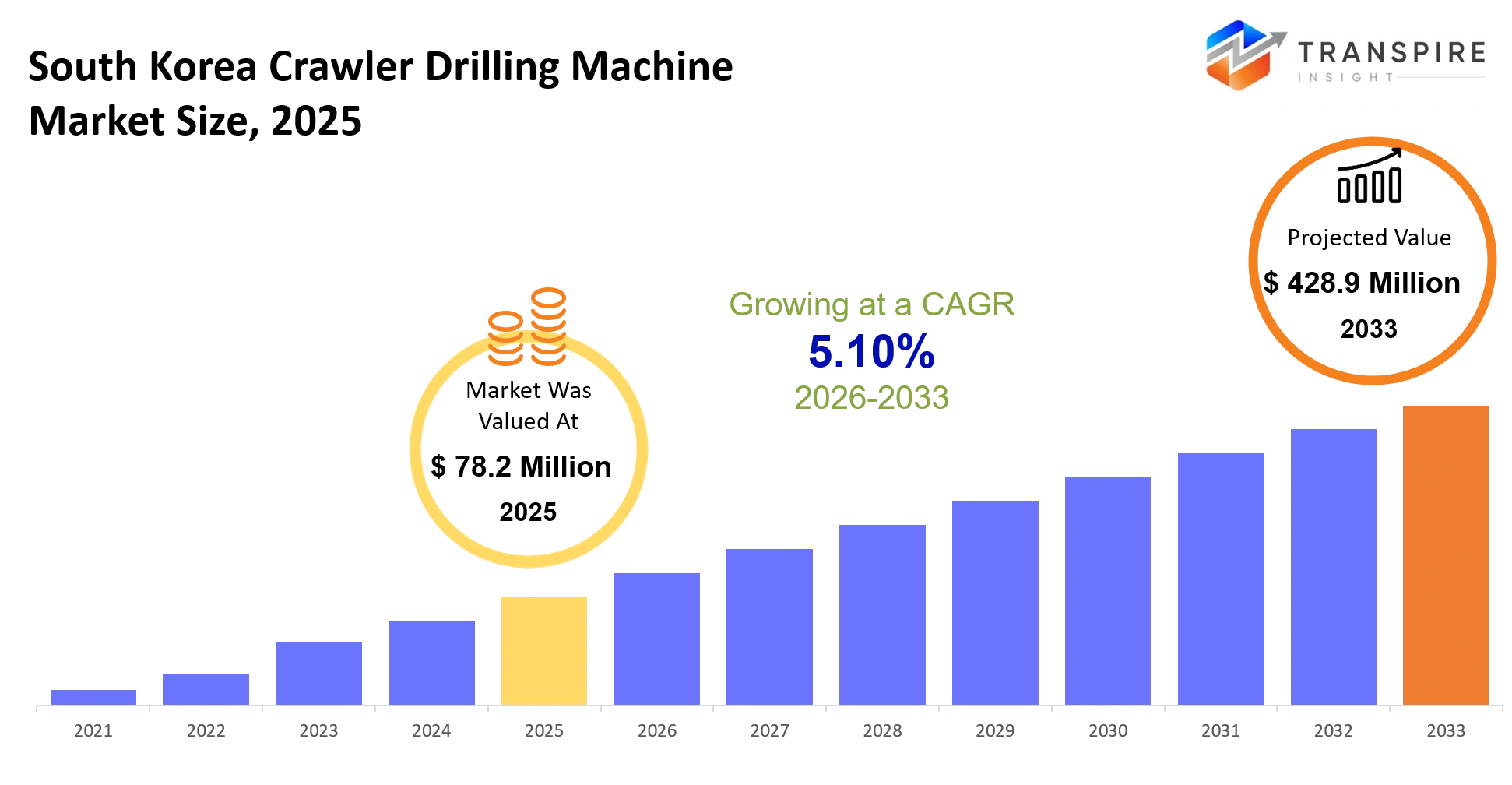
- South Korea Crawler Drilling Machine Market Size 2025: USD 78.2 Million
- South Korea Crawler Drilling Machine Market Size 2033: USD 428.9 Million
- South Korea Crawler Drilling Machine Market CAGR: 5.10%
- South Korea Crawler Drilling Machine Market Segments: By Type (Hydraulic, Pneumatic, Rotary, Others); By Application (Mining, Construction, Quarrying, Infrastructure, Others)
To learn more about this report,  Download Free Sample Report
South Korea Crawler Drilling Machine Market Summary
The South Korea Crawler Drilling Machine Market was valued at USD 78.2 Million in 2025. It is forecast to reach USD 428.9 Million by 2033. That is a CAGR of 5.10% over the period.
Crawler drilling machines are used in South Korea to drill deep and stable boreholes for mining, quarrying, construction foundations ,and bigger infrastructure jobs like tunnels and highways. In real life these machines help with the annoying problem of working on uneven or rocky terrain where mobility, precision, and drilling stability affect both safety on site and how fast a project finishes. Their tracked base lets them keep working without much break even when the ground is harsh. So they end up being pretty much required for heavy civil engineering and resource extraction work.
In the last 3–5 years, the market kinda moved in a more permanent way toward automated drilling setups and fuel-efficient systems. Contractors are using smarter construction equipment to reduce downtime and improve accuracy, and that’s changed buying habits. One big trigger was the rise in infrastructure modernization projects, plus tighter safety rules and emissions standards for heavy equipment operations. Together these pressures pushed contractors to swap out older, diesel-heavy rigs. As that happened, demand climbed for advanced crawler drilling machines with better control features and less operational risk.
Because of this, procurement decisions are now more and more connected to productivity results and lifecycle cost, not just the initial purchase price. That approach is boosting adoption among major contractors and mining operators ,and it directly supports revenue growth for manufacturers that sell high-efficiency, digitally supported drilling solutions.
Key Market Insights
- South Korea Crawler Drilling Machine Market is kinda shifting, toward automated drilling systems, as contractors lean into precision and also less operational downtime.
- It’s not just a small change either, industry adoption went up by almost 30% from 2022 to 2025, mostly because large scale infrastructure and tunnel construction keep expanding.
- On the ground, the demand pull is coming from replacing older hydraulic rigs with fuel efficient crawler based drilling machines across industrial builds and field work.
- In 2025, Gyeonggi-do stays out front, holding around 38% share, helped by very dense construction activity and infrastructure coverage.
- Meanwhile, Ulsan looks like the fastest mover during 2025–2030, mainly tied to industrial expansion and engineering work linked to mining.
- Gangwon-do, on the other hand, keeps a steadier trend, supported by quarrying activity and the fact that the terrain is mountainous so related infrastructure development keeps going.
- For machine type, hydraulic crawler drilling machines still lead at about 52% share, because they deliver strong capability for heavy duty jobs where conditions can be tough.
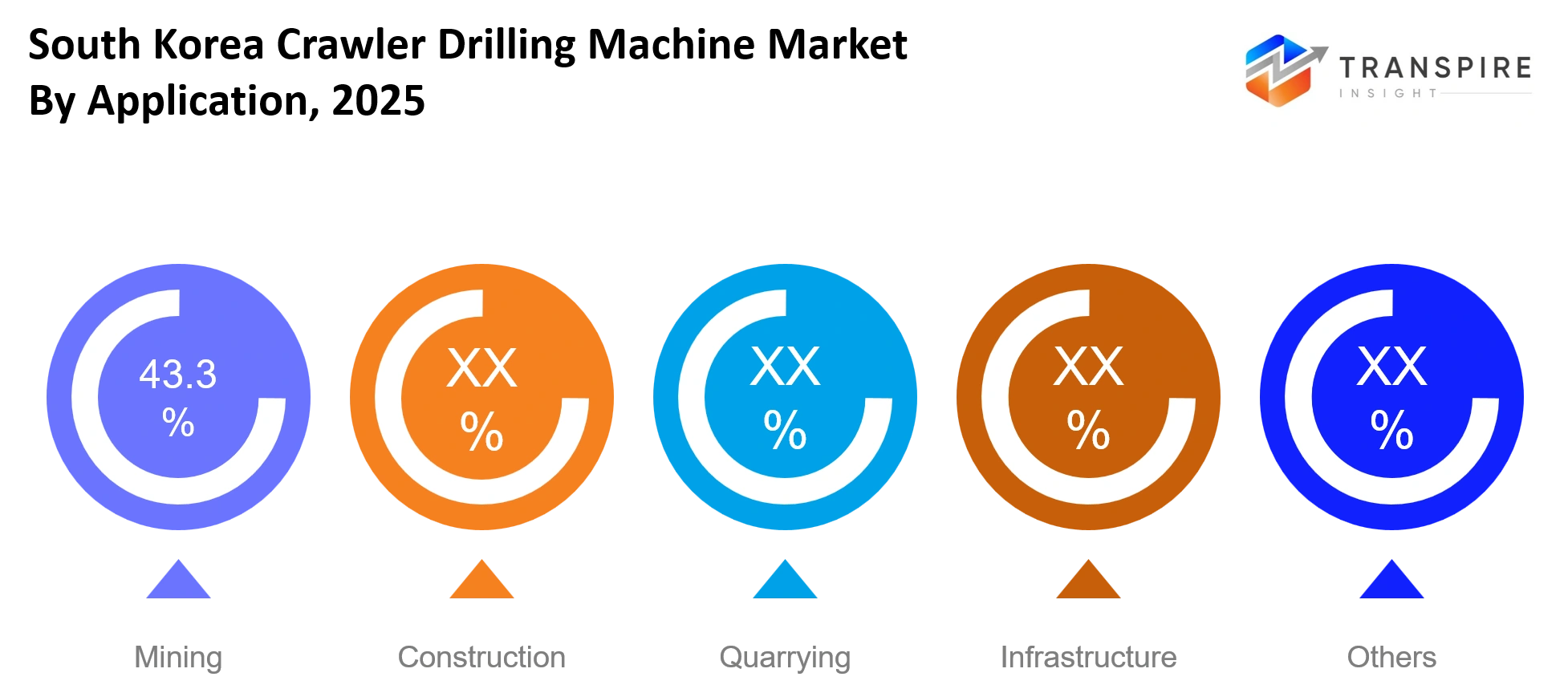
- When you look at end use, construction applications lead too, with roughly 45% share, driven by ongoing growth in urban infrastructure.
- Mining and quarrying is described more as the quickest segment, because raw material demand is increasing and that keeps engineering and extraction needs rising.
- And in terms of key customers, construction contractors are leading with around 48% share, since execution rates on infrastructure projects tend to stay high.
What are the Key Drivers, Restraints, and Opportunities in the South Korea Crawler Drilling Machine Market?
The South Korea Crawler Drilling Machine Market seems to be pushed mostly by big infrastructure builds, plus a lot of tunnel work that ties into upgrades for urban transit and also broader industrial corridor plans. This “buzz” wasn’t random though , it picked up after government spending rose for highways , rail systems, and smart city projects, and all of that really needs drilling solutions that are steady, exact, and able to handle complex terrain. Because contractors care a lot about output and keeping schedules, more buyers are moving toward crawler drilling machines that have automation, along with better fuel efficiency, so equipment purchases go up and fleet upgrades become the default move.
Still, there’s a structural issue, basically the upfront price on advanced crawler drilling systems is high, and then the replacement cycles are also long, at least in construction and mining. A lot of mid-sized contractors just stick with older hydraulic rigs, mostly due to cash limits and because financing for high-spec machinery is hard to get. Because of that, modernization slows down, and new technology doesn’t spread as fast, especially for firms in regional areas outside the biggest cities.
But there is an emerging chance that looks pretty strong: automated drilling and remote operation tools being rolled out in rough, mountainous zones like Gangwon-do, where the terrain itself raises operational risk and makes labor dependency more noticeable. At the same time, more spending on digital construction, plus sensor based drilling control, is starting to boost accuracy and cut downtime. If contractors keep adopting these smarter drilling fleets, they should see efficiency advantages, so automation ends up acting like a real growth catalyst for suppliers aiming at infrastructure and mining projects.
What Has the Impact of Artificial Intelligence Been on the South Korea Crawler Drilling Machine Market?
Artificial intelligence and advanced digital systems are, kind of, steadily reshaping crawler drilling operations in South Korea, especially across big infrastructure and mining efforts where accuracy and runtime basically decide the project budget. In the more demanding places, like tunnels and quarries, modern crawler drilling machines now fold in AI based control logic that tweaks drilling pressure, rotation speed, and feed rates on the fly, depending on rock hardness and what the ground is doing at that moment. With this kind of automation, drilling accuracy typically gets a boost, and operator dependence goes down, though it’s not as simple as just “set it and forget it”, because conditions can vary a lot.
Machine learning models are also showing up for predictive maintenance, by reading vibration trends, changes in hydraulic pressure, and engine load signals coming from the equipment itself. The goal is to catch early clues of deterioration in essential parts, such as drill bits, hydraulic pumps, and undercarriage systems. In practice, crews that rely on predictive analytics say they’re seeing roughly 10–15% better directionally on uptime, plus fewer surprise breakdowns. That usually translates into smoother schedules, and better fleet utilization across the whole job.
Still, there’s a real bottleneck. The integration cost for AI enabled systems can be high, especially for mid sized contractors that still operate older hydraulic rigs. Also, sensor standardization is not consistent across manufacturers, so the data stream can end up messy or incompatible, which then hurts model accuracy once you’re out in the real world. So, even with the productivity upsides being pretty clear, adoption stays uneven across advanced construction sites, more patchy than anyone would like.
Key Market Trends
- Between 2022 and 2025, the use of crawler drilling machines went up about 28% , mainly because infrastructure projects kept expanding across South Korea.
- Contractors started moving from regular hydraulic rigs toward automated crawler systems after 2023, mostly so drilling precision could be better and so routine operation downtime could be cut down, a bit.
- Spending on infrastructure in South Korea didn’t just tick upward after 2022 it sort of accelerated, so demand grew for high capacity drilling equipment for tunneling as well as for highway builds.
- After 2024, Epiroc and Sandvik also pushed more digital drilling system deployments in Asia, aiming to reinforce real time monitoring of equipment.
- In 2025 Komatsu increased its hybrid drilling machine lineup, trying to squeeze more fuel efficiency gains out of construction and mining work.
- Around the same time mining operators gradually pulled back from manual drilling equipment after 2023, partly due to stricter safety rules and productivity related expectations.
- Since 2024, government-backed smart construction initiatives sort of nudged the sector toward sensor based drilling systems, especially across bigger infrastructure schemes.
- In Gangwon-do, crawler drilling adoption rose after 2023, linked to more quarrying activity and also mountainous construction work.
- Also, leasing models became more common after 2024, because contractors seemed to prefer flexible financing instead of outright buying expensive machinery.
- Finally predictive maintenance adoption grew after 2023 , which helped reduce unplanned downtime by improving hydraulic and mechanical fault detection processes.
South Korea Crawler Drilling Machine Market Segmentation
By Type
Hydraulic crawler drilling machines kind of dominate the South Korea Crawler Drilling Machine Market, mostly because they’re strong on heavy-duty construction and mining stuff. In practice these units make stable drilling possible, even when the rock is tough and the terrain is all over the place. After 2022 demand picked up, probably because infrastructure projects spread across urban areas as well as industrial zones. Most contractors also stick with hydraulic systems , since they tend to be durable and they keep a consistent output when drilling goes on for long hours.
Rotary crawler drilling machines are getting more attention too, especially for precision oriented drilling tasks inside infrastructure work and tunneling projects. Pneumatic systems still get used, but it’s more limited… mostly for smaller-scale quarrying and lighter construction. Meanwhile other types stay pretty niche, though they still help with specialized drilling requirements in particular industrial use cases. Overall, the South Korea Crawler Drilling Machine Market seems to be moving toward higher-efficiency hydraulic and rotary systems. That shift is mainly driven by productivity expectations, and basically what operators need day after day.
By Application
Construction is still the top application in the South Korea Crawler Drilling Machine Market, mostly because urban development doesn’t really slow down and transport infrastructure keeps getting bigger. Demand stays high, especially with tunnel construction, highway jobs and foundation drilling activities. After 2023 growth picked up, well, in part because large scale public infrastructure budgets started rolling out more strongly across major cities. Contractors lean on crawler drilling machines to keep ground penetration stable and also accurate, even when soil conditions are kind of tricky or irregular.
On the mining side there’s steady growth as well, mainly driven by modernization of extraction equipment and ongoing safety upgrades. In quarrying, crawler drilling machines help with efficient rock fragmentation and material retrieval, rather than doing it the slow way. Infrastructure work continues to add more need through rail, road and smart city development programs. There are also other uses that sound more specialized, like industrial drilling tasks that call for tight precision along with advanced machine stability across different ground types.
To learn more about this report, Download Free Sample Report
What are the Key Use Cases Driving the South Korea Crawler Drilling Machine Market?
Construction foundation drilling is still basically the main reason the South Korea Crawler Drilling Machine Market keeps moving. Big infrastructure jobs—like highways, tunnels, and city rail—need drilling that stays stable and accurate even when soil conditions keep changing. Most contractors rely on crawler drilling machines to keep control, and safety, during deep foundation tasks, especially in crowded urban areas where underground layouts get complicated, and honestly they can be hard to predict.
Meanwhile mining and quarrying are also pulling more weight in the market. As industrial operators modernize how they extract materials they are starting to want better efficiency, so crawler drilling machines get used for rock fragmentation and for blast prep that is more controlled. Not only the construction side, but also resource extraction teams are increasingly choosing these machines, because they help deliver consistent drilling performance. There are also infrastructure developers using them on rail and road expansion schedules, with steady output across different terrain types and project sizes.
Newer use cases are starting to show up too, like smart city infrastructure upgrades, plus automation support around tunnel boring. In energy work, renewable power installations in mountainous regions are beginning to adopt crawler drilling machines for solid ground preparation. This kind of demand should continue rising as digital construction methods and precision drilling technologies get more widely combined, and used in day to day project workflows.
|
Report Metrics |
Details |
|
Market size value in 2025 |
USD 286.9 Million |
|
Market size value in 2026 |
USD 302.7 Million |
|
Revenue forecast in 2033 |
USD 428.9 Million |
|
Growth rate |
CAGR of 5.10% from 2026 to 2033 |
|
Base year |
2025 |
|
Historical data |
2021 - 2024 |
|
Forecast period |
2026 - 2033 |
|
Report coverage |
Revenue forecast, competitive landscape, growth factors, and trends |
|
Regional scope |
South Korea |
|
Key company profiled |
Epiroc, Sandvik, Caterpillar, Komatsu, Furukawa, Junjin, Soosan, Hyundai Everdigm, Atlas Copco, Liebherr, Sunward, XCMG, SANY, Doosan, Volvo CE |
|
Customization scope |
Free report customization (country, regional & segment scope). Take advantage of customized purchase options tailored to meet your exact research needs. |
|
Report Segmentation |
By Type (Hydraulic, Pneumatic, Rotary, Others); By Application (Mining, Construction, Quarrying, Infrastructure, Others) |
Which Regions are Driving the South Korea Crawler Drilling Machine Market Growth?
Seoul and the surrounding Gyeonggi-do region lead the South Korea Crawler Drilling Machine Market due to dense infrastructure development and strong concentration of construction contractors. Continuous investment in urban transit systems, smart city projects, and highway expansion drives consistent drilling equipment demand. The region benefits from advanced construction technology adoption and strong regulatory enforcement for safe foundation drilling practices. A well-established ecosystem of equipment suppliers, rental companies, and infrastructure developers further supports sustained market leadership.
Busan represents a stable secondary region supported by its strong industrial base and port-related infrastructure development. Unlike Seoul, Busan’s demand is shaped more by logistics expansion, coastal construction, and industrial facility upgrades rather than dense urban redevelopment. Consistent investment in industrial zones and transport connectivity projects supports steady crawler drilling machine usage. The region also benefits from long-term public infrastructure planning, which ensures predictable equipment demand across construction cycles.
Gangwon-do is the fastest-growing region due to increased infrastructure development in mountainous terrain and quarrying activities. Recent expansion in road connectivity projects and energy infrastructure installations has accelerated demand for crawler drilling machines. Government-backed regional development programs after 2024 have improved access to remote construction zones. This growth signals strong opportunities for equipment suppliers targeting complex terrain construction and long-term infrastructure modernization projects through 2026–2033.
Who are the Key Players in the South Korea Crawler Drilling Machine Market and How Do They Compete?
Competition in the South Korea Crawler Drilling Machine Market is moderately consolidated, though a few global heavy equipment manufacturers still sort of hold the advanced technology supply , while regional players tend to fight more on rental services and cost sensitive contracts. Established firms keep their lead by providing high performance drilling systems, solid aftersales support, and tighter integration with digital monitoring tools. New entrants meanwhile hit noticeable hurdles tied to high capital needs, strict safety requirements,and the fact they must show proven reliability for infrastructure and mining work. So overall competition is pushed by technology progression, equipment durability, plus service based lifecycle support, not pricing alone.Epiroc leans into automation driven crawler drilling solutions that push better precision for tunneling and mining use cases. Epiroc differentiates with real time drilling control systems and predictive maintenance integration. Its expansion plan includes reinforcing partnerships with Korean infrastructure contractors to deliver digitally enabled drilling fleets for big scale jobs.
Sandvik highlights high efficiency rotary and hydraulic drilling technologies aimed at hard rock conditions. Its edge comes from durable machine design, and drilling software that helps improve penetration accuracy. Sandvik is also moving forward via service based agreements and equipment modernization programs across Asian construction markets.Caterpillar competes using large scale equipment reliability, and it leans on strong distribution networks across Asia. It stands out through integrated fleet management systems, these help construction contractors optimize machine utilization. Growth is supported through dealer network expansion and
Company List
- Epiroc
- Sandvik
- Caterpillar
- Komatsu
- Furukawa Rock Drill
- Junjin CSM
- Soosan Heavy Industries
- Hyundai Everdigm
- Atlas Copco
- Liebherr
- Sunward Intelligent Equipment
- XCMG
- SANY Group
- Doosan Bobcat
- Volvo Construction Equipment
Recent Development News
In April 2026, Komatsu Ltd. expanded its underground and surface drilling equipment business through enhanced product integration aimed at improving fleet efficiency and lifecycle service support. The development reinforced Komatsu’s position in Asia’s construction and mining machinery segment, supporting crawler drilling machine deployment in infrastructure-heavy markets like South Korea. https://uk.finance.yahoo.com
What Strategic Insights Define the Future of the South Korea Crawler Drilling Machine Market?
In the South Korea Crawler Drilling Machine Market, things are slowly but clearly moving toward more automated and digitally connected drilling systems, mostly because infrastructure work is getting more complicated and people need higher precision, every time. In the next 5 to 7 years, the demand picture will likely be shaped by smart construction adoption, where contractors care more about real-time drilling control, predictive maintenance, and fuel efficient operations , not just raw power. This change is being pulled forward by big urban transit expansion, tunnel construction, and industrial modernization efforts, all of which ask for better accuracy and less downtime during projects.
There’s also a quieter risk, kind of off to the side, where the market depends more on a small set of global equipment suppliers. That can create a lot of pressure on pricing and it can also make supply chain disruptions more painful during global manufacturing cycles. If capital equipment production slows down, or if export restrictions show up, even briefly, it could hit South Korea’s infrastructure schedules directly.
At the same time, there’s an opportunity that’s starting to stand out: autonomous drilling systems that are paired with AI based terrain mapping. This looks especially relevant for mountainous areas like Gangwon-do, where the land isn’t forgiving and operational risk rises quickly. With these setups, safety and drilling efficiency can improve in remote job sites. Market players should probably build stronger local service ecosystems and keep pushing digital upgrades for equipment, while also setting up long term partnerships with infrastructure contractors, so the market can deliver steady equipment demand plus aftersales revenue, year after year.
South Korea Crawler Drilling Machine Market Report Segmentation
-
By Type
- Hydraulic
- Pneumatic
- Rotary
- Others
-
By Application
- Mining
- Construction
- Quarrying
- Infrastructure
- Others
Frequently Asked Questions
Find quick answers to common questions.
The expected South Korea Crawler Drilling Machine Market size for the market will be USD 428.9 Million in 2033.
By Type (Hydraulic, Pneumatic, Rotary, Others); By Application (Mining, Construction, Quarrying, Infrastructure, Others).
Major South Korea Crawler Drilling Machine Market players are Epiroc, Sandvik, Caterpillar, Komatsu, Furukawa, Junjin, Soosan, Hyundai Everdigm, Atlas Copco, Liebherr, Sunward, XCMG, SANY, Doosan, Volvo CE.
The South Korea Crawler Drilling Machine Market size is USD 286.9 Million in 2025.
The South Korea Crawler Drilling Machine Market CAGR is 5.10% from 2026 to 2033.
- Epiroc
- Sandvik
- Caterpillar
- Komatsu
- Furukawa Rock Drill
- Junjin CSM
- Soosan Heavy Industries
- Hyundai Everdigm
- Atlas Copco
- Liebherr
- Sunward Intelligent Equipment
- XCMG
- SANY Group
- Doosan Bobcat
- Volvo Construction Equipment
About the Authors

Kartik bhong
I am Kartik Bhong, a Senior Research Analyst at Transpire Insight, specializing in the Packaging, Manufacturing, and Construction industry. My work focuses on analyzing market trends, emerging technologies, industry regulations, and competitive landscapes to deliver accurate, data-driven insights. I am passionate about transforming complex industry information into clear, practical content that helps businesses, professionals, and decision-makers stay informed and make confident strategic decisions. Through continuous research and a strong commitment to accuracy, I strive to create reliable, well-researched content that reflects the latest developments across these dynamic industries and supports the vision of Transpire Insight in delivering valuable market intelligence.

Chakradhar Khansole
Chakradhar serves as the Research Director at Transpire Insight, bringing over 8 years of experience in technology, innovation, and strategic market intelligence. He specializes in transforming complex market data into actionable business insights that enable organizations to make informed, growth-oriented decisions. Recognized for his strategic vision and analytical expertise, Chakradhar leads high-impact research initiatives, delivering comprehensive market assessments, competitive intelligence, and forward-looking industry analysis.
Recently Published Reports
-
Apr 2026
Handling and Lifting Equipment Market
Handling and Lifting Equipment Market Size, Share & Analysis Report By Product (Cranes and Hoists, Forklifts, Conveyor Systems, Aerial Work Platforms, Others), By Application (E-Commerce, Automotive and Railway, Food and Beverages, Aviation, Others), and Geography (North America, Europe, Asia-Pacific, Middle East and Africa, South and Central America), 2021 - 2031
-
Apr 2026
HVAC Equipment Market
HVAC Equipment Market Size, Share & Analysis Report By Heating Equipment Type (Boilers and Furnaces, Heat Pumps, and Unitary Heaters), By Ventilation Equipment (Air Handling Units, Humidifiers and Dehumidifiers, Air Filters, and Fan Coiling Units), By Air Conditioning Equipment (Unitary Air Conditioners, Room Air Conditioners, Packaged Terminal Air Conditioners, and Chillers), By End User (Commercial, Residential, Industrial, and others), and Geography (North America, Europe, Asia-Pacific, Middle East and Africa, South and Central America), 2021 – 2031
-
Apr 2026
Refrigeration Valves Market
Refrigeration Valves Market Size, Share & Analysis Report By Type (Solenoid Valves, Expansion Valves, Check Valves, Service Valves, Others), By Application (Commercial Refrigeration, Industrial Refrigeration, Transport Refrigeration, Residential Refrigeration, Air Conditioning Systems), By End User (Food and Beverage Industry, Pharmaceutical Industry, HVAC Industry, Chemical Industry, Others), and Geography (North America, Europe, Asia-Pacific, Middle East and Africa, South and Central America), 2021 – 2031
-
Apr 2026
E-Commerce Packaging Materials Market
E-Commerce Packaging Materials Market By Material Type (Corrugated Boxes, Paper & Paperboard, Foam & Cushioning Materials, Plastic Packaging, Flexible Packaging, Protective Packaging, Others), By Product(Primary Packaging, Secondary Packaging, Tertiary Packaging), By Packaging Function (Protective Packaging, Branding & Presentation Packaging, Transit & Logistic Packaging, Sustainable Packaging, Tamper Evidence Packaging), By End-User (Retail & Consumer Goods, Electronic Appliances, Food & Beverages, Healthcare & Pharmaceutical, Fashion & Apparel, Home & Furnishing, Others); By Industry Analysis, Size, Share, Growth, Trends, and Forecasts 2021-2033