

Europe Construction Equipment Rental Market Size & Forecast:
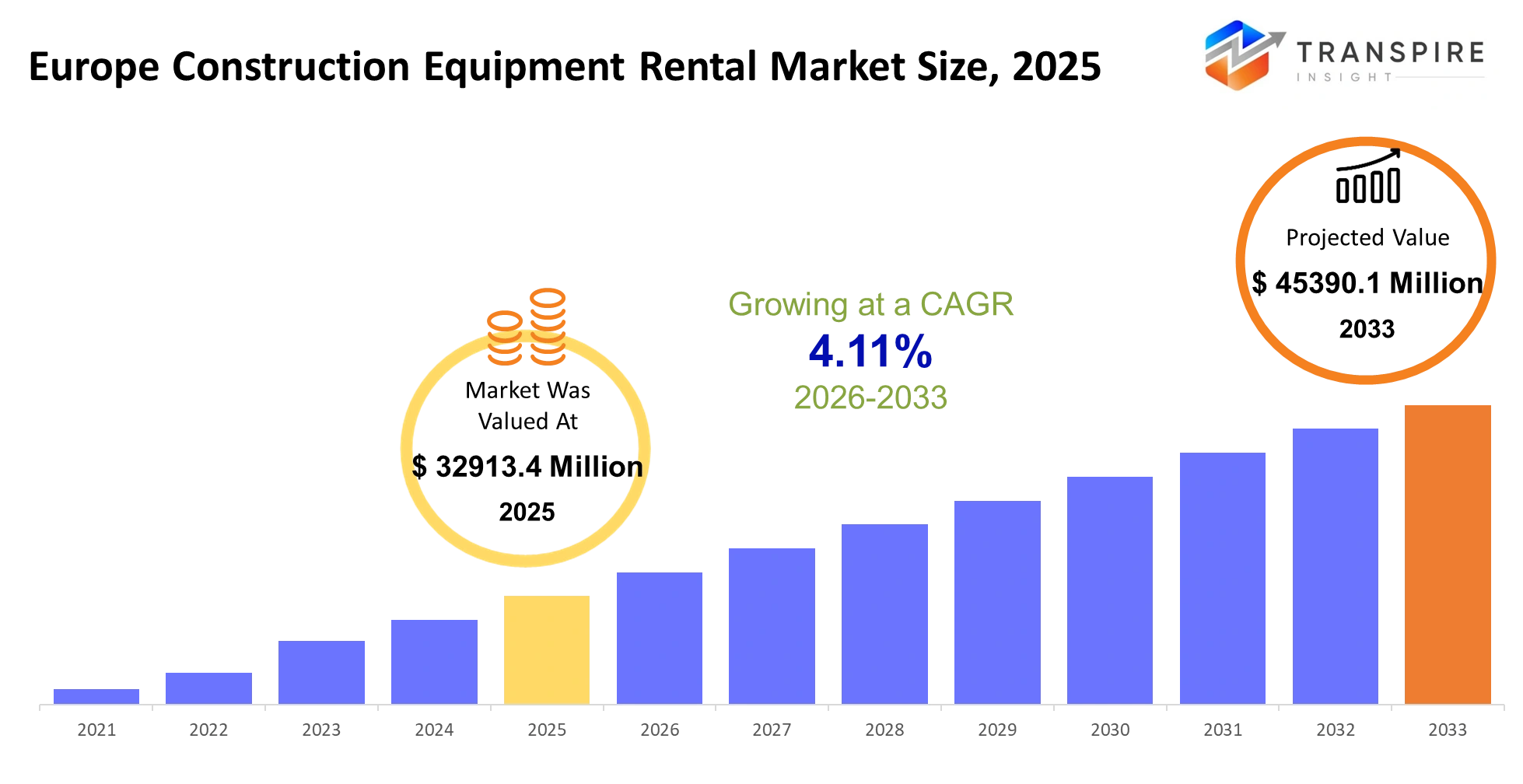
- Europe Construction Equipment Rental Market Size 2025: USD 32913.4 Million
- Europe Construction Equipment Rental Market Size 2033: USD 45390.1 Million
- Europe Construction Equipment Rental Market CAGR: 4.11%
- Europe Construction Equipment Rental Market Segments: By Type (Earthmoving Equipment, Material Handling, Concrete Equipment, Others); By Application (Construction, Infrastructure, Industrial, Others); By End-User (Contractors, Construction Firms, Government, Others); By Rental (Short-term, Long-term, Others).
To learn more about this report,  Download Free Sample Report
Europe Construction Equipment Rental Market Summary
The Europe Construction Equipment Rental Market was valued at USD 32913.4 Million in 2025. It is forecast to reach USD 45390.1 Million by 2033. That is a CAGR of 4.11% over the period.
The Europe Construction Equipment Rental Market provides contractors and infrastructure developers and industrial operators with access to essential construction equipment which includes excavators and loaders and cranes without requiring them to bear expensive ownership costs and the long-term depreciation of equipment. The system allows companies to match their equipment needs with their project requirements which enables them to control their financial operations while minimizing the danger of losing equipment across multiple construction locations.
The market has experienced a complete transformation during the last three to five years because rental companies now operate electric vehicles which come with telematics systems that enable them to monitor vehicle usage and achieve higher equipment availability while adhering to stricter rules for urban emissions. The post-pandemic supply chain disruptions which caused equipment delivery delays functioned as the main factor that pushed contractors to depend on rental equipment as their only trustworthy solution. The combination of inflation and rising financing expenses created a situation where ownership became less desirable which resulted in increased reliance on rental services. The two operational forces drive rental businesses to increase their revenue through investments in modern low-emission equipment and data-based fleet optimization instead of traditional methods which involve expanding their stock of physical assets.
Key Market Insights
- The Europe Construction Equipment Rental Market will be 45 to 50 percent controlled by Western Europe during 2025 because of its established construction infrastructure.
-
The demand in Germany and France and the UK exists because these countries execute major infrastructure upgrades and city renewal initiatives.
-
The EU-funded transport and energy infrastructure projects will make Eastern Europe the quickest developing area until 2030.
- Excavators have an industry-leading position which exceeds 30 percent market share because people use them in both residential and commercial building projects.
-
The second-biggest market segment consists of loaders and backhoe loaders because they can work on various mid-scale construction tasks.
- The segment for electric and hybrid equipment rental will experience its highest growth period which will continue from 2025 until 2030.
-
The Europe Construction Equipment Rental Market experiences its main growth through infrastructure development which creates 40 percent market share through highway and rail construction projects.
- The European market experiences its fastest growth in urban construction because smart city projects and housing shortages drive demand in major cities.
- The construction contractors sector represents the most significant customer group which holds 55 percent market share because they depend on equipment rentals to fulfill their temporary work requirements.
- The end-user segment for industrial maintenance and utilities shows the highest growth because companies increasingly delegate their equipment-dependent tasks to outside providers.
What are the Key Drivers, Restraints, and Opportunities in the Europe Construction Equipment Rental Market?
Three main forces are currently changing how construction equipment rental services operate throughout Europe because these forces determine which customers will use their services and which financial systems will govern their operations.
The primary driver is the accelerating shift toward capital-light construction models, triggered by rising interest rates and stricter EU emissions compliance requirements. Contractors now prefer renting over ownership to avoid high upfront capital expenditure and the financial burden of maintaining aging diesel fleets. The increased demand from customers has resulted in rental companies achieving better usage rates because infrastructure markets in Germany and France continue to receive project investments which have specific completion deadlines.
The main restraint is equipment supply rigidity within the rental ecosystem. Many mid-sized rental firms still rely on legacy diesel-heavy fleets with slow replacement cycles due to high electrification costs and uncertain resale value of older machinery. The existing structural problem prevents fleet upgrades which leads to operational violations of low-emission zones in Amsterdam and Paris while decreasing potential income from premium electric equipment rentals. The existing system creates an imbalance between regions because there is a shortage of current machines while the demand for them continues to grow.
The fast expansion of electrified compact construction machinery throughout the Nordic countries creates a significant opportunity for development in Sweden and Norway. Strong government incentives and early adoption of battery-powered excavators are enabling rental firms such as Volvo Construction Equipment to pilot fully electric rental fleets. The charging infrastructure development at job sites will help this business model obtain new high-profit rental agreements which will promote its expansion throughout Europe.
What Has the Impact of Artificial Intelligence Been on the Europe Construction Equipment Rental Market?
The European Construction Equipment Rental Market experiences operational efficiency improvements through artificial intelligence and advanced digital systems which integrate intelligence into their fleet management and compliance workflows. AI-powered telematics systems enable rental operators to monitor their equipment automatically through real-time engine load and fuel consumption and emissions control systems across multiple construction sites. The system generates automatic alerts which identify all non-compliant activities in low-emission zones that need to be reported to regulatory authorities which results in decreased manual work and faster processing times.
Organizations now use predictive analytics models to determine their maintenance requirements which apply to high-use equipment that includes excavators and loaders. Machine learning tools use vibration patterns and hydraulic pressure data and historical failure rates to determine servicing schedules which prevent equipment breakdowns and result in a 10 to 15 percent increase in fleet availability for digitally advanced operators. The same models apply to fuel efficiency optimization and idle time reduction for extensive equipment rental operations.
The current state of AI applications encounters a major problem because different types of outdated equipment storage systems use different methods to collect operational data. The mid-sized rental companies in the industry use equipment from different periods which do not have unified sensor systems. This situation results in lower predictive model accuracy and prevents the complete implementation of automation solutions.
Key Market Trends
- Western European rental operators decreased their diesel vehicle usage after 2022 because they needed to comply with the new EU Stage V emissions regulations which required them to replace diesel vehicles with electric ones.
- Contractors increasingly shifted from ownership to rental contracts post-2021 because rising interest rates and equipment procurement delays made equipment ownership unworkable for them.
- Telematics systems became widespread after 2020 which allowed construction sites to monitor equipment usage in real time while decreasing equipment downtime during their work.
- Rental companies implemented AI-powered predictive maintenance solutions after 2023 which helped them decrease unexpected maintenance outages while enhancing equipment performance throughout its operational life.
- The demand for compact electric excavators has grown since 2022 which has become particularly strong in urban construction zones that enforce strict noise and emission control measures.
- Contractors adopted rental equipment during the 2020-2022 period because supply chain disruptions made it difficult to maintain equipment for their projects throughout Europe.
- Loxam and Boels Rental expanded their international fleet operations after 2023 to meet the rise in infrastructure-related demands that exist in Eastern European markets.
- Digital rental platforms replaced manual booking systems in many firms after 2021 because they enabled better pricing information and decreased the need for administrative work.
- The 2024 EU-funded infrastructure programs created new rental demand in Poland and Romania through their funding of major transport construction initiatives.
Europe Construction Equipment Rental Market Segmentation
By Type:
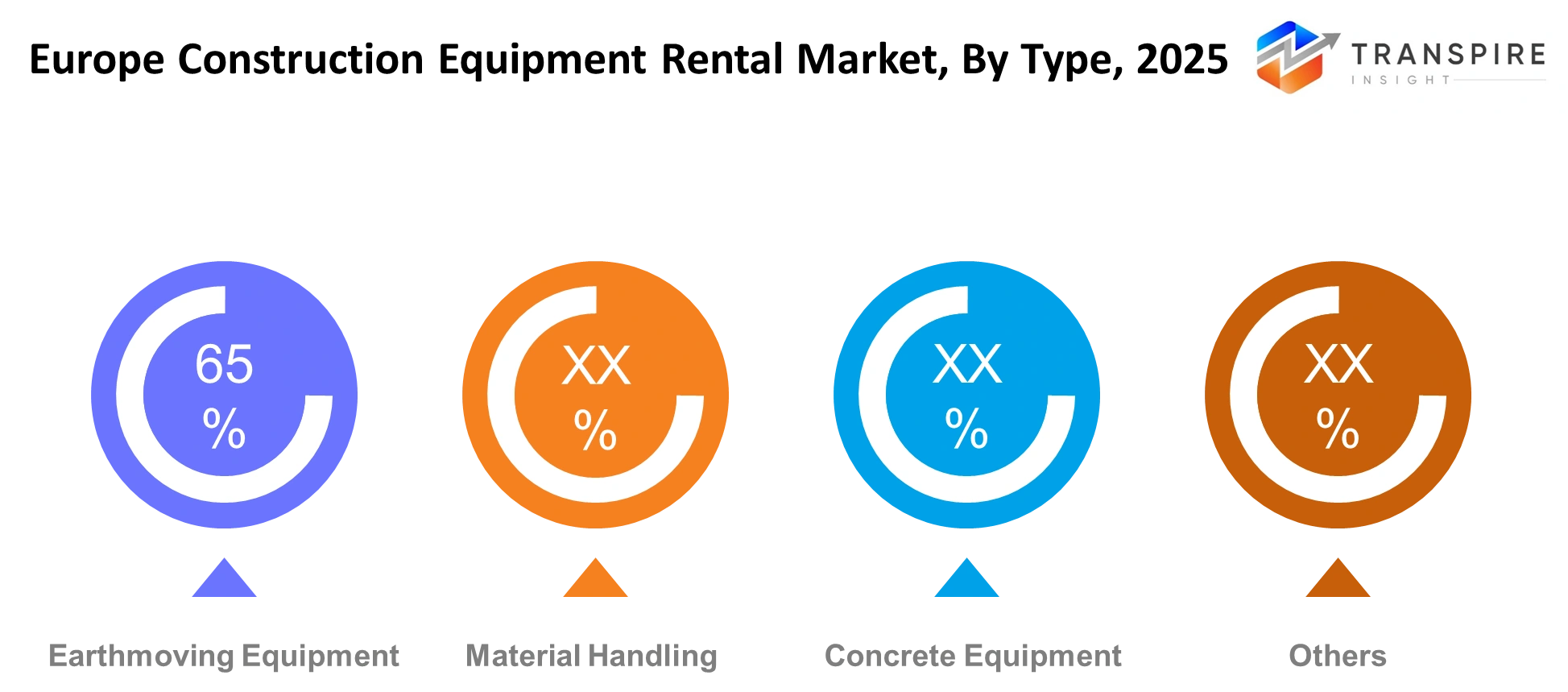
The equipment types include Earthmoving Equipment, Material Handling, Concrete Equipment and Others. Earthmoving equipment holds the strongest position within the equipment mix. The equipment operates essential functions for excavation and grading and site preparation in almost all construction work. The dedicated rental market for excavators and loaders exists because these machines have high acquisition costs while their usage occurs on brief project durations.
The segment experiences growth because infrastructure renewal programs and rapid western European urban redevelopment development. The contractors choose rental solutions because they want to avoid ownership risks which come with equipment depreciation and emissions regulations. The demand for concrete equipment and material handling systems increases because of commercial building projects and warehouse development.
Climate regulations will make electrified earthmoving equipment more popular for use before the forecast period ends. The rental operators who update their fleets with environmentally friendly excavators will gain better control over rental prices and equipment usage whereas the rental companies that fail to modernize will experience decreased market strength.
To learn more about this report, Download Free Sample Report
By Application:
The construction sector uses more equipment rental services than any other sector because European cities maintain continuous construction activities that involve building new residential and commercial properties. The construction industry needs rental solutions because it operates multiple sites which become difficult to manage under its current combination of short project durations and high project segmentation.
The fastest expanding application field shows the most rapid growth through infrastructure development which includes rail system upgrades and highway construction work and EU supported energy conversion initiatives. The industrial sector maintains consistent performance because it needs heavy machinery for both facility maintenance work and manufacturing plant improvements which happen at regular intervals.
Eastern and Central European nations will experience growth through infrastructure projects which receive funding from government spending initiatives. The rental providers who match their equipment inventory to meet requirements of large-scale public infrastructure projects will achieve extended equipment usage periods and stable revenue growth.
By End-User:
The contractors push forward their work because they need equipment which they can use on different project sites. The contractors use rental services because they want to keep their cash flow intact while they maintain operational flexibility instead of building their own equipment inventory.
Construction firms represent a major market segment which uses rental fleets to create hybrid ownership systems that enable them to handle peak demand times. Government agencies use temporary heavy equipment for public infrastructure projects which require its deployment at construction sites.
The development of future projects will occur through government-funded infrastructure initiatives and new procurement regulations which demand organizations to demonstrate cost-effective solutions. The contractual relationships between rental providers and institutional clients will result in extended contract durations and decreased customer turnover.
By Rental Duration:
The usage patterns of short-term rentals show superiority because urban construction sites experience abrupt project changes which create unpredictable equipment needs at different times. The model enables contractors to deploy equipment instantly while it helps decrease their costs which result from unused equipment.
The trend toward long-term rentals has increased because businesses want to establish fixed monthly expenses which include complete maintenance packages for their continuous infrastructure work. The trend shows that businesses now prefer to operate through expenditure-based models rather than making upfront investments.
The expansion of long-term contracts will continue to grow because rental companies will start to provide their clients complete digital monitoring alongside maintenance solutions. Service providers who offer their clients both adaptable options and service agreements will achieve better customer retention rates together with increased efficiency in managing their vehicle fleets.
What are the Key Use Cases Driving the Europe Construction Equipment Rental Market?
The primary application which drives the European Construction Equipment Rental Market exists for construction site development work which needs equipment for excavation and grading and foundation building. Construction companies prefer to rent earthmoving machines because their projects require them to work at different locations throughout the day instead of maintaining expensive equipment that will not be used.
Government-supported transport projects and manufacturing plant modernization projects drive infrastructure expansion and industrial facility renovations as their secondary application. The construction industry increasingly depends on rented material handling equipment and concrete equipment to complete projects on time while dealing with changes in their work requirements.
The construction of urban areas which restrict emissions and the establishment of renewable energy facilities through wind farm foundation projects act as new operational applications. The European Union environmental regulations and offshore infrastructure development projects lead to increased use of low-emission electrified rental machines at specialized project locations.
|
Report Metrics |
Details |
|
Market size value in 2025 |
USD 32913.4 Million |
|
Market size value in 2026 |
USD 34228.4 Million |
|
Revenue forecast in 2033 |
USD 45390.1 Million |
|
Growth rate |
CAGR of 4.11% from 2026 to 2033 |
|
Base year |
2025 |
|
Historical data |
2021 - 2024 |
|
Forecast period |
2026 - 2033 |
|
Report coverage |
Revenue forecast, competitive landscape, growth factors, and trends |
|
Regional scope |
Europe (Germany, United Kingdom, France, Italy, Spain, Rest of Europe) |
|
Key company profiled |
Ashtead Group, United Rentals, Loxam, Herc Rentals, Kiloutou, Sunbelt Rentals, Boels Rental, H&E Equipment, Speedy Hire, Nishio Rent All, Kanamoto, Aktio, Finning, Byrne Equipment, Zeppelin Rental. |
|
Customization scope |
Free report customization (country, regional & segment scope). Avail customized purchase options to meet your exact research needs. |
|
Report Segmentation |
By Type (Earthmoving Equipment, Material Handling, Concrete Equipment, Others); By Application (Construction, Infrastructure, Industrial, Others); By End-User (Contractors, Construction Firms, Government, Others); By Rental (Short-term, Long-term, Others). |
Which Regions are Driving the Europe Construction Equipment Rental Market Growth?
Western Europe leads the Europe Construction Equipment Rental Market because it has high urban construction activity and its emissions standards are enforced strictly and it has a complete equipment rental system in place. The equipment rental market in Germany France and the United Kingdom maintains its strength because these countries operate extensive equipment fleets which their contractors require for short-term equipment needs. The EU Stage V emission standards establish strong regulatory frameworks that require all businesses to continuously update their vehicle fleets, which results in increased demand for rental services. The presence of major rental companies and integrated logistics networks further strengthens operational efficiency and market dominance.
Southern Europe generates stable revenues that differ from other regions because its revenue base depends on economic recovery cycles and public infrastructure rehabilitation projects instead of regulatory requirements. The construction industry in Italy and Spain requires equipment for long-term construction projects and infrastructure enhancements for the tourism sector, which results in steady equipment demand that does not experience significant fluctuations. The Western European market uses strict emissions regulations to control emissions, but Western European market participants use their budget constraints to introduce new technologies into their businesses. The rental market experiences consistent growth because mid-sized construction companies require equipment for their extended projects while they know their equipment needs throughout the entire project duration.
Eastern Europe experiences its highest growth rate because EU funding for transport corridors and energy infrastructure and urban development projects has increased. The demand for advanced construction equipment has increased because Poland Romania and Czechia recently made investments to develop their highway and logistics hub systems. The combination of rapid urban growth and infrastructure development spending has led to a rental model shift in procurement practices because organizations now prefer equipment rental over owning equipment that is not available in the country.For market entrants and investors, this region presents high-growth potential through 2033, particularly for scalable fleets and cost-competitive rental strategies aligned with large public works programs.
Who are the Key Players in the Europe Construction Equipment Rental Market and How Do They Compete?
The construction equipment rental market in Europe exhibits a moderate level of market consolidation within Western European markets, whereas Eastern European markets and Southern European markets remain divided among many smaller rental companies. The major rental companies use fleet updates and online booking systems and flexible contracts to compete against each other instead of relying on price competition. The established companies maintain their market position through long-term infrastructure contract agreements, but digital-first companies use their asset-light operations and rapid booking technology to create margin pressure.
The companies Loxam, Boels Rental, Kiloutou, and Cramo use fleet electrification together with utilization efficiency methods to achieve lower operational expenses. Loxam operates fleet distribution across international borders between France and Germany. Boels Rental uses Cramo digital systems for Northern Europe to achieve better equipment operational time monitoring. Kiloutou uses its extensive network of equipment distribution centers in France and Spain to deliver equipment quickly for short-term needs.
Herc Rentals and United Rentals expand in Europe through infrastructure and industrial contracts, using telematics-enabled fleets and predictive maintenance tools. Herc Rentals supplies high-usage equipment for energy and construction projects, while United Rentals provides standardized equipment to international construction companies that require equipment across multiple locations. Both companies purchase emissions-compliant machinery to enhance their ability to compete with long-established rental businesses in Europe.
Company List
- Ashtead Group
- United Rentals
- Loxam
- Herc Rentals
- Kiloutou
- Sunbelt Rentals
- Boels Rental
- H&E Equipment
- Speedy Hire
- Nishio Rent All
- Kanamoto
- Aktio
- Finning
- Byrne Equipment
- Zeppelin Rental
Recent Development News
“In January 2026, Kiloutou announced the acquisition of DEA S.r.l. The move strengthened its Italian footprint and expanded its earthmoving and access equipment fleet, improving regional penetration in Northern Italy.
Source: https://www.kiloutou.com
“In April 2026, Kiloutou entered the Irish market through the acquisition of KDM Hire. The deal expanded its branch network across Belfast, Dublin, and Cork, accelerating cross-border growth in the equipment rental sector.
Source: https://www.irishnews.com
What Strategic Insights Define the Future of the Europe Construction Equipment Rental Market?
The Europe Construction Equipment Rental Market is progressing toward a new market framework which combines digital technology with electrification and requires less emphasis on fleet ownership than on operational asset monitoring and resource productivity. The growth path of the industry nowadays depends on European Union decarbonization requirements together with urban development restrictions which compel construction companies to use rental services instead of owning their machinery. The next 5 to 7 years will see organizations gain their competitive edge through data-based fleet management systems which exceed their current ability to manage fleet capacity.
The smaller rental operators face an indirect threat because they will need to spend money on compliance requirements which they cannot afford to pay for their electrification and telematics implementation projects. The growing need for consolidation will create challenges to pricing independence which will particularly affect Southern and Eastern European markets.
An emerging opportunity lies in battery-swappable compact construction equipment for dense urban zones, especially in Germany and the Netherlands where low-emission construction corridors are expanding. The system decreases operational downtime by solving charging infrastructure issues which leads to multiple new rental periods throughout the day.
Market participants should prioritize modular electrified fleet investment combined with unified digital platforms that optimize cross-border asset deployment, as operational efficiency will increasingly define margin leadership.
Europe Construction Equipment Rental Market Report Segmentation
By Type
- Earthmoving Equipment
- Material Handling
- Concrete Equipment
- Others
By Application
- Construction
- Infrastructure
- Industrial
- Others
By End-User
- Contractors
- Construction Firms
- Government
- Others
By Rental
- Short-term
- Long-term
- Others
Frequently Asked Questions
Find quick answers to common questions.
The Europe Construction Equipment Rental Market size is USD 45390.1 Million in 2033.
Key segments for the Europe Construction Equipment Rental Market are By Type (Earthmoving Equipment, Material Handling, Concrete Equipment, Others); By Application (Construction, Infrastructure, Industrial, Others); By End-User (Contractors, Construction Firms, Government, Others); By Rental (Short-term, Long-term, Others).
Major Europe Construction Equipment Rental Market players are Ashtead Group, United Rentals, Loxam, Herc Rentals, Kiloutou, Sunbelt Rentals, Boels Rental, H&E Equipment, Speedy Hire, Nishio Rent All, Kanamoto, Aktio, Finning, Byrne Equipment, Zeppelin Rental.
The Europe Construction Equipment Rental Market size is USD 32913.4 Million in 2025.
The Europe Construction Equipment Rental Market CAGR is 4.11% from 2026 to 2033.
- Ashtead Group
- United Rentals
- Loxam
- Herc Rentals
- Kiloutou
- Sunbelt Rentals
- Boels Rental
- H&E Equipment
- Speedy Hire
- Nishio Rent All
- Kanamoto
- Aktio
- Finning
- Byrne Equipment
- Zeppelin Rental
Recently Published Reports
-
Apr 2026
Handling and Lifting Equipment Market
Handling and Lifting Equipment Market Size, Share & Analysis Report By Product (Cranes and Hoists, Forklifts, Conveyor Systems, Aerial Work Platforms, Others), By Application (E-Commerce, Automotive and Railway, Food and Beverages, Aviation, Others), and Geography (North America, Europe, Asia-Pacific, Middle East and Africa, South and Central America), 2021 - 2031
-
Apr 2026
HVAC Equipment Market
HVAC Equipment Market Size, Share & Analysis Report By Heating Equipment Type (Boilers and Furnaces, Heat Pumps, and Unitary Heaters), By Ventilation Equipment (Air Handling Units, Humidifiers and Dehumidifiers, Air Filters, and Fan Coiling Units), By Air Conditioning Equipment (Unitary Air Conditioners, Room Air Conditioners, Packaged Terminal Air Conditioners, and Chillers), By End User (Commercial, Residential, Industrial, and others), and Geography (North America, Europe, Asia-Pacific, Middle East and Africa, South and Central America), 2021 – 2031
-
Apr 2026
Refrigeration Valves Market
Refrigeration Valves Market Size, Share & Analysis Report By Type (Solenoid Valves, Expansion Valves, Check Valves, Service Valves, Others), By Application (Commercial Refrigeration, Industrial Refrigeration, Transport Refrigeration, Residential Refrigeration, Air Conditioning Systems), By End User (Food and Beverage Industry, Pharmaceutical Industry, HVAC Industry, Chemical Industry, Others), and Geography (North America, Europe, Asia-Pacific, Middle East and Africa, South and Central America), 2021 – 2031
-
Apr 2026
E-Commerce Packaging Materials Market
E-Commerce Packaging Materials Market By Material Type (Corrugated Boxes, Paper & Paperboard, Foam & Cushioning Materials, Plastic Packaging, Flexible Packaging, Protective Packaging, Others), By Product(Primary Packaging, Secondary Packaging, Tertiary Packaging), By Packaging Function (Protective Packaging, Branding & Presentation Packaging, Transit & Logistic Packaging, Sustainable Packaging, Tamper Evidence Packaging), By End-User (Retail & Consumer Goods, Electronic Appliances, Food & Beverages, Healthcare & Pharmaceutical, Fashion & Apparel, Home & Furnishing, Others); By Industry Analysis, Size, Share, Growth, Trends, and Forecasts 2021-2033