

Europe Industrial Services Market Size & Forecast:
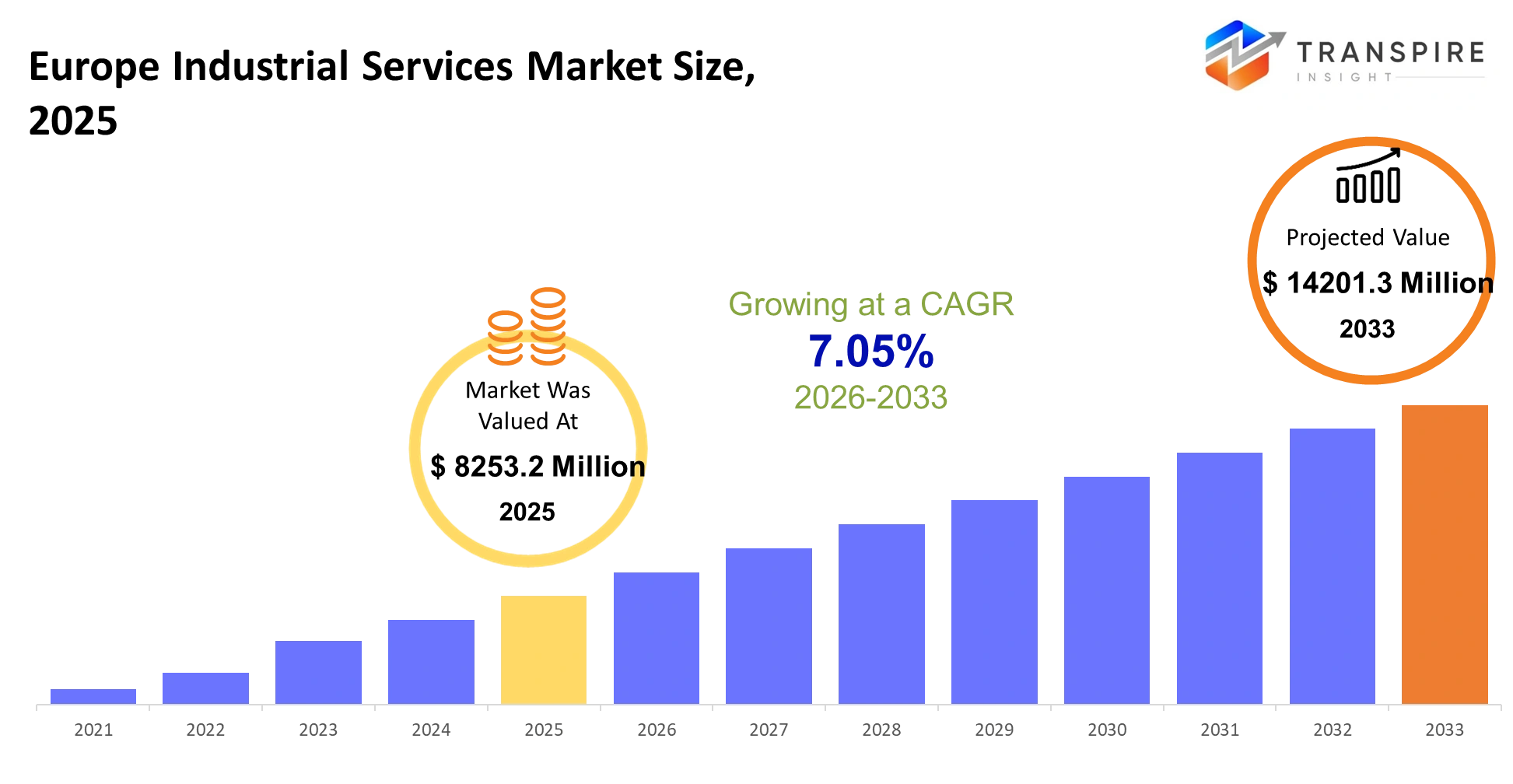
- Europe Industrial Services Market Size 2025: USD 8253.2 Million
- Europe Industrial Services Market Size 2033: USD 14201.3 Million
- Europe Industrial Services Market CAGR: 7.05%
- Europe Industrial Services Market Segments: By Type (Maintenance, Repair, Installation, Others), By Application (Manufacturing, Energy, Oil & Gas, Utilities, Others), By End-User (Industrial Companies, Utilities, Government, Others), By Service (On-site, Remote, Others).
To learn more about this report,  Download Free Sample Report
Europe Industrial Services Market Summary:
The Europe Industrial Services Market size is estimated at USD 8253.2 Million in 2025 and is anticipated to reach USD 14201.3 Million by 2033, growing at a CAGR of 7.05% from 2026 to 2033. The Europe Industrial Services Market keeps factories, energy assets, and infrastructure running safely and efficiently by handling maintenance, inspection, calibration, and on-site technical support. The system operates to protect asset-intensive sectors including chemicals and power and manufacturing from downtime hazards which arise when production stops for even brief periods.
The market has experienced a structural transformation during the past 3–5 years as industrial operations now utilize predictive services which rely on digital technology and sensors and remote monitoring and data analytics to replace traditional time-based maintenance methods. The COVID-19 disruption became a major trigger which demonstrated how service operations that depend on manual work at physical locations face operational weaknesses while also pushing businesses to implement remote diagnostics and automated solutions.
The business expansion process now proceeds according to an understandable framework. Operators who need to reduce operational risks and comply with environmental regulations will outsource their specialized requirements to external service providers, which will result in increased service agreements and extended revenue streams for service companies.
Key Market Insights
- The industrial services market in Europe sees Western Europe as its leading region which holds almost 45 percent of the market share for 2024 because of its robust industrial infrastructure.
- The period until 2030 sees Eastern Europe as the fastest-developing region because of manufacturing operations moving to the area and European Union-sponsored industrial modernization projects.
- The maintenance services market reaches more than 40 percent market share in 2024 because industrial facilities need to maintain operations while their equipment reaches its end of life.
- The second-largest market share belongs to inspection and testing services which receive backing from strict European Union regulations that enforce safety and environmental protection standards.
- The predictive and digital services market represents its most rapid expansion sector which will extend until 2030 through IoT and AI system adoption for monitoring purposes.
- The energy and power sector holds the highest market share of 30 percent in 2024 because of grid modernization activities and renewable energy project implementation.
- The European market sees renewable energy infrastructure services as the fastest-growing application because countries pursue their net-zero emissions and sustainable development objectives.
- The manufacturing sector controls more than 35 percent of the European Industrial Services Market because businesses require ongoing production and equipment efficiency improvements.
- The oil and gas and energy transition sector shows the highest growth rate because companies use asset repurposing methods while implementing carbon reduction strategies until 2030.
What are the Key Drivers, Restraints, and Opportunities in the Europe Industrial Services Market?
The primary force driving the European Industrial Services Market forward comes from organizations that implement predictive maintenance systems. The European Union established stricter safety and emissions regulations which became effective after 2020. Industries like power and chemicals now have to comply with new uptime and backlog reporting and asset integrity standards that exceed the capabilities of current reactive maintenance systems. Operators now choose to use sensor technology for monitoring their systems while they select external partners who possess digital expertise to deliver their required specialized services. The transition from one-time service delivery to ongoing performance monitoring brings two financial benefits. The transition from one-time service delivery to ongoing performance monitoring creates two financial benefits.
The industrial asset framework across Europe faces a fundamental challenge because it consists of numerous outdated industrial facilities which lack digital connectivity. The process of retrofitting older plants with modern monitoring systems requires mid-sized operators to spend high capital costs while needing skilled workers and experiencing operational interruptions. The advanced services adoption process becomes slower while market expansion gets restricted especially in Southern and Eastern Europe
Service providers experience delayed revenue collection because of their business operations which differ from region to region. The advanced services adoption process becomes slower while market expansion gets restricted especially in Southern and Eastern Europe
Service providers have a significant market opportunity to deliver maintenance services for renewable and hybrid energy infrastructure , particularly for Northern Europe's offshore wind and hydrogen energy projects. The assets from the beginning require specialized services for their inspection needs and corrosion control requirements and remote diagnostic capabilities. Service providers that establish their expertise in these fields at an early stage will receive high-value contracts that will last through the growing investments in Germany and the Netherlands.
What Has the Impact of Artificial Intelligence Been on the Europe Industrial Services Market?
Industrial services currently undergo a transformation which uses artificial intelligence together with advanced digital technologies to replace manual inspection work through automated systems that maintain continuous operational monitoring. AI-controlled systems now manage scrubber flow rates together with their alkalinity dosing and washwater discharge through exhaust gas cleaning technology which uses sensor data to achieve sulfur emission limits while reducing chemical consumption. Fleet operators use central dashboards for their vessels which automatically monitor compliance and detect regulatory breaches, which then generates automatic responses without requiring human work.
Machine learning models enhance predictive abilities through their examination of past performance data together with weather patterns and fuel quality changes to predict equipment deterioration and emissions discharge. The system enables service providers to establish maintenance schedules before equipment failures happen, which results in decreased operational interruptions and longer equipment lifespan. The system enables operators to achieve higher operational availability through engine-scrubber optimization, which also decreases fuel usage and results in fewer costs associated with non-compliance penalties.
The process of technology adoption currently encounters a significant barrier. Real-time analytics and model performance tracking face limitations because many vessels and legacy industrial facilities operate with broken data systems and unreliable internet connections. The development of AI solutions faces challenges due to the combination of high integration expenses and the unavailability of reliable training data from actual extreme operating conditions.
Key Market Trends
- Operational procedures for industrial operators have shifted from scheduled maintenance to predictive service contracts since 2020 because they require more than 35% of their operations to use sensor-based monitoring systems for their mission-critical assets.
- The implementation of strict EU emissions regulations in 2021 led businesses to increase their outsourcing of compliance services which required them to depend more on specialized companies for their inspection and reporting tasks.
- Digital service platforms developed by Siemens AG and ABB Ltd. between 2019 to 2024 began to replace traditional diagnostic methods as they implemented remote asset management capabilities.
- The energy transition projects which started in 2022 have created an increased demand for renewable infrastructure services because offshore wind maintenance contracts have grown substantially across Northern Europe.
- Manufacturers have cut their number of internal maintenance staff members by approximately 20% since 2018 because they prefer using long-term service contracts to maintain fixed operational expenses while enhancing their system availability.
- The industrial service adoption rates in Eastern Europe increased after 2021 when manufacturers started diversifying their supply chains from Western Europe to new operational territories.
- AI-powered inspection systems which became available after 2020 have delivered a maintenance solution that enables operators to lower their unexpected equipment downtime rates by 25%.
- The number of regulatory audits has increased since 2021 which has led organizations to implement ongoing monitoring solutions that replace their former practice of conducting compliance assessments at set intervals.
- The service providers have grown their business operations by forming strategic partnerships and acquiring new businesses since 2019 which has enhanced their ability to perform digital diagnostics and deliver services across multiple locations.
Europe Industrial Services Market Segmentation
By Type
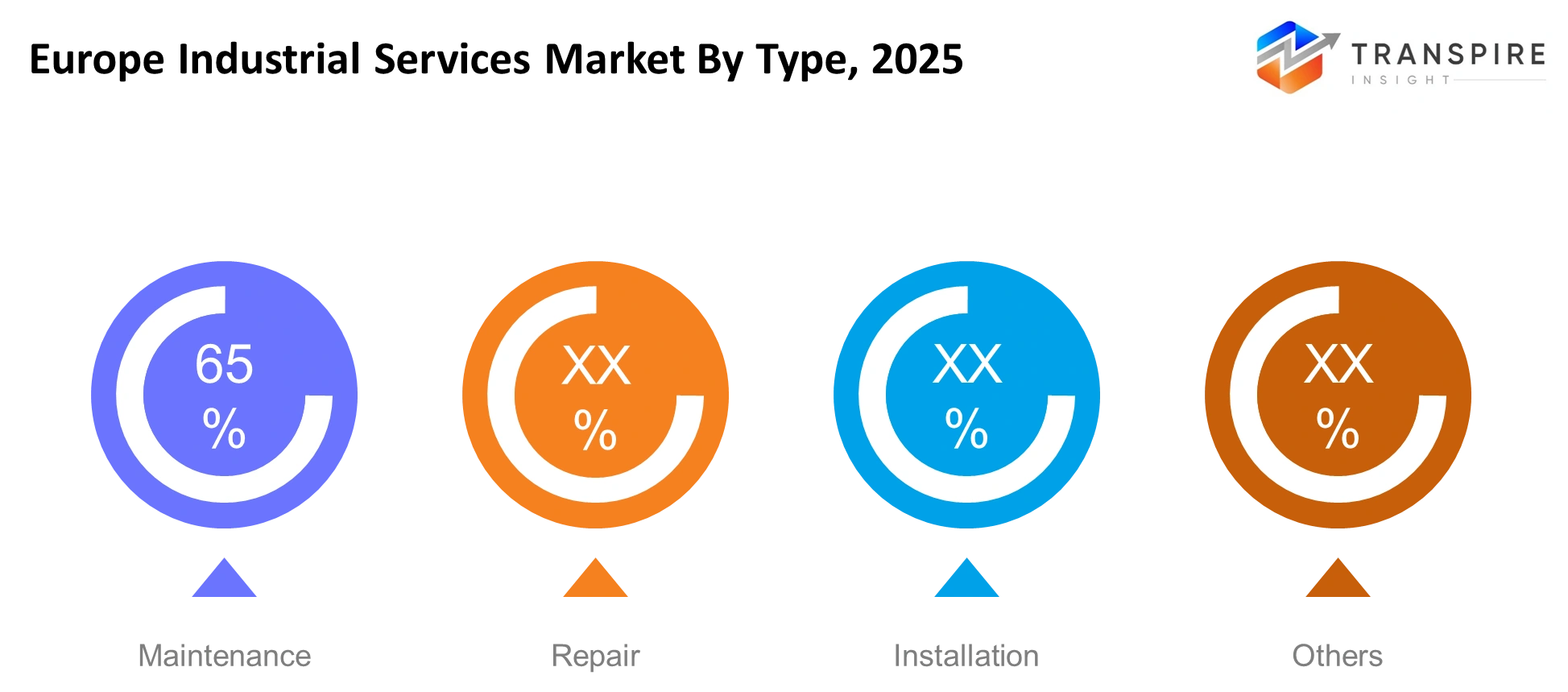
The Europe Industrial Services Market by Type is led by maintenance services, which hold the dominant position due to continuous asset upkeep requirements across manufacturing plants, energy facilities, and heavy industrial operations. Repair services follow closely, supported by aging infrastructure that demands frequent corrective interventions. The capacity expansion and modernization projects require installation services, while the specialized operational requirements need calibration and inspection services.
Maintenance operations take precedence because businesses need to prevent unplanned downtime and meet strict EU safety regulations. The segment now experiences changes because businesses are adopting predictive maintenance models which decrease their need for reactive maintenance procedures. Future development points toward integrated service contracts that combine maintenance and repair into unified performance-based agreements, offering predictable revenue streams for providers and higher operational reliability for buyers.
To learn more about this report, Download Free Sample Report
By Application
The manufacturing sector drives European Industrial Services Market applications because it needs ongoing equipment maintenance to keep production lines operating at full capacity. Energy and utilities applications maintain strong market positions because grid modernization and renewable energy development projects span the entire region. The oil and gas industry uses applications yet they are shifting toward asset repurposing and efficiency optimization instead of pursuing new project development.
The manufacturing sector requires downtime protection while energy and utilities need compliance solutions that enable system operational changes. Decarbonization initiatives and infrastructure upgrades drive market growth while wind and hydrogen systems experience their strongest development at this time. Renewable energy applications will become more important in the future because these applications require extensive service work and long-term maintenance contracts provide service providers with predictable revenue streams.
By End-User
The Industrial Services Market in Europe has its largest market share which industrial companies hold because they need advanced machinery to operate their production systems. The utilities sector exists as an essential market segment which depends on infrastructure reliability together with the need to meet regulatory compliance standards. The government-related end-users support public infrastructure projects and energy transition initiatives while logistics and transportation companies represent another end-user group whose service requirements are expanding.
Industrial companies lead the market because they operate heavy machinery and they need to improve their operational processes throughout their entire equipment life cycle. The utility sector is experiencing growing effects from smart grid technology and environmental sustainability requirements. The future will see all end-user groups increasing their outsourcing activities because businesses need to cut costs which will create demand for ongoing service agreements and comprehensive asset management solutions.
By Service
The Europe Industrial Services Market by Service is divided into three parts which include on-site services and remote services and hybrid services. The physical demands of industrial equipment maintenance and inspection work give on-site services their current market leadership in this sector. The market for remote services is growing rapidly because digital monitoring systems and connectivity solutions now allow companies to perform real-time diagnostics while decreasing travel expenses. The energy and manufacturing sectors are increasingly using hybrid models which combine on-site intervention with remote oversight.
The adoption of IoT-enabled equipment together with predictive analytics platforms drives the growth of remote services. The presence of on-site services becomes necessary when complex repairs and installations need physical work to be done. Future implications point toward a gradual balance shift, which will allow remote services to handle a greater volume of routine monitoring tasks while on-site services will be used for operations that have high complexity and high risk, thus enhancing service efficiency and minimizing operational downtime.
What are the Key Use Cases Driving the Europe Industrial Services Market?
The primary application for the European Industrial Services Market focuses on equipment repair work and production efficiency enhancement which applies to both manufacturing and industrial operations. The automotive industry and chemical industry and machinery industry require continuous production operations which need both preventive and predictive maintenance practices to prevent expensive production interruptions.
The current applications now include both compliance monitoring and performance optimization functions which support energy and utility system operations. Inspection services together with digital diagnostics support power plants and grid operators in their efforts to achieve EU safety requirements and emissions control standards. The oil and gas industry applies these services to their operations in order to enhance productivity while they tackle the challenges of outdated infrastructure and safety threats.
The new use cases focus on two technologies which enable autonomous system inspection and AI-based remote maintenance of wind energy and hydrogen production systems. The current applications are still in development but they have started to grow because Europe is expanding its renewable energy capacity. The use of drone inspections together with real-time digital twin technology will transform asset monitoring and maintenance procedures throughout the upcoming forecast period.
|
Report Metrics |
Details |
|
Market size value in 2025 |
USD 8253.2 Million |
|
Market size value in 2026 |
USD 8814.5 Million |
|
Revenue forecast in 2033 |
USD 14201.3 Million |
|
Growth rate |
CAGR of 7.05% from 2026 to 2033 |
|
Base year |
2025 |
|
Historical data |
2021 - 2024 |
|
Forecast period |
2026 - 2033 |
|
Report coverage |
Revenue forecast, competitive landscape, growth factors, and trends |
|
Regional scope |
Europe (Germany, United Kingdom, France, Italy, Spain and Rest of Europe) |
|
Key company profiled |
Siemens, ABB, Schneider Electric, GE, Honeywell, Emerson, Bosch, Mitsubishi Electric, Hitachi, Rockwell Automation, Toshiba, Yokogawa, Larsen & Toubro, Fluor, Technip Energies |
|
Customization scope |
Free report customization (country, regional & segment scope). Avail customized purchase options to meet your exact research needs. |
|
Report Segmentation |
By Type (Maintenance, Repair, Installation, Others), By Application (Manufacturing, Energy, Oil & Gas, Utilities, Others), By End-User (Industrial Companies, Utilities, Government, Others), By Service (On-site, Remote, Others) |
Which Regions are Driving the Europe Industrial Services Market Growth?
The Europe Industrial Services Market demonstrates its largest presence in Western Europe because of its numerous advanced manufacturing facilities and its strict enforcement of regulations and its well-developed industrial systems. Germany, France and the Netherlands operate extensive industrial equipment which demands ongoing upkeep and compliance tracking needs. EU environmental standards together with workplace safety requirements compel operators to conduct their inspections through certified service providers. The existing ecosystem of engineering firms and automation companies together with specialized service providers delivers services at a high intensity. The demand for industrial support services which operate in energy and shipping and manufacturing industries increases because of major ports and logistics corridors.
The Europe Industrial Services Market depends on Southern Europe for stable operation which depends on industrial processes and infrastructure upkeep instead of advanced technological changes. The manufacturing and utility industries and maritime-related sectors together create cost-effective services which Italy and Spain depend on for their economic growth. The region develops through industrial asset modernization which follows a slow process instead of Western Europe industrial development through direct digital technology implementation. Maintenance and repair services experience constant demand from ship repair yards and energy utilities and transport infrastructure systems. The main industrial areas maintain their economic stability which drives their continuous need for third-party service providers during times of reduced capital investment.
The eastern European area shows the fastest development because of industrial movements to new locations and incoming foreign direct investments and European Union modernization initiatives. The manufacturing sector of Poland and Romania has expanded through post-2020 supply chain diversification trends which led to their energy infrastructure improvements. The establishment of new industrial parks and logistics hubs has created a greater need for companies that provide installation work and maintenance services and compliance solutions. The recent funding for automation and energy transition initiatives has increased the outsourcing of services to emerging industrial markets. The area provides strong growth opportunities for market new entrants and investors between 2026 and 2033 because industrial ecosystems will develop and service activities will increase.
Who are the Key Players in the Europe Industrial Services Market and How Do They Compete?
The Europe Industrial Services Market shows moderate consolidation, where global engineering groups and specialized service providers compete for long-term industrial contracts. The existing market players maintain their market share through their combined maintenance contracts and their development of digital service systems which enable them to retain customers throughout their complete asset lifespan. The industry fight has shifted to focus on three main areas which include organizations predictive maintenance skills their EU regulation compliance knowledge and their capacity to assist international customers with complex industrial and energy asset needs. Current service differentiation requires businesses to base their market identity on their technological connections and dependable service commitments rather than using cost as their primary differentiation factor.
Siemens AG focuses on digital industrial services by embedding AI-driven predictive maintenance into its broader automation ecosystem which reinforces their control of factory and energy operational systems. ABB Ltd. establishes its competitive edge through its electrification and robotics and grid reliability solutions which help heavy industrial operations achieve better efficiency. Schneider Electric establishes its market position through energy management software development together with sustainable lifecycle service model delivery. The companies extend their operations into European manufacturing and utility markets through their cloud-based industrial platforms and their strategic partnerships and their analytics tool integration.
Bilfinger SE implements plant maintenance and turnaround operations in chemical and energy facilities while building its market presence through essential business purchases in Eastern European markets. Altrad Group provides industrial services which include scaffolding and insulation and shutdown support for major infrastructure development projects. Both companies secure new international business opportunities through contract agreements which connect service delivery to refinery upgrades and power plant maintenance and industrial development initiatives throughout Europe.
Company List
- Siemens
- ABB
- Schneider Electric
- GE
- Honeywell
- Emerson
- Bosch
- Mitsubishi Electric
- Hitachi
- Rockwell Automation
- Toshiba
- Yokogawa
- Larsen & Toubro
- Fluor
- Technip Energies
Recent Development News
In April 2026, Kone Acquires TK Elevator in Major European Industrial Services Consolidation: Finnish elevator and industrial maintenance company Kone announced a €29.4 billion acquisition of Germany-based TK Elevator (TKE), creating the world’s largest lift and industrial mobility services provider. The deal significantly strengthens Kone’s service and maintenance footprint across Europe and the Americas amid rising infrastructure modernization demand.
Source: https://www.reuters.com
In April 2026, Siemens Energy Raises 2026 Outlook Following Surge in Industrial Power Service Orders: Germany’s Siemens Energy raised its 2026 financial outlook after reporting strong growth in industrial power equipment and grid-service orders linked to AI data centers and electrification projects across Europe. The company highlighted accelerating demand for industrial infrastructure support and maintenance services.
Source: https://www.reuters.com
What Strategic Insights Define the Future of the Europe Industrial Services Market?
The Europe Industrial Services Market is entirely evolving toward integrated data-based service systems which unite maintenance work with compliance requirements and performance improvement activities into continuous asset monitoring. The EU regulatory frameworks have become stricter while industrial and energy infrastructure facilities now use AI-based predictive maintenance tools at an increasing pace which drives this technological transformation. Service providers who use digital monitoring and field execution together will obtain more long-term contracts during the next 5 to 7 years because this approach will make traditional repair-based business models less important.
A less obvious risk is growing dependency on digital platforms owned by a few dominant industrial technology providers which creates concentration risk while restricting pricing options for independent service companies. Smaller operators will experience margin pressure if platform access terms become more restrictive even though demand for their services will increase.
Northern Europe presents an emerging opportunity through its offshore hydrogen production facilities and hybrid renewable energy hubs which develop new systems without existing legacy network constraints. All assets need dedicated lifecycle management systems which begin from their initial development stage. The market participants must invest in digital systems which link energy management automatic systems and compliance analytics to build contracts for upcoming market sectors.
Europe Industrial Services Market Report Segmentation
By Type
- Maintenance
- Repair
- Installation
- Others
By Application
- Manufacturing
- Energy
- Oil & Gas
- Utilities
- Others
By End-User
- Industrial Companies
- Utilities
- Government
- Others
By Service
- On-site
- Remote
- Others
Frequently Asked Questions
Find quick answers to common questions.
The approximate Europe Industrial Services Market size for the market will be USD 14201.3 Million in 2033.
The key segments of the Europe Industrial Services Market are By Type (Maintenance, Repair, Installation, Others), By Application (Manufacturing, Energy, Oil & Gas, Utilities, Others), By End-User (Industrial Companies, Utilities, Government, Others), By Service (On-site, Remote, Others).
Major players in the Europe Industrial Services Market are Siemens, ABB, Schneider Electric, GE, Honeywell, Emerson, Bosch, Mitsubishi Electric, Hitachi, Rockwell Automation, Toshiba, Yokogawa, Larsen & Toubro, Fluor, Technip Energies.
The current market size of the Europe Industrial Services Market is USD 8253.2 Million in 2025.
The Europe Industrial Services Market CAGR is 7.05%.
- Siemens
- ABB
- Schneider Electric
- GE
- Honeywell
- Emerson
- Bosch
- Mitsubishi Electric
- Hitachi
- Rockwell Automation
- Toshiba
- Yokogawa
- Larsen & Toubro
- Fluor
- Technip Energies
Recently Published Reports
-
Apr 2026
Handling and Lifting Equipment Market
Handling and Lifting Equipment Market Size, Share & Analysis Report By Product (Cranes and Hoists, Forklifts, Conveyor Systems, Aerial Work Platforms, Others), By Application (E-Commerce, Automotive and Railway, Food and Beverages, Aviation, Others), and Geography (North America, Europe, Asia-Pacific, Middle East and Africa, South and Central America), 2021 - 2031
-
Apr 2026
HVAC Equipment Market
HVAC Equipment Market Size, Share & Analysis Report By Heating Equipment Type (Boilers and Furnaces, Heat Pumps, and Unitary Heaters), By Ventilation Equipment (Air Handling Units, Humidifiers and Dehumidifiers, Air Filters, and Fan Coiling Units), By Air Conditioning Equipment (Unitary Air Conditioners, Room Air Conditioners, Packaged Terminal Air Conditioners, and Chillers), By End User (Commercial, Residential, Industrial, and others), and Geography (North America, Europe, Asia-Pacific, Middle East and Africa, South and Central America), 2021 – 2031
-
Apr 2026
Refrigeration Valves Market
Refrigeration Valves Market Size, Share & Analysis Report By Type (Solenoid Valves, Expansion Valves, Check Valves, Service Valves, Others), By Application (Commercial Refrigeration, Industrial Refrigeration, Transport Refrigeration, Residential Refrigeration, Air Conditioning Systems), By End User (Food and Beverage Industry, Pharmaceutical Industry, HVAC Industry, Chemical Industry, Others), and Geography (North America, Europe, Asia-Pacific, Middle East and Africa, South and Central America), 2021 – 2031
-
Apr 2026
E-Commerce Packaging Materials Market
E-Commerce Packaging Materials Market By Material Type (Corrugated Boxes, Paper & Paperboard, Foam & Cushioning Materials, Plastic Packaging, Flexible Packaging, Protective Packaging, Others), By Product(Primary Packaging, Secondary Packaging, Tertiary Packaging), By Packaging Function (Protective Packaging, Branding & Presentation Packaging, Transit & Logistic Packaging, Sustainable Packaging, Tamper Evidence Packaging), By End-User (Retail & Consumer Goods, Electronic Appliances, Food & Beverages, Healthcare & Pharmaceutical, Fashion & Apparel, Home & Furnishing, Others); By Industry Analysis, Size, Share, Growth, Trends, and Forecasts 2021-2033