

Asia Pacific Rotary Drilling Rig Market Size & Forecast:
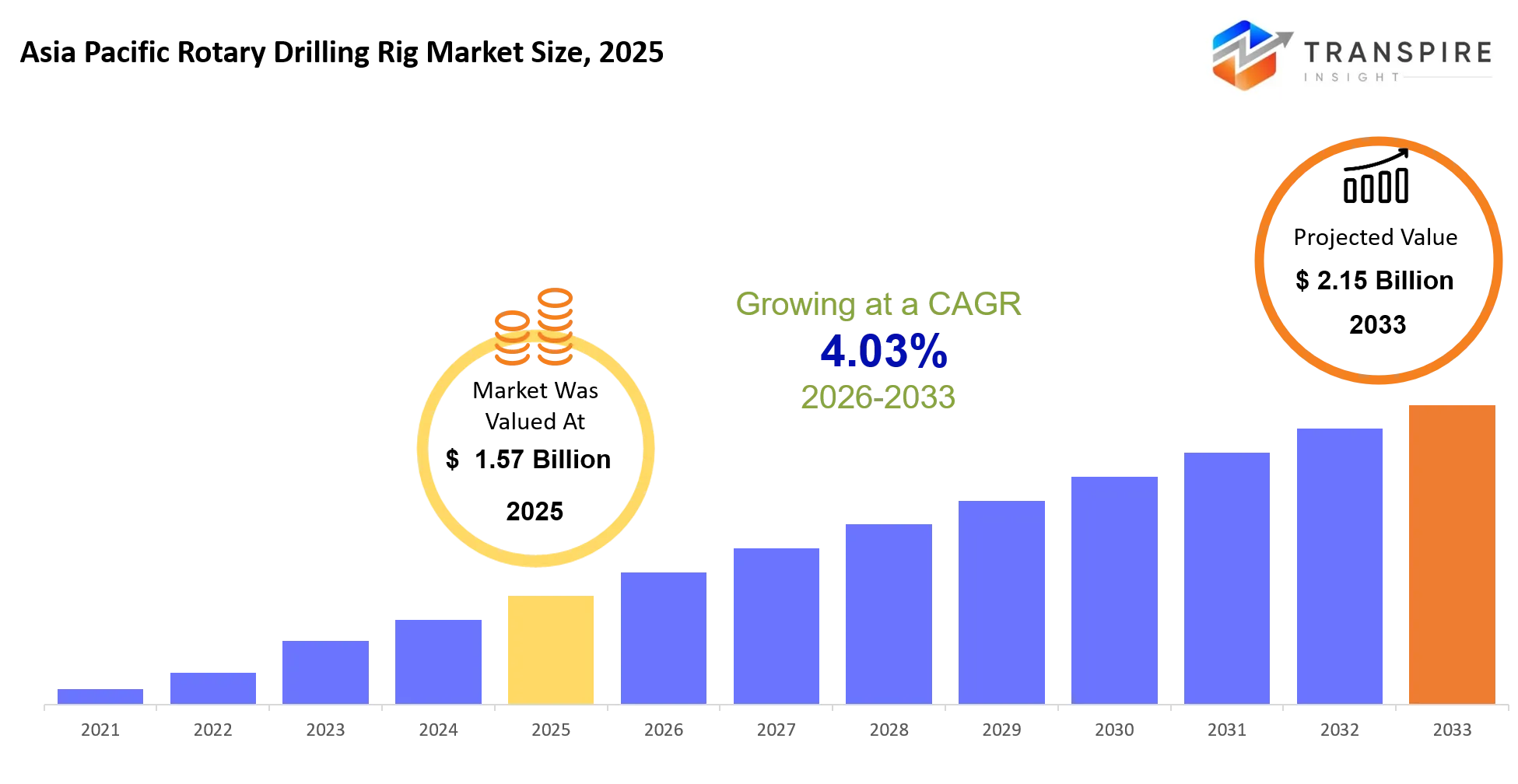
- Asia Pacific Rotary Drilling Rig Market Size 2025: USD 1.57 Billion
- Asia Pacific Rotary Drilling Rig Market Size 2033: USD 2.15 Billion
- Asia Pacific Rotary Drilling Rig Market CAGR: 4.03%
- Asia Pacific Rotary Drilling Rig Market Segments: By Product Type (Hydraulic Drilling Rigs, Electric Drilling Rigs, Pneumatic Drilling Rigs, Others); By Application (Mining Operations, Oil & Gas Drilling, Construction Activities, Geothermal Drilling, Others); By End User (Mining Companies, Oil & Gas Companies, Construction Firms, Others)
To learn more about this report,  Download Free Sample Report
Asia Pacific Rotary Drilling Rig Market Summary
The Asia Pacific Rotary Drilling Rig Market was valued at USD 1.57 Billion in 2025. It is forecast to reach USD 2.15 Billion by 2033. That is a CAGR of 4.03% over the period.
The Asia Pacific rotary drilling rig market actually supplies the hardware that is used to bore into rock and soil, for things like mining, construction foundation work, and energy exploration, basically enabling those projects that need deep , stable access to subsurface resources. In practice, these rigs end up shaping how fast new mines, metro systems, and infrastructure corridors can go from planning and sketches into real execution.
Over the last 3–5 years the space has been moving toward automated and hybrid electric rigs , swapping out older diesel-heavy fleets because contractors are now more focused on precision, better fuel efficiency, and lower emissions. One big structural change is the more and more digital control systems that get wired into the rigs, which boost drilling accuracy while also trimming down downtime. This transition has been pushed faster by the rise in critical mineral extraction across Indonesia and Australia, largely tied to global demand for lithium and nickel for electric vehicle supply chains. As a result, drilling activity feels more continuous and technically complicated , so operators have been leaning into advanced rigs that reduce operational risk and help improve overall project throughput.
Key Market Insights
- China sort of dominates the Asia Pacific Rotary Drilling Rig Market, with almost 35% share because of huge scale mining and infrastructure efforts.
- Meanwhile Australia comes up as the quickest-growing area through 2030, mainly from critical mineral surveying and automation focused mining spending.
- India also keeps climbing, supported by metro rail upgrades and highway base drilling projects.
- Hydraulic rotary drilling rigs are leading the Asia Pacific Rotary Drilling Rig Market, with around 40% share, mostly for their high accuracy and hardwearing build.
- On the application side mining work is in front with nearly 45% share, driven by ongoing mineral extraction needs.
- For growth though infrastructure foundation drilling looks like the fastest mover, thanks to urban transit programs and smart city development.
- Energy exploration stays fairly steady, with offshore plus onshore drilling modernization initiatives keeping the pace.
- When it comes to end users, mining firms show the biggest demand share, due to continuous resource recovery and expansion programs.
- Construction contractors meanwhile are kinda the fastest-growing end user group, mostly pushed by the rapid city infrastructure buildouts, not really slowing down.
- At the same time, government infrastructure agencies are funding more advanced drilling technologies, trying to get better long-term efficiency for the big projects , you know.
What are the Key Drivers, Restraints, and Opportunities in the Asia Pacific Rotary Drilling Rig Market?
The main growth force seems to be large scale infrastructure plus critical mineral development, especially across China, India, and Indonesia. You can see government supported programs for metro rail expansion, renewable energy corridors, and lithium nickel mining, all of which has sparked steady demand for high capacity rotary drilling rigs. That change has, in a pretty direct way increased fleet utilization rates, and also sped up procurement cycles. Contractors keep putting money into quicker, deeper, and more accurate drilling systems, mainly so they can hit tight project deadlines and handle the growing engineering complexity.
Now a major structural barrier is the big upfront capital requirement for advanced rotary drilling rigs, along with maintenance expenses, plus component costs that keep climbing. These rigs need specialized operators and regular servicing, and that basically slows adoption among mid tier contractors. It feels structural because financing access and technical skill availability can't be ramped up quickly. So, lots of firms keep relying on older mechanical rigs. That then delays modernization, and it also suppresses upside revenue potential for OEMs across the Asia Pacific Rotary Drilling Rig Market.
The next growth phase is starting to form around autonomous, or at least semi autonomous, drilling technologies that get paired with real time geological mapping systems. In Australia, the Pilbara mining region is showing early adoption, where AI enabled rigs help improve drilling precision and cut downtime a bit, that kind of. This is supposed to unlock higher productivity cycles, and at the same time it is expected to broaden demand for premium equipment across advanced mining corridors , not just in one site.
What Has the Impact of Artificial Intelligence Been on the Asia Pacific Rotary Drilling Rig Market?
Artificial intelligence and more modern digital systems are kind of reshaping how operational intelligence works, and how equipment gets used, in the Asia Pacific Rotary Drilling Rig Market. Basically rigs are moving away from manually managed assets , and toward data driven drilling platforms, even if some teams still do parts by hand.
In automation and operational optimization, AI enabled control systems are now adjusting drilling pressure rotation speed and torque in real time, guided by subsurface resistance info. At the same time, integrated fleet monitoring platforms watch utilization levels, fuel burn and compliance factors across several rigs . That lets contractors fine tune deployment timetables between mining and infrastructure locations, so coordination is a bit smoother on big multi site efforts. Usually this means less idle time and fewer coordination gaps when projects get complicated.
Predictive features are also becoming really central to maintenance approaches. Machine learning models kinda watch vibration patterns, hydraulic behavior, and wear signals , then try to forecast failures before the breakdowns start to show up. In a few mining operations in Australia and Indonesia, predictive maintenance setups have been connected with clear decreases in unplanned downtime , and also improved lifecycle planning for the machinery. Operators are also using AI based geological interpretation tools, to sharpen drilling paths . That tends to raise penetration efficiency, and it can also trim rework cycles that used to feel unavoidable.
Operationally, these technologies help in bringing down fuel consumption, supporting better uptime, and giving more disciplined cost control, especially where mining runs at a high intensity. But, even with that, adoption is still kind of held back by the fact that the integration costs are high , and there’s also a limited supply of truly solid real-time geological plus operational information. In remote mining areas, connectivity that comes and goes also makes it hard to keep AI model training going uninterrupted and to keep tuning things in real time. As a result, the larger digital transformation moves slowly, across the Asia Pacific Rotary Drilling Rig Market, for a full rollout.
Key Market Trends
- China ramped up deployment of higher capacity rotary rigs after 2024, kind of swapping out older mechanical fleets across huge infrastructure corridors, not all at once but steadily.
- Meanwhile Australia’s mining operators moved more toward autonomous drilling systems from 2023 to 2025, which helped their ore extraction efficiency, especially in Pilbara operations.
- India also went further with hydraulic rotary rig procurement after the 2023 metro rail boom, which meant less dependence on traditional foundation drilling contractors, even when schedules got weird.
- Hybrid plus electric rig adoption picked up fast starting in 2024 , and as OEMs worked through tougher emissions norms across Asia Pacific construction zones it kind of made these options more common.
- Epiroc expanded its digital drilling automation platforms in 2025, which boosted fleet monitoring and also trimmed the unplanned downtime around mining jobs.
- Sandvik meanwhile strengthened its AI enabled rock analysis integration starting in 2024, that sharpened drilling precision for deep mineral exploration, a kind of use case.
- Contractors, they more and more shifted away from rental-heavy arrangements after 2023 into more ownership setups too, mostly because utilization rates stayed higher, and because everyone wanted steadier project continuity.
- And then in 2022–2023 the supply chain disruptions hit, so regional manufacturing localization of rig components across China and Southeast Asia happened, meaning parts stopped waiting as long, less idle time overall.
- On the infrastructure side, developers started adopting real time drilling telemetry systems from 2024 onward, which improved compliance tracking and cut down operational inefficiencies.
Asia Pacific Rotary Drilling Rig Market Segmentation
By Product Type:
Hydraulic drilling rigs keep taking the lead, mostly because they manage torque well, stay consistent during penetration, and fit pretty naturally for hard rock mining and foundation jobs across the Asia Pacific construction belts. Meanwhile electric drilling rigs are getting more attention too, since teams try to cut fuel consumption, lower emissions, and push overall operational efficiency especially inside regulated industrial jobs.
Pneumatic drilling rigs, and a few other versions, still get chosen for specific smaller or lighter drilling needs where you want more flexibility plus a cheaper setup, so they match short-term project timelines. Also the ongoing swap out of older mechanical systems helps keep upgrades moving, at mining and infrastructure locations.
By Application:
In practice, mining operations are still the biggest application base. That’s helped a lot by mineral extraction activity that’s climbing in Australia, Indonesia, and China, where more precise deep drilling really does back stronger output recovery. Oil and gas drilling also keeps steady demand in some offshore and onshore fields, mostly linked to exploration and well development tasks, rather than anything sudden.
On the construction side, adoption keeps rising, pushed along by metro rail expansions, highway programs, and general urban infrastructure growth across India and Southeast Asia. Geothermal drilling is moving forward too, though at a slower pace, still it’s visible, as renewable energy spending continues to grow, which supports the long range clean energy targets, and at the same time nudges deeper subsurface exploration practices in regional markets.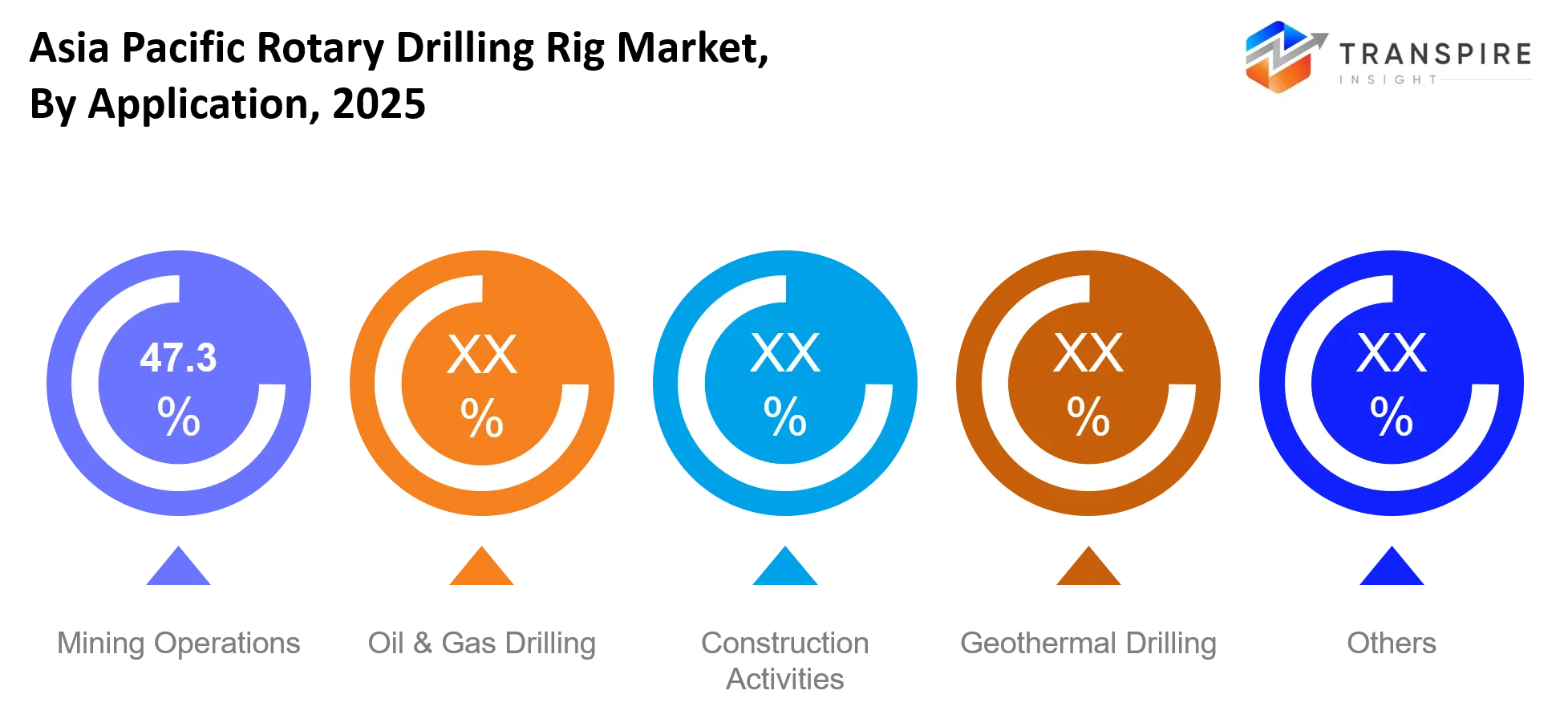
To learn more about this report, Download Free Sample Report
By End User:
Mining companies are basically the main end-users, since there is always this steady need for high capacity drilling gear that goes into exploration and extraction cycles, you know. Oil and gas companies tend to rely on rotary rigs for exploration boreholes, reservoir development, and also field maintenance tasks, where precision matters and you need real depth capability. Construction firms end up using more and more equipment for foundation drilling, especially in big infrastructure builds and urban development efforts across many Asia Pacific economies.
Other end users also pop up, like government-backed infrastructure bodies and specialized contractors, who help with energy and industrial growth projects. Because of that mix, there is a continuous pull, for advanced and automated drilling systems spanning multiple project categories.
What are the Key Use Cases Driving the Asia Pacific Rotary Drilling Rig Market?
In the Asia Pacific Rotary Drilling Rig Market mining exploration and extraction still stays the main reason why people buy these rigs. Big mineral requirements coming from electric vehicle supply chains have, kind of, pushed operators to bore deeper and quicker even when the rock is tough. As a result there is a continued pull for high capacity rigs, rigs that can hold their accuracy while under heavy loads and at the same time boost productivity for each drilling run
Then, sort of, the side jobs are growing too, like infrastructure foundation drilling and energy related construction. Construction companies now more often use rotary rigs for metro rail, for highway foundations, and for bigger commercial builds, especially across India , China, and parts of Southeast Asia. Oil and gas players keep using them selectively as well, mainly for onshore field development and service drilling where depth control and precision really matter
More recently geothermal drilling and underground storage projects are starting to show up more in discussions. With more renewable energy spending, deeper geothermal prospecting is getting attention too. At the same time industrial carbon storage efforts are beginning to trial rotary drilling options. These uses are still kind of in an early stage, however they should slowly help broaden equipment demand and diversification over the coming years
|
Report Metrics |
Details |
|
Market size value in 2025 |
USD 1.57 Billion |
|
Market size value in 2026 |
USD 1.63 Billion |
|
Revenue forecast in 2033 |
USD 2.15 Billion |
|
Growth rate |
CAGR of 4.03% from 2026 to 2033 |
|
Base year |
2025 |
|
Historical data |
2021 - 2024 |
|
Forecast period |
2026 - 2033 |
|
Report coverage |
Revenue forecast, competitive landscape, growth factors, and trends |
|
Regional scope |
Asia Pacific (India, China, Japan, Australia,South Korea, Rest of Asia Pacific) |
|
Key company profiled |
Caterpillar, Komatsu, Sandvik, Epiroc, Liebherr, Atlas Copco, XCMG, SANY, Zoomlion, Furukawa Rock Drill, Bauer Group, Casagrande, Soilmec, Hitachi Construction Machinery, Junttan |
|
Customization scope |
Free report customization (country, regional & segment scope). Avail customized purchase options to meet your exact research needs. |
|
Report Segmentation |
By Product Type (Hydraulic Drilling Rigs, Electric Drilling Rigs, Pneumatic Drilling Rigs, Others); By Application (Mining Operations, Oil & Gas Drilling, Construction Activities, Geothermal Drilling, Others); By End User (Mining Companies, Oil & Gas Companies, Construction Firms, Others) |
Which Regions are Driving the Asia Pacific Rotary Drilling Rig Market Growth?
China is leading the Asia Pacific rotary drilling rig market, mostly because of its huge scale infrastructure pipeline and those pretty aggressive mineral development policies. The government keeps pumping money into transport corridors, urban metro systems, and energy projects , so equipment usage stays high, almost on schedule. There is also a solid domestic manufacturing base which helps with rapid placement of advanced rigs, but at competitive costs. With integrated supply lines and strong contractor communities, upgrades keep rolling through both mining and construction locations. All of this ends up locking in sustained dominance, and pretty stable procurement cycles for heavy duty drilling gear.
Australia takes the second position, and it is less about raw project quantity, more about a structured mining industry and strict operational expectations. In this case the growth is steered by long-life mining assets plus constant reinvestment in equipment replacement cycles. Big mining operators tend to emphasize safety compliance, productivity efficiency , and precision drilling especially for iron ore and critical mineral activities. Regulatory enforcement is steady, so major mining corporations can plan capital spending without too much guesswork. As a result, demand for rotary drilling rigs stays consistent, and the volatility stays low.
India is showing the quickest growth momentum, kinda pushed by the rapid buildout of metro rail systems , plus highways and industrial corridors. Lately, reforms around infrastructure financing and more public private partnerships have basically sped up the go-ahead on projects and also the purchase of equipment. On the ground, domestic construction firms are moving away from older, conventional drilling methods and they’re adopting modern rotary rigs, so they can stick to the more tight schedules. This change is gradually reshaping equipment demand patterns across both urban and semi-urban zones. For investors and new entrants, India still looks like a solid long term expansion story all the way through 2033.
Who are the Key Players in the Asia Pacific Rotary Drilling Rig Market and How Do They Compete?
Competition in the Asia Pacific Rotary Drilling Rig Market stays fairly consolidated, but it’s not totally locked down. A handful of global OEMs hold solid positions, while the regional makers keep pushing—mainly by pricing, plus a more localized service angle. Honestly the market feels less about “just equipment supply” now, and more about how much technology is packed in. Buyers lean toward automation, better fuel efficiency, and predictive maintenance features, even when the initial capex matters.
The existing players try to defend their share by modernizing digital drilling platforms and then stretching after-sales networks, so they can stay close during long operating windows. Meanwhile mid-tier entrants tend to bet on cost advantages and quick delivery cycles, especially inside domestic demand in China, and India, where schedules can be brutal.
Caterpillar Inc. shows up with cost-efficient heavy equipment integration and a dealer-first service footprint across Asia Pacific. Their edge is basically the way rotary drilling systems get bundled with the wider construction machinery ecosystem, so contractors can standardize their fleets under one supplier. Their push includes strengthening distribution partnerships and making telematics integration more effective, for fleet optimization—so customers can keep tracking and adjusting performance without too much delay.
Epiroc, on the other hand, leans heavily into automation-driven drilling solutions. They stand out with advanced digital control systems and autonomous rig capabilities. Their rigs get used a lot in major mining operations where precision plus uptime are non-negotiable. The company keeps expanding through technology partnerships and also by increasing its reach in Australian and Indonesian mining projects, piece by piece over time.
Sandvik keeps pushing high-performance drilling tools along with AI enabled rock analysis systems that help boost drilling precision even in those tricky geological contexts. The real difference seems to be the mix of actual hardware plus software analytics, used for interpreting the ore body, kind of end to end. Growth gets a lift from money put into mining heavy markets and also by working together with big resource operators across the whole region.
Company List
- Caterpillar
- Komatsu
- Sandvik
- Epiroc
- Liebherr
- Atlas Copco
- XCMG
- SANY
- Zoomlion
- Furukawa Rock Drill
- Bauer Group
- Casagrande
- Soilmec
- Hitachi Construction Machinery
- Junttan
Recent Development News
In April 2026, Halliburton acquired Sekal AS from Sumitomo Corporation. The acquisition strengthens Halliburton’s drilling automation and digital rig operations capabilities, enhancing real-time rig control and efficiency across global drilling activities, including Asia Pacific offshore and onshore operations. Source https://www.halliburton.com/
In April 2026, ADNOC Drilling announced it would acquire an 80% stake in MB Petroleum Services. The deal expands ADNOC Drilling’s regional rig fleet by adding 21 operational drilling rigs across Oman, Kuwait, Saudi Arabia, and Bahrain, strengthening its Asia-linked Middle East drilling footprint and increasing contracted rig capacity through 2033.
Source https://www.reuters.com/
What Strategic Insights Define the Future of the Asia Pacific Rotary Drilling Rig Market?
The Asia Pacific Rotary Drilling Rig Market is kinda moving, structurally, toward more automation, electrification and data plugged in drilling systems as mining and infrastructure operators try to push productivity per drill cycle rather than just buying more equipment volume. That shift is mostly being pulled by the rising demand for critical minerals, stricter emissions rules , and a lot more project complexity , especially as crews drill deeper and hit tougher rock layers across Australia, China and parts of Southeast Asia. Over the next 5–7 years, real competitive advantage will likely lean much more on software ability and operational intelligence, than mechanical capacity alone .
A risk that is a bit less obvious is the growing dependence on a smaller set of high end component suppliers for sensors, control modules and precision hydraulics. If that supply chain gets disrupted, even if demand stays strong, rig rollout can still slow down . So the problem turns into a hidden delivery bottleneck, not just a general cost issue. At the same time modular autonomous drilling platforms are starting to look like a genuine chance, especially in the far flung mining lanes of Western Australia and Indonesia, where labor shortages are pushing automation adoption faster than before.
Market participants should focus on hybrid rigs that blend electrification with scalable autonomy features . This lets mid tier contractors adopt in phases, while still keeping a clean upgrade pathway later on, without too much rework or lock in.
Asia Pacific Rotary Drilling Rig Market Report Segmentation
By Product Type
- Hydraulic Drilling Rigs
- Electric Drilling Rigs
- Pneumatic Drilling Rigs
By Application
- Mining Operations
- Oil & Gas Drilling
- Construction Activities
- Geothermal Drilling
By End User
- Mining Companies
- Oil & Gas Companies
- Construction Firms
Frequently Asked Questions
Find quick answers to common questions.
The Asia Pacific Rotary Drilling Rig Market size is USD 2.15 Billion in 2033.
Key Segments for the Asia Pacific Rotary Drilling Rig Market are By Product Type (Hydraulic Drilling Rigs, Electric Drilling Rigs, Pneumatic Drilling Rigs, Others); By Application (Mining Operations, Oil & Gas Drilling, Construction Activities, Geothermal Drilling, Others); By End User (Mining Companies, Oil & Gas Companies, Construction Firms, Others).
Major Asia Pacific Rotary Drilling Rig Market players are Caterpillar, Komatsu, Sandvik, Epiroc, Liebherr, Atlas Copco, XCMG, SANY, Zoomlion, Furukawa Rock Drill, Bauer Group, Casagrande, Soilmec, Hitachi Construction Machinery, Junttan.
The Asia Pacific Rotary Drilling Rig Market size is USD 1.57 Billion in 2025.
The Asia Pacific Rotary Drilling Rig Market CAGR is 4.03% from 2026 to 2033.
- Caterpillar
- Komatsu
- Sandvik
- Epiroc
- Liebherr
- Atlas Copco
- XCMG
- SANY
- Zoomlion
- Furukawa Rock Drill
- Bauer Group
- Casagrande
- Soilmec
- Hitachi Construction Machinery
- Junttan
About the Authors

Avinash Kumar
I’m Avinash Kumar, a Senior Research Analyst at Transpire Insight, with expertise in the Electronics and Semiconductor and Energy & Power industry. My work focuses on analyzing emerging technologies, market trends, industry developments, and innovation across these sectors. I specialize in transforming complex technical and market insights into clear, research-backed content that helps professionals, businesses, and decision-makers stay informed. Through continuous industry research and data-driven analysis, I strive to deliver accurate, reliable, and practical perspectives on the latest advancements shaping the semiconductor and energy landscape.

Chakradhar Khansole
Chakradhar serves as the Research Director at Transpire Insight, bringing over 8 years of experience in technology, innovation, and strategic market intelligence. He specializes in transforming complex market data into actionable business insights that enable organizations to make informed, growth-oriented decisions. Recognized for his strategic vision and analytical expertise, Chakradhar leads high-impact research initiatives, delivering comprehensive market assessments, competitive intelligence, and forward-looking industry analysis.
Recently Published Reports
-
Apr 2026
Active Power Filter Market
Active Power Filter Market Size, Share & Analysis Report By Type (Shunt Active Power Filters, Series Active Power Filter, Hybrid Active Power Filter), By Application (Harmonics Mitigation, Reactive Power Compensation, Voltage Regulation, Power Factor Correction), By Phase (Single Phase, Three Phase), By End-User Industry (Manufacturing, Healthcare, Commercial, Automotive, Oil and Gas, Others), and Geography (North America, Europe, Asia-Pacific, Middle East and Africa, South and Central America), 2021 - 2031
-
Apr 2026
Electrical Transformer Market
Electrical Transformer Market Size, Share & Analysis Report By Core (Closed, Shell, and Berry), By Insulation (Gas, Oil, Solid, Air, and Other), By Phase (Single, and Three), By Rating (100 MVA to 500 MVA, 501 MVA to 800 MVA, and 801 MVA to 1200 MVA), and Geography (North America, Europe, Asia-Pacific, Middle East and Africa, South and Central America), 2021 – 2031
-
Apr 2026
Hydraulic Piston Pumps Market
Hydraulic Piston Pumps Market Size, Share & Analysis Report By Type (Axial Piston Pumps, Radial Piston Pumps), By Operating Pressure (Low Pressure, Medium Pressure, High Pressure), By Application (Construction, Mining, Agriculture, Automotive, Oil & Gas, Industrial Machinery, Others), By End-User (OEMs, Aftermarket), and Geography (North America, Europe, Asia-Pacific, Middle East and Africa, South and Central America), 2021 – 2031
-
Apr 2026
Laboratory Gas Generators Market
Laboratory Gas Generators Market Size, Share & Analysis Report By Product (Nitrogen Gas Generator, Hydrogen Gas Generator, Zero Air Gas Generator, Purge Gas Generator, TOC Gas Generators, Others), By Application (Gas Chromatography, Liquid Chromatography-mass Spectrometry (LC-MS), Gas Analyzers, Others), By End-user (Life Science, Chemical & Petrochemical, Food & Beverage, Others), and Geography (North America, Europe, Asia-Pacific, Middle East and Africa, South and Central America), 2021 – 2031