

United Kingdom Electric Kick Scooter Market Size & Forecast:
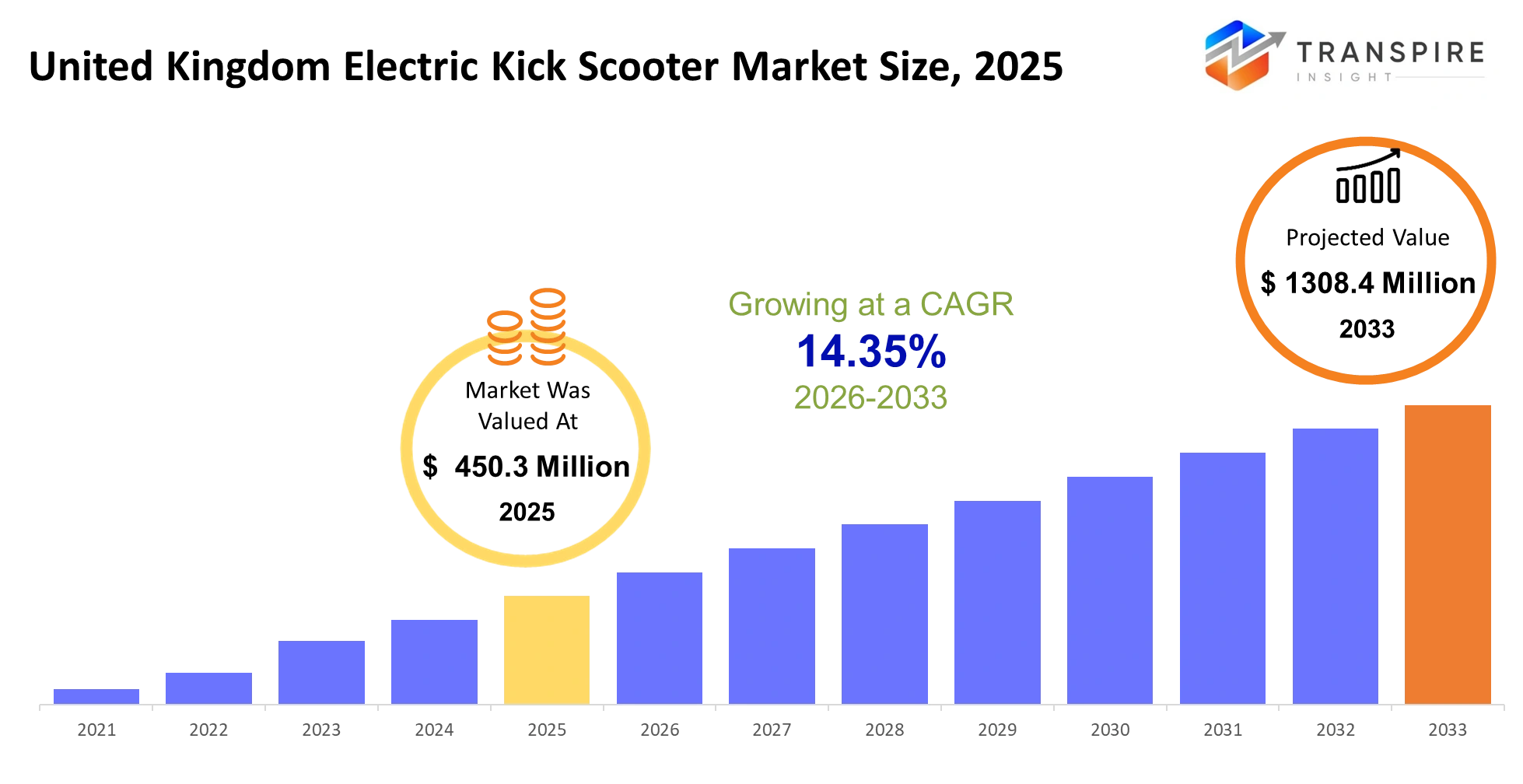
- United Kingdom Electric Kick Scooter Market Size 2025: USD 450.3 Million
- United Kingdom Electric Kick Scooter Market Size 2033: USD 1308.4 Million
- United Kingdom Electric Kick Scooter Market CAGR: 14.35%
- United Kingdom Electric Kick Scooter Market Segments: By Product Type (Foldable Electric Scooters, Off-road Electric Scooters, Lightweight Scooters, Smart Scooters, High-speed Scooters, Commuter Scooters, Others); By Battery Type (Lithium-ion Batteries, Lead-acid Batteries, Solid-state Batteries, Others); By Application (Personal Mobility, Shared Mobility Services, Last-mile Delivery, Tourism & Recreation, Campus Mobility, Others); By End User (Individual Consumers, Fleet Operators, Rental Service Providers, Delivery Companies, Others); By Connectivity (App-connected Scooters, GPS-enabled Scooters, IoT-enabled Scooters, Others).
To learn more about this report,  Download Free Sample Report
United Kingdom Electric Kick Scooter Market Summary
The United Kingdom Electric Kick Scooter Market was valued at USD 450.3 Million in 2025. It is forecast to reach USD 1308.4 Million by 2033. That is a CAGR of 14.35% over the period.
The United Kingdom electric kick scooter market is kind of shifting the way people move for short trips inside cities, by presenting a quicker and cheaper option versus using cars, taxis, or those packed public transport systems. It fixes a pretty normal mobility issue in dense urban areas, since these scooters cut down commute time for first and last mile travel. At the same time, they ease congestion across business zones and along residential corridors.
In the past five years, what used to feel like a niche consumer gadget thing has grown into a more regulated urban mobility setup, supported by rental operators, city pilot schemes, and even connected fleet technologies. Those government-backed e-scooter trials that rolled out in places like London, Liverpool and Bristol helped speed up commercial use. They also made it easier to justify investment in charging points and fleet management. And then the pandemic period happened, causing supply chain friction, but in a weird way it also nudged commuting habits. People leaned more toward single-rider, individual mobility solutions instead. Later on, as battery efficiency kept getting better and app-based rental platforms kept expanding, operators were able to squeeze out higher ride utilization. They also saw steadier subscription income and deeper adoption among daily commuters, students, and delivery riders.
Key Market Insights
- England kinda dominated the United Kingdom Electric Kick Scooter Market, with something like over 68% of revenue share in 2025, mainly because urban density stayed higher and rental pilot deployments rolled out more often.
- London still stayed the biggest adoption hub, and that was backed by shared mobility programs plus the steady rise of daily commuter reliance on micro mobility transport networks, sort of like people just got used to it.
- Shared electric scooters made up nearly 55% of the market in 2025, as operators pushed subscription based fleet access into university areas and business districts, more or less everywhere.
- Foldable lightweight scooters then became the fastest growing product category between 2026 and 2033, driven by how professionals prefer multimodal commuting options, which sounds simple but it really mattered.
- Lithium-ion battery powered models pulled in more than 80% of overall industry demand, largely thanks to longer range, quicker charging cycles, and better battery durability.
- Personal commuting applications represented around 60% of total scooter usage in 2025, and fuel costs plus parking constraints definitely nudged urban mobility choices in that direction.
- Food delivery and gig economy riders turned into a fast expanding end user group, especially across the Manchester, Birmingham, and Glasgow metropolitan zones.
- Companies like Voi Technology, Lime, Tier Mobility, Bird, and Dott kept strengthening their market position by using city partnerships, plus fleet expansion strategies that looked pretty consistent.
- Fleet operators increasingly started weaving in GPS tracking, AI driven route optimization, and remote diagnostics to raise asset utilization, and also cut maintenance downtime—less waiting around, more riding.
- After 2023, investments in battery swapping infrastructure went up, which let operators shrink charging turnaround time and improved daily fleet availability by nearly 20%, overall.
What are the Key Drivers, Restraints, and Opportunities in the United Kingdom Electric Kick Scooter Market?
The main push, that speeding up the United Kingdom electric kick scooter market a bit, is sort of this big structural shift in city transit rules. Local authorities in a few of the bigger UK cities have rolled out shared e-scooter trials, kind of easing pressure on public transport and at the same time limiting road congestion on busy, crowded corridors. After 2022 though, fuel prices went up and, honestly that did change how commuters do the math on costs, so affordable electric mobility started feeling a lot more attractive.Together, these factors lifted the daily ride numbers. They also nudged fleet operators to bring in more vehicles and that directly supports recurring rental income, plus the after-market pull for batteries, software platforms, and maintenance work.
The biggest thing holding the market back is still the fragmented rule-set around owning a private e-scooter and whether it’s legal on roads. Rental fleets mostly function inside government authorized pilot schemes. But privately owned scooters are often blocked from public road use in many places. So the regulations don’t line up, and that leaves manufacturers, insurers, and even infrastructure backers uneasy. Because of that, consumer take-up tends to move slower, and large scale investments in charging points, plus local distribution partnerships, get delayed.
One notable chance is starting to appear via integration with smart city transport ecosystems. Mobility as a Service platforms are, sort of, starting to bundle scooters together with buses, trains, and bike sharing into one digital payment stream. Cities putting money into connected transport infrastructure, especially around London, and the West Midlands, are laying ground work for AI supported fleet coordination. This includes predictive charging routines, and longer term commercial fleet contracts too, sort of like, a smoother arrangement across providers.
What Has the Impact of Artificial Intelligence Been on the United Kingdom Electric Kick Scooter Market?
Artificial intelligence along with advanced digital systems is, in a way, reshaping how things get run across the United Kingdom electric kick scooter ecosystem by boosting fleet efficiency safety monitoring, and asset lifecycle control. More and more shared mobility operators are rolling out AI powered fleet analytics platforms so they can automate scooter distribution, battery management, plus rider behavior monitoring in real time. Machine learning models look at traffic density, trip frequency, weather conditions, and charging cycles to place scooters in high demand city areas a bit more precisely, than before.
Predictive maintenance setups have turned out especially useful for big commercial fleets. Operators lean on sensor driven diagnostics to spot battery degradation, brake wear, motor overheating, and tire performance, before anything actually breaks or stops. The effect is less vehicle downtime and cheaper maintenance bills, while also raising fleet utilization rates. On top of that, AI assisted route optimization tools can support delivery riders and commuters in trimming trip duration and energy use, which helps overall operational efficiency across rental networks.
Meanwhile advanced digital compliance tools now include geofencing and automated speed regulation, especially in places where pedestrians are common. That helps operators align with municipal safety requirements more easily. A few providers even say they get better fleet availability and lower operational losses thanks to remote diagnostics, plus maintenance planning that runs automatically.
Still, AI adoption doesn’t come without friction. Limitations show up around integration costs and the fact that urban infrastructure is inconsistent from one area to the next. Smaller operators often find the expense of connected sensors, cloud analytics services, and real time data handling systems, harder to justify or absorb.
Key Market Trends
- After 2022, shared mobility operators kinda expanded past London and kept going, boosting fleet penetration across the urban transport corridors in Birmingham, Bristol, Liverpool and Nottingham, really steadily.
- By 2025 lithium-ion battery adoption moved beyond 80%, mainly because manufacturers improved riding range , charging speed, and even battery replacement efficiency, which is not small stuff.
- GPS enabled geofencing systems became the norm across commercial fleets once more strict municipal safety requirements started showing up during regional pilot programs, and yeah it felt kinda sudden.
- Subscription based scooter rentals rose almost 25% between 2023 and 2025, driven by commuter preference for predictable transport costs, not just whatever fluctuates.
- Delivery riders also began leaning into high range electric scooters more often as fuel price volatility raised the operating expenses for older petrol powered two wheelers.
- Operators like Lime and Voi Technology put serious money into AI powered fleet redistribution , plus predictive maintenance capabilities that help avoid downtime.
- Lightweight foldable scooter models gained momentum among rail commuters, using scooters as part of a multimodal daily routine, like ride first then rail then walk.
- Local councils started allocating dedicated micro mobility lanes and parking zones more and more, after they saw congestion reduction benefits from earlier trial deployments, pretty directly.
- Battery swapping networks rolled out across high density business districts, improving daily fleet utilization and cutting charging downtime quite a lot, especially after 2024.
- Finally manufacturers shifted sourcing strategies toward nearby battery suppliers, because pandemic era supply disruptions exposed how dependent they were on Asian component networks, which was honestly the whole point for the change.
United Kingdom Electric Kick Scooter Market Segmentation
By Product Type
Foldable Electric Scooters hold the dominant market position, because city commuters are more and more choosing compact mobility solutions that sort of slip in easily with trains,buses and office spaces. Their lightweight frames ,and the fact that they’re easy to store, help adoption keep moving in dense urban areas where parking is still kind of scarce. Commuter Scooters keep the second-largest spot due to steady daily demand from office travelers who want a cost-effective transport option for short-distance trips. Smart Scooters are still climbing, mainly as app-based control systems get smoother, with digital locking options and battery analytics that make day to day use more convenient, plus fleet management feels more efficient. High-speed Scooters mostly attract performance-minded customers, while Off-road Electric Scooters fit recreational and adventure driven riding segments. The other categories stay in niche territory, tied to specialized design ,and buyers who are price-sensitive also tend to look there.
Foldable and commuter-focused scooters are expected to keep their structural leadership, since urban mobility planning increasingly supports compact electric transportation systems. Smart Scooters are positioned for the quickest expansion, because AI-enabled diagnostics, geofencing tools, and connected navigation features become standard across premium lines. High-speed and off-road models may see selective growth through enthusiast communities and tourism related recreational use cases. Over the forecast period, product developers are expected to push priorities like battery efficiency, lighter materials, and stronger safety integration, so rider adoption improves and commercial fleet durability becomes more reliable.
By Battery Type
Lithium-ion Batteries still hold the dominant market position, mainly because manufacturers seem to be putting more weight on longer riding range, faster charging time, and lighter battery weight for both consumer users and fleet operations. Their strong energy density and the fact that battery production costs keep falling keeps helping adoption across the premium as well as mid-range scooter segments. Lead-acid Batteries basically stay limited to low-cost entry-level products where price is treated as more important than performance efficiency. Solid-state Batteries are getting a lot of attention lately, since better safety performance and more stable thermal behavior, can really support upcoming high-performance mobility use cases. Meanwhile, the other battery technologies remain stuck in experimental or niche development tracks, with low commercial take-up.
Lithium-ion tech should further tighten its lead as charging infrastructure expands and more money flows into battery recycling which, in turn, improves long term supply chain efficiency. Solid-state Batteries may also show the quickest technological progress because investment is rising in next-generation energy storage systems, aiming for higher range potential and less fire risk. Lead-acid battery demand is likely to keep shrinking too, since lower lifecycle performance and a heavier design make it less suitable for urban mobility situations. Over the forecast period, battery suppliers and investors are expected to focus more on fast-charging capability, sustainable material sourcing, and energy optimization overall.
By Application
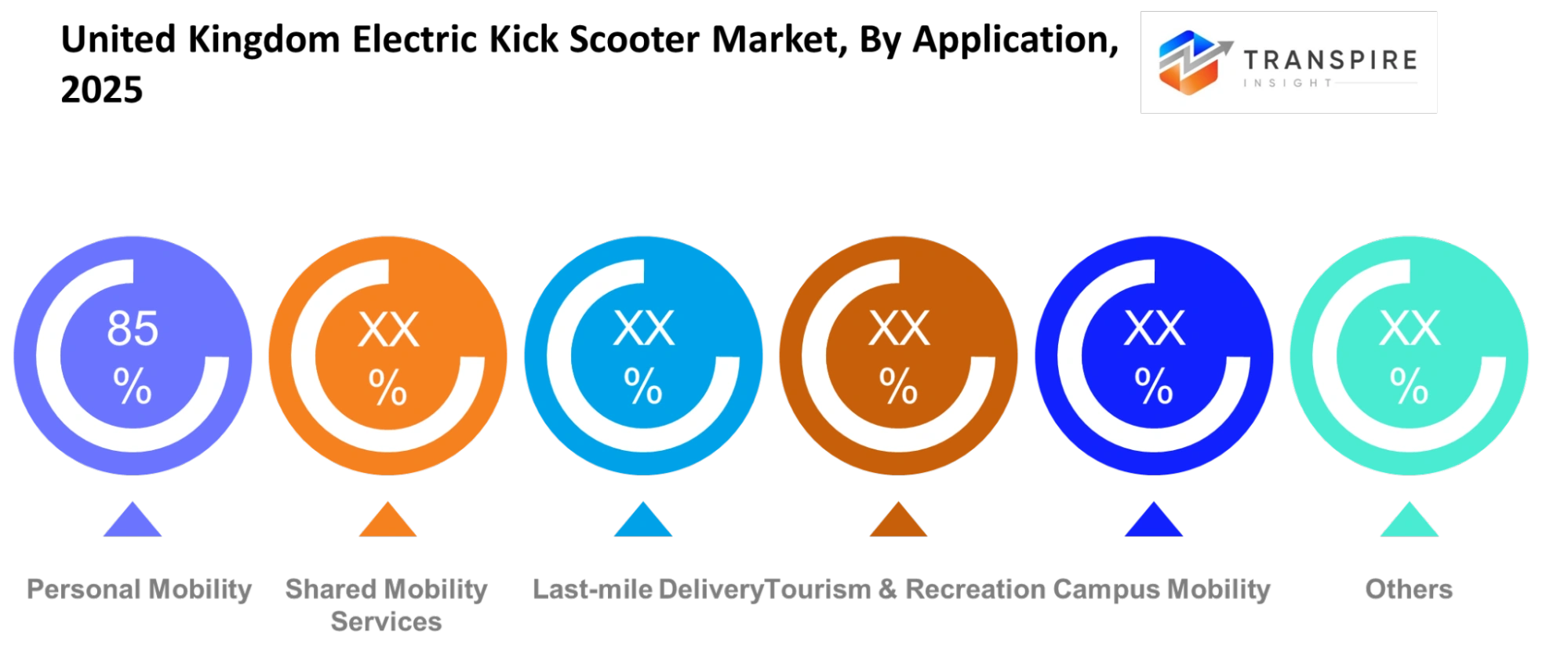
Personal Mobility kind of holds the dominant application spot because every day commuting, across the major UK cities, keeps pulling strong consumer interest toward short distance electric transportation. The rising fuel costs and those congestion style commuting slowdowns really help adoption, especially among students, office workers, and general urban residents. Shared Mobility Services sit in a strong secondary position too, mostly from city approved rental programs and app based scooter access across transport hubs ,and commercial areas. Last mile Delivery is still expanding fast, since gig economy delivery platforms need transport that’s cost efficient and can handle tightly packed traffic. Tourism & Recreation plus Campus Mobility stay steady and grow in a more localized way, like inside university zones and in tourist heavy urban centers.
Personal mobility applications are expected to stay out front because urban transport networks are moving toward more flexible and lower cost electric commuting options. Shared mobility and delivery centric applications should see faster growth as fleet operators tune battery management and boost day to day operational efficiency via AI based fleet analytics. Campus mobility programs are likely to climb slowly, while universities keep investing in low emission transportation infrastructure and student mobility access. Across the forecast window, app growth will lean more and more on regulatory support, the availability of charging infrastructure, and how well digital mobility platforms actually integrate.
To learn more about this report, Download Free Sample Report
By End User
Individual Consumers hold the dominant end-user place, because direct scooter ownership keeps expanding among city commuters who want more predictable transportation costs, and also that daily travel kind of flexibility. Solid demand for foldable and lighter weight models helps keep consumer buying activity pretty stable across most metropolitan areas, even when prices can shift a bit. Fleet Operators take the second-largest position, mainly because more app-connected scooters are being rolled out inside city-authorized rental networks, and the whole setup is becoming more common. Rental Service Providers still keep gaining momentum, as subscription-based mobility models are making access to electric transportation easier, without anyone needing full-on ownership of the product. Delivery Companies are also showing up as a fast-growing category, because food delivery and courier operations increasingly rely on electric scooters for short-distance urban logistics and that daily hustle.
Individual consumer demand is expected to stay structurally dominant, since ownership arrangements tend to feel more convenient, and they usually translate into lower long-term commuting costs versus shared transport alternatives. Fleet Operators and Rental Service Providers should see sharper commercial growth too, because municipalities keep backing regulated shared mobility systems. Delivery-focused adoption is likely to accelerate further as quick-commerce keeps expanding, plus same-day fulfillment services push into more major cities. In the end-user competition, the advantage will more and more go to firms that can merge vehicle dependability with digital fleet visibility, and also provide maintenance support that is efficient, and not just “available.”
By Connectivity
App-connected scooters sit in the dominant place in the market mostly because smartphone integration lets riders do remote locking, watch battery status, follow rides with tracking tools, and even handle digital payments both for private use and for commercial operations. There’s also a noticeable, kind of steady, consumer pull toward connected mobility experiences, and that pressure keeps adoption moving forward across the higher-end scooter categories.
GPS-enabled scooters still hold a strong secondary role, mainly because shared mobility teams are getting more dependent on fleet tracking, route optimization, and geofencing systems. Meanwhile, IoT-enabled scooters keep gaining momentum because real-time diagnostics together with predictive maintenance make day-to-day operations smoother, especially for bigger commercial fleets. The other connectivity approaches are comparatively stuck at basic electronic functions, without the stronger data integration, or at least not in the same way.
In the long run, app-connected and GPS-enabled platforms are likely to keep leading, because digital mobility ecosystems are leaning more and more on real-time operational visibility along with user analytics. IoT-enabled scooters, though, are set up for the quickest expansion, since fleet operators are investing in AI-assisted maintenance and automated asset management platforms. Over the forecast period, connectivity progress will matter more and more for competitive differentiation across both commercial and consumer scooter types. Technology providers and manufacturers are expected to focus on cybersecurity, cloud-based fleet coordination, and smarter battery analytics so they can support next-generation mobility infrastructure.
What are the Key Use Cases Driving the United Kingdom Electric Kick Scooter Market?
Personal, urban commuting still seems to be the main thing pushing electric kick scooter adoption across the United Kingdom. Everyday commuters end up depending on these scooters for short distances, like moving between residential areas, train stations, universities and office districts. The reason is pretty simple: scooters cut down on travel time, and they also sidestep parking-related expenses in packed city centers, where everything can feel slow, or rather constantly jammed.
Then there’s the commercial delivery side, which is growing pretty fast too. Food delivery riders and gig-economy workers use electric scooters more and more for quick route drops across urban areas, especially where traffic congestion makes vans harder, and motorcycles don’t always work as well. Alongside that, shared mobility operators are rolling out rental fleets around transport hubs, tourist districts, and near university campuses, mainly to keep urban transportation services more flexible, and kind of easier to tap into.
More “newer” use cases are showing up as well, like corporate mobility programs and smart tourism services. Some businesses are folding electric scooters into employee travel plans inside business parks, or industrial campuses. Meanwhile, tourism operators in big cities are trying guided micro-mobility experiences, blending app based navigation with location analytics, and of course sustainable urban sightseeing solutions that people can actually feel good about.
|
Report Metrics |
Details |
|
Market size value in 2025 |
USD 450.3 Million |
|
Market size value in 2026 |
USD 511.8 Million |
|
Revenue forecast in 2033 |
USD 1308.4 Million |
|
Growth rate |
CAGR of 14.35% from 2026 to 2033 |
|
Base year |
2025 |
|
Historical data |
2021 - 2024 |
|
Forecast period |
2026 - 2033 |
|
Report coverage |
Revenue forecast, competitive landscape, growth factors, and trends |
|
Regional scope |
United Kingdom |
|
Key company profiled |
Segway-Ninebot, Xiaomi, Razor USA, NIU Technologies, Bird Global, Lime, Voi Technology, Pure Electric, Unagi Scooters, Apollo Scooters, Yadea, Gogoro, Turboant, Okai, SWAGTRON. |
|
Customization scope |
Free report customization (country, regional & segment scope). Avail customized purchase options to meet your exact research needs. |
|
Report Segmentation |
By Product Type (Foldable Electric Scooters, Off-road Electric Scooters, Lightweight Scooters, Smart Scooters, High-speed Scooters, Commuter Scooters, Others); By Battery Type (Lithium-ion Batteries, Lead-acid Batteries, Solid-state Batteries, Others); By Application (Personal Mobility, Shared Mobility Services, Last-mile Delivery, Tourism & Recreation, Campus Mobility, Others); By End User (Individual Consumers, Fleet Operators, Rental Service Providers, Delivery Companies, Others); By Connectivity (App-connected Scooters, GPS-enabled Scooters, IoT-enabled Scooters, Others). |
Which Regions are Driving the United Kingdom Electric Kick Scooter Market Growth?
England still looks like the dominant region inside the United Kingdom electric kick scooter market because it kind of merges the country’s largest urban crowd with the most developed shared mobility framework. London, Birmingham, Bristol and Liverpool have, in particular, gained momentum from government supported e-scooter trials. Those trials ended up making a more regulated setting for operators and investors, so it feels steadier overall. Transport for London plus the various regional councils rolled out designated parking bays, geofencing rules and fleet monitoring benchmarks, which in turn helped stabilize day to day operations for companies like Lime and Voi Technology. All that mix of municipal agreements, app based mobility connection, and pretty dense commuting patterns keeps England’s top position for fleet deployment, as well as the recurring rental income.
Scotland, on the other hand, counts as the second most important regional contributor but the growth logic there is not the same as England’s high density city model. Places such as Glasgow and Edinburgh lean more on consistent public transport alignment strategies and long term local authority spending on active mobility infrastructure, rather than rushing into fleet expansion. The region’s economic staying power and structured transport scheduling give shared mobility providers a more predictable set of operating conditions. Scotland also stresses safety compliance, rider education, and lower emission transport corridors a bit more strongly. Because of that, it becomes a dependable market for operators aiming for sustained utilization, not just aggressive short term scaling.
Wales is showing up as the fastest-growing region, largely because of newer investments in sustainable urban movement and regional connectivity programs.
Who are the Key Players in the United Kingdom Electric Kick Scooter Market and How Do They Compete?
In the United Kingdom electric kick scooter market, competition is still moderately fragmented sort of, because the sector is like a mash-up between consumer hardware makers, and app-based shared mobility operators. In practice, firms don’t really fight on price only , they lean more toward operational reliability, fleet technology, battery performance, and these municipal partnerships that everyone suddenly wants. Shared mobility providers are quietly (or not so quietly) upending the usual scooter sales model by stacking recurring revenue via subscription access and plugging the scooters into wider urban transport ecosystems. And yeah, regulatory compliance has turned into the big deal—think geofencing, rider verification, plus AI-enabled fleet monitoring, these are now major differentiators in city contracts.
Lime shows up with big fleet deployment and close municipal integration across key UK cities. It stands out using AI-powered fleet redistribution systems, more advanced geofencing tools, and multimodal transport integration where e-scooters and e-bikes are kind of merged into one single platform. Its recent push into the West Midlands helped improve regional presence, while also lowering operating costs thanks to bigger fleet density. Voi Technology meanwhile leans hard into safety engineering and vehicle durability, releasing updated scooter models with upgraded suspension setups, plus longer battery life, so maintenance doesn’t pop up as often and fleet uptime stays steadier.
Segway-Ninebot keeps a solid footing through hardware innovation, and also OEM supply links with commercial fleet operators. It gets an advantage from scale manufacturing and connected mobility software, which supports remote diagnostics, and predictive maintenance. Xiaomi is aiming more at value-conscious riders with lightweight, foldable scooters, and it ties those products into its broader smart device ecosystem in a way that feels cohesive, even if it’s basically still just a scooter at the core.
Company List
- Segway-Ninebot
- Xiaomi
- Razor USA
- NIU Technologies
- Bird Global
- Lime
- Voi Technology
- Pure Electric
- Unagi Scooters
- Apollo Scooters
- Yadea
- Gogoro
- Turboant
- Okai
- SWAGTRON
Recent Development News
In March 2026, Lime entered a partnership with Transport for West Midlands to operate a new regional e-bike and e-scooter hire scheme. The agreement introduced more than 2,000 new electric bikes and scooters across the West Midlands and expanded shared mobility infrastructure without taxpayer funding.
Source: http://roadsafetygb.org.uk
In March 2025, Voi Technology launched the new Voiager 8 electric scooter alongside two upgraded e-bike models for UK and European markets. The product launch strengthened Voi’s focus on fleet durability, rider safety, and operational efficiency within shared urban mobility networks.
Source: https://www.electrive.com
In May 2026, Lime secured a major investment milestone by filing for an initial public offering on Nasdaq. The IPO filing highlighted USD 886.7 million in 2025 revenue and positioned the company for future expansion across global and UK shared micro-mobility markets.
Source: https://www.reuters.com
What Strategic Insights Define the Future of the United Kingdom Electric Kick Scooter Market?
The United Kingdom electric kick scooter market is kinda moving , toward integrated urban mobility ecosystems, where scooters are treated as part of a connected public transportation system rather than just standalone rental stuff. This shift seems pushed by city-level congestion control policies, digital mobility platforms, and the growth of AI-enabled fleet operations that improve utilization efficiency, and also nudge operating costs down. Still, there is one more hidden problem, regulatory inconsistency around privately owned scooters—this could slow infrastructure investment, and leave manufacturers and insurers in a bit of a gray zone even while commercial fleet growth is looking strong.
A big, emerging chance shows up around battery-swapping infrastructure and multimodal mobility subscriptions that link back into regional transport routines. Cities that invest in smart transport alignment could end up with scalable recurring revenue streams for operators who can blend scooters, e-bikes, and public transit inside one unified digital platform. Market participants should really lean into partnerships with municipal authorities and transport agencies , not just chase hardware sales, because over time the real edge will likely depend on ecosystem integration, compliance know-how, and data-driven fleet optimization.
United Kingdom Electric Kick Scooter Market Report Segmentation
By Product Type
- Foldable Electric Scooters
- Off-road Electric Scooters
- Lightweight Scooters
- Smart Scooters
- High-speed Scooters
- Commuter Scooters
- Others
By Battery Type
- Lithium-ion Batteries
- Lead-acid Batteries
- Solid-state Batteries
- Others
By Application
- Personal Mobility
- Shared Mobility Services
- Last-mile Delivery
- Tourism & Recreation
- Campus Mobility
- Others
By End User
- Individual Consumers
- Fleet Operators
- Rental Service Providers
- Delivery Companies
- Others
By Connectivity
- App-connected Scooters
- GPS-enabled Scooters
- IoT-enabled Scooters
- Others
Frequently Asked Questions
Find quick answers to common questions.
The estimated United Kingdom Electric Kick Scooter Market size for the market will be USD 1308.4 Million in 2033.
Key segments for the United Kingdom Electric Kick Scooter Market are By Product Type (Foldable Electric Scooters, Off-road Electric Scooters, Lightweight Scooters, Smart Scooters, High-speed Scooters, Commuter Scooters, Others); By Battery Type (Lithium-ion Batteries, Lead-acid Batteries, Solid-state Batteries, Others); By Application (Personal Mobility, Shared Mobility Services, Last-mile Delivery, Tourism & Recreation, Campus Mobility, Others); By End User (Individual Consumers, Fleet Operators, Rental Service Providers, Delivery Companies, Others); By Connectivity (App-connected Scooters, GPS-enabled Scooters, IoT-enabled Scooters, Others).
Major United Kingdom Electric Kick Scooter Market players are Segway-Ninebot, Xiaomi, Razor USA, NIU Technologies, Bird Global, Lime, Voi Technology, Pure Electric, Unagi Scooters, Apollo Scooters, Yadea, Gogoro, Turboant, Okai, SWAGTRON.
The United Kingdom Electric Kick Scooter Market size is USD 450.3 Million in 2025.
The United Kingdom Electric Kick Scooter Market CAGR is 14.35% from 2026 to 2033.
- Segway-Ninebot
- Xiaomi
- Razor USA
- NIU Technologies
- Bird Global
- Lime
- Voi Technology
- Pure Electric
- Unagi Scooters
- Apollo Scooters
- Yadea
- Gogoro
- Turboant
- Okai
- SWAGTRON
About the Authors

Mayur Shinde
I am Mayur Shinde, a Senior Research Analyst at Transpire Insight, specializing in the Automotive & Transportation and Information & Communication Technology (ICT) Industry. My work focuses on analyzing emerging market trends, technological advancements, competitive landscapes, and industry developments to deliver accurate, data-driven insights. I am passionate about transforming complex market information into clear, actionable content that helps businesses, professionals, and decision-makers stay informed and make confident strategic decisions.

Chakradhar Khansole
Chakradhar serves as the Research Director at Transpire Insight, bringing over 8 years of experience in technology, innovation, and strategic market intelligence. He specializes in transforming complex market data into actionable business insights that enable organizations to make informed, growth-oriented decisions. Recognized for his strategic vision and analytical expertise, Chakradhar leads high-impact research initiatives, delivering comprehensive market assessments, competitive intelligence, and forward-looking industry analysis.
Recently Published Reports
-
Apr 2026
ATV & UTV Market
ATV & UTV Market Size, Share & Analysis Report By Type (ATV, and UTV), By Variants (Less Than 400 CC, 400 CC To 800 CC, and More Than 800 CC), and Geography (North America, Europe, Asia-Pacific, Middle East and Africa, South and Central America), 2021 - 2031
-
Apr 2026
Automotive Central Gateway Module Market
Automotive Central Gateway Module Market Size, Share & Analysis Report By Type (Ethernet Central Gateway Module, CAN Central Gateway Module, LIN Central Gateway Module, and FlexRay), By Application (Powertrain Control, Body Control, Infotainment System, Advanced Driver Assistance Systems (ADAS), and Others), By End User (Passenger Vehicles, and Commercial Vehicles), and Geography (North America, Europe, Asia-Pacific, Middle East and Africa, South and Central America), 2021 - 2031
-
Apr 2026
Automotive Engine Oil Filter Market
Automotive Engine Oil Filter Market Size, Share & Analysis Report By Filter Type (Fuel Filter, Engine Oil Filter, Hydraulic Oil Filter, and Others), By Filter Media (Cellulose, Synthetic, and Micro), By Sales Channel (OEMs, and Aftermarket), By Vehicle Type (Passenger Cars, Light Commercial Vehicles, Heavy Duty Trucks, Buses and Coaches, and Off-road Vehicles), and Geography (North America, Europe, Asia-Pacific, Middle East and Africa, South and Central America), 2021 - 2031
-
Apr 2026
Automotive Parts Aluminium Die Casting Market
Automotive Parts Aluminium Die Casting Market Size, Share & Analysis Report By Production Process (Pressure Die Casting, Vacuum Die Casting, Squeeze Die Casting, Gravity Die Casting), By Application (Body Parts, Engine Parts, Transmission Parts, Battery And Related Components, Other Application Types), and Geography (North America, Europe, Asia-Pacific, Middle East and Africa, South and Central America), 2021 - 2031
Our Clients



