South Korea Smart Mobility Market Size & Forecast:
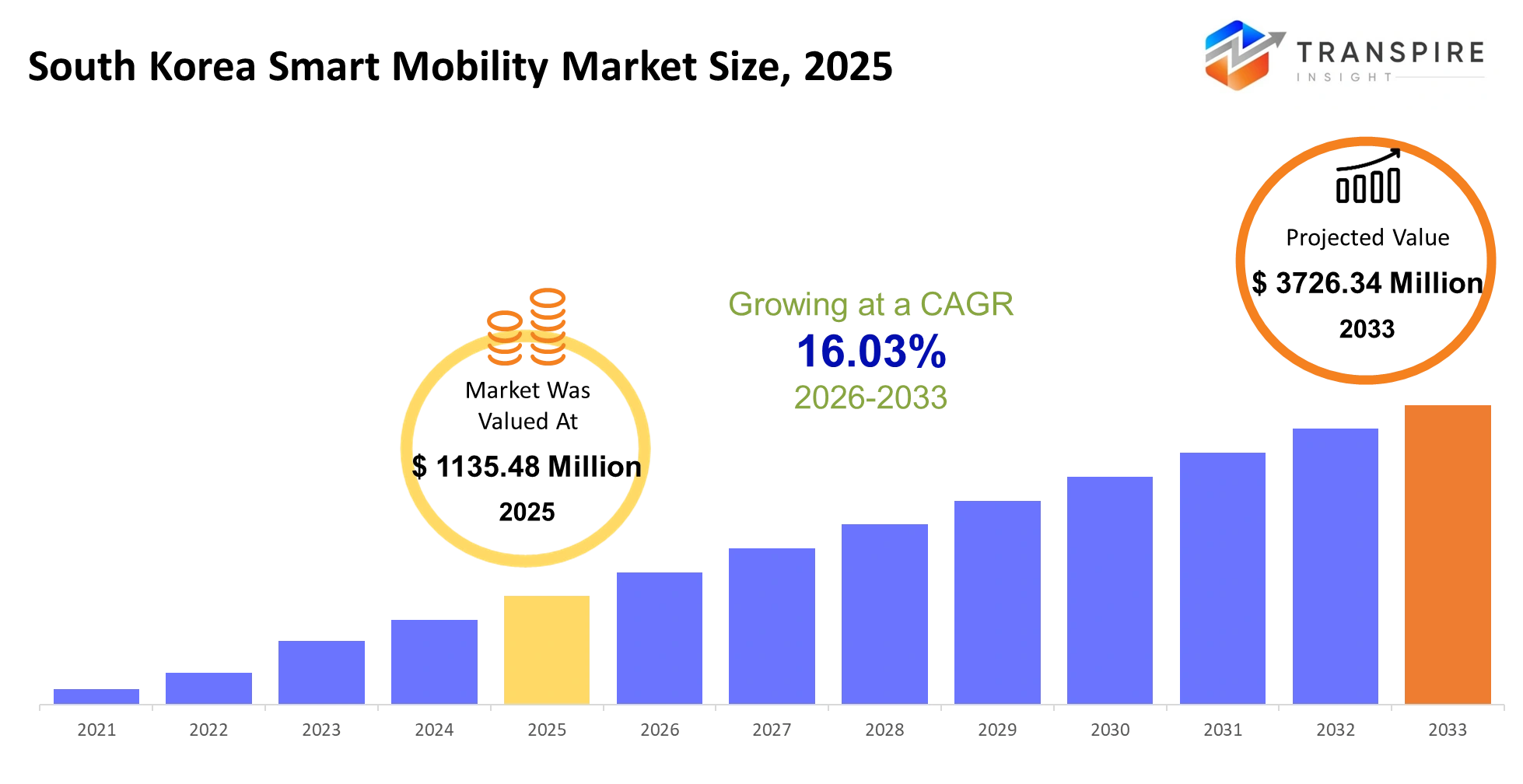
- South Korea Smart Mobility Market Size 2025: USD 1135.48 Million
- South Korea Smart Mobility Market Size 2033: USD 3726.34 Million
- South Korea Smart Mobility Market CAGR: 16.03%
- South Korea Smart Mobility Market Segments: By Solution Type (Ride-sharing Platforms, Smart Traffic Management, Connected Vehicles, Mobility-as-a-Service, Others); By Application (Urban Transportation, Fleet Management, Logistics, Public Transportation, Others); By Technology (AI-enabled Mobility, IoT-based Systems, 5G Connectivity, Others); By End User (Government Authorities, Mobility Service Providers, Consumers, Others).
To learn more about this report,  Download Free Sample Report
South Korea Smart Mobility Market Summary
The South Korea Smart Mobility Market was valued at USD 1135.48 Million in 2025. It is forecast to reach USD 3726.34 Million by 2033. That is a CAGR of 16.03% over the period.
The South Korea Smart Mobility Market, kind of supports connected transportation systems, like it helps reduce congestion, boosts fleet efficiency and then optimizes how people move through cities via public transit, logistics, and passenger mobility networks. Basically, the market blends electric vehicles with autonomous capabilities, plus intelligent traffic systems, and then mobility-as-a-service platforms, all to tackle urban density, aging transport infrastructure, and emissions control in crowded places like Seoul and Busan. Over the past five years, things have moved away from isolated EV rollouts toward a more complete digital mobility ecosystem, the kind that’s actually backed by 5G, AI-based traffic coordination, and vehicle-to-everything communication.
During COVID-19 the whole contactless movement services got a big push, along with smart logistics spend, and then South Korea’s carbon neutrality plan nudged municipalities and automakers toward low-emission transport infrastructure. This change is, somehow, reshaping what gets bought and how procurement happens for fleet operators and city authorities too, and it’s opening recurring revenue paths in software integration, charging infrastructure, and intelligent mobility management services rather than depending only on vehicle sales.
Key Market Insights
- The Seoul metropolitan region kind of dominated the South Korea Smart Mobility Market, with almost 42% market share in 2025, mainly because it has advanced digital transport infrastructure and that sort of thing.
- Busan then showed up as the fastest growing regional market through 2033, supported by smart port modernization, and also investments in autonomous logistics corridors, which is kinda the main push.
- Electric mobility solutions accounted for about 38% share in 2025, driven by nationwide EV charging infrastructure plus battery technology expansion, and related services.
- Autonomous driving software stayed as the second largest segment, benefiting from pilot deployments across public transit, and commercial fleet operations too.
- Mobility-as-a-service platforms are expected to grow the quickest between 2025 and 2033, mostly due to adopting integrated payment, and route optimization.
- Smart public transportation applications captured nearly 35% of revenue share in 2025 , because municipalities prioritized congestion reduction and traffic analytics systems, even when budgets are tight.
- AI-enabled logistics, and fleet management platforms are seeing new demand from e-commerce and last mile delivery operators across urban mobility networks.
- Commercial fleet operators stayed the leading end user group, with just over 40 % share, and a lot of it is tied to connected fleet monitoring as well as EV transition programs , a kind of double push.
- Meanwhile big names like Hyundai Motor Company, Kia Corporation, Samsung SDS, LG CNS, and SK Telecom are trying to tighten their competitive posture through AI based mobility innovation and strategic collaborations.
- In general, the South Korea Smart Mobility Market seems to be getting more traction thanks to strategic expansion into connected infrastructure, 5G enabled transport systems, and progress in autonomous vehicle technology, so the long-term industry size and revenue forecast also look better over time.
- So, what are the key drivers , constraints, and opportunities in the South Korea Smart Mobility Market?
- One major driver that’s basically pushing the South Korea Smart Mobility Market is the government led shift toward connected and low emission transportation infrastructure.
- 5G-enabled transportation systems, and autonomous vehicle technology advancements, improving the long term industry size and revenue forecast too.
What are the Key Drivers, Restraints, and Opportunities in the South Korea Smart Mobility Market?
A major driver pushing the South Korea Smart Mobility Market is sort of government-led shift toward connected and low-emission transportation infrastructure. South Korea’s carbon neutrality agenda and smart city development programs, they basically sparked big investments in EV charging networks, AI-based traffic systems and autonomous vehicle pilot zones. City administrations increasingly weave in real-time traffic analytics and intelligent transportation system features into daily urban planning, because congestion control and energy efficiency have turned into economic priorities, not just environmental ones by themselves.
The biggest brake still seems to be the high infrastructure integration cost linked to connected mobility ecosystems. Smart traffic systems, autonomous navigation platforms, and vehicle-to-everything communication networks all need synchronized upgrades across telecom infrastructure, road frameworks, sensors, and fleet hardware. Those investments come with long procurement cycles and kind of tangled interoperability standards, so fast nationwide rollout stays hard. Smaller municipalities and mid-sized fleet operators often postpone adoption too, since upfront capital spending stays difficult to justify when you only look at short-term operational returns.
A noticeable opening is showing up in autonomous logistics, and also smart freight mobility, tied to South Korea’s semiconductor sector, e-commerce activity, and smart port industries. Busan’s smart port modernization moves and AI enabled freight corridor efforts are building the right conditions for autonomous delivery vehicles, predictive fleet management, and connected cargo monitoring technologies. As logistics providers chase quicker route selection and reduced fuel use, software-centric mobility platforms are placed to
What Has the Impact of Artificial Intelligence Been on the South Korea Smart Mobility Market?
Artificial intelligence has, in a kinda practical way, changed how fast and efficient operations run across South Korea’s linked transportation ecosystem by supporting real time automation , predictive analytics, and sort of intelligent traffic coordination. AI based mobility platforms now automate traffic light management, fleet routing, and vehicle diagnostics, all by pulling information from connected sensors , telematics systems, and the wider urban infrastructure web. Public transport operators are using machine learning models more and more , to tune route timing and to cut down passenger congestion during those busiest travel windows
Predictive maintenance is now one of the more profitable uses. Fleet operators apply AI models to look at battery condition, component wear, and driving behavior signals so they can reduce unexpected stops and also lower maintenance spend. Autonomous shuttle operators and logistics fleets use AI navigation too, for obstacle detection , route optimization, and energy conscious driving. As a result, operational uptime improves while fuel use and electricity consumption drop across high traffic corridors
AI powered traffic management tools have also helped with regulatory alignment , since they can watch emissions performance, vehicle efficiency, and city traffic density in real time. Still, big deployments run into constraints tied to the cost of infrastructure integration and to data that is often fragmented. For example, autonomous mobility depends on steady 5G access, lots of sensor calibration work, and very large sets of locally trained data, and those things are still hard to standardize across every urban and industrial area in South Korea.
Key Market Trends
- Since 2021, Seoul has expanded intelligent traffic platforms across 1,200+ intersections, which ended up cutting average congestion delays by almost 20% during peak commuting hours.
- South Korea’s EV charging network hit past 300,000 units in 2025, and that helped commercial fleet electrification a lot too, plus it reduced urban delivery operating costs quite significantly.
- Between 2022 and 2025, Hyundai Motor Company increased autonomous driving investments by more than 35% , and it sort of shifted emphasis toward software-defined mobility ecosystems, rather than just hardware.
- Busan’s smart port projects processed over 22 million TEUs in 2024, and it pushed forward autonomous freight mobility along with AI-enabled logistics coordination systems, in a more coordinated way than before.
- In 2023, vehicle-to-everything infrastructure deployments improved connected vehicle communication latency by nearly 30%, so autonomous navigation reliability became stronger in dense urban corridors.
- Public transportation agencies even swapped static scheduling systems for AI-based route optimization platforms, which improved fleet utilization rates and also brought down passenger wait times.
- SK Telecom and Samsung SDS expanded mobility-data partnerships, aiming to strengthen predictive traffic analytics and cloud-connected fleet management services.
- Meanwhile, commercial logistics operators increased connected fleet software spending after e-commerce parcel volumes rose by more than 18% between 2021 and 2024.
- Electric bus deployments actually grew fast after government subsidy programs covered close to 50% of procurement costs for municipal transportation authorities.
- And mobility-as-a-service applications saw stronger city adoption after integrated payment systems unified metro, taxi, bus, and shared mobility access through one single digital platform, instead of separate logins or scattered tickets.
South Korea Smart Mobility Market Segmentation
By Solution Type
Ride-sharing platforms hold a leading position in the market because urban consumers increasingly prefer app based mobility access rather than private vehicle ownership, especially in dense metropolitan regions. High smartphone penetration with integrated digital payment systems, and also the steady urban transport demand are still key factors supporting platform expansion across Seoul plus a few other major cities. Smart traffic management is taking the second-largest slot, mainly from rising municipal investment in AI driven congestion monitoring, and intelligent transportation infrastructure, but it also feels like it depends on how quickly pilots turn into real deployments. Connected vehicles and mobility-as-a-service platforms are still expanding in a fairly steady way, whereas the remaining players stay tied to more specialized mobility technologies and pilot stage transportation services.
Ride-sharing demand is pushed by commuting habits that are shifting, shorter city travel patterns, and pressure to reduce traffic congestion in crowded districts. Smart traffic management benefits from government backed smart city programs that focus on real time traffic optimization and public safety upgrades. Connected vehicle adoption keeps getting support as vehicle-to-everything communication is rolled out more widely, along with autonomous driving technologies across commercial and passenger fleets. During the forecast period mobility-as-a-service platforms are expected to grow rather fast, which in turn encourages technology providers to build integrated ecosystems that blend public transit, ride-sharing, and digital payment infrastructure into one unified transportation platform.
By Application
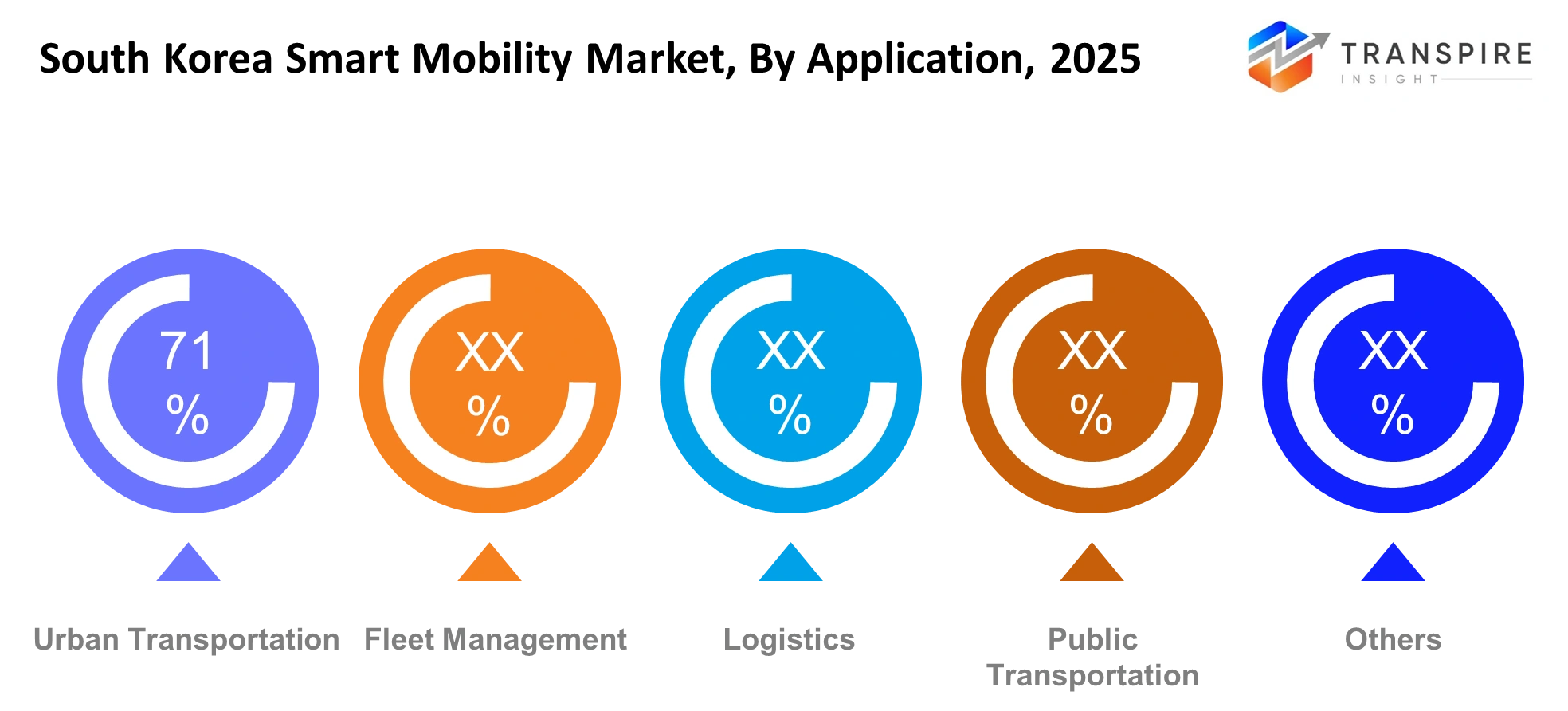
Urban transport is still driving most of the market , mainly because municipal governments keep betting on “intelligent mobility” in order to improve traffic flow, make commuter movement more efficient , and also support air quality management. At the same time, large deployments of AI-based traffic analytics along with connected transportation infrastructure over multiple metro regions keep reinforcing this segment’s market strength. Fleet management is taking the second place as an application segment, mostly as logistics, delivery networks, and corporate transport systems become more digital. Logistics and public transportation uses are also picking up speed, while the rest stays a bit tucked in, limited to specific commercial experiments or small pilot style mobility situations.
Overall demand for urban transportation is being nudged forward by expanding smart city initiatives and by the growing pressure to get more from public infrastructure efficiency. For fleet management, the rise is connected to wider adoption of telematics systems, predictive maintenance platforms, and real-time route optimization across commercial vehicle operators. Logistics applications are getting fuel from the fast growth of e-commerce, plus more spending on connected delivery systems and smart freight corridors. During the forecast period, logistics and public transportation applications are expected to accelerate notably, which should open doors for AI mobility analytics providers and developers working on connected infrastructure.
To learn more about this report, Download Free Sample Report
By Technology
AI-enabled mobility sort of holds the dominant position, because transportation operators keep leaning on predictive analytics, autonomous navigation, and intelligent traffic management systems to boost operational efficiency. In general, AI technologies stay in the core role for route optimization, fleet monitoring, and passenger flow analysis across urban mobility ecosystems. IoT-based systems sit as the second-largest segment too, mostly due to the rising deployment of connected sensors, telematics platforms, and infrastructure monitoring technologies across mobility networks. Meanwhile 5G connectivity is still emerging quickly, especially via integration with autonomous transportation and vehicle communication systems, and a few other areas remain tied to early-stage mobility technologies.
The demand for AI-enabled mobility is driven by the need for real-time transportation analytics, automated traffic coordination, and predictive operational decision-making. IoT-based systems gain support from expanding smart infrastructure deployment, plus deeper integration of connected devices across vehicles, roads, and logistics operations. 5G connectivity is picking up momentum because autonomous mobility platforms demand low-latency communication and steady high-speed data transfer for safe vehicle operation. Over the forecast period, 5G-enabled mobility infrastructure is expected to grow at the fastest pace , which then pushes telecom operators and technology developers to invest heavily in connected transportation ecosystems.
By End User
Government authorities kinda dominate the market, because public sector agencies still keep leading investments in intelligent transportation systems, EV infrastructure and the modernization of urban mobility programs. Municipal governments show up with a lot of procurement activity, mostly tied to big smart city endeavors, and also public transportation digitization efforts. Mobility service providers take the second-largest slice, since platform operators, logistics firms and fleet managers are more and more deploying connected transportation tools, not only to improve efficiency but also to keep operations smoother. Consumer adoption keeps growing steadily, through app-based mobility services and connected vehicle platforms, while the others group still tends to link more with niche commercial transportation users rather than broad consumer use.
This kind of government authority demand is backed by transport modernization policies, congestion reduction goals, and carbon neutrality promises across South Korea. Mobility service providers, meanwhile, benefit from rising competition in ride-hailing, delivery logistics, and integrated transportation management services. Consumer adoption gets more traction as AI-enabled navigation systems become more common, along with subscription-based mobility platforms and connected vehicle technologies. During the forecast period, mobility service providers are expected to deliver the fastest technology investment growth, so it opens up strong chances for software developers, telecom operators and companies building digital mobility infrastructure, overall.
What are the Key Use Cases Driving the South Korea Smart Mobility Market?
Smart public transportation keeps being the big one in the South Korea Smart Mobility Market, mostly because the major metro areas need some really in-between traffic coordination and digitally linked transit setups to handle population density without getting messy. Local governments are still rolling out AI driven traffic management platforms, linked buses, and one unified payment workflow , so commuters move with less friction and fewer travel delays show up.
At the same time connected logistics and fleet management software are growing fast, especially across e-commerce, plant operations, and smart port activities. Delivery businesses are starting to lean harder on route optimization tools , telematics systems , and electric commercial vehicles, basically to get better delivery throughput and also lower day-to-day operating costs along those urban freight routes.
Newer things are also showing up like autonomous delivery robots, vehicle-to-everything communication networks, and AI powered air mobility platforms. In pilot programs across smart cities and logistics hubs, they are testing self-driving shuttle services and connected mobility infrastructure, and that may end up changing how urban transportation is shaped over the forecast period.
|
Report Metrics |
Details |
|
Market size value in 2025 |
USD 1135.48 Million |
|
Market size value in 2026 |
USD 1315.97 Million |
|
Revenue forecast in 2033 |
USD 3726.34 Million |
|
Growth rate |
CAGR of 16.03% from 2026 to 2033 |
|
Base year |
2025 |
|
Historical data |
2021 - 2024 |
|
Forecast period |
2026 - 2033 |
|
Report coverage |
Revenue forecast, competitive landscape, growth factors, and trends |
|
Regional scope |
South Korea |
|
Key company profiled |
Hyundai Motor Company, Kia Corporation, Samsung SDS, LG CNS, Kakao Mobility, Naver Cloud, Uber, Didi Global, Siemens Mobility, Bosch, Cisco Systems, IBM, SK Telecom, Hancom Mobility, Toyota Tsusho. |
|
Customization scope |
Free report customization (country, regional & segment scope). Avail customized purchase options to meet your exact research needs. |
|
Report Segmentation |
By Solution Type (Ride-sharing Platforms, Smart Traffic Management, Connected Vehicles, Mobility-as-a-Service, Others); By Application (Urban Transportation, Fleet Management, Logistics, Public Transportation, Others); By Technology (AI-enabled Mobility, IoT-based Systems, 5G Connectivity, Others); By End User (Government Authorities, Mobility Service Providers, Consumers, Others). |
Which Regions are Driving the South Korea Smart Mobility Market Growth?
The Seoul Capital Area still feels like the major region for the South Korea Smart Mobility Market, mainly because it blends dense urban bones, fast digital connectivity, and pretty coordinated policy work. Seoul’s municipal government sped up the roll out of AI driven traffic control systems, combined mobility payment platforms, and linked public transit networks across 2021 to 2025. The area also has the advantage of South Korea’s strongest EV charging footprint, plus autonomous mobility trial programs, and 5G enabled transportation corridors.
Busan shows up as the second most influential regional market, but the way it grows is not really the same as Seoul’s more consumer oriented mobility mix. The city’s strength is more about smart logistics modernization, port digitization, and autonomous freight mobility that ties into shipping plus industrial trade routes. Busan Port processed over 22 million TEUs in 2024, and that pushed logistics players to fund AI powered fleet coordination and connected cargo handling systems. With long term infrastructure planning, steady industrial spending, and government supported smart port programs, Busan turns into a dependable source of recurring mobility technology revenue, not just a fast spike in urban transport activity.
Incheon is getting the fastest momentum among the regions , since airport linked mobility modernization and smart logistics infrastructure spending started to rise much more sharply after 2023. The push for autonomous shuttle trials, intelligent transportation systems , and connected freight corridors around Incheon International Airport opened up new commercial opportunities for mobility software vendors and telecom companies. Local authorities also increased investment in vehicles to everything infrastructure.
Who are the Key Players in the South Korea Smart Mobility Market and How Do They Compete?
Competition in the South Korea Smart Mobility Market is kinda getting more technology-centric day by day, like automakers, telecom operators, cloud providers, and mobility platform companies are all trying to grab control of connected transportation ecosystems. The overall market still looks moderately consolidated, mostly because big domestic players already have solid infrastructure, manufacturing know-how, and digital platform strength. But the thing is, competition is not really about vehicle production or transportation services only anymore. Instead companies are differentiating through AI integration, autonomous driving software, cloud connectivity, real-time analytics, and integrated mobility platforms that kinda pull transportation, payments, and logistics oversight into one single ecosystem.
Hyundai Motor Company and Kia Corporation are trying to strengthen their place by using software-defined vehicles, autonomous mobility partnerships, and even robotics integration in a practical way. Hyundai, for example, pushed further into an AI-focused mobility ecosystem via the NUMA alliance starting in 2025 , and at the same time it keeps widening its collaboration in autonomous driving as well as advanced air mobility technologies. Their competitive edge comes from mixing vehicle manufacturing scale with AI mobility software and smart transportation infrastructure partnerships, so it’s not just one layer, it’s multiple layers together.
SK Telecom, on the other hand, competes by leaning hard on nationwide 5G infrastructure and AI-native network technologies, to back connected transportation systems and autonomous mobility communication. Samsung SDS differentiates itself through cloud-connected logistics analytics, plus enterprise fleet management platforms that are linked with industrial supply chains.
Company List
- Hyundai Motor Company
• Kia Corporation
• Samsung SDS
• LG CNS
• Kakao Mobility
• Naver Cloud
• Uber
• Didi Global
• Siemens Mobility
• Bosch
• Cisco Systems
• IBM
• SK Telecom
• Hancom Mobility
• Toyota Tsusho
Recent Development News
In March 2026, SK Telecom entered a partnership with Ericsson to advance AI-powered 5G and 6G mobile network technologies. The collaboration strengthens South Korea’s smart mobility infrastructure by improving autonomous network optimization, low-latency connectivity, and AI-native transportation communication systems.
Source: https://news.sktelecom.com
In February 2026, Hyundai Motor Company announced a multi-billion-dollar investment program focused on AI, robotics, hydrogen infrastructure, and autonomous mobility technologies in South Korea. The investment supports future smart mobility ecosystems and strengthens the country’s position in AI-driven transportation and connected infrastructure development.
Source: https://www.reuters.com
What Strategic Insights Define the Future of the South Korea Smart Mobility Market?
South Korea Smart Mobility Market is moving, structurally, toward fully integrated mobility ecosystems where AI, autonomous transportation, cloud infrastructure, and connected logistics act like a unified digital platform, not just separate technologies. This shift is being pushed by government funded smart city investments, full scale 5G rollout across the country, and real pressure to make urban infrastructure work more efficiently. Still, there’s one risk that isn’t talked about enough , the market is getting more and more reliant on a small circle of telecom operators, cloud providers, and automotive technology platforms. Over time that can raise ecosystem concentration issues, plus make interoperability a harder problem than it should be.
At the same time, a noticeable new opening shows up in autonomous freight mobility, linked with smart ports and airport logistics corridors. This is especially relevant around Busan and Incheon, because infrastructure modernization there is speeding up. For companies planning to enter, the smartest move is to push for strategic collaborations with telecom operators and municipal infrastructure providers. Because honestly, the future competitive edge will depend less on standalone mobility products and more on ecosystem integration capability.
South Korea Smart Mobility Market Report Segmentation
By Solution Type
- Ride-sharing Platforms
- Smart Traffic Management
- Connected Vehicles
- Mobility-as-a-Service
- Others
By Application
- Urban Transportation
- Fleet Management
- Logistics
- Public Transportation
- Others
By Technology
- AI-enabled Mobility
- IoT-based Systems
- 5G Connectivity
- Others
By End User
- Government Authorities
- Mobility Service Providers
- Consumers
- Others
Frequently Asked Questions
Find quick answers to common questions.
The estimated South Korea Smart Mobility Market size for the market will be USD 3726.34 Million in 2033.
Key segments for the South Korea Smart Mobility Market are By Solution Type (Ride-sharing Platforms, Smart Traffic Management, Connected Vehicles, Mobility-as-a-Service, Others); By Application (Urban Transportation, Fleet Management, Logistics, Public Transportation, Others); By Technology (AI-enabled Mobility, IoT-based Systems, 5G Connectivity, Others); By End User (Government Authorities, Mobility Service Providers, Consumers, Others).
Major South Korea Smart Mobility Market players are Hyundai Motor Company, Kia Corporation, Samsung SDS, LG CNS, Kakao Mobility, Naver Cloud, Uber, Didi Global, Siemens Mobility, Bosch, Cisco Systems, IBM, SK Telecom, Hancom Mobility, Toyota Tsusho.
The South Korea Smart Mobility Market size is USD 1135.48 Million in 2025.
The South Korea Smart Mobility Market CAGR is 16.03% from 2026 to 2033.
• Hyundai Motor Company
• Kia Corporation
• Samsung SDS
• LG CNS
• Kakao Mobility
• Naver Cloud
• Uber
• Didi Global
• Siemens Mobility
• Bosch
• Cisco Systems
• IBM
• SK Telecom
• Hancom Mobility
• Toyota Tsusho
Recently Published Reports
-
Apr 2026
ATV & UTV Market
ATV & UTV Market Size, Share & Analysis Report By Type (ATV, and UTV), By Variants (Less Than 400 CC, 400 CC To 800 CC, and More Than 800 CC), and Geography (North America, Europe, Asia-Pacific, Middle East and Africa, South and Central America), 2021 - 2031
-
Apr 2026
Automotive Central Gateway Module Market
Automotive Central Gateway Module Market Size, Share & Analysis Report By Type (Ethernet Central Gateway Module, CAN Central Gateway Module, LIN Central Gateway Module, and FlexRay), By Application (Powertrain Control, Body Control, Infotainment System, Advanced Driver Assistance Systems (ADAS), and Others), By End User (Passenger Vehicles, and Commercial Vehicles), and Geography (North America, Europe, Asia-Pacific, Middle East and Africa, South and Central America), 2021 - 2031
-
Apr 2026
Automotive Engine Oil Filter Market
Automotive Engine Oil Filter Market Size, Share & Analysis Report By Filter Type (Fuel Filter, Engine Oil Filter, Hydraulic Oil Filter, and Others), By Filter Media (Cellulose, Synthetic, and Micro), By Sales Channel (OEMs, and Aftermarket), By Vehicle Type (Passenger Cars, Light Commercial Vehicles, Heavy Duty Trucks, Buses and Coaches, and Off-road Vehicles), and Geography (North America, Europe, Asia-Pacific, Middle East and Africa, South and Central America), 2021 - 2031
-
Apr 2026
Automotive Parts Aluminium Die Casting Market
Automotive Parts Aluminium Die Casting Market Size, Share & Analysis Report By Production Process (Pressure Die Casting, Vacuum Die Casting, Squeeze Die Casting, Gravity Die Casting), By Application (Body Parts, Engine Parts, Transmission Parts, Battery And Related Components, Other Application Types), and Geography (North America, Europe, Asia-Pacific, Middle East and Africa, South and Central America), 2021 - 2031
Our Clients