
Europe Electric Mobility Market Size & Forecast:
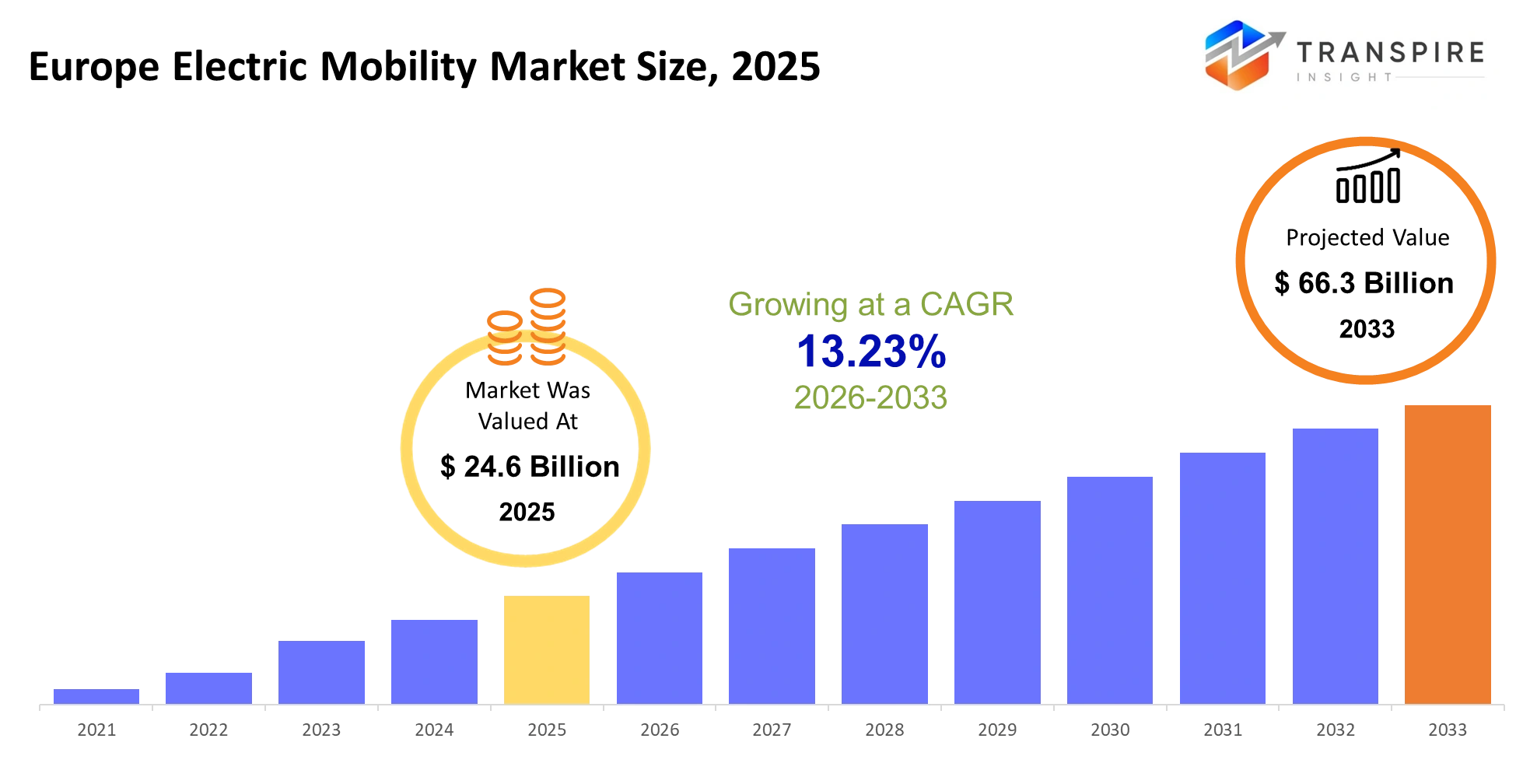
- Europe Electric Mobility Market Size 2025: USD 24.6 Billion
- Europe Electric Mobility Market Size 2033: USD 66.3 Billion
- Europe Electric Mobility Market CAGR: 13.23%
- Europe Electric Mobility Market Segments: By Type (Electric Cars, Electric Buses, Electric Bikes, Electric Trucks, Electric Scooters, Others); By Application (Passenger Transport, Public Transport, Logistics, Others); By End-User (Individuals, Fleet Operators, Government, Others); By Component (Batteries, Motors, Charging Infrastructure, Power Electronics, Others).
To learn more about this report,  Download Free Sample Report
Europe Electric Mobility Market Summary
The Europe Electric Mobility Market was valued at USD 24.6 Billion in. 2025. It is forecast to reach USD 66.3 Billion by 2033. That is a CAGR of 13.23% over the period.
Digitally connected low-emission mobility systems together with all types of passenger travel and logistics and public infrastructure systems create a new transportation system which Europe Electric Mobility Market supports. The market protects users from fuel price changes while assisting automakers to meet EU emissions standards and enabling cities to use electric transport systems for traffic control and pollution management. The ecosystem now extends beyond vehicles into charging infrastructure battery supply chains fleet software and grid integration services.
The market underwent a complete transformation during the previous 3 to 5 years because consumers stopped using incentives to adopt products and regulations began to dictate their industrial growth. OEMs and fleet operators had to speed up their electrification plans because EU fleet emission targets and urban low-emission zone enforcement required them to do so. After the Russia-Ukraine conflict energy prices rose which made buyer behavior change because they realized fossil fuel dependence creates high operational expense risks. To maintain their profit margins and secure their supply chains manufacturers increased their spending on local battery manufacturing and platform uniformity. The company now generates ongoing revenue streams through its charging services fleet management system and energy optimization software which it uses to sell its products.
Key Market Insights
- The 2025 Europe Electric Mobility Market shows Western Europe maintaining a market share between 45 and 50 percent because of stringent CO₂ regulations and its extensive network of charging stations.
- The 2026 to 2033 period will see Southern and Eastern Europe as the most rapidly expanding areas because EU-funded charging infrastructure development and manufacturing localization programs provide assistance to these regions.
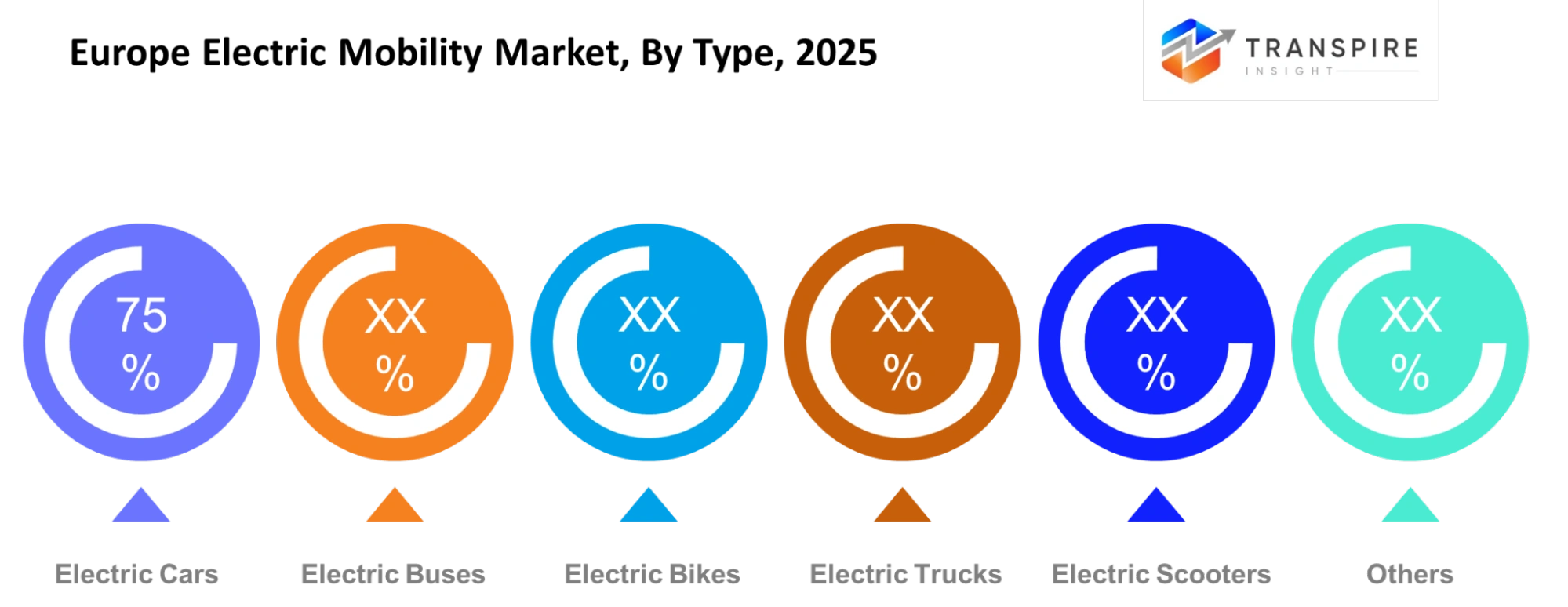
- The Europe Electric Mobility Market sees electric passenger cars as its primary market segment which accounts for more than 60 percent of total demand because of quick OEM platform standardization and consumer adoption patterns.
- The product category of light commercial logistics vehicles exhibits the highest growth rate because e-commerce continues to expand and cities implement delivery restrictions that require low-emission vehicles.
- The primary application for passenger transport holds a 55 percent market share while logistics activities show rapid growth in last-mile delivery network implementation.
- Fleet operators represent the most rapidly expanding end-user segment because companies move their corporate electrification initiatives from pilot testing to complete implementation.
- The Europe Electric Mobility Market sees individuals as the main users but the market shows a transition toward fleet-based procurement which dominates bulk purchasing activities.
- Volkswagen enhances its electric vehicle dominance by increasing MEB platform production capacity and implementing software solutions that decrease manufacturing expenses while accelerating product introduction times.
- Tesla improves its market position through Supercharger network development and pricing changes that help protect its market share in Europe.
- BYD speeds up its European expansion plans through factory discussions and development of affordable electric vehicle models that aim at markets sensitive to tariff costs.
What are the Key Drivers, Restraints, and Opportunities in the Europe Electric Mobility Market?
The main factor that boosts adoption rates of electric vehicles in Europe is the combination of regulatory enforcement and upcoming carbon dioxide reduction targets and low-emission zone implementation in major European cities. European Union emission cap regulations require automotive manufacturers and fleet managers to accelerate their adoption of electric vehicles instead of using their existing vehicle replacement schedule. The need to meet regulations drives up electric vehicle sales for passenger cars and light commercial trucks because businesses must comply with regulations that require them to purchase electric vehicles. The company generates revenue from products that comply with multiple EU market homologation standards, which lowers costs associated research and development of new products.
The most significant restraint remains charging infrastructure inconsistency combined with grid capacity limitations. The rapid growth of vehicle adoption faces permanent obstacles because of three factors, which include permitting delays and the uneven spread of fast-charging corridors and the limited capacity of local electricity grids. The current situation, which shows a deficit between vehicle adoption and energy system development, creates two problems: it decreases efficiency across energy systems and it prevents the rapid deployment of electric vehicle fleets, which is especially important in Southern and Eastern Europe. The gap creates two problems: it prevents charging operators from generating revenue and it creates unpredictable conditions for logistics and mobility services.
Vehicle-to-grid integration through smart energy market adaptations presents an important opportunity for development, which the Netherlands and Germany have established as their base. The existing pilot programs permit electric vehicle fleets to send their stored energy back to the electrical grid during times of high electricity usage.Electric vehicles now function as distributed energy assets because they convert from their previous role as energy consumers which creates new revenue opportunities for fleet operators and utility companies through their emerging grid flexibility service.
What Has the Impact of Artificial Intelligence Been on the Europe Electric Mobility Market?
Electric mobility operations throughout Europe use artificial intelligence to automate their charging networks and fleet operations and their compliance tracking systems. Smart charging platforms use AI-powered load balancing systems to manage grid demand because the system automatically moves electric fleet charging activities to times when electricity demand is lowest. AI-enabled fleet management systems in logistics and public transport use their vehicle tracking capabilities to monitor usage while they maintain compliance with EU emissions reporting standards through real-time monitoring which decreases the need for human supervision and administrative work.
Machine learning models, which study data patterns, now create better predictive maintenance methods for batteries and motors and power electronics components. The system uses thermal analysis together with charging cycle information and driving pattern data to determine degradation risks and create maintenance schedules which show upcoming failures. Fleet operators achieve better vehicle availability with decreased total operational costs because they switched to condition-based maintenance methods instead of traditional reactive ones. Energy optimization algorithms increase range efficiency because they use traffic data and terrain information and weather conditions to optimize driving patterns and route selection.
AI implementation in organizations continues to face challenges because organizations operate their charging networks with disconnected data systems and power distribution systems. The smaller fleet operators face difficulties because they need to spend more money to achieve system integration while they deal with lacking of common telemetry standards which exist between different OEM platforms. The system needs real-world data for testing because its predictive capabilities require accurate environmental models which remain unproven in practical use.
Key Market Trends
- European OEMs shifted from standalone EV launches to shared platforms like Volkswagen MEB, which resulted in lower production expenses and faster vehicle development since 2023.
- Chinese automakers established European operations through their plans to build local assembly facilities in 2025, which helped them to decrease tariff costs and improve delivery times to major EU markets.
- The funding for charging infrastructure development dedicated itself to building highway corridor networks, which enhanced the capacity of electric vehicles to travel throughout Western Europe.
- Fleet operators increased electrification of last-mile logistics since 2024, which resulted from cities enforcing stricter low-emission zone regulations at their urban centers.
- The European Union established a supply chain system through its supported gigafactories which started battery production operations in 2023.
- Tesla used price changes and local software development to protect its market position against cheaper competitors during its 2025 European business operations.
- Governments modified their incentive programs by replacing purchase subsidies with infrastructure funding, which created new factors that influence upcoming electric vehicle adoption patterns.
- Vehicle-to-grid pilots expanded from small utility trials to multi-city deployments, which established electric vehicles as decentralized energy resources throughout European electric power networks.
- Renault and Stellantis focused their development efforts on creating compact electric vehicles for urban markets, which became essential because European regulations demanded reduced space usage and lower emissions.
Europe Electric Mobility Market Segmentation
By Type:
European electric mobility currently operates as an electric car market because consumers purchase electric cars, manufacturers produce multiple electric car models, and European Union emissions standards create requirements which lead to faster electric car adoption by drivers. Major markets such as Germany and France and the Netherlands maintain their market control through high purchasing incentives which make electric cars more affordable to customers.
The market grows because OEMs establish standard platforms while companies compete to offer better price and range performance. Chinese companies create competitive pressure because they produce cost-efficient products, while European businesses develop their premium brands through software solutions. The development of charging infrastructure between highways enables drivers to travel long distances which creates consistent demand for electric vehicles.
Electric vehicles will remain the dominant automotive technology throughout the forecast period although their profit margins will decline because of increasing product standardization. Battery performance and software capabilities and energy systems will become the main focus for developers. Investors will choose to invest in companies which have platforms that can grow multiple lines of business instead of those which depend on one successful product.
To learn more about this report, Download Free Sample Report
By Application:
Passenger transport holds the leading position as urban electrification policies and private vehicle demand continue to expand across major European economies. Cities with high population density and low-emission zones create conditions which drive faster replacement of vehicles, which makes passenger mobility the main factor for increasing transportation volume.
The electrification of last-mile delivery services along with the growth of e-commerce business operations is driving rapid progress in logistics software solutions. Electric vans serve as the primary choice for fleet operators because these vehicles enable their businesses to meet urban access rules while they lower expenses during peak traffic times. The electrification of public transportation increases constant demand which municipal bus fleets fulfill through their electric vehicle upgrades that government funding programs support.
The logistics industry will drive future expansion because organizations maintain high vehicle usage levels while their drivers follow set transportation patterns. The depot-based charging infrastructure will emerge as the primary focus for future investment initiatives. Original equipment manufacturers and fleet operators will prioritize total cost of ownership management instead of evaluating vehicles based on their sales costs.
By End-User:
The individual market segment dominates the market because retail customers continue to demand products which receive support from subsidies and tax benefits while new vehicle models enter the market across different price points. Urban drivers choose electric vehicles as their main mode of transportation because these vehicles help them save money while they meet emission control requirements in restricted zones.
Fleet operators show faster growth as corporate leasing, ride-hailing, and logistics companies scale electrification to control operating expenses. Predictable usage patterns make fleets more suitable for charging optimization and battery lifecycle management. Government procurement supports adoption in public service fleets, particularly buses and municipal vehicles.
The fleet adoption process will develop faster than individual customer purchase patterns because fleets achieve better operational efficiency and organizations buy through centralized procurement systems. The charging-as-a-service model and fleet management platforms will operate as essential business enablers. The market will attract investor interest toward businesses that provide complete fleet energy solutions together with mobility services.
By Component:
The battery system constitutes the essential component which brings the most value because it determines all aspects of vehicle range and operational expenses and driving capabilities. The market shows high demand for both lithium-ion batteries and new solid-state battery technologies which leads to increased investment in battery production facilities throughout Europe.
The public and private networks for charging infrastructure experience their most rapid growth period as they expand to accommodate rising demand. Power electronics together with motors achieve higher significance because of their improved energy efficiency and their use in various vehicle platforms. Local supply chain production controls enable businesses to strengthen their production capacity for essential components.
The future business expansion will move toward complete systems that merge battery technology with charging solutions and energy management systems. Suppliers who manage their complete supply chain which includes material extraction and waste processing will establish a competitive edge. The ability to develop unique technologies holds greater significance than the capacity to produce goods at high volume.
What are the Key Use Cases Driving the Europe Electric Mobility Market?
The primary application of passenger electric vehicles in Europe exists because strict CO₂ fleet regulations and rapid urban adoption lead to their widespread use. The strongest demand exists in private mobility and commuter segments because low-emission zones and fuel cost advantages make EVs the default choice. This use case generates the highest volumes because OEMs focus on creating mass-market models which achieve compliance requirements for major EU nations.
Light commercial fleets and corporate mobility programs are expanding quickly across last-mile delivery and ride-hailing services. Urban distribution fleets now electrify their fleets because city access restrictions force logistics providers to adopt this solution while leasing companies expand their EV offerings to corporate clients who need predictable operating costs. These segments sit between consumer demand and regulatory pressure which leads to faster fleet replacement.
The future of vehicle-to-grid integration and shared mobility platforms exists as new applications which show significant potential for growth. Energy utilities are testing EVs as distributed storage assets in their grid balancing programs. The pilots of autonomous shuttles in controlled urban areas indicate future demand for mobility-as-a-service ecosystems because these systems will grow through shared usage instead of individual ownership.
|
Report Metrics |
Details |
|
Market size value in 2025 |
USD 24.6 Billion |
|
Market size value in 2026 |
USD 27.8 Billion |
|
Revenue forecast in 2033 |
USD 66.3 Billion |
|
Growth rate |
CAGR of 13.23% from 2026 to 2033 |
|
Base year |
2025 |
|
Historical data |
2021 - 2024 |
|
Forecast period |
2026 - 2033 |
|
Report coverage |
Revenue forecast, competitive landscape, growth factors, and trends |
|
Regional scope |
Europe (Germany, United Kingdom, France, Italy, Spain, Rest of Europe) |
|
Key company profiled |
Tesla, BYD, Volkswagen, BMW, Daimler, Volvo, Renault, Nissan, Hyundai, Kia, Tata Motors, Rivian, NIO, XPeng, Lucid Motors. |
|
Customization scope |
Free report customization (country, regional & segment scope). Avail customized purchase options to meet your exact research needs. |
|
Report Segmentation |
By Type (Electric Cars, Electric Buses, Electric Bikes, Electric Trucks, Electric Scooters, Others); By Application (Passenger Transport, Public Transport, Logistics, Others); By End-User (Individuals, Fleet Operators, Government, Others); By Component (Batteries, Motors, Charging Infrastructure, Power Electronics, Others). |
Which Regions are Driving the Europe Electric Mobility Market Growth?
The electric mobility transition process in Europe operates as the most advanced global example because Europe implements strict regulations which control emissions through its established emissions standards. The EU establishes CO₂ fleet targets which require countries to implement electric vehicle charging infrastructure in all urban areas through their low-emission zone system. European countries like the Netherlands and Germany and France maintain extensive charging networks because this creates a direct need for fast-charging stations which will enable drivers to travel longer distances without worrying about charging their vehicles. The automotive supply chain functions at full capacity while utilities work together to create a system which enables electric vehicle charging from both personal vehicles and commercial fleets.
The market receives its most stable contribution from Northern Europe through its market presence which operates through different industry dynamics, which include Scandinavian countries. The main strength of this market lies in its operational steadiness, which rests on strong consumer faith, as customers trust electric vehicles and the permanent tax benefits that governments maintain through both permanent policies and their temporary political periods. Norway shows almost complete electric vehicle adoption at 100 percent because drivers access public charging stations and the country generates electricity through its hydroelectric power systems. The automotive manufacturers use this region as their main testing area for premium electric vehicle strategies because it maintains stable conditions which protect against industrial economic changes.
Recent infrastructure investments together with EU-sponsored modernization initiatives have made Southern and Eastern Europe the most rapidly expanding regions. The three countries of Spain and Poland and Romania have increased their electric vehicle adoption rates because they invested heavily in highway charging infrastructure and domestic vehicle manufacturing incentives. The market here expands at a faster pace because it depends on the initial round of electric vehicle adoption instead of the market's existing products which need to be replaced.For investors and entrants, this region offers higher risk but also outsized volume upside as vehicle penetration rapidly catches up through 2026–2033.
Who are the Key Players in the Europe Electric Mobility Market and How Do They Compete?
European electric mobility competition now moves through its process from separate market segments to its current stage of selecting market segments to merge. Existing market players maintain significant industry shares while upcoming Chinese companies bring them to face new competitive challenges. Business rivalry now focuses on four main factors which are cost per kilometer, software-defined vehicle systems, charging infrastructure availability and European Union localization requirement compliance. Existing companies maintain their market position through system expansion and strategic partnerships while new companies drive down prices and push for common product features.
Volkswagen aims for cost leadership through enhanced operational efficiency which will be achieved through shared EV platforms that use MEB technology and Cariad software systems. Volkswagen also establishes external partnerships which will help the company accelerate its product development process and maximize its production capacity at European facilities. BMW establishes market differentiation through its Neue Klasse EV platform which uses high-energy-density batteries and simple electronic systems to achieve superior range and decreased manufacturing costs. Tesla uses complete business control together with its specialized system and Supercharger network to create ecosystem benefits which help it maintain market share for its European operations. BYD operates its business mainly through cost leadership which it achieves by using blade battery technology and establishing local manufacturing plants throughout Europe to minimize tariffs and speed up product distribution. Renault strengthens its position in compact urban EVs, targeting dense city mobility needs with smaller form factors tailored to European regulation and infrastructure constraints.
Company List
- Tesla
- BYD
- Volkswagen
- BMW
- Daimler
- Volvo
- Renault
- Nissan
- Hyundai
- Kia
- Tata Motors
- Rivian
- NIO
- XPeng
- Lucid Motors
Recent Development News
In May 2026, Volkswagen and Xpeng entered discussions regarding the potential acquisition or shared use of a European manufacturing facility. The talks reflect a broader shift toward Chinese OEM integration into European production networks as Volkswagen explores cost-efficient capacity strategies and Xpeng accelerates its regional expansion.
Source: https://www.reuters.com
“In May 2026, BYD entered negotiations with Stellantis and other European automakers to acquire underutilised factories across Europe. The discussions signal BYD’s accelerated push for localised production to bypass tariffs and strengthen its European manufacturing footprint amid rising EV competition.
Source: https://www.reuters.com
What Strategic Insights Define the Future of the Europe Electric Mobility Market?
The Europe Electric Mobility Market is moving toward a structurally consolidated phase over the next 5–7 years, where growth is less driven by early adoption and more by regulatory enforcement, fleet electrification mandates, and price parity between EVs and internal combustion vehicles. The arrival of Chinese manufacturers into the market will create competitive pressure which leads to product commoditization because companies will need to create unique products through software and charging systems and energy integration instead of focusing on hardware. Grid systems together with permitting systems present a hidden danger because vehicle demand growth would create constraints on distribution networks and charging infrastructure which would limit usage and slow down vehicle adoption while battery mineral supply chain dependence creates multiple geopolitical risks. The vehicle-to-grid (V2G) system of integration is becoming a critical turning point because it allows electric vehicles to operate as decentralized energy resources in Europe balancing markets. Market participants should therefore prioritize ecosystem integration strategies, establishing partnerships with utilities while developing smart energy management systems.
Europe Electric Mobility Market Report Segmentation
By Type
- Electric Cars
- Electric Buses
- Electric Bikes
- Electric Trucks
- Electric Scooters
- Others
By Application
- Passenger Transport
- Public Transport
- Logistics
- Others
By End-User
- Individuals
- Fleet Operators
- Government
- Others
By Component
- Batteries
- Motors
- Charging Infrastructure
- Power Electronics
- Others
Frequently Asked Questions
Find quick answers to common questions.
The Europe Electric Mobility Market size is USD 66.3 Billion in 2033.
Key segments for the Europe Electric Mobility Market are By Type (Electric Cars, Electric Buses, Electric Bikes, Electric Trucks, Electric Scooters, Others); By Application (Passenger Transport, Public Transport, Logistics, Others); By End-User (Individuals, Fleet Operators, Government, Others); By Component (Batteries, Motors, Charging Infrastructure, Power Electronics, Others).
Major Europe Electric Mobility Market players are Tesla, BYD, Volkswagen, BMW, Daimler, Volvo, Renault, Nissan, Hyundai, Kia, Tata Motors, Rivian, NIO, XPeng, Lucid Motors.
The Europe Electric Mobility Market size is USD 24.6 Billion in 2025.
The Europe Electric Mobility Market CAGR is 13.23% from 2026 to 2033.
- Tesla
- BYD
- Volkswagen
- BMW
- Daimler
- Volvo
- Renault
- Nissan
- Hyundai
- Kia
- Tata Motors
- Rivian
- NIO
- XPeng
- Lucid Motors
Recently Published Reports
-
Apr 2026
ATV & UTV Market
ATV & UTV Market Size, Share & Analysis Report By Type (ATV, and UTV), By Variants (Less Than 400 CC, 400 CC To 800 CC, and More Than 800 CC), and Geography (North America, Europe, Asia-Pacific, Middle East and Africa, South and Central America), 2021 - 2031
-
Apr 2026
Automotive Central Gateway Module Market
Automotive Central Gateway Module Market Size, Share & Analysis Report By Type (Ethernet Central Gateway Module, CAN Central Gateway Module, LIN Central Gateway Module, and FlexRay), By Application (Powertrain Control, Body Control, Infotainment System, Advanced Driver Assistance Systems (ADAS), and Others), By End User (Passenger Vehicles, and Commercial Vehicles), and Geography (North America, Europe, Asia-Pacific, Middle East and Africa, South and Central America), 2021 - 2031
-
Apr 2026
Automotive Engine Oil Filter Market
Automotive Engine Oil Filter Market Size, Share & Analysis Report By Filter Type (Fuel Filter, Engine Oil Filter, Hydraulic Oil Filter, and Others), By Filter Media (Cellulose, Synthetic, and Micro), By Sales Channel (OEMs, and Aftermarket), By Vehicle Type (Passenger Cars, Light Commercial Vehicles, Heavy Duty Trucks, Buses and Coaches, and Off-road Vehicles), and Geography (North America, Europe, Asia-Pacific, Middle East and Africa, South and Central America), 2021 - 2031
-
Apr 2026
Automotive Parts Aluminium Die Casting Market
Automotive Parts Aluminium Die Casting Market Size, Share & Analysis Report By Production Process (Pressure Die Casting, Vacuum Die Casting, Squeeze Die Casting, Gravity Die Casting), By Application (Body Parts, Engine Parts, Transmission Parts, Battery And Related Components, Other Application Types), and Geography (North America, Europe, Asia-Pacific, Middle East and Africa, South and Central America), 2021 - 2031
Our Clients