
South Korea Coherent Optical Equipment Market Size & Forecast:
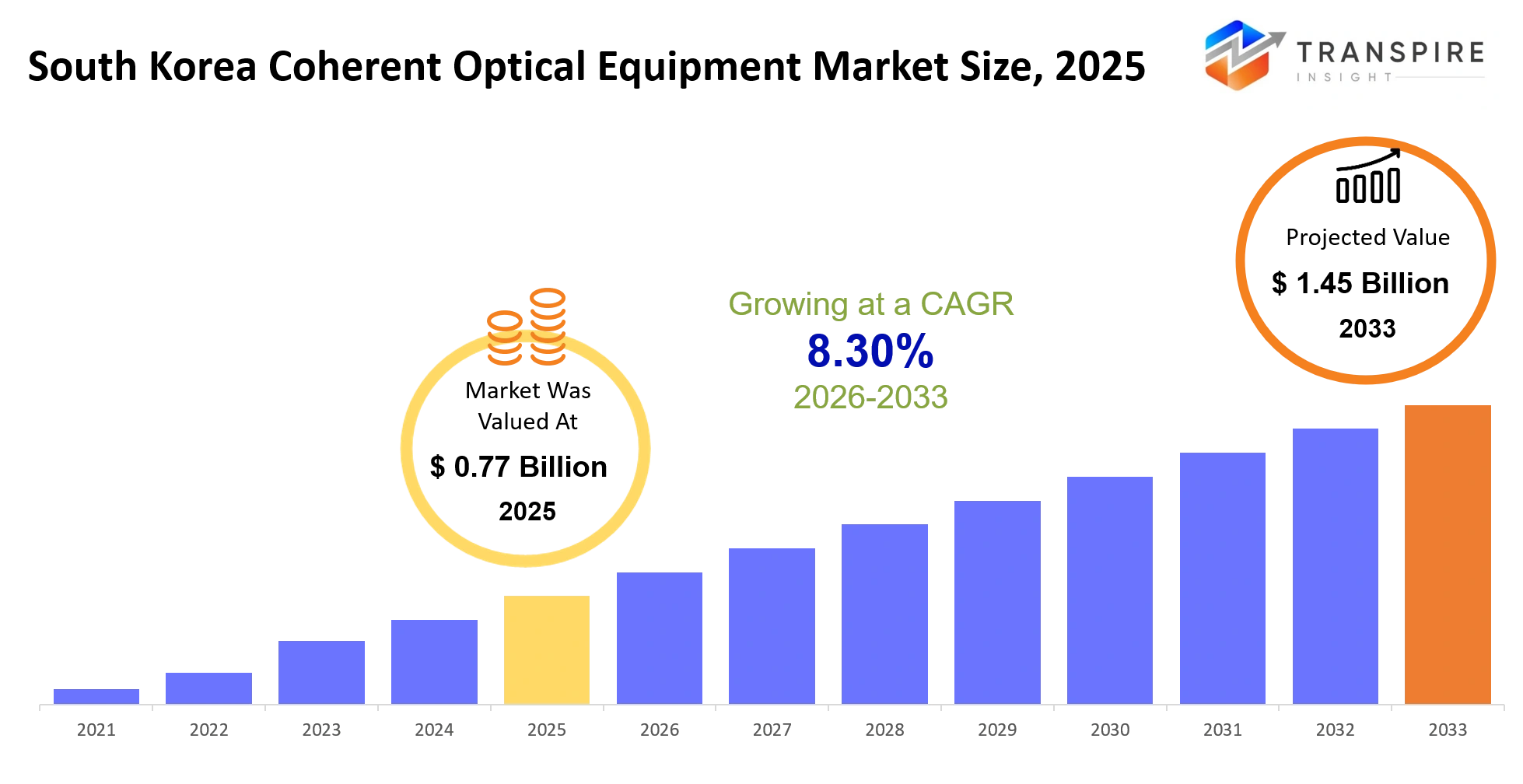
- South Korea Coherent Optical Equipment Market Size 2025: USD 0.77 Billion
- South Korea Coherent Optical Equipment Market Size 2033: USD 1.45 Billion
- South Korea Coherent Optical Equipment Market CAGR: 8.30%
- South Korea Coherent Optical Equipment Market Segments:By Equipment Type (Optical Transceivers, Optical Amplifiers, Wavelength Division Multiplexing Equipment, Optical Switches, Others); By Technology (100G Coherent Optics, 400G Coherent Optics, 800G Coherent Optics, Others); By Application (Telecommunication Networks, Data Centers, Submarine Communication, Enterprise Networks, Others); By End User (Telecom Operators, Cloud Service Providers, Enterprises, Government Organizations, Others); By Form Factor (Pluggable Modules, Embedded Modules, Rack-mounted Systems, Others).
To learn more about this report,  Download Free Sample Report
South Korea Coherent Optical Equipment Market Summary
The South Korea Coherent Optical Equipment Market was valued at USD 0.77 Billion in 2025. It is forecast to reach USD 1.45 Billion by 2033. That is a CAGR of 8.30% over the period.
The South Korea Coherent Optical Equipment Market is really important for moving lots of information. It helps telecom networks and data centers talk to each other. This equipment is great because it lets phone companies and businesses send amounts of information like videos and cloud stuff without losing the signal even when it has to travel very far. The South Korea Coherent Optical Equipment Market is key to keeping the country's infrastructure working properly. This is because more and more people are using things that need a lot of bandwidth like the 5G networks, big data centers and cloud systems. The South Korea Coherent Optical Equipment Market plays a role in all of this.
In the last few years the market has changed a lot. It used to be about traditional optical transport systems. Now it's all about technologies that make it possible to send more data through the same fiber. A big reason for this change was the growth of 5G networks and big data centers. They put a lot of strain on existing fiber capacity. This forced operators to upgrade their networks faster than they had planned. The Coherent Optical Equipment Market benefited from this shift.
Now there's a demand for optical modules that can handle lots of data. There's also a need for network architectures that're more flexible. This is helping vendors that supply lasers, chips and transceivers to grow their revenue. As a result more telecom operators and cloud providers are adopting Coherent Optical Equipment. They want to get latency and be able to easily expand their bandwidth. The South Korea Coherent Optical Equipment Market is growing because of this increased adoption of Coherent Optical Equipment.The Coherent Optical Equipment is really helping them achieve their goals.The demand for Coherent Optical Equipment is high.The Coherent Optical Equipment Market is expected to keep growing.The South Korea Coherent Optical Equipment Market is a player, in this growth.
Key Market Insights
- The South Korea Coherent Optical Equipment Market is doing well. It is growing steadily. This is because there are upgrades to the 5G backbone and more traffic in data centers. The South Korea Coherent Optical Equipment Market needs systems to handle a lot of data through 2033.
- The South Korea Coherent Optical Equipment Market is also growing because of a trend. This trend is using 400G and 800G. Companies are updating their systems to make them faster and more efficient.
- In 2024 the Seoul area had a part of the market. It had 46% of the market. This is because the Seoul area has a lot of telecom infrastructure, big data centers and companies that need the internet.
- The Gyeonggi region is expected to grow from 2025 to 2033. This is because new data centers are being built and companies are updating their networks.
- In 2024 the part of the market that makes optical transceivers was the biggest. It had a 39% share. This is because telecom companies switched to modules to handle more data.
- The part of the market that uses DSP-based systems is growing fast. This is because network operators want systems that can handle a lot of data and use energy.
- In 2024 most of the South Korea Coherent Optical Equipment Market was for connecting data centers. It had a 42% share. This is because companies are moving to the cloud and using Artificial Intelligence.
- The South Korea Coherent Optical Equipment Market is helping to modernize telecom backbone networks. It is moving to flexible and software-defined networks.
- In 2024 cloud providers had a share of the market. They had 44% of the market. This is because they need reliable networks for their hybrid cloud services.
- Companies like Nokia, Ciena, Huawei, Infinera and Cisco are doing well in the South Korea Coherent Optical Equipment Market. They are. Partnering to release 800G products. This is making their position stronger, in the South Korea Coherent Optical Equipment Market.
What are the Key Drivers, Restraints, and Opportunities in the South Korea Coherent Optical Equipment Market?
The main reason the South Korea Coherent Optical Equipment Market is growing is that telecom companies are upgrading their systems. They are moving from 100G to 400G and 800G technologies. This change is happening because of the expansion of 5G networks and big data centers. More people are using cloud computing and Artificial Intelligence which means data traffic. This increased traffic is causing congestion in the backbone. As a result telecom operators are spending money on systems.
They are also investing in high-capacity transceivers. The goal is to make their networks more efficient. They want to support data movement. The South Korea Coherent Optical Equipment Market is growing because of these upgrades. Telecom companies need equipment to support their new networks. The demand for this equipment is increasing. It is driven by the need for efficient data movement. The expansion of 5G networks and big data centers is driving this demand. Coherent optical equipment helps telecom companies handle the increased data traffic. It enables them to provide reliable services to their customers. The South Korea Coherent Optical Equipment Market will continue to grow. It will grow as telecom companies continue to upgrade their networks. They will need optical equipment to support their new networks. The market will benefit from this increased demand.
The biggest challenge is that upgrading networks is very expensive and takes time. Many telecom operators still use DWDM systems that have already been paid off and replacing them requires planning and a lot of investment. This makes it hard for smaller telecom operators to adopt technologies and delays revenue for equipment vendors. There is an opportunity for growth in the Seoul and Gyeonggi regions, where new big data centers are being built. These data centers are driving demand for optical interconnects. Companies are investing in technologies like 800G optics and flexible optical networking which will help vendors get big contracts as cloud providers expand their networks for Artificial Intelligence workloads. The South Korea Coherent Optical Equipment Market is expected to benefit from this trend. Coherent optical equipment is in demand. The demand for equipment will continue to grow. The South Korea Coherent Optical Equipment Market will keep growing because of the demand for optical equipment.
What Has the Impact of Artificial Intelligence Been on the South Korea Coherent Optical Equipment Market?
Artificial intelligence and new digital technologies are changing how optical transport networks work. They make it possible to automate a lot of things in these networks. For example they can automate network orchestration, across high capacity fiber systems that are used in optical transmission equipment.
In telecom companies systems that use intelligence are always watching the traffic, how the wavelengths are being used and the quality of the signals. If they see a problem they automatically change the path of the data to prevent much traffic and keep the service quality high. This means that people who work in network operations centers do not have to get involved much. Artificial intelligence helps to respond when there is a lot of data being sent. This often happens because of cloud and artificial intelligence work. Optical transport networks that use intelligence can handle this situation better.
People are using machine learning models more to keep optical components like tunable lasers, DSP modules and transceivers in good condition. These systems look at how the signals are getting weaker and predict when something might go wrong before it actually happens. This helps the network to be available all the time and makes long distance transmission more stable. Maintenance is now based on the condition of the components rather than a fixed schedule. Artificial intelligence is also used to make the use of the available space on the network, which means more data can be sent without having to add a lot of new equipment.
But there is a problem. It is very expensive to add artificial intelligence systems to the old optical transport infrastructure especially when there are many different types of equipment from different companies. This makes it hard to use intelligence across all the old telecom networks and it slows down the process of getting the benefits of automation. Artificial intelligence and new digital technologies are changing optical transport networks. They are doing this by enabling automated network orchestration, across high capacity fiber systems used in coherent optical transmission equipment and that is what artificial intelligence and new digital technologies are doing to optical transport networks.
Key Market Trends
- This change is happening fast. It is leading to investment in Digital Signal Processing, pluggable optics and optical networks that can be taken apart and put back together. This is happening in cities and big data centers.
- Telecom operators stopped using 100G networks in 2020. They started using 400G networks after 2022 because Artificial Intelligence workloads got bigger and cloud services got more popular.
- Telecom carriers started using Digital Signal Processing systems between 2023 and 2025. They replaced optical modules with new ones that can easily increase bandwidth.
- The amount of traffic between data centers has gone up a lot since 2021. This made big cloud providers start using 800G links to reduce delay.
- Companies like Huawei, Ciena and Nokia made 400G products after 2023. This was to meet the growing demand from Artificial Intelligence and cloud services.
- Network operators started using DWDM systems from 2022 onwards. This was because maintenance costs were too high and they needed to use their resources efficiently.
- The Seoul city networks started using an architecture that can be taken apart and put back together after 2023. This helped them grow their enterprise and cloud services faster.
- Cloud providers spent thirty percent more on infrastructure between 2022 and 2024. They wanted to upgrade their connections to handle Artificial Intelligence workloads.
- Companies like Infinera and Cisco made optics solutions in 2024. This helped them set up solutions across city networks and long distance networks.
- The government started focusing on making Digital Signal Processing and digital infrastructure strong after 2023. This led to investment in modernizing Digital Signal Processing and telecom networks across the country.
South Korea Coherent Optical Equipment Market Segmentation
By Equipment Type
Optical Transceivers are very important for optical communication. They help turn signals into light signals and vice versa. This is crucial for reliable data transmission.
With more people using the internet and needing bandwidth the demand for better Optical Transceivers is increasing.Optical Amplifiers help keep signals strong over distances.This is important for communication networks.As more money is invested in expanding networks there will be opportunities to use Optical Amplifiers in high-capacity systems.Wavelength Division Multiplexing Equipment helps use fiber infrastructure It lets many signals travel through one fiber.Optical Switches make networks more flexible and better at managing traffic. Other equipment types support needs in different network setups.As people use data and upgrade infrastructure there will be more demand for all types of equipment.
By Technology
100G Coherent Optics is still used in communication systems. It provides reliable transmission.Many network operators use it to balance performance and cost.400G Coherent Optics is becoming more popular.This is because it supports bandwidth in telecommunications and cloud services.It helps networks grow while keeping performance high. 800G Coherent Optics is getting attention.This is because data traffic is increasing.There is a need for connectivity and better data handling.This supports investment in optical technologies.Other technologies support network needs.Technology advancements will shape infrastructure and support more network capacity.
By Application
Telecommunication Networks need reliable optical communication systems.
This is because digital connectivity is expanding.Network upgrades support demand for optical infrastructure.Data Centers need efficient data movement.This is because of cloud computing, artificial intelligence and digital services.Submarine Communication systems rely on technologies.They help transmit data across distances.Enterprise Networks invest in high-speed connectivity.This improves efficiency and supports digital transformation.Other applications include research networks and special communication systems.Different applications support long-term growth in the optical communications industry.
To learn more about this report, Download Free Sample Report
By End User
Telecom Operators use a lot of optical communication technologies.This is because they are expanding networks and customers want high-speed connectivity.Cloud Service Providers need efficient optical solutions.This is because they handle volumes of data traffic from digital services.Enterprises modernize communication infrastructure.This supports operations and data-intensive applications.Government Organizations invest in reliable communication networks.This is for public service functions.Other end users include research institutions and special technology organizations.Many end users support market demand and encourage innovation.
By Form Factor
Pluggable Modules are widely used.They provide installation flexibility and easy upgrades.
Many operators prefer solutions. They allow replacement and expansion without major changes.Embedded Modules are integrated into networking equipment.They support compact system designs.Rack-mounted Systems support deployments.They require management and high-capacity operation.These systems are used in communication hubs, data centers and enterprise environments.Scalability is essential in these setups.Other form factors support deployment needs in different network structures. Infrastructure. Increasing data traffic supports demand, across all form factor categories.
What are the Key Use Cases Driving the South Korea Coherent Optical Equipment Market?
The South Korea Coherent Optical Equipment Market is mostly driven by data center interconnects. This is because a lot of people are using cloud computing and artificial intelligence now so they need optical links that can transfer data quickly between big facilities. Telecom operators also use optical systems to manage a lot of traffic on their networks and keep everything running smoothly.
There are some areas where coherent optical equipment is being used, like 5G transport networks and helping big companies connect to the cloud. These companies need fast connections to do things like trade stocks in real time, run factories and use cloud services. Because people are using services more and more operators are starting to use better coherent systems that can handle more bandwidth.
Some new uses for optical equipment are coming up like helping networks run better with artificial intelligence and making sure edge computing nodes have good connections. As cities get smarter and more things become automated people will need optical links that can keep up. This will keep growing as people need to be able to communicate smoothly to make all these new digital systems work. The South Korea Coherent Optical Equipment Market will see more of the data center interconnect and other uses like 5G transport networks and enterprise cloud connectivity. Coherent optical equipment will be important for all these things.
|
Report Metrics |
Details |
|
Market size value in 2025 |
USD 0.77 Billion |
|
Market size value in 2026 |
USD 0.83 Billion |
|
Revenue forecast in 2033 |
USD 1.45 Billion |
|
Growth rate |
CAGR of 8.30% from 2026 to 2033 |
|
Base year |
2025 |
|
Historical data |
2021 - 2024 |
|
Forecast period |
2026 - 2033 |
|
Report coverage |
Revenue forecast, competitive landscape, growth factors, and trends |
|
Regional scope |
South Korea |
|
Key company profiled |
Samsung Electronics, Infinera, Ciena Corporation, Cisco Systems, Nokia, Huawei, ZTE Corporation, Fujitsu, NEC Corporation, Juniper Networks, Coherent Corp., Lumentum Holdings, Broadcom, Ericsson, ADVA Optical Networking. |
|
Customization scope |
Free report customization (country, regional & segment scope). Avail customized purchase options to meet your exact research needs. |
|
Report Segmentation |
By Equipment Type (Optical Transceivers, Optical Amplifiers, Wavelength Division Multiplexing Equipment, Optical Switches, Others); By Technology (100G Coherent Optics, 400G Coherent Optics, 800G Coherent Optics, Others); By Application (Telecommunication Networks, Data Centers, Submarine Communication, Enterprise Networks, Others); By End User (Telecom Operators, Cloud Service Providers, Enterprises, Government Organizations, Others); By Form Factor (Pluggable Modules, Embedded Modules, Rack-mounted Systems, Others). |
Which Regions are Driving the South Korea Coherent Optical Equipment Market Growth?
The Seoul Metropolitan Area is the leader of the South Korea Coherent Optical Equipment Market. This is because the Seoul Metropolitan Area has a lot of telecom operators, big data centers and advanced digital infrastructure all close together. The government of South Korea is supporting the use of Artificial Intelligence and the expansion of 5G networks, which is helping to modernize the networks in the Seoul Metropolitan Area. Big cloud service providers have connection centers in the Seoul Metropolitan Area, which means they need high-capacity optical transmission systems. There are also network vendors and system integrators in the Seoul Metropolitan Area, which helps to get coherent optical solutions up and running quickly.
Gyeonggi Province is the most important region for the South Korea Coherent Optical Equipment Market. This is not just because of the number of telecom operators. Also because of the use of cloud services by companies. Gyeonggi Province has a lot of manufacturing and semiconductor facilities, which need stable optical links to support automation and the exchange of data in real time. Compared to the Seoul Metropolitan Area the growth in the Gyeonggi Province is more steady and based on the development of infrastructure. This is because companies are investing in network upgrades, which helps to keep the demand for optical solutions stable. The Gyeonggi Province is also home to industries that are always looking to improve their use of technology which means the demand for South Korea Coherent Optical Equipment will stay strong.
The Busan region is growing the fastest. This is because of the recent projects to digitalize the ports and automate the logistics. The investments in port infrastructure and 5G-enabled maritime communication systems have increased the demand for high-capacity optical networks in the Busan region. The expansion of shipping connectivity hubs has also led to the adoption of low-latency transmission systems. This growth is a sign for companies that are working on modernizing the infrastructure and for investors who are looking at the next-generation digital port ecosystems from 2026, to 2033. The South Korea Coherent Optical Equipment Market is doing well in the Busan region. It will likely continue to do so in the future.
Who are the Key Players in the South Korea Coherent Optical Equipment Market and How Do They Compete?
Competition in the South Korea Coherent Optical Equipment Market is not very intense. A few big global telecom equipment companies are competing for high-value contracts. These companies protect their positions by improving their technology, developing new products and working closely with telecom operators.They focus on technology and making their systems work well together.New companies find it hard to enter the market because it costs a lot to develop technology and meet the strict requirements of cloud providers and carriers.
Ciena is a company that focuses on creating technology for high-capacity optical transport systems. They are particularly good at creating 800G solutions for big data center interconnects. Ciena's strength comes from its WaveLogic DSP platforms. These platforms help improve efficiency and reduce power consumption. This is appealing to cloud operators who manage AI workloads.
Ciena grows by partnering with data center operators and telecom carriers.They help these companies upgrade their backbone networks.Nokia is another company that strengthens its position by offering integrated IP and optical networking solutions.These solutions combine routing and coherent optics in one architecture.This helps telecom operators manage their networks more easily.Nokia expands by working with telecom providers and helping them modernize their 5G backbone projects.
Huawei stays competitive, by offering systems that combine hardware and software.These systems are cost-efficient. Tailored for large-scale deployments.Huawei grows by working on network infrastructure projects and partnering with carriers.They focus on creating -high-speed transport networks.
Company List
- Infinera
- Huawei
- ZTE Corporation
- Fujitsu
- NEC Corporation
- Juniper Networks
- Coherent Corp
- Lumentum Holdings
- Broadcom
- Ericsson
- ADVA Optical Networking
Recent Development News
"In December 2025, Coherent Corp. announced a new portfolio of next-generation pluggable optical technologies targeting 1.6T and emerging AI-driven data center architectures. The launch strengthens its position in high-speed coherent optics for hyperscale network upgrades and accelerates adoption of advanced optical interconnect solutions."
Source: https://www.coherent.com
"In March 2026, NVIDIA and Coherent Corp. entered a strategic partnership to develop advanced optical interconnect technologies for next-generation AI data center infrastructure. The collaboration aims to improve bandwidth density and energy efficiency in high-performance computing networks."
Source: https://www.omrglobal.com
What Strategic Insights Define the Future of the South Korea Coherent Optical Equipment Market?
The South Korea Coherent Optical Equipment Market is moving towards powerful optical networks. These networks are controlled by software. Have a lot of capacity. The 400G and 800G systems are becoming the standard for networks and data centers. This is happening because artificial intelligence is being used more and more.. Big cloud companies are growing really fast. They need optical networks to handle all the traffic.
Network operators want to be able to control their networks easily. They want to be able to add bandwidth when they need it.. They want to save money in the long run. So they are looking for networks that're flexible and can be programmed.
There is a problem that's not so obvious. A lot of companies rely on a few suppliers for important parts like DSP chips and optical components. If there is a problem with these suppliers it can delay projects. Make them more expensive. This can happen even if people still want to buy the products.
There is an opportunity for companies that can make optical networks work better with artificial intelligence. These networks can adjust to changing traffic patterns in time. This is especially important in places like Seoul that have a lot of data centers. Companies that can make hardware and software work will be able to charge more for their products.
Companies should work with cloud providers and telecom operators to make hardware and software solutions. This will help them get long-term contracts and be successful in the South Korea Coherent Optical Equipment Market.
South Korea Coherent Optical Equipment Market Report Segmentation
By Component
- Optical Transceivers
- Optical Amplifiers
- Wavelength Division Multiplexing (WDM) Systems
- Coherent DSP Chips
- Optical Switches
By Technology
- 100G Coherent Systems
- 200G Coherent Systems
- 400G Coherent Systems
- 800G and Above Coherent Systems
- Flexible Grid Technology
- Probabilistic Constellation Shaping (PCS)
By Application
- Data Center Interconnect (DCI)
- Metro Network
- Long-Haul Network
- Submarine Networks
- 5G Transport Networks
By End User
- Telecom Operators
- Cloud Service Providers
- Enterprises
- Government & Defense
- Data Center Operators
By Fiber Type
- Single-Mode Fiber
- Multi-Mode Fiber
By Deployment
- On-Premises Optical Networks
- Cloud-Based Optical Network Management Systems
Frequently Asked Questions
Find quick answers to common questions.
The expected South Korea Coherent Optical Equipment Market size for the market will be USD 1.45 Billion in 2033.
Key segments for the South Korea Coherent Optical Equipment Market are, By Equipment,By Equipment Type (Optical Transceivers, Optical Amplifiers, Wavelength Division Multiplexing Equipment, Optical Switches, Others); By Technology (100G Coherent Optics, 400G Coherent Optics, 800G Coherent Optics, Others); By Application (Telecommunication Networks, Data Centers, Submarine Communication, Enterprise Networks, Others); By End User (Telecom Operators, Cloud Service Providers, Enterprises, Government Organizations, Others); By Form Factor (Pluggable Modules, Embedded Modules, Rack-mounted Systems, Others).
Major South Korea Coherent Optical Equipment Market players areSamsung Electronics, Infinera, Ciena Corporation, Cisco Systems, Nokia, Huawei, ZTE Corporation, Fujitsu, NEC Corporation, Juniper Networks, Coherent Corp., Lumentum Holdings, Broadcom, Ericsson, ADVA Optical Networking points.
The South Korea Coherent Optical Equipment Market size is USD 0.77 Billion in 2025.
The South Korea Coherent Optical Equipment Market CAGR is 8.30% from 2026 to 2033.
- Samsung Electronics
- Infinera
- Ciena Corporation
- Cisco Systems
- Nokia
- Huawei
- ZTE Corporation
- Fujitsu
- NEC Corporation
- Juniper Networks
- Coherent Corp
- Lumentum Holdings
- Broadcom
- Ericsson
- ADVA Optical Networking
About the Authors

Mayur Shinde
I am Mayur Shinde, a Senior Research Analyst at Transpire Insight, specializing in the Automotive & Transportation and Information & Communication Technology (ICT) Industry. My work focuses on analyzing emerging market trends, technological advancements, competitive landscapes, and industry developments to deliver accurate, data-driven insights. I am passionate about transforming complex market information into clear, actionable content that helps businesses, professionals, and decision-makers stay informed and make confident strategic decisions.

Chakradhar Khansole
Chakradhar serves as the Research Director at Transpire Insight, bringing over 8 years of experience in technology, innovation, and strategic market intelligence. He specializes in transforming complex market data into actionable business insights that enable organizations to make informed, growth-oriented decisions. Recognized for his strategic vision and analytical expertise, Chakradhar leads high-impact research initiatives, delivering comprehensive market assessments, competitive intelligence, and forward-looking industry analysis.
Recently Published Reports
-
Apr 2026
3D Optical Profiler Market
3D Optical Profiler Market Size, Share & Analysis Report By Type (Desktop 3D Optical Profiler, and Portable 3D Optical Profiler), By Technology (Confocal Technology, and White Light Interference), By End-Use Industry (Manufacturing, Research Institutions, Automotive, Aerospace and Defense, Medical Devices, and Other), and Geography (North America, Europe, Asia-Pacific, Middle East and Africa, South and Central America), 2021 - 2031
-
Apr 2026
Depth Sensor Market
Depth Sensor Market Size, Share & Analysis Report By Type (Infrared Depth Sensors, Time-of-Flight (ToF) Sensors, Stereo Vision Sensors, Structured Light Sensors, Ultrasonic Depth Sensors), By Application (Automotive, Robotics, Gaming, Consumer Electronics, Industrial Automation, Healthcare, Security & Surveillance, Others), By End Users (Automotive Manufacturers, Consumer Electronics Companies, Healthcare Providers, Industrial Companies, Security Agencies, Gaming Companies, Robotics Companies, Others), and Geography (North America, Europe, Asia-Pacific, Middle East and Africa, South and Central America), 2021 – 2031
-
Apr 2026
Digital Manufacturing Market
Digital Manufacturing Market Size, Share & Analysis Report By Component (Hardware, Software, and Services), By Technology (Robotics, 3D Printing, Internet of Things (IoT), and Others), By Application (Automotive and Transportation, Aerospace and Defense, Consumer Electronics, Industrial Machinery, and Others), By Process Type (Computer-Based Designing, Computer-Based Simulation, Computer 3D Visualization, Analytics, and Others), and Geography (North America, Europe, Asia-Pacific, Middle East and Africa, South and Central America), 2021 – 2031
-
Apr 2026
Digital Visa Services Market
Digital Visa Services Market Size, Share & Analysis Report By Type (Individual Travelers, Group Travelers), By Application (Tourism, Business Travel, Others), and Geography (North America, Europe, Asia-Pacific, Middle East and Africa, South and Central America), 2021 – 2031