

United States Optical Transceiver Market Size & Forecast:
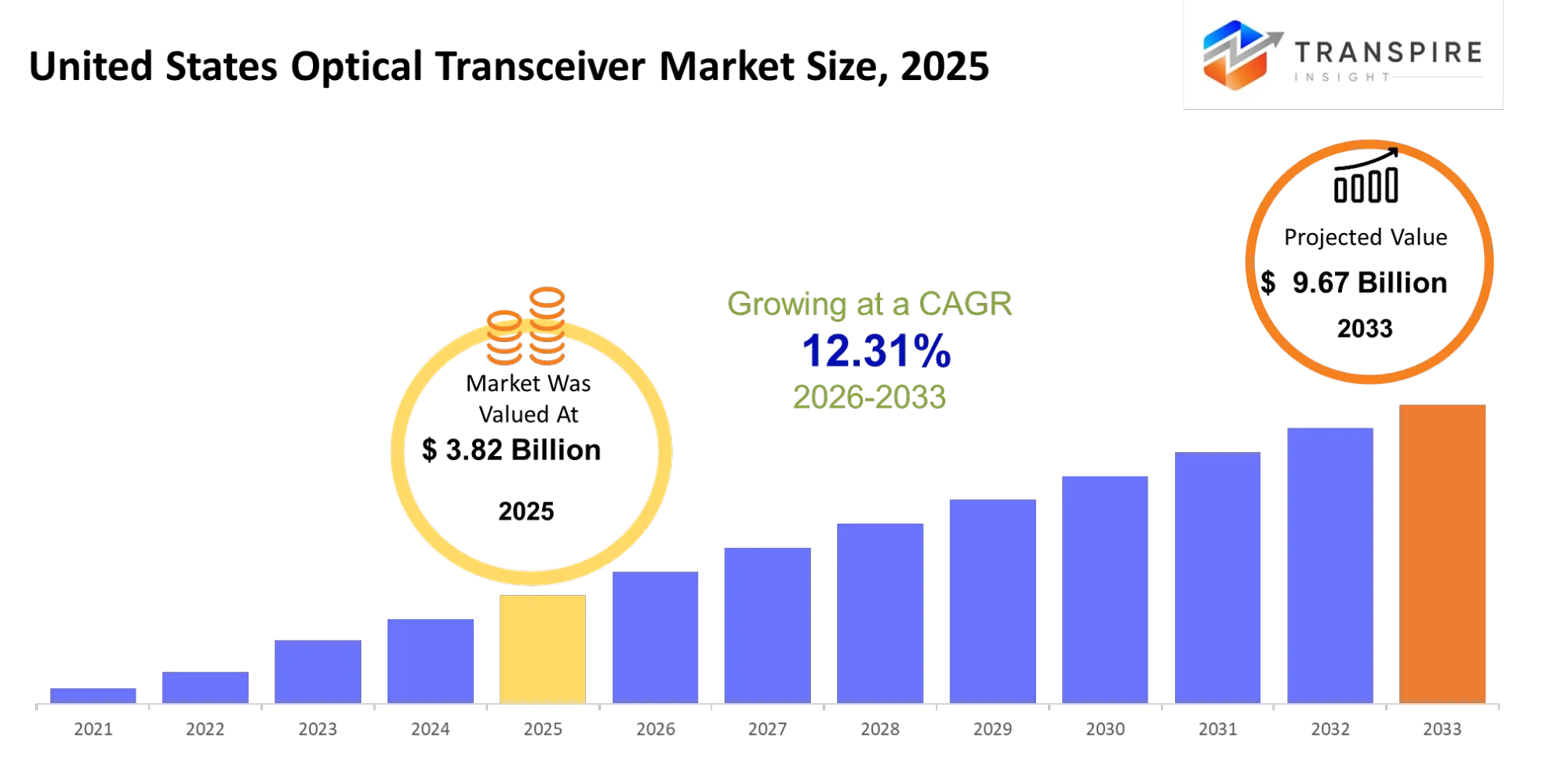
- United States Optical Transceiver Market Size 2025: USD 3.82 Billion
- United States Optical Transceiver Market Size 2033: USD 9.67 Billion
- United States Optical Transceiver Market CAGR: 12.31%
- United States Optical Transceiver Market Segments: By Form Factor: SFP, QSFP, CFP, XFP, CXP, OSFP | By Data Rate: Below 10 Gbps, 10–40 Gbps, 41–100 Gbps, Above 100 Gbps | By Application: Data Centers, Telecommunications, Enterprise Networks, 5G Networks
To learn more about this report,  Download Free Sample Report
United States Optical Transceiver Market Summary
The United States Optical Transceiver Market was valued at USD 3.82 Billion in 2025. It is forecast to reach USD 9.67 Billion by 2033. That is a CAGR of 12.31% over the period.
The United States optical transceiver market, kind of sits in the middle of modern digital infrastructure, enabling the fast conversion of electrical signals into optical signals that carry huge amounts of data across cloud data centers, telecom backbones, enterprise networks, and AI computing clusters. In real life, these devices basically solve bandwidth deadlocks that might otherwise slow down things like video streaming, 5G connectivity, and large scale AI model training.
Over the last five years , the whole market has seen a more obvious structural turn away from smaller 100G rollouts and toward 400G and 800G optical modules, pushed by hyperscale data center growth, and also by how compute-heavy generative AI workloads are. During and after the pandemic, global semiconductor supply disruption became a big spark, because it revealed weak spots in component sourcing, and then U.S. operators started diversifying suppliers, plus speeding up domestic network infrastructure investments. That change has reshaped purchasing, operators now lean toward higher capacity, energy efficient transceivers that cut latency and reduce operating cost , so modernization turns into stronger market revenues and quicker enterprise adoption.
Key Market Insights
- Somehow the Western United States is still leading the United States Optical Transceiver Market, it shows up with almost 38% market share in 2025, mostly pushed by the big hyperscale data center cluster s and their massive networking pull.
- Northern Virginia along with the Eastern corridor keeps a strong grip on share, largely because of thick fiber infrastructure, and also the huge colocation facilities that keep multiplying.
- Meanwhile the Southern U.S. region feels like the fastest-growth pocket through 2031 , powered by new cloud infrastructure spending and the kind of operating costs that just sit more comfortably than elsewhere.
- Texas and Arizona are starting to look like key expansion points for optical networking rollouts, and there’s also semiconductor-linked manufacturing energy feeding that move.
- On the product side, 400G optical transceivers are the clear main player, about 41% of the overall industry size in 2025, with hyperscaler network modernization doing most of the heavy lifting.
- 100G transceivers sit in the second spot too, they still matter a lot for enterprise campus refreshes, and metro network upgrades as well.
- 800G optical transceivers, they are kinda the fastest-growing bit, expected to expand more than 18% each year all the way to 2030—so yeah.
- On top of that the Data center interconnect use cases are leading inside the United States optical transceiver market, and for 2025 they account for almost 46% of overall demand.
- Also AI cluster networking is moving the quickest, it gets pushed by high-performance computing setups, plus accelerated GPU server deployments, you know the usual.
- Meanwhile edge computing infrastructure is also nudging a new appetite for smaller, ultra low-latency optical transceiver solutions.
- And cloud service providers pretty much dominate, holding above 44% market share which is backed by very aggressive infrastructure scaling plans.
What are the Key Drivers, Restraints, and Opportunities in the United States Optical Transceiver Market?
The main force driving the United States optical transceiver market is sort of the fast scaling of AI workloads across these hyperscale data centers. That change really got going after 2022 when large language models became commercially deployed and GPU intensive computing went widespread, and suddenly the network designs had to push past the usual 100G and 200G boundaries. So, in practice, operators are moving toward 400G and then 800G optical transceivers to manage all that east-west traffic inside the data centers. And yeah this transition tends to raise revenue per port, while also making the replacement periods quicker, since high performance computing clusters basically need dense, low latency optical interconnects to keep things efficient.
One big structural barrier is the complexity, and also this cost concentration inside the optical supply chain. It’s especially noticeable around advanced pieces like DSP chips and indium phosphide lasers. Those components rely on a small set of specialized manufacturers, so availability is naturally constrained. This isn’t something you fix overnight either, because it needs multi year capital investment for new fabrication capacity, plus deep technical knowhow. The outcome is longer lead times and pricing that can swing around a lot, which then delays rollout timelines, and it also suppresses near term revenue capture for network operators, even when demand is there.
Silicon photonics integration kind of gives a clear road for the next growth phase. A bunch of companies are throwing money at co-packaged optics and integrated photonic chips which aim to cut power use, reduce the footprint while also pushing bandwidth density higher. Like, U.S. based hyperscalers are already piloting co-packaged optics inside AI clusters, where the energy efficiency piece really hits the operating costs, in a pretty direct way. And as these solutions slowly mature, they might open up broader adoption across both enterprise and edge data centers, which should expand the addressable market as well.
What Has the Impact of Artificial Intelligence Been on the United States Optical Transceiver Market?
Artificial intelligence is starting to nudge how optical transceiver networks get designed, observed, and run across U.S. data center and telecom settings. Lately, operators are rolling out AI powered network management platforms that do traffic steering on their own, flex bandwidth in a live way, and fine tune transceiver behavior in real time. In practice this cuts down on all that hands-on stuff in huge scale data centers, where thousands of optical connections have to keep steady latency and throughput even while workloads swing around.
Machine learning models are also being used for predictive upkeep, by watching how signals fade, tracking temperature changes, and watching error rates inside optical modules. Rather than waiting for a failure, teams can spot early signs of component wear, fatigue if you want, and swap transceivers before the network actually gets disrupted. This method has bumped uptime up, and it’s also been lowering the unplanned outage count. Some hyperscale setups even report double digit cuts in downtime tied to maintenance, plus more energy efficiency since link utilization ends up better tuned.
On top of that, AI driven analytics help with performance tweaking inside dense AI clusters, where optical interconnect efficiency really matters for computing output, and for the operational cost. That said, adoption still runs into a pretty clear snag around integration. A lot of legacy network designs don’t have consistent, standardized data structures, so it gets harder to train useful models, or push AI tools out at scale. This in turn drags implementation timelines, and it raises the initial spend, especially for enterprise providers trying to transition from older infrastructure.
Key Market Trends
- Between 2021 and 2025, the big hyperscalers, including Microsoft and Google kinda pushed 400G deployments faster and faster, so the average 100G procurement volumes in major U.S. data centers went down.
- In 2023, when generative AI workloads really took off, the appetite for 800G modules spiked, because GPU clusters need that ultra low latency east-west data movement, like not just “fast” but very, very consistent.
- After the 2021 semiconductor shortage, supply chain plans shifted, U.S. operators started leaning into diversification, they moved a bit away from East Asian component suppliers, mainly to improve resilience and keep things from getting stuck.
- Silicon photonics then went from pilot tests into actual commercial purchasing between 2022 and 2025, and vendors said they were aiming for 20% to 30% lower power consumption, which sounds small but it adds up at scale.
- Also, buyer preferences changed—less “just the cost per unit” and more a total lifecycle efficiency angle, since power and cooling expenses became the real center of gravity for procurement decisions.
- For telecom carriers, optical spending took a turn after 5G standalone rollouts settled by 2024, and suddenly metro network densification was prioritized over long-haul backbone expansion.
- Companies like Cisco Systems and NVIDIA Corporation increased investment in co packaged optics, basically to be ready for 1.6T commercial deployment.
- Meanwhile, regional manufacturing picked up after 2022 federal semiconductor incentives, which pushed domestic photonics production and reduced reliance on overseas fabrication ecosystems.
- By 2025, AI enabled network monitoring tools became normal practice, helping operators trim unplanned optical link failures through predictive diagnostics.
United States Optical Transceiver Market Segmentation
By Form Factor:
The United States Optical Transceiver Market really has a sort of mixed demand spread across form factor categories, and it feels like each one is doing its own job for network needs, kinda depending on transmission speed, packing density and compatibility with the overall system architecture. SFP modules keep showing up as still very relevant, mostly because they are used all over in enterprise connectivity and they’re a cost effective way to roll out across normal, everyday networking setups. There’s also steady demand coming from small to mid scale infrastructure projects, so that segment stays around for the long run.
QSFP, on the other hand, has picked up momentum. A lot of this comes from large cloud infrastructure and hyperscale data processing, where bandwidth has to be higher and the configurations need to stay compact. And as data intensive applications grow, more teams are putting these modules into advanced network systems. CFP and XFP are still kinda important in certain telecom settings, especially where older systems are still running, but yeah the replacement cycles mean there are fewer brand new installs happening.Then you’ve got CXP and OSFP getting more acceptance too, mainly as high speed transmission becomes more of a must for next generation computing workloads. This is particularly noticeable where ultra low latency matters, and where large data movement is basically central to daily operations.
By Data Rate:
Data rate segmentation kind of mirrors how the required speed shifts across communication infrastructure in the United States, within the Optical Transceiver Market. Under 10 Gbps transceivers still keep showing up in legacy systems and pretty basic enterprise communication setups, where the bandwidth appetite stays moderate. A lot of the existing infrastructure spanning multiple institutional and regional networks actually keeps supporting this slice, so expansion happens but it remains slower, still fairly steady though.
Then the 10–40 Gbps and 41–100 Gbps categories are getting adopted more broadly, largely because cloud workloads keep expanding, digital connectivity demands get stronger, and enterprise modernization projects are running faster. These bands tend to give a kind of middle ground between performance and cost efficiency for many typical use cases. Over 100 Gbps has, on the other hand, emerged as the fastest-growing part of the market. That’s mainly tied to hyperscale data centers, artificial intelligence processing, and advanced telecom backhaul systems that need much higher transmission capacity. If investment keeps going into high-speed architecture, this segment should keep strengthening as overall digital traffic volumes keep rising across commercial and industrial operations.
By Application:
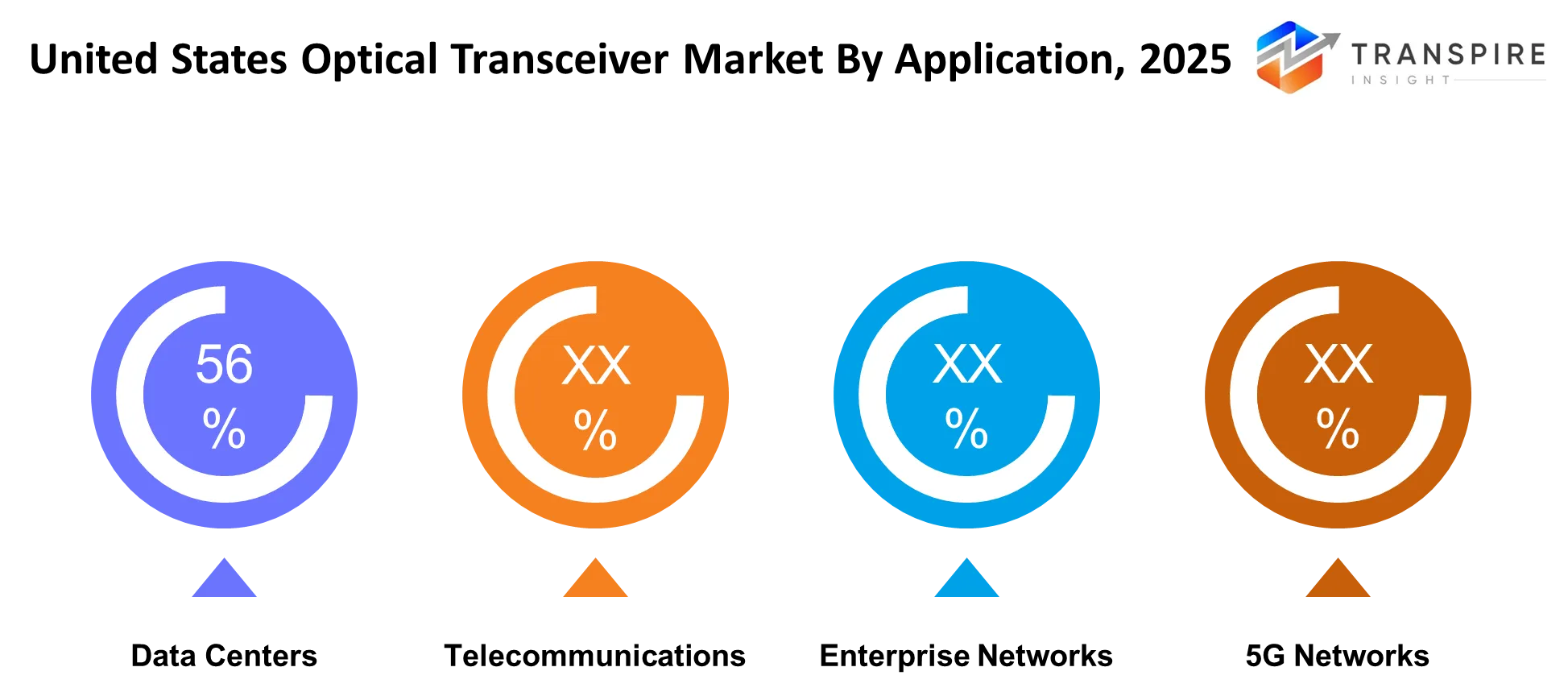
Application based growth in the United States Optical Transceiver Market is showing up pretty strong across data centers, telecom networks, enterprise environments , and yes 5G networks too. Data centers seem to be the top application area, mostly because digital storage needs keep climbing, cloud computing is still expanding , and there is more demand for those high performance processing spaces. Big operators also keep rolling out upgrades for optical connectivity , so they can handle rising traffic loads in a more efficient manner.
Telecommunications is still a big slice of the mix, service providers are actively aiming to boost network speed, reliability , and the overall reach of nationwide fiber buildouts. Meanwhile enterprise networks keep adopting optical transceivers, mainly to enable protected internal communications and better operational efficiency. Then there is the 5G network segment, it’s opening fresh opportunities, driven by dense infrastructure deployment and growing need for low latency data movement. In a sense, optical connectivity has turned into an everyday requirement for moving data smoothly between distributed network nodes, so this particular application area stays one of the more strategically important parts for where the market goes next.
To learn more about this report, Download Free Sample Report
What are the Key Use Cases Driving the United States Optical Transceiver Market?
The main reason pushing optical transceiver adoption in the United States, is hyperscale data center interconnect , kinda straightforward. Cloud providers basically depend on high speed optical links to push huge amounts of information between servers, storage platforms, and AI compute clusters. This scenario is the big driver because even tiny latency reductions end up mattering, like you can actually measure gains in computing efficiency and day to day service delivery.
Then there is what comes after hyperscale , telecom operators are rolling out more advanced optical modules across metro fiber networks, for 5G backhaul and edge computing support. At the same time enterprise campuses in financial services and healthcare are refreshing internal networks, to manage heavier traffic connected to real-time analytics and also safer data handling.
You can also see newer applications forming in AI supercomputing clusters and autonomous system test setups. Research groups and semiconductor developers are starting to weave next generation optical interconnects into their plans, so distributed GPU training becomes more efficient. Meanwhile, early edge AI deployments in manufacturing and smart infrastructure suggest this might broaden over the long term.
|
Report Metrics |
Details |
|
Market size value in 2025 |
USD 3.82 Billion |
|
Market size value in 2026 |
USD 4.29 Billion |
|
Revenue forecast in 2033 |
USD 9.67 Billion |
|
Growth rate |
CAGR of 12.31% from 2026 to 2033 |
|
Base year |
2025 |
|
Historical data |
2021 - 2024 |
|
Forecast period |
2026 - 2033 |
|
Report coverage |
Revenue forecast, competitive landscape, growth factors, and trends |
|
Geographic scope |
United States of America |
|
Key company profiled |
Cisco, Finisar, Broadcom, Fujitsu Optical Components, Intel, Lumentum, Sumitomo Electric |
|
Customization scope |
Free report customization (country, regional & segment scope). Avail customized purchase options to meet your exact research needs. |
|
Report Segmentation |
By Form Factor: SFP, QSFP, CFP, XFP, CXP, OSFP | By Data Rate: Below 10 Gbps, 10–40 Gbps, 41–100 Gbps, Above 100 Gbps | By Application: Data Centers, Telecommunications, Enterprise Networks, 5G Networks |
Which Regions are Driving the United States Optical Transceiver Market Growth?
The Western United States is still basically the most important regional market for optical transceivers, with California, Oregon, and Washington taking the lead. That happens because you have hyperscale data centers packed in there, nearby subsea cable landing stations, and pretty solid state level help for building digital infrastructure. Silicon Valley keeps doing what it does best, a dense network of cloud providers plus semiconductor companies and photonics developers, sort of like one big engine. And that whole setup then turns into this self reinforcing loop where spending on infrastructure, technology partnerships, and local engineering talent sort of feed each other, and the region stays on top.
The Eastern United States comes next as a very stable contributor too, with Northern Virginia, New Jersey, and parts of the Northeast acting as major optical networking hubs. Compared to the West, this area benefits less from concentrated technology development clusters, and more from its long standing colocation presence and the mature enterprise connectivity needs. Financial institutions, government networks, and telecom backbone operators keep their procurement routines consistent, so demand stays more predictable. The resilience here is less about quick expansion, and more about long term utilization of what’s already built. So for suppliers it turns into a dependable revenue base, even when growth is not super aggressive.
The Southern United States is kind of emerging as the fastest-growing region, especially across Texas, Arizona and Georgia. This momentum picked up after 2023, when operators started expanding data center construction, mostly because power costs went down, tax incentives looked better, and there was that big pool of available land for hyperscale campuses. You can also see it in the way state-backed infrastructure initiatives are rolling out, and with new semiconductor manufacturing investments adding more pressure to handle stronger, more reliable regional connectivity. So for market entrants, or really anyone investing early, this kind of growth usually means there’s a significant opening to build supply relationships sooner rather than later as the digital infrastructure scales through 2033.
Who are the Key Players in the United States Optical Transceiver Market and How Do They Compete?
The United States optical transceiver market looks like it’s consolidating in a moderate way, like a handful of vertically integrated technology companies kind of hold onto the higher performance segments , while more specialized suppliers still push forward in those niche and cost sensitive categories. Overall competition seems to be shifting away from price by itself. It’s more about transmission speed, power efficiency , and how well silicon photonics gets pulled into the bigger system. Most incumbents stay busy defending share using pretty aggressive product roadmaps, linked to 800G and 1.6T deployments, but newer entrants often aim at AI cluster networking and custom photonic architectures instead. Still, the real deciding factor is whether a company can scale manufacturing fast enough while also clearing hyperscaler qualification expectations.
Cisco Systems competes with a pretty tight hardware-software kind of glue, pairing optical modules with its switching platforms so it can offer optimized end to end performance for enterprise and cloud customers. That ecosystem style approach, honestly reduces interoperability risk for buyers, and it helps with longer term customer stickiness. Coherent Corp. sets itself apart through strong photonics manufacturing know-how and a wide coherent optics lineup that supports metro as well as long haul deployments. It also keeps investing in advanced indium phosphide technology, which in practice supports better performance in high capacity transmission settings.
NVIDIA Corporation is kinda expanding its whole direction with AI centered networking solutions, specially after the Mellanox integration, and it’s positioning optical interconnects as this very critical piece in GPU cluster architecture. Broadcom Inc. meanwhile is leaning hard into silicon photonics, and custom ASIC integration, so hyperscalers can deploy these very efficient, app specific optical solutions. On the other hand, Lumentum Holdings is gaining leverage through precision optical component design and some strategic partnerships with telecom equipment providers, that helps them push deeper in carrier network upgrades, more aggressively than before.
Company List
- Cisco
- Finisar
- Broadcom
- Fujitsu Optical Components
- Intel
- Lumentum
- Sumitomo Electric
Recent Development News
In April 2026, Credo Technology Group announced acquisition of DustPhotonics. The deal vertically integrates silicon photonics capabilities into Credo’s optical connectivity portfolio, strengthening U.S. optical transceiver innovation across 800G, 1.6T, and next-generation AI data center interconnect applications. Source https://investors.credosemi.com/
In March 2026, Lumentum Holdings launched its 1.6T DR4 OSFP optical transceiver prototype at OFC 2026. The product demonstration marked a significant step toward higher-bandwidth AI infrastructure deployment in the U.S., positioning Lumentum to address rising hyperscale data center demand for next-generation optical modules.Source https://investor.lumentum.com/
What Strategic Insights Define the Future of the United States Optical Transceiver Market?
The United States optical transceiver market is moving toward more highly integrated and AI optimized optical networking architectures over the next five to seven years. This shift is being pushed by the structural convergence of hyperscale computing, generative AI infrastructure, plus the constant need to cut power consumption per transmitted bit. As the network density keeps rising, buyers will likely start caring much more about co packaged optics, silicon photonics and software defined optical control, not just standalone performance upgrades that used to be the headline stuff.
There is also a risk that’s less visible, market concentration around a limited number of advanced component suppliers, especially for DSP processors and photonic integrated circuits. If anything goes wrong in that narrow supply base it can cause bottlenecks, and those delays can slow down hyperscale deployments, while also messing with pricing across the whole value chain. But at the same time, there’s an opportunity building up, in edge AI infrastructure across Southern U.S. data corridors, where regional expansion and lower cost power access are making conditions friendlier for distributed optical deployment. Kind of like a quieter wave happening in parallel.
For market participants the clearest strategic move is to put money in early ecosystem partnerships that span semiconductor design, photonics packaging, and AI network orchestration. The companies that secure these cross layer capabilities now, will probably be better positioned to catch the next wave of infrastructure spending before the window closes, so to speak.
United States Optical Transceiver Market Report Segmentation
By Form Factor
- SFP
- QSFP
- CFP
- XFP
- XP
- OSFP
By Data Rate
- Below 10 Gbps
- 10–40 Gbps
- 41–100 Gbps
- Above 100 Gbps
By Application
- Data Centers
- Telecommunications
- Enterprise Networks
- 5G Networks
Frequently Asked Questions
Find quick answers to common questions.
The United States Optical Transceiver Market size is USD 9.67 Billion in 2033.
Key segments for the United States Optical Transceiver Market are By Form Factor: SFP, QSFP, CFP, XFP, CXP, OSFP | By Data Rate: Below 10 Gbps, 10–40 Gbps, 41–100 Gbps, Above 100 Gbps | By Application: Data Centers, Telecommunications, Enterprise Networks, 5G Networks.
Major United States Optical Transceiver Market players are Cisco, Finisar, Broadcom, Fujitsu Optical Components, Intel, Lumentum, Sumitomo Electric.
The United States Optical Transceiver Market size is USD 3.82 Billion in 2025.
The United States Optical Transceiver Market CAGR is 12.31% from 2026 to 2033.
- Cisco
- Finisar
- Broadcom
- Fujitsu Optical Components
- Intel
- Lumentum
- Sumitomo Electric
Recently Published Reports
-
Apr 2026
Fiber Optic Faceplates Market
Fiber Optic Faceplates Market Size, Share & Analysis Report By Type (< 300 mm2, 300-350 mm2, and > 350 mm2, By Application (Night Vision, Holographic Imaging, Medical, and Others), and Geography (North America, Europe, Asia-Pacific, Middle East and Africa, South and Central America), 2021 - 2031
-
Apr 2026
High Temperature Superconductors Market
High Temperature Superconductors Market Size, Share & Analysis Report By Type (1G HTS, and 2G HTS), By Application (Power Cable, Fault Current Limiter, and Transformer), and Geography (North America, Europe, Asia-Pacific, Middle East and Africa, South and Central America), 2021 - 2031
-
Apr 2026
Industrial Plugs and Socket Market
Industrial Plugs and Socket Market Size, Share & Analysis Report By Type (Industrial Plugs, Industrial Sockets), By Current (Up to 32 A, 32 to 125 A, Above 125 A), By Protection (Dustproof and Splash Proof, Waterproof, Explosion Proof), By End User (Heavy Industries, Oil and Gas, Chemicals and Pharmaceuticals, Power Generation, Others), and Geography (North America, Europe, Asia-Pacific, Middle East and Africa, South and Central America), 2021 - 2031
-
Apr 2026
InGaAs Avalanche Photodiodes Market
InGaAs Avalanche Photodiodes Market Size, Share & Analysis Report By Type (1100 - 1700 nm, and 1000 - 1600 nm), By Application (Missile Warning System, Muzzle Flash Detection, Wafer Defect Inspection, Laser Rangefinders, and Others), and Geography (North America, Europe, Asia-Pacific, Middle East and Africa, South and Central America), 2021 - 2031