
Japan Very Small Aperture Terminal (VSAT) Market Size & Forecast:
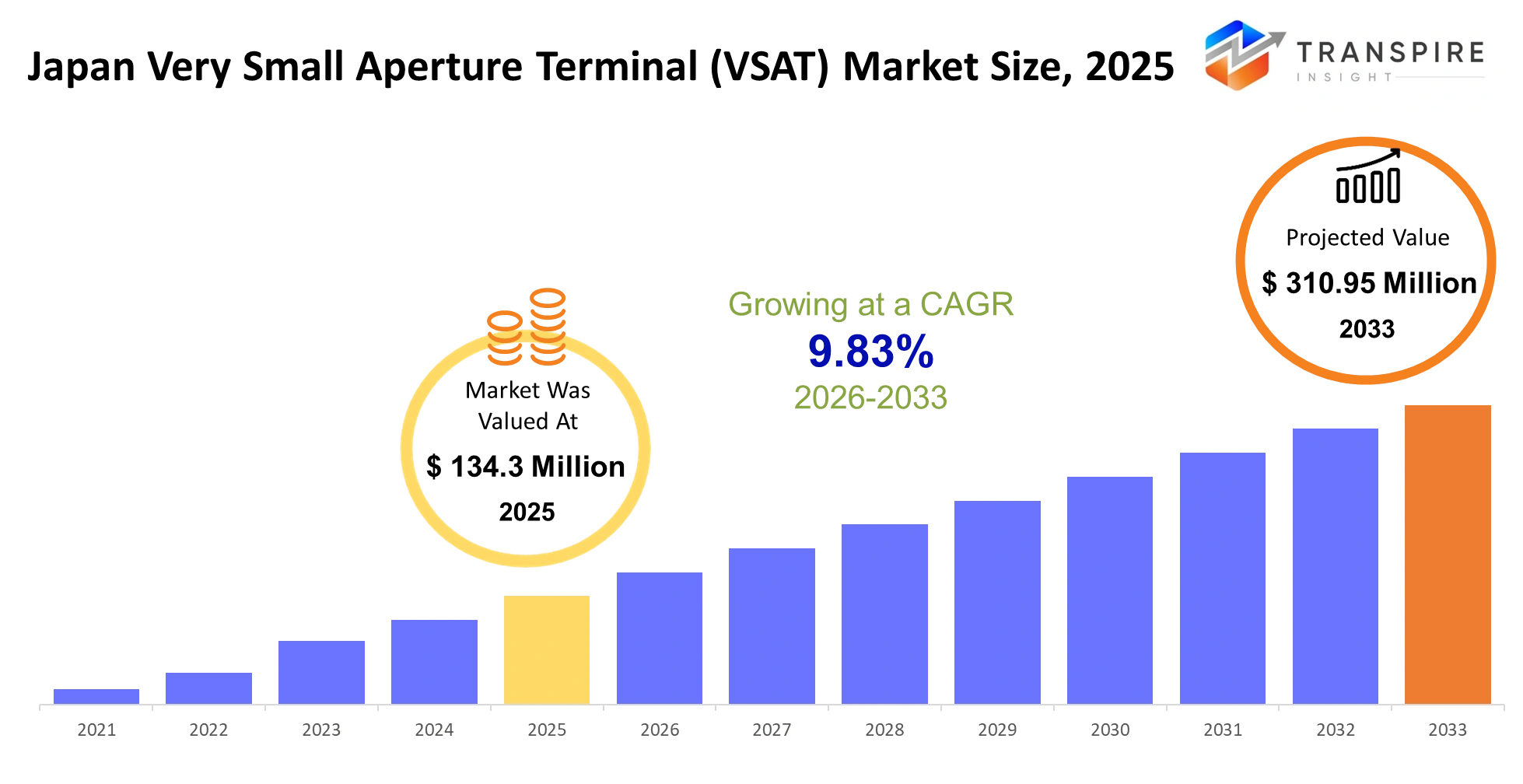
- Japan Very Small Aperture Terminal (VSAT) Market Size 2025: USD 134.3 Million
- Japan Very Small Aperture Terminal (VSAT) Market Size 2033: USD 310.95 Million
- Japan Very Small Aperture Terminal (VSAT) Market CAGR: 9.83%
- Japan Very Small Aperture Terminal (VSAT) Market Segments: By Type (Fixed VSAT, Mobile VSAT, Broadband VSAT, Hybrid VSAT, Others); By Application (Telecom, Maritime Communication, Defense, Remote Connectivity, Broadcasting, Others); By End-User (Telecom Operators, Defense Sector, Enterprises, Maritime Industry, Government, Others); By Frequency Band (Ku-band, Ka-band, C-band, Others).
To learn more about this report,  Download Free Sample Report
Japan Very Small Aperture Terminal (VSAT) Market Summary
The Japan Very Small Aperture Terminal (VSAT) Market was valued at USD 134.3 Million in 2025. It is forecast to reach USD 310.95 Million by 2033. That is a CAGR of 9.83% over the period.
The Very Small Aperture Terminal (VSAT) market in Japan provides ships at sea and offshore energy facilities and coastal industrial and disaster sites with uninterrupted satellite communication because terrestrial networks do not operate in those areas. The system provides maritime operators and infrastructure managers with two fundamental functions which are real-time navigation updates and emergency response connectivity together with fleet coordination and equipment monitoring.
The market has undergone a structural transformation during the last three to five years because it now depends on hybrid systems which combine low Earth orbit constellations with existing VSAT technologies to provide better performance than traditional geostationary satellite connections. The COVID-19 disruption together with global supply chain instability which followed it, created a situation that showed shipping and offshore logistics, operational risk from connectivity failures. The maritime industry in Japan made substantial investments in building communication systems which provide constant operational capacity. The need for operational digitization has become the main factor, which determines system adoption, because it drives system upgrades for fleet management and remote asset control.
Key Market Insights
- The Kanto region holds the largest market share of the Japanese Very Small Aperture Terminal (VSAT) market because its port facilities and shipping centers generate 38% of total market business in 2025.
- The Kansai region experiences its highest growth rate because industrial automation and coastal logistics modernization projects are developed throughout the entire forecast period.
- The demand for offshore energy and fisheries communication upgrades in Kyushu supports the development of maritime digital connectivity infrastructure.
- Japanese Maritime VSAT solutions established a 42% market share in the Very Small Aperture Terminal (VSAT) market because shipping fleets depend on their connectivity solutions.
- The second-largest market share belongs to managed satellite communication services because businesses increasingly outsource their network operations duties.
- The fastest-growing segment between 2025 and 2030 will develop through Hybrid VSAT systems which use both GEO and LEO technologies because users require reduced latency times.
- The Japan Very Small Aperture Terminal (VSAT) Market shows fleet management applications as the leading solution which holds almost 40% market share because users need to track their assets in real time.
- Japan conducts offshore platform monitoring as its most rapidly expanding application because the country develops energy resilience together with remote asset operations.
- The commercial shipping industry dominates with approximately 45% market share because companies need to transport large volumes of cargo and access international trade routes.
- Offshore energy operators experience the fastest growth among end-user groups because they require more automation and remote monitoring capabilities.
What are the Key Drivers, Restraints, and Opportunities in the Japan Very Small Aperture Terminal (VSAT) Market?
The digital transformation process which affects maritime and offshore operations functions as the main driving force behind growth in the Japan Very Small Aperture Terminal (VSAT) Market. Shipping operators and coastal infrastructure managers are increasingly integrating real-time vessel tracking, predictive maintenance, and remote monitoring systems, all of which depend on uninterrupted satellite connectivity. The shift became more significant after supply chain disruptions demonstrated how communication blackouts at sea created operational risks, which led fleets to replace their outdated satellite links with advanced VSAT systems. The Japan Very Small Aperture Terminal (VSAT) Market experiences growth because operators now spend more on managed connectivity services, which create dependable income streams for their business operations.
Small and mid-sized fleet operators face a major obstacle because they must pay high total ownership costs which prevent them from accessing VSAT services. VSAT deployment requires specialized hardware, installation, and ongoing bandwidth leasing, which cannot be easily reduced due to limited competition in satellite spectrum and infrastructure dependency. The cost structure maintains its fixed nature because it prevents organizations from achieving affordable solutions during short timeframes. The adoption process among smaller operators experiences delays because it restricts market access beyond large commercial shipping and offshore enterprises.
The combination of low Earth orbit (LEO) satellite networks with current VSAT systems creates a major business opportunity. Companies such as SKY Perfect JSAT are exploring hybrid connectivity models to reduce latency and expand coverage across remote maritime routes. The Japanese offshore wind industry requires continuous low-latency data streams for its automated turbine operations and energy forecasting needs.
What Has the Impact of Artificial Intelligence Been on the Japan Very Small Aperture Terminal (VSAT) Market?
The Japan Very Small Aperture Terminal (VSAT) Market experiences transformation through artificial intelligence which creates an intelligent operational layer from satellite connections used in maritime and offshore operations. Shipping operators are increasingly using AI-powered systems together with VSAT networks to automate their fleet compliance monitoring which includes tracking ship routes and fuel consumption and scrubber operation in real-time. The systems streamline the reporting process while helping companies meet regulatory requirements which have become more stringent under Japanese maritime emission regulations and international maritime standards.
The maintenance of communication terminals and onboard equipment now uses machine learning models for its predictive maintenance functions. The analysis of bandwidth patterns and signal degradation and engine telemetry data enables operators to create maintenance schedules which predict equipment failures before they happen. The system has achieved two objectives by decreasing unexpected downtime through its fuel optimization methods which improve overall voyage performance and decrease business expenses.
The Japan Very Small Aperture Terminal (VSAT) Market faces an artificial intelligence adoption challenge because of its system design which requires continuous at-sea data transmission. The training datasets for maritime operations become incomplete because ships need to cross distant ocean areas which experience satellite signal coverage gaps that prevent effective route modeling. The combination of artificial intelligence systems with existing onboard systems results in higher installation expenses which create obstacles to expansion for smaller fleets despite the technology's ability to increase operational efficiency.
Key Market Trends
- The period from 2022 until 2025 saw maritime operators transition from using traditional GEO systems to implementing hybrid LEO-GEO VSAT systems which provided better performance through reduced latency.
- The commercial maritime industry in Japan experienced an increase in VSAT-powered digital operations when shipping fleets began using real-time fleet monitoring systems from 2023 onwards.
- Operators began to prefer managed satellite services after they began outsourcing their network operations to decrease their internal technical needs and protect themselves from operational interruptions.
- After 2024, offshore wind projects began to use VSAT systems which connected their turbine performance monitoring systems to the continuous monitoring systems that operated throughout Japan's coastal energy zones.
- The combination of regulatory requirements for maritime emissions tracking and the need for real-time emissions data monitoring systems led to the adoption of scrubber monitoring systems that used satellite communication links.
- After 2023, KDDI Corporation and NTT Communications started building AI-based maritime connectivity systems which increased competition between companies in the market.
- The implementation of predictive maintenance tools created better vessel availability because the system detected equipment problems through its constant satellite-based monitoring.
- After 2022, cybersecurity protection gained importance as VSAT providers installed encryption upgrades to secure maritime data transmission between VSAT systems and their protected channels.
- Small fleet operators gradually delayed adoption due to high infrastructure costs which made it harder for them to compete with large commercial shipping companies because they fell behind in digital technology adoption.
Japan Very Small Aperture Terminal (VSAT) Market Segmentation
By Type :
The demand for fixed VSAT services remains strong because remote offices and mining sites and rural areas need these services. The system maintains continuous communication through its stable installation and reliable operational performance. Organizations that require permanent solutions without the need for mobility choose fixed setups because they enable remote sites to maintain continuous data transmission and operational reliability.
The rising demand for mobile VSAT and broadband VSAT systems occurs because users need better speed and adaptable network solutions. The maritime industry and the transport sector depend on mobile systems to enable their users to communicate while they move. The combination of broadband systems with hybrid systems enables users to access more data capacity while maintaining operational flexibility and extended service coverage. The usage of data-intensive services has increased across various industries, which has led to the rise of these particular service types.
By Application :
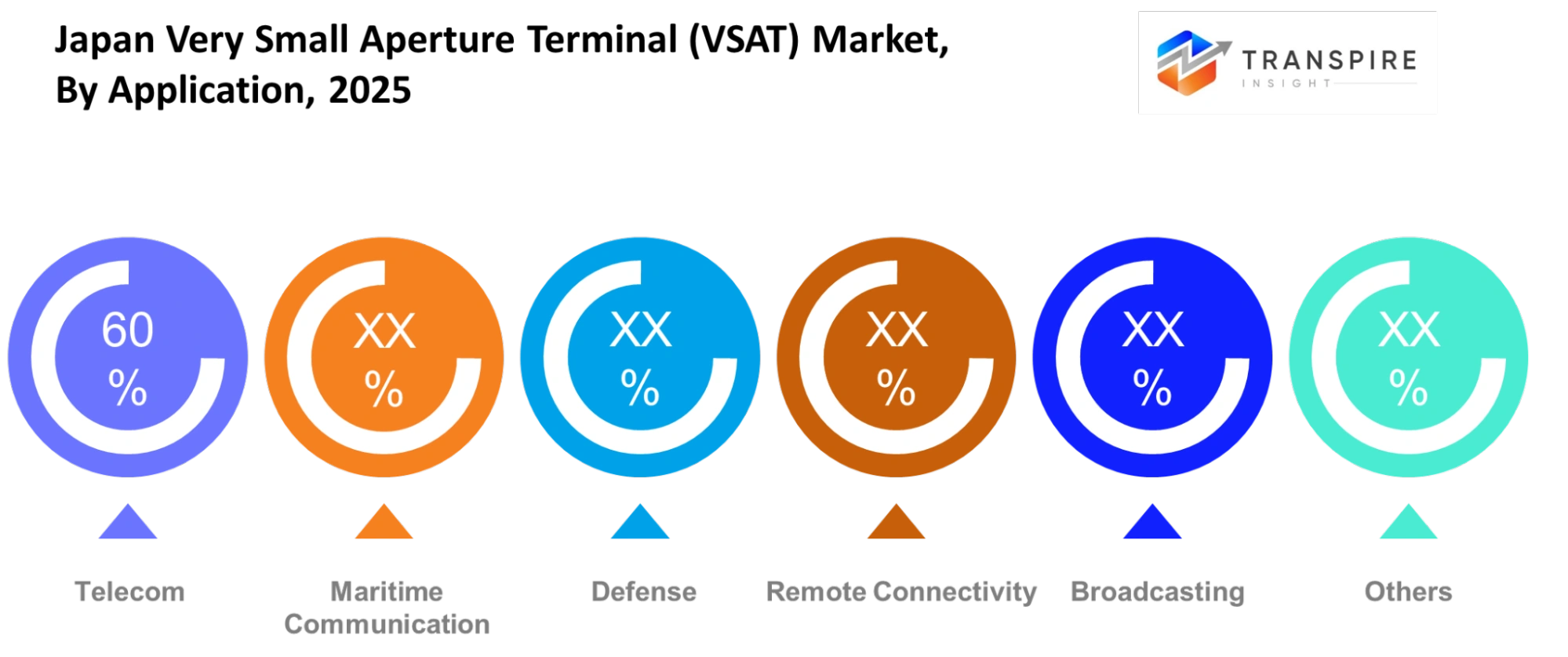
VSAT technology depends on telecom services and remote connectivity applications for development, especially in locations that lack terrestrial network infrastructure. Satellite links provide telecom operators with extended coverage that enables them to maintain continuous service. Remote connectivity enables industries to operate from remote locations, which allows them to maintain consistent communication for their daily work and their team activities.
The three sectors of maritime communication and defense applications and broadcasting services drive the adoption of this technology. Maritime users depend on VSAT for navigation and communication at sea. Defense organizations use secure satellite links to support their mission operations and coordination activities. Broadcasting services use VSAT technology to transmit content to remote areas, which enables them to deliver uninterrupted signals throughout various regions.
To learn more about this report, Download Free Sample Report
By End-User :
The major end users of VSAT systems are telecom operators and enterprises who use the technology to expand their networks and meet their business communication requirements. Enterprises that operate in remote areas depend on satellite connectivity to maintain their business activities. Telecom companies use VSAT technology to create network coverage solutions which maintain service operations throughout areas that lack ground network systems.
The defense sector, maritime industry, and government bodies also play a key role in adoption. Defense organizations need secure and stable communication systems to support their field operations. Maritime industry users require constant connectivity for safety and coordination. Government projects use VSAT for rural development, emergency response, and public service communication in isolated areas.
By Frequency Band :
The telecommunications industry continues to use Ku-band because it provides equal performance throughout its operational range. The system enables VSAT users to access multiple applications which include both broadcast and enterprise communication functions. C-band offers weatherproof stability which makes it ideal for deployment in areas that experience heavy rainfall while maintaining vital operational links throughout the entire day.
Ka-band has become more popular because it provides users with faster internet access and increased data transmission capabilities. The system enables users to access both advanced broadband services and applications that require large amounts of data. Enterprises and mobility-based services now use Ka-band technology because high-speed internet access has become more common. The combined application of all three frequency bands provides superior network coverage, operational efficiency, and adaptive service delivery capabilities.
What are the Key Use Cases Driving the Japan Very Small Aperture Terminal (VSAT) Market?
The main application for Very Small Aperture Terminal (VSAT) systems in Japan operates through maritime services which provide real-time connectivity to commercial shipping fleets. The large cargo operators need permanent satellite connections which provide them with essential navigation updates and route optimization details and crew communication capabilities during their international shipping activities. The highest demand occurs because operational downtime at sea reduces freight efficiency which subsequently affects delivery timeframes to customers.
Energy operators and logistics companies use offshore asset monitoring and fleet performance management which emerges as a growing application. Offshore wind farms and oil platforms increasingly depend on VSAT-enabled systems to transmit equipment status and safety alerts and maintenance data. The commercial fishing fleet utilizes these systems to enhance their capabilities for tracking fish catches and reporting compliance with regulations.
The new use cases develop to support autonomous vessel operations and artificial intelligence-based maritime activities. The experimental projects in Japan use VSAT technology together with autonomous systems which enable remote control of vessels and automatic route planning. Disaster response organizations investigate satellite-based systems for emergency coordination which will enable them to maintain communication during typhoons and coastal disruptions, which creates potential for growth into new areas beyond standard maritime operations.
|
Report Metrics |
Details |
|
Market size value in 2025 |
USD 134.3 Million |
|
Market size value in 2026 |
USD 161.32 Million |
|
Revenue forecast in 2033 |
USD 310.95 Million |
|
Growth rate |
CAGR of 9.83% from 2026 to 2033 |
|
Base year |
2025 |
|
Historical data |
2021 - 2024 |
|
Forecast period |
2026 - 2033 |
|
Report coverage |
Revenue forecast, competitive landscape, growth factors, and trends |
|
Country scope |
Japan |
|
Key company profiled |
Hughes Network Systems, Viasat, Gilat Satellite Networks, Inmarsat, SES, Intelsat, KVH Industries, Cobham, Thales, Airbus, NEC, Fujitsu, Mitsubishi Electric, Comtech, Speedcast. |
|
Customization scope |
Free report customization (country, regional & segment scope). Avail customized purchase options to meet your exact research needs. |
|
Report Segmentation |
By Type (Fixed VSAT, Mobile VSAT, Broadband VSAT, Hybrid VSAT, Others); By Application (Telecom, Maritime Communication, Defense, Remote Connectivity, Broadcasting, Others); By End-User (Telecom Operators, Defense Sector, Enterprises, Maritime Industry, Government, Others); By Frequency Band (Ku-band, Ka-band, C-band, Others). |
Which Regions are Driving the Japan Very Small Aperture Terminal (VSAT) Market Growth?
Kanto leads the Japan Very Small Aperture Terminal (VSAT) Market because it contains multiple major ports which include Yokohama and Tokyo and it houses the main offices of many large shipping and logistics companies. The enforcement of maritime safety regulations together with digital tracking requirements has created an urgent need for VSAT systems which commercial fleets operate out of this central location. The region operates a complete satellite communications system which maritime IT service providers establish through their advanced capabilities. The combination of high vessel traffic and ongoing international trade activities creates regular requirements for connectivity solutions in this area.
Kansai exists as a dependable second-tier area which receives support from its powerful industrial sector and its extensive port system that connects to Osaka and Kobe. The global shipping activities which drive Kanto operations create a different pattern for VSAT usage in Kanto compared to the regional manufacturing activities and coastal shipping routes which drive VSAT usage in Kansai. The shipowners here choose to maintain their core business operations through dependable systems while they implement digital enhancements in a gradual manner. The commercial fleet industry adopts satellite communication systems at a steady rate because economic conditions remain stable and logistics companies continue to invest in their operational networks.
Kyushu stands as the most rapidly expanding area within the Japan Very Small Aperture Terminal (VSAT) Market due to its recent funding for offshore energy projects and its development of port facilities. Government-supported programs which aim to develop renewable energy sources have particularly increased the need for real-time systems which allow remote monitoring of offshore wind facilities. Maritime operators in this region are rapidly adopting VSAT solutions to support decentralized operations across dispersed coastal assets. The growth of this market creates new entry possibilities for technology companies which focus on developing solutions for the emerging energy and fisheries markets.
Who are the Key Players in the Japan Very Small Aperture Terminal (VSAT) Market and How Do They Compete?
The Japan VSAT market shows moderate market consolidation because global satellite companies and local telecommunications firms compete to provide hybrid LEO-GEO services and manage maritime operations. The existing companies maintain their market shares by offering bundled fleet communication services. The new market entrants who establish relationships with LEO satellites compel companies to decrease their prices while they rapidly transition to advanced systems that include LEO capabilities. The current market situation shows that companies need to provide reliable service through seamless system integration to compete against their rivals who focus on low-cost solutions.
Inmarsat develops maritime broadband and safety communication systems which enable fleet mobility operations while expanding its existing vessel connectivity service. SES S.A. extends its hybrid satellite capacity to deliver offshore monitoring services and high-bandwidth industrial solutions. The company Intelsat provides worldwide coverage which enables reliable connectivity while offering maritime and aviation services through partnerships with logistics companies that operate in the Asia-Pacific shipping routes.
SKY Perfect JSAT establishes hybrid connectivity services in Japan by utilizing its domestic satellite network together with its extensive maritime industry relationships. KDDI Corporation enhances unified network management through VSAT integration with IoT and 5G services which it developed for use in coastal industrial environments. NTT Communications expands its business into government and disaster-response maritime communication services through its development of cloud-based satellite networks and cybersecurity capabilities.
Company List
- Hughes Network Systems
- Viasat
- Gilat Satellite Networks
- Inmarsat
- SES
- Intelsat
- KVH Industries
- Cobham
- Thales
- Airbus
- NEC
- Fujitsu
- Mitsubishi Electric
- Comtech
- Speedcast
Recent Development News
In April 2026, Space Compass entered a memorandum of understanding with Airbus Defence and Space to explore cooperation in optical communications and Earth observation solutions. The partnership is expected to strengthen Japan’s next-generation VSAT and satellite backhaul ecosystem by enabling near-real-time high-capacity data relay capabilities for enterprise and government connectivity applications.
Source: https://space-compass.com/
In February 2026, SKY Perfect JSAT launched commercial sales of high-resolution thermal infrared satellite data through a strategic partnership with constellr. This marked Japan’s first private-sector commercial deployment of such satellite data services, expanding domestic satellite network capabilities and creating new high-value applications for VSAT-supported government, infrastructure, and industrial monitoring services.
Source: https://www.constellr.com/
What Strategic Insights Define the Future of the Japan Very Small Aperture Terminal (VSAT) Market?
The Japan Very Small Aperture Terminal (VSAT) Market is undergoing a fundamental transformation which will establish a hybrid software-defined connectivity system that unites satellite communication with AI-based maritime operations and edge analytics. The next 5–7 years will see demand driven by two main factors: autonomous fleet coordination and offshore energy digitization together with regulatory requirements for vessel emissions monitoring and tracking. The combination of LEO satellite expansion and Japan's development of intelligent maritime logistics systems has created a driving force for this transition.
Maritime operations face hidden dangers because companies rely too much on a limited number of satellite backbone suppliers. This dependency creates permanent pricing structures and operational delays which will occur when shipping demand reaches its highest levels. The integration of VSAT technology with autonomous vessel navigation systems will create new business prospects for coastal test corridors in Kyushu and selected industrial ports which are currently testing pilot projects.
Market participants should prioritize modular, interoperable satellite platforms that can seamlessly switch between GEO and LEO networks while embedding cybersecurity and AI analytics at the edge. The maritime connectivity system will establish its permanent role as essential digital infrastructure through this method.
Japan Very Small Aperture Terminal (VSAT) Market Report Segmentation
By Type
- Fixed VSAT
- Mobile VSAT
- Broadband VSAT
- Hybrid VSAT
By Application
- Telecom
- Maritime Communication
- Defense
- Remote Connectivity
- Broadcasting
By End-User
- Telecom Operators
- Defense Sector
- Enterprises
- Maritime Industry
- Government
By Frequency Band
- Ku-band
- Ka-band
- C-band
Frequently Asked Questions
Find quick answers to common questions.
The Japan Very Small Aperture Terminal (VSAT) Market size is USD 310.95 Million in 2033.
Key segments for the Japan Very Small Aperture Terminal (VSAT) Market are By Type (Fixed VSAT, Mobile VSAT, Broadband VSAT, Hybrid VSAT, Others); By Application (Telecom, Maritime Communication, Defense, Remote Connectivity, Broadcasting, Others); By End-User (Telecom Operators, Defense Sector, Enterprises, Maritime Industry, Government, Others); By Frequency Band (Ku-band, Ka-band, C-band, Others).
Major Japan Very Small Aperture Terminal (VSAT) Market players are Hughes Network Systems, Viasat, Gilat Satellite Networks, Inmarsat, SES, Intelsat, KVH Industries, Cobham, Thales, Airbus, NEC, Fujitsu, Mitsubishi Electric, Comtech, Speedcast.
The Japan Very Small Aperture Terminal (VSAT) Market size is USD 134.3 Million in 2025.
The Japan Very Small Aperture Terminal (VSAT) Market CAGR is 9.83% from 2026 to 2033.
- Hughes Network Systems
- Viasat
- Gilat Satellite Networks
- Inmarsat
- SES
- Intelsat
- KVH Industries
- Cobham
- Thales
- Airbus
- NEC
- Fujitsu
- Mitsubishi Electric
- Comtech
- Speedcast
Recently Published Reports
-
Apr 2026
Aerospace Fluoropolymers Market
Aerospace Fluoropolymers Market Size, Share & Analysis Report By Type (PTFE, FEP, PFA, ETFE, and Others), By Application (Electrical Insulation, Seals & Gaskets, Coatings, and Others), By End User (Commercial Aviation, Military Aviation, General Aviation, and Others), and Geography (North America, Europe, Asia-Pacific, Middle East and Africa, South and Central America), 2021 - 2031
-
Apr 2026
Airborne SATCOM System Market
Airborne SATCOM System Market Size, Share & Analysis Report By Type (SATCOM Terminals, Transceivers, Airborne Radio, Modems and Routers, SATCOM Radomes, and Other), By Application (Government and Defense and Commercial), and Geography (North America, Europe, Asia-Pacific, Middle East and Africa, South and Central America), 2021 – 2031
-
Apr 2026
Ship Leasing Market
Ship Leasing Market Size, Share & Analysis Report By Vessel Type (Container Ships, Bulk Carriers, Tankers, and Specialized Vessels), By Lease Duration (Short-Term Lease (Less than 1 year), Medium-Term Lease (1-5 years), and Long-Term Lease (More than 5 years)), By Lease Type (Bareboat Charter, Time Charter, Financial Lease, and Others), By End-User Industry (Oil and Gas, Manufacturing and Industrial, Automotive, Agriculture and Food, Retail and Consumer Goods, and Others), and Geography (North America, Europe, Asia-Pacific, Middle East and Africa, South and Central America), 2021 – 2031
-
Apr 2026
Thread Rolling Dies Market
Thread Rolling Dies Market Size, Share & Analysis Report By Type (Flat Thread Rolling Dies, Circular (Cylindrical) Dies, Tangential Thread Rolling Dies, Planetary Thread Rolling Dies, and Other Types), By Material Type (High-Speed Steel (HSS), Carbide, Tool Steel, Alloy Steel, and Other Specialized Alloys), By Distribution Channel (Direct Sales, Distributors and Dealers, and Online Platforms), By Application (Automotive Industry, Aerospace and Defense, Construction and Infrastructure, Industrial Machinery, Electronics and Electrical Components, Medical Devices, and Fastener Production), and Geography (North America, Europe, Asia-Pacific, Middle East and Africa, South and Central America), 2021 – 2031
Our Clients